

The Debt That Ends Every Debt
What Surrendering to Mukunda Really Means
No one is self-made. We arrive in a body we did not manufacture. We breathe air we did not produce, eat food grown through forces we do not control, speak a language inherited from people long dead, and think with concepts preserved by teachers we may never meet. Parents, relatives, farmers, animals, rivers, trees, scholars, governments, and generations of ancestors all make our present life possible.
Vedic culture describes this condition with a blunt word: debt. Then Śrīmad-Bhāgavatam 11.5.41 makes a startling declaration. A person who surrenders completely to Mukunda is no longer the servant or debtor of the gods, sages, other living beings, relatives, human society or forefathers.
Does devotion cancel responsibility? May someone chant Kṛṣṇa’s name, walk away from dependent parents, break promises and announce, “I owe no one anything”? No. That reading misses both halves of the verse. It notices “no longer a debtor” but ignores “with his whole being he has taken shelter of Mukunda.” The verse does not sanctify irresponsibility. It describes a radical reorganization of responsibility: every obligation is brought to its root and fulfilled through service to the source, maintainer and shelter of all beings.
Surrender does not make a person less responsible. It removes divided ownership of the self.
The verse
देवर्षिभूताप्तनृणां पितॄणां
न किङ्करो नायमृणी च राजन् ।
सर्वात्मना यः शरणं शरण्यं
गतो मुकुन्दं परिहृत्य कर्तम् ॥
devarṣi-bhūtāpta-nṛṇāṁ pitṝṇāṁ
na kiṅkaro nāyam ṛṇī ca rājan
sarvātmanā yaḥ śaraṇaṁ śaraṇyaṁ
gato mukundaṁ parihṛtya kartam
“O King, one who has set aside what must otherwise be done and, with his whole being, has gone for shelter to Mukunda—the one truly worthy of being sought as shelter—is neither servant nor debtor of the gods, sages, living beings, relatives, human beings or forefathers.”
Śrīmad-Bhāgavatam 11.5.41
A familiar Vaiṣṇava translation reads:
“Anyone who has completely surrendered unto Kṛṣṇa, Mukunda, giving up all other duties, is no longer a debtor nor is he obliged to anyone—not the demigods, nor the sages, nor the people in general, nor kinsmen, nor humanity, nor forefathers.”
Śrīmad-Bhāgavatam 11.5.41
Is the quotation correct?
Yes. The Sanskrit text is correct, and the translation faithfully communicates its main teaching. Three qualifications make it more precise. First, bhūta means “living being” or “created being,” whereas nṛṇām means “of human beings.” Translating both as “people in general” and “humanity” conveys the broad scope, but the Sanskrit intentionally includes nonhuman life as well as human society.
Second, “completely surrendered” translates the crucial word sarvātmanā—“with the whole self,” “entirely,” or “in every respect.” The verse is not describing someone who merely adopts a religious label, attends a ceremony or occasionally chants. Its exemption is as complete as its surrender.
Third, “giving up all other duties” requires context. Parihṛtya kartam means setting aside what would otherwise have to be done: the separate rites and obligations by which ordinary Vedic society attempts to repay its many creditors. It does not mean rejecting moral conduct, exploiting others or refusing service that Kṛṣṇa Himself would want performed.
The verse is therefore correct—but it is easy to quote beyond one’s actual level of surrender.
Who says this, and why?
The verse belongs to a layered conversation. Nārada Muni is instructing Vasudeva, Kṛṣṇa’s father. As part of that instruction, Nārada recounts the ancient meeting between King Nimi and the nine Yogendras, the spiritually realized sons of Ṛṣabhadeva. King Nimi asks deep questions about devotion, the conditioned soul and the forms and methods of divine worship in the four ages.
The sage Karabhājana answers Nimi’s question about worship in each age. He describes the Lord’s forms and the prescribed process for Satya, Tretā, Dvāpara and Kali. When he reaches Kali-yuga, he glorifies congregational chanting of the Lord’s names and predicts the presence of many devotees. His teaching culminates in verses 41 and 42: the fully surrendered devotee owes no separate religious debt, and the Lord dwelling in the devotee’s heart personally removes an accidental deviation.
This setting matters. Verse 11.5.41 is not an isolated attack on duty. It comes at the climax of an explanation of wholehearted devotion in the age of congregational chanting.
What the Sanskrit actually says
The sentence is compact, but every expression carries weight.
The double description śaraṇaṁ śaraṇyam is especially powerful. The devotee goes for refuge to the one who can truly provide refuge. Parents protect, governments protect, physicians protect and natural systems sustain—but none does so independently or forever. Mukunda is the shelter within and behind those secondary shelters.
Born into debt: the older Vedic background
The Bhāgavatam’s declaration is radical because the culture behind it took inherited obligation seriously. An early statement in the Taittirīya Saṁhitā identifies three debts:
जायमानो वै ब्राह्मणस्त्रिभिरृणवा जायते
ब्रह्मचर्येणर्षिभ्यो यज्ञेन देवेभ्यः प्रजया पितृभ्यः ।
jāyamāno vai brāhmaṇas tribhir ṛṇavā jāyate
brahmacaryeṇarṣibhyo yajñena devebhyaḥ prajayā pitṛbhyaḥ
“At birth a brāhmaṇa is born with three debts: to the sages through disciplined Vedic study, to the gods through sacrifice, and to the forefathers through offspring.”
The statement arose within a specific Vedic social and ritual setting, but its underlying insight is universal: life is received before it is achieved. Knowledge, natural resources and family continuity precede our individual choices.
Later tradition describes five great daily offerings. Manu-smṛti 3.70 states:
अध्यापनं ब्रह्मयज्ञः पितृयज्ञस्तु तर्पणम् ।
होमो दैवो बलिर्भौतो नृयज्ञोऽतिथिपूजनम् ॥
adhyāpanaṁ brahma-yajñaḥ pitṛ-yajñas tu tarpaṇam
homo daivo balir bhauto nṛ-yajño ’tithi-pūjanam
“Teaching and studying sacred knowledge is the offering to Brahman and the sages; offerings of water constitute the sacrifice to the ancestors; fire offering is the sacrifice to the gods; an offering of food is the sacrifice to living beings; and honoring a guest is the sacrifice to humanity.”
These are often called the five great sacrifices. They train a householder not to consume the world as though everything were personally earned.
Gods
Receive nature’s gifts with gratitude rather than entitlement
Sages
Preserve truth and pass useful knowledge onward
Ancestors
Honor previous generations and use the life received from them well
Other beings
Practice compassion and avoid needless harm
Human society
Serve people rather than treating society only as a supplier
Relatives and friends
Love without possession and accept concrete responsibility
The Bhāgavatam does not deny that these gifts are real. Its own list is even wider than the older three-debt formulation. The question is not whether gratitude is due. The question is how gratitude becomes complete.
Ordinary life: enjoyment creates obligation
The Bhagavad-gītā states the ordinary law sharply:
इष्टान्भोगान्हि वो देवा दास्यन्ते यज्ञभाविताः ।
तैर्दत्तानप्रदायैभ्यो यो भुङ्क्ते स्तेन एव सः ॥
iṣṭān bhogān hi vo devā dāsyante yajña-bhāvitāḥ
tair dattān apradāyaibhyo yo bhuṅkte stena eva saḥ
“Nourished through sacrifice, the gods will provide the necessities you desire. One who enjoys what they give without returning an offering to them is certainly a thief.”
Bhagavad-gītā 3.12
This is the default condition. If I take from parents, teachers, society, animals and nature only to enlarge my private enjoyment, I accumulate obligation. Saying “God gave it” while remaining selfish does not settle the account. It merely gives selfishness religious vocabulary.
Śrīmad-Bhāgavatam 11.5.41 describes a different center of life. The surrendered devotee no longer receives everything for private consumption. Body, home, income, ability, relationships and time are offered back to their ultimate source. The direction of the whole life changes.
How can one act settle many debts?
The Bhāgavatam answers with two simple images:
यथा तरोर्मूलनिषेचनेन
तृप्यन्ति तत्स्कन्धभुजोपशाखाः ।
प्राणोपहाराच्च यथेन्द्रियाणां
तथैव सर्वार्हणमच्युतेज्या ॥
yathā taror mūla-niṣecanena
tṛpyanti tat-skandha-bhujopaśākhāḥ
prāṇopahārāc ca yathendriyāṇāṁ
tathaiva sarvārhaṇam acyutejyā
“As watering a tree’s root satisfies its trunk, branches and twigs, and as supplying food to the life center satisfies the senses, so worship of Acyuta fulfills the worship due to all.”
Śrīmad-Bhāgavatam 4.31.14
Watering the root does not reject the branches. It is the effective way to nourish them. Feeding the stomach does not insult the hands and eyes. It supplies what they need through their actual center.
This is the logic of freedom from debt. The devotee does not declare that the gods, sages, ancestors and living beings are worthless. He recognizes them as connected with the Supreme and serves the whole through its source.
That changes the motive, ownership and direction of ordinary actions:
- Caring for parents is no longer performed merely from social pressure, fear or family ego. It becomes service offered to Kṛṣṇa through persons entrusted to one’s care.
- Feeding people is not philanthropy for prestige. It becomes respect for living beings who belong to the Lord.
- Protecting animals and the natural world is not peripheral to devotion. It follows from recognizing their relation to the same divine source.
- Studying the words of sages is not intellectual collecting. It becomes grateful reception and faithful transmission.
- Earning and maintaining a household are not automatically material. Their spiritual quality depends on whom the household is understood to belong to and what it is used for.
The surrendered person may outwardly perform many of the same responsible acts as anyone else. What disappears is the idea that separate powers independently own pieces of him.
What “complete surrender” looks like
The word sarvātmanā prevents cheap imitation. Gauḍīya Vaiṣṇava texts describe surrender through six practical characteristics:
आनुकूल्यस्य सङ्कल्पः प्रातिकूल्यस्य वर्जनम् ।
रक्षिष्यतीति विश्वासो गोप्तृत्वे वरणं तथा ।
आत्मनिक्षेपकार्पण्ये षड्विधा शरणागतिः ॥
ānukūlyasya saṅkalpaḥ prātikūlyasya varjanam
rakṣiṣyatīti viśvāso goptṛtve varaṇaṁ tathā
ātma-nikṣepa-kārpaṇye ṣaḍ-vidhā śaraṇāgatiḥ
“The six divisions of surrender are: accepting what is favorable to devotion, rejecting what is unfavorable, confidence that the Lord will protect, accepting the Lord as one’s maintainer, offering oneself fully, and humility.”
This verse appears in Hari-bhakti-vilāsa and is quoted in Śrī Caitanya-caritāmṛta, Madhya 22.100. Its six elements turn surrender from a vague feeling into a testable way of life.
1. Accept what supports devotion
Surrender has positive content: hearing, chanting, remembrance, worship, honest work, saintly association and responsible service.
2. Reject what obstructs devotion
One cannot offer the self while protecting habits built on deceit, cruelty, exploitation or addiction. Renunciation begins with what is hostile to love of God.
3. Trust the Lord’s protection
This is not a guarantee that the body will never suffer. It is confidence that no circumstance can ultimately separate the surrendered soul from divine care and direction.
4. Accept the Lord as maintainer
Income, employers, family, agriculture and governments may function as immediate supports. Surrender recognizes that none is independent of the ultimate maintainer.
5. Offer the self
The devotee does not offer only incense, money or an hour of time. He offers the claimant behind them: “I am Yours.”
6. Remain humble
If surrender produces contempt—“I am beyond duty; ordinary people are beneath me”—its essential mood is absent. Genuine refuge destroys self-importance. The Caitanya-caritāmṛta gives this surrender a personal voice:
শরণ লঞা করে কৃষ্ণে আত্মসমর্পণ ।
কৃষ্ণ তারে করে তৎকালে আত্মসম ॥
śaraṇa lañā kare kṛṣṇe ātma-samarpaṇa
kṛṣṇa tāre kare tat-kāle ātma-sama
“When a devotee takes shelter and fully offers himself to Kṛṣṇa, Kṛṣṇa immediately accepts him as one of His own.”
Caitanya-caritāmṛta, Madhya 22.102
The heart of freedom from debt is therefore not legal cancellation. It is belonging.
“Give up all duties” does not mean “do nothing”
Pure devotion is not inactivity. Rūpa Gosvāmī defines it as sustained, favorable cultivation of service:
अन्याभिलाषिताशून्यं ज्ञानकर्माद्यनावृतम् ।
आनुकूल्येन कृष्णानुशीलनं भक्तिरुत्तमा ॥
anyābhilāṣitā-śūnyaṁ jñāna-karmādy-anāvṛtam
ānukūlyena kṛṣṇānuśīlanaṁ bhaktir uttamā
“The highest devotion is the favorable cultivation of service to Kṛṣṇa, free from extraneous desires and uncovered by pursuits of speculative knowledge, reward-seeking action and the like.”
Bhakti-rasāmṛta-sindhu 1.1.11
The word anuśīlanam means active, continuing cultivation. A surrendered person has not escaped work; he has escaped work performed for a false center. The Bhāgavatam also states a necessary threshold:
तावत्कर्माणि कुर्वीत न निर्विद्येत यावता ।
मत्कथाश्रवणादौ वा श्रद्धा यावन्न जायते ॥
tāvat karmāṇi kurvīta na nirvidyeta yāvatā
mat-kathā-śravaṇādau vā śraddhā yāvan na jāyate
“One should continue performing prescribed duties as long as one has neither become detached from reward-seeking work nor awakened genuine faith in hearing and chanting about Me.”
Śrīmad-Bhāgavatam 11.20.9
This verse closes an obvious loophole. A person who has not developed real faith and wholehearted engagement cannot prematurely imitate the freedom of complete surrender. Abandoning discipline before a higher commitment has actually taken possession of the heart usually produces not transcendence but disorder.
The Bhagavad-gītā gives the same invitation
The theological center of Śrīmad-Bhāgavatam 11.5.41 is already present in Kṛṣṇa’s concluding instruction to Arjuna:
सर्वधर्मान्परित्यज्य मामेकं शरणं व्रज ।
अहं त्वां सर्वपापेभ्यो मोक्षयिष्यामि मा शुचः ॥
sarva-dharmān parityajya mām ekaṁ śaraṇaṁ vraja
ahaṁ tvāṁ sarva-pāpebhyo mokṣayiṣyāmi mā śucaḥ
“Set aside all separate paths of duty and take refuge in Me alone. I shall free you from all sinful reactions. Do not fear.”
Bhagavad-gītā 18.66
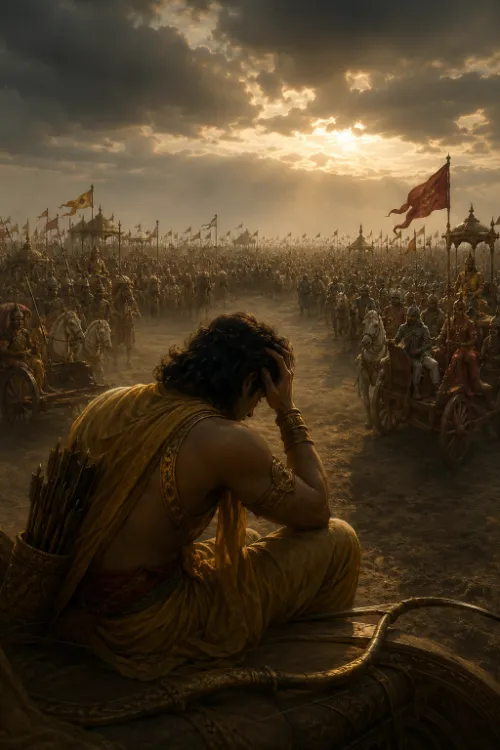
Kṛṣṇa speaks this after instructing Arjuna to act, not after teaching him to evade action. Arjuna’s surrender is expressed by carrying out a difficult responsibility in obedience to Kṛṣṇa. “Abandon all duties” therefore means abandon every supposedly independent claim that competes with the Lord’s final direction. It does not mean replace divine direction with personal convenience.
This is exactly the movement in the Bhāgavatam verse: from many independent creditors to the one refuge in whom every legitimate obligation finds its proper place.
Why Caitanya-caritāmṛta quotes the verse
The marginal notation is correct: Śrī Caitanya-caritāmṛta, Madhya 22.141 reproduces Śrīmad-Bhāgavatam 11.5.41 verbatim. The printed Bengali-script text is still Sanskrit, not a Bengali translation:
দেবর্ষিভূতাপ্তনৃণাং পিতৄণাং
ন কিঙ্করো নায়মৃণী চ রাজন্ ।
সর্বাত্মনা যঃ শরণং শরণ্যং
গতো মুকুন্দং পরিহৃত্য কর্তম্ ॥
devarṣi-bhūtāpta-nṛṇāṁ pitṝṇāṁ
na kiṅkaro nāyam ṛṇī ca rājan
sarvātmanā yaḥ śaraṇaṁ śaraṇyaṁ
gato mukundaṁ parihṛtya kartam
“O King, one who has wholly taken shelter of Mukunda, the giver of shelter, setting aside all separate obligations, is neither servant nor debtor of the gods, sages, living beings, relatives, human society or ancestors.”
Kṛṣṇadāsa Kavirāja places the Sanskrit authority between two Bengali verses that interpret it and guard it from misuse. Immediately before the quotation he writes:
কাম ত্যজি’ কৃষ্ণ ভজে শাস্ত্র-আজ্ঞা মানি’ ।
দেব-ঋষি-পিত্রাদিকের কভু নহে ঋণী ॥
kāma tyaji’ kṛṣṇa bhaje śāstra-ājñā māni’
deva-ṛṣi-pitrādikera kabhu nahe ṛṇī
“One who abandons selfish desire and worships Kṛṣṇa while honoring the commands of scripture is never indebted to the gods, sages, forefathers and others.”
Caitanya-caritāmṛta, Madhya 22.140
The wording is decisive: selfish desire is abandoned, and scripture’s command is honored. The person does not reject authority in favor of whim. Immediately after the quotation Kṛṣṇadāsa Kavirāja adds:
বিধি-ধর্ম ছাড়ি’ ভজে কৃষ্ণের চরণ ।
নিষিদ্ধ পাপাচারে তার কভু নহে মন ॥
vidhi-dharma chāḍi’ bhaje kṛṣṇera caraṇa
niṣiddha pāpācāre tāra kabhu nahe mana
“Although such a devotee has gone beyond ordinary regulated duty and worships Kṛṣṇa’s feet, his mind is never inclined toward forbidden sinful conduct.”
Caitanya-caritāmṛta, Madhya 22.142
The three verses form one argument:
- The devotee gives up selfish desire and follows scriptural direction.
- Complete shelter of Mukunda removes separate ritual indebtedness.
- Freedom from ordinary regulation does not produce attraction to sin.
Quoting verse 22.141 without verses 140 and 142 removes the guardrails deliberately placed around it.
What if a sincere devotee fails?
The Bhāgavatam immediately follows the debt verse with a compassionate but carefully worded assurance:
स्वपादमूलं भजतः प्रियस्य
त्यक्तान्यभावस्य हरिः परेशः ।
विकर्म यच्चोत्पतितं कथञ्चिद्
धुनोति सर्वं हृदि सन्निविष्टः ॥
sva-pāda-mūlaṁ bhajataḥ priyasya
tyaktānya-bhāvasya hariḥ pareśaḥ
vikarma yac cotpatitaṁ kathañcid
dhunoti sarvaṁ hṛdi sanniviṣṭaḥ
“The Supreme Lord Hari, dwelling within the heart of His dear devotee who worships the shelter of His feet and has given up all other loyalties, removes whatever wrong action may somehow occur accidentally.”
Śrīmad-Bhāgavatam 11.5.42
The protective words are utpatitam kathañcit—a wrong action that “somehow arises,” an accidental stumble. The verse does not license planned wrongdoing followed by a demand for divine erasure. Deliberate exploitation of mercy reveals that surrender is incomplete.
The distinction is practical:
- A sincere devotee falls, regrets it, corrects course and returns to service.
- An exploiter plans the offense, invokes surrender as immunity and intends to continue.
Hari’s internal purification is promised to the first, not advertised as insurance for the second.
What the verse does not authorize
It does not authorize neglect of dependent parents or children
If someone genuinely depends on your care, walking away for comfort, prestige or false renunciation is not repayment through Kṛṣṇa. It is shifting the cost of your choice onto another living being. Care itself may be devotional service when performed as an offering.
It does not erase promises, wages, bills or civil obligations
The verse concerns religious indebtedness and ultimate allegiance. It is not a legal instrument that cancels loans, contracts, taxes or compensation owed for harm. A devotee should become more trustworthy, not less.
It does not justify contempt for gods, sages or ancestors
They are not treated as independent rivals to Kṛṣṇa, but neither are they objects of ridicule. Gratitude and respect remain. Separate worship motivated by independent material reward is what loses necessity.
It does not turn chanting into payment for selfish consumption
One cannot exploit workers, animals, family and nature throughout the day and imagine that a religious practice at night has watered the root. Service to the root must carry nourishment to the branches.
It does not belong to the ego
“I owe no one anything” is ordinarily the voice of entitlement. The verse’s speaker is describing someone who has already offered the very “I” that wants independence. If the claim enlarges ego, it contradicts sarvātmanā.
What it means in real life
1. Stop treating gratitude as fragmented bookkeeping
It is impossible to calculate and repay every influence that made us. We do not even know all our benefactors. Surrender gives gratitude a center: receive everything as Kṛṣṇa’s mercy, use it in His service and treat its immediate carriers with respect.
2. Ask who owns your abilities
Education, money, influence, health and time can be treated as private assets or entrusted resources. Surrender begins when the question changes from “What can I obtain with this?” to “What service is this for?”
3. Let devotion improve ordinary relationships
If spiritual practice makes someone harsher at home, less honest at work and indifferent to suffering, the branches are not receiving water. The claimed service to the root should be examined.
4. Serve without turning people into ultimate masters
Family and society can demand actions opposed to conscience and devotion. Freedom from debt means their claims are not absolute. One may respect parents without obeying wrongdoing, serve society without worshiping public opinion, and honor tradition without preserving its errors.
5. Replace guilt with ordered responsibility
Some people are crushed by competing demands: family expects one thing, career another, society another and spiritual life something else. The verse does not say that every demand deserves obedience. It gives a governing question: “What genuinely serves Mukunda and the beings who belong to Him?”
That question may simplify life, but it rarely makes life lazy.
6. Measure surrender by direction, not performance
Complete surrender is the verse’s standard, but beginners should not pretend perfection or despair because they lack it. The honest beginning is to place one responsibility after another in relation to Kṛṣṇa—food, work, speech, money, family care, study and prayer—and keep correcting the center.
A practical test of the claim
Before saying “I am no longer indebted,” ask:
- Have I surrendered selfish desire, or merely rejected inconvenient duties?
- Is my decision guided by scripture, mature spiritual counsel and honest reflection—or only by preference?
- Are people entrusted to me being protected or abandoned?
- Has devotion made me more truthful, compassionate and dependable?
- Am I serving other beings as connected with Kṛṣṇa, or using Kṛṣṇa to avoid them?
- If I am corrected, do I become humble and change—or defend myself with quotations?
These questions do not weaken the verse. They protect its greatness from imitation.
The deepest meaning of freedom from debt
Śrīmad-Bhāgavatam 11.5.41 begins with a world of many claimants and ends with Mukunda. The gods supply. The sages teach. Living beings sustain. Relatives care. Society supports. Ancestors transmit life. Their gifts are real, but none is the independent source. When a person offers his whole being to the source of them all, he is no longer trapped in separate ritual accounts. His life itself becomes the offering through which every legitimate debt is honored at its root.
This is not the freedom of a person who belongs to no one. It is the freedom of a person who belongs completely to Mukunda—and therefore learns how to serve everyone without mistaking anyone for the ultimate owner of the self.
Textual notes
The supplied Sanskrit of Śrīmad-Bhāgavatam 11.5.41 is correct. Some editions print minor typographical variants such as pitṛṇām instead of the metrically and grammatically expected genitive plural pitṝṇām; the meaning is unchanged.
Śrī Caitanya-caritāmṛta, Madhya 22.141 quotes the Bhāgavatam verse verbatim. Its Bengali-script presentation represents Sanskrit sounds in Bengali letters; it is not a separate Bengali composition.
The familiar translation is accurate but interpretive. “Lotus feet,” commonly supplied in Vaiṣṇava translations, is implicit in taking shelter of Mukunda but does not appear as a separate word in verse 11.5.41. The Lord’s feet are stated explicitly in the following verse, 11.5.42.
Kartam is an uncommon nominal form from the verbal root meaning “to do.” In context it means “what is to be done,” “prescribed duty” or “obligation.” Jīva Gosvāmī glosses it with kṛtyam, “that which ought to be done.”
The article distinguishes ordinary moral and social responsibility from separate Vedic ritual indebtedness. This distinction is required by Śrīmad-Bhāgavatam 11.20.9, Caitanya-caritāmṛta Madhya 22.140–142 and the Bhāgavatam’s immediate next verse.