

The One Who Fulfills Kṛṣṇa’s Desire
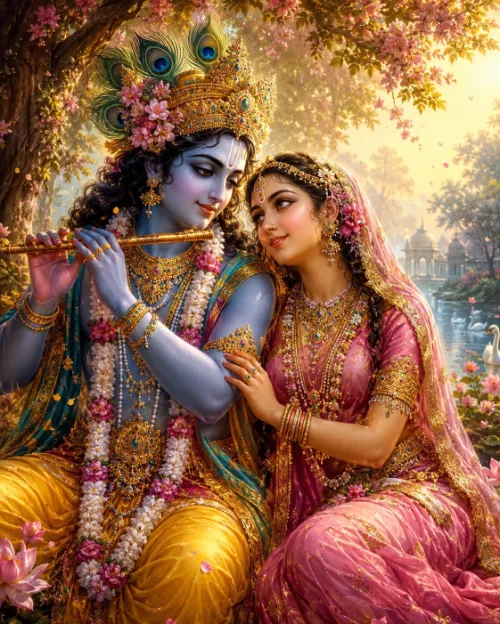
The One Who Fulfills Kṛṣṇa’s Desire: Why She Is Called Rādhā
Kṛṣṇadāsa Kavirāja is not offering a decorative play on names. He is defining Śrī Rādhā by the deepest movement of Her being: Her love exists entirely for Kṛṣṇa’s delight.
The line is short, but it contains an entire theology of divine love. Rādhā is not merely the woman whom Kṛṣṇa loves most. She is the perfect personal embodiment of love that seeks the happiness of its beloved rather than its own. Yet Gauḍīya theology does not reduce Her to a subordinate mortal worshiper. She is simultaneously Kṛṣṇa’s supreme worshiper, His own pleasure potency, the source of all His loving consorts, the one who enchants Him, and the supreme goddess worshiped by all.
That apparent paradox—the greatest worshiper is also supremely worshipable—is essential to understanding who Rādhā is.
The original verse
কৃষ্ণবাঞ্ছা–পূর্তিরূপ করে আরাধনে ।
অতএব ‘রাধিকা’ নাম পুরাণে বাখানে ॥
kṛṣṇa-vāñchā-pūrti-rūpa kare ārādhane
ataeva ‘rādhikā’ nāma purāṇe vākhāne
“Her worship consists of fulfilling the desires of Lord Kṛṣṇa. Therefore the Purāṇas call Her Rādhikā.”
A slightly more literal rendering would be:
“She performs worship whose very form is the fulfillment of Kṛṣṇa’s desires; therefore a Purāṇic text declares Her name to be Rādhikā.”
The phrase pūrti-rūpa is strong. It does not merely say that fulfilling Kṛṣṇa’s wishes is one activity included in Her worship. It says that such fulfillment is the form, nature, and defining shape of Her worship.
A close reading
The Bengali purāṇe is a locative form—“in a Purāṇa” or “in Purāṇic scripture.” Prabhupāda’s “the Purāṇas” conveys the broader scriptural tradition, but the immediate textual proof is one precise verse from the Śrīmad-Bhāgavatam.
The real Purāṇic source: Śrīmad-Bhāgavatam 10.30.28
Kṛṣṇadāsa Kavirāja does not leave his claim unsupported. In Ādi 4.88—the very next verse—he quotes this statement spoken by the gopīs during their search for Kṛṣṇa:
अनयाराधितो नूनं भगवान् हरिरीश्वरः ।
यन्नो विहाय गोविन्दः प्रीतो यामनयद् रहः ॥
anayārādhito nūnaṁ
bhagavān harir īśvaraḥ
yan no vihāya govindaḥ
prīto yām anayad rahaḥ
“Surely this particular gopī has perfectly worshiped Bhagavān Hari, the Supreme Lord. Govinda was so pleased with Her that He left us behind and led Her to a secluded place.”
The narrative setting matters. During the rāsa dance, Kṛṣṇa disappears. The gopīs follow His footprints and discover a second set beside them. From the signs on the ground they conclude that one extraordinarily fortunate gopī has gone away alone with Him. Their evidence is not a public title, institutional position, or ritual achievement. Their evidence is Kṛṣṇa’s response: He was pleased—prītaḥ.
The crucial expression is:
anayā ārādhitaḥ — “by this particular woman, He was worshiped and fully pleased.”
Through vowel combination, anayā ārādhitaḥ becomes anayārādhitaḥ. Gauḍīya commentators hear the name Rādhā shining within ārādhitaḥ. Thus Kṛṣṇadāsa’s sequence is exact:
- Rādhā’s worship is the fulfillment of Kṛṣṇa’s desires.
- The Bhāgavatam says that one unique gopī worshiped Kṛṣṇa so perfectly that He left the others to be alone with Her.
- Therefore that unnamed gopī is recognized as Rādhikā, the unsurpassed worshiper and satisfier of Govinda.
Is Rādhā explicitly named in this Bhāgavatam verse?
Not as a separate, overt proper noun. The Sanskrit says anayā, “by this one,” and yām, “whom.” Her identity is indirect. The name is theologically disclosed through ārādhitaḥ and through the exceptional gopī’s role in the narrative.
This qualification should not be concealed. The traditional Gauḍīya claim is not that the printed text contains “Rādhā” as an ordinary subject noun. It is that Śukadeva reveals Her confidentially—through grammar, implication, narrative supremacy, and the word ārādhitaḥ.
Viśvanātha Cakravartī explains that Śukadeva had carefully kept Her name hidden, but that it nevertheless emerged from his mouth within ārādhitaḥ, like a kettledrum announcing Her supreme good fortune. The concealment is not treated as absence or ignorance. It is treated as a feature of confidentiality.
The word family: Rādhā, rādh , and ārādhana
Prabhupāda’s purport states:
“The name ‘Rādhā’ is derived from the root word ārādhana, which means ‘worship.’ The personality who excels all in worshiping Kṛṣṇa may therefore be called Rādhikā, the greatest servitor.”
The theological meaning is clear. A small philological refinement makes it even more precise. Strictly speaking, the Sanskrit verbal root is √rādh, not ārādhana. The root carries senses such as succeeding, accomplishing, attaining, gratifying, and propitiating. With the prefix ā-, it forms ā-√rādh: to win someone’s favor, satisfy, propitiate, or worship. From this comes ārādhana: gratification, propitiation, adoration, worship, or devoted service.
The meanings “worship” and “satisfy” therefore belong together. In this word family, worship is not simply the performance of prescribed gestures. It is action that successfully gains the beloved’s favor and gives satisfaction.
That is why translating ārādhana only as “ritual worship” is too narrow here. Rādhā’s ārādhana is the complete art of giving Kṛṣṇa joy. The name Rādhikā is a standard affectionate form of Rādhā in devotional Sanskrit and Bengali. In Gauḍīya usage it evokes not merely one who performs worship, but the one in whom worship reaches its unsurpassable perfection.
Rādhā’s worship is not formal ritual
In ordinary religious speech, “worship” may suggest a worshiper standing before a deity with lamps, incense, flowers, prayers, and offerings. These are genuine forms of worship, but Ādi 4.87 points to something deeper.
Rādhā’s entire existence is worship:
- Her attention is worship because it rests completely upon Kṛṣṇa.
- Her speech is worship because it intensifies His loving exchanges.
- Her beauty is worship because it gives Govinda pleasure.
- Her cooking, decorating, meeting, separation, joking, jealousy, glances, silence, and apparent resistance all serve the unfolding of divine rasa.
- Even Her own happiness becomes service because it increases Kṛṣṇa’s happiness.
Kṛṣṇadāsa prepares for 4.87 with this description:
গোবিন্দানন্দিনী, রাধা, গোবিন্দমোহিনী ।
গোবিন্দসর্বস্ব, সর্বকান্তা–শিরোমণি ॥
govindānandinī rādhā, govinda-mohinī
govinda-sarvasva, sarva-kāntā-śiromaṇi
“Rādhā gives bliss to Govinda and enchants Govinda. She is everything to Govinda, the crown jewel of all His beloveds.”
Bengali — Caitanya-caritāmṛta, Ādi 4.82
This is not the language of distant ceremonial homage. Govindānandinī—“She who gives joy to Govinda”—is practically a theological definition of Her name. Govinda-mohinī goes further: Kṛṣṇa enchants all beings, but Rādhā enchants Him.
Her service is therefore powerful, creative, intimate, and sovereign in love.
Why Rādhā can fulfill Kṛṣṇa’s desires completely
If Rādhā were merely an unusually accomplished finite soul, Ādi 4.87 would praise Her devotion but would not explain how She can satisfy the unlimited desires of the unlimited Lord. The preceding theology supplies the answer: Rādhā is Kṛṣṇa’s own internal pleasure potency, hlādinī-śakti, personified.
राधा कृष्णप्रणयविकृतिर्ह्लादिनी शक्तिरस्माद्
एकात्मानावपि भुवि पुरा देहभेदं गतौ तौ ।
चैतन्याख्यं प्रकटमधुना तद्द्वयं चैक्यमाप्तं
राधाभावद्युतिसुवलितं नौमि कृष्णस्वरूपम् ॥
rādhā kṛṣṇa-praṇaya-vikṛtir hlādinī śaktir asmād
ekātmānāv api bhuvi purā deha-bhedaṁ gatau tau
caitanyākhyaṁ prakaṭam adhunā tad-dvayaṁ caikyam āptaṁ
rādhā-bhāva-dyuti-suvalitaṁ naumi kṛṣṇa-svarūpam
“Rādhā is the transformation of Kṛṣṇa’s love, His pleasure potency. Although Rādhā and Kṛṣṇa are one in identity, They eternally assume two forms. Now those two have become one as Śrī Caitanya. I bow to that form of Kṛṣṇa, adorned with Rādhā’s emotion and golden radiance.”
Sanskrit — Caitanya-caritāmṛta, Ādi 1.5 and 4.55
This verse, attributed by Kṛṣṇadāsa to the confidential teachings of Svarūpa Dāmodara, establishes both oneness and distinction:
- Rādhā is not external to Kṛṣṇa like an unrelated second absolute.
- She is not a material transformation.
- She is His own hlādinī, the potency through which bliss is experienced and exchanged.
- Yet She exists eternally in a distinct personal form so that love, service, attraction, meeting, separation, and reciprocation can occur.
Kṛṣṇadāsa restates the point in Bengali:
রাধিকা হয়েন কৃষ্ণের প্রণয়–বিকার ।
স্বরূপশক্তি—‘হ্লাদিনী’ নাম যাঁহার ॥
rādhikā hayena kṛṣṇera praṇaya-vikāra
svarūpa-śakti—‘hlādinī’ nāma yāṅhāra
“Rādhikā is the transformation of Kṛṣṇa’s love. She is His intrinsic potency known as hlādinī.”
Caitanya-caritāmṛta , Ādi 4.59
Rādhā can perfectly satisfy Kṛṣṇa because She is the personal fullness of His own capacity for bliss and love. The pleasure potency does not mechanically deliver pleasure to Him; it becomes a person who loves Him freely, infinitely, and in ever-new ways.
From prema to mahābhāva : why Her worship surpasses all others
Kṛṣṇadāsa presents a progression:
হ্লাদিনীর সার ‘প্রেম’, প্রেমসার ‘ভাব’ ।
ভাবের পরমকাষ্ঠা, নাম—‘মহাভাব’ ॥
মহাভাবস্বরূপা শ্রীরাধা–ঠাকুরাণী ।
সর্বগুণখনি কৃষ্ণকান্তা–শিরোমণি ॥
hlādinīra sāra ‘prema’, prema-sāra ‘bhāva’
bhāvera parama-kāṣṭhā, nāma—‘mahābhāva’
mahābhāva-svarūpā śrī-rādhā-ṭhākurāṇī
sarva-guṇa-khani kṛṣṇa-kāntā-śiromaṇi
“The essence of the pleasure potency is prema. The essence of prema is bhāva, and the highest limit of bhāva is called mahābhāva. Śrī Rādhā Ṭhākurāṇī is the very embodiment of mahābhāva, the mine of every virtue and the crown jewel among Kṛṣṇa’s beloveds.”
Caitanya-caritāmṛta , Ādi 4.68–69
Rādhā is therefore not simply the best devotee in a quantitative ranking, as though She performed more acts of worship than everyone else. She is the fullest qualitative form of divine love itself. Her worship is perfect because Her love has reached the state in which every emotion, sense, thought, gesture, and part of Her being exists for Kṛṣṇa.
Rūpa Gosvāmī describes Her supremacy:
Sanskrit — Ujjvala-nīlamaṇi , Rādhā-prakaraṇa 3
तयोरप्युभयोर्मध्ये राधिका सर्वथाधिका ।
महाभावस्वरूपेयं गुणैरतिवरीयसी ॥
tayor apy ubhayor madhye
rādhikā sarvathādhikā
mahābhāva-svarūpeyaṁ
guṇair ativarīyasī
“Of the two foremost gopīs, Rādhikā is superior in every respect. She is the embodiment of mahābhāva and surpasses all through Her qualities.”
The supreme worshiper is also the supreme goddess
Immediately after quoting anayārādhito nūnam, Kṛṣṇadāsa draws a conclusion that may surprise readers:
অতএব সর্বপূজ্যা, পরম–দেবতা ।
সর্বপালিকা, সর্ব–জগতের মাতা ॥
ataeva sarva-pūjyā, parama-devatā
sarva-pālikā, sarva-jagatera mātā
“Therefore Rādhā is worshipable by all, the supreme goddess, the protectress of all, and the mother of the entire universe.”
Caitanya-caritāmṛta , Ādi 4.89
Why does proving that Rādhā worships Kṛṣṇa lead to the declaration that everyone should worship Her? Because in Gauḍīya theology the highest greatness is not domination but perfect love. Rādhā is supremely worshipable precisely because She is the supreme abode of worship. She is not honored in competition with Kṛṣṇa; She is honored because no one belongs to Kṛṣṇa, knows Kṛṣṇa, delights Kṛṣṇa, or gives Kṛṣṇa to others as completely as She does.
The Bṛhad-gautamīya-tantra, as quoted in Ādi 4.83, says:
देवी कृष्णमयी प्रोक्ता राधिका परदेवता ।
सर्वलक्ष्मीमयी सर्वकान्तिः सम्मोहिनी परा ॥
devī kṛṣṇa-mayī proktā
rādhikā para-devatā
sarva-lakṣmī-mayī sarva-
kāntiḥ sammohinī parā
“The radiant goddess Rādhikā is declared to be wholly filled with Kṛṣṇa and the supreme divinity. She contains all Lakṣmīs and all beauty; She is the supreme enchantress and the transcendent potency.”
The expression kṛṣṇa-mayī receives two complementary explanations in Ādi 4.85–86. First, Kṛṣṇa fills Her within and without: wherever She looks, Kṛṣṇa appears. Second, She is one with Him as His own loving potency. Her exclusive concentration upon Kṛṣṇa and Her ontological unity with Him are not separate ideas. Each explains the other.
“Fulfilling Kṛṣṇa’s desires” does not mean mechanical obedience
The phrase can be misunderstood if imported into ordinary power relations. It does not describe an erased personality whose worth lies in obeying every immediate command. Rādhā is not passive, voiceless, or psychologically dependent. Gauḍīya poetry portrays Her as forceful, intelligent, playful, proud in love, independent in mood, and capable of making Kṛṣṇa plead for Her favor.
Her māna—loving indignation or jealous sulking—may appear to obstruct Kṛṣṇa’s immediate wish. Her companions may prevent Him from entering the grove. She may turn away, answer indirectly, or refuse easy reconciliation. Yet these apparently contrary movements intensify love, deepen Kṛṣṇa’s eagerness, and produce richer rasa.
Kṛṣṇadāsa says of Her love:
যাহা হৈতে সুনির্মল দ্বিতীয় নাহি আর ।
তথাপি সর্বদা বাম্য–বক্র–ব্যবহার ॥
yāhā haite sunirmala dvitīya nāhi āra
tathāpi sarvadā vāmya-vakra-vyavahāra
“Nothing is purer than Her love, yet its behavior is always contrary and crooked.”
Caitanya-caritāmṛta , Ādi 4.130
“Crooked” here does not mean dishonest or morally corrupt. It means that divine love does not move like a straight commercial transaction. Its turns, obstacles, concealments, and reversals create ever-new sweetness.
Therefore kṛṣṇa-vāñchā-pūrti means fulfilling Kṛṣṇa’s deepest desire for loving rasa, not mechanically gratifying every surface impulse. Sometimes love fulfills the beloved most completely by making fulfillment difficult.
Her happiness is not erased—it becomes part of the gift
Selfless love is sometimes imagined as the annihilation of one’s own joy. The Caitanya-caritāmṛta presents something more subtle. The gopīs do not seek private gratification, yet their happiness expands without limit because Kṛṣṇa is pleased by their happiness.
এ বিরোধের এক মাত্র দেখি সমাধান ।
গোপিকার সুখ কৃষ্ণসুখে পর্যবসান ॥
e virodhera eka mātra dekhi samādhāna
gopikāra sukha kṛṣṇa-sukhe paryavasāna
“I see only one solution to this apparent contradiction: the gopīs’ happiness culminates in Kṛṣṇa’s happiness.”
Caitanya-caritāmṛta , Ādi 4.189
And again:
প্রীতিবিষয়ানন্দে তদাশ্রয়ানন্দ ।
তাঁহা নাহি নিজসুখবাঞ্ছার সম্বন্ধ ॥
prīti-viṣayānande tad-āśrayānanda
tāṅhā nāhi nija-sukha-vāñchāra sambandha
“The abode of love rejoices in the joy of love’s object; that joy has no connection with a separate desire for personal gratification.”
Caitanya-caritāmṛta , Ādi 4.199
In the technical language of devotional aesthetics:
- Kṛṣṇa is the viṣaya, the object toward whom love flows.
- Rādhā is the supreme āśraya, the personal abode in whom love resides.
- The joy of the āśraya arises from the joy of the viṣaya.
- Kṛṣṇa, in turn, takes pleasure in Rādhā’s beauty, qualities, love, and happiness.
This creates an ever-expanding circuit rather than one-sided self-denial:
Rādhā’s love increases Kṛṣṇa’s joy → Kṛṣṇa’s joy increases Rādhā’s joy → Her blossoming joy increases His joy still further.
Neither person disappears. Love removes selfish rivalry, not personal distinction.
The line between prema and ordinary desire
Rāmānanda Rāya gives one of the clearest definitions in the Caitanya-caritāmṛta:
নিজেন্দ্রিয়সুখহেতু কামের তাৎপর্য ।
কৃষ্ণসুখ-তাৎপর্য গোপীভাব-বর্য ॥
nijendriya-sukha-hetu kāmera tātparya
kṛṣṇa-sukha-tātparya gopī-bhāva-varya
“The aim of ordinary desire is the happiness of one’s own senses. The excellent mood of the gopīs has Kṛṣṇa’s happiness as its aim.”
Caitanya-caritāmṛta , Madhya 8.217
This is the moral and theological key to Ādi 4.87. Externally, selfish desire and divine love may use some of the same vocabulary: attraction, longing, meeting, touch, delight. Their inner direction is opposite.
- Ordinary desire asks, “How can the other person complete my enjoyment?”
- Prema asks, “How may I contribute to the beloved’s joy?”
- Rādhā’s mahābhāva makes that second movement total, spontaneous, infinitely intelligent, and ever increasing.
This does not authorize human beings to imitate esoteric divine pastimes or to baptize exploitative relationships as “selfless service.” The criterion is the absence of private exploitation. Where coercion, manipulation, entitlement, or concealed self-gratification dominates, the language of Rādhā’s love is being misused.
Rādhā as the perfection of Rūpa Gosvāmī’s definition of bhakti
Rūpa Gosvāmī defines pure devotion as favorable cultivation directed toward Kṛṣṇa:
अन्याभिलाषिताशून्यं ज्ञानकर्माद्यनावृतम् ।
आनुकूल्येन कृष्णानुशीलनं भक्तिरुत्तमा ॥
anyābhilāṣitā-śūnyaṁ
jñāna-karmādy-anāvṛtam
ānukūlyena kṛṣṇānuśīlanaṁ
bhaktir uttamā
“The highest devotion is the sustained cultivation of service to Kṛṣṇa performed for His favor, free from extraneous desires and unobscured by pursuits of impersonal knowledge, reward-seeking action, and the like.”
Sanskrit — Bhakti-rasāmṛta-sindhu 1.1.11
The central word is ānukūlyena: favorably, in a way intended for Kṛṣṇa’s pleasure. Ādi 4.87 presents Rādhā as the personal summit of this principle. What Rūpa defines conceptually as uttamā-bhakti, Rādhā embodies without limit as mahābhāva.
She is not simply a practitioner who follows the definition. She is the original divine reality from whom the highest moods of devotion become available.
Beloved because She loves—or lover because She is beloved?
The Gauḍīya answer is both. A famous verse attributed to the Padma Purāṇa declares:
यथा राधा प्रिया विष्णोस्तस्याः कुण्डं प्रियं तथा ।
सर्वगोपीषु सैवैका विष्णोरत्यन्तवल्लभा ॥
yathā rādhā priyā viṣṇos
tasyāḥ kuṇḍaṁ priyaṁ tathā
sarva-gopīṣu saivaikā
viṣṇor atyanta-vallabhā
“As Rādhā is dear to Kṛṣṇa, so Her lake is dear to Him. Among all the gopīs, She alone is His supremely beloved.”
Being Kṛṣṇa’s supreme beloved is not separate from being His supreme worshiper. Her capacity to delight Him is the perfection of Her love, and the perfection of Her love makes Her uniquely dear to Him.
But even “Kṛṣṇa’s favorite” remains too shallow if it suggests an arbitrary preference. Rādhā is not first because Kṛṣṇa happens to select Her from a group of otherwise equivalent candidates. She is first because She is His complete pleasure potency and the fullest abode of love for Him.
Kṛṣṇa Himself wants to understand Her love
The theology eventually reverses the original perspective. Ādi 4.87 begins with Rādhā fulfilling Kṛṣṇa’s desires. The chapter culminates in a desire that even Kṛṣṇa cannot fulfill while remaining only in His own position: He wants to understand Rādhā’s love from within.
श्रीराधायाः प्रणयमहिमा कीदृशो वानयैवा-
स्वाद्यो येनाद्भुतमधुरिमा कीदृशो वा मदीयः ।
सौख्यं चास्या मदनुभवतः कीदृशं वेति लोभात्
तद्भावाढ्यः समजनि शचीगर्भसिन्धौ हरीन्दुः ॥
śrī-rādhāyāḥ praṇaya-mahimā kīdṛśo vānayaivā-
svādyo yenādbhuta-madhurimā kīdṛśo vā madīyaḥ
saukhyaṁ cāsyā mad-anubhavataḥ kīdṛśaṁ veti lobhāt
tad-bhāvāḍhyaḥ samajani śacī-garbha-sindhau harīnduḥ
“Longing to know the greatness of Śrī Rādhā’s love, the astonishing sweetness in Himself that She alone tastes through that love, and the nature of Her happiness in experiencing Him, Lord Hari—richly endowed with Her emotion—arose like the moon from the ocean of Śacī’s womb.”
Sanskrit — Caitanya-caritāmṛta, Ādi 1.6 and 4.230
This is the inner Gauḍīya explanation of Śrī Caitanya’s appearance. Rādhā fulfills Kṛṣṇa’s desires so completely that Her love awakens new desires within Him: to know Her love, to taste Himself through Her vision, and to experience Her joy.
Her service does not leave Kṛṣṇa untouched at the top of a hierarchy. It conquers, educates, and transforms the experience of the Absolute. Kṛṣṇa becomes the student of Rādhā’s love.
What Ādi 4.87 does—and does not—teach
It teaches that:
- Rādhā’s name is connected with the Sanskrit family of √rādh and ārādhana: accomplishment, satisfaction, propitiation, worship, and service.
- The immediate Purāṇic evidence is Śrīmad-Bhāgavatam 10.30.28, quoted in the next verse of the Caitanya-caritāmṛta.
- Rādhā is identified as the unnamed gopī whose worship pleased Govinda beyond all others.
- Her worship is defined by Kṛṣṇa’s happiness, not by a separate desire for Her own gratification.
- She can satisfy Him fully because She is His own internal pleasure potency, not an ordinary conditioned being.
- Her selfless love does not erase personality or mutual joy; it produces an endless exchange in which each delights the other.
- Her position as supreme worshiper is the very reason She is supremely worshipable.
It does not teach that:
- the name “Rādhā” occurs as an explicit independent noun in Bhāgavatam 10.30.28;
- worship means only formal ritual;
- Rādhā is a powerless subordinate without individuality;
- fulfilling Kṛṣṇa’s desires means simplistic compliance with every immediate request;
- selfless love requires the suppression of all joy;
- human exploitation can be excused by imitating the language of confidential divine love; or
- Rādhā and Kṛṣṇa are two competing gods.
The practical challenge hidden in the name
The verse is not only an exalted description of Rādhā. It also exposes the ordinary structure of ego-centered devotion. It is possible to worship God while remaining centered on oneself: seeking security, prestige, mystical experience, relief, success, recognition, or even the pleasure of considering oneself advanced. Rādhā’s name asks a more difficult question:
Is my worship organized around what I hope to receive, or around what will genuinely please Kṛṣṇa?
For a practitioner, this does not require imitating Rādhā’s intimate moods. It begins with accessible forms of favorable service:
- hearing and chanting attentively rather than mechanically;
- serving without demanding recognition;
- caring for devotees and other living beings because they belong to Kṛṣṇa;
- accepting guidance rather than inventing a spirituality that flatters the ego;
- offering one’s abilities where they are actually useful;
- and learning to rejoice when Kṛṣṇa is served well, even if someone else receives the visible credit.
Rādhā’s standard is unreachable by self-assertion. It is approached through grace, remembrance, service, and following those devoted to Her.
The statement “Her worship consists of fulfilling Kṛṣṇa’s desires” is correct, but its full meaning is larger than a dictionary definition. Rādhā is called Rādhikā because in Her, ārādhana becomes perfect. She does not merely perform worship; She is worship perfected into personhood. Her mind, senses, body, emotions, beauty, intelligence, speech, resistance, meeting, separation, suffering, and joy all move toward one inexhaustible center: the ever-new happiness of Kṛṣṇa.
Yet because She is Kṛṣṇa’s own hlādinī-śakti, this movement is not the servitude of an inferior being to a remote ruler. It is the internal drama of the one Absolute appearing as lover and beloved, potency and possessor of potency, abode of love and object of love. They are one without collapsing their relationship and two without becoming independent absolutes.
Rādhā is more than “Kṛṣṇa’s beloved.” She is the love by which Kṛṣṇa becomes fully beloved, the joy by which Govinda is given joy, and the worship so perfect that the worshiper becomes worshipable.
That is why She is called Rādhā.
Primary texts cited
- Śrī Caitanya-caritāmṛta, Ādi 1.5–6; 4.55, 4.59, 4.68–71, 4.82–89, 4.129–130, 4.189, 4.199, 4.230
- Śrī Caitanya-caritāmṛta, Madhya 8.217–218; 19.167
- Śrīmad-Bhāgavatam 10.30.28
- Rūpa Gosvāmī, Bhakti-rasāmṛta-sindhu 1.1.11
- Rūpa Gosvāmī, Ujjvala-nīlamaṇi, Rādhā-prakaraṇa 3
- Bṛhad-gautamīya-tantra, verse quoted in Caitanya-caritāmṛta Ādi 4.83
- Padma Purāṇa, verse quoted in Caitanya-caritāmṛta Ādi 4.215, Madhya 8.99 and Madhya 18.8