

One Potency, Three Divine Functions
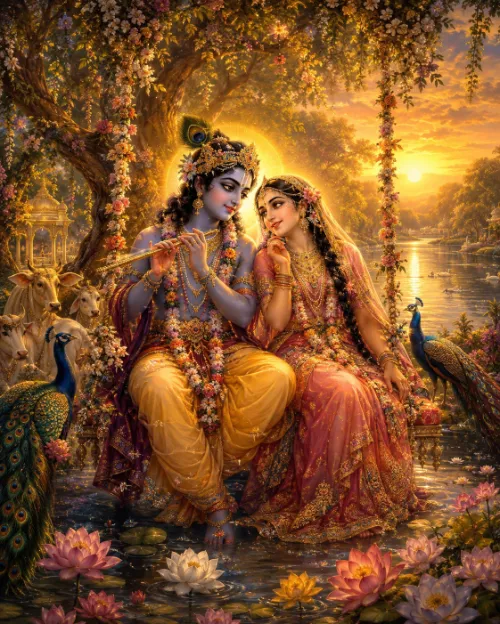
One Potency, Three Divine Functions: What Sandhinī, Saṁvit, and Hlādinī Actually Mean
Kṛṣṇa’s spiritual reality does not have to borrow existence, consciousness, or happiness from anywhere else. It exists, knows, and delights by its own intrinsic power. Caitanya-caritāmṛta, Ādi-līlā 4.62 names three ways in which that one power functions: sandhinī establishes and sustains spiritual reality, saṁvit makes divine reality self-revealing and knowable, and hlādinī enables Kṛṣṇa to relish bliss and enables His devotees to participate in that bliss through love.
The familiar summary is therefore basically correct:
One qualification is needed. The correspondences are not merely approximate: verse 4.62 states them directly. What is approximate is any English shorthand used to translate them. “Existence,” “knowledge,” and “bliss” are useful, but each word is too thin unless its active and relational force is explained.
The other essential qualification comes from the preceding verse: these are not three independent substances, beings, or rival powers. They are three distinguishable functions—or three predominant manifestations—of Kṛṣṇa’s one intrinsic spiritual potency. The theology is one power, threefold in operation.
The central verse
আনন্দাংশে হ্লাদিনী, সদংশে সন্ধিনী ।
চিদংশে সম্বিৎ—যারে জ্ঞান করি’ মানি ॥ ৬২ ॥
ānandāṁśe hlādinī, sad-aṁśe sandhinī
cid-aṁśe samvit—yāre jñāna kari’ māni
In the bliss-aspect [of the spiritual potency] is hlādinī; in the being-aspect, sandhinī; and in the consciousness-aspect, saṁvit, which I acknowledge as the power of knowledge.
As the expression of divine bliss, the one spiritual potency is called hlādinī; as the power that establishes eternal spiritual reality, it is called sandhinī; and as the expression of consciousness and revelation, it is called saṁvit.
This second rendering adds no new doctrine. It simply makes explicit what the preceding verse and the older Sanskrit source require: one potency is being described under three functional aspects.
A word-by-word reading
- ānanda-aṁśe — “in the aspect, share, or manifestation of bliss.” Ānanda is not passing pleasure but intrinsic spiritual bliss.
- hlādinī — “that which gladdens or gives delight,” from the verbal root associated with refreshing, pleasing, or causing joy.
- sat-aṁśe, appearing by sandhi as sad-aṁśe — “in the aspect of real or enduring being.” Here sat points to reality and existence untouched by material decay.
- sandhinī — the potency that establishes, supports, holds together, and provides the concrete reality of spiritual existence.
- cit-aṁśe, contracted in the Bengali line as cid-aṁśe — “in the aspect of consciousness.”
- samvit / saṁvit — full cognition, awareness, or knowledge. The Sanskrit stem is often written saṁvid, while its nominative singular form is saṁvit. Gauḍīya editions also print samvit according to their transliteration convention.
- yāre jñāna kari’ māni — “which I regard or acknowledge as knowledge.” The phrase does not reduce saṁvit to stored information; it identifies saṁvit as the spiritual function by which reality is consciously known and disclosed.
The word aṁśa can literally mean a portion or share. Yet the context prevents us from imagining three sliced-off pieces. The preceding verse says “one spiritual potency,” and the Sanskrit source quoted immediately afterward says that the three exist in God as one. Here, therefore, aṁśa is best understood as an aspect, functional expression, or predominance within an indivisible power.
The indispensable preceding verse: one potency, three forms
সচ্চিদানন্দ, পূর্ণ, কৃষ্ণের স্বরূপ ।
একই চিচ্ছক্তি তাঁর ধরে তিন রূপ ॥ ৬১ ॥
sac-cid-ānanda, pūrṇa, kṛṣṇera svarūpa
eka-i cic-chakti tāṅra dhare tina rūpa
Kṛṣṇa’s own nature is complete being, consciousness, and bliss. His one spiritual potency assumes three forms.
Verse 4.62 should never be detached from 4.61:
The Bengali compound cic-chakti is the sandhi form of cit-śakti, “conscious or spiritual potency.” The emphatic phrase eka-i means “one indeed,” “one alone,” or simply “one and the same.” The line therefore places a guardrail around everything that follows:
eka-i cic-chakti—“it is one spiritual potency.”
This is not arithmetical monism that erases all distinction, nor a tritheism of three autonomous energies. It is a unity capable of internally differentiated activity. Gauḍīya theology often speaks this way: the reality is one, but its powers and relationships are genuinely varied.
The real Sanskrit source: Dhruva’s prayer in the Viṣṇu Purāṇa
Kṛṣṇadāsa Kavirāja does not present the triad as a late invention. Immediately after explaining it in Bengali, he quotes a Sanskrit verse from the Viṣṇu Purāṇa. In its original narrative setting, the child Dhruva has completed severe austerity and beholds Lord Viṣṇu. Feeling unable to praise Him adequately, Dhruva asks for the intelligence to do so. The Lord touches Dhruva with the tip of His conch, and Dhruva then speaks his celebrated hymn. The verse about hlādinī, sandhinī, and saṁvit appears near the culmination of that prayer.
ह्लादिनी सन्धिनी संवित् त्वय्येका सर्वसंस्थितौ ।
ह्लादतापकरी मिश्रा त्वयि नो गुणवर्जिते ॥
hlādinī sandhinī saṁvit tvayy ekā sarva-saṁsthitau
hlāda-tāpa-karī miśrā tvayi no guṇa-varjite
In You—the ground in which everything is fully established—hlādinī, sandhinī, and saṁvit are one. The mixed potency that produces material pleasure and pain is not in You, for You are free from the material qualities.
Viṣṇu Purāṇa 1.12.69; quoted in Caitanya-caritāmṛta, Ādi 4.63
Some editions number the verse 1.12.68.
Several details are decisive. First, the verse says tvayy ekā: “in You, one.” The feminine singular ekā refers to the one potency whose functions have just been named. Plural names do not imply separate ultimate energies.
Second, the Lord is addressed as sarva-saṁsthita, the one in whom everything is established or the basis of the complete order of reality. The threefold potency is not an external apparatus propping up an otherwise incomplete God. It is His own intrinsic power.
Third, the second half contrasts this pure power with miśrā, the mixed, material energy experienced as alternating pleasure and pain. The contrast is not between a living, qualified God and a featureless absolute. It is between spiritual qualities and qualities produced by the three material guṇas.
Finally, guṇa-varjita here means “free from the material modes,” not “devoid of all qualities.” The very first half has just affirmed positive divine powers. The point is that God’s existence, knowledge, and bliss are not products of material goodness, passion, or ignorance.
Jīva Gosvāmī’s classical explanation
Jīva Gosvāmī gives the most precise early Gauḍīya analysis in the Bhagavat-sandarbha. Section numbers differ among editions; A. C. Bhaktivedanta Swami Prabhupāda’s commentary cites section 103, while some electronic arrangements place the passage under a different anuccheda number. The wording, however, is unmistakable.
One reality; therefore one potency, distinguished threefold
प्रथमं तावद् एकस्यैव तत्त्वस्य सच्चिदानन्दत्वाच् छक्तिर् अप्य् एका त्रिधा भिद्यते ।
prathamaṁ tāvad ekasyaiva tattvasya sac-cid-ānandatvāc chaktir apy ekā tridhā bhidyate
First of all, because the one Reality is being, consciousness, and bliss, its potency also—though one—is distinguished threefold.
The verb bhidyate, “is distinguished” or “is divided conceptually,” should be read together with ekā, “one.” Jīva is analyzing how the potency operates, not cutting it into independent substances.
Sandhinī: that by which spiritual reality is established
सत्तां दधाति धारयति च सा सर्वदेशकालद्रव्यादिप्राप्तिकरी सन्धिनी ।
sattāṁ dadhāti dhārayati ca sā sarva-deśa-kāla-dravyādi-prāptikarī sandhinī
That which bestows and sustains existence, and makes available all spiritual place, time, substance, and so forth, is sandhinī.
This is richer than “the power of preservation.” Material preservation means keeping an already existing object from breaking down. Sandhinī is more fundamental: it is the power by which the whole concrete order of spiritual reality stands forth and endures. Divine abodes, forms, relationships, paraphernalia, places, and occasions are not projections onto an impersonal spiritual blank. They possess positive, eternal reality through sandhinī.
Sandhinī does not mean that Kṛṣṇa depends upon a platform more ultimate than Himself. The potency is His own svarūpa-śakti, His intrinsic power. When Caitanya-caritāmṛta says that Kṛṣṇa’s existence “rests” in śuddha-sattva, it describes the self-manifesting ground supplied by His own energy, not an alien cause beneath God.
Saṁvit: that by which Kṛṣṇa knows and makes Himself known
तथा संविद्रूपोऽपि यया संवेत्ति संवेदयति च सा संवित् ।
tathā saṁvid-rūpo ’pi yayā saṁvetti saṁvedayati ca sā saṁvit
Although He is consciousness by nature, that by which He knows and causes others to know is saṁvit.
Saṁvit is therefore not inert data. It has a double movement:
- self-cognition—Kṛṣṇa knows Himself, His powers, His devotees, and His relations without obstruction; and
- revelation—He enables others to know Him.
This is crucial for bhakti. If God were only an object reached by the autonomous effort of a finite mind, knowledge of Him would be an achievement external to Him. In this theology, however, God is known through His own self-disclosing potency. Revelation is personal participation, not merely correct description.
Later in the same section, Caitanya-caritāmṛta states that the essence of saṁvit is knowledge of Kṛṣṇa’s full divinity:
কৃষ্ণে ভগবত্তা-জ্ঞান—সংবিতের সার ।
ব্রহ্মজ্ঞানাদিক সব তার পরিবার ॥ ৬৭ ॥
kṛṣṇe bhagavattā-jñāna—saṁvitera sāra
brahma-jñānādika saba tāra parivāra
Knowledge of Kṛṣṇa as Bhagavān is the essence of saṁvit. Knowledge of Brahman and other such realizations form its surrounding retinue.
The metaphor parivāra means family, entourage, attendants, or dependent circle. The verse does not call knowledge of Brahman false. It locates it within a fuller disclosure. Impersonal realization apprehends genuine spiritual reality, but Bhagavān-realization includes identity, qualities, activity, relationship, and the possibility of love. Saṁvit reaches its fullest expression not when the Absolute is known merely as undifferentiated being, but when Kṛṣṇa is recognized as the possessor of all divine fullness.
Hlādinī: that by which bliss is relished and shared
तथा ह्लादरूपोऽपि यया संविद् उत्कटरूपया तं ह्लादं संवेत्ति संवेदयति च सा ह्लादिनी ।
tathā hlāda-rūpo ’pi yayā saṁvid-utkaṭa-rūpayā taṁ hlādaṁ saṁvetti saṁvedayati ca sā hlādinī
Although He is bliss by nature, that intensified form of conscious potency by which He experiences that bliss and causes others to experience it is hlādinī.
Again the movement is double: Kṛṣṇa relishes bliss, and Kṛṣṇa communicates bliss. Hlādinī is not a private sensation sealed inside an isolated deity. It is the power of divine delight as self-enjoyment, mutual enjoyment, love, and participation.
The word “pleasure potency” can sound sensual or mechanical in modern English. “Bliss potency” is better, but still incomplete. Hlādinī is the capacity of divine love to give joy to Kṛṣṇa and to make the devotee capable of sharing in His joy. In Gauḍīya theology, bliss reaches its highest intelligible form not in solitary absorption but in loving reciprocity.
Why sat, cit, and ānanda need active interpretations
The compact formula sat-cit-ānanda is often rendered “eternity, knowledge, and bliss.” That is serviceable, but it can sound static: three abstract properties sitting inside God. Verse 4.62 turns the nouns into powers.
- Sat becomes sandhinī: being establishes and sustains a real spiritual world.
- Cit becomes saṁvit: consciousness knows, reveals, and makes relationship intelligible.
- Ānanda becomes hlādinī: bliss delights, is tasted, and is shared as love.
The Upaniṣadic background helps explain why the Gauḍīya tradition treats reality, cognition, and bliss as intrinsic to the Absolute rather than later additions.
सत्यं ज्ञानम् अनन्तं ब्रह्म ।
satyaṁ jñānam anantaṁ brahma
Brahman is reality, knowledge, and the infinite.
Taittirīya Upaniṣad 2.1.1
And later:
आनन्दो ब्रह्मेति व्यजानात् ।
ānando brahmeti vyajānāt
He realized: Brahman is bliss.
Taittirīya Upaniṣad 3.6.1
The Caitanya-caritāmṛta does more than repeat these predicates. It gives them a specifically personal and relational exposition. Being is the ground of Kṛṣṇa’s eternal world; consciousness is His self-disclosure; bliss matures as love.
The triad belongs to the internal potency—not to material nature
Another verse of the Viṣṇu Purāṇa supplies the wider map of divine energies:
विष्णुशक्तिः परा प्रोक्ता क्षेत्रज्ञाख्या तथापरा ।
अविद्याकर्मसंज्ञान्या तृतीया शक्तिरिष्यते ॥
viṣṇu-śaktiḥ parā proktā kṣetrajñākhyā tathāparā
avidyā-karma-saṁjñānyā tṛtīyā śaktir iṣyate
Viṣṇu’s potency is declared to be supreme; another potency is known as the conscious living being, and a third is called ignorance and karma.
Viṣṇu Purāṇa 6.7.61
Gauḍīya theologians use this three-energy map to distinguish:
- the internal or intrinsic potency (svarūpa-śakti or antaraṅga-śakti), whose functions are sandhinī, saṁvit, and hlādinī;
- the living beings (jīva-śakti or taṭastha-śakti), conscious but finite; and
- the external potency (māyā-śakti), which produces the material field of conditioned experience.
These two triads must not be confused. Sandhinī, saṁvit, and hlādinī are three functions within the one internal potency. They are not the same classification as internal, marginal, and external energy.
This distinction also prevents a serious misunderstanding. The jīva is conscious, but the jīva is not the whole saṁvit potency. The finite self can know because it is conscious by nature, yet its conditioned cognition is limited and can be obscured. Saṁvit in its primary sense is Kṛṣṇa’s unrestricted, intrinsic power of knowledge and disclosure.
Viśuddha-sattva: pure spiritual actuality
The next verse of the Caitanya-caritāmṛta turns from the general triad to sandhinī’s concentrated expression:
সন্ধিনীর সার অংশ—‘শুদ্ধসত্ত্ব’ নাম ।
ভগবানের সত্তা হয় যাহাতে বিশ্রাম ॥ ৬৪ ॥
sandhinīra sāra aṁśa—‘śuddha-sattva’ nāma
bhagavānera sattā haya yāhāte viśrāma
The essential expression of sandhinī is called śuddha-sattva, pure spiritual being, in which Bhagavān’s manifest existence rests.
Here sattva does not mean the material mode of goodness. Material sattva belongs to the three-guṇa system and can be mixed with passion and ignorance. Śuddha-sattva is spiritual actuality untouched by māyā.
The Bhāgavata Purāṇa describes Kṛṣṇa’s own nature in precisely this contrast:
विशुद्धसत्त्वं तव धाम शान्तं
तपोमयं ध्वस्तरजस्तमस्कम् ।
मायामयोऽयं गुणसम्प्रवाहो
न विद्यते तेऽग्रहणानुबन्धः ॥
viśuddha-sattvaṁ tava dhāma śāntaṁ
tapo-mayaṁ dhvasta-rajas-tamaskam
māyā-mayo ’yaṁ guṇa-sampravāho
na vidyate te ’grahaṇānubandhaḥ
Your own luminous nature is pure spiritual being and perfectly serene, full of spiritual radiance and free from passion and darkness. In You there is no flux of material qualities born of māyā and bound to ignorance.
Śrīmad-Bhāgavatam 10.27.4, spoken by Indra to Kṛṣṇa
Jīva Gosvāmī explains viśuddha-sattva as the self-luminous manifestation in which the Lord’s own nature and intrinsic potency become evident without depending on anything else. This can sound puzzling because Caitanya-caritāmṛta 4.64 connects śuddha-sattva especially with sandhinī, while Jīva also explains its self-revealing operation through saṁvit. There is no contradiction. The three are never isolated: the common spiritual field is one, while a term is applied according to the function that predominates in a given analysis.
Thus:
- when the emphasis is the stable actuality of divine being, the term is sandhinī;
- when the emphasis is self-luminosity and disclosure, the term is saṁvit;
- when the emphasis is love and relishable bliss, the term is hlādinī.
This language of predominance is more accurate than a diagram of sealed compartments.
What each potency contributes to a spiritual world
The triad answers three questions that any account of a fully personal Absolute must face.
Is the divine world real?
Sandhinī answers yes. Spiritual form, place, sequence, relation, and identity are not temporary symbolic aids imposed by a material mind. Kṛṣṇa’s abode, associates, names, forms, and paraphernalia have positive spiritual being. Sandhinī is the ontological “there-ness” of eternal līlā.
Can that world be known?
Saṁvit answers yes, but not by conquest. Divine reality is self-revealing. Kṛṣṇa knows Himself and grants knowledge of Himself. A devotee’s realization is therefore both cognition and grace. One does not manufacture Kṛṣṇa as a concept; one receives a disclosure in which the knower, the known, and their relationship become spiritually illuminated.
Why is divine plurality not a burden?
Hlādinī answers: because the fullness of spiritual difference is relishable relationship. Difference does not have to entail alienation. In Kṛṣṇa’s spiritual life it provides the grammar of love—lover and beloved, servant and served, friend and friend, parent and child. Hlādinī turns conscious relationship into blissful reciprocity.
Taken together, the three functions describe a spiritual world that is real, intelligible, and lovable.
Why the chapter moves from the triad to Śrī Rādhā
Ādi-līlā 4 is not an abstract catalogue of divine attributes. Its subject is Kṛṣṇa’s desire to understand and taste the love of Śrī Rādhā, a desire that helps explain His appearance as Śrī Caitanya. The discussion of the three potencies serves that larger argument.
Before naming the triad, Kṛṣṇadāsa Kavirāja identifies Rādhā with Kṛṣṇa’s internal hlādinī potency:
রাধিকা হয়েন কৃষ্ণের প্রণয়-বিকার ।
স্বরূপশক্তি—‘হ্লাদিনী’ নাম যাঁহার ॥ ৫৯ ॥
rādhikā hayena kṛṣṇera praṇaya-vikāra
svarūpa-śakti—‘hlādinī’ nāma yāṅhāra
Rādhikā is the transformation—or living expression—of Kṛṣṇa’s love. She is His intrinsic potency, known as hlādinī.
After treating sandhinī and saṁvit, the chapter returns to hlādinī and traces its intensification:
হ্লাদিনীর সার ‘প্রেম’, প্রেমসার ‘ভাব’ ।
ভাবের পরমকাষ্ঠা, নাম—‘মহাভাব’ ॥ ৬৮ ॥
hlādinīra sāra ‘prema’, prema-sāra ‘bhāva’
bhāvera parama-kāṣṭhā, nāma—‘mahā-bhāva’
The essence of hlādinī is divine love; the essence of divine love is bhāva; and the highest limit of bhāva is called mahābhāva.
Then comes the personal culmination:
মহাভাবস্বরূপা শ্রীরাধা-ঠাকুরাণী ।
সর্বগুণখনি কৃষ্ণকান্তা-শিরোমণি ॥ ৬৯ ॥
mahābhāva-svarūpā śrī-rādhā-ṭhākurāṇī
sarva-guṇa-khani kṛṣṇa-kāntā-śiromaṇi
Śrī Rādhā is the very embodiment of mahābhāva, the mine of every excellence and the crown jewel among Kṛṣṇa’s beloveds.
The logic of the passage is now visible: one intrinsic potency → three functions → hlādinī’s essence as prema → prema intensified as bhāva → bhāva perfected as mahābhāva → mahābhāva embodied as Śrī Rādhā.
Rādhā is therefore not introduced as a secondary goddess added to an already complete Kṛṣṇa from outside. In the chapter’s own language, she is the personal fullness of His intrinsic capacity for love and bliss. Yet she is not reduced to an impersonal force. Gauḍīya thought holds together identity and distinction: Rādhā is Kṛṣṇa’s own power of love, fully personified, and thus capable of the most intimate reciprocal relation with Him.
The three functions are inseparable in devotion
In lived bhakti, the triad does not arrive in three separate packets.
- A devotee’s relationship with Kṛṣṇa must have spiritual reality and continuity: sandhinī.
- That relationship must be recognized and illuminated: saṁvit.
- It must be animated by affection and relishable joy: hlādinī.
Knowledge without hlādinī could remain detached recognition. Feeling without saṁvit could be misdirected sentiment. Neither could endure without the spiritual actuality expressed through sandhinī. Authentic bhakti is real, lucid, and loving at once.
This helps explain why saṁvit and hlādinī are repeatedly said to cooperate. The fullest knowledge of Bhagavān is not emotionally sterile, and the highest love is not blind. Love reveals its object more deeply; genuine revelation intensifies love.
The point also clarifies why ordinary material pleasure is not hlādinī. Material pleasure depends on contact, fluctuation, lack, and bodily conditions; it is followed or accompanied by loss and pain. Hlādinī is intrinsic to spiritual reality and centered on giving pleasure to Kṛṣṇa. When communicated to a devotee, it reorients desire away from possession and toward service.
Philosophical implications
The Absolute is not an inert substance
The triad presents ultimate reality as dynamically self-sufficient. Kṛṣṇa does not merely have being, knowledge, and bliss as attributes. His internal potency eternally establishes, reveals, and relishes His fullness. The Absolute is therefore not less alive than finite persons; it is the inexhaustible ground of personhood, relation, and love.
Divine self-sufficiency includes relationship
Human dependence can make relationship look like evidence of incompleteness: we seek others because we lack something. Gauḍīya theology reverses the assumption at the divine level. Kṛṣṇa’s relationships arise from overflowing fullness, not deficiency. Hlādinī is the power by which complete bliss becomes reciprocal without ceasing to be complete.
Spiritual variety need not threaten unity
If all difference were material, liberation would require the erasure of names, forms, and relations. Sandhinī, saṁvit, and hlādinī instead explain how spiritual variety can be intrinsic to nondual reality. The unity is the one svarūpa-śakti; the variety is its real, eternal, personal functioning.
Revelation is ontological as well as informational
Saṁvit does not merely send facts about a distant God. Because it belongs to Kṛṣṇa’s own nature, its disclosure brings the devotee into a real relation with the one disclosed. To know Kṛṣṇa is not simply to hold a correct proposition; it is to be situated within a divinely revealed relationship.
Bliss culminates in love, not sensation
The sequence hlādinī → prema → bhāva → mahābhāva → Rādhā defines bliss personally. The highest ānanda is not an undifferentiated feeling of well-being but perfect love in which Kṛṣṇa and His devotee give joy to one another.
Common misunderstandings to avoid
“There are three separate internal energies.”
No. The text says eka-i cic-chakti, “one spiritual potency,” and tvayy ekā, “one in You.” Three names identify functional distinctions within that unity.
“The mapping to sat-cit-ānanda is only a later interpretation.”
No. Ādi 4.62 explicitly says ānandāṁśe, sad-aṁśe, and cid-aṁśe. The mapping is stated by the verse itself. What later theologians supply is a fuller explanation of each function.
“Aṁśa proves that the potency is physically divided.”
No. Aṁśa can mean portion, but the surrounding assertion of unity controls its meaning here. “Aspect,” “functional expression,” or “predominant operation” best preserves the passage as a whole.
A compact interpretive paraphrase
The whole teaching can be stated in one paragraph: Kṛṣṇa is complete spiritual being, consciousness, and bliss. His intrinsic potency is one, yet it can be distinguished according to three inseparable functions. As sandhinī, it establishes and sustains the eternal reality of His form, abode, associates, and relationships. As saṁvit, it is His perfect self-knowledge and His power to reveal Himself to others. As hlādinī, it is His power to relish and communicate bliss, culminating in prema, mahābhāva, and Śrī Rādhā. These are not material modes, detachable parts, or three independent beings. They are the real internal dynamism of one personal Absolute: the power by which divine life is eternally real, self-luminous, and infinitely lovable.
Final assessment
The original summary was substantially right, but it can be made more exact in four ways:
- The correspondence is explicit, not merely approximate: sat → sandhinī, cit → saṁvit, and ānanda → hlādinī.
- The English glosses need expansion: sandhinī establishes spiritual actuality, saṁvit knows and reveals, and hlādinī relishes and shares bliss as love.
- The three are not independent energies: both Caitanya-caritāmṛta 4.61 and the quoted Viṣṇu Purāṇa verse insist on one intrinsic potency.
- The section has a personal destination: its analysis of hlādinī culminates in Śrī Rādhā as mahābhāva embodied.
The shortest faithful formula is therefore:
One divine potency, three inseparable functions: sandhinī makes spiritual reality stand, saṁvit makes it shine in consciousness, and hlādinī makes it blossom as love.
Primary texts and editions consulted
- Caitanya-caritāmṛta, Ādi-līlā 4.59, 4.61–4.64, and 4.67–4.69.
- Viṣṇu Purāṇa 1.12.48–75, especially 1.12.69; some editions number the triad verse 1.12.68.
- Viṣṇu Purāṇa 6.7.60–63, especially 6.7.61.
- Jīva Gosvāmī, Bhagavat-sandarbha, discussion of the three functions of the svarūpa-śakti; section numbering varies by edition.
- Śrīmad-Bhāgavatam 10.27.4.
- Taittirīya Upaniṣad 2.1.1 and 3.6.1.