

From Divine Bliss to Śrī Rādhā
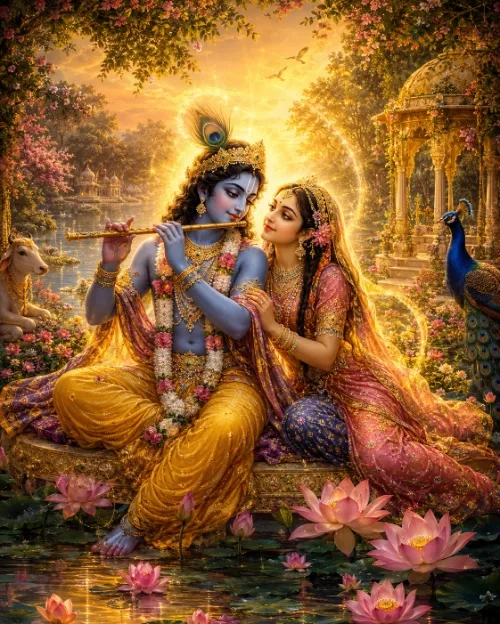
From Divine Bliss to Śrī Rādhā: How Sandhinī, Saṁvit, and Hlādinī Lead to Prema, Mahābhāva, and the Gauḍīya Understanding of Rādhā
Why does Kṛṣṇa experience bliss if He is already bliss itself? How can the Absolute know Himself if He is already pure consciousness? And what does Gauḍīya Vaiṣṇava theology mean when it says that Śrī Rādhā is not merely the greatest lover of Kṛṣṇa but Kṛṣṇa’s own hlādinī-śakti—the intrinsic potency of divine bliss—and mahābhāva itself in personal form?
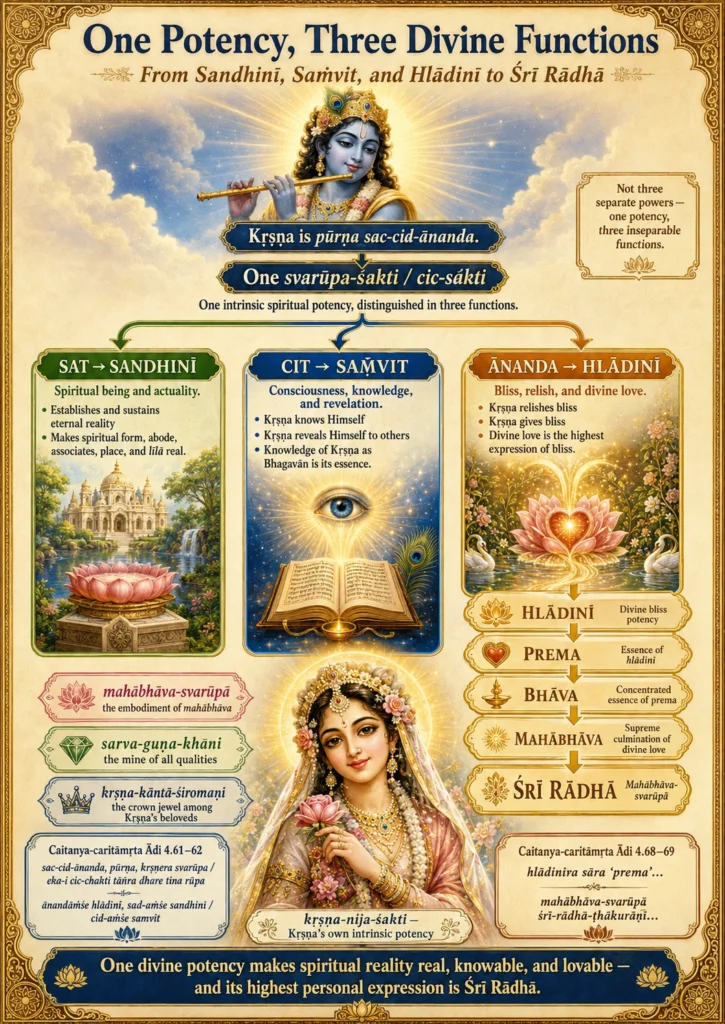
A single sheet tracing Kṛṣṇa’s one svarūpa-śakti through sandhinī, saṁvit and hlādinī — being, knowing and bliss — and then following hlādinī onward through prema and bhāva to mahābhāva in Śrī Rādhā.
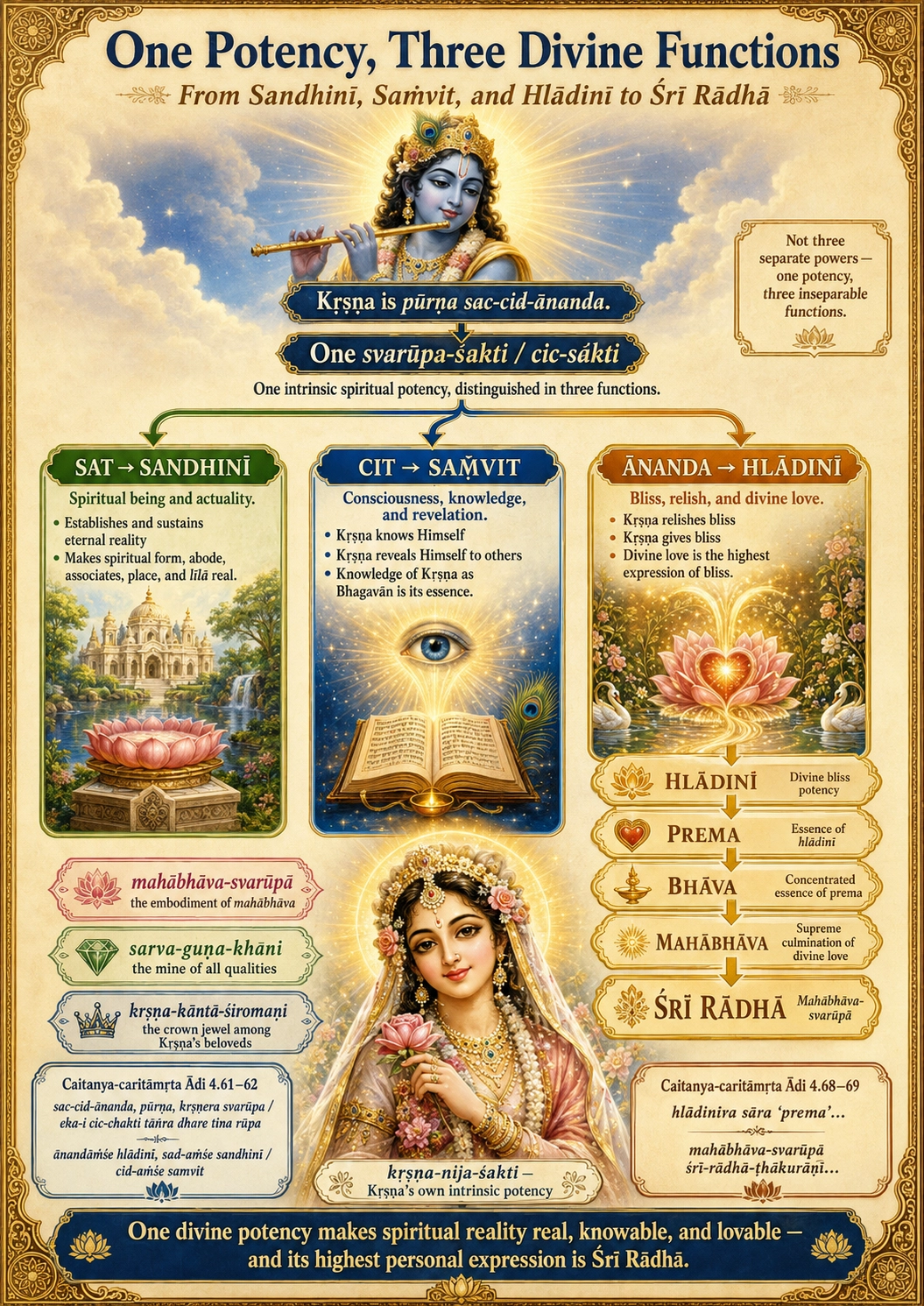
A compact series of verses in the fourth chapter of the Caitanya-caritāmṛta provides one of the tradition’s most profound answers. The argument begins with Kṛṣṇa as sac-cid-ānanda—complete spiritual being, consciousness, and bliss. It then identifies three principal functions of His one internal potency: sandhinī — the power of spiritual being and actuality; saṁvit — the power of consciousness, knowledge, and self-revelation; hlādinī — the power of bliss, relish, and love.
But Kṛṣṇadāsa Kavirāja does not stop there. He follows hlādinī inward toward its most concentrated essence: hlādinī → prema → bhāva → mahābhāva and then makes the extraordinary conclusion: mahābhāva-svarūpā śrī-rādhā-ṭhākurāṇī Śrī Rādhā is the very embodiment of mahābhāva.
The passage is therefore not merely a classification of divine energies. It is a theological path leading from the nature of God Himself to the identity of Śrī Rādhā.
One God, One Potency, Three Functions
The starting point is Caitanya-caritāmṛta, Ādi-līlā 4.61:
সচ্চিদানন্দ, পূর্ণ, কৃষ্ণের স্বরূপ ।
একই চিচ্ছক্তি তাঁর ধরে তিন রূপ ॥
sac-cid-ānanda, pūrṇa, kṛṣṇera svarūpa
eka-i cic-chakti tāṅra dhare tina rūpa
“Kṛṣṇa’s own nature is complete being, consciousness, and bliss. His one spiritual potency assumes three forms.”
The emphatic Bengali expression is: eka-i cic-chakti “one and the same spiritual potency.” That statement controls everything that follows. Sandhinī, saṁvit, and hlādinī are not three independent divine substances, three separate goddesses, or three rival powers standing beside Kṛṣṇa.
They are distinguishable functions of one svarūpa-śakti, Kṛṣṇa’s intrinsic spiritual potency. The following verse gives the correspondence explicitly.
আনন্দাংশে হ্লাদিনী, সদংশে সন্ধিনী ।
চিদংশে সম্বিৎ—যারে জ্ঞান করি’ মানি ॥
ānandāṁśe hlādinī, sad-aṁśe sandhinī
cid-aṁśe samvit—yāre jñāna kari’ māni
“In the aspect of bliss is hlādinī; in the aspect of being is sandhinī; and in the aspect of consciousness is saṁvit, which is understood as the power of knowledge.”
Caitanya-caritāmṛta, Ādi 4.62
The correspondence is therefore not a later theological guess: sat → sandhinī cit → saṁvit ānanda → hlādinī Later theologians such as Jīva Gosvāmī provide a deeper explanation of what those three terms actually mean.
The Older Sanskrit Source: Viṣṇu Purāṇa
Kṛṣṇadāsa Kavirāja immediately supports the doctrine by quoting a Sanskrit verse from the Viṣṇu Purāṇa.
ह्लादिनी सन्धिनी संवित् त्वय्येका सर्वसंस्थितौ ।
ह्लादतापकरी मिश्रा त्वयि नो गुणवर्जिते ॥
hlādinī sandhinī saṁvit
tvayy ekā sarva-saṁsthitau
hlāda-tāpa-karī miśrā
tvayi no guṇa-varjite
“In You, the ground in which everything is established, hlādinī, sandhinī, and saṁvit exist as one potency. The mixed potency that produces material pleasure and suffering does not exist in You, who are free from the material guṇas.”
Viṣṇu Purāṇa 1.12.69; quoted in Caitanya-caritāmṛta, Ādi 4.63
Some editions number this verse 1.12.68. The crucial word is: ekā — “one.” Again the text insists on unity. Three functions are named, but the potency is one. The second half adds an equally important distinction. The spiritual potency is contrasted with miśrā, the mixed material energy through which conditioned beings experience alternating pleasure and pain.
This means that hlādinī is not material pleasure purified, refined, or multiplied to infinity. Material pleasure belongs to a world of: desire and frustration, contact and separation, gain and loss, pleasure and pain.
Hlādinī belongs to Kṛṣṇa’s own spiritual nature. It is intrinsically divine.
A Note on the Bhagavat-sandarbha Numbering
A. C. Bhaktivedanta Swami Prabhupāda cites Jīva Gosvāmī’s explanation of these potencies in his purport to Ādi 4.62. The passage is sometimes referenced as Bhagavat-sandarbha 102, sometimes as 103, and in other arrangements under still different anuccheda numbers.
This is an editorial problem rather than a doctrinal one. Different Sanskrit editions divide and number the Sandarbhas differently. For careful citation, it is therefore safer to write: Jīva Gosvāmī, Bhagavat-sandarbha, discussion of the three functions of the svarūpa-śakti; anuccheda numbering varies by edition.
The Sanskrit passage itself is unmistakable.
Jīva Gosvāmī: Why One Potency Becomes Threefold
Jīva first states the principle behind the triad:
प्रथमं तावद् एकस्यैव तत्त्वस्य सच्चिदानन्दत्वाच् छक्तिर् अप्य् एका त्रिधा भिद्यते ।
prathamaṁ tāvad ekasyaiva tattvasya sac-cid-ānandatvāc chaktir apy ekā tridhā bhidyate
“First of all, because the one Reality is being, consciousness, and bliss, His potency also, although one, is distinguished threefold.”
The logic is precise: Bhagavān is one. His nature is: sat — being cit — consciousness ānanda — bliss His svarūpa-śakti is likewise one. But that one potency can be distinguished according to the way it expresses: being, consciousness, and bliss.
Thus the triad is not created by cutting one spiritual energy into separate pieces. Rather, one indivisible divine potency is understood according to predominant function.
Sandhinī: The Power by Which Spiritual Reality Stands
Jīva defines sandhinī:
सत्तां दधाति धारयति च सा सर्वदेशकालद्रव्यादिप्राप्तिकरी सन्धिनी ।
sattāṁ dadhāti dhārayati ca sā sarva-deśa-kāla-dravyādi-prāptikarī sandhinī
“That which establishes and sustains being, and makes possible all spiritual place, time, substance, and so forth, is sandhinī.”
This is much richer than simply saying: “Sandhinī maintains Kṛṣṇa’s existence.” That phrase can accidentally sound as if Kṛṣṇa depends upon a second reality underneath Him in order to continue existing.
That is not Jīva’s meaning. Sandhinī is Kṛṣṇa’s own intrinsic power of spiritual actuality. Through sandhinī there can be genuine spiritual: forms, places, abodes, associates, relationships, paraphernalia, events, and eternal līlā.
In other words, Kṛṣṇa’s spiritual world is not an impersonal blank upon which form and relationship are temporarily projected. It possesses positive spiritual reality. Sandhinī is the power by which that reality stands and endures.
Śuddha-sattva: The Concentrated Expression of Sandhinī
Kṛṣṇadāsa immediately continues:
সন্ধিনীর সার অংশ—‘শুদ্ধসত্ত্ব’ নাম ।
ভগবানের সত্তা হয় যাহাতে বিশ্রাম ॥
sandhinīra sāra aṁśa—‘śuddha-sattva’ nāma
bhagavānera sattā haya yāhāte viśrāma
“The essential expression of sandhinī is called śuddha-sattva, pure spiritual being, in which Bhagavān’s manifest existence rests.”
Caitanya-caritāmṛta, Ādi 4.64
Here śuddha-sattva must not be confused with the material mode of goodness. Material sattva-guṇa belongs to prakṛti. It remains one of the three material guṇas. Śuddha-sattva is categorically different.
It is spiritual actuality untouched by māyā. The Bhāgavatam describes Kṛṣṇa in a similar way.
विशुद्धसत्त्वं तव धाम शान्तं
तपोमयं ध्वस्तरजस्तमस्कम् ।
मायामयोऽयं गुणसम्प्रवाहो
न विद्यते तेऽग्रहणानुबन्धः ॥
viśuddha-sattvaṁ tava dhāma śāntaṁ
tapo-mayaṁ dhvasta-rajas-tamaskam
māyā-mayo ’yaṁ guṇa-sampravāho
na vidyate te ’grahaṇānubandhaḥ
“Your own luminous nature is pure spiritual being and perfectly peaceful, full of spiritual radiance and free from passion and darkness. In You there is no current of material qualities produced by māyā and bound to ignorance.”
Śrīmad-Bhāgavatam 10.27.4
Thus sandhinī does not mean merely preservation. It means the positive reality of the spiritual world itself.
Saṁvit: Kṛṣṇa Knows—and Makes Himself Known
Jīva’s definition of saṁvit is equally important:
तथा संविद्रूपोऽपि यया संवेत्टि संवेदयति च सा संवित् ।
tathā saṁvid-rūpo ’pi yayā saṁvetti saṁvedayati ca sā saṁvit
“Although He is consciousness by nature, that by which He knows and causes others to know is saṁvit.”
Two actions appear: saṁvetti — He knows; saṁvedayati — He causes another to know. This gives saṁvit a double movement: divine self-cognition and divine self-revelation. Kṛṣṇa knows Himself perfectly.
And He makes Himself knowable. That has enormous consequences for the Gauḍīya understanding of revelation. Knowledge of Bhagavān is not merely the achievement of an autonomous finite intellect examining God from the outside.
God reveals God. The finite soul can know Kṛṣṇa because Kṛṣṇa’s own saṁvit potency makes that knowledge possible. Revelation is therefore not merely information transmitted about a distant object.
It is participation in Bhagavān’s own self-disclosure.
The Fullness of Saṁvit Is Knowledge of Kṛṣṇa as Bhagavān
Kṛṣṇadāsa later states:
কৃষ্ণে ভগবত্তা-জ্ঞান—সম্বিতের সার ।
ব্রহ্মজ্ঞানাদিক সব তার পরিবার ॥
kṛṣṇe bhagavattā-jñāna—saṁvitera sāra
brahma-jñānādika saba tāra parivāra
“Knowledge of Kṛṣṇa as Bhagavān is the essence of saṁvit. Knowledge of Brahman and other such realizations form its surrounding retinue.”
Caitanya-caritāmṛta, Ādi 4.67
The word parivāra can mean family, entourage, attendants, or surrounding circle. The verse does not declare Brahman-realization false. It places it within a larger disclosure.
To know Brahman is to know genuine spiritual reality. But to know Bhagavān is to know that spiritual reality as: person, identity, form, qualities, will, activity, relationship, and the object of love.
Saṁvit therefore reaches its fullest expression when the Absolute is known not merely as spiritual existence but as Kṛṣṇa.
Hlādinī: The Power of Divine Relish
Jīva’s third definition goes still deeper:
तथा ह्लादरूपोऽपि यया संविदुत्कटरूपया तं ह्लादं संवेत्टि संवेदयति च सा ह्लादिनी ।
tathā hlāda-rūpo ’pi yayā saṁvid-utkaṭa-rūpayā taṁ hlādaṁ saṁvetti saṁvedayati ca sā hlādinī
“Although He is bliss by nature, that intensified form of conscious potency by which He experiences that bliss and causes others to experience it is hlādinī.”
Again two movements appear: Kṛṣṇa relishes bliss; Kṛṣṇa causes bliss to be relished. But Jīva adds something extraordinary: saṁvid-utkaṭa-rūpayā hlādinī is described as an intensified form of conscious potency.
This means the highest divine bliss is not unconscious sensation. It is fully conscious. Indeed, divine bliss and divine knowledge intensify together. Hlādinī is not the opposite of saṁvit.
It is conscious spiritual reality reaching its highest mode of relish.
Being, Knowing, Relishing
Jīva even speaks of these functions in an ascending order of richness. The conceptual progression is:
- sandhinī — spiritual reality exists
- saṁvit — spiritual reality knows and reveals itself
- hlādinī — spiritual reality becomes consciously relishable as bliss and love
We might summarize: being → consciousness → conscious bliss Or more personally: reality → revelation → love This helps explain why Caitanya-caritāmṛta gives only a relatively brief discussion of sandhinī and saṁvit before devoting most of the chapter to hlādinī.
The chapter is moving toward Śrī Rādhā.
If Kṛṣṇa Is Bliss, Why Does He Need Hlādinī?
This question reaches the heart of the theology. If Kṛṣṇa is already ānanda-svarūpa, bliss itself, would saying that hlādinī gives Him bliss imply that He previously lacked it?
No. Hlādinī does not insert happiness into an otherwise incomplete God. Rather: Kṛṣṇa is bliss, and hlādinī is His intrinsic power of relishing, expressing, communicating, and reciprocating that bliss.
Divine relationship therefore does not arise because Kṛṣṇa is lonely or deficient. It arises from fullness. The Absolute does not enter relationship because He lacks something.
His fullness itself possesses the power to become reciprocal love. This is one of the most distinctive features of Gauḍīya theology. Self-sufficiency does not imply isolation.
Ultimate fullness includes relationship.
The Chapter Now Turns Completely Toward Hlādinī
Earlier in the chapter, before even giving the threefold classification, Kṛṣṇadāsa has already identified Rādhā with Kṛṣṇa’s hlādinī potency.
রাধিকা হয়েন কৃষ্ণের প্রণয়–বিকার ।
স্বরূপশক্তি—‘হ্লাদিনী’ নাম যাঁহার ॥
rādhikā hayena kṛṣṇera praṇaya-vikāra
svarūpa-śakti—‘hlādinī’ nāma yāṅhāra
“Rādhikā is the transformation, or personal expression, of Kṛṣṇa’s love. She is His intrinsic potency known as hlādinī.”
Caitanya-caritāmṛta, Ādi 4.59
Thus the discussion of hlādinī is never merely abstract. It is preparing the reader to understand Rādhā.
Hlādinī Becomes Prema
Kṛṣṇadāsa gives the decisive progression in Ādi 4.68:
হ্লাদিনীর সার ‘প্রেম’, প্রেমসার ‘ভাব’ ।
ভাবের পরমকাষ্ঠা, নাম—‘মহাভাব’ ॥
hlādinīra sāra ‘prema’, prema-sāra ‘bhāva’
bhāvera parama-kāṣṭhā, nāma—‘mahābhāva’
“The essence of hlādinī is prema; the essence of prema is bhāva; and the supreme culmination of bhāva is called mahābhāva.”
This produces one of the most important theological sequences in Gauḍīya literature:
- hlādinī
- prema
- bhāva
- mahābhāva
But this should not be understood as four unrelated substances arranged like rungs of a ladder. The key word is: sāra — essence, core, concentrated substance, quintessence.
Thus: hlādinīra sāra prema means not merely that prema comes after hlādinī. It means: prema is the concentrated essence of hlādinī. And: prema-sāra bhāva means: bhāva is the concentrated essence of prema.
The movement therefore goes deeper and deeper into the interior intensity of divine bliss.
Parama-kāṣṭhā: The Absolute Summit
The phrase used for mahābhāva is: parama-kāṣṭhā Kāṣṭhā can mean a limit, culmination, extremity, highest point, or final stage. Parama-kāṣṭhā therefore means: the supreme limit, ultimate culmination, absolute summit.
So mahābhāva is not simply: “very strong emotion.” That translation would reduce an intricate spiritual category to ordinary psychology. Mahābhāva is the supreme possible intensification of transcendental prema within Gauḍīya rasa theology.
An Essential Warning: Two Different Uses of Bhāva
This point is indispensable. Many readers know the famous developmental sequence of sādhana: śraddhā → sādhu-saṅga → bhajana-kriyā → anartha-nivṛtti → niṣṭhā → ruci → āsakti → bhāva → prema There bhāva comes before prema.
Yet Ādi 4.68 appears to say: prema → bhāva → mahābhāva Is that a contradiction? No. The word bhāva is being used in two different technical contexts. In the progression of the practitioner, bhāva-bhakti means the first sprouting of mature divine love immediately prior to prema.
But in advanced mādhurya-rasa theology, especially in Rūpa Gosvāmī’s Ujjvala-nīlamaṇi, the word bhāva can refer to an extraordinary intensification of already fully developed prema—especially anurāga reaching an extreme condition.
Thus the bhāva of Ādi 4.68 belongs to the interior intensification of prema, not to the earlier sādhaka-stage called bhāva-bhakti. Without this distinction the verse appears to reverse the familiar sequence.
It does not.
Rūpa Gosvāmī’s Technical Definition
Rūpa Gosvāmī defines this advanced bhāva in Ujjvala-nīlamaṇi:
अनुरागः स्वसंवेद्यदशां प्राप्य प्रकाशितः ।
यावदाश्रयवृत्तिश्चेद् भाव इत्यभिधीयते ॥
anurāgaḥ sva-saṁvedya-daśāṁ prāpya prakāśitaḥ
yāvad-āśraya-vṛttiś ced bhāva ity abhidhīyate
A close explanatory rendering is: “When anurāga becomes manifest in an extraordinary state in which its own intensity is directly experienced and fills the entire capacity of its receptacle, it is called bhāva.”
The terminology is highly technical, but the central point is unmistakable: this bhāva is not ordinary emotion. It is anurāga intensified beyond its usual limits. Rūpa then says:
मुकुन्दमहिषीवृन्दैः अप्यसाव् अतिदुर्लभः ।
व्रजदेव्येकसंवेद्यो महाभावाख्ययोच्यते ॥
mukunda-mahiṣī-vṛndair apy asāv ati-durlabhaḥ
vraja-devy-eka-saṁvedyo mahābhāvākhyayocyate
“This state is exceedingly difficult to attain even for the queens of Mukunda; it is uniquely experienced by the goddesses of Vraja and is called mahābhāva.”
Mahābhāva therefore belongs to the highest reaches of Vraja-gopī prema. It is not a generic synonym for advanced spirituality.
Mahābhāva Itself Has Higher Intensifications
Rūpa Gosvāmī does not even stop at the word mahābhāva. He analyzes further intensifications such as: rūḍha and adhirūḍha, and still more extraordinary expressions associated especially with Śrī Rādhā.
Thus mahābhāva is not devotional hyperbole. It is a technical category inside a carefully articulated theology of rasa. That makes Kṛṣṇadāsa’s next sentence extraordinarily significant.
Rādhā Is Not Merely a Knower of Mahābhāva
মহাভাবস্বরূপা শ্রীরাধা–ঠাকুরাণী ।
সর্বগুণখনি কৃষ্ণকান্তা–শিরোমণি ॥
mahābhāva-svarūpā śrī-rādhā-ṭhākurāṇī
sarva-guṇa-khani kṛṣṇa-kāntā-śiromaṇi
“Śrī Rādhā Ṭhākurāṇī is the very embodiment of mahābhāva. She is the mine of all excellences and the crown jewel among Kṛṣṇa’s beloveds.”
Caitanya-caritāmṛta, Ādi 4.69
Three extraordinary descriptions appear.
Mahābhāva-svarūpā
This is stronger than: “Rādhā experiences mahābhāva.” It says: mahābhāva-svarūpā She is mahābhāva in embodied personal form. Mahābhāva is not merely one quality She possesses among many.
It defines Her spiritual identity. Rūpa Gosvāmī independently confirms this in Ujjvala-nīlamaṇi 4.3:
तयोरप्युभयोर्मध्ये राधिका सर्वथाधिका ।
महाभावस्वरूपेयं गुणैरतिवरीयसी ॥
tayor apy ubhayor madhye
rādhikā sarvathādhikā
mahābhāva-svarūpeyaṁ
guṇair ativarīyasī
“Of the two foremost beloveds, Rādhikā is superior in every respect. She is the embodiment of mahābhāva and surpasses all through Her qualities.”
Thus Kṛṣṇadāsa’s statement rests directly upon Rūpa Gosvāmī’s technical rasa theology.
Sarva-guṇa-khani
The second expression is: sarva-guṇa-khani khani means: mine, deposit, treasury, source. So Rādhā is not merely said to possess many good qualities. She is described as: “the mine of all qualities.”
The image suggests an inexhaustible reservoir of spiritual excellence.
Kṛṣṇa-kāntā-śiromaṇi
The third expression is: kṛṣṇa-kāntā-śiromaṇi kāntā — beloved, female lover, consort; śiro — head or crown; maṇi — jewel. Thus: śiromaṇi means literally the crown jewel, figuratively the supreme member of a class.
Rādhā is therefore: “the crown jewel among all Kṛṣṇa’s beloveds.” This is not merely a statement that She is one important gopī. Her prema is presented as the supreme manifestation of all love directed toward Kṛṣṇa.
Rādhā Is Kṛṣṇa’s Own Potency
The next verses prevent us from misunderstanding Rādhā as merely an extraordinarily successful finite soul who achieved an unparalleled devotional state.
কৃষ্ণপ্রেম–ভাবিত যাঁর চিত্তেন্দ্রিয়–কায় ।
কৃষ্ণ–নিজশক্তি রাধা ক্রীড়ার সহায় ॥
kṛṣṇa-prema-bhāvita yāṅra cittendriya-kāya
kṛṣṇa-nija-śakti rādhā krīḍāra sahāya
“Her mind, senses, and body are completely permeated by love for Kṛṣṇa. Rādhā is Kṛṣṇa’s own potency and assists Him in His pastimes.”
Caitanya-caritāmṛta, Ādi 4.71
The decisive phrase is: kṛṣṇa-nija-śakti “Kṛṣṇa’s own potency.” Rādhā is therefore not external to Kṛṣṇa. She belongs to His svarūpa-śakti.
The Foundational Verse: Rādhā Is Hlādinī-Śakti
This principle is stated in perhaps the most famous theological verse of the chapter:
राधा कृष्णप्रणयविकृतिर्ह्लादिनी शक्तिरस्माद्
एकात्मानावपि भुवि पुरा देहभेदं गतौ तौ ।
चैतन्याख्यं प्रकटमधुना तद्द्वयं चैक्यमाप्तं
राधाभावद्युतिसुवलितं नौमि कृष्णस्वरूपम् ॥
rādhā kṛṣṇa-praṇaya-vikṛtir hlādinī śaktir asmād
ekātmānāv api bhuvi purā deha-bhedaṁ gatau tau
caitanyākhyaṁ prakaṭam adhunā tad-dvayaṁ caikyam āptaṁ
rādhā-bhāva-dyuti-suvalitaṁ naumi kṛṣṇa-svarūpam
“Rādhā is the transformation of Kṛṣṇa’s love, His hlādinī potency. Although Rādhā and Kṛṣṇa are one in identity, They eternally assume two distinct forms. Now those two have become united as Śrī Caitanya. I bow to that form of Kṛṣṇa adorned with Rādhā’s mood and golden radiance.”
This verse gives the ontological foundation for everything that follows. Rādhā and Kṛṣṇa are: one in divine reality and two in personal relationship. That distinction is essential.
Rādhā is not merely an impersonal divine force. She is a fully personal lover of Kṛṣṇa. Yet She is not a second independent Absolute standing outside Him. She is His own hlādinī-śakti in personal form.
Rādhā as Āśraya, Kṛṣṇa as Viṣaya
Gauḍīya rasa theology offers another distinction that makes the relationship clearer. Prema involves: āśraya — the locus or bearer of love; viṣaya — the object toward whom that love is directed.
In the highest Vraja mādhurya-rasa: Kṛṣṇa is the supreme viṣaya of prema. He is the one who is loved. Rādhā is the supreme āśraya of prema. She is the one in whom love for Kṛṣṇa reaches its supreme possible intensity.
This explains how Kṛṣṇa can be the Supreme Lord while Rādhā can possess a love that “conquers” Him. Kṛṣṇa is the supreme object of love. Rādhā is the supreme bearer of love.
Their reciprocal relationship is the highest unfolding of hlādinī.
How Can the All-Attractive Kṛṣṇa Be Attracted by Rādhā?
Kṛṣṇa means the all-attractive. Yet Gauḍīya texts repeatedly describe Him as conquered, enchanted, or controlled by Rādhā’s love. Why? Because the very potency by which Kṛṣṇa experiences supreme bliss stands before Him personally as Śrī Rādhā.
Hlādinī has become relationship. Divine bliss has become love. Love has become a lover. And that lover is Rādhā. Thus the paradox is not accidental. It is built into the theology.
The all-attractive Lord is attracted by the highest manifestation of His own potency of love.
Brahma-saṁhitā: The Spiritual Consorts Are Kṛṣṇa’s Own Blissful Reality
A beautiful parallel appears in Brahma-saṁhitā 5.37:
आनन्दचिन्मयरसप्रतिभाविताभिस्
ताभिर्य एव निजरूपतया कलाभिः ।
गोलोक एव निवसत्यखिलात्मभूतो
गोविन्दमादिपुरुषं तमहं भजामि ॥
ānanda-cinmaya-rasa-pratibhāvitābhis
tābhir ya eva nija-rūpatayā kalābhiḥ
goloka eva nivasaty akhilātma-bhūto
govindam ādi-puruṣaṁ tam ahaṁ bhajāmi
“I worship Govinda, the original person, who eternally resides in Goloka with His own expansions, permeated by conscious, blissful rasa.”
The key expression is: ānanda-cinmaya-rasa conscious spiritual bliss expressed as rasa. Kṛṣṇa’s eternal associates are not material additions to God. They belong to the self-expression of His own spiritual reality.
This is the same theological universe as the doctrine of hlādinī.
Divine Bliss Is Ultimately Personal
The entire passage therefore radically expands the meaning of the word ānanda. If we simply say: “Kṛṣṇa is bliss,” we might imagine divine bliss as a solitary, motionless state of self-contentment.
Gauḍīya theology does not deny self-sufficiency. It deepens it. Ānanda becomes:
- hlādinī
- prema
- bhāva
- mahābhāva
- Śrī Rādhā
The highest meaning of divine bliss is therefore not merely a sensation. It is love. And not merely love in abstraction. It is love in reciprocal personal relationship. The highest ānanda is not lonely.
It is relational.
Rādhā Is Not “Made of Emotion”
Modern English can easily trivialize this theology. If we translate mahābhāva simply as “the highest emotion,” the entire doctrine begins to sound psychological. But ordinary emotions arise through conditioned mind and body.
They fluctuate. They depend on memory, hormones, contact, loss, expectation, and material identity. Rādhā’s mahābhāva is described as: eternal, spiritual, self-luminous, intrinsic to svarūpa-śakti, completely centered upon Kṛṣṇa, and untouched by material nature.
Thus a better description is: Śrī Rādhā is the personal embodiment of the supreme possible intensification of transcendental love for Kṛṣṇa.
The Complete Theological Progression
The argument from Ādi 4.59 onward can now be stated with precision.
- Kṛṣṇa is complete sac-cid-ānanda.
- He possesses one svarūpa-śakti.
- Because Kṛṣṇa is sat-cit-ānanda, that potency operates principally as:
sandhinī — the actuality of spiritual being; saṁvit — spiritual consciousness and self-revelation;
- hlādinī — spiritual bliss and loving relish.
- The chapter turns especially toward hlādinī.
- hlādinīra sāra prema
The essence of hlādinī is prema.
This is one of the most tightly constructed theological arguments in Gauḍīya literature.
It allows unity to become relationship.
Why the Three Functions Cannot Be Separated
In actual bhakti, sandhinī, saṁvit, and hlādinī never arrive as isolated packets. A relationship with Kṛṣṇa must be: real — sandhinī; consciously known — saṁvit; lovingly relished — hlādinī.
Knowledge without hlādinī could become detached recognition. Feeling without saṁvit could become misdirected sentiment. Neither could endure without the spiritual actuality expressed through sandhinī.
Authentic bhakti is therefore simultaneously: real, lucid, and loving.
The Absolute Is Not an Inert Substance
One major philosophical implication follows. Kṛṣṇa does not merely possess existence, knowledge, and bliss as static attributes. His internal potency eternally: establishes, reveals, and relishes His divine fullness.
Ultimate reality is therefore not less alive than finite personality. It is the inexhaustible source of: personhood, consciousness, relationship, beauty, and love.
Self-Sufficiency Does Not Mean Isolation
Human relationships often arise from lack. We need others because we are incomplete. One might therefore imagine that a perfectly complete God could have no genuine relationships.
Gauḍīya theology reverses that assumption. Kṛṣṇa’s relationships do not arise from deficiency. They arise from overflowing fullness. Hlādinī is the power through which complete bliss becomes reciprocal without becoming incomplete.
Thus relationship is not evidence that the Absolute lacks something. It is evidence that divine fullness contains the infinite capacity to give and receive love.
The Shortest Faithful Formula
The entire theology can be compressed into four lines: Sandhinī makes spiritual reality stand. Saṁvit makes spiritual reality know and reveal itself. Hlādinī makes spiritual reality relishable as bliss and love.
And the supreme personal fullness of that hlādinī potency is Śrī Rādhā. Or in its full theological sequence:
- one svarūpa-śakti
- sandhinī, saṁvit, hlādinī
- hlādinī concentrated as prema
- prema intensified as bhāva
- bhāva reaching mahābhāva
- mahābhāva embodied as Śrī Rādhā.
The doctrine of sandhinī, saṁvit, and hlādinī begins as an explanation of sac-cid-ānanda. But it ends as a theology of Rādhā and Kṛṣṇa. Sandhinī explains why the spiritual world is eternally real.
Saṁvit explains how Kṛṣṇa knows Himself and reveals Himself. Hlādinī explains how divine reality is relished as bliss. Then the text asks what the innermost essence of that bliss is.
Its answer is: prema. What is the concentrated essence of prema? bhāva. What is its ultimate summit? mahābhāva. And where does mahābhāva exist in its fullest personal form?
Śrī Rādhā. Thus Rādhā is not introduced into Gauḍīya theology from outside Kṛṣṇa. The argument proceeds from Kṛṣṇa’s own nature. She is His nija-śakti—His own intrinsic potency.
She is His hlādinī-śakti—the divine capacity for bliss and love. She is the supreme āśraya of prema—the ultimate bearer of love for Him. And She is mahābhāva-svarūpā—the personal embodiment of divine love at its absolute summit.
The deepest point is therefore not simply that Kṛṣṇa possesses bliss. It is that divine bliss naturally unfolds as divine love. And in Gauḍīya theology, that love reaches its perfect personal fullness as Śrī Rādhā.
Primary texts and classical sources discussed
- Kṛṣṇadāsa Kavirāja Gosvāmī, Śrī Caitanya-caritāmṛta, Ādi-līlā 4.59, 4.61–4.71.
- Viṣṇu Purāṇa 1.12.69; numbered 1.12.68 in some editions.
- Jīva Gosvāmī, Bhagavat-sandarbha, discussion of the three functions of the svarūpa-śakti; anuccheda numbering varies among editions.
- Rūpa Gosvāmī, Ujjvala-nīlamaṇi, especially the sections defining bhāva, mahābhāva, and Rādhā’s supremacy.
- Śrīmad-Bhāgavatam 10.27.4.
- Brahma-saṁhitā 5.37.
Websites and digital editions consulted
- Digitized Sanskrit editions of Ujjvala-nīlamaṇi and its classical commentary tradition were also compared for the technical discussion of bhāva and mahābhāva.