

Change Begins Within the Leader
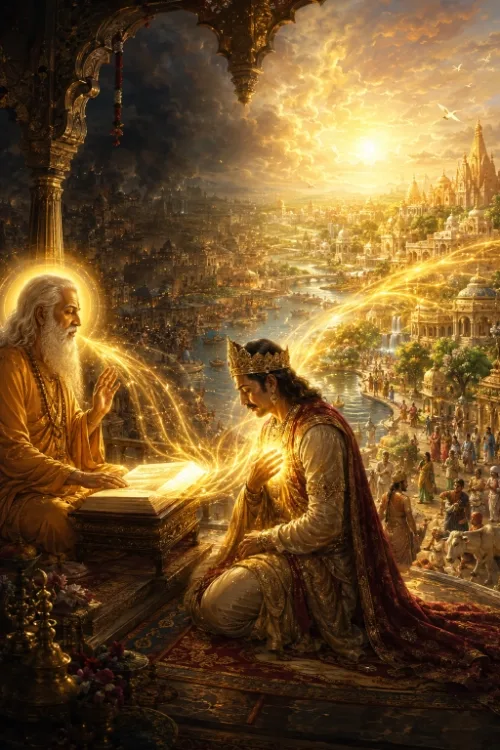
The Power of Sacred Speech and Prabhupāda’s Vision of a Revolution in Consciousness
Changing a government is easier than changing the consciousness that governs it. A society may replace its rulers, laws, or economic system and still reproduce the same greed, envy, and hunger for power. Institutions matter, but external reform alone cannot purify the human heart.
Vedic thought goes further: a ruler’s character is not merely private—it radiates throughout the kingdom. Through personal example, public decisions, and subtler spiritual influence, the leader’s qualities help shape society’s consciousness. A ruler established in truthfulness, self-restraint, compassion, and devotion does more than govern efficiently; such a ruler helps align the entire realm with dharma.
The story’s deepest concern, then, is not which political system is best, but what kind of consciousness occupies its center. When authority becomes service, and the leader lives under a higher divine order, that elevation spreads outward, transforming both public life and the people themselves.
From the perspective of the Śrīmad-Bhāgavatam, this is because the deepest social problems are generated before they become political problems. They begin in consciousness.
That principle lies behind a striking statement by A. C. Bhaktivedanta Swami Prabhupāda in his purport to Śrīmad-Bhāgavatam 1.5.11: “If there is a change of heart of the leaders only, certainly there will be a radical change in the atmosphere of the world.”
This sentence is not itself a translation of the Sanskrit verse. It is Prabhupāda’s social application of a much broader claim made by Nārada to Vyāsadeva: spiritually potent speech can produce a janatāgha-viplava—an upheaval in the sinful or destructive condition of society.
The Sanskrit does not specifically mention presidents, kings, ministers, or corporate leaders. Instead, it gives the underlying principle: words centered upon Bhagavān can transform collective consciousness.
Prabhupāda then joins that principle with another explicit teaching of the Bhagavad-gītā: people follow the standards established by influential persons. Put the two together and the reasoning becomes powerful: transform the consciousness that shapes society, especially in those whose behavior becomes a public standard, and the atmosphere of society itself can begin to change.
The Original Verse: A Revolution Through Speech
तद्वाग्विसर्गो जनताघविप्लवो
यस्मिन् प्रतिश्लोकमबद्धवत्यपि ।
नामान्यनन्तस्य यशोऽङ्कितानि यत्
शृण्वन्ति गायन्ति गृणन्ति साधवः ॥
tad-vāg-visargo janatāgha-viplavo
yasmin prati-ślokam abaddhavaty api
nāmāny anantasya yaśo ’ṅkitāni yat
śṛṇvanti gāyanti gṛṇanti sādhavaḥ
“That creation of speech in which the names and glories of the Unlimited Lord are inscribed produces an upheaval in the sinful condition of people in general. Even if every verse is not perfectly composed, sādhus hear it, sing it, and receive it.”
Śrīmad-Bhāgavatam 1.5.11
Prabhupāda translates the central expression much more dramatically: such literature can bring about “a revolution in the impious lives of this world’s misdirected civilization.”
The Sanskrit supports the force of that language. The key word is: viplava.
Janatāgha-viplava : What Kind of Revolution?
The compound can be broken down: janatā — the people collectively, the population; agha — sin, wrongdoing, harmful karmic condition, moral corruption; viplava — upheaval, overturning, disruption, destruction, radical disturbance.
Thus: janatā-agha-viplavaḥ means approximately: “that which overturns the sinful condition of society.” This is not primarily a call for: violent revolution, regime change, class conflict, or political insurrection.
The revolution begins deeper. It is a revolution in: desire, values, identity, speech, conduct, and ultimately the way human beings understand what life is for. Politics may change as a consequence.
But politics is not the starting point.
Nārada Is Speaking to Vyāsa
The immediate context is essential. Nārada is speaking to Vyāsadeva. Vyāsa has already accomplished what would seem like an impossible intellectual achievement. He has organized Vedic revelation.
He has discussed: dharma, ritual, social responsibility, philosophy, renunciation, history, and liberation. Yet he remains dissatisfied. Nārada explains why.
Knowledge Can Be Vast and Still Incomplete
भवतानुदितप्रायं
यशो भगवतोऽमलम् ।
येनैवासौ न तुष्येत
मन्ये तद्दर्शनं खिलम् ॥
bhavatānudita-prāyaṁ
yaśo bhagavato ’malam
yenaivāsau na tuṣyeta
manye tad darśanaṁ khilam
“You have not sufficiently and directly proclaimed the spotless glories of Bhagavān. I consider a presentation that does not satisfy Him to be incomplete.”
Śrīmad-Bhāgavatam 1.5.8
The important word is: khilam something incomplete, deficient, or not brought to full fruition. Nārada is not telling Vyāsa: “You need more information.” Vyāsa already possesses extraordinary knowledge.
The criticism is: the knowledge has not yet been brought clearly enough to its devotional center.
Beautiful Writing Is Not Automatically Transformative
Nārada then gives one of the Bhāgavata’s most famous judgments on literature.
न यद्वचश्चित्रपदं हरेर्यशो
जगत्पवित्रं प्रगृणीत कर्हिचित् ।
तद्वायसं तीर्थमुशन्ति मानसा
न यत्र हंसा निरमन्त्युशिक्क्षयाः ॥
na yad vacaś citra-padaṁ harer yaśo
jagat-pavitraṁ pragṛṇīta karhicit
tad vāyasaṁ tīrtham uśanti mānasā
na yatra haṁsā niramanty uśik-kṣayāḥ
“Words may be beautifully composed, but if they do not proclaim the glories of Hari that purify the world, spiritually discerning persons regard them like a place for crows rather than a place where swans delight.”
Śrīmad-Bhāgavatam 1.5.10
The phrase: citra-padam suggests beautifully arranged, striking, ornate language. Nārada’s point is deliberately uncomfortable: literary beauty does not automatically equal spiritual value.
One can write magnificently and still leave the reader spiritually unchanged.
Then Comes the Opposite Case
Verse 1.5.11 reverses the situation. Even if the language is not perfect— prati-ślokam abaddhavaty api “even if verse by verse it is imperfectly constructed”—
if it genuinely contains the names and glories of Ananta, sincere sādhus will:
- śṛṇvanti — hear it;
- gāyanti — sing or recite it;
- gṛṇanti — accept, repeat, praise, or receive it.
The hierarchy is therefore: truth before ornament. Not: sloppiness instead of scholarship. This distinction matters.
The Verse Does Not Praise Inaccuracy
ŚB 1.5.11 should never be used to justify: poor research, false citations, careless Sanskrit, fabricated quotations, or theological error. The contrast is more precise. A text may be: grammatically elegant, stylistically brilliant, rhetorically sophisticated, and spiritually empty.
Another may lack literary refinement yet possess profound spiritual substance. The Bhāgavata prefers the second. Ideally, of course, a serious spiritual writer should strive for both: accuracy and depth, clarity and beauty, scholarship and realization.
The verse simply establishes which is fundamental.
Vāg-visarga : Words Create Worlds
Another important expression is: tad-vāg-visargaḥ vāk — speech, word, language; visarga — creation, emission, projection. The phrase can mean something like: “that creation through speech.”
This is a remarkably powerful concept. Words do not merely describe society. They help create the mental world in which society lives. Stories teach people: what success looks like, what deserves admiration, what kind of person is heroic, what sacrifices are worthwhile, what is shameful, what is normal, what happiness means.
Speech therefore has civilizational power.
Literature Can Normalize Destruction
Words can make greed respectable. They can glamorize violence. They can eroticize everything. They can teach people to measure themselves primarily by: wealth, appearance, status, consumption, or influence.
Media can turn envy into aspiration. Advertising can transform manufactured desire into perceived necessity. Politics can make hostility virtuous. Entertainment can make degradation amusing.
The Bhāgavata therefore treats speech seriously. What people repeatedly hear becomes part of the atmosphere of their consciousness.
But Speech Can Also Reverse the Process
That is the positive side of: janatāgha-viplavaḥ. Speech can also awaken: restraint, gratitude, compassion, self-knowledge, responsibility, remembrance of Bhagavān, and recognition that life has a purpose beyond consumption.
Thus the Bhāgavata proposes something radical: change the stream of consciousness entering society, and the society itself can begin to change.
The Final Line Describes How Transformation Spreads
The verse says: śṛṇvanti gāyanti gṛṇanti sādhavaḥ They: hear, then repeat, then receive and praise. This is a transmission cycle. The message moves: speaker → listener → heart → speech → new listener.
A sacred text is therefore not socially transformative merely because it exists on a shelf. Its power becomes active through: hearing, reflection, internalization, practice, and transmission.
The Next Verse Goes Even Further
Nārada immediately says:
नैष्कर्म्यमप्यच्युतभाववर्जितं
न शोभते ज्ञानमलं निरञ्जनम् ।
कुतः पुनः शश्वदभद्रमीश्वरे
न चार्पितं कर्म यदप्यकारणम् ॥
naiṣkarmyam apy acyuta-bhāva-varjitaṁ
na śobhate jñānam alaṁ nirañjanam
kutaḥ punaḥ śaśvad abhadram īśvare
na cārpitaṁ karma yad apy akāraṇam
“Even pure knowledge free from material action does not appear beautiful when devoid of loving orientation toward Acyuta. What then can be said of ordinary action that is not offered to the Lord?”
Śrīmad-Bhāgavatam 1.5.12
This raises the standard enormously. Nārada is not merely contrasting: bad literature with moral literature. He says that even: pure knowledge and renunciation remain incomplete without: acyuta-bhāva devotional orientation toward Acyuta, the infallible Lord.
That is why Prabhupāda does not believe society’s deepest problems can be solved merely through better administration. The crisis is ultimately one of consciousness.
Where Do “The Leaders” Come From?
The Sanskrit of ŚB 1.5.11 does not explicitly mention leaders. That part belongs to Prabhupāda’s purport. His reasoning is essentially:
- Śrīmad-Bhāgavatam can transform consciousness.
- Society needs transformation.
- Certain people exert enormous influence over what society values.
- If those people undergo genuine transformation, the effect spreads.
This principle is stated explicitly by Kṛṣṇa in the Bhagavad-gītā.
यद्यदाचरति श्रेष्ठस्
तत्तदेवेतरो जनः ।
स यत्प्रमाणं कुरुते
लोकस्तदनुवर्तते ॥
yad yad ācarati śreṣṭhas
tat tad evetaro janaḥ
sa yat pramāṇaṁ kurute
lokas tad anuvartate
“Whatever a prominent person does, ordinary people tend to follow. Whatever standard such a person establishes, the world follows that standard.”
Bhagavad-gītā 3.21: People Follow the Prominent
This verse supplies the clearest scriptural basis for Prabhupāda’s social reasoning.
Śreṣṭha : More Than a Politician
The Sanskrit says: śreṣṭhaḥ a prominent, eminent, leading, or socially authoritative person. That category is much broader than government. A śreṣṭha may be: a ruler, teacher, religious leader, business executive, intellectual, scientist, celebrity, artist, journalist, parent, or cultural figure.
Anyone whose conduct is imitated becomes a kind of leader.
Leaders Create Norms Before They Create Laws
The important word in Bhagavad-gītā 3.21 is: pramāṇam here meaning a standard or authoritative example. Leadership therefore works through more than legislation.
Leaders teach society:
- what deserves respect,
- what constitutes success,
- what lifestyle is admirable,
- what behavior is normal,
- what ambition is legitimate.
A ruler may change laws. But a cultural leader may change what millions of people want. That can be even more powerful.
Example Is More Powerful Than Instruction
The Caitanya-caritāmṛta states the principle explicitly.
আপনে না কৈলে ধর্ম শিখান না যায় ।
এই ত’ সিদ্ধান্ত গীতা-ভাগবতে গায় ॥
āpane nā kaile dharma śikhāna nā yāya
ei ta’ siddhānta gītā-bhāgavate gāya
“Unless one practices dharma oneself, one cannot effectively teach it to others. This conclusion is proclaimed in the Gītā and the Bhāgavata.”
Caitanya-caritāmṛta, Ādi 3.21
This is crucial. A leader teaches with: behavior, habits, priorities, and character. Not only with speeches.
A Hypocritical Leader Teaches Hypocrisy
A leader may verbally praise honesty. But if he succeeds through dishonesty, the real lesson becomes: dishonesty works. A leader may praise restraint. But if he openly glorifies excess, excess becomes prestigious.
A religious teacher may speak about humility. But if he cultivates personal adoration, the community learns ambition. People are often more influenced by embodied standards than by official doctrine.
That is why leadership carries such enormous spiritual responsibility.
The Bhāgavata Holds Rulers Responsible
The account of King Pṛthu makes this unusually explicit.
य उद्धरेत्करं राजा
प्रजा धर्मेष्वशिक्षयन् ।
प्रजानां शमलं भुङ्क्ते
भगं च स्वं जहाति सः ॥
ya uddharet karaṁ rājā
prajā dharmeṣv aśikṣayan
prajānāṁ śamalaṁ bhuṅkte
bhagaṁ ca svaṁ jahāti saḥ
“A king who collects taxes from the citizens but fails to educate them in dharma becomes implicated in their wrongdoing and loses his own good fortune.”
Śrīmad-Bhāgavatam 4.21.24
This is a remarkable political theology. Power does not merely provide privilege. Power generates responsibility.
Leadership Is Responsible for the Moral Environment It Helps Create
A ruler cannot reasonably: shape institutions, collect public resources, control education, set incentives, normalize behavior, and then claim no responsibility for the moral environment generated by those systems.
That is the principle behind the Pṛthu passage. Its ancient political form may differ from modern states, but the ethical insight remains powerful: authority increases accountability.
The Positive Model of Leadership
Pṛthu continues:
तत् प्रजा भर्तृपिण्डार्थं
स्वार्थमेवानसूयवः ।
कुरुताधोक्षजधियस्
तर्हि मेऽनुग्रहः कृतः ॥
tat prajā bhartṛ-piṇḍārthaṁ
svārtham evānasūyavaḥ
kurutādhokṣaja-dhiyas
tarhi me ’nugrahaḥ kṛtaḥ
“Therefore, O citizens, perform your responsibilities while keeping your consciousness directed toward Adhokṣaja, the Supreme Lord. In doing so you will achieve your real welfare and also benefit your ruler.”
Śrīmad-Bhāgavatam 4.21.25
The ideal ruler does not merely want productive citizens. He wants citizens capable of pursuing their highest welfare.
What Does “Change of Heart” Actually Mean?
Prabhupāda’s phrase can sound vague if left unexplained.
A genuine change of heart is not merely:
- becoming sentimental,
- speaking religious language,
- or publicly identifying with a tradition.
It means the center of motivation changes. From: “How can I possess?” toward: “How can I serve?” From: exploitation toward stewardship. From: greed toward restraint. From: ego-centered power toward responsibility.
From: seeing others as instruments toward recognizing them as persons with spiritual value. From: independent proprietorship toward accountability before Bhagavān. That kind of change cannot remain purely private if the person possesses social power.
Consciousness Eventually Becomes Policy
A politician driven by greed makes different decisions from one genuinely committed to responsibility. A business leader who views workers merely as production inputs behaves differently from one who sees them as human beings with moral worth.
A teacher interested mainly in career advancement creates a different classroom from one who sees education as service. A religious leader seeking personal prestige creates a different institution from one seeking the spiritual growth of others.
Inner orientation eventually becomes outer structure. That is why a change of heart matters socially.
What Is the “Atmosphere of the World”?
Prabhupāda’s use of atmosphere is important. He does not mean climate. He means the moral and psychological environment people inhabit. An atmosphere consists of: what is admired, what is mocked, what is rewarded, what is hidden, what is normalized, what children are taught, what adults aspire to, what media repeats, what institutions incentivize.
No single law creates this atmosphere. It arises from millions of repeated signals. Leaders have unusual influence because their signals are amplified.
Leaders Are Multipliers
If one individual changes deeply, the immediate effect may reach: family, friends, colleagues. If a widely influential person changes deeply, the effect can reach: thousands, millions, institutions, or generations.
That is why Prabhupāda focuses strategically on leaders. They are multipliers of example.
But the Bhāgavata Is Not Elitist
This must also be emphasized. The original verse says: janatā the people collectively. The transformation is not reserved for rulers. Nor did Prabhupāda’s strategy consist merely of converting elites.
His movement emphasized broad dissemination through: books, public kīrtana, prasāda, temples, teaching, and personal association. The model works in both directions: people influence leaders and leaders influence people.
Society and Leadership Form a Feedback Loop
A society often produces leaders who embody its own aspirations. If a culture worships: wealth, domination, celebrity, and sensuality, then leaders who excel in those things become attractive.
Those leaders then reinforce the same values. The loop becomes: public desire → leader → public imitation → stronger public desire. Changing either side can weaken the cycle.
Changing both can transform it.
This Is Why Literature Matters Politically Without Being Political Propaganda
ŚB 1.5.11 is a verse about speech and literature, not legislation. Why? Because long before people vote, legislate, buy, marry, fight, or govern, they possess an image of: what life means.
Literature helps create that image. Narrative shapes imagination. Imagination shapes desire. Desire shapes behavior. Behavior shapes institutions. Thus cultural transformation can precede political transformation.
Sacred Literature Competes for the Human Imagination
Every civilization tells stories. Those stories answer questions such as: Who is admirable? What should I want? What makes life meaningful? What is worth dying for? What is worth sacrificing?
Who am I? If these questions are answered primarily through: consumerism, nationalism, sexual identity, prestige, power, or accumulation, the corresponding civilization develops around them.
The Bhāgavata offers a different center: Bhagavān and the soul’s relationship with Him. That is why Nārada thinks literature can create a viplava.
The Deepest Revolution Is a Change in What People Desire
Laws can restrain behavior. Institutions can reward certain actions. But desire remains powerful. A society of greedy people with perfect anti-corruption laws will continually search for new forms of corruption.
A society obsessed with consumption will find new things to consume. A society driven by ego will turn even spiritual institutions into arenas for prestige. Thus the Bhāgavata aims deeper: transform desire itself.
From Agha to Bhakti
The process implied by 1.5.11 can be represented as:
This is a revolution from the inside outward.
Why Bhakti Is Central Rather Than Generic Morality
One might ask: Why not simply teach people to be ethical? Nārada answers indirectly in verse 1.5.12. Even pure knowledge without: acyuta-bhāva loving orientation toward Acyuta is considered incomplete.
The Bhāgavata does not deny moral improvement. It asks what ultimately grounds it. For Vaiṣṇava theology, the deepest transformation occurs when the individual no longer sees himself as: independent proprietor, ultimate enjoyer, or autonomous center.
Instead: Bhagavān becomes the center.
This Changes the Meaning of Leadership
Ordinary leadership asks: “How can I make people follow me?” Bhāgavata leadership should ask: “How can my position serve their genuine welfare?” Ordinary power wants loyalty.
Spiritualized power accepts responsibility. Ordinary leadership often converts people into instruments. Bhāgavata leadership should understand power as service entrusted temporarily to the leader.
That is a radical difference.
Prabhupāda’s Publishing Mission Fits Directly Into This Theology
Prabhupāda repeatedly used ŚB 1.5.11 to explain why he placed such extraordinary importance on publishing and distributing spiritual literature. His reasoning was essentially Vyāsic: write, translate, print, distribute, hear, discuss, transform.
He knew that books could travel where a preacher could not. A text could enter: homes, universities, libraries, governments, and private lives. Thus printing became part of the spiritual strategy of janatāgha-viplava.
Imperfect Language, Powerful Substance
Prabhupāda also applied: prati-ślokam abaddhavaty api personally. He acknowledged that his English was not always that of a polished literary stylist. But he placed confidence in the subject matter: the names, teachings, and glories of Bhagavān.
That should not be romanticized into: “bad writing is spiritual.” The better lesson is: Spiritual truth does not derive its power from literary vanity. Language is the vehicle.
Truth is the substance.
The Ideal Is Truth Beautifully Presented
There is no conflict between devotion and quality. A strong Vaiṣṇava presentation should strive to be: textually accurate, linguistically clear, intellectually coherent, beautifully written, honest about evidence, and spiritually substantial.
ŚB 1.5.11 tells us only that if a choice must be made between: beautiful emptiness and awkward truth, truth remains more valuable.
What This “Revolution” Is Not
It is not necessarily: a Vaiṣṇava political party, a theocratic state, forced conversion, censorship, violence, or seizure of institutions. None of that follows from the Sanskrit term viplava in this context.
The revolutionary instrument in the verse is: vāk speech. Its method is: śravaṇa and kīrtana hearing and speaking. Its battlefield is: consciousness.
Why This May Be More Radical Than Political Revolution
Political revolutions replace: leaders, laws, constitutions, or economic structures. But history repeatedly shows that new structures can reproduce: greed, corruption, violence, vanity, and exploitation when the consciousness operating them remains unchanged.
The Bhāgavata’s proposal is more demanding: change the person who uses the system. Then systems may change differently.
Prabhupāda’s Quote in Its Full Meaning
We can now understand: “If there is a change of heart of the leaders only, certainly there will be a radical change in the atmosphere of the world.” It does not mean: one saintly president instantly solves every social problem.
It means: leadership has disproportionate normative power. If those who define public standards genuinely change their understanding of: success, ownership, pleasure, responsibility, human dignity, and Bhagavān, the effects will not remain private.
They will spread through: example, institutions, culture, and public expectations.
Śrīmad-Bhāgavatam 4.21.24
Those who wield authority carry responsibility for the moral condition they help create. Taken together:
- transformative truth
- transforms people
- transformed leaders embody new standards
- society imitates those standards
- the atmosphere changes.
But the Transformation Must Be Real
This is the crucial safeguard. A politician publicly quoting scripture while remaining: corrupt, greedy, violent, dishonest, or intoxicated with power has not undergone the transformation Prabhupāda is describing.
The same applies to: religious leaders, teachers, business people, or anyone else. A change of vocabulary is not a change of heart. The test is: conduct.
The Real Question for Leaders
The Bhāgavata therefore asks leaders something far more demanding than: “Are you religious?” It asks: What do you consider valuable? Why do you want power? Whom does your position serve?
What standards does your life establish? What behavior becomes normal because people imitate you? Do your decisions increase: greed, fear, division, and exploitation? Or: responsibility, truthfulness, restraint, compassion, and spiritual understanding?
That is leadership as a theological responsibility.
The Same Question Applies to Everyone
Because almost everyone leads someone. Parents lead children. Teachers lead students. Managers lead employees. Older siblings lead younger siblings. Writers lead readers.
Creators lead audiences. Religious practitioners influence newcomers. Thus Bhagavad-gītā 3.21 eventually becomes personal. The question is not merely: “What should the president do?”
It is: “What am I teaching by example?”
The Revolution Begins Before Society Notices
A genuine transformation may begin invisibly. A person hears. Something changes. A desire weakens. A value shifts. A habit changes. Then relationships change. Then decisions change.
Eventually institutions feel the effect. By the time society sees the “revolution,” its deepest cause may already have been developing quietly in consciousness. That is the logic of Nārada’s vāg-visarga.
Prabhupāda’s statement about leaders belongs to a much larger Bhāgavata vision. The world’s atmosphere is not created only by: laws, markets, technology, or governments. It is created by human consciousness operating through them.
And consciousness is shaped by: what people hear, what they admire, what they imitate, and what they believe life is for. That is why Nārada assigns astonishing power to spiritually truthful speech: tad-vāg-visargo janatāgha-viplavaḥ “That creation of speech produces an upheaval in the destructive condition of society.”
And that is why Prabhupāda turns immediately toward leadership. People imitate the prominent. Prominent people establish norms. Norms create atmosphere. Therefore a genuine transformation in those who define public standards can radiate far beyond their private spiritual lives.
But the real revolution is not: put religious labels on the old consciousness. It is: change the consciousness itself. From exploitation to service. From greed to responsibility.
From ego to accountability. From self-centeredness to Bhagavān-centeredness. Then social change becomes not merely imposed but expressed. The shortest form of the whole teaching is:
- Change what people hear, and you can change what they value.
- Change what leaders value, and you can change what society imitates.
- Change what society imitates, and the atmosphere of the world begins to change.
That is the deeper meaning behind Prabhupāda’s striking statement: “If there is a change of heart of the leaders only, certainly there will be a radical change in the atmosphere of the world.”