

Asita Devala: The Sage Who Carried the Mahābhārata
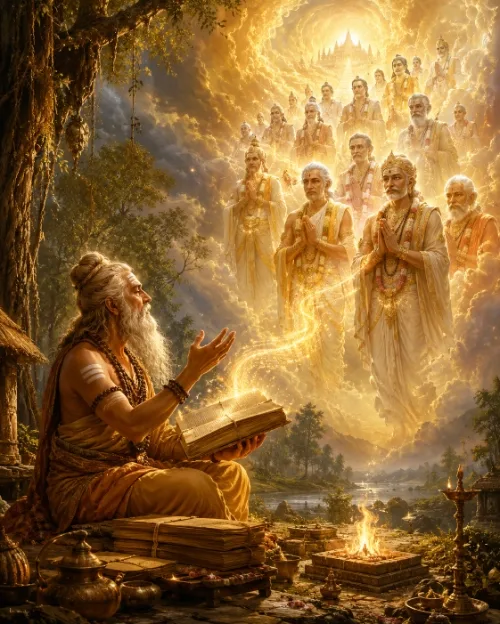
Who was Asita Devala, what does “1,500,000 verses” really mean, and why does the Mahābhārata place its own history across human and celestial worlds?
Among the sages gathered around Bhīṣma at the end of his life, the Śrīmad-Bhāgavatam quietly names Asita. A. C. Bhaktivedanta Swami Prabhupāda identifies him in his purport as Asita Devala Ṛṣi, describing him as a powerful ancient sage and adding an astonishing detail: “He explained to his father 1,500,000 verses from the Mahābhārata.”
The statement points toward a fascinating ancient tradition—but the Sanskrit behind it requires an important correction. The Mahābhārata does indeed associate 1,500,000 verses with a realm connected to the ancestors. It also says that Asita-Devala transmitted the Mahābhārata to the Pitṛs.
But the Sanskrit does not say that he explained those verses “to his father.” It says: pitṝn — “the Pitṛs,” the ancestral beings, plural. That small grammatical correction opens an extraordinary window into the way the Mahābhārata understands itself: not merely as a gigantic earthly epic, but as a cosmic body of sacred knowledge transmitted in different forms among gods, ancestors, Gandharvas, and human beings.
And Asita-Devala stands inside that tradition as one of its great transmitters.
Asita at Bhīṣma’s Deathbed
The immediate source is Śrīmad-Bhāgavatam 1.9. The Kurukṣetra war is over. Bhīṣma lies upon his bed of arrows, waiting for the auspicious moment to leave his body. Yudhiṣṭhira approaches him together with the Pāṇḍavas and Kṛṣṇa.
An extraordinary gathering of sages arrives.
पर्वतो नारदो धौम्यो
भगवान् बादरायणः ।
बृहदश्वो भरद्वाजः
सशिष्यो रेणुकासुतः ॥
वसिष्ठ इन्द्रप्रमदस्
त्रितो गृत्समदोऽसितः ।
कक्षीवान् गौतमोऽत्रिश्च
कौशिकोऽथ सुदर्शनः ॥
parvato nārado dhaumyo
bhagavān bādarāyaṇaḥ
bṛhadaśvo bharadvājaḥ
saśiṣyo reṇukā-sutaḥ
vasiṣṭha indrapramadas
trito gṛtsamado ’sitaḥ
kakṣīvān gautamo ’triś ca
kauśiko ’tha sudarśanaḥ
“There were present Parvata, Nārada, Dhaumya, the venerable Bādarāyaṇa Vyāsa, Bṛhadaśva, Bharadvāja, Paraśurāma together with his disciples, Vasiṣṭha, Indrapramada, Trita, Gṛtsamada, Asita, Kakṣīvān, Gautama, Atri, Kauśika and Sudarśana.”
Śrīmad-Bhāgavatam 1.9.6–7
The Sanskrit itself says simply: asitaḥ — “Asita.” It does not say Asita Devala here. The commentarial tradition provides the more specific identification. That distinction will become important.
A Gathering of Extraordinary Authority
Look at the company in which Asita appears: Nārada, Vyāsa, Vasiṣṭha, Bharadvāja, Atri, Gautama, Paraśurāma and other celebrated ṛṣis. This is not an incidental list of obscure ascetics.
The scene portrays Bhīṣma’s departure as an event so important that some of the greatest spiritual authorities in the sacred world assemble to witness it. To be named among them already tells us something about Asita’s traditional stature.
But Was Asita the Same Person as Devala?
Here the sources become complicated. Modern readers understandably want a simple biography: Asita Devala was one man; these were his parents; these were his activities. The Sanskrit tradition is not so cooperative.
Sometimes Asita and Devala appear as separate sages. Elsewhere we encounter Asita-Devala as a combined designation. And elsewhere Devala is remembered as belonging to Asita’s lineage or as Asita’s son.
The safest conclusion is therefore: The ancient traditions surrounding Asita and Devala overlap, and not every textual occurrence should automatically be forced into the biography of one historical individual.
Bhagavad-gītā Clearly Separates Asita and Devala
One of the strongest pieces of evidence comes from the Bhagavad-gītā. Arjuna has just acknowledged Kṛṣṇa as the Supreme Reality.
परं ब्रह्म परं धाम
पवित्रं परमं भवान् ।
पुरुषं शाश्वतं दिव्यम्
आदिदेवमजं विभुम् ॥
आहुस्त्वामृषयः सर्वे
देवर्षिर्नारदस्तथा ।
असितो देवलो व्यासः
स्वयं चैव ब्रवीषि मे ॥
paraṁ brahma paraṁ dhāma
pavitraṁ paramaṁ bhavān
puruṣaṁ śāśvataṁ divyam
ādi-devam ajaṁ vibhum
āhus tvām ṛṣayaḥ sarve
devarṣir nāradas tathā
asito devalo vyāsaḥ
svayaṁ caiva bravīṣi me
“You are the Supreme Brahman, the supreme abode and the supreme purifier. You are the eternal divine Person, the primal Lord, unborn and all-pervading. All the sages declare this of You, as does the divine sage Nārada; Asita, Devala and Vyāsa also declare it, and now You Yourself tell me the same.”
Bhagavad-gītā 10.12–13
Grammatically the list is unmistakable:
- Asitaḥ
- Devalaḥ
- Vyāsaḥ
They are separate names. So at least here, Asita and Devala are distinct authorities.
That Verse Shows How Highly They Were Regarded
This is perhaps more important than the identity puzzle itself. Arjuna is trying to establish that his understanding of Kṛṣṇa is not merely personal enthusiasm. He appeals to authoritative sages: Nārada, Asita, Devala, Vyāsa.
That places Asita and Devala in an extraordinary theological category. They are cited as recognized authorities concerning the identity of Bhagavān. Whatever uncertainties remain about individual biographies, their scriptural prestige is clear.
The Mahābhārata Also Knows Asita and Devala Separately
The epic likewise contains passages where both appear independently. At Janamejaya’s sarpa-satra, the famous snake sacrifice, a large assembly of learned sages gathers. Both Asita and Devala occur among the names of the ṛṣis associated with that event.
This is especially interesting because Prabhupāda’s Bhāgavata purport also connects Asita with Janamejaya’s sacrifice. Again the evidence suggests: Asita and Devala can certainly function as distinct personalities in the epic tradition.
But Devala Is Also Connected Genealogically With Asita
Other Mahābhārata traditions remember Devala as a descendant or son of Asita. That provides a possible explanation for expressions such as: Asita-Devala which may function like a lineage designation.
Ancient Sanskrit names often operate differently from modern surnames. A person can be identified through: father, teacher, gotra, ancestral sage, birthplace, or lineage.
Thus a compound designation need not always mean that two familiar names represent one and the same independent personal name.
More Than One Devala May Be Preserved in the Tradition
Another complication is that Devala is not necessarily unique. Ancient literature sometimes preserves several figures bearing the same name across different lineages and periods.
The same is true of many ṛṣi names. This is one reason it is hazardous to take every occurrence of “Devala” across the Mahābhārata, Purāṇas, and later literature and construct one seamless modern biography.
Traditional sacred history often preserves lineages of names as well as individuals.
Now the Astonishing Claim: 1,500,000 Verses
The statement that Asita-Devala transmitted 1,500,000 verses belongs to a much larger Mahābhārata tradition. Certain received recensions describe a colossal Mahābhārata containing: 6,000,000 verses in total.
These are distributed across several realms. The tradition gives approximately:
- 3,000,000 verses among the devas
- 1,500,000 among the Pitṛs
- 1,400,000 among Gandharvas and related celestial beings
- 100,000 among human beings.
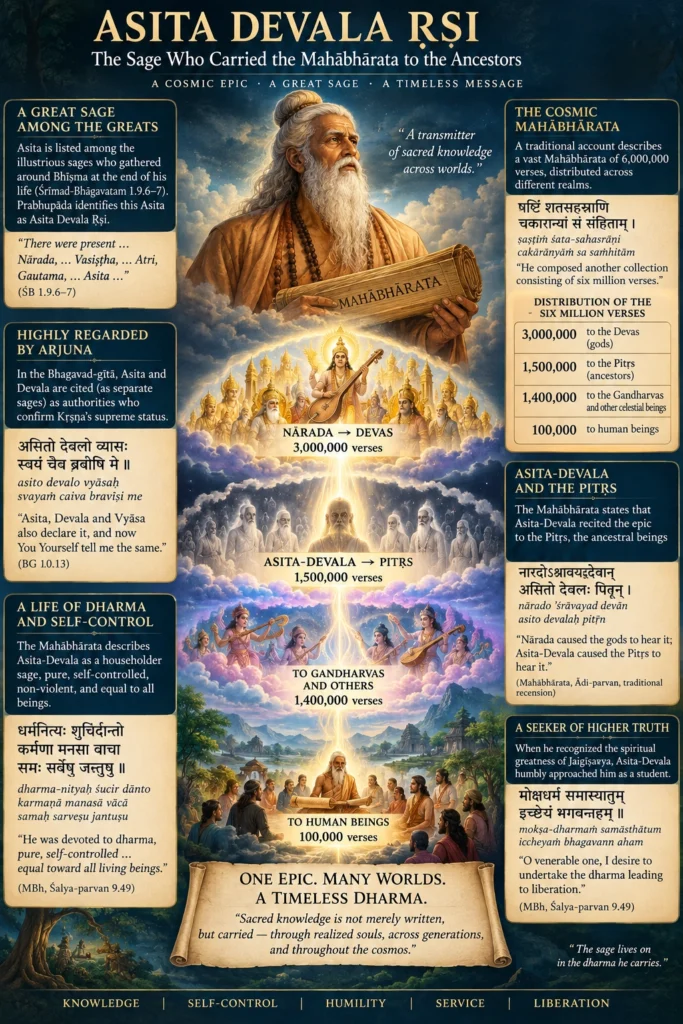
A single sheet on Asita Devala Ṛṣi — the sages who gathered around Bhīṣma, the Gītā verse naming Asita and Devala, and how the six-million-verse Mahābhārata is distributed among devas, Pitṛs, Gandharvas and human beings.
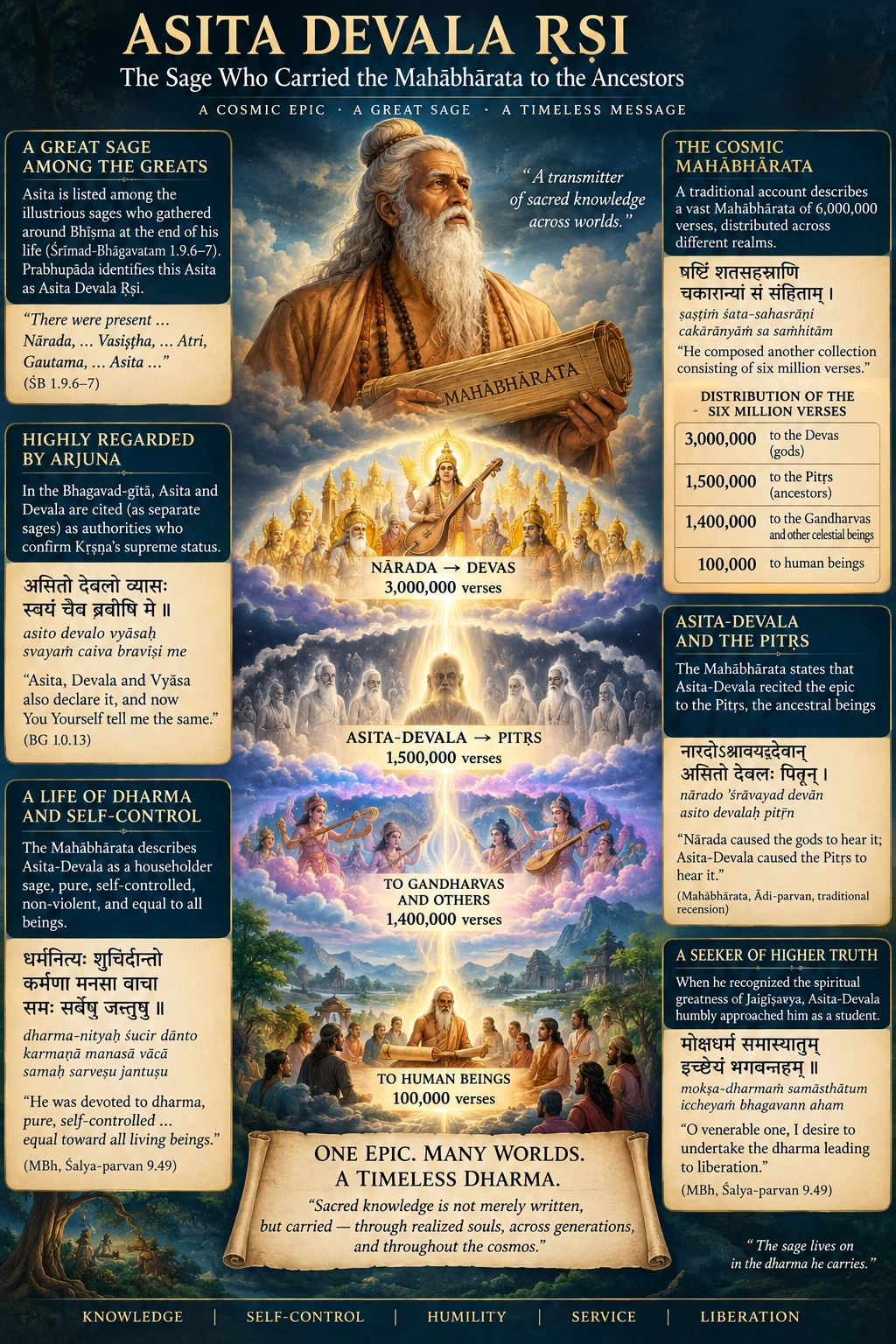
The familiar human Mahābhārata therefore represents only a fraction of the cosmic Bhārata imagined by this tradition.
The Sanskrit Behind the Six-Million-Verses Tradition
One received version states:
षष्टिं शतसहस्राणि
चकारान्यां स संहिताम् ।
ṣaṣṭiṁ śata-sahasrāṇi
cakārānyāṁ sa saṁhitām
“He composed another collection consisting of sixty hundred-thousands”—that is, six million verses.
The distribution then continues:
त्रिंशच्छतसहस्रं च
देवलोके प्रतिष्ठितम् ।
पित्र्ये पञ्चदश प्रोक्तं
गन्धर्वेषु चतुर्दश ॥
triṁśac-chata-sahasraṁ ca
devaloke pratiṣṭhitam
pitrye pañcadaśa proktaṁ
gandharveṣu caturdaśa
“Thirty hundred-thousands [three million] were established in the realm of the gods; fifteen hundred-thousands [1.5 million] were spoken of in the ancestral realm, and fourteen hundred-thousands [1.4 million] among the Gandharvas.”
And:
एकं शतसहस्रं तु
मानुषेषु प्रतिष्ठितम् ॥
ekaṁ śata-sahasraṁ tu
mānuṣeṣu pratiṣṭhitam
“One hundred thousand, however, was established among human beings.”
This is where the 1,500,000 figure comes from.
The Crucial Verse About Asita-Devala
The Mahābhārata then identifies transmitters associated with the different audiences. The crucial Sanskrit says:
नारदोऽश्रावयद्देवान्
असितो देवलः पितॄन् ।
nārado ’śrāvayad devān
asito devalaḥ pitṝn
“Nārada caused the gods to hear it; Asita-Devala caused the Pitṛs to hear it.”
This is the line that changes everything. The word is: pitṝn not: “father.”
Pitṝn Means “the Ancestors”
The noun is: pitṛ which can mean: father, ancestor, forefather. But the form in the verse is: pitṝn the accusative plural. Therefore the meaning here is: “the fathers” in the traditional religious sense: the Pitṛs, the ancestral beings.
It cannot grammatically mean: “his father.” For that, the sentence would require a singular form and a different construction.
So the Purport Requires a Small but Important Correction
Prabhupāda’s purport says: “He explained to his father 1,500,000 verses from the Mahābhārata.” The underlying epic tradition is better expressed as: “Asita-Devala transmitted the Mahābhārata to the Pitṛs, and a related received tradition assigns 1,500,000 verses of the Mahābhārata to the ancestral realm, Pitṛloka.”
This is much more faithful to the Sanskrit. And it is actually much more interesting. Instead of a private conversation between a sage and his father, we have a cosmic transmission of the Mahābhārata to the ancestral world.
Who Are the Pitṛs?
The Sanskrit word: pitṛ literally relates to fathers or ancestors. But Vedic and Purāṇic cosmology treats the Pitṛs as more than merely one’s recently deceased human relatives.
They form classes of ancestral beings connected with: ancestral rites, continuity of lineage, post-mortem existence, and the cosmic order governing relations between descendants and ancestors.
Hence: Pitṛloka means: “the world or realm of the Pitṛs.” The Mahābhārata tradition therefore imagines its sacred history being heard not only on Earth but in the ancestral realm itself.
This Is Part of a Cosmic Transmission Network
The surrounding verses give the larger picture. Vyāsa first teaches the Mahābhārata to Śuka.
इदं द्वैपायनः पूर्वं
पुत्रमध्यापयच्छुकम् ।
ततोऽन्येभ्योऽनुरूपेभ्यः
शिष्येभ्यः प्रददौ प्रभुः ॥
idaṁ dvaipāyanaḥ pūrvaṁ
putram adhyāpayac chukam
tato ’nyebhyo ’nurūpebhyaḥ
śiṣyebhyaḥ pradadau prabhuḥ
“Dvaipāyana first taught this to his son Śuka and afterward entrusted it to other qualified disciples.”
Then different transmitters carry the knowledge toward different audiences. Thus the model is not simply: Vyāsa writes book → people read book. It is:
- Vyāsa
- realized transmitters
- different worlds and audiences.
This is a sacred culture of heard transmission.
Nārada Takes It to the Gods
The first name is significant: Nārada. Nārada is the archetypal wandering divine sage. He moves between worlds. He teaches: gods, kings, sages, demons, children, ascetics, and householders.
So it is entirely fitting that the Mahābhārata imagines: Nārada → devas. He carries sacred knowledge into the divine realms.
Asita-Devala Takes It to the Ancestors
Then: Asita-Devala → Pitṛs. The sage becomes the transmitter of sacred history to the ancestral realm. This is the context behind the famous 1,500,000 verses. His role is therefore not merely that of: “a learned man who knew an enormous book.”
He is placed inside a cosmic system of revelation.
Śuka Is Also a Cosmic Teacher
Śukadeva is likewise assigned audiences beyond ordinary humanity in the traditional transmission scheme. This is fitting because Śuka’s own biography portrays him as radically detached from normal embodied identity.
He is not presented merely as a human literary scholar. He is a spiritually realized transmitter capable of moving within a sacred cosmological framework.
And Humanity Receives Its Own Mahābhārata
The human version is traditionally described as approximately: śata-sāhasrī saṁhitā “the collection of one hundred thousand verses.” This corresponds broadly to the scale of the received Mahābhārata.
Thus the tradition imagines the earthly epic as the human expression of a much larger cosmic body of knowledge.
Does This Mean Five Million Nine Hundred Thousand Verses Were Historically Lost?
Not necessarily. That would be too simplistic. The six-million-verse tradition is first of all a sacred textual claim about the cosmic extension of the Mahābhārata. Modern manuscript scholarship cannot reconstruct five million missing earthly Sanskrit verses.
Nor is that necessarily what the traditional claim intends. The texts say the other versions belong to other realms and audiences. Therefore it would be misleading to write: “The original earthly Mahābhārata had six million verses, but 5.9 million were lost.”
That changes the tradition into something it does not quite say.
A Necessary Textual-Critical Qualification
There is another important detail. The complete numerical scheme of six million verses belongs especially to the received or vulgate Mahābhārata tradition. The Bhandarkar Oriental Research Institute’s Critical Edition, reconstructed through comparison of many manuscripts, does not retain every one of those numerical lines in its main reconstructed text.
However, the transmission tradition involving: Nārada → devas and Asita-Devala → Pitṛs is itself deeply embedded in the Mahābhārata textual tradition. Therefore a rigorous article should distinguish: traditional sacred cosmology from modern manuscript-critical reconstruction.
Neither should simply be concealed.
Tradition and Textual Criticism Ask Different Questions
Traditional sacred history asks: How was this revelation transmitted through the cosmos? Modern textual criticism asks: Which readings can be reconstructed from surviving manuscripts?
These are not identical questions. One works inside the metaphysical worldview of the epic. The other reconstructs textual history from physical evidence. A careful reader can understand the distinction without pretending that one question automatically answers the other.
The Deeper Meaning of the Cosmic Mahābhārata
The theological idea is extraordinary. The Mahābhārata does not present itself merely as: the national epic of an ancient earthly civilization. It presents dharma as something relevant throughout cosmic existence.
The struggles it explores— duty, desire, karma, violence, loyalty, truth, power, renunciation, God, and liberation— are not treated as temporary cultural curiosities. They are part of the structure of conscious existence.
That is why the epic can imagine different orders of beings hearing different forms of the same sacred history.
Sacred Knowledge Is Larger Than Human Access
There is also an epistemological lesson. Humans receive: 100,000 verses. Other realms receive more. The symbolic implication is: human knowledge is partial. The fact that human beings possess one recension does not mean all truth has been compressed into what is presently accessible to them.
This is consistent with the wider Purāṇic worldview, in which human perception represents only one narrow layer of a much larger cosmos.
Asita-Devala as a Sage of Dharma
The Mahābhārata preserves another important portrait of Asita-Devala. In the Śalya-parvan, he is described as an exemplary sage.
Mahābhārata, Śalya-parvan
गार्हस्थ्यं धर्ममास्थाय
असितो देवलः पुरा ॥
gārhasthyaṁ dharmam āsthāya
asito devalaḥ purā
“In former times Asita-Devala lived established in the dharma of household life.”
This itself is significant. He is not initially presented as someone who believed spirituality required abandoning all ordinary social responsibility. He practices gārhasthya-dharma.
Self-Control Was His Real Power
The text continues:
धर्मनित्यः शुचिर्दान्तो
न्यस्तदण्डो महातपाः ।
कर्मणा मनसा वाचा
समः सर्वेषु जन्तुषु ॥
dharma-nityaḥ śucir dānto
nyasta-daṇḍo mahā-tapāḥ
karmaṇā manasā vācā
samaḥ sarveṣu jantuṣu
“He was constantly devoted to dharma, pure, self-controlled, free from violence and a great ascetic; in action, mind, and speech he was equal toward all living beings.”
This gives real substance to the description: “a great, powerful sage.” His greatest power is not initially described as supernatural spectacle. It is: dāntaḥ — self-controlled.
śuciḥ — pure. samaḥ sarveṣu jantuṣu — equal toward all living beings. That is spiritual power directed inward.
Power Over Oneself Comes Before Power Over Others
This is a deeply classical Indian ideal. A person may control: armies, institutions, wealth, or other people and still be a slave to: anger, lust, envy, fear, and pride. The ṛṣi ideal reverses the hierarchy.
The genuinely powerful person is first: master of himself. That is the background against which the extraordinary status of sages such as Asita-Devala should be understood.
His Encounter With Jaigīṣavya
The same Mahābhārata narrative tells a revealing story involving another yogic sage: Jaigīṣavya. Jaigīṣavya stays near Devala’s āśrama. Eventually Devala perceives extraordinary spiritual capacities in him and realizes that Jaigīṣavya has attained a state beyond his own.
A lesser sage might respond with: jealousy, competition, or wounded prestige. Devala responds differently. He approaches him as a student.
The Great Sage Says: Teach Me
The Mahābhārata gives his request:
मोक्षधर्मं समास्थातुम्
इच्छेयं भगवन्नहम् ॥
mokṣa-dharmaṁ samāsthātum
iccheyaṁ bhagavann aham
“O venerable one, I desire to undertake the dharma leading to liberation.”
This may tell us more about his greatness than supernatural powers ever could. He is already: respected, disciplined, learned, and spiritually advanced. But when he recognizes a deeper realization, he says: “Teach me.”
A Great Teacher Must Still Be Able to Become a Student
This is a profound Vedic principle. Spiritual authority does not mean: “I can no longer learn from anyone.” Quite the opposite. The higher one advances, the more accurately one may recognize genuine spiritual attainment.
Asita-Devala’s humility therefore becomes part of his authority. He is powerful enough to know: when another person knows more.
From Dharma Toward Mokṣa
His life therefore illustrates another progression. He begins as a sage established in: gārhasthya-dharma disciplined household spirituality. Then he seeks: mokṣa-dharma the path toward liberation.
The movement is:
- dharma
- self-control
- equanimity
- yoga
- renunciation
- liberation.
This makes him a fitting authority for kings such as Yudhiṣṭhira, who constantly struggle with the relationship between worldly responsibility and ultimate spiritual good.
Devala and Yudhiṣṭhira
The Mahābhārata remembers Devala as a teacher whose principles Yudhiṣṭhira knew. In the context of the disastrous gambling episode, Yudhiṣṭhira appeals to teachings associated with Devala, son of Asita, concerning righteous conduct and the consequences of action.
This produces one of the Mahābhārata’s painful ironies: Yudhiṣṭhira knows the principles of dharma—and yet still walks into disaster. The epic repeatedly teaches that: knowing what is right is not identical with having the clarity, freedom, and courage to act rightly under pressure.
That distinction is central to the Mahābhārata.
Scriptural Knowledge Must Become Character
This connects Asita-Devala with a wider principle. A sage is not authoritative merely because he has memorized an enormous quantity of material. Even knowing 1,500,000 verses would not, by itself, prove spiritual greatness.
The Mahābhārata’s portrait emphasizes something more difficult: self-control, equanimity, purity, humility, and realization. Knowledge becomes meaningful when it becomes character.
Asita-Devala and Lord Śiva
Prabhupāda’s purport also remembers Asita Devala as a devotee of Lord Śiva. That should not be surprising. The religious world of the Mahābhārata is not neatly divided by later, simplified sectarian boundaries.
Great ṛṣis may: honor Śiva, speak about Viṣṇu, teach yoga, perform Vedic sacrifice, and pursue liberation within the same sacred universe. One should therefore avoid imposing overly rigid modern sectarian identities onto every ancient sage.
Yet Asita and Devala Are Also Authorities on Kṛṣṇa
This makes Bhagavad-gītā 10.13 especially important. Whatever other devotions or disciplines they practiced, Arjuna invokes Asita and Devala as authorities confirming Kṛṣṇa’s supreme status.
That means the Vaiṣṇava tradition does not remember them as spiritually irrelevant simply because another source associates them with Śiva. Their spiritual world is broader than that.
Asita-Devala at the Great Turning Points of Sacred History
The traditions surrounding Asita and Devala repeatedly place them near major dynastic and religious events. They appear around: Bhīṣma’s departure, Yudhiṣṭhira, Janamejaya’s snake sacrifice and other great assemblies.
This creates the image of the ṛṣi as something more than a private forest mystic. The sage acts as a custodian of dharma across generations. Kings come and go. Dynasties rise and fall.
The ṛṣis preserve continuity.
The Chronology Is Intentionally Larger Than Ordinary Human Biography
Bhīṣma belongs to the Kurukṣetra generation. Janamejaya belongs several generations later:
- Arjuna
- Abhimanyu
- Parīkṣit
- Janamejaya.
Yet sages associated with the earlier generation may appear in the later one. Within epic sacred chronology, this is not inherently problematic. Great ṛṣis are frequently portrayed as possessing extraordinarily long lives.
Their presence gives stability to a world in which royal power constantly changes.
Ṛṣis as Living Memory
This is one of the most beautiful functions of the sages. They carry memory across generations.
They remember:
- what earlier kings did,
- what catastrophes occurred,
- which vows were made,
- what dharma was taught,
- what mistakes destroyed dynasties.
In that sense, sages such as Asita-Devala function almost as living archives of civilization. Their authority comes partly from having seen what short-lived political actors have forgotten.
Why the 1,500,000 Verses Matter
The number should therefore not be reduced to a strange piece of trivia. Its larger meaning is: Asita-Devala was remembered as a transmitter of an immense sacred tradition beyond the ordinary human sphere.
The number establishes scale. The audience establishes cosmic scope. The act of recitation establishes his role: not merely author—but transmitter.
But the Number Should Not Become Sensationalism
We should resist statements such as: “Scientists have lost 1.4 million verses.” or: “The original Mahābhārata definitely survives somewhere with six million earthly verses.”
Those claims go beyond what the textual evidence establishes. The tradition itself places the additional recensions in different cosmic realms. Its point is theological and cosmological, not merely bibliographical.
The Human Mahābhārata Is Already Vast
Even the approximately hundred-thousand-verse human tradition is enormous. Its subjects include: dharma, politics, war, family, pilgrimage, cosmology, yoga, renunciation, philosophy, ritual, devotion, and liberation.
Most famously, it contains the Bhagavad-gītā. The cosmic expansion of the epic therefore amplifies a self-understanding already present in its human form: The Mahābhārata intends to speak about virtually the entire field of human and spiritual existence.
A Cosmic Sacred History
The six-million-verse tradition can be summarized symbolically:
- Devas hear their Mahābhārata.
- Pitṛs hear theirs.
- Gandharvas and other celestial beings hear theirs.
- Humans receive ours.
One sacred history becomes differentiated according to the capacities and worlds of its hearers. This is remarkably similar to the broader Vedic principle that revelation may be transmitted differently according to:
The truth remains connected while presentation varies.
Asita-Devala Was Therefore More Than “A Sage Who Knew Many Verses”
Taken together, the evidence paints a richer portrait.
He belongs to a world of sages who were remembered as:
- custodians of sacred memory;
- transmitters of the Mahābhārata;
- teachers of dharma;
- practitioners of austerity and self-control;
- seekers of liberation;
- participants in major royal and sacrificial assemblies;
and authoritative witnesses concerning Bhagavān. That is far more interesting than the isolated statistic “1,500,000 verses.”
What We Can Say With Confidence
Several conclusions are secure within the traditional sources.
- First: Śrīmad-Bhāgavatam 1.9 names a sage called Asita among the great ṛṣis assembled around Bhīṣma.
- Second: Prabhupāda identifies this Asita as Asita Devala Ṛṣi.
- Third: Bhagavad-gītā names Asita and Devala separately as authoritative sages.
- Fourth: Mahābhārata traditions likewise sometimes distinguish Asita and Devala.
- Fifth: other traditions connect Devala genealogically with Asita.
- Sixth: a Mahābhārata transmission verse says that Asita-Devala recited the epic to the Pitṛs.
- Seventh: received Mahābhārata traditions associate 1,500,000 verses with Pitṛloka.
- Eighth: the Sanskrit does not say that these verses were explained “to his father.”
That last point is the central correction.
What Remains Uncertain
Several things should be stated more cautiously. We cannot confidently assume that: every Asita in every Sanskrit text is one historical individual; every Devala is the same Devala; every expression Asita-Devala functions in exactly the same way; or the full six-million-verse description belongs uniformly to every ancient Mahābhārata recension.
The tradition itself is more complex. A serious devotional article should not fear that complexity. Accuracy strengthens tradition; it does not diminish it.
A Better Version of the Original Purport Note
Instead of: “Asita Devala Ṛṣi … explained to his father 1,500,000 verses from the Mahābhārata,” a more textually precise explanation would be: Asita—or Asita-Devala in the commentarial tradition—was a celebrated ancient ṛṣi associated with the Mahābhārata and its transmission. A received Mahābhārata tradition describes a six-million-verse cosmic recension, of which 1,500,000 verses belonged to the realm of the Pitṛs. Another verse states that Asita-Devala recited the Mahābhārata to those Pitṛs, the ancestral beings. Thus the Sanskrit points not to his individual father but to the ancestral world.
That retains the substance while correcting the grammar.
The Deeper Spiritual Lesson
The most interesting thing about Asita-Devala is ultimately not: how many verses he knew. It is what the tradition expects from a bearer of sacred knowledge.
The sage must be:
- learned enough to preserve revelation,
- disciplined enough not to be conquered by himself,
- humble enough to learn from another realized sage,
- wise enough to instruct rulers,
and realized enough to carry sacred knowledge between generations—and, in the epic imagination, between worlds. That is a very different conception of scholarship from simply accumulating information.
Sacred Knowledge Is Something Carried
The Mahābhārata transmission tradition repeatedly presents knowledge as something that passes through persons:
- Vyāsa teaches Śuka.
- Nārada teaches the devas.
- Asita-Devala teaches the Pitṛs.
Vaiśampāyana teaches Janamejaya. The scripture exists through: hearing and recitation. The genuine transmitter therefore becomes part of the revelation’s living history.
A brief purport note about Asita Devala opens into a surprisingly large world. At Bhīṣma’s deathbed, Asita stands among some of the greatest sages of sacred history. The Bhagavad-gītā remembers Asita and Devala as authorities whose testimony confirms Kṛṣṇa’s divine supremacy.
The Mahābhārata preserves Asita-Devala as a sage characterized by: purity, self-control, equanimity, dharma, and eventually a desire for mokṣa. And within the epic’s remarkable cosmic transmission tradition, he is remembered as the sage who carried the Mahābhārata to the Pitṛs—the ancestral beings.
That is where the famous 1,500,000 verses belong. So the important correction is simple: not “to his father,” but “to the Pitṛs.” Yet that grammatical correction reveals something much larger.
The Mahābhārata understands itself as more than an earthly book. It is portrayed as cosmic sacred history, transmitted in different forms through different realms of conscious existence.
Nārada carries it to the gods. Asita-Devala carries it to the ancestors. Other sages carry it elsewhere. Human beings receive their hundred-thousand-verse tradition. And behind all of them stands Vyāsa—the organizer of sacred knowledge.
The deepest significance of Asita-Devala is therefore not that he supposedly memorized an impossible quantity of literature. It is that he represents the ancient ideal of the ṛṣi as transmitter: one who receives truth, realizes it, lives it, and carries it onward.
Across generations. And, in the sacred imagination of the Mahābhārata, across worlds.
Primary texts and classical sources discussed
- A. C. Bhaktivedanta Swami Prabhupāda, purport to the sage-list in Śrīmad-Bhāgavatam 1.9.6–7 — identification of Asita as Asita Devala and the note concerning 1,500,000 Mahābhārata verses.
- Traditional Mahābhārata accounts of Janamejaya’s sarpa-satra, where Asita and Devala occur among the great sages associated with the sacrificial assembly.