

When Nanda’s Son Became Śacī’s Son
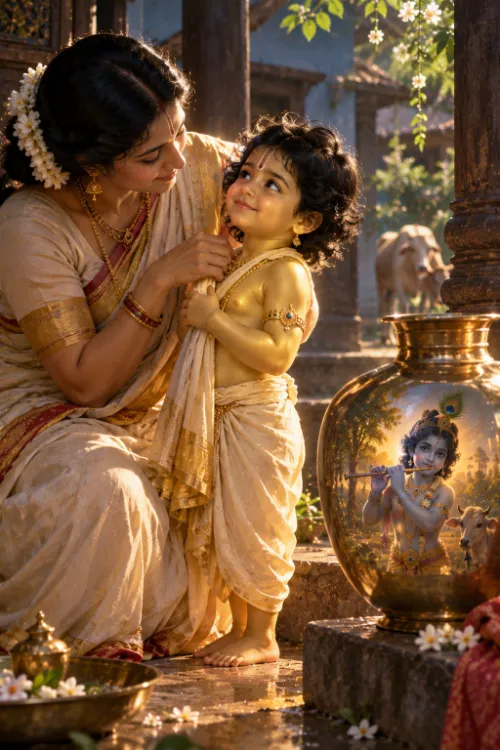
The Meaning and Scriptural Architecture of a Single Bengali Couplet
One short Bengali couplet makes one of the boldest claims in Gauḍīya Vaiṣṇava theology: the golden ascetic Śrī Caitanya is not merely a saint, prophet, empowered devotee, or partial divine manifestation. He is the very Kṛṣṇa whom the Śrīmad-Bhāgavatam celebrates as Nanda’s son.
That wording is deliberate. Kṛṣṇadāsa Kavirāja does not identify Caitanya only with an abstract Absolute, a majestic creator, or even Viṣṇu in a general sense. He points specifically to Nanda’s Kṛṣṇa—the cowherd child of Vraja who is carried in his father’s arms, bound by Yaśodā’s rope, surrounded by friends, and conquered by the love of His devotees.
The verse therefore contains an entire theology in miniature. It tells readers who Caitanya is, which manifestation of God He is, and what kind of divinity He reveals: not power held at a distance, but the Supreme freely entering relationships of intimacy, dependence, tenderness, and love.
The verse
‘নন্দসুত’ বলি’ যাঁরে ভাগবতে গাই ।
সেই কৃষ্ণ অবতীর্ণ চৈতন্যগোসাঞি ॥ ৯ ॥
‘nanda-suta’ bali’ yāṅre bhāgavate gāi
sei kṛṣṇa avatīrṇa caitanya-gosāñi
That very Kṛṣṇa who is celebrated in the Bhāgavatam as “the son of Nanda” has descended as Lord Caitanya.
The familiar translation—“He whom Śrīmad-Bhāgavatam describes as the son of Nanda Mahārāja has descended to earth as Lord Caitanya”—is substantially correct. A few details, however, sharpen its force:
- sei means “that,” “that very one,” or “the selfsame.” It asserts identity, not resemblance.
- nanda-suta means “Nanda’s son.” Suta can mean “son” or “child.”
- bhāgavate gāi literally has the sense “we sing or celebrate in the Bhāgavata.” “Describes” gives the meaning, but “celebrates” preserves the devotional tone of gāi, “I/we sing.”
- avatīrṇa means “descended,” “come down,” or “manifested.” “To earth” is a reasonable implication, although those words are not separately present in the Bengali.
- gosāñi, an older Bengali form related to Sanskrit gosvāmī, is an honorific meaning “Lord” or “Master.”
The verse does not say that Caitanya resembles Kṛṣṇa, represents Kṛṣṇa, or was merely inspired by Kṛṣṇa. Its grammatical center is sei kṛṣṇa—“that very Kṛṣṇa.”
Verdict: correct, but with one important source-critical qualification
The statement is correct as a translation and as a concise expression of Gauḍīya doctrine. Yet its two halves do not have exactly the same textual status.
- The Śrīmad-Bhāgavatam repeatedly presents Kṛṣṇa as the son of Nanda and Yaśodā, explicitly using expressions such as nanda-sūnuḥ, “Nanda’s son,” and svam ātmajam, “his own son.”
- The conclusion that this same Kṛṣṇa descended as Caitanya is Kṛṣṇadāsa Kavirāja’s theological assertion. Gauḍīya tradition supports it through a cumulative interpretation of several scriptural passages, but the Bhāgavatam itself nowhere states in one unambiguous sentence, “Kṛṣṇa will appear in Bengal as Śrī Caitanya, the son of Śacī.”
That distinction does not weaken the verse. It explains how it works. The first line identifies the Kṛṣṇa under discussion from the Bhāgavatam; the second states the Gauḍīya conclusion concerning Caitanya’s identity.
The immediate argument of Caitanya-caritāmṛta
Ādi-līlā, chapter 2, is not a loose collection of praises. It presents a structured theological argument.
The Sanskrit invocation on which this argument rests first appears in Ādi 1.3 and is repeated at Ādi 2.5:
यदद्वैतं ब्रह्मोपनिषदि तदप्यस्य तनुभा
य आत्मान्तर्यामी पुरुष इति सोऽस्यांशविभवः ।
षडैश्वर्यैः पूर्णो य इह भगवान् स स्वयमयं
न चैतन्यात् कृष्णाज्जगति परतत्त्वं परमिह ॥
yad advaitaṁ brahmopaniṣadi tad apy asya tanu-bhā
ya ātmāntar-yāmī puruṣa iti so ’syāṁśa-vibhavaḥ
ṣaḍ-aiśvaryaiḥ pūrṇo ya iha bhagavān sa svayam ayaṁ
na caitanyāt kṛṣṇāj jagati para-tattvaṁ param iha
The nondual Brahman proclaimed in the Upaniṣads is the radiance of His body. The Self known as the indwelling Puruṣa is the manifestation of His plenary portion. He who is Bhagavān, complete in the six divine excellences, is this very Lord Himself. In this world there is no supreme reality higher than Kṛṣṇa Caitanya.
This is followed by a succinct Bengali declaration:
স্বয়ং ভগবান্ কৃষ্ণ, বিষ্ণু–পরতত্ত্ব ।
পূর্ণজ্ঞান পূর্ণানন্দ পরম মহত্ত্ব ॥
svayaṁ bhagavān kṛṣṇa, viṣṇu-paratattva
pūrṇa-jñāna pūrṇānanda parama mahattva
Kṛṣṇa is Bhagavān Himself, the supreme reality of Viṣṇu-tattva—complete knowledge, complete bliss, and supreme greatness.
Thus Ādi 2.9 is a bridge
The preceding verses establish that Bhagavān in His fullest personal form is Kṛṣṇa; verse 2.9 identifies Caitanya with precisely that Kṛṣṇa.
Does the Bhāgavatam really call Kṛṣṇa “Nanda’s son”?
Yes—both directly and throughout its narrative world.
The exact expression: nanda-sūnuḥ
When Kṛṣṇa leaves Vraja for Mathurā, the gopīs lament:
न नन्दसूनुः क्षणभङ्गसौहृदः
समीक्षते नः स्वकृतातुरा बत ।
विहाय गेहान् स्वजनान् सुतान् पतींस्
तद्दास्यमद्धोपगता नवप्रियः ॥
na nanda-sūnuḥ kṣaṇa-bhaṅga-sauhṛdaḥ
samīkṣate naḥ sva-kṛtāturā bata
vihāya gehān sva-janān sutān patīṁs
tad-dāsyam addhopagatā nava-priyaḥ
Alas, Nanda’s son, whose affection seems broken in a moment, does not even look upon us, though He has made us heartsick. We abandoned homes, relatives, children, and husbands to enter His service, yet He now seeks new beloveds.
Sanskrit — Śrīmad-Bhāgavatam 10.39.22
The compound nanda-sūnuḥ is the Sanskrit equivalent of Bengali nanda-suta: “the son of Nanda.” But the context matters as much as the dictionary. This is not a genealogical footnote. It is the cry of the gopīs at the moment of separation. “Nanda’s son” names Kṛṣṇa as He belongs to Vraja and as Vraja’s devotees love Him.
The God praised by the Vedas becomes Yaśodā’s child
King Parīkṣit marvels at the paradox of Yaśodā’s motherhood:
त्रय्या चोपनिषद्भिश्च साङ्ख्ययोगैश्च सात्वतैः ।
उपगीयमानमाहात्म्यं हरिं सामन्यतात्मजम् ॥ ४५ ॥
नन्दः किमकरोद् ब्रह्मन् श्रेय एवं महोदयम् ।
यशोदा च महाभागा पपौ यस्याः स्तनं हरिः ॥ ४६ ॥
trayyā copaniṣadbhiś ca sāṅkhya-yogaiś ca sātvataiḥ
upagīyamāna-māhātmyaṁ hariṁ sāmanyatātmajam
nandaḥ kim akarod brahman śreya evaṁ mahodayam
yaśodā ca mahā-bhāgā papau yasyāḥ stanaṁ hariḥ
Although the Vedas, the Upaniṣads, Sāṅkhya, Yoga, and the Sātvata scriptures sing His greatness, Yaśodā regarded Hari as her own son. O brāhmaṇa, what immensely auspicious deeds did Nanda perform? And how greatly fortunate was Yaśodā, whose breast Hari drank?
Sanskrit — Śrīmad-Bhāgavatam 10.8.45–46
The compact phrase sāmanyatātmajam resolves through Sanskrit sandhi as sā amanyata ātmajam—“she considered Him her own son.” The object of Vedic revelation does not merely visit Yaśodā’s house. He accepts the position of her child.
The following passage states the relationship even more directly:
ततो भक्तिर्भगवति पुत्रीभूते जनार्दने ।
दम्पत्योर्नितरामासीद् गोपगोपीषु भारत ॥
tato bhaktir bhagavati putrī-bhūte janārdane
dampatyor nitarām āsīd gopa-gopīṣu bhārata
Then, when Bhagavān Janārdana had become their son, the couple’s devotion to Him grew exceedingly intense, as did that of the cowherd men and women, O descendant of Bharata.
Sanskrit — Śrīmad-Bhāgavatam 10.8.51
The expression bhagavati putrī-bhūte is astonishing: “when Bhagavān had become a son.” The Supreme is not stripped of divinity; rather, divine freedom is shown to include the freedom to become intimately related to His devotees.
Nanda sees “his own son”
After Yaśodā binds mischievous Kṛṣṇa to a mortar, Nanda releases Him:
उलूखलं विकर्षन्तं दाम्ना बद्धं स्वमात्मजम् ।
विलोक्य नन्दः प्रहसद्वदनो विमुमोच ह ॥
ulūkhalaṁ vikarṣantaṁ dāmnā baddhaṁ svam ātmajam
vilokya nandaḥ prahasad-vadano vimumoca ha
Seeing his own son, bound with a rope and dragging the mortar, Nanda smiled and released Him.
Sanskrit — Śrīmad-Bhāgavatam 10.11.6
Here Kṛṣṇa is svam ātmajam, “his own son.” Nanda does not approach Him as a philosopher approaching Brahman or as a subordinate approaching a sovereign. He sees a small child who needs to be untied.
The child of Nanda is Bhagavān Himself
The title “Nanda’s son” might sound provincial unless read together with the Bhāgavatam’s larger theology. The work famously distinguishes Kṛṣṇa from a list of divine descents:
एते चांशकलाः पुंसः कृष्णस्तु भगवान् स्वयम् ।
इन्द्रारिव्याकुलं लोकं मृडयन्ति युगे युगे ॥
ete cāṁśa-kalāḥ puṁsaḥ kṛṣṇas tu bhagavān svayam
indrāri-vyākulaṁ lokaṁ mṛḍayanti yuge yuge
These are portions or portions of portions of the Supreme Person, but Kṛṣṇa is Bhagavān Himself. Age after age they bring relief to the world when it is afflicted by the enemies of the gods.
Sanskrit — Śrīmad-Bhāgavatam 1.3.28
Gauḍīya theologians place special weight on tu, “but,” and svayam, “Himself.” Their conclusion is not merely that Kṛṣṇa is one divine incarnation among many, but that He is the original, complete personal Absolute from whom other divine forms proceed.
That highest reality is precisely the cowherd child whom Brahmā beholds:
श्रीब्रह्मोवाच
नौमीड्य तेऽभ्रवपुषे तडिदम्बराय
गुञ्जावतंसपरिपिच्छलसन्मुखाय ।
वन्यस्रजे कवलवेत्रविषाणवेणु-
लक्ष्मश्रिये मृदुपदे पशुपाङ्गजाय ॥
śrī-brahmovāca
naumīḍya te ’bhra-vapuṣe taḍid-ambarāya
guñjāvataṁsa-paripiccha-lasan-mukhāya
vanya-sraje kavala-vetra-viṣāṇa-veṇu-
lakṣma-śriye mṛdu-pade paśupāṅgajāya
Brahmā said: O worshipable Lord, I bow to You, whose body resembles a raincloud and whose garment flashes like lightning; whose face shines beneath guñjā ornaments and a peacock feather; whose beauty is marked by a forest garland, a morsel of food, a herding stick, a buffalo horn, and a flute; whose feet are tender; and who are the son of the cowherd chief.
Sanskrit — Śrīmad-Bhāgavatam 10.14.1
The final word, paśupāṅgajāya, addresses Kṛṣṇa as the offspring of the chief of the cowherds. Brahmā, the cosmic creator, bows before a village boy carrying lunch and a herding stick. The apparently ordinary details do not conceal a lesser God. They reveal the intimacy of the fullest God.
Later Brahmā exclaims:
अहो भाग्यमहो भाग्यं नन्दगोपव्रजौकसाम् ।
यन्मित्रं परमानन्दं पूर्णं ब्रह्म सनातनम् ॥
aho bhāgyam aho bhāgyaṁ nanda-gopa-vrajaukasām
yan-mitraṁ paramānandaṁ pūrṇaṁ brahma sanātanam
How greatly fortunate—how greatly fortunate—are Nanda, the cowherds, and all the residents of Vraja, for their friend is the eternal, complete Brahman, the highest bliss.
Sanskrit — Śrīmad-Bhāgavatam 10.14.32
This verse overturns the assumption that spiritual greatness must always produce formality or distance. The eternal and complete Brahman is a friend in Vraja.
Why say “Nanda’s son” instead of simply “Kṛṣṇa”?
The expression selects a particular mode of divine self-revelation. Gauḍīya theology often distinguishes aiśvarya, awareness of God’s majesty and sovereign power, from mādhurya, the sweetness and intimacy in which divinity appears in humanlike relationships. These are not two gods. They are two ways in which the one Lord is encountered.
Nanda and Yaśodā do not spend their days calculating that their child is the metaphysical source of everything. They worry that He has not eaten, chastise Him for stealing butter, protect Him from danger, and tie Him when He is naughty. Their love is called vātsalya-rasa, the devotional relationship of parental affection.
This leads to the principle sometimes called bhakta-vaśyatā: the Lord freely allows Himself to be brought under the control of His devotee’s love. Yaśodā’s rope binds the one whom space cannot contain. Nanda’s hands release the one who liberates all beings. Divine submission to love is not a failure of omnipotence; in Gauḍīya thought it is one of omnipotence’s highest expressions.
“Nanda’s son” therefore identifies more than Kṛṣṇa’s household. It evokes a world in which the Absolute becomes approachable without becoming ordinary, and intimate without ceasing to be infinite.
Devakī’s son or Yaśodā’s son?
The Bhāgavatam narrates Kṛṣṇa’s appearance before Vasudeva and Devakī in Mathurā and His transfer to Gokula, where Nanda and Yaśodā raise Him. At the narrative level, both identities are present. Calling Nanda and Yaśodā merely “foster parents,” however, can flatten the devotional meaning of the text. The Bhāgavatam itself speaks of Kṛṣṇa becoming their son and of Nanda seeing Him as “his own son.”
Later Gauḍīya commentators developed this further. Viśvanātha Cakravartī, drawing on supplementary Purāṇic tradition, explains that Kṛṣṇa appeared in a majestic four-armed manifestation before Devakī and simultaneously as the intimate two-armed child of Yaśodā. This is a commentarial theological synthesis, not something stated in the wording of Ādi 2.9 itself. Its purpose is to affirm that Yaśodā’s motherhood is not an emotional fiction or a second-class substitute. In the eternal devotional reality of Vraja, Kṛṣṇa truly belongs to Nanda and Yaśodā.
How is “Nanda’s son” identified with Caitanya?
This is where careful reading is essential. No single verse in the Bhāgavatam supplies Caitanya’s later historical name, birthplace, parents, appearance, and mission in one indisputable prediction. Gauḍīya authors instead read several passages together. Their argument is cumulative.
The figure worshiped by saṅkīrtana
The most important passage is spoken by Karabhājana Ṛṣi while describing worship in different ages:
कृष्णवर्णं त्विषाकृष्णं साङ्गोपाङ्गास्त्रपार्षदम् ।
यज्ञैः सङ्कीर्तनप्रायैर्यजन्ति हि सुमेधसः ॥
kṛṣṇa-varṇaṁ tviṣākṛṣṇaṁ sāṅgopāṅgāstra-pārṣadam
yajñaiḥ saṅkīrtana-prāyair yajanti hi su-medhasaḥ
Those of refined intelligence worship, by sacrifices consisting chiefly of congregational glorification, the one who is kṛṣṇa-varṇa, whose complexion is not dark, and who is accompanied by His limbs, subsidiary limbs, weapons, and associates.
Sanskrit — Śrīmad-Bhāgavatam 11.5.32
Several compact expressions permit more than one grammatical shade:
- kṛṣṇa-varṇam can mean one who utters or describes Kṛṣṇa, one whose designation contains “Kṛṣṇa,” or one who belongs to Kṛṣṇa’s category.
- tviṣā akṛṣṇam means “not dark in complexion.” Gauḍīyas understand this as golden.
- saṅkīrtana-prāyaiḥ yajñaiḥ means “by sacrifices consisting predominantly of congregational chanting or glorification.”
- sāṅgopāṅgāstra-pārṣadam describes Him as accompanied by limbs, subsidiary limbs, weapons, and associates. Gauḍīya exegesis identifies His close companions and understands His transforming “weapons” as the holy name, beauty, compassion, and spiritual attraction rather than instruments of violence.
The correspondence with Caitanya is powerful within the tradition: He is golden rather than dark, continually voices Kṛṣṇa’s names, appears with intimate companions, and makes congregational chanting the central religious practice of the age.
Still, precision matters. The name “Caitanya” is not lexically present in this Sanskrit verse. Its application to Caitanya is a coherent and influential Gauḍīya interpretation, not a translation accepted identically by every Vedānta tradition.
The hidden descent in Kali-yuga
Prahlāda addresses the Lord:
इत्थं नृतिर्यगृषिदेवझषावतारैर्
लोकान् विभावयसि हंसि जगत्प्रतीपान् ।
धर्मं महापुरुष पासि युगानुवृत्तं
छन्नः कलौ यदभवस्त्रियुगोऽथ स त्वम् ॥
itthaṁ nṛ-tiryag-ṛṣi-deva-jhaṣāvatārair
lokān vibhāvayasi haṁsi jagat-pratīpān
dharmaṁ mahā-puruṣa pāsi yugānuvṛttaṁ
channaḥ kalau yad abhavas tri-yugo ’tha sa tvam
In this way, through descents among humans, animals, sages, gods, and aquatics, You protect the worlds and destroy those who oppose them. O Great Person, You preserve the dharma appropriate to each age. Because You are hidden in the age of Kali, You are therefore called Tri-yuga.
Sanskrit — Śrīmad-Bhāgavatam 7.9.38
Gauḍīya authors connect channaḥ kalau, “hidden in Kali,” with Caitanya: Kṛṣṇa appears, but His divinity is concealed beneath the form and conduct of His own devotee. This passage supplies a theological pattern rather than an explicit historical identification.
Golden form and renunciation
The Caitanya-caritāmṛta also cites names from the Viṣṇu-sahasranāma tradition:
सुवर्णवर्णो हेमाङ्गो वराङ्गश्चन्दनाङ्गदी ।
संन्यासकृच्छमः शान्तो निष्ठाशान्तिपरायणः ॥
suvarṇa-varṇo hemāṅgo varāṅgaś candanāṅgadī
sannyāsa-kṛc chamaḥ śānto niṣṭhā-śānti-parāyaṇaḥ
Golden in complexion, golden-limbed, beautiful-bodied, and adorned with sandalwood; accepting renunciation, self-controlled and peaceful, He is the supreme refuge of steadfast devotion and peace.
Sanskrit — cited at Caitanya-caritāmṛta, Ādi 3.49
Gauḍīyas see a striking portrait of golden-bodied Caitanya, who accepted sannyāsa, the renounced order. Yet these are broad divine epithets; their specific application to Caitanya again belongs to the tradition’s interpretive synthesis.
One person, a different role
If Caitanya is Kṛṣṇa, why does Caitanya worship Kṛṣṇa, chant Kṛṣṇa’s names, and behave as Kṛṣṇa’s devotee? The Caitanya-caritāmṛta answers directly:
আপনি করিমু ভক্তভাব অঙ্গীকারে ।
আপনি আচরি’ ভক্তি শিখাইমু সবারে ॥
āpani karimu bhakta-bhāva aṅgīkāre
āpani ācari’ bhakti śikhāimu sabāre
I shall personally accept the disposition of a devotee, and by personally practicing devotion I shall teach it to everyone.
Bengali — Ādi 3.20
The same divine person appears in a different devotional role:
This is not reincarnation in the ordinary sense of a karmically conditioned soul taking another body. Avatāra means a divine descent or self-manifestation. Kṛṣṇa does not stop being Kṛṣṇa, nor is His Vraja form replaced. The same eternal divine person manifests another form, mood, and activity for a particular purpose.
From Yaśodā’s son to Śacī’s son
The Caitanya-caritāmṛta later makes the same identification in language even more intimate:
প্রভুর কহিল এই জন্মলীলা–সূত্র ।
যশোদা–নন্দন যৈছে হৈল শচীপুত্র ॥
prabhura kahila ei janma-līlā-sūtra
yaśodā-nandana yaiche haila śacī-putra
The thread of the Lord’s appearance pastime is stated here: Yaśodā’s son became the son of Śacī.
Bengali — Ādi 14.3
Narottama Dāsa Ṭhākura expresses the same conviction in a beloved Bengali song:
ব্রজেন্দ্রনন্দন যেই, শচীসুত হৈল সেই,
বলরাম হৈল নিতাই
vrajendra-nandana yei, śacī-suta haila sei,
balarāma haila nitāi
He who was the son of the king of Vraja became the son of Śacī; Balarāma became Nitāi.
These formulations preserve continuity and transformation at once. The person is the same—sei, “that very one”—but the parental home, complexion, outward role, and manifest mission differ.
Why does Kṛṣṇa descend as His own devotee?
The tradition gives both an inward and an outward reason. Inwardly, Caitanya tastes the devotion directed toward Kṛṣṇa—above all the love associated with Śrī Rādhā and Vraja. Outwardly, He makes that love accessible through devotion centered on the divine names. The opening of the work announces this gift:
अनर्पितचरीं चिरात् करुणयावतीर्णः कलौ
समर्पयितुमुन्नतोज्ज्वलरसां स्वभक्तिश्रियम् ।
हरिः पुरटसुन्दरद्युतिकदम्बसन्दीपितः
सदा हृदयकन्दरे स्फुरतु वः शचीनन्दनः ॥
anarpita-carīṁ cirāt karuṇayāvatīrṇaḥ kalau
samarpayitum unnatojjvala-rasāṁ sva-bhakti-śriyam
hariḥ puraṭa-sundara-dyuti-kadamba-sandīpitaḥ
sadā hṛdaya-kandare sphuratu vaḥ śacī-nandanaḥ
May Śacī’s son, Hari, always manifest in the cave of your hearts. Radiant with the beautiful brilliance of molten gold, He descended mercifully in the age of Kali to bestow the splendor of His own devotion in its most elevated and luminous flavor—a gift not bestowed for a very long time.
Sanskrit — Caitanya-caritāmṛta, Ādi 1.4
The movement from Nanda’s home to Śacī’s home is therefore not a change of identity but an expansion of divine generosity. The Kṛṣṇa who receives Vraja’s love appears as Caitanya to experience that love from the devotee’s side and to teach others the path of receiving it.
Three dimensions of the claim
Ādi 2.9 can be read on three inseparable levels.
Metaphysical identity
Caitanya is Kṛṣṇa Himself, not merely Kṛṣṇa’s messenger or a spiritually gifted human being. This is the force of sei kṛṣṇa.
Devotional identity
He is specifically Nanda’s Kṛṣṇa: the personal Absolute of Vraja, whose fullness is revealed through intimate relationships. The verse does not lead first to cosmic grandeur but to the courtyard of Nanda and Yaśodā.
Mission identity
The object of the highest devotion appears in the role of His own devotee. He comes not only to demand worship, but to demonstrate devotion, relish it, and distribute it through saṅkīrtana—the shared glorification of the divine names.
Together these levels explain why the verse is much richer than a bare statement that “Caitanya is God.” It identifies which God, known through which relationships, appearing for what purpose.
What the verse does—and does not—claim
It does claim
- Caitanya and Kṛṣṇa are the same divine person.
- The Kṛṣṇa intended is the Kṛṣṇa of Vraja, celebrated as Nanda’s son.
- Caitanya’s appearance is an avatāra, a divine descent, not an ordinary material birth compelled by karma.
- The intimate form of God is not subordinate to the impersonal Absolute; in this theology, Brahman is the radiance of the personal Lord.
- Divine greatness reaches a climax not only in ruling the universe but in becoming accessible to love.
It does not claim
- that the Bhāgavatam contains the exact Bengali sentence of Ādi 2.9;
- that the Bhāgavatam explicitly names “Śrī Caitanya” in an uncontested prediction;
- that Nanda and Yaśodā’s relationship with Kṛṣṇa is merely symbolic;
- that Kṛṣṇa’s eternal Vraja identity disappears when Caitanya manifests;
- that all Hindu or Vedānta traditions interpret the supporting verses in the same way.
These qualifications make the doctrine more intelligible, not less devotional. Good theology should state both what its sources explicitly say and how a tradition reasons from those sources.
The deeper theological reversal
Ordinary religious imagination tends to measure God by distance: the more inaccessible, untouchable, and overwhelming the deity, the greater the divinity. Vraja reverses that instinct. The Supreme displays an even greater freedom by becoming touchable, feedable, protectable, and lovable.
The sequence is extraordinary:
- the Upaniṣadic Brahman becomes Yaśodā’s child;
- the liberator of all beings is untied by Nanda;
- the object of all worship takes the role of a worshiper;
- the giver of divine love enters the emotions of His devotee;
- the dark cowherd Kṛṣṇa appears in a golden form to spread His own names.
Power can command submission. Love produces willing self-giving. In the Gauḍīya vision, Caitanya is the fullest revelation of that self-giving: God does not merely permit human beings to approach Him; He crosses the distance Himself, adopts the devotee’s heart, and shows how divine love is lived.
Caitanya-caritāmṛta, Ādi 2.9 is correctly understood as an unequivocal identification of Śrī Caitanya with Kṛṣṇa. Yet the full force of the verse lies in the expression “Nanda’s son.” Kṛṣṇadāsa Kavirāja is not pointing only to a universal creator or remote Supreme Being. He is pointing to the child of Vraja—the complete Bhagavān who lets Yaśodā bind Him, lets Nanda care for Him, plays with cowherd friends, and becomes the beloved of the gopīs.
The Bhāgavatam firmly supplies that Vraja identity. Gauḍīya theologians then identify the golden, non-dark, saṅkīrtana-centered figure of Kali-yuga with this same Kṛṣṇa. That identification is a tradition-specific scriptural synthesis and should be presented honestly as such. Within that synthesis, however, the conclusion is exact and radical:
The son of Nanda became the son of Śacī. The Lord who receives the love of Vraja appeared in the heart and role of His own devotee so that the world could learn, taste, and share that love.
Principal texts discussed
- Caitanya-caritāmṛta, Ādi-līlā 1.3–4; 2.5–10; 3.20; 3.49; 14.3
- Śrīmad-Bhāgavatam 1.3.28; 7.9.38; 10.8.45–46, 51; 10.11.6; 10.14.1, 32; 10.39.22; 11.5.32
- Viṣṇu-sahasranāma tradition, as cited in Caitanya-caritāmṛta, Ādi 3.49
- The songs of Narottama Dāsa Ṭhākura
- Gauḍīya commentarial discussion associated with Viśvanātha Cakravartī Ṭhākura