

Distilled Core of Vedic Revelation
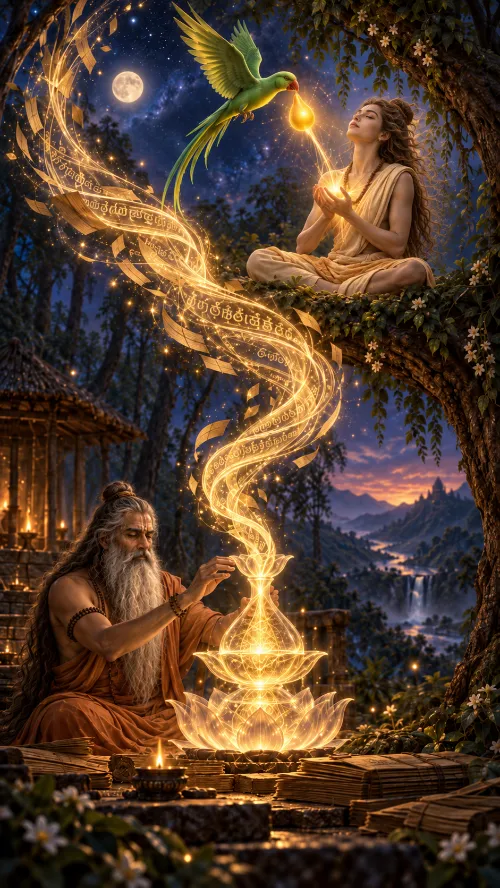
Why the Bhāgavata calls itself the essence of the essence
The Vedic corpus is enormous. It contains ritual, cosmology, philosophy, theology, social order, sacrifice, meditation, ethics, kingship, renunciation, liberation, and sacred history. It speaks to people at many levels of spiritual development and addresses many different human aims.
Then Śrīmad-Bhāgavatam makes an extraordinary claim. Vyāsa, after surveying this vast inheritance, extracts its essence. Not merely a summary. Not merely a collection of favorite passages.
The sāra—the concentrated spiritual core. And he gives that distilled essence to one of the most unusual recipients imaginable: his son Śukadeva, a sage already so self-realized that ordinary religious instruction should have had nothing left to offer him.
तदिदं ग्राहयामास
सुतमात्मवतां वरम् ।
सर्ववेदेतिहासानां
सारं सारं समुद्धृतम् ॥
tad idaṁ grāhayām āsa
sutam ātmavatāṁ varam
sarva-vedetihāsānāṁ
sāraṁ sāraṁ samuddhṛtam
“Vyāsa caused his son—the foremost among the self-realized—to grasp this Bhāgavata, the choicest essence extracted from all the Vedas and Itihāsas.”
Śrīmad-Bhāgavatam 1.3.41
The verse is deceptively short. Yet almost every phrase carries theological weight.
The Verse Belongs to a Transmission Sequence
The opening words are: tad idam “this very [Bhāgavata].” The reference is to the immediately preceding verse.
इदं भागवतं नाम
पुराणं ब्रह्मसम्मितम् ।
उत्तमश्लोकचरितं
चकार भगवानृषिः ।
निःश्रेयसाय लोकस्य
धन्यं स्वस्त्ययनं महत् ॥
idaṁ bhāgavataṁ nāma
purāṇaṁ brahma-sammitam
uttama-śloka-caritaṁ
cakāra bhagavān ṛṣiḥ
niḥśreyasāya lokasya
dhanyaṁ svasty-ayanaṁ mahat
“The divine sage composed this Purāṇa called the Bhāgavata, describing the activities of Uttamaśloka, for the ultimate welfare of the people; it is blessed, auspicious, and great.”
Śrīmad-Bhāgavatam 1.3.40
Then 1.3.41 tells us what happens next: Vyāsa teaches it to Śukadeva. And 1.3.42 continues:
स तु संश्रावयामास
महाराजं परीक्षितम् ।
प्रायोपविष्टं गङ्गायां
परीतं परमर्षिभिः ॥
sa tu saṁśrāvayām āsa
mahārājaṁ parīkṣitam
prāyopaviṣṭaṁ gaṅgāyāṁ
parītaṁ paramarṣibhiḥ
“He, in turn, caused Mahārāja Parīkṣit to hear it as the king sat fasting on the bank of the Gaṅgā, surrounded by great sages.”
Śrīmad-Bhāgavatam 1.3.42
So three verses give us a compact sacred genealogy:
- Vyāsa composes the Bhāgavata.
- Śukadeva receives it.
- Parīkṣit hears it.
That sequence is fundamental to the identity of the text.
The Bhāgavata is not presented merely as a manuscript. It is realization transmitted through hearing.
Grāhayām Āsa — Vyāsa Did Not Merely Hand Over a Book
The verb: grāhayām āsa comes from the Sanskrit root: √grah to grasp, seize, receive, understand. In the causative form it means: “caused to grasp,” or: “made someone learn,”
“caused someone to understand,” “imparted.” This is stronger than merely saying: “Vyāsa gave the text to Śuka.” The Sanskrit suggests an active process of teaching and assimilation.
Vyāsa caused Śukadeva to grasp the Bhāgavata. This is important because Vedic transmission is fundamentally oral and relational. Knowledge becomes authoritative not merely because words exist on a page, but because they are: heard, understood, realized, and transmitted onward.
The next verse reinforces the same idea with another causative verb: saṁśrāvayām āsa “caused [Parīkṣit] to hear thoroughly.” Thus the movement is: Vyāsa → Śuka → Parīkṣit through: teaching → hearing → realization → retransmission.
Śukadeva Is Not an Ordinary Student
The next expression is: sutam ātmavatāṁ varam sutam — his son ātmavatām — among the self-realized, self-possessed, spiritually established varam — the foremost, best, most excellent.
So: “his son, foremost among the self-realized.” This description is crucial. If the verse merely said: “Vyāsa taught the Bhāgavata to his son,” we might imagine a normal father instructing a young student.
But Śukadeva is emphatically not described as a beginner. He is: ātmavatāṁ varam the foremost among those established in self-realization. That raises an obvious question.
Why would someone already self-realized need to study anything? The Bhāgavata itself asks exactly that.
Śukadeva Was Already an Ātmārāma
शौनक उवाच
स वै निवृत्तिनिरतः
सर्वत्रोपेक्षको मुनिः ।
कस्य वा बृहतीमेताम्
आत्मारामः समभ्यसत् ॥
śaunaka uvāca
sa vai nivṛtti-nirataḥ
sarvatropekṣako muniḥ
kasya vā bṛhatīm etām
ātmārāmaḥ samabhyasat
Śaunaka said: “He was absorbed in renunciation, indifferent to external things, and satisfied in the self. Why, then, did such an ātmārāma study this vast work?”
Śrīmad-Bhāgavatam 1.7.9
The word: ātmārāma means one who delights in the self. Śukadeva is presented as already: detached, self-satisfied, beyond ordinary material attraction. From the standpoint of many spiritual systems, one might expect his journey to be finished.
Yet the Bhāgavata says otherwise.
Even Liberated Sages Become Attracted to Hari
The answer follows immediately.
आत्मारामाश्च मुनयो
निर्ग्रन्था अप्युरुक्रमे ।
कुर्वन्त्यहैतुकीं भक्तिम्
इत्थम्भूतगुणो हरिः ॥
ātmārāmāś ca munayo
nirgranthā apy urukrame
kurvanty ahaitukīṁ bhaktim
ittham-bhūta-guṇo hariḥ
“Even sages who delight in the self and are free from bondage render causeless devotion to Urukrama, for Hari possesses such extraordinary qualities.”
Śrīmad-Bhāgavatam 1.7.10
This is one of the most important theological claims behind 1.3.41. Śukadeva is not attracted to the Bhāgavata because he still needs: material prosperity, ritual merit, philosophical sophistication, or even liberation.
He is already beyond ordinary material desire. And still: Hari attracts him. That means the Bhāgavata is positioning bhakti not merely as a means to liberation, but as something that remains meaningful beyond liberation.
That is a profound shift.
Why Ātmavatāṁ Varam Is So Deliberate
The phrase is almost an argument in itself. If Vyāsa had given the Bhāgavata only to: a beginner, a ritualist, a troubled householder, or someone seeking liberation, we might conclude that the text belongs to an early or middle stage of spiritual life.
Instead he gives it to: ātmavatāṁ varam “the foremost among the self-realized.” The implication is clear: The Bhāgavata begins where some other spiritual paths think the journey ends.
Śuka is already spiritually fulfilled in one sense. Yet he finds a new dimension in: Bhagavān’s names, qualities, forms, pastimes, relationships, and rasa. This is why Śukadeva is so important to the Bhāgavata’s self-understanding.
Sarva-vedetihāsānām — “Of All the Vedas and Itihāsas”
The next compound is: sarva-veda-itihāsānām sarva — all veda — the Vedas itihāsa — sacred historical tradition -ānām — “of,” genitive plural. A literal translation is: “of all the Vedas and Itihāsas.”
What is itihāsa? The word is traditionally associated with: iti ha āsa “thus indeed it was.” In classical Indian textual culture, Itihāsa especially refers to the great sacred historical-epic tradition, above all the Mahābhārata.
It is not exactly equivalent to the modern academic discipline of “history.” Nor is it simply fiction. It presents sacred narrative, genealogy, kingship, cosmic events, moral instruction, and theology through remembered history.
So the phrase means that Vyāsa has drawn the essence not only from abstract Vedic teaching, but also from the great narrative tradition of sacred history.
Sāraṁ Sāram — The Essence of the Essence
Now comes the heart of the verse: sāraṁ sāram The Bhāgavata does not merely say: sāram “the essence.” It repeats the word. The repetition intensifies it:
- the very essence
- the choicest essence
- the essence of the essence
- what is essential within what is already essential.
Then comes: samuddhṛtam from: sam + ud + √hṛ to draw up, extract, lift out, bring forth thoroughly. So the phrase: sāraṁ sāraṁ samuddhṛtam evokes a process of extraction.
Something vast has been examined. Its richest substance has been drawn out. This is why “the cream of all Vedic literature” is such an effective metaphor.
The Bhāgavata Is Not Merely a Summary
This distinction is important. An ordinary summary reduces quantity. The Bhāgavata’s claim is stronger. It claims to preserve the deepest purpose. A summary might say: “The Vedas contain these ten subjects.”
A distillation asks: What is all of this finally for? That is the sense of sāra. Not everything contained in every Vedic text is repeated in the Bhāgavata. It does not reproduce every: ritual rule, grammatical discussion, social regulation, sacrificial formula, or technical instruction.
Instead, it claims to reveal the ultimate organizing purpose behind the corpus.
The Bhāgavata Uses Another Metaphor: The Ripe Fruit of the Vedic Tree
Its opening verses offer a famous parallel image.
निगमकल्पतरोर्गलितं फलं
शुकमुखादमृतद्रवसंयुतम् ।
पिबत भागवतं रसमालयं
मुहुरहो रसिका भुवि भावुकाः ॥
nigama-kalpa-taror galitaṁ phalaṁ
śuka-mukhād amṛta-drava-saṁyutam
pibata bhāgavataṁ rasam ālayam
muhur aho rasikā bhuvi bhāvukāḥ
“O spiritually sensitive and discerning people, drink the Bhāgavata—the fully ripened fruit of the desire tree of Vedic revelation. Having passed through the mouth of Śuka, it has become filled with nectarean rasa.”
Śrīmad-Bhāgavatam 1.1.3
Here the metaphor changes. In 1.3.41: the Vedas are something from which essence is extracted. In 1.1.3: the Vedas are a tree and the Bhāgavata is its ripe fruit. The theological claim is the same.
The Bhāgavata presents itself as culmination.
The Fruit Is Not the Enemy of the Tree
This point prevents a common misunderstanding. When the Bhāgavata calls itself the ripened fruit or distilled essence of Vedic revelation, it does not mean: “The earlier Vedas are useless.”
The relationship is not: Bhāgavata versus Veda. It is: Veda → culmination in Bhāgavata. A fruit does not reject the tree. It reveals what the tree was growing toward. Likewise, “essence” does not mean contempt for the larger tradition.
It means: the ultimate purpose has become concentrated and unmistakable.
What Is That Ultimate Purpose?
The Bhāgavata answers repeatedly.
स वै पुंसां परो धर्मो
यतो भक्तिरधोक्षजे ।
अहैतुक्यप्रतिहता
ययात्मा सुप्रसीदति ॥
sa vai puṁsāṁ paro dharmo
yato bhaktir adhokṣaje
ahaituky apratihatā
yayātmā suprasīdati
“The supreme dharma for humanity is that which gives rise to causeless and uninterrupted devotion to Adhokṣaja; by such devotion the self becomes completely satisfied.”
Śrīmad-Bhāgavatam 1.2.6
The Bhāgavata therefore judges religion according to its capacity to awaken: bhakti. Not merely: ritual correctness, prosperity, social order, or liberation. The sāra is increasingly identified as loving devotion to Bhagavān.
The Gītā Gives the Same Interpretive Key
सर्वस्य चाहं हृदि सन्निविष्टो
मत्तः स्मृतिर्ज्ञानमपोहनं च ।
वेदैश्च सर्वैरहमेव वेद्यो
वेदान्तकृद्वेदविदेव चाहम् ॥
sarvasya cāhaṁ hṛdi sanniviṣṭo
mattaḥ smṛtir jñānam apohanaṁ ca
vedaiś ca sarvair aham eva vedyo
vedānta-kṛd veda-vid eva cāham
“I am situated in everyone’s heart. From Me come remembrance, knowledge and forgetfulness. By all the Vedas, I am to be known. I am the author of Vedānta and the knower of the Vedas.”
Bhagavad-gītā 15.15
The key phrase is: vedaiś ca sarvair aham eva vedyaḥ “By all the Vedas I am to be known.” Within Vaiṣṇava interpretation, that gives the meaning of sāra. The Vedic tradition contains many subjects.
But its ultimate vedya—the One to be known—is Bhagavān. The Bhāgavata makes that center explicit.
Vyāsa Does Not Extract the Essence Merely Through Scholarship
This is crucial. One might imagine 1.3.41 as describing a learned compiler surrounded by manuscripts, comparing sources and selecting the best material. But the Bhāgavata’s own narrative says that Vyāsa’s decisive breakthrough comes through direct realization.
After Nārada instructs him, Vyāsa enters deep meditation.
भक्तियोगेन मनसि
सम्यक् प्रणिहितेऽमले ।
अपश्यत्पुरुषं पूर्णं
मायां च तदपाश्रयाम् ॥
bhakti-yogena manasi
samyak praṇihite ’male
apaśyat puruṣaṁ pūrṇaṁ
māyāṁ ca tad-apāśrayām
“With his purified mind perfectly fixed through bhakti-yoga, Vyāsa saw the complete Supreme Person and also māyā, dependent upon Him.”
Śrīmad-Bhāgavatam 1.7.4
The key phrase is: apaśyat puruṣaṁ pūrṇam “he saw the complete Person.” Vyāsa’s distillation is therefore not presented merely as literary synthesis. It is rooted in vision.
He sees: Bhagavān, māyā, the jīva’s predicament, and the remedy. Then he composes.
The Essence Is Identified as Bhakti-yoga
A few verses later the text becomes explicit.
अनर्थोपशमं साक्षाद्
भक्तियोगमधोक्षजे ।
लोकस्याजानतो विद्वांश्
चक्रे सात्वतसंहिताम् ॥
anarthopaśamaṁ sākṣād
bhakti-yogam adhokṣaje
lokasyājānato vidvāṁś
cakre sātvata-saṁhitām
“The direct means for the cessation of the living being’s unwanted suffering is bhakti-yoga toward Adhokṣaja. Because people do not know this, the learned Vyāsa composed the Sātvata-saṁhitā.”
Śrīmad-Bhāgavatam 1.7.6
Now the meaning of sāraṁ sāram becomes much clearer. What did Vyāsa extract? The Bhāgavata answers: the direct means of spiritual transformation—bhakti-yoga.
Hearing the Bhāgavata Is Supposed to Produce a Result
The next verse makes the text’s purpose practical.
यस्यां वै श्रूयमाणायां
कृष्णे परमपूरुषे ।
भक्तिरुत्पद्यते पुंसः
शोकमोहभयापहा ॥
yasyāṁ vai śrūyamāṇāyāṁ
kṛṣṇe parama-pūruṣe
bhaktir utpadyate puṁsaḥ
śoka-moha-bhayāpahā
“By hearing this literature, devotion to Kṛṣṇa, the Supreme Person, arises within a human being and removes lamentation, illusion and fear.”
Śrīmad-Bhāgavatam 1.7.7
The measure of the Bhāgavata is therefore not merely: “How much information does it contain?” But: What does it do to consciousness? The claimed effect is: bhaktir utpadyate “bhakti arises.”
And that bhakti removes: śoka — lamentation moha — illusion bhaya — fear. The sāra is therefore not merely conceptual. It is transformative.
The Bhāgavata Again Calls Itself the Essence of Vedānta
Near the very end of the work, the same claim returns.
सर्ववेदान्तसारं हि
श्रीभागवतमिष्यते ।
तद्रसामृततृप्तस्य
नान्यत्र स्याद्रतिः क्वचित् ॥
sarva-vedānta-sāraṁ hi
śrī-bhāgavatam iṣyate
tad-rasāmṛta-tṛptasya
nānyatra syād ratiḥ kvacit
“Śrīmad-Bhāgavatam is declared to be the essence of all Vedānta. One who is satisfied by the nectar of its rasa finds no comparable attraction elsewhere.”
Śrīmad-Bhāgavatam 12.13.15
Again: sāra “essence.” The claim at the beginning and the claim at the end match. The Bhāgavata presents itself not merely as one Purāṇa among others, but as the concentrated theological culmination of Vedānta.
But What Makes Śukadeva So Important?
Because Śuka functions almost like an experiment. If the Bhāgavata were merely a text for the materially conditioned, Śukadeva should not need it. If it were merely a path to liberation, Śukadeva should already be beyond it.
Yet: he becomes absorbed in it. Why? Because liberation from matter does not exhaust spiritual reality. Beyond freedom from bondage remain: Bhagavān, His beauty, His qualities, His names, His līlā, His devotees, His relationships, His rasa.
This is why the Ātmārāma verse is so crucial. Hari’s qualities are so extraordinary that even those already satisfied in the self become devotees.
From Liberation to Rasa
This is where the Bhāgavata’s theology becomes especially distinctive. Many spiritual paths can be imagined as moving toward: freedom from suffering or: freedom from rebirth or: realization of the self.
The Bhāgavata does not reject those achievements. But it asks: What comes after freedom? Its answer is: positive relationship with Bhagavān. Freedom is not the final emptiness left after everything is negated.
It becomes the space in which: love, service, beauty, relationship, and rasa can fully unfold. Śukadeva is the embodiment of this transition.
The Bhāgavata Is Both Medicine and Nectar
For Parīkṣit, the Bhāgavata is urgent medicine. He has seven days to live. For Śukadeva, it is nectar. He is already self-realized. This gives the text a remarkable dual identity.
It is: medicine for the conditioned and: rasa for the liberated.
That is why the same text can speak to: fear, death, karma, suffering, liberation, and also: divine friendship, parental affection, beauty, romantic devotion, and the intimate līlās of Kṛṣṇa.
It does not stop at cure. It proceeds to taste.
Parīkṣit Makes the Meaning of “Essence” Existential
Śukadeva proves the Bhāgavata’s depth. Parīkṣit proves its urgency. The king knows he has only seven days to live. Every secondary concern has become irrelevant. There is no time for: political strategy, wealth accumulation, dynastic planning, social prestige, or long-term worldly ambition.
At the threshold of death, the question becomes: What is worth hearing when nothing trivial remains? The Bhāgavata’s narrative answer is: this. That is another way to understand sāra.
The essence is what remains meaningful when time strips away everything secondary.
Śuka and Parīkṣit Represent Two Extremes
The pairing is beautiful.
One has transcended the world. The other is about to lose the world. And they meet through the same scripture. The implication is powerful: The Bhāgavata is relevant both before liberation and beyond liberation.
For one, it is the path. For the other, it is the nectar tasted after the path has already been crossed.
Vyāsa’s Earlier Dissatisfaction Helps Explain the Distillation
The background of the First Canto also matters. Vyāsa had already produced enormous sacred literature. Yet he remained dissatisfied. Nārada told him that the spotless glories of Bhagavān had not been sufficiently brought to the center.
That diagnosis eventually leads Vyāsa to compose the Bhāgavata. So when 1.3.41 says: sāraṁ sāraṁ samuddhṛtam “the very essence thoroughly extracted,” we should read this against Vyāsa’s earlier crisis.
The Vedic system already contained enormous knowledge. What was missing was not simply more information. It was a clear center. The Bhāgavata is presented as the work in which that center becomes explicit.
What Has Been Removed in the Distillation?
The opening of the Bhāgavata gives a clue.
धर्मः प्रोज्झितकैतवोऽत्र
dharmaḥ projjhita-kaitavo ’tra
“Here deceptive or materially motivated forms of religion are thoroughly cast aside.”
Śrīmad-Bhāgavatam 1.1.2
The verb: projjhita suggests something completely swept away or rejected. The Bhāgavata’s distillation therefore involves removal of secondary motives. Religion pursued primarily for: wealth, power, heaven, prestige, material enjoyment, or self-centered liberation cannot remain the ultimate center.
After the secondary motives are removed, what remains? Bhagavān and bhakti. That is the theological core.
The Vedas Are Vast Because Human Beings Are Diverse
Why, then, are the Vedas not simply the Bhāgavata from the beginning? Because Vedic literature addresses people at many levels. Human beings desire different things. Some want: wealth, children, victory, heaven, purification, knowledge, liberation.
The broader Vedic tradition meets people where they are. The Bhāgavata, by contrast, increasingly asks: Where is all of this ultimately supposed to lead? That is why it calls itself the essence.
It is less concerned with the entire staircase than with the destination.
Essence Does Not Mean Simplification
This is another important distinction. The Bhāgavata is not simple in the sense of intellectually thin. It contains: complex cosmology, subtle metaphysics, psychology, ethics, politics, philosophy, theology, poetry, and sophisticated aesthetics.
The distillation is therefore not: complexity → oversimplification. It is: multiplicity → integration around a central truth. Everything is reorganized around Bhagavān.
The Word Samuddhṛtam Suggests Extraction, Not Invention
Vyāsa does not claim to invent a new religion. The image is extraction. The essence was already present throughout the Vedic tradition. But it had to be: identified, drawn out, made explicit, and concentrated.
The metaphor is like refining ore. A mountain may contain gold. But the gold must be separated from the surrounding material. Likewise, the Bhāgavata presents itself as a refinement of Vedic revelation into its highest theological concentration.
Three Powerful Metaphors
The tradition gives us three especially useful ways to understand this claim.
The Tree and the Fruit
The Vedas are the tree. The Bhāgavata is the ripened fruit. The fruit is the culmination of the tree’s growth.
Milk and Cream
The Vedic corpus is like milk. The Bhāgavata is the richest concentrated portion.
Ore and Essence
The Vedic inheritance contains immense material. Vyāsa extracts the sāra. All three metaphors point toward the same conclusion: The Bhāgavata does not claim merely to be another book inside the Vedic library. It claims to reveal what the library ultimately means.
The Transmission Itself Is Theological
Now the full sequence becomes especially significant.
This is almost a theological demonstration. The scripture is authenticated from both sides: by one who has already transcended worldly life and: by one who is about to lose worldly life entirely.
The Bhāgavata Is Not Merely Read—It Is Heard
The verbs in these verses repeatedly stress transmission through hearing. Vyāsa: grāhayām āsa causes Śuka to grasp. Śuka: saṁśrāvayām āsa causes Parīkṣit to hear. Elsewhere: śrūyamāṇāyām “while it is being heard.”
The Bhāgavata’s transformative power is therefore tied to śravaṇa, sacred hearing. This is not accidental. Bhakti traditions place hearing at the beginning because consciousness is reshaped through what it repeatedly receives.
The Bhāgavata is not presented merely as an object of detached literary analysis. It is something to be heard until its vision enters the hearer.
From Information to Realization
The full movement can therefore be represented as: Vedic revelation → Vyāsa’s realization → Bhāgavata composition → Śukadeva’s reception → Śukadeva’s speaking → Parīkṣit’s hearing → transformation of consciousness.
This is more than textual history. It is a theory of sacred knowledge.
Knowledge becomes complete when:
- truth is realized,
- realization becomes speech,
- speech is received by a qualified hearer,
- and hearing transforms consciousness.
Why the Phrase Sāraṁ Sāram Is So Strong
The repetition should not be flattened. The text could have said: sāram samuddhṛtam “the essence was extracted.” Instead: sāraṁ sāram samuddhṛtam The effect is emphatic. It suggests: the most essential element among essentials.
It is a way of saying: Not merely valuable. Not merely authoritative. Not merely sacred. Concentrated. The Bhāgavata is presenting itself as what remains after spiritual priority has been clarified.
A More Precise Translation
A translation that preserves more of the Sanskrit nuance might read: “Vyāsa imparted this Bhāgavata to his son Śukadeva, foremost among the self-realized, having drawn out within it the choicest essence of all the Vedas and sacred histories.”
Or more literally: “He caused his son—the best among the self-realized—to grasp this, the very essence thoroughly extracted from all the Vedas and Itihāsas.” Both translations highlight four important ideas: grāhayām āsa — caused to grasp, imparted ātmavatāṁ varam — foremost among the self-realized sāraṁ sāram — the choicest essence samuddhṛtam — thoroughly extracted.
The Deeper Claim: Bhakti Is Not Below Liberation
Perhaps the most important implication of the whole verse is easy to miss. Śukadeva’s presence changes the hierarchy. If he is already an ātmārāma, yet still becomes absorbed in Kṛṣṇa-kathā, then the Bhāgavata is effectively saying: liberation is not the final ceiling.
Beyond liberation lies: positive attraction, relationship, service, and rasa. That is why Hari’s qualities can attract even those who are free from worldly bondage. And that is why Śukadeva—the liberated sage—is the perfect mouth through which the Bhāgavata reaches the world.
This verse is not merely claiming that the Bhāgavata contains the “best parts” of earlier scriptures. It is describing spiritual distillation. Vyāsa has inherited the full breadth of Vedic revelation.
He enters realization. He sees the complete Supreme Person. He sees māyā. He understands the jīva’s predicament. He identifies bhakti-yoga as the direct remedy. Then he composes a scripture in which the ultimate purpose of the Vedas becomes unmistakable.
That scripture is given to: Śukadeva—the foremost among the self-realized. Śuka receives it not because he still needs liberation, but because Bhagavān’s qualities are attractive even beyond liberation.
Then Śuka speaks it to: Parīkṣit—a man with only seven days to live. Thus the Bhāgavata stands between two extraordinary hearers: one who has already transcended the world, and one who is about to leave it.
That is the force of:
सारं सारं समुद्धृतम्
sāraṁ sāraṁ samuddhṛtam
“the very essence, thoroughly extracted.”
Śrīmad-Bhāgavatam 1.3.41
The Vedas are the tree. The Bhāgavata is the ripe fruit. The Vedas are the vast inheritance. The Bhāgavata is the concentrated conclusion.
Vyāsa extracts it. Śukadeva tastes it. Parīkṣit drinks it at the edge of death. And the claim of the text is profound: When everything secondary is stripped away, what remains is Bhagavān, bhakti, and the rasa of hearing about Him.
That is why the Bhāgavata calls itself not merely Vedic literature— but the essence of the essence.
Primary Texts Discussed
- Śrīmad-Bhāgavatam
1.1.2
1.1.3
1.2.6
1.3.40–42
1.7.4
1.7.6–10
12.13.15 - Bhagavad-gītā
15.15
Source Sites
- Bhaktivedanta VedaBase — vedabase.io
For Sanskrit text, transliteration, translations, and Gauḍīya Vaiṣṇava purports to the Śrīmad-Bhāgavatam and Bhagavad-gītā. - GRETIL — Göttingen Register of Electronic Texts in Indian Languages
For comparison with Sanskrit textual editions. - Sanskrit Heritage / Digital Sanskrit lexical resources
For grammatical and lexical checking of terms such as grāhayām āsa, sāra, samuddhṛta, ātma-vat, and itihāsa. - Traditional Bhāgavata commentary collections
For the broader interpretive tradition surrounding Śukadeva’s self-realization, the Ātmārāma verse, and the Bhāgavata’s status as the culmination of Vedānta.