

The Cosmic Foam of Universes
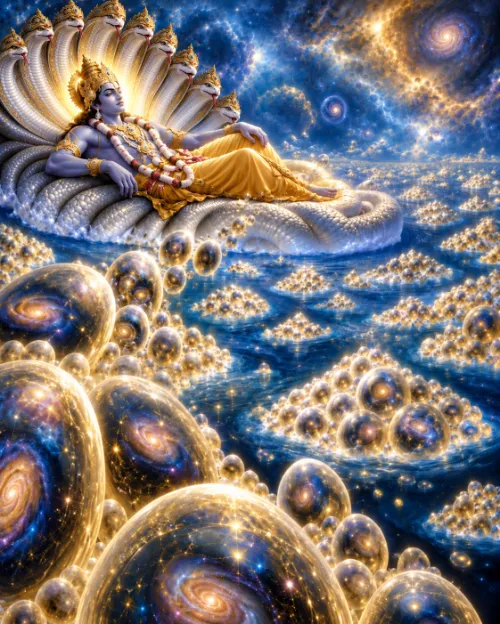
Mahā-Viṣṇu, the Causal Ocean, and the Gauḍīya Vaiṣṇava Account of Cosmic Creation
A striking image appears in A. C. Bhaktivedanta Swami Prabhupāda’s purport to Caitanya-caritāmṛta, Ādi-līlā 5.22: “The numberless universes exist together in foamlike clusters…”
He continues by saying that only some of these universes are directly surrounded by the waters of the Causal Ocean, and then describes Kāraṇodakaśāyī Viṣṇu—Mahā-Viṣṇu—glancing upon material nature, after which the material elements progressively manifest.
At first this sounds like an isolated piece of cosmic imagery. It is not. Behind those few sentences stands an entire Gauḍīya cosmology involving: innumerable universes, cosmic eggs, the Causal Ocean, Mahā-Viṣṇu, divine glance, prakṛti, the mahat-tattva, false ego, subtle sensory potentials, the five gross elements, and three successive forms of Viṣṇu entering ever more deeply into creation.
But one important source-critical distinction must be made immediately. The words “foamlike clusters” themselves appear to be Prabhupāda’s explanatory visualization. The Sanskrit and Bengali sources more directly speak of: masses, aggregates, groupings and arrangements of cosmic eggs.
So the strongest formulation is: the scriptural tradition clearly teaches innumerable clustered universes; Prabhupāda visualizes these clusters as cosmic foam. That distinction makes the teaching clearer, not weaker.
The Actual Verse: Ādi-līlā 5.22 Is About Goloka
Caitanya-caritāmṛta Ādi 5.22 itself does not describe cosmic foam. It quotes Brahma-saṁhitā 5.29:
चिन्तामणिप्रकरसद्मसु कल्पवृक्ष-
लक्षावृतेषु सुरभीरभिपालयन्तम् ।
लक्ष्मीसहस्रशतसम्भ्रमसेव्यमानं
गोविन्दमादिपुरुषं तमहं भजामि ॥
cintāmaṇi-prakara-sadmasu kalpa-vṛkṣa-
lakṣāvṛteṣu surabhīr abhipālayantam
lakṣmī-sahasra-śata-sambhrama-sevyamānaṁ
govindam ādi-puruṣaṁ tam ahaṁ bhajāmi
“I worship Govinda, the original person, who tends the surabhi cows in abodes made of spiritual gems and surrounded by millions of desire trees, and who is served with great reverence by countless goddesses of fortune.”
The verse describes: Goloka. Prabhupāda then uses the purport to unfold the enormous cosmological hierarchy beneath Goloka: Goloka, Vaikuṇṭha, brahmajyoti, the Causal Ocean, Mahā-Viṣṇu, innumerable material universes, and the progressive manifestation of material creation.
So the “foamlike clusters” image belongs not to the verse itself but to the extended cosmological explanation in the purport.
The Scriptural Foundation: Universes as Cosmic Eggs
The Sanskrit tradition repeatedly describes individual universes as:
अण्ड
aṇḍa
an egg. Hence:
ब्रह्माण्ड
brahmāṇḍa
literally means: “Brahmā’s egg,” the cosmic egg or universe. The image is not merely decorative. A universe is conceived as a complete enclosed world-system with its own: Brahmā, cosmic hierarchy, planetary structure, elemental coverings, creation, maintenance, and dissolution.
A brahmāṇḍa is therefore much larger conceptually than: a planet or: a galaxy. It is a complete universe.
“Masses of Cosmic Eggs”
One of the strongest supporting passages is Śrīmad-Bhāgavatam 3.11.41:
दशोत्तराधिकैर्यत्र
प्रविष्टः परमाणुवत् ।
लक्ष्यतेऽन्तर्गताश्चान्ये
कोटिशो ह्यण्डराशयः ॥
daśottarādhikair yatra
praviṣṭaḥ paramāṇuvat
lakṣyate ’ntar-gatāś cānye
koṭiśo hy aṇḍa-rāśayaḥ
“Within that immense cosmic scale are countless collections of universes, appearing like minute particles within a far greater aggregate.”
The crucial expression is:
अण्डराशयः
aṇḍa-rāśayaḥ
“masses, heaps or collections of cosmic eggs.”
That is extremely close conceptually to: clusters of universes. So while “foam” may be Prabhupāda’s visual analogy, the idea of universes existing in great aggregated masses is deeply scriptural.
Caitanya-caritāmṛta Speaks of an Aggregate of Universes
Ādi 5.50 says:
मायाभर्ताजाण्डसङ्घाश्रयाङ्गः
शेते साक्षात् कारणाम्भोधिमध्ये ।
यस्यैकांशः श्रीपुमानादिदेवस्
तं श्रीनित्यानन्दरामं प्रपद्ये ॥
māyā-bhartājāṇḍa-saṅghāśrayāṅgaḥ
śete sākṣāt kāraṇāmbhodhi-madhye
yasyaikāṁśaḥ śrī-pumān ādi-devas
taṁ śrī-nityānanda-rāmaṁ prapadye
“I surrender to Śrī Nityānanda Rāma, one portion of whom is the original puruṣa, Kāraṇodakaśāyī Viṣṇu, who lies in the Causal Ocean, is the master of māyā and is the shelter of the multitude of universes.”
The decisive phrase is:
अजाण्डसङ्घ
aja-aṇḍa-saṅgha
an aggregate or multitude of cosmic eggs. Again: not one universe, but: a collection of universes.
Countless Arrangements of Cosmic Eggs
Later, Kṛṣṇadāsa Kavirāja writes:
অগণ্য, অনন্ত যত অণ্ড-সন্নিবেশ ।
ততরূপে পুরুষ করে সবাতে প্রকাশ ॥
agaṇya, ananta yata aṇḍa-sanniveśa
tata-rūpe puruṣa kare sabāte prakāśa
“Countless and unlimited are the arrangements of universes; the puruṣa manifests Himself separately within every one of them.”
Caitanya-caritāmṛta, Ādi 5.67
The phrase: aṇḍa-sanniveśa means: arrangements, assemblages, groupings of cosmic eggs. So several independent expressions converge: aṇḍa-rāśayaḥ — masses of universes aja-aṇḍa-saṅgha — aggregate of universes aṇḍa-sanniveśa — arrangements of universes This is the textual background behind Prabhupāda’s: “foamlike clusters.”
Why “Foam” Is a Powerful Analogy
Imagine sea foam. It consists of innumerable bubbles: pressed together, overlapping visually, forming irregular masses. Some bubbles are exposed at the outside of the cluster.
Others sit deeper inside it and primarily touch: other bubbles. This may explain Prabhupāda’s otherwise puzzling sentence that: only some universes are surrounded by the water of the Causal Ocean.
The word: “so” in his sentence suggests that this follows from the foamlike clustering itself. A plausible interpretation is: the whole mass exists in relation to the Causal Ocean, while only the outer cosmic bubbles in a dense cluster are individually exposed to the surrounding causal water.
That is a sensible geometric reading of Prabhupāda’s analogy. But it should be stated honestly as: an interpretive reconstruction of the image, not as a separate doctrine spelled out in a Sanskrit verse.
Beyond Vaikuṇṭha: The Causal Ocean
Caitanya-caritāmṛta places the Causal Ocean at the boundary between the spiritual and material manifestations. Ādi 5.51 says:
বৈকুণ্ঠ-বাহিরে যেই জ্যোতির্ময় ধাম ।
তাহার বাহিরে ‘কারণার্ণব’ নাম ॥
vaikuṇṭha-bāhire yei jyotir-maya dhāma
tāhāra bāhire ‘kāraṇārṇava’ nāma
“Outside the Vaikuṇṭha planets is the effulgent spiritual region; beyond that is the ocean called Kāraṇārṇava, the Causal Ocean.”
Then:
বৈকুণ্ঠ বেড়িয়া এক আছে জলনিধি ।
অনন্ত, অপার—তার নাহিক অবধি ॥
vaikuṇṭha beḍiyā eka āche jala-nidhi
ananta, apāra — tāra nāhika avadhi
“There is an ocean surrounding the Vaikuṇṭha region, unlimited and unfathomable, whose extent cannot be measured.”
Ādi 5.52
This ocean is called: Kāraṇārṇava, Kāraṇāmbhodhi, Kāraṇa-samudra — the: Causal Ocean.
This Is Not Ordinary Water
The text immediately warns us against imagining it as an enormous physical Atlantic Ocean somewhere beyond the last galaxy. Ādi 5.54 says:
চিন্ময়–জল সেই পরম কারণ ।
যার এক কণা গঙ্গা পতিতপাবন ॥
cinmaya-jala sei parama kāraṇa
yāra eka kaṇā gaṅgā patita-pāvana
“That causal water is spiritual; one drop of it, the Gaṅgā, purifies the fallen.”
The crucial word is: cinmaya spiritual, consciousness-based, nonmaterial. So: Causal Ocean ≠ ordinary H₂O. The imagery is simultaneously: cosmic and: metaphysical.
Mahā-Viṣṇu Lies in That Ocean
The next stage is:
সেই ত’ কারণার্ণবে সেই সঙ্কর্ষণ ।
আপনার এক অংশে করেন শয়ন ॥
sei ta’ kāraṇārṇave sei saṅkarṣaṇa
āpanāra eka aṁśe karena śayana
“Within that Causal Ocean Saṅkarṣaṇa expands Himself in one portion and lies down.”
Ādi 5.55
That expansion is: Kāraṇodakaśāyī Viṣṇu or: Kāraṇārṇavaśāyī Viṣṇu more commonly: Mahā-Viṣṇu. He is the first puruṣa associated with material creation as a whole.
Māyā Cannot Touch Him
The next verses establish a crucial metaphysical distinction.
মায়াশক্তি রহে কারণাব্ধির বাহিরে ।
কারণ–সমুদ্র মায়া পরশিতে নারে ॥
māyā-śakti rahe kāraṇābdhira bāhire
kāraṇa-samudra māyā paraśite nāre
“The material energy remains outside the Causal Ocean; māyā cannot touch the waters of the Causal Ocean.”
Ādi 5.57
This means Mahā-Viṣṇu does not become: materially entangled in order to produce material creation. He remains transcendental. That is why the next idea—the: glance —is so important.
Mahā-Viṣṇu Glances Upon Prakṛti
Ādi 5.56 says:
মহৎস্রষ্টা পুরুষ, তিঁহো জগৎ–কারণ ।
আদ্য–অবতার করে মায়ায় ঈক্ষণ ॥
mahat-sraṣṭā puruṣa, tiṅho jagat-kāraṇa
ādya-avatāra kare māyāya īkṣaṇa
“He is the puruṣa who brings forth the mahat-tattva and is the cause of the material universes. The original avatāra casts His glance upon māyā.”
The important word is:
ईक्षण
īkṣaṇa
glance, seeing, directed vision. This “glance” expresses a theological idea: Bhagavān can cause material nature to become active without Himself entering into material contamination.
Bhagavad-gītā Gives the Same Principle
Kṛṣṇa says:
मयाध्यक्षेण प्रकृतिः
सूयते सचराचरम् ।
हेतुनानेन कौन्तेय
जगद्विपरिवर्तते ॥
mayādhyakṣeṇa prakṛtiḥ
sūyate sa-carācaram
hetunānena kaunteya
jagad viparivartate
“Under My superintendence material nature produces all moving and nonmoving beings. Because of this, O son of Kuntī, the cosmic manifestation repeatedly comes forth.”
Bhagavad-gītā 9.10
The key term is:
अध्यक्ष
adhyakṣa
superintendent, overseer, director. Thus: Mahā-Viṣṇu’s glance and: Kṛṣṇa’s superintendence express the same broader principle. Matter acts. But it does not act: independently.
Prakṛti Is Real—but Not Autonomous
Kṛṣṇadāsa Kavirāja states this explicitly:
জগৎকারণ নহে প্রকৃতি জড়রূপা ।
শক্তি সঞ্চারিয়া তারে কৃষ্ণ করে কৃপা ॥
jagat-kāraṇa nahe prakṛti jaḍa-rūpā
śakti sañcāriyā tāre kṛṣṇa kare kṛpā
“Prakṛti, being inert, cannot independently be the ultimate cause of the universe. Kṛṣṇa infuses His potency into her.”
Ādi 5.59
The crucial term is: jaḍa-rūpā inert by nature. Matter possesses causal capacities. But in this theology, those capacities ultimately depend upon: śakti divine power.
The Red-Hot Iron Analogy
The next verse explains the relationship beautifully:
কৃষ্ণশক্ত্যে প্রকৃতি হয় গৌণ কারণ ।
অগ্নিশক্ত্যে লৌহ যৈছে করয়ে জারণ ॥
kṛṣṇa-śaktye prakṛti haya gauṇa kāraṇa
agni-śaktye lauha yaiche karaye jāraṇa
“Through Kṛṣṇa’s potency, prakṛti becomes a secondary cause, just as iron acquires the ability to burn through the power of fire.”
Ādi 5.60
An iron rod placed in fire becomes: red, hot, capable of burning. It genuinely burns. Yet its burning capacity depends upon: fire. Likewise: prakṛti genuinely produces material transformations, but its causal power is derivative.
Theologically: matter acts because divine śakti empowers it.
Ingredient Cause and Efficient Cause
This fits a classical Indian distinction between different forms of causation.
Upādāna-kāraṇa
the ingredient or material cause. For a clay pot: clay.
Nimitta-kāraṇa
the intelligent or efficient cause. For a clay pot: the potter. Material nature supplies the constituents. But consciousness and divine agency provide: direction, activation, ordering.
So Gauḍīya cosmology rejects both extremes: matter is absolutely unreal and does nothing and: matter is completely autonomous and sufficient to explain itself. Instead: prakṛti is a real dependent energy of Bhagavān.
The Eightfold Material Energy
Kṛṣṇa summarizes material nature:
भूमिरापोऽनलो वायुः
खं मनो बुद्धिरेव च ।
अहङ्कार इतीयं मे
भिन्ना प्रकृतिरष्टधा ॥
bhūmir āpo ’nalo vāyuḥ
khaṁ mano buddhir eva ca
ahaṅkāra itīyaṁ me
bhinnā prakṛtir aṣṭadhā
“Earth, water, fire, air, ether, mind, intelligence and false ego—these constitute My eightfold separated material energy.”
Bhagavad-gītā 7.4
The eight are:
- earth
- water
- fire
- air
- ether
- mind
- intelligence
- false ego.
Notice immediately: this is not simply an ancient chemical table. Three of the eight are: psychological or subtle principles. So the system describes not merely matter but: the structure of embodied experience.
The Sāṅkhya Unfolding: From Subtle to Gross
The Bhāgavatam’s Third Canto, especially Kapila’s teaching in chapter 26, explains the progression far more precisely than Prabhupāda’s short purport can. The basic movement is:
- prakṛti
- mahat-tattva
- ahaṅkāra
- subtle sensory potentials
- gross elements.
This is a process of: manifestation and differentiation. Not biological evolution. Not Darwinian natural selection. Not ordinary chemistry. It is: Sāṅkhya cosmological evolution of tattvas.
From False Ego Comes Sound and Ether
ŚB 3.26.32 says:
तामसाच्च विकुर्वाणाद्
भगवद्वीर्यचोदितात् ।
शब्दमात्रमभूत्तस्मान्
नभः श्रोत्रं तु शब्दगम् ॥
tāmasāc ca vikurvāṇād
bhagavad-vīrya-coditāt
śabda-mātram abhūt tasmān
nabhaḥ śrotraṁ tu śabdagam
“When the tamasic form of false ego is impelled by the potency of Bhagavān, the subtle principle of sound manifests; from it arise ether and the faculty of hearing.”
The first gross element is therefore: ākāśa / nabhas ether or space. Its subtle sensory correlate is: śabda sound.
Ether Gives Rise to Air
नभसः शब्दतन्मात्रात्
कालगत्या विकुर्वतः ।
स्पर्शोऽभवत्ततो वायुस्
त्वक्स्पर्शस्य च सङ्ग्रहः ॥
nabhasaḥ śabda-tanmātrāt
kāla-gatyā vikurvataḥ
sparśo ’bhavat tato vāyus
tvak sparśasya ca saṅgrahaḥ
“As ether and its subtle quality of sound transform under the influence of time, touch becomes manifest; from that arise air and the faculty of touch.”
ŚB 3.26.35
Thus:
- ether
- touch
- air.
Air Gives Rise to Fire
वायोश्च स्पर्शतन्मात्राद्
रूपं दैवेरितादभूत् ।
समुत्थितं ततस्तेजश्
चक्षू रूपोपलम्भनम् ॥
vāyoś ca sparśa-tanmātrād
rūpaṁ daiveritād abhūt
samutthitaṁ tatas tejaś
cakṣū rūpopalambhanam
“From air and the subtle potential of touch, under divine direction, form becomes manifest. From that arise fire and the faculty of vision.”
ŚB 3.26.38
Thus:
- air
- form
- fire.
Fire Gives Rise to Water
रूपमात्राद्विकुर्वाणात्
तेजसो दैवचोदितात् ।
रसमात्रमभूत्तस्माद्
अम्भो जिह्वा रसग्रहः ॥
rūpa-mātrād vikurvāṇāt
tejaso daiva-coditāt
rasa-mātram abhūt tasmād
ambho jihvā rasa-grahaḥ
“As fire transforms under divine direction, the subtle quality of taste manifests; from that arise water and the faculty of taste.”
ŚB 3.26.41
Thus:
- fire
- taste
- water.
Water Gives Rise to Earth
रसमात्राद्विकुर्वाणाद्
अम्भसो दैवचोदितात् ।
गन्धमात्रमभूत्तस्मात्
पृथ्वी घ्राणस्तु गन्धगः ॥
rasa-mātrād vikurvāṇād
ambhaso daiva-coditāt
gandha-mātram abhūt tasmāt
pṛthvī ghrāṇas tu gandhagaḥ
“As water transforms under divine direction, the subtle principle of odor manifests; from that arise earth and the faculty of smell.”
ŚB 3.26.44
Thus:
- water
- smell
- earth.
The Complete Gross Sequence
The progression is:
- ether
- air
- fire
- water
- earth.
But the full system is more subtle:
The tanmātras—sound, touch, form, taste and smell—are subtle causal potentials, not merely the ordinary sensory experiences modern physiology describes.
So a direct equation such as: ākāśa = vacuum or: tejas = photons would be misleading. The metaphysical systems are different.
What “Finer to Gross” Really Means
Prabhupāda’s description of creation moving from finer to grosser elements should be understood philosophically.
The system begins with:
- unmanifest material potential,
- cosmic intelligence,
- egoic differentiation,
- subtle sensory potentials,
- and only later gross perceptible matter.
Thus matter does not begin with: stones and atoms. It begins with: subtle organizing principles. This is classical Sāṅkhya metaphysics.
From Elements to Cosmic Eggs
The material principles eventually combine into: brahmāṇḍas cosmic eggs. At this stage the theology introduces another expansion of Viṣṇu. The first puruṣa: Kāraṇodakaśāyī Viṣṇu relates to the whole multitude of universes.
The second: Garbhodakaśāyī Viṣṇu enters each individual universe. The third: Kṣīrodakaśāyī Viṣṇu enters within creation at the level of: Paramātmā.
The Three Viṣṇus
Caitanya-caritāmṛta Ādi 5.7 summarizes:
सङ्कर्षणः कारणतोयशायी
गर्भोदशायी च पयोऽब्धिशायी ।
शेषश्च यस्यांशकलाः स नित्या-
नन्दाख्यरामः शरणं ममास्तु ॥
saṅkarṣaṇaḥ kāraṇa-toya-śāyī
garbhoda-śāyī ca payo ’bdhi-śāyī
śeṣaś ca yasyāṁśa-kalāḥ sa nityā-
nandākhya-rāmaḥ śaraṇaṁ mamāstu
“May Nityānanda Rāma be my shelter. Kāraṇodakaśāyī Viṣṇu, Garbhodakaśāyī Viṣṇu, Kṣīrodakaśāyī Viṣṇu and Śeṣa are His portions and portions of portions.”
Their functions can be summarized:
Universes Arise With Mahā-Viṣṇu’s Breath
One of the grandest cosmological verses comes from Brahma-saṁhitā 5.48:
यस्यैकनिश्वसितकालमथावलम्ब्य
जीवन्ति लोमविलजा जगदण्डनाथाः ।
विष्णुर्महान् स इह यस्य कलाविशेषो
गोविन्दमादिपुरुषं तमहं भजामि ॥
yasyaika-niśvasita-kālam athāvalambya
jīvanti loma-vilajā jagad-aṇḍa-nāthāḥ
viṣṇur mahān sa iha yasya kalā-viśeṣo
govindam ādi-puruṣaṁ tam ahaṁ bhajāmi
“The lords of the universes, born from the pores of Mahā-Viṣṇu, live only for the duration of one of His breaths. I worship Govinda, of whom that Mahā-Viṣṇu is but a particular plenary portion.”
The crucial words are:
लोमविलजाः
loma-vila-jāḥ
“born from the pores.”
And:
जगदण्डनाथाः
jagad-aṇḍa-nāthāḥ
“the lords of the cosmic eggs.”
Those lords are: the Brahmās. Thus the cosmology envisions: innumerable universes and consequently: innumerable Brahmās.
Caitanya-caritāmṛta Repeats the Breath Imagery
পুরুষ–নাসাতে যবে বাহিরায় শ্বাস ।
নিশ্বাস সহিতে হয় ব্রহ্মাণ্ড–প্রকাশ ॥
puruṣa-nāsāte yabe bāhirāya śvāsa
niśvāsa sahite haya brahmāṇḍa-prakāśa
“When the puruṣa exhales, the universes become manifest along with His outward breath.”
Ādi 5.68
This is one of the central images of the whole system. From inside a universe: cosmic history is enormous. From the standpoint of Mahā-Viṣṇu: universes appear and disappear with: breathing.
The scale is intentionally overwhelming.
Each Universe Has Its Own Brahmā
A universe is therefore not merely an empty bubble. Each is a fully structured world-system. Each has: its own Brahmā, cosmic administration, internal hierarchy, cycles of creation and dissolution.
Brahma-saṁhitā calls the Brahmās: jagad-aṇḍa-nāthāḥ “lords of the cosmic eggs.” Gauḍīya literature even speaks elsewhere of Brahmās with different numbers of heads, corresponding to universes of different magnitudes.
The point is: our Brahmā is not the only Brahmā. Our universe is not the only universe.
The Universe Is Surrounded by Elemental Coverings
The cosmic egg is also described as enclosed within successive layers. Traditional cosmology gives coverings associated with: earth, water, fire, air, ether, false ego, mahat-tattva, prakṛti.
Each successive covering is described as vastly thicker than the one before it. This is why texts can speak of yogīs: penetrating the coverings of the universe. Such language does not refer merely to spacecraft passing beyond a physical atmosphere.
The coverings include: subtle metaphysical strata.
This Is Not a Galaxy
A common modern mistake is to identify: brahmāṇḍa with: galaxy. That does not fit the traditional usage. A galaxy is an astronomical structure containing: stars, gas, dust, dark matter.
A brahmāṇḍa is: one complete universe. It includes its own Brahmā and cosmic cycle. So: Milky Way ≠ brahmāṇḍa in any straightforward scriptural equation.
Is This a “Multiverse”?
In one limited sense: yes. The texts unmistakably teach: many universes existing simultaneously. That is a genuine plurality of universes. But calling it: “the ancient Hindu version of modern multiverse theory”
can become misleading. Modern multiverse proposals arise from very different frameworks: inflationary cosmology, quantum mechanics, string theory, mathematical cosmology.
The Bhāgavata system arises from: puruṣa, prakṛti, karma, guṇas, tattvas, Mahā-Viṣṇu, cyclic creation. The resemblance is therefore: structural rather than: scientific identity.
The fair statement is: Vaiṣṇava scripture clearly envisages countless universes. It is not fair automatically to conclude: therefore it predicted a specific modern cosmological model.
The Deepest Claim Is Not “Many Universes”
The multiverse-like imagery is spectacular, but it is not actually the theological center. The deepest claim is: matter is dependent. Prakṛti does not awaken itself. Mahā-Viṣṇu: glances.
Then the material principles begin to unfold. This is why the text repeatedly uses: īkṣaṇa — glance adhyakṣa — superintendence śakti — potency. Consciousness and divine agency stand metaphysically prior to active material manifestation.
The Universe Is Not Produced by Divine Exhaustion
Another subtle implication follows. Mahā-Viṣṇu does not have to: labor, construct, carry, or struggle. The universes emerge with: His breath. Prakṛti responds to: His glance.
The images emphasize the asymmetry between: creator and: creation. Something unimaginably vast to us is effortless to Him.
And Even Mahā-Viṣṇu Is Not the Ultimate Source
This is perhaps the most astonishing theological move. One might assume: if innumerable universes come from Mahā-Viṣṇu, surely Mahā-Viṣṇu must be the ultimate Godhead. But Brahma-saṁhitā 5.48 says:
विष्णुर्महान् स इह यस्य कलाविशेषः
viṣṇur mahān sa iha yasya kalā-viśeṣaḥ
“That Mahā-Viṣṇu is but a particular plenary portion of Him.”
Of whom? Govinda. Kṛṣṇa. So the hierarchy moves:
- Kṛṣṇa
- Mahā-Viṣṇu
- innumerable universes
- innumerable Brahmās
- cosmic creation.
This is why Gauḍīya cosmology can describe unimaginably vast manifestations and still insist that: they are peripheral to Kṛṣṇa.
From Goloka to Cosmic Foam
Now the structure of Prabhupāda’s entire purport to CC Ādi 5.22 makes sense. The verse begins with: Govinda in Goloka. The purport descends:
- Goloka
- Vaikuṇṭha
- brahmajyoti
- Causal Ocean
- Mahā-Viṣṇu
- countless clustered universes
- individual brahmāṇḍas
- material elements
- planetary systems
- living beings.
Thus the “foamlike clusters” are not the grandest reality. They are far below: Goloka. The imagery deliberately reverses our ordinary sense of scale. To us: the universe seems incomprehensibly vast.
Within Gauḍīya theology: countless universes resemble bubbles around one expansion of Bhagavān.
The Foam Analogy Therefore Does More Than Describe Shape
It communicates: number. Foam contains innumerable bubbles. Fragility. Bubbles arise and disappear. Dependence. The bubbles depend upon the medium in which they occur. Scale.
A bubble may be a complete world from the inside while tiny from a higher perspective. Multiplicity. No single bubble exhausts the whole. These qualities make foam a surprisingly effective theological image.
The Breath Adds Another Layer
The bubbles do not merely exist. They appear and disappear cyclically with: Mahā-Viṣṇu’s breathing. Thus the cosmos is not a one-time mechanical event. It is: rhythmic, cyclic, dependent.
Manifestation: exhalation. Withdrawal: inhalation. Creation and dissolution become almost physiological from the divine perspective.
The Material World Is Vast but Not Ultimate
This may be the practical philosophical conclusion. Human beings naturally assume that whatever appears enormous must be: fundamental. Mountains appear enormous. Planets are larger.
Stars are larger. Galaxies are incomprehensibly larger. The observable cosmos appears almost beyond imagination. Gauḍīya cosmology replies: size is not the same thing as ultimacy.
Even innumerable universes can remain: dependent phenomena. What matters metaphysically is not: how large something is, but: what it depends upon.
A Source-Critical Summary
The evidence can therefore be divided carefully.
Directly Scriptural
The tradition explicitly teaches:
- innumerable universes;
- universes described as cosmic eggs;
- great masses or collections of such cosmic eggs;
- Mahā-Viṣṇu lying in the Causal Ocean;
- the Causal Ocean as spiritual rather than ordinary material water;
- māyā being unable to touch Mahā-Viṣṇu directly;
- Mahā-Viṣṇu glancing upon material nature;
- prakṛti acting as a dependent cause;
- material elements unfolding progressively from subtle to gross;
- universes appearing in association with Mahā-Viṣṇu’s breath;
- Garbhodakaśāyī Viṣṇu entering each universe;
- Kṣīrodakaśāyī Viṣṇu entering creation as Paramātmā.
Prabhupāda’s Explanatory Visualization
The specific phrase: “foamlike clusters” appears to be his own visualization of the scriptural: masses and aggregates of cosmic eggs.
Reasonable Interpretation
The idea that only outer universes in a dense foamlike cluster would be individually surrounded by the Causal Ocean is a plausible way to understand his sentence—but should be presented as: interpretation, not as a directly quoted Sanskrit doctrine.
The phrase: “foamlike clusters of universes” is memorable because it turns cosmic immensity into something almost effortless. Countless brahmāṇḍas. Countless Brahmās. Countless complete world-systems.
Yet all of them remain secondary. The Sanskrit tradition speaks of:
अण्डराशयः
aṇḍa-rāśayaḥ
“masses of cosmic eggs.”
Caitanya-caritāmṛta speaks of:
अजाण्डसङ्घ
aja-aṇḍa-saṅgha
“the aggregate of universes.”
And:
অগণ্য, অনন্ত যত অণ্ড-সন্নিবেশ
agaṇya, ananta yata aṇḍa-sanniveśa
“countless and endless arrangements of cosmic universes.”
Mahā-Viṣṇu lies in the: Kāraṇārṇava Causal Ocean. He does not physically struggle with matter. He: glances.
মায়ায় ঈক্ষণ
māyāya īkṣaṇa
“He casts His glance upon māyā.”
And material nature begins to unfold. From subtle principles arise: ether, air, fire, water, earth. From these arise complete cosmic structures.
Mahā-Viṣṇu exhales. Universes manifest. He inhales. They are withdrawn. And yet Brahma-saṁhitā gives the final theological reversal:
विष्णुर्महान् स इह यस्य कलाविशेषः
viṣṇur mahān sa iha yasya kalā-viśeṣaḥ
“That Mahā-Viṣṇu is only a particular plenary portion of Him.”
The ultimate source is: Govinda. That is the real point of the cosmic foam. Not merely: the universe is larger than we imagined.
But: even countless universes are smaller in the hierarchy of reality than we imagined. From inside one cosmic bubble, creation appears immeasurably vast. From the standpoint of Mahā-Viṣṇu, innumerable such bubbles arise with: a breath.
And from the standpoint of Gauḍīya theology, even Mahā-Viṣṇu ultimately points beyond Himself to: Śrī Kṛṣṇa, Govinda, the original person.