

Nakula and Sahadeva: The Twin Pāṇḍavas Born from the Twin Gods
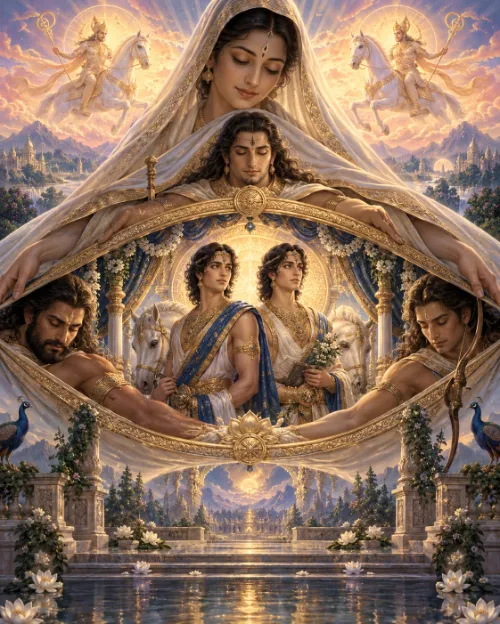
Mādrī, the Aśvins, and the layered fatherhood of the twin Pāṇḍavas
A short note in the purport to Śrīmad-Bhāgavatam 3.1.39 states:
“Nakula and Sahadeva were twin brothers, sons of Mādrī.”
The statement is completely correct—but it compresses an unusually rich piece of Mahābhārata theology and family history into a single sentence. Nakula and Sahadeva were indeed the twin sons of Queen Mādrī, Pāṇḍu’s second wife. Yet, according to the epic’s account of their extraordinary birth, their divine progenitors were themselves twins: the Aśvin gods, Nāsatya and Dasra. After Mādrī died with Pāṇḍu, Kuntī raised the two boys together with Yudhiṣṭhira, Bhīma and Arjuna, so completely integrating them into her household that the Bhāgavata can speak of the twins within the family of Pṛthā—Kuntī herself.
The verse therefore opens a window onto several themes at once: divine and human parentage, adoption and kinship, the theology of the Aśvins, the extraordinary beauty of the twins, their practical gifts, and the profound loyalty binding the five Pāṇḍavas together.
Vidura asks about “the twins”
यमावुतस्वित्तनयौ पृथायाः
पार्थैर्वृतौ पक्ष्मभिरक्षिणीव ।
रेमात उद्दाय मृधे स्वरिक्थं
परात्सुपर्णाविव वज्रिवक्त्रात् ॥
yamāv utasvit tanayau pṛthāyāḥ
pārthair vṛtau pakṣmabhir akṣiṇīva
remāta uddāya mṛdhe sva-rikthaṁ
parāt suparṇāv iva vajri-vaktrāt
“And are the twins doing well, protected by the sons of Pṛthā just as the two eyes are protected by the eyelids? Having recovered their own inheritance in battle from their enemy, may they enjoy it like Garuḍa after obtaining the nectar despite the wielder of the thunderbolt.”
Śrīmad-Bhāgavatam 3.1.39
Vidura does not even need to name Nakula and Sahadeva. He simply says: yamau — “the twins.” That alone is enough. This tells us something about how firmly Nakula and Sahadeva were perceived as a pair in the epic imagination.
But why does the verse associate them with Pṛthā?
This is one of the most intriguing details. Pṛthā is Kuntī. Yet Nakula and Sahadeva were born from Mādrī, not Kuntī. The verse nevertheless says: tanayau pṛthāyāḥ literally, “the two sons of Pṛthā.”
Immediately afterward it says that they were: pārthaiḥ vṛtau “protected by the Pārthas,” the sons of Pṛthā. The wording only makes sense when the family history is remembered.
After Mādrī’s death, Kuntī became the mother responsible for all five Pāṇḍavas. The two younger boys were not maintained as a separate Mādrī-line within the household. They were raised as Kuntī’s own.
So the verse can both distinguish the twins from Kuntī’s three biological sons and nevertheless absorb them into Pṛthā’s maternal family. That is not careless genealogy.
It reflects lived kinship.
Two mothers, one Pāṇḍava family
Pāṇḍu had two principal queens: Kuntī, also called Pṛthā and Mādrī, princess of Madra. Kuntī bore:
- Yudhiṣṭhira,
- Bhīma,
- Arjuna.
Mādrī bore:
- Nakula,
- Sahadeva.
Yet the Mahābhārata does not ultimately organize the five princes into rival maternal factions. They are simply: the five Pāṇḍavas. This becomes especially poignant because Mādrī dies while the twins are still young.
Kuntī therefore inherits not merely political responsibility for them but motherhood itself.
Why Pāṇḍu could not father children normally
The unusual birth of all five Pāṇḍavas begins with Pāṇḍu’s curse. While hunting, Pāṇḍu kills a sage who is united with his wife in the form of a deer. The dying sage curses him: if Pāṇḍu ever approaches either of his wives sexually, he will die.
This creates a dynastic catastrophe. Pāṇḍu is king. He needs heirs. Yet ordinary marital procreation has become fatal. The solution enters through Kuntī.
Kuntī’s divine mantra
Before her marriage, Kuntī had served the formidable sage Durvāsas. Pleased with her, he taught her a mantra by which she could invoke a deity and receive a child through that divine being.
Through this mantra she eventually invokes:
- Dharma → Yudhiṣṭhira
- Vāyu → Bhīma
- Indra → Arjuna.
Mādrī, however, remains childless. Pāṇḍu therefore asks Kuntī to share the mantra with her co-wife.
Kuntī agrees. And then comes one of the cleverest little moments in the birth narratives of the Mahābhārata.
Kuntī says: invoke one deity once
The epic has Kuntī instruct Mādrī:
एवमुक्ताब्रवीन्माद्रीं
सकृच्चिन्तय दैवतम् ।
तस्मात्ते भवितापत्यम्
अनुरूपमसंशयम् ॥
evam uktābravīn mādrīṁ
sakṛc cintaya daivatam
tasmāt te bhavitāpatyam
anurūpam asaṁśayam
“Thus addressed, Kuntī said to Mādrī: ‘Meditate upon a deity just once. From that deity you will certainly obtain suitable offspring.’”
The crucial word is: sakṛt “once.” Mādrī apparently receives one invocation. So whom does she choose? A deity who is already two.
Mādrī invokes the twin Aśvins
ततो माद्री विचार्यैव
जगाम मनसाश्विनौ ।
तावागम्य सुतौ तस्यां
जनयामासतुर्यमौ ॥
tato mādrī vicāryaiva
jagāma manasāśvinau
tāv āgamya sutau tasyāṁ
janayām āsatur yamau
“Then Mādrī, having carefully considered the matter, turned her mind toward the two Aśvins. They came and begot twin sons in her.”
Mahābhārata, Ādi-parvan
This is wonderfully elegant. Kuntī permits one divine invocation. Mādrī invokes the Aśvins, an inseparable pair of gods. One invocation therefore produces: yamau — twins.
Nakula and Sahadeva. The twins are thus born from twin divine fathers.
Nāsatya and Dasra: the divine twins
The Aśvins are among the oldest deities of Vedic literature. They appear repeatedly in the Ṛgveda, many centuries before the literary formation of the Mahābhārata. Their common names are: Nāsatya and Dasra.
The Śrīmad-Bhāgavatam explicitly identifies them as the divine progenitors of Nakula and Sahadeva.
शापान्मैथुनरुद्धस्य
पाण्डोः कुन्त्यां महारथाः ।
जाता धर्मानिलेन्द्रेभ्यो
युधिष्ठिरमुखास्त्रयः ॥
नकुलः सहदेवश्च
माद्र्यां नासत्यदस्रयोः ॥
śāpān maithuna-ruddhasya
pāṇḍoḥ kuntyāṁ mahā-rathāḥ
jātā dharmānilendrebhyo
yudhiṣṭhira-mukhās trayaḥ
nakulaḥ sahadevaś ca
mādryāṁ nāsatya-dasrayoḥ
“Because Pāṇḍu was prevented from sexual union by the curse, the three great warriors beginning with Yudhiṣṭhira were born through Kuntī from Dharma, Vāyu and Indra. Nakula and Sahadeva were born through Mādrī from Nāsatya and Dasra.”
Śrīmad-Bhāgavatam 9.22.27–28
This gives the traditional genealogy with complete clarity.
Who, then, was their father?
The question requires more than one answer because epic kinship functions on several levels.
None of these descriptions cancels the others. Ancient epic genealogy is often layered rather than reducible to modern biological categories.
The Mahābhārata calls them portions of the Aśvins
The relationship is not presented merely as divine paternity. Elsewhere, the Mahābhārata states:
अश्विनोस्तु तथैवांशौ
रूपेणाप्रतिमौ भुवि ।
नकुलः सहदेवश्च
सर्वलोकमनोहरौ ॥
aśvinos tu tathaivāṁśau
rūpeṇāpratimau bhuvi
nakulaḥ sahadevaś ca
sarva-loka-manoharau
“Nakula and Sahadeva were likewise portions of the two Aśvins, incomparable in beauty upon the earth and captivating to all people.”
The significant word is: aṁśau “two portions” or “two manifestations.” Thus the twins participate in the common epic pattern whereby great heroes are simultaneously human royal figures and earthly manifestations of divine beings.
They were famous for extraordinary beauty
The Mahābhārata emphasizes this immediately after their birth.
नकुलं सहदेवं च
रूपेणाप्रतिमौ भुवि ॥
nakulaṁ sahadevaṁ ca
rūpeṇāpratimau bhuvi
“Nakula and Sahadeva were incomparable in beauty upon the earth.”
The phrase: rūpeṇa apratimau means literally:
“having no equal in beauty.”
This is not merely a later artistic tradition. Their beauty is part of their earliest epic characterization.
Beauty, brilliance, and noble qualities
The epic then associates physical beauty with deeper excellence:
रूपसत्त्वगुणोपेताव्
एतावन्याञ्जनानति ।
भासतस्तेजसात्यर्थं
रूपद्रविणसम्पदा ॥
rūpa-sattva-guṇopetāv
etāv anyāñ janān ati
bhāsatas tejasātyarthaṁ
rūpa-draviṇa-sampadā
“These two, endowed with beauty, strength of character and excellent qualities, surpassed other people and shone greatly with splendor and richness of form.”
Several qualities are brought together:
- rūpa — beauty
- sattva — strength of character, nobility
- guṇa — excellent qualities
- tejas — brilliance, splendor.
The twins are therefore portrayed not merely as handsome, but as radiant and accomplished princes.
Why beauty suits sons of the Aśvins
The connection is not accidental. The Aśvins are repeatedly portrayed in Vedic literature as:
- youthful,
- radiant,
- beautiful,
- swift,
- benevolent,
- rescuers,
- healers,
- closely associated with horses.
Their Pāṇḍava sons inherit a literary aura very much in keeping with those divine prototypes. Especially Nakula.
The Aśvins: ancient divine physicians
The Ṛgveda calls the Aśvins: daivyā bhiṣajā “the two divine physicians.”
उत त्या दैव्या भिषजा
शं नः करतो अश्विना ।
युयुयातामितो रपो
अप स्रिधः ॥
uta tyā daivyā bhiṣajā
śaṁ naḥ karato aśvinā
yuyuyātām ito rapo
apa sridhaḥ
“May those two divine physicians, the Aśvins, bring us well-being; may they drive away affliction and remove what harms us.”
Ṛgveda 8.18.8
The twins are among the great rescuing and healing gods of the Ṛgveda. Their myths repeatedly involve:
- restoring health,
- rescuing people from danger,
- restoring lost faculties,
- rejuvenation,
- swift arrival in crisis.
This makes the Pāṇḍava twins’ own technical competence especially fitting.
Nakula and the horses
The word Aśvin itself is related to: aśva — horse. The Aśvins are the divine horsemen. So it is especially striking that during the Pāṇḍavas’ year of disguise at King Virāṭa’s court, Nakula chooses to become the royal keeper and trainer of horses.
अश्वबन्धो भविष्यामि
विराटनृपतेरहम् ।
ग्रन्थिको नाम नाम्नाहं
कर्मैतत्सुप्रियं मम ॥
aśva-bandho bhaviṣyāmi
virāṭa-nṛpater aham
granthiko nāma nāmnāhaṁ
karmaitat supriyaṁ mama
“I shall become King Virāṭa’s keeper of horses. I shall be known by the name Granthika, for this work is very dear to me.”
Mahābhārata, Virāṭa-parvan
Nakula is not merely able to ride. He claims expertise in:
- horse breeding,
- training,
- care,
- recognizing their qualities,
- and treating their illnesses.
For the son of the divine Aśvin horsemen and physicians, the symbolism is almost perfect.
Sahadeva and the cattle
Sahadeva chooses a parallel but distinct field of expertise. During the incognito year he becomes responsible for Virāṭa’s cattle. The epic portrays him as skilled in:
- identifying cattle,
- herd management,
- breeding,
- health,
- and practical animal husbandry.
The younger Pāṇḍavas are therefore not simply “the two less important brothers.” Each possesses specialized knowledge. Nakula is especially identified with horses. Sahadeva with cattle.
And both remain formidable kṣatriya warriors.
Mādrī’s tragic death
The twins’ childhood becomes dramatically different after Pāṇḍu’s death. The curse upon Pāṇḍu is finally fulfilled when desire overwhelms him and he approaches Mādrī. He dies.
Mādrī then concludes that she, rather than Kuntī, should follow Pāṇḍu in death. The result is devastating: Nakula and Sahadeva lose both parents at once. They are still children.
Kuntī survives. And this is where the family structure of Bhāgavatam 3.1.39 becomes understandable.
Mādrī entrusts the twins to Kuntī
The emotional logic of the episode is crucial. Mādrī recognizes that Kuntī is better positioned to raise all five boys impartially. Kuntī therefore becomes responsible for: Yudhiṣṭhira, Bhīma, Arjuna, Nakula, Sahadeva.
The distinction between “Kuntī’s three” and “Mādrī’s two” does not disappear genealogically. But emotionally and socially, one mother now protects five sons. This is what lies behind the Bhāgavata’s striking use of Pṛthā’s name.
Why the eye-and-eyelid metaphor is so beautiful
Now return to Vidura’s words: pārthair vṛtau pakṣmabhir akṣiṇīva “protected by the Pārthas as the two eyes are protected by the eyelids.” This is an extraordinarily intimate comparison.
An eyelid does not protect the eye like a soldier guarding a distant fortress. It is:
- physically close,
- instinctively responsive,
- constantly present,
- naturally protective.
The three elder brothers therefore guard Nakula and Sahadeva not merely as fellow princes. They protect them as something belonging to their own body.
The twins themselves become “the two eyes”
There is an elegant poetic correspondence: yamau — the two twins are compared to: akṣiṇī — the two eyes. Two brothers. Two eyes. And surrounding the two eyes: pakṣmāṇi — eyelids/lashes.
The simile subtly preserves their twin identity even in its grammar. Nakula and Sahadeva are presented as a precious pair.
Not “half-brothers” in any meaningful emotional sense
Technically, modern language may call the Pāṇḍavas half-brothers because they had different mothers and different divine progenitors. But that description is emotionally misleading.
The epic consistently portrays them as a single fraternal unit. They share:
- exile,
- humiliation,
- danger,
- political dispossession,
- marriage alliances,
- military struggle,
- Kurukṣetra,
- kingship,
- and eventually the final journey.
The maternal distinction never becomes a fracture within the five. That is exactly what makes Vidura’s metaphor so effective.
Sva-riktham: their own inheritance
The next important word in 3.1.39 is: sva-riktham
Thus Vidura says that the twins recovered:
“their own inheritance.”
This matters enormously to the moral framing of the Kurukṣetra conflict. The Pāṇḍavas are not described here as imperial aggressors who seized someone else’s wealth. They recover: sva-riktham what properly belongs to them.
The political struggle is therefore framed as restoration of dispossessed rights.
Why Garuḍa suddenly appears
The final comparison in the verse is: suparṇāv iva vajri-vaktrāt “like Suparṇa/Garuḍa in relation to the wielder of the thunderbolt.” The allusion is to the famous myth of Garuḍa obtaining amṛta, the nectar of immortality.
Garuḍa overcomes enormous opposition, including conflict involving Indra, the wielder of the thunderbolt: vajrī “he who possesses the vajra.” Vidura compares the Pāṇḍavas’ recovery of their kingdom to Garuḍa’s recovery of the nectar.
The underlying idea is:
something precious has been obtained despite overwhelming opposition.
Garuḍa and the Pāṇḍavas share another feature
The comparison is not merely military. Garuḍa is intimately connected with Viṣṇu. The Pāṇḍavas are intimately connected with Kṛṣṇa. So the analogy carries a devotional undertone: divine protection enables victory against apparently superior worldly power.
Duryodhana had:
- immense military resources,
- Bhīṣma,
- Droṇa,
- Karṇa,
- Śalya,
- vast allied armies.
Yet the Pāṇḍavas had: Kṛṣṇa. The Bhāgavata’s theology repeatedly makes that distinction decisive.
Nakula and Sahadeva are quieter—but not insignificant
Modern retellings of the Mahābhārata often revolve almost entirely around: Arjuna, Bhīma, Yudhiṣṭhira, Karna, Draupadī, Kṛṣṇa. Nakula and Sahadeva therefore easily become background figures.
But the Sanskrit epic gives them distinct identities.
Nakula
He is famous for:
- extraordinary beauty,
- swordsmanship,
- horsemanship,
- veterinary expertise,
- royal conduct.
Sahadeva
He is associated with:
- intelligence,
- careful judgment,
- cattle management,
- warfare,
- quiet competence.
Both fight throughout the Kurukṣetra war. Both participate in the Pāṇḍavas’ political and military life. And Vidura specifically asks about them.
Five Pāṇḍavas, five divine lineages
The whole family embodies an unusual combination of human dynasty and divine participation.
Yet all five belong dynastically to: Pāṇḍu. This is why “fatherhood” in the epic cannot be reduced to one modern biological category.
There is: divine begetting, dynastic fatherhood, maternal descent, and social parenthood. The five Pāṇḍavas exist at the intersection of all four.
Mādrī’s choice is symbolically perfect
There is a particularly beautiful symmetry in the birth story. Mādrī herself enters the Pāṇḍava family as the second wife. She longs for children after seeing Kuntī already possessing three sons.
Given one opportunity to invoke divine help, she calls upon the divine pair. The result is a pair. Thus:
- twin gods
- one invocation
- twin sons
The structure is almost too elegant to be accidental.
Why the Aśvin connection matters beyond genealogy
The divine parentage also helps characterize the twins. The Aśvins embody:
- youth,
- beauty,
- swiftness,
- horsemanship,
- medicine,
- rescue,
- practical skill.
Nakula and Sahadeva similarly appear as:
- exceptionally beautiful,
- youthful princes,
- technically skilled,
- closely associated with animal husbandry,
- excellent warriors.
This is a common feature of epic divine parentage: the human hero reflects something of the deity from whom he descends. Bhīma resembles Vāyu in force. Arjuna resembles Indra in warrior brilliance.
Yudhiṣṭhira resembles Dharma in ethical consciousness. Nakula and Sahadeva bear the literary imprint of the Aśvins.
Why “sons of Mādrī” is true—but incomplete
We can now see the layers hidden inside the purport sentence.
“Nakula and Sahadeva were twin brothers, sons of Mādrī.”
Correct. But more fully: They are: sons of Mādrī by birth, sons of the twin Aśvins in divine genealogy, sons of Pāṇḍu in dynastic identity, and sons of Kuntī in maternal upbringing after Mādrī’s death.
Each statement captures a different dimension of the same family reality.
The deeper emotional meaning of Śrīmad-Bhāgavatam 3.1.39
Vidura’s question is therefore much more than:
“How are Nakula and Sahadeva?”
Every phrase carries history.
A single verse quietly compresses: birth, bereavement, adoption, brotherhood, exile, injustice, battle, restoration and divine protection. That is the density of Purāṇic poetry.
The most striking image: two orphaned boys become the family’s two eyes
Perhaps the most beautiful point is not theological but human. Nakula and Sahadeva lose Mādrī. They lose Pāṇḍu. They are the youngest. They could easily have become marginal figures within a complicated royal family.
Instead, Kuntī raises them. Their elder brothers surround them. And the Bhāgavata compares them to: the two eyes protected by eyelids. That metaphor tells us how completely the Pāṇḍava family absorbed the twins.
Not tolerated. Not merely provided for. Protected as one protects one’s own sight.
The short purport statement is therefore correct, but a fuller formulation would be:
Nakula and Sahadeva were the twin youngest Pāṇḍavas, born from Queen Mādrī when she invoked the twin Aśvin gods, Nāsatya and Dasra, through the mantra shared with her by Kuntī. The Mahābhārata describes them as earthly portions of the Aśvins and emphasizes their exceptional beauty and brilliance. After Mādrī died with Pāṇḍu, Kuntī raised them together with Yudhiṣṭhira, Bhīma and Arjuna as her own sons. This family history explains why Śrīmad-Bhāgavatam 3.1.39 can associate the twins with Pṛthā and compare the three elder Pāṇḍavas’ protection of them to eyelids guarding the two eyes.
The verse therefore preserves a beautiful paradox of epic kinship:
Nakula and Sahadeva have several fathers and two mothers in different senses—but only one Pāṇḍava family.
And perhaps that is why the simplest name for them remains the most fitting: yamau “the twins.”
Principal texts
- Śrīmad-Bhāgavatam 3.1.39
- Śrīmad-Bhāgavatam 9.22.27–28
- Mahābhārata, Ādi-parvan — birth of Nakula and Sahadeva
- Mahābhārata, Ādi-parvan — Aṁśāvataraṇa passages
- Mahābhārata, Virāṭa-parvan — Nakula and Sahadeva during the incognito year
- Ṛgveda — hymns to the Aśvins, including their designation as divine physicians