

Kṛṣṇa in Dvārakā and Vṛndāvana
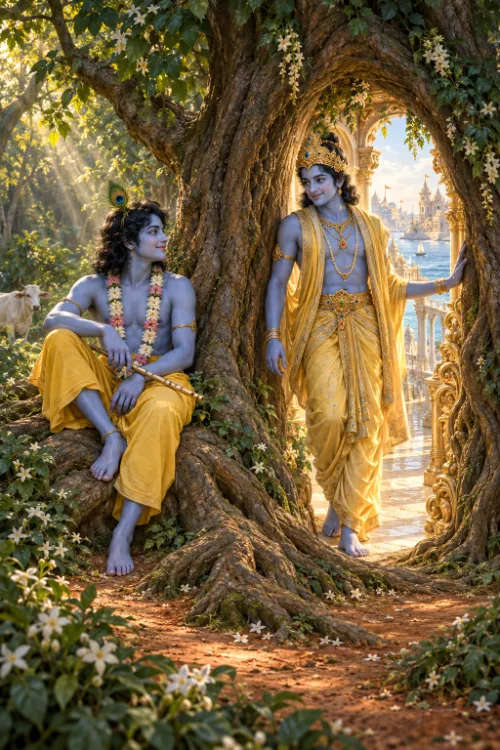
One Godhead, distinct divine relationships
How can Kṛṣṇa remain eternally in Vṛndāvana while living and acting in Dvārakā? Gauḍīya Vaiṣṇava theology answers through divine manifestation: the Supreme Person can reveal Himself in distinct forms and relationships without dividing His being or exhausting His presence.
The distinction concerns more than location. In Vraja, Kṛṣṇa lives as a cowherd, surrounded by intimate affection. As Vāsudeva in Mathurā and Dvārakā, He manifests royal relationships and responsibilities. Both are fully divine. Yet their pastimes disclose different configurations of identity, affection, majesty, and sweetness.
Equal divinity does not make every divine relationship interchangeable. This principle is essential to understanding a striking statement in A. C. Bhaktivedanta Swami Prabhupāda’s purport to Śrīmad-Bhāgavatam 3.1.34: “Lord Kṛṣṇa in Dvārakā is the Vāsudeva expansion of the original group.”
The same purport affirms that the original Kṛṣṇa eternally remains in Goloka Vṛndāvana and that His plenary manifestations share the same divine nature and potency. Read together with the Sanskrit and Bengali sources, these statements form a coherent account of unity that includes real personal distinction.
The account below presents the Gauḍīya interpretation represented by these texts. Other Vaiṣṇava traditions do not necessarily organize the relationships among divine forms in exactly the same way. Sanskrit quotations are supplied in Devanāgarī with IAST transliteration; Bengali quotations retain their original script. English translations are explanatory renderings unless expressly attributed.
The immediate setting of Śrīmad-Bhāgavatam 3.1.34 is a conversation between Vidura and Uddhava. Vidura asks about Aniruddha:
अपिस्विदास्ते भगवान् सुखं वो
यः सात्वतां कामदुघोऽनिरुद्धः ।
यमामनन्ति स्म हि शब्दयोनिं
मनोमयं सत्त्वतुरीयतत्त्वम् ॥
apisvid āste bhagavān sukhaṁ vo
yaḥ sātvatāṁ kāma-dugho ’niruddhaḥ
yam āmananti sma hi śabda-yoniṁ
mano-mayaṁ sattva-turīya-tattvam
“Is Bhagavān Aniruddha, who fulfills the desires of the Sātvatas, living happily among you? From ancient times He has been acknowledged as the source of sacred revelation, the principle associated with mind, and the fourth transcendent manifestation.”
Śrīmad-Bhāgavatam 3.1.34
The final expressions are rendered here according to the theological reading developed in the commentary. The verse combines a personal inquiry with recognition of Aniruddha’s divine identity.
The verse and the purport should be distinguished. The Sanskrit verse asks about Aniruddha; the commentary explains Him through the fourfold manifestation and identifies Dvārakā Kṛṣṇa within that framework. The sentence about Vāsudeva is therefore a statement in Prabhupāda’s commentary, rather than a literal translation of words occurring in this verse.
Catur-vyūha means “fourfold manifestation” or “fourfold arrangement.” In the Dvārakā setting, its names correspond to these divine persons:
These family relationships belong to the narrative unfolding of divine pastimes. Within Gauḍīya theology, they do not imply that eternal divine persons first acquire existence through material reproduction. The distinction between divine manifestation and ordinary birth is indispensable here.
A small textual caution belongs alongside this table. The surrounding purport to 3.1.34 calls Aniruddha Kṛṣṇa’s son. Read as immediate genealogy, that wording is inaccurate: Śrīmad-Bhāgavatam 10.61.18 identifies Pradyumna as His father and Rukmavatī as His mother. Aniruddha is therefore Kṛṣṇa’s grandson. This correction concerns the genealogical wording; it does not alter the purport’s identification of Dvārakā Kṛṣṇa as Vāsudeva.
Spelling also matters. Vasudeva, with a short initial a, is Kṛṣṇa’s father. Vāsudeva, with a long initial ā, names Kṛṣṇa as Vasudeva’s son and also functions as a divine name in the fourfold manifestation. These usages overlap, so their significance must be established from context.
The four names are rooted in the Bhāgavata’s own language of worship. In Śrīmad-Bhāgavatam 4.24.34–36, Śiva prays:
नमः पङ्कजनाभाय भूतसूक्ष्मेन्द्रियात्मने ।
वासुदेवाय शान्ताय कूटस्थाय स्वरोचिषे ॥
सङ्कर्षणाय सूक्ष्माय दुरन्तायान्तकाय च ।
नमो विश्वप्रबोधाय प्रद्युम्नायान्तरात्मने ॥
नमो नमोऽनिरुद्धाय हृषीकेशेन्द्रियात्मने ।
नमः परमहंसाय पूर्णाय निभृतात्मने ॥
namaḥ paṅkaja-nābhāya
bhūta-sūkṣmendriyātmane
vāsudevāya śāntāya
kūṭa-sthāya sva-rociṣe
saṅkarṣaṇāya sūkṣmāya
durantāyāntakāya ca
namo viśva-prabodhāya
pradyumnāyāntar-ātmane
namo namo ’niruddhāya
hṛṣīkeśendriyātmane
namaḥ paramahaṁsāya
pūrṇāya nibhṛtātmane
“Obeisance to the lotus-naveled Lord, the ground of the subtle elements and senses; to Vāsudeva, peaceful, unchanging, and self-luminous.
“Obeisance to Saṅkarṣaṇa, subtle, unsurpassable, and the bringer of dissolution; and to Pradyumna, the inner Self who awakens the universe.
“Repeated obeisance to Aniruddha, Lord and inner ruler of the senses; obeisance to the supreme swan, complete and inwardly established.”
Śrīmad-Bhāgavatam 4.24.34–36
The names carry a significance extending beyond genealogy. They express divine governance of existence and the inner life of living beings. The commentaries elaborate their connections with the mind, intelligence, senses, and cosmic processes. Their exact functions should be read within the particular passage, rather than forced into a single chart supposedly covering every theological system.
The phrase “the original group” also needs explanation. Gauḍīya texts distinguish the original fourfold manifestation associated with Dvārakā from a subsequent fourfold manifestation in the spiritual sky. Caitanya-caritāmṛta Ādi 5.40 states:
সেই পরব্যোমে নারায়ণের চারি পাশে ।
দ্বারকা–চতুর্ব্যূহের দ্বিতীয় প্রকাশে ॥
sei para-vyome nārāyaṇera cāri pāśe
dvārakā-catur-vyūhera dvitīya prakāśe
“In that spiritual sky, surrounding Nārāyaṇa on four sides, appears the second manifestation of Dvārakā’s fourfold expansion.”
Caitanya-caritāmṛta Ādi 5.40
Caitanya-caritāmṛta Madhya 20.193 likewise describes a second manifestation of the four forms. Consequently, the appearance of the same divine name in two passages does not by itself establish that both passages concern exactly the same level of manifestation. The surrounding discussion must identify the reference.
These descriptions express relationships of manifestation and theological origin. They should not be imagined as a sequence of material births in which God gradually assembles Himself over time.
The foundation for the Gauḍīya understanding of Kṛṣṇa’s original identity is Śrīmad-Bhāgavatam 1.3.28:
एते चांशकलाः पुंसः कृष्णस्तु भगवान् स्वयम् ।
इन्द्रारिव्याकुलं लोकं मृडयन्ति युगे युगे ॥
ete cāṁśa-kalāḥ puṁsaḥ
kṛṣṇas tu bhagavān svayam
indrāri-vyākulaṁ lokaṁ
mṛḍayanti yuge yuge
“These are portions and portions of portions of the Supreme Person; Kṛṣṇa, however, is Bhagavān Himself. Age after age they bring relief to the world troubled by Indra’s enemies.”
Śrīmad-Bhāgavatam 1.3.28
Gauḍīya theologians give particular weight to kṛṣṇas tu bhagavān svayam, “Kṛṣṇa, however, is Bhagavān Himself.” They read it as establishing Kṛṣṇa as the original Supreme Person from whom divine manifestations proceed.
Prabhupāda’s commentary to this verse distinguishes divine capacity from the particular powers displayed in a given mission. A manifestation reveals the powers appropriate to its activities. The display does not exhaust the divine reality from which it proceeds.
The vocabulary of manifestation becomes more precise in Caitanya-caritāmṛta Madhya 20.174–188. The original form is called svayaṁ-rūpa, “His own original form.” Other categories describe personal manifestations and forms appropriate to particular pastimes. Balarāma is identified as a vaibhava-prakāśa, a manifestation of Kṛṣṇa, while the original fourfold forms are discussed as prābhava-vilāsa, manifestations for distinct divine pastimes.
For understanding Vraja and Dvārakā, the most accessible statement is Madhya 20.177:
স্বয়ংরূপের গোপবেশ, গোপ-অভিমান ।
বাসুদেবের ক্ষত্রিয়-বেশ, ‘আমি — ক্ষত্রিয়’-জ্ঞান ॥
svayaṁ-rūpera gopa-veśa, gopa-abhimāna
vāsudevera kṣatriya-veśa, ‘āmi — kṣatriya’-jñāna
“In His own original form, He has the dress and self-understanding of a cowherd. As Vāsudeva, He has a warrior’s dress and the awareness, ‘I am a kṣatriya.’”
Caitanya-caritāmṛta Madhya 20.177
The distinction reaches into the character of His relationships. The word abhimāna here concerns His sense of identity within His pastimes. His cowherd identity includes a world of belonging and affection; His royal identity includes another configuration of family life and responsibility.
These forms cannot be adequately explained as a change of costume. Their devotional identities have real significance. At the same time, visible appearance alone cannot settle every theological classification: Madhya 20.175–176 discusses Devakī’s son in both two-armed and four-armed forms. Dvārakā Kṛṣṇa therefore need not always be depicted with four arms.
The teaching that Kṛṣṇa never leaves Vṛndāvana has an identifiable textual basis. Caitanya-caritāmṛta Antya 1.67 quotes:
कृष्णोऽन्यो यदुसम्भूतो यः पूर्णः सोऽस्त्यतः परः ।
वृन्दावनं परित्यज्य स क्वचिन्नैव गच्छति ॥
kṛṣṇo ’nyo yadu-sambhūto
yaḥ pūrṇaḥ so ’sty ataḥ paraḥ
vṛndāvanaṁ parityajya
sa kvacin naiva gacchati
“The Kṛṣṇa who appears in the Yadu dynasty is a distinct manifestation; the complete Kṛṣṇa is beyond that manifestation. He never goes anywhere abandoning Vṛndāvana.”
Caitanya-caritāmṛta Antya 1.67
This rendering makes explicit the manifestation distinction through which the Gauḍīya tradition reads the verse. Its language of difference does not establish two unrelated Supreme Beings.
The purport locates the quotation in Rūpa Gosvāmī’s Laghu-bhāgavatāmṛta 1.5.461. That is a precise, verifiable reference for the verse as quoted here. Assigning it an earlier Purāṇa location would require separate textual verification.
Immediately before this, in Antya 1.66, Caitanya instructs Rūpa:
কৃষ্ণেরে বাহির নাহি করিহ ব্রজ হৈতে ।
ব্রজ ছাড়ি’ কৃষ্ণ কভু না যান কাহাঁতে ॥
kṛṣṇere bāhira nāhi kariha vraja haite
vraja chāḍi’ kṛṣṇa kabhu nā yāna kāhāṅte
“Do not take Kṛṣṇa outside Vraja. Kṛṣṇa never goes anywhere leaving Vraja.”
Caitanya-caritāmṛta Antya 1.66
The instruction concerns the presentation of Kṛṣṇa’s pastimes as well as their theology. The particular identity and devotional atmosphere of Vraja must be preserved. Read within this framework, “never leaves” affirms the eternal presence of Kṛṣṇa’s original Vraja manifestation. It does not require deleting the Bhāgavata’s accounts of His activities in Mathurā and Dvārakā. Gauḍīya theology reads the narrative movements together with the doctrine of His eternal manifestations.
The same care is needed with the devotees’ separation. The eternal presence of Vraja Kṛṣṇa does not make their longing trivial. Statements about divine presence and descriptions of experienced separation address distinct dimensions of divine life. A theological explanation should preserve the seriousness of the relationships it seeks to explain.
Nor does remaining in Goloka confine God to one geographical point. Brahma-saṁhitā 5.37 joins residence in Goloka with universal presence:
आनन्दचिन्मयरसप्रतिभाविताभिस्
ताभिर्य एव निजरूपतया कलाभिः ।
गोलोक एव निवसत्यखिलात्मभूतो
गोविन्दमादिपुरुषं तमहं भजामि ॥
ānanda-cinmaya-rasa-pratibhāvitābhis
tābhir ya eva nija-rūpatayā kalābhiḥ
goloka eva nivasaty akhilātma-bhūto
govindam ādi-puruṣaṁ tam ahaṁ bhajāmi
“I worship Govinda, the primordial Person, who resides in Goloka with those manifestations of His own potency who are imbued with blissful spiritual rasa, while Himself being the Self of all.”
Brahma-saṁhitā 5.37
Here rasa means the experienced flavor of spiritual relationship. The third line holds two affirmations together: He resides in Goloka, and He is the Self of all. His presence in His own abode does not exclude His presence elsewhere.
The Bhāgavata also portrays simultaneous personal presence in a narrative setting. In Śrīmad-Bhāgavatam 10.69.2, Nārada marvels:
चित्रं बतैतदेकेन वपुषा युगपत्पृथक् ।
गृहेषु द्व्यष्टसाहस्रं स्त्रिय एक उदावहत् ॥
citraṁ bataitad ekena
vapuṣā yugapat pṛthak
gṛheṣu dvy-aṣṭa-sāhasraṁ
striya eka udāvahat
“How astonishing! He alone, with one form, simultaneously married sixteen thousand women in separate residences.”
Śrīmad-Bhāgavatam 10.69.2
The words yugapat, “simultaneously,” and pṛthak, “separately,” establish the extraordinary character of this presence. This episode does not independently prove every detail of the Vraja–Dvārakā distinction. It does, however, show that the Bhāgavata’s account of divine embodiment already exceeds the limitations of an ordinary body occupying one place at a time.
The traditional image for full divine manifestation is a lamp lighting another lamp. Brahma-saṁhitā 5.46 states:
दीपार्चिरेव हि दशान्तरमभ्युपेत्य
दीपायते विवृतहेतुसमानधर्मा ।
यस्तादृगेव हि च विष्णुतया विभाति
गोविन्दमादिपुरुषं तमहं भजामि ॥
dīpārcir eva hi daśāntaram abhyupetya
dīpāyate vivṛta-hetu-samāna-dharmā
yas tādṛg eva hi ca viṣṇutayā vibhāti
govindam ādi-puruṣaṁ tam ahaṁ bhajāmi
“As a lamp’s flame, passing to another wick, shines with the same nature as the flame from which it was kindled, so Govinda manifests as Viṣṇu. I worship that Govinda, the primordial Person.”
Brahma-saṁhitā 5.46
The analogy preserves a relation of origin alongside equality of nature. One flame kindles another, and the second is fully fire. In theological terms, viṣṇu-tattva identifies these forms as belonging to the divine reality of the Lord Himself.
“Expansion” therefore need not imply a weaker copy, a fragment detached from a larger body, or a finite soul elevated to Godhood. The language concerns personal divine manifestation. The analogy should illuminate that point without importing every physical property of ordinary flames into the doctrine.
The most important qualification follows: full divinity coexists with distinctions in the manifestation of qualities and rasa. Rūpa Gosvāmī states the principle in Bhakti-rasāmṛta-sindhu 1.2.59, quoted in Caitanya-caritāmṛta Madhya 9.117:
सिद्धान्ततस्त्वभेदेऽपि श्रीशकृष्णस्वरूपयोः ।
रसेनोत्कृष्यते कृष्णरूपमेषा रसस्थितिः ॥
siddhāntatas tv abhede ’pi
śrīśa-kṛṣṇa-svarūpayoḥ
rasenotkṛṣyate kṛṣṇa-
rūpam eṣā rasa-sthitiḥ
“Although, in established doctrine, there is no difference between the forms of Lakṣmī’s Lord and Kṛṣṇa, Kṛṣṇa’s form excels in rasa. Such is the determination concerning rasa.”
Bhakti-rasāmṛta-sindhu 1.2.59
This verse directly compares Nārāyaṇa and Kṛṣṇa. It also articulates a principle useful for understanding the wider Gauḍīya account: non-difference in Godhead does not erase distinctions in the character of loving relationships.
Rasa involves the intimacy, sweetness, and particular emotional life of devotion. Divine greatness includes the capacity to enter these relationships fully. Gauḍīya theology consequently gives special prominence to Kṛṣṇa’s Vraja manifestation without denying the divinity of His other forms.
Rūpa gives a more technical statement in Bhakti-rasāmṛta-sindhu 2.1.222, quoted in Caitanya-caritāmṛta Madhya 20.400:
प्रकाशिताखिलगुणः स्मृतः पूर्णतमो बुधैः ।
असर्वव्यञ्जकः पूर्णतरः पूर्णोऽल्पदर्शकः ॥
prakāśitākhila-guṇaḥ
smṛtaḥ pūrṇatamo budhaiḥ
asarva-vyañjakaḥ pūrṇa-
taraḥ pūrṇo ’lpa-darśakaḥ
“The wise call Him ‘most complete’ when all His qualities are manifested; ‘more complete’ when He does not manifest them all; and ‘complete’ when He displays comparatively fewer.”
Bhakti-rasāmṛta-sindhu 2.1.222
The terms are pūrṇa, “complete”; pūrṇatara, “more complete”; and pūrṇatama, “most complete.” The operative language concerns what is manifested. It should not be read as a scale measuring how much Godhood a form possesses.
The following verse, Bhakti-rasāmṛta-sindhu 2.1.223, quoted in Caitanya-caritāmṛta Madhya 20.401, applies this language to Kṛṣṇa’s settings:
कृष्णस्य पूर्णतमता व्यक्ताभूद्गोकुलान्तरे ।
पूर्णता पूर्णतरता द्वारकामथुरादिषु ॥
kṛṣṇasya pūrṇatamatā
vyaktābhūd gokulāntare
pūrṇatā pūrṇataratā
dvārakā-mathurādiṣu
“Kṛṣṇa’s most complete manifestation appeared within Gokula; His completeness and greater completeness appeared in Dvārakā, Mathurā, and related settings.”
Bhakti-rasāmṛta-sindhu 2.1.223
This language makes it impossible to reduce the teaching to an undifferentiated assertion that all forms display everything identically. The tradition affirms real excellence in the fullness of revelation while maintaining the divine identity of the manifestations themselves.
A reader can therefore keep three questions distinct. Who is present? The fully divine Lord. In what manifestation and relationships? Those appropriate to the particular form and setting. What is being disclosed? A particular fullness of qualities, pastimes, and devotional sweetness.
This approach also encourages care in devotional judgment. Recognition of Vraja’s special place in Gauḍīya theology need not diminish reverence for Vāsudeva, Nārāyaṇa, or other personal manifestations of the Lord. Their distinctiveness is part of what makes their worship and relationships meaningful.
Kṛṣṇa’s presence in Dvārakā and His eternal life in Vṛndāvana thus belong to a theology in which divine unity sustains personal variety. His full presence is inexhaustible, and His relationships have enduring significance. The Godhead’s completeness includes the freedom to reveal majesty, intimacy, and love in distinct forms without ceasing to be one.
Texts and online sources
The passages were checked in the following online editions. The Bhakti-rasāmṛta-sindhu and Laghu-bhāgavatāmṛta references above are supplied through their quotations and identifications in Caitanya-caritāmṛta; this article does not claim an independent manuscript collation of those works. Sanskrit passages printed in Bengali script in that edition have been presented here in Devanāgarī.
- Śrīmad-Bhāgavatam 3.1.34: verse and Prabhupāda’s purport.
- Śrīmad-Bhāgavatam 4.24.34, 4.24.35, and 4.24.36: Śiva’s prayers naming the four manifestations.
- Śrīmad-Bhāgavatam 1.3.28: Kṛṣṇa as Bhagavān Himself.
- Śrīmad-Bhāgavatam 10.61.18: Aniruddha’s parentage.
- Śrīmad-Bhāgavatam 10.69.1–6: includes verse 2 on simultaneous presence in separate residences.
- Caitanya-caritāmṛta Ādi 5.40: the second fourfold manifestation.
- Caitanya-caritāmṛta Madhya 20.174, 20.175, 20.176, and 20.177: manifestation categories, bodily forms, and relational identities.
- Caitanya-caritāmṛta Madhya 20.187, 20.188, and 20.193: Balarāma and the fourfold manifestations.
- Caitanya-caritāmṛta Antya 1.66 and 1.67: Kṛṣṇa’s eternal presence in Vraja; the latter identifies Laghu-bhāgavatāmṛta 1.5.461.
- Brahma-saṁhitā 5.37: residence in Goloka and universal presence.
- Brahma-saṁhitā 5.46: the lamp analogy.
- Caitanya-caritāmṛta Madhya 9.117: Bhakti-rasāmṛta-sindhu 1.2.59 on divine identity and rasa.
- Caitanya-caritāmṛta Madhya 20.398, 20.399, 20.400, and 20.401: fullness of manifestation and quotations from Bhakti-rasāmṛta-sindhu 2.1.221–223.