

When Vṛndāvana Makes Prema Explode
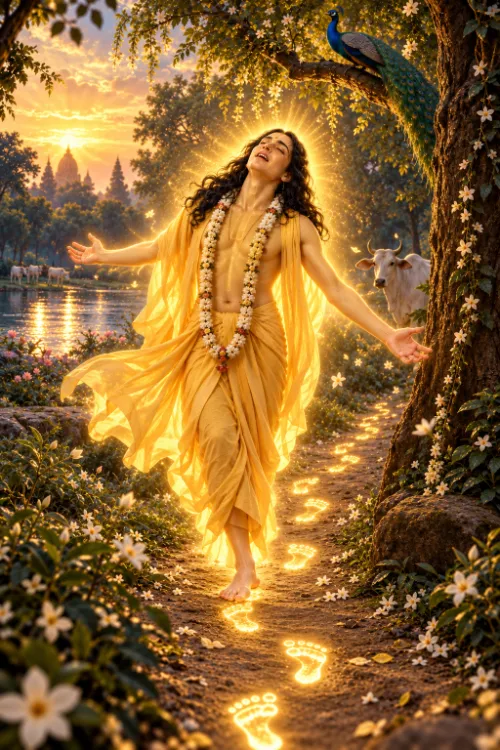
Caitanya’s journey into Vraja and the stimuli that intensify divine love
Some places do more than hold memories. They awaken them. In Gauḍīya Vaiṣṇava theology, Vṛndāvana is not merely the historical setting of Kṛṣṇa’s childhood and youth. It is līlā-bhūmi—the living landscape of His most intimate pastimes. Its forests, riverbanks, hills, animals, trees, flowers, pathways, and even its dust are connected with Kṛṣṇa’s relationships with the Vrajavāsīs.
This is why Śrī Caitanya Mahāprabhu’s entrance into Vraja is described in language of almost unimaginable emotional escalation.
নীলাচলে ছিলা যৈছে প্রেমাবেশ মন ।
বৃন্দাবন যাইতে পথে হৈল শত-গুণ ॥
nīlācale chilā yaiche premāveśa mana
vṛndāvana yāite pathe haila śata-guṇa
“Śrī Caitanya Mahāprabhu’s mind was absorbed in ecstatic love at Nīlācala, Jagannātha Purī, but as He traveled on the road toward Vṛndāvana, that love became a hundredfold.”
Caitanya-caritāmṛta, Madhya 17.226
Then the intensity rises dramatically.
সহস্রগুণ প্রেম বাড়ে মথুরা দরশনে ।
লক্ষগুণ প্রেম বাড়ে, ভ্রমেন যবে বনে ॥
sahasra-guṇa prema bāḍe mathurā daraśane
lakṣa-guṇa prema bāḍe, bhramena yabe vane
“His prema increased a thousandfold upon seeing Mathurā, and it increased a hundred thousandfold when He wandered through the forests of Vṛndāvana.”
Caitanya-caritāmṛta, Madhya 17.227
These verses are not simply saying that Mahāprabhu “felt happier” as He approached Vṛndāvana. They describe a progressive intensification of already perfect divine love, caused by increasing proximity to the places saturated with Kṛṣṇa’s līlā.
The key to understanding them lies in three ideas:
prema, uddīpana, and dhāma.
First: Mahāprabhu is already in premāveśa
The first verse says: premāveśa mana This is stronger than saying: “His mind was full of love.”
So premāveśa suggests:
a consciousness flooded and dominated by prema.
That means the starting point is already extraordinary. At Jagannātha Purī, Mahāprabhu is not emotionally neutral. He is already immersed in ecstatic love. Yet Kṛṣṇadāsa says that on the road to Vṛndāvana the intensity becomes: śata-guṇa “a hundredfold.”
Then in Mathurā: sahasra-guṇa “a thousandfold.” Then in Vṛndāvana: lakṣa-guṇa “a hundred thousandfold.” The entire passage is built around escalating impossibility.
Are the numbers meant literally?
The Sanskrit-derived Bengali numerals themselves are exact:
- śata — one hundred
- sahasra — one thousand
- lakṣa — one hundred thousand
But the passage should not be read as if Kṛṣṇadāsa were performing a mathematical measurement of mystical emotion.
The numbers function as ascending poetic magnitudes. The structure is what matters:
- Nīlācala
- road to Vṛndāvana
- Mathurā
- Vṛndāvana forests
And at each stage the language of measurement becomes more extreme.
The movement is: 100 → 1,000 → 100,000 until eventually Kṛṣṇadāsa abandons arithmetic altogether and says that Mahāprabhu’s transformations in Vṛndāvana cannot be adequately described even in millions of books.
So the numbers are meaningful—but their deepest purpose is rhetorical:
The closer Mahāprabhu comes to Vraja, the more inadequate ordinary measures become.
The very next verse explains the whole phenomenon
অন্য-দেশ প্রেম উছলে ‘বৃন্দাবন’-নামে ।
সাক্ষাৎ ভ্রময়ে এবে সেই বৃন্দাবনে ॥
anya-deśa prema uchale ‘vṛndāvana’-nāme
sākṣāt bhramaye ebe sei vṛndāvane
“While He was in other places, His prema would surge merely upon hearing the name ‘Vṛndāvana.’ Now He was directly wandering in that very Vṛndāvana.”
Caitanya-caritāmṛta, Madhya 17.228
The contrast is brilliant. Elsewhere: vṛndāvana-nāme “upon the name Vṛndāvana” was enough. Now: sākṣāt … sei vṛndāvane “He was directly in that very Vṛndāvana.” The name alone had already functioned as an overwhelming stimulus.
Now He is physically moving through the land itself.
Then bodily life continues almost automatically
প্রেমে গরগর মন রাত্রি-দিবসে ।
স্নান-ভিক্ষাদি-নির্বাহ করেন অভ্যাসে ॥
preme garagara mana rātri-divase
snāna-bhikṣādi-nirvāha karena abhyāse
“Day and night His mind was overwhelmed by prema. He continued activities such as bathing and eating merely out of habit.”
Caitanya-caritāmṛta, Madhya 17.229
This verse gives us the experiential meaning of “hundred thousandfold.” His ordinary activities do not entirely stop. But they continue: abhyāse “by habit.” The body performs its routines.
The mind is elsewhere.
Vṛndāvana as uddīpana
The most precise theological explanation comes from Rūpa Gosvāmī’s aesthetics of bhakti-rasa. In the Bhakti-rasāmṛta-sindhu, Rūpa explains that love becomes fully relishable through certain causes and stimuli called: vibhāvas.
तत्र ज्ञेया विभावास्तु रत्यास्वादनहेतवः ।
ते द्विधालम्बना एके तथैवोद्दीपनाः परे ॥
tatra jñeyā vibhāvās tu raty-āsvādana-hetavaḥ
te dvidhālambanā eke tathaivoddīpanāḥ pare
“Vibhāvas are those factors that cause the tasting of rati, loving attachment. They are of two kinds: some are ālambana, the foundations of love, and others are uddīpana, the stimuli that awaken it.”
Bhakti-rasāmṛta-sindhu 2.1.14
The word we need is: uddīpana from a root meaning: “to kindle,”, “to inflame,”, “to intensify.” An uddīpana does not necessarily create love from nothing. It awakens and intensifies love already present.
What kinds of things can act as uddīpanas?
Rūpa lists them.
उद्दीपनास्तु ते प्रोक्ता भावमुद्दीपयन्ति ये ।
ते तु श्रीकृष्णचन्द्रस्य गुणाश्चेष्टाः प्रसाधनम् ॥
स्मिताङ्गसौरभे वंशशृङ्गनूपुरकम्बवः ।
पदाङ्कक्षेत्रतुलसीभक्ततद्वासरादयः ॥
uddīpanās tu te proktā bhāvam uddīpayanti ye
te tu śrī-kṛṣṇa-candrasya guṇāś ceṣṭāḥ prasādhanam
smitāṅga-saurabhe vaṁśa-śṛṅga-nūpura-kambavaḥ
padāṅka-kṣetra-tulasī-bhakta-tad-vāsarādayaḥ
“Those things that awaken bhāva are called uddīpanas. Among them are Śrī Kṛṣṇacandra’s qualities, activities and ornaments; His smile and bodily fragrance; His flute, horn, ankle bells and conch; the marks of His feet, His sacred place, tulasī, His devotees, His holy days, and similar things.”
Bhakti-rasāmṛta-sindhu 2.1.301–302
The key word here is: kṣetra the sacred place associated with Kṛṣṇa. So Rūpa’s technical theory gives us a direct way of reading Madhya 17.226–227:
Vṛndāvana itself functions as an uddīpana of Kṛṣṇa-prema.
The place does not create love—it activates love
This distinction matters. Imagine a melody associated with someone deeply loved. The melody did not create the relationship. But the moment it is heard, memory floods consciousness.
A scent can do the same. A street. A room. A piece of clothing. A voice. Rūpa’s theology applies this principle at a far deeper spiritual level: prema exists ↓ a Kṛṣṇa-related stimulus appears ↓ the love surges into manifestation.
For Mahāprabhu, Vṛndāvana is not merely one stimulus among many. It is an entire environment made of stimuli.
Vṛndāvana as an ecology of uddīpana
Almost everything in Vraja can evoke Kṛṣṇa. A peacock recalls His feather. A dark-blue neck recalls His complexion. A tamāla tree recalls His bodily hue. The Yamunā recalls His water pastimes.
Govardhana recalls cowherding, protection, and intimate meetings. The cows recall Govinda. The forest paths recall His footprints. The groves recall rāsa and secret encounters.
A flute-like sound recalls His veṇu. Dust recalls the feet of the Vrajavāsīs. Trees and creepers recall places where Kṛṣṇa once played. Thus Vṛndāvana becomes almost a total field of remembrance.
It is not one uddīpana. It is an ecology of uddīpana.
The chapter shows this happening immediately
Just before the verses you quoted, Mahāprabhu sees peacocks.
ময়ূরের কণ্ঠ দেখি’ প্রভুর কৃষ্ণস্মৃতি হৈল ।
প্রেমাবেশে মহাপ্রভু ভূমিতে পড়িল ॥
mayūrera kaṇṭha dekhi’ prabhura kṛṣṇa-smṛti haila
premāveśe mahāprabhu bhūmite paḍila
“Seeing the necks of the peacocks, Mahāprabhu immediately remembered Kṛṣṇa, and overwhelmed by prema He fell to the ground.”
Caitanya-caritāmṛta, Madhya 17.218
The sequence is perfect: peacock neck ↓ Kṛṣṇa-smṛti ↓ premāveśa ↓ collapse The natural world has become theology.
Why a peacock’s neck?
Because its deep blue-green iridescence evokes Kṛṣṇa’s complexion. A visual perception becomes: memory and memory becomes: rasa. The external object does not remain external.
It becomes a doorway into relationship. That is exactly what uddīpana means.
Even the trees and creepers respond
The chapter does not portray Vṛndāvana as passive scenery. It describes the landscape itself as participating.
প্রভু দেখি’ বৃন্দাবনের বৃক্ষ-লতাগণে ।
অঙ্কুর-পুলক, মধু-অশ্রু বরিষণে ॥
prabhu dekhi’ vṛndāvanera vṛkṣa-latā-gaṇe
aṅkura pulaka, madhu-aśru variṣaṇe
“Seeing the Lord, the trees and creepers of Vṛndāvana manifested sprouts like hairs standing on end and poured streams of honey like tears.”
Caitanya-caritāmṛta, Madhya 17.200
The metaphor is deliberate: sprouting = horripilation honey = tears The vegetation is described as undergoing ecstatic symptoms. Mahāprabhu responds to Vṛndāvana. Vṛndāvana responds to Mahāprabhu.
Vraja is not a neutral geographical container
This is one of the deepest theological ideas behind the passage. Modern thinking tends to imagine place as neutral. A location is coordinates. Events happen there. Later the events are gone.
The place remains materially similar but spiritually empty. Gauḍīya theology imagines Vraja differently. Vṛndāvana is: līlā-bhūmi the land of divine līlā. The place itself retains a relationship with Kṛṣṇa.
So the Yamunā is not merely water. Govardhana is not merely rock. The groves are not merely vegetation. The dust is not merely mineral particles. Their significance comes from relationship.
The Bhāgavata’s classic image of Vṛndāvana
The Śrīmad-Bhāgavatam gives one of the most famous descriptions of Kṛṣṇa entering the forest.
बर्हापीडं नटवरवपुः कर्णयोः कर्णिकारं
बिभ्रद्वासः कनककपिशं वैजयन्तीं च मालाम् ।
रन्ध्रान् वेणोरधरसुधयापूरयन् गोपवृन्दैः
वृन्दारण्यं स्वपदरमणं प्राविशद्गीतकीर्तिः ॥
barhāpīḍaṁ naṭa-vara-vapuḥ karṇayoḥ karṇikāraṁ
bibhrad vāsaḥ kanaka-kapiśaṁ vaijayantīṁ ca mālām
randhrān veṇor adhara-sudhayāpūrayan gopa-vṛndair
vṛndāraṇyaṁ sva-pada-ramaṇaṁ prāviśad gīta-kīrtiḥ
“Wearing a peacock feather upon His head, karṇikāra flowers at His ears, golden-yellow garments and a Vaijayantī garland, Kṛṣṇa appeared as the greatest of dancers. Filling the holes of His flute with the nectar of His lips and accompanied by the cowherd boys singing His glories, He entered the forest of Vṛndāvana, beautifying it with the marks of His lotus feet.”
Śrīmad-Bhāgavatam 10.21.5
Notice how many uddīpanas appear in a single verse: peacock feather, Kṛṣṇa’s form, His garments, His garland, His flute, His cowherd companions, His footprints, the forest itself.
Vṛndāvana is saturated with relational signs.
Sva-pada-ramaṇam: Vṛndāvana made beautiful by His own feet
One phrase is particularly suggestive: vṛndāraṇyaṁ sva-pada-ramaṇam the forest of Vṛndāvana made delightful by His own lotus feet. The dhāma is therefore not merely memorable because “events happened there.”
It is marked by Kṛṣṇa’s presence. He walked there. Played there. Grazed cows there. Played His flute there. Met His friends there. Met the gopīs there. Danced there. The place itself becomes a vast network of relational memory.
Why Mathurā produces a thousandfold increase—but Vṛndāvana a hundred-thousandfold increase
The distinction in Madhya 17.227 is deliberate. Mathurā-darśana brings: sahasra-guṇa a thousandfold increase. But entering the forests of Vṛndāvana produces: lakṣa-guṇa a hundred-thousandfold increase.
Why? Gauḍīya theology distinguishes sacred places according to the intimacy of the līlā manifested there. Rūpa Gosvāmī later gives a famous hierarchy.
वैकुण्ठाज्जनितो वरा मधुपुरी तत्रापि रासोत्सवाद्
वृन्दारण्यमुदारपाणिरमणात्तत्रापि गोवर्धनः ।
राधाकुण्डमिहापि गोकुलपतेः प्रेमामृताप्लावनात्
कुर्यादस्य विराजतो गिरितटे सेवां विवेकी न कः ॥
vaikuṇṭhāj janito varā madhu-purī tatrāpi rāsotsavād
vṛndāraṇyam udāra-pāṇi-ramaṇāt tatrāpi govardhanaḥ
rādhā-kuṇḍam ihāpi gokula-pateḥ premāmṛtāplāvanāt
kuryād asya virājato giri-taṭe sevāṁ vivekī na kaḥ
“Mathurā is superior even to Vaikuṇṭha because Kṛṣṇa appeared there. Superior to Mathurā is the forest of Vṛndāvana because of the rāsa festival. Superior even to Vṛndāvana is Govardhana because of Kṛṣṇa’s intimate pastimes there, and superior still is Rādhā-kuṇḍa because it is flooded with the nectar of the prema of the Lord of Gokula. What thoughtful person would not serve that Rādhā-kuṇḍa situated at the foot of Govardhana?”
Upadeśāmṛta 9
This hierarchy is not merely about “more holiness.” It is about: greater intimacy of līlā.
Mathurā and Vṛndāvana reveal different dimensions of Kṛṣṇa
Mathurā is sacred because Kṛṣṇa appears there. But Vṛndāvana is the landscape of: mādhurya sweetness and intimacy. There Kṛṣṇa is not primarily encountered as majestic Lord.
He appears as: Yaśodā’s son, Nanda’s child, the friend of the cowherd boys, the flute-playing lover of the gopīs, the boy who runs through forests barefoot. This is the Kṛṣṇa of relational intimacy.
And Gauḍīya theology places this mādhurya above mere majestic awareness of divinity.
Vraja is the land where God is loved without distance
In Vaikuṇṭha, Bhagavān may be worshiped with awareness of majesty. In Vraja, that awareness recedes. Yaśodā does not constantly think: “He is the Absolute.” She thinks: “He is my child.”
The cowherd boys do not tremble before Him as cosmic Lord. They wrestle with Him. The gopīs do not approach Him primarily as God. They love Him as their beloved. That intimacy gives Vraja its distinctive theological status.
Caitanya’s reaction becomes even more profound when we ask: who is Caitanya?
According to the Caitanya-caritāmṛta, Caitanya is not merely an exalted pilgrim visiting Kṛṣṇa’s homeland. He is identified as Kṛṣṇa Himself, endowed with Rādhā’s bhāva and radiance.
Svarūpa Dāmodara’s famous verse states:
राधा कृष्णप्रणयविकृतिर्ह्लादिनी शक्तिरस्माद्
एकात्मानावपि भुवि पुरा देहभेदं गतौ तौ ।
चैतन्याख्यं प्रकटमधुना तद्द्वयं चैक्यमाप्तं
राधाभावद्युतिसुवलितं नौमि कृष्णस्वरूपम् ॥
rādhā kṛṣṇa-praṇaya-vikṛtir hlādinī śaktir asmād
ekātmānāv api bhuvi purā deha-bhedaṁ gatau tau
caitanyākhyaṁ prakaṭam adhunā tad-dvayaṁ caikyam āptaṁ
rādhā-bhāva-dyuti-suvalitaṁ naumi kṛṣṇa-svarūpam
“Rādhā is the transformation of Kṛṣṇa’s love, His hlādinī potency. Although Rādhā and Kṛṣṇa are one in identity, They eternally manifest in two forms. Now those two have become one and appeared as Śrī Caitanya. I bow to that form of Kṛṣṇa adorned with Rādhā’s mood and radiance.”
Caitanya-caritāmṛta, Ādi 1.5
The decisive phrase is: rādhā-bhāva-dyuti-suvalitam “adorned with Rādhā’s bhāva and radiance.”
So who is entering Vṛndāvana?
This is where the passage becomes extraordinary. It is: Kṛṣṇa Himself experiencing: Rādhā’s love while entering: the landscape of Rādhā-Kṛṣṇa līlā. From Kṛṣṇa’s side: Vṛndāvana is His own most intimate home.
From Rādhā’s side: Vṛndāvana is the landscape of Her entire relationship with Kṛṣṇa. Meeting. Separation. Longing. Jealousy. Expectation. Flute-calls. Forest rendezvous. Yamunā banks.
Govardhana. Rādhā-kuṇḍa. In Caitanya, according to Gauḍīya theology, these perspectives converge.
Vṛndāvana is therefore not simply remembered—it is recognized
For an ordinary pilgrim, seeing Vṛndāvana can produce remembrance. For Mahāprabhu, the theological situation is different. If He is Kṛṣṇa carrying Rādhā’s bhāva, then His encounter with Vraja is not merely:
“I have read about this place.”
It is closer to:
“This is the landscape of My own deepest divine relationships.”
That helps explain why the chapter portrays even trees and creepers as if they recognize Him. The meeting is reciprocal. It resembles reunion.
Why even a peacock becomes unbearable
A peacock is no longer “just a bird.” Its neck evokes Kṛṣṇa’s blue form. Its feather evokes His crown. The forest evokes His movements. The sound of animals recalls His cowherd life.
The whole landscape becomes dense with relational associations. Thus apparently tiny perceptions can produce overwhelming reactions. The force comes not from the object itself but from what the object carries within love.
Even Uddhava longs to become grass in Vṛndāvana
The Bhāgavata itself gives extraordinary status to the vegetation of Vraja.
आसामहो चरणरेणुजुषामहं स्यां
वृन्दावने किमपि गुल्मलतौषधीनाम् ।
या दुस्त्यजं स्वजनमार्यपथं च हित्वा
भेजुर्मुकुन्दपदवीं श्रुतिभिर्विमृग्याम् ॥
āsām aho caraṇa-reṇu-juṣām ahaṁ syāṁ
vṛndāvane kim api gulma-latauṣadhīnām
yā dustyajaṁ sva-janam ārya-pathaṁ ca hitvā
bhejur mukunda-padavīṁ śrutibhir vimṛgyām
“Oh, may I become some bush, creeper or herb in Vṛndāvana so that I may receive the dust of the feet of these gopīs, who abandoned what is ordinarily most difficult to abandon and took shelter of Mukunda’s feet—the very goal sought by the Vedas.”
Śrīmad-Bhāgavatam 10.47.61
The speaker is Uddhava. One of Kṛṣṇa’s most learned and exalted associates. Yet he does not ask: “Let me become the greatest philosopher of Vraja.” He asks:
“Let me become vegetation there.”
Why? Because even the plants of Vṛndāvana stand in relation to gopī-prema.
Sacred geography here is relational, not magical
It is important not to reduce this theology to a crude idea:
“The soil itself automatically creates spiritual emotion.”
That is not the point. The dhāma has power because of relationship with Bhagavān and His līlā. Its significance is not arbitrary. It is relational. The tree matters because Kṛṣṇa stood beneath it.
The river matters because He entered it. The hill matters because He played upon it. The grove matters because love unfolded there. Thus Vṛndāvana is sacred not through impersonal magical geography but through relational density.
Does this make Jagannātha Purī inferior?
No—not in any simplistic way. The very first verse says Mahāprabhu was already in: premāveśa at Nīlācala. Jagannātha Purī later becomes the setting for some of His most intense experiences of: vipralambha love in separation.
In the Antya-līlā, His states of longing become so extreme that ordinary bodily categories seem unable to contain them. So we should not turn the sequence: Purī → road → Mathurā → Vṛndāvana into a crude ranking: bad → good → better → best.
The passage describes the specific emotional dynamics of this journey. Different places awaken different modes of divine relationship.
Purī and Vṛndāvana evoke different flavors of the same love
Purī becomes deeply associated with: separation from Kṛṣṇa. Vṛndāvana is the intimate landscape of: Vraja-līlā itself. So the same divine love may manifest differently according to:
- place,
- memory,
- līlā,
- relationship,
- mood.
That is precisely why Gauḍīya theology needs the language of: rasa.
Can perfect prema increase?
This is a very important philosophical question. If Caitanya already possesses perfect divine love, what could it mean for that love to become “hundredfold” or “hundred thousandfold”?
Gauḍīya theology does not conceive spiritual perfection as static. Transcendental bliss is described as ever-increasing. Mahāprabhu’s own Śikṣāṣṭaka contains the famous phrase:
आनन्दाम्बुधिवर्धनं
प्रतिपदं पूर्णामृतास्वादनम् ॥
ānandāmbudhi-vardhanaṁ
prati-padaṁ pūrṇāmṛtāsvādanam
“It causes the ocean of bliss to increase and enables one to taste complete nectar at every step.”
Śikṣāṣṭaka 1
The paradox is intentional. An ordinary ocean cannot keep expanding indefinitely. But the spiritual ocean of bliss does. So perfect prema can still become: more intense, more fresh, more relishable, more expansive.
Perfection is not frozen.
Material pleasure diminishes; spiritual rasa increases
This is one of the great contrasts in Gauḍīya aesthetics. Material pleasure often follows diminishing returns. The first experience is intense. Repeated experience becomes familiar.
Familiarity reduces excitement. Divine rasa is described in the opposite way. Kṛṣṇa is: ever fresh. The relationship deepens. Meeting creates new longing. Separation intensifies memory.
Recognition produces new dimensions of emotion. So repetition does not exhaust the beloved. It reveals further inexhaustibility.
This explains the rhetoric of 100, 1,000, 100,000
The numbers move upward because transcendental love itself is being portrayed as: non-static and inexhaustible. The progression does not say: “His previous love was deficient.”
It says:
Even perfect love has unlimited capacities for new manifestation.
That is why arithmetic eventually fails.
Kṛṣṇadāsa finally gives up trying to measure it
এইমত প্রেম—যাবৎ ভ্রমিল ‘বার’ বন ।
একত্র লিখিলুঁ, সর্বত্র না যায় বর্ণন ॥
ei-mata prema—yāvat bhramila ‘bāra’ vana
ekatra likhiluṅ, sarvatra nā yāya varṇana
“In this way He experienced prema while wandering through the twelve forests. I have described it in one place, because it is impossible to describe it everywhere.”
Caitanya-caritāmṛta, Madhya 17.230
Then:
বৃন্দাবনে হৈল প্রভুর যতেক প্রেমের বিকার ।
কোটি-গ্রন্থে ‘অনন্ত’ লিখেন তাহার বিস্তার ॥
vṛndāvane haila prabhura yateka premera vikāra
koṭi-granthe ‘ananta’ likhena tāhāra vistāra
“Lord Ananta could write millions of books describing the transformations of Mahāprabhu’s prema in Vṛndāvana.”
Caitanya-caritāmṛta, Madhya 17.231
The message is clear: 100 1,000 100,000 millions of books and still: not enough. The numbers are finally swallowed by rasa.
The twelve forests
The phrase: bāra vana “the twelve forests” refers to the traditional twelve principal forests of Vraja. Lists vary slightly in arrangement across sources, but traditionally include famous Vraja forests such as:
- Madhuvana,
- Tālavana,
- Kumudavana,
- Bahulāvana,
- Kāmyavana,
- Khadiravana,
- Vṛndāvana,
- Bhadravana,
- Bhāṇḍīravana,
- Bilvavana,
- Lohavana,
- Mahāvana.
Mahāprabhu’s journey is therefore not merely toward one town called “Vrindavan.” It is movement through Vraja-maṇḍala, a sacred landscape distributed across many līlā-sites.
The dhāma is memory made geographical
A useful way to understand the theology is this: līlā becomes place, and place becomes memory. The Yamunā embodies water-līlā. Govardhana embodies protection and intimacy.
The groves embody secret meetings. The cow paths embody Kṛṣṇa’s daily movements. The trees embody shelter. The dust carries footprints. The whole landscape becomes memory made geographical.
That is why walking through Vṛndāvana is not merely sightseeing within the theology of the text. It is moving through the architecture of līlā.
But the theology goes even further: Vraja is eternally connected with the līlā
A purely psychological reading would say:
“Mahāprabhu remembers ancient events because the landscape reminds Him of them.”
Gauḍīya theology makes a stronger claim. The dhāma is not spiritually exhausted by the past. Its relationship with Bhagavān’s līlā is eternal. Thus Vṛndāvana is not simply: “the former location of sacred events.”
It is: the eternal field of Kṛṣṇa’s intimate līlā, manifest and unmanifest according to divine arrangement. This is why pilgrims do not regard themselves merely as visiting archaeological remains.
They seek darśana of the dhāma.
Why the dust matters
The theology of Vraja repeatedly gives special significance to: rajaḥ dust. The dust touches: Kṛṣṇa’s feet, the feet of the gopīs, the feet of the cowherd boys, the feet of the cows, the feet of the Vrajavāsīs.
In relational theology, contact carries meaning. Thus even dust becomes an uddīpana. This helps explain why Uddhava longs for the dust of the gopīs’ feet.
Why Govardhana and Rādhā-kuṇḍa become even more intense
Rūpa’s Upadeśāmṛta goes beyond Vṛndāvana and makes a further hierarchy:
- Vṛndāvana
- Govardhana
- Rādhā-kuṇḍa.
Why? Again, not because one plot of land has “more sacred particles.”
It is because the intimacy of the līlā associated with it increases. Govardhana is saturated with Kṛṣṇa’s intimate cowherd and amorous pastimes. Rādhā-kuṇḍa is saturated especially with the highest expressions of Rādhā-Kṛṣṇa prema.
So sacred geography mirrors relational depth.
Caitanya’s Vṛndāvana journey is therefore theological revelation
The chapter is not merely a travelogue. It teaches what Vṛndāvana means. It reveals:
- dhāma,
- remembrance,
- uddīpana,
- rasa,
- Kṛṣṇa-līlā,
- Rādhā-bhāva,
- ever-expanding prema.
Mahāprabhu’s own body becomes almost an instrument through which the meaning of Vraja is displayed. He does not lecture: “Vṛndāvana is spiritually powerful.” He falls unconscious because a peacock reminds Him of Kṛṣṇa.
That is theology enacted rather than stated.
Why this matters for ordinary devotees
Obviously, ordinary pilgrims do not possess Mahāprabhu’s mahābhāva. The passage should not encourage imitation. But it does establish a principle:
Spiritual perception can be cultivated through intentional contact with Kṛṣṇa-related stimuli.
That is why bhakti tradition values:
- visiting the dhāma,
- hearing līlā-kathā,
- seeing the deity,
- hearing the flute in poetry,
- remembering Kṛṣṇa’s names,
- honoring tulasī,
- serving devotees,
- observing holy days.
All of these are forms of uddīpana. They help direct consciousness toward relationship.
The goal is not tourism but remembrance
This is an important distinction. One may physically enter Vṛndāvana and remain mentally elsewhere. One may walk beside the Yamunā while thinking only about business. One may photograph Govardhana without remembering Kṛṣṇa.
So geography alone does not automatically produce rasa. The theological ideal is: dhāma + śravaṇa + smaraṇa + bhakti place, hearing, remembrance and devotion working together.
Mahāprabhu represents the absolute summit of this dynamic.
The road itself already acts as an uddīpana
Verse 226 says His love increased even: vṛndāvana yāite pathe “on the road while going to Vṛndāvana.” He has not yet reached the destination. Why should the road matter? Because anticipation itself becomes a stimulus.
The mind knows:
“I am approaching Vṛndāvana.”
Thus future proximity already acts upon present consciousness. This is psychologically recognizable. But here it is transformed into divine rasa.
Mathurā becomes recognition
Then: mathurā daraśane “upon seeing Mathurā” the increase becomes thousandfold. Mathurā is no longer anticipation. It is direct encounter with the sacred region of Kṛṣṇa’s appearance.
The emotional field becomes stronger.
Vṛndāvana becomes saturation
Then: bhramena yabe vane “when He wanders through the forests” the intensity becomes: lakṣa-guṇa a hundred thousandfold. Now He is no longer: approaching, or seeing from outside.
He is moving within the līlā-land. That distinction is the emotional architecture of the two verses: anticipation → recognition → immersion.
A useful three-stage reading
The progression can therefore be summarized as:
Why the word vana matters
Verse 227 does not merely say: “when He entered Vṛndāvana.” It says: bhramena yabe vane “when He wandered in the forest.” The forest matters because Vraja-līlā is fundamentally pastoral.
Kṛṣṇa is not primarily the king of a palace here. He is: a cowherd, a flute-player, a forest wanderer. The vana is where His mādhurya becomes fully visible.
Vṛndāvana’s theological superiority is therefore relational, not political
Mathurā and Dvārakā present Kṛṣṇa in increasingly royal contexts. Vṛndāvana presents Him without royal distance. This is why Gauḍīya literature places such extraordinary value on the cowherd līlā.
The Supreme is not less divine because He appears as a village boy. His divinity is considered more intimate because it is hidden beneath sweetness.
The paradox: the Supreme becomes more fully known when His supremacy is forgotten
This is one of the great Gauḍīya ideas. In Vraja, the residents often do not consciously relate to Kṛṣṇa as: “the Almighty God.” Yet their love is regarded as the highest.
Why? Because the relationship becomes unrestricted by awe. The mother can scold Him. The friend can defeat Him in wrestling. The beloved can become angry with Him. The ordinary markers of divine distance disappear.
The result is: mādhurya—sweet intimacy. Thus Vṛndāvana stimulates a form of love difficult to access through majestic theology alone.
Caitanya’s Vṛndāvana experience is therefore a revelation of mādhurya
Mahāprabhu’s exploding prema is not merely a reaction to holiness. It is a reaction to: Kṛṣṇa’s sweetest relational world. That is why peacocks, cows, trees and forests matter more here than palaces or symbols of majesty.
The entire chapter is saturated with the theology of simplicity: ordinary-looking nature carrying extraordinary relational meaning.
The deepest reading of the numbers
Now the numerical sequence becomes almost symbolic.
And after that: numbers collapse. Because rasa has crossed beyond what arithmetic can express.
Caitanya-caritāmṛta Madhya 17.226–227 is therefore not simply saying:
“Caitanya loved Vṛndāvana very much.”
It is saying something much deeper:
Divine love responds to relationship, and sacred place can function as an active stimulus of that relationship. As Caitanya moves from Purī toward Mathurā and then into Vṛndāvana, the environment becomes increasingly saturated with reminders of Kṛṣṇa’s intimate līlā. His already perfect prema therefore manifests with ever-greater force.
Rūpa Gosvāmī gives the technical term: uddīpana —something that kindles and intensifies love. Vṛndāvana becomes the supreme landscape of such stimulation. And the Caitanya-caritāmṛta adds the most extraordinary layer:
The one entering Vṛndāvana is Kṛṣṇa Himself, carrying Rādhā’s bhāva.
So His journey is simultaneously: Kṛṣṇa returning to His own most intimate home and Rādhā’s love encountering the geography of Her beloved. This is why the road awakens anticipation.
Mathurā awakens recognition. Vṛndāvana produces total immersion. And why, finally, the language of: hundredfold, thousandfold, hundred-thousandfold gives way to a confession: the experience cannot actually be measured.
The deepest formula of the passage is therefore:
The closer Mahāprabhu comes to the center of Vraja-līlā, the more the geography of Kṛṣṇa becomes the geography of memory, and the more memory becomes prema.
Or more simply:
In Vṛndāvana, place itself becomes rasa.
Principal texts
- Caitanya-caritāmṛta, Madhya-līlā 17.200, 17.218, 17.226–231
- Caitanya-caritāmṛta, Ādi-līlā 1.5
- Bhakti-rasāmṛta-sindhu 2.1.14, 2.1.301–302
- Śrīmad-Bhāgavatam 10.21.5
- Śrīmad-Bhāgavatam 10.47.61
- Rūpa Gosvāmī, Upadeśāmṛta 9
- Caitanya-caritāmṛta, Antya-līlā — Mahāprabhu’s later states of vipralambha at Jagannātha Purī
- Śikṣāṣṭaka, verse 1