

Kṛṣṇa’s Lotus Hands: The Thirty-Three Auspicious Marks
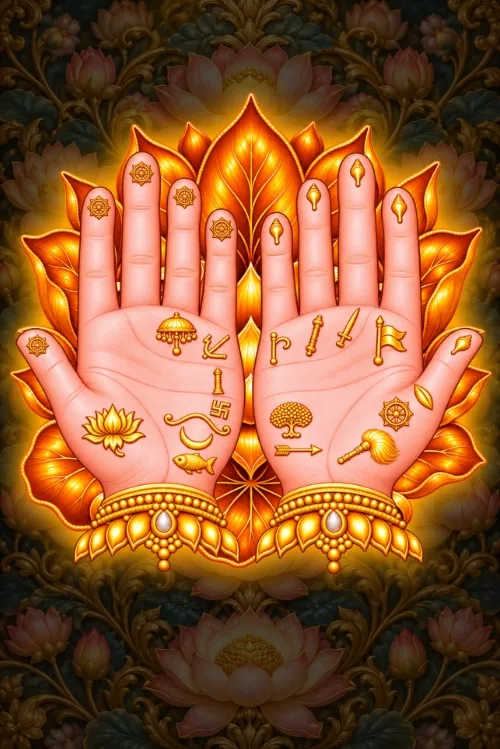
The sacred markings upon Śrī Kṛṣṇa’s palms, their scriptural foundations, their spiritual meanings, and the extraordinary beauty of the hands that protect, bless, and enchant His devotees.
Five discs are traditionally depicted upon the fingertips of Lord Kṛṣṇa’s left hand, while five conchshells adorn the fingertips of His right. Extraordinary symbols appear across His palms: a lotus, an umbrella, a plow, a sword, an elephant goad, a victory flag, and many others. Even the principal lines of His palms are regarded as auspicious. Together, these markings form a traditional enumeration of thirty-three sacred characteristics—sixteen upon the left hand and seventeen upon the right.
Yet the true wonder of Kṛṣṇa’s hands is not limited to their extraordinary markings. These hands lifted Govardhana Hill to shelter the inhabitants of Vṛndāvana. They are the hands whose delicate fingers play the enchanting melodies of His flute, the hands that rest affectionately on the shoulders of His cowherd friends, and the hands that reassure and protect those who approach Him in devotion.
The sacred symbols reveal His divine sovereignty, but His pastimes reveal something even more remarkable. The Lord who possesses unlimited power expresses His highest sweetness through the simplest gestures of love.
The Sanskrit scriptures offer a profound understanding of these divine hands. Some passages explicitly describe auspicious markings upon them. Others celebrate their beauty, their power, their tenderness, and their intimate relationship with the inhabitants of Vraja. Together, they reveal why the lotus hands of Śrī Kṛṣṇa occupy such a beautiful place in Gauḍīya Vaiṣṇava meditation.
1. The hand marked with a divine wheel: An extraordinary scriptural revelation
One of the strongest scriptural foundations for the sacred markings upon Kṛṣṇa’s hands appears in the Tenth Canto of the Śrīmad-Bhāgavatam, during the arrival of Akrūra in Vṛndāvana.
Akrūra traveled from Mathurā under the orders of King Kaṁsa, who intended to bring Kṛṣṇa and Balarāma under his control. Yet Akrūra himself was a deeply devoted servant of the Lord. Throughout the journey, he meditated upon his extraordinary good fortune in being allowed to see Kṛṣṇa.
When he reached the pastures of Vraja, he discovered footprints bearing divine symbols. Overwhelmed with devotion, he descended from his chariot, fell to the ground, and rolled in the dust touched by the Lord’s feet.
Eventually, he saw Kṛṣṇa and Balarāma. Akrūra fell before Them, overcome with spiritual emotion. Kṛṣṇa recognized His devotee and welcomed him with extraordinary affection.
bhagavāṁs tam abhipretya
rathāṅgāṅkita-pāṇinā
parirebhe ’bhyupākṛṣya
prītaḥ praṇata-vatsalaḥ
Recognizing Akrūra, the Supreme Lord drew him close with His hand, which bore the mark of a chariot wheel, and embraced him affectionately. Kṛṣṇa was pleased, for He is always loving toward those who surrender to Him.
Śrīmad-Bhāgavatam 10.38.36
The expression rathāṅgāṅkita-pāṇinā is especially significant. The word rathāṅga literally refers to a chariot wheel and can also denote the divine disc. Aṅkita means marked or impressed with a sign, while pāṇi means hand.
Thus, the verse explicitly describes Kṛṣṇa’s hand as bearing the mark of a wheel or disc.
This is not simply a poetic comparison or an artistic interpretation. It is a direct statement in the Śrīmad-Bhāgavatam that a distinctive symbol appears upon the Lord’s hand.
The accompanying traditional commentary explains that by extending His wheel-marked hand, Kṛṣṇa also indicated His ability to destroy Kaṁsa, the tyrannical king who had sent Akrūra to Vraja.
Yet the action Kṛṣṇa performs in this scene is not one of violence or punishment. He draws His devotee close and embraces him.
The hand bearing the emblem of divine power becomes an instrument of personal affection. This combination of supreme majesty and extraordinary tenderness is essential to understanding Kṛṣṇa’s transcendental personality.
2. The transcendental beauty of Kṛṣṇa’s hands
The extraordinary nature of Kṛṣṇa’s hands is not limited to the markings appearing upon His palms. According to Gauḍīya Vaiṣṇava theology, His entire form is transcendental, eternally beautiful, and filled with spiritual consciousness and bliss.
One of the most celebrated descriptions appears in the Śrī Brahma-saṁhitā, a Sanskrit theological work of special importance to the Gauḍīya Vaiṣṇava tradition.
ālola-candraka-lasad-vanamālya-vaṁśī-
ratnāṅgadaṁ praṇaya-keli-kalā-vilāsam
śyāmaṁ tri-bhaṅga-lalitaṁ niyata-prakāśaṁ
govindam ādi-puruṣaṁ tam ahaṁ bhajāmi
I worship Govinda, the original Supreme Lord, adorned with a swinging forest-flower garland, a beautiful flute, and jeweled ornaments upon His arms. His dark-blue form bends gracefully in three places, and He eternally delights in the beautiful arts of loving pastimes.
Śrī Brahma-saṁhitā 5.31
This description reveals the distinctive nature of Kṛṣṇa’s beauty. Unlike the majestic four-armed forms of Viṣṇu, who visibly display the conchshell, disc, club, and lotus, Kṛṣṇa appears in Vṛndāvana as an enchanting two-armed cowherd boy.
His hands are adorned with beautiful ornaments and hold His beloved flute. Their movements participate in the extraordinary sweetness of His personal pastimes.
The next verse of the Brahma-saṁhitā explains the transcendental nature of His limbs.
aṅgāni yasya sakalendriya-vṛtti-manti
paśyanti pānti kalayanti ciraṁ jaganti
ānanda-cinmaya-sad-ujjvala-vigrahasya
govindam ādi-puruṣaṁ tam ahaṁ bhajāmi
I worship Govinda, the original Lord, whose transcendental form is eternally radiant with spiritual consciousness and bliss. Each of His limbs possesses the functions of all the senses, and He eternally perceives, sustains, and manifests the worlds.
Śrī Brahma-saṁhitā 5.32
The expression aṅgāni yasya sakalendriya-vṛtti-manti teaches that every limb of the Supreme Lord possesses extraordinary spiritual potency.
An ordinary material body functions through specialized organs. Eyes see, ears hear, and hands grasp or touch. The Brahma-saṁhitā describes Kṛṣṇa’s spiritual form as free from these material limitations.
His hands, therefore, are not understood as ordinary physical instruments. They belong to a transcendental form whose nature is entirely spiritual.
The auspicious markings are contemplated within this broader theological understanding. They are not merely unusual features of physical anatomy but signs associated with the divine personality of Govinda.
3. The thirty-three auspicious marks on Lord Kṛṣṇa’s lotus hands
The traditional Gauḍīya Vaiṣṇava enumeration describes sixteen auspicious markings on Kṛṣṇa’s left palm and seventeen on His right, producing a total of thirty-three.
The complete list is preserved in devotional compilations, including a widely circulated collection describing the sacred markings of Kṛṣṇa, Rādhārāṇī, Caitanya Mahāprabhu, Nityānanda Prabhu, and Advaita Ācārya.
The exact original Sanskrit source establishing this particular division of sixteen and seventeen has not yet been conclusively identified. A specialized devotional publication, Pāda-sevanam, collects descriptions of divine hand and foot markings and provides an important starting point for further textual investigation.
The Śrīmad-Bhāgavatam independently confirms the presence of a wheel marking upon Kṛṣṇa’s hand, while the fuller thirty-three-mark arrangement is best identified as a traditional devotional iconographic enumeration.
The left lotus hand: Sixteen auspicious marks
Disc — Cakra
Disc — Cakra
Disc — Cakra
Disc — Cakra
Disc — Cakra
Umbrella — Chatra
Plow — Hala
Sacrificial post or pillar of glory — Yūpa
Lotus — Padma / kamala
Svastika — Svastika
Unstrung bow — Dhanus / cāpa
Half-moon — Ardha-candra
Fish — Matsya / mīna
Life line — Āyu-rekhā
Fate or good-fortune line — Saubhāgya-rekhā
Enjoyment line — Bhoga-rekhā
The right lotus hand: Seventeen auspicious marks
Conchshell — Śaṅkha
Conchshell — Śaṅkha
Conchshell — Śaṅkha
Conchshell — Śaṅkha
Conchshell — Śaṅkha
Elephant goad — Aṅkuśa
Iron club or bar — Parigha
Sword — Asi / khaḍga
Victory flag — Dhvaja
Tree — Taru / vṛkṣa
Barleycorn — Yava
Disc — Cakra
Sharp arrow — Śara / bāṇa
Yak-tail whisk — Cāmara
Life line — Āyu-rekhā
Fate or good-fortune line — Saubhāgya-rekhā
Enjoyment line — Bhoga-rekhā
These Sanskrit terms identify the objects represented by the marks. They should not be mistaken for a reconstructed quotation from an unidentified Sanskrit source.
The arrangement contains ten fingertip symbols, seventeen additional pictorial emblems, and six auspicious palm lines. The total is therefore thirty-three.
One particularly interesting feature is the presence of six discs altogether. Five are associated with the fingertips of the left hand, while another disc appears separately upon the right palm.
This does not mean that every scriptural passage describing the Lord’s wheel-marked hand identifies its precise position. The Bhāgavatam confirms the emblem itself, while the particular left-and-right distribution belongs to the traditional arrangement.
4. The five discs: Divine sovereignty and the destruction of ignorance
The disc, or cakra, is among the most important emblems of Lord Viṣṇu.
The Sanskrit word can mean a wheel, circle, or disc, while in Vaiṣṇava iconography it is particularly associated with Sudarśana-cakra, the divine weapon of the Supreme Lord.
Its symbolism includes irresistible divine power, the destruction of harmful forces, and the protection of devotees.
The five fingertip discs of Kṛṣṇa’s left hand, together with the additional disc on His right palm, emphasize His divine sovereignty.
Yet the deeper devotional significance of the disc becomes apparent when its power is understood in relation to the inner life of the devotee.
Classical Vaiṣṇava commentary associates the disc marking on Kṛṣṇa’s foot with the destruction of the six internal enemies: lust, anger, greed, delusion, pride, and envy.
These are commonly called the six enemies of the conditioned soul. They distort perception, intensify selfish attachment, and prevent the development of pure devotion.
In the traditional commentary to Śrīmad-Bhāgavatam 10.30.25, Śrīla Viśvanātha Cakravartī Ṭhākura cites verses attributed to the Skanda Purāṇa that explain the significance of several markings on Kṛṣṇa’s feet.
One passage states:
dakṣiṇasya padāṅguṣṭha-
mūle cakraṁ bibharty ajaḥ
tatra bhakta-janasyāri-
ṣaḍ-varga-cchedanāya saḥ
At the base of His right great toe, the unborn Lord bears a disc, whose purpose is to cut through the six enemies of His devotees.
Skanda Purāṇa, cited at Śrīmad-Bhāgavatam 10.30.25
This passage specifically concerns Kṛṣṇa’s foot, not His hand. Nevertheless, it provides a classical example of how the symbol of the disc is interpreted within the devotional tradition.
Its significance is not restricted to external conquest. It also concerns the Lord’s power to remove spiritual obstacles within consciousness.
The disc upon Kṛṣṇa’s hand can therefore inspire meditation upon divine strength directed toward spiritual protection.
5. The umbrella: The Lord who becomes the shelter of Vraja
The umbrella, or chatra, is a traditional emblem of sovereignty and protection.
In Indian royal culture, a ceremonial parasol signified exalted authority and served as a visible symbol of kingship.
On Kṛṣṇa’s palm, however, the umbrella acquires special significance when considered alongside one of His most celebrated pastimes: the lifting of Govardhana Hill.
The inhabitants of Vraja had worshiped Govardhana upon Kṛṣṇa’s recommendation rather than performing their customary sacrifice to Indra. Enraged, Indra unleashed a terrifying storm upon Vṛndāvana.
Heavy rain, powerful winds, and thunder threatened the lives of the cowherds, their families, and their animals. The inhabitants of Vraja turned to Kṛṣṇa for protection.
He responded by lifting Govardhana Hill with one hand and holding it above them like a vast protective canopy.
ity uktvaikena hastena
kṛtvā govardhanācalam
dadhāra līlayā viṣṇuś
chatrākam iva bālakaḥ
Having spoken these words, Kṛṣṇa, who is Viṣṇu Himself, lifted Govardhana Hill with one hand and held it effortlessly, just as a child might hold up a mushroom.
Śrīmad-Bhāgavatam 10.25.19
The expression ekena hastena means with one hand, while līlayā emphasizes the playful ease with which Kṛṣṇa performed the feat.
The accompanying commentary cites the Harivaṁśa to confirm that Kṛṣṇa lifted the mountain with His left hand.
This is especially meaningful because the traditional umbrella marking is also placed on His left palm.
The correspondence does not establish that the Govardhana narrative was originally composed to explain the palm emblem. Nevertheless, it offers a beautiful subject for devotional contemplation.
The hand adorned with the symbol of an umbrella becomes the very hand that raises a mountain to protect an entire community.
Yet the spiritual beauty of the episode is not limited to the extraordinary display of power. The inhabitants of Vraja love Kṛṣṇa as their own child, friend, and beloved. Even as He effortlessly holds the mountain, their affection for Him remains intimate and personal.
His supreme majesty does not destroy the sweetness of their relationship.
The umbrella therefore represents more than royal protection. It evokes the extraordinary shelter of the Lord who cares personally for His devotees.
6. The plow: Balarāma and the cultivation of devotion
The plow, hala, is one of the characteristic emblems of Lord Balarāma, Kṛṣṇa’s elder brother.
Balarāma is often called Haladhara, the bearer of the plow. His association with agriculture, strength, and divine support makes this symbol especially meaningful.
In Gauḍīya Vaiṣṇava theology, Kṛṣṇa and Balarāma are inseparable divine personalities whose pastimes reveal different aspects of the Supreme Lord’s transcendental relationships.
The plow upon Kṛṣṇa’s hand can therefore invite remembrance of His intimate relationship with Balarāma.
Agriculture also provides a natural metaphor for spiritual cultivation.
Before seeds can grow, the soil must be prepared. The earth must be loosened, weeds removed, and favorable conditions created. Similarly, the heart must become receptive before the seed of devotion can develop fully.
Pride, envy, selfish attachment, and spiritual inattentiveness obstruct the growth of bhakti. Through hearing, chanting, remembrance, and service, the heart gradually becomes suitable for the cultivation of spiritual love.
The association of the plow with this process is a devotional interpretation based upon the traditional symbolism of agriculture and Balarāma. It should not be presented as a separately verified scriptural explanation of this exact palm marking.
Nevertheless, the image expresses a fundamental spiritual principle: divine love develops in a heart that has been carefully cultivated.
7. The sacrificial post: Consecrating life to the Supreme
The symbol often described in English as the Pillar of Glory requires a more precise understanding.
The Sanskrit term yūpa commonly refers to a sacrificial post used in Vedic ceremonies. It may also denote a victory or commemorative pillar.
The expression Pillar of Glory captures the possible association with triumph, but it does not fully convey the sacred ritual significance of the object.
As a symbol, the yūpa recalls sacrifice, dedication, consecration, and the offering of one’s activities to a higher purpose.
The Bhagavad-gītā repeatedly emphasizes that action becomes spiritually transformative when performed without selfish attachment and dedicated to the Supreme Lord.
This teaching offers a meaningful devotional interpretation of the sacrificial post upon Kṛṣṇa’s palm.
The highest spiritual achievement does not consist merely in abandoning worldly action. Rather, action itself can become a form of devotion when its purpose is transformed.
The symbol thus evokes the consecration of life through loving service.
8. The lotus, svastika, and half-moon: The beauty of auspiciousness
Several markings on Kṛṣṇa’s left palm belong to the gentler language of sacred beauty.
The lotus, padma, is among the most important symbols in Vaiṣṇava literature. Rising above muddy water without being stained, it represents purity, transcendence, and spiritual beauty.
Kṛṣṇa’s eyes, face, hands, and feet are repeatedly compared to lotuses. The image does not merely suggest freedom from contamination. It also conveys attraction, tenderness, and beauty.
In the literature of devotion, the lotus often becomes an image of the relationship between the Lord and His devotees. The heart is drawn toward the Lord’s beauty just as a bee is attracted to a fragrant flower.
The svastika is an ancient Indian sign of auspiciousness, harmony, and well-being. The Sanskrit word svasti expresses favorable fortune or blessing. Its religious significance long predates its appropriation by the Nazi movement.
On Kṛṣṇa’s palm, the svastika can be contemplated as a symbol of supreme auspiciousness and the spiritual benefit of remembering the Lord.
The half-moon, ardha-candra, evokes serenity, cooling light, and gentle beauty.
Sanskrit poetry frequently uses moonlight to represent soothing sweetness. Within devotional contemplation, the half-moon may suggest the cooling influence of divine mercy upon the suffering heart.
These three emblems express a different dimension of the Lord’s personality from the weapons and royal insignia. They evoke purity, serenity, harmony, and spiritual attraction.
9. The unstrung bow and fish: Power held in reserve and divine protection
The unstrung bow is a distinctive emblem in the traditional arrangement.
The Sanskrit terms dhanus and cāpa designate a bow. The specific description of the bow as unstrung belongs to the iconographic tradition rather than being inherent in the general Sanskrit terms.
A bow without its string is not immediately prepared to release an arrow, yet it still possesses the potential for powerful action.
In devotional contemplation, this can suggest restrained strength or power held peacefully in reserve.
The bow also appears in Sanskrit descriptions of Kāma, the deity of desire, and can therefore evoke the themes of attraction and love. However, the identification of this particular marking as Kāma’s bow would require specific textual evidence.
The fish, matsya or mīna, evokes divine preservation and protection.
Within Vaiṣṇava theology, Matsya is an incarnation of the Supreme Lord associated with preservation during a great cosmic flood.
The fish may therefore serve as a reminder of the Lord’s power to guide and protect living beings through apparently overwhelming dangers.
It can also evoke the sacred waters of the Yamunā, where many of Kṛṣṇa’s intimate pastimes take place.
These interpretations remain devotional contemplations rather than conclusively established explanations of the individual palm markings.
10. The five conchshells: Divine proclamation and sacred sound
The five fingertips of Kṛṣṇa’s right hand are traditionally adorned with conchshell markings.
The conch, śaṅkha, is a principal emblem of Lord Viṣṇu and is associated with sacred proclamation, purity, and auspicious beginnings.
In the Bhagavad-gītā, Kṛṣṇa sounds His divine conchshell, Pāñcajanya, before the great battle of Kurukṣetra.
The sound of the conch announces divine authority and a moment of extraordinary significance.
The five fingertip conches can therefore invite contemplation of Kṛṣṇa as the supreme source of spiritual guidance and protection.
Yet Kṛṣṇa’s relationship with sacred sound possesses another remarkable dimension.
In Vṛndāvana, He does not ordinarily announce His presence through the majestic sound of the conchshell. He enchants the world through the sweetness of His flute.
The conch and flute thus represent two different expressions of divine sound.
The conch evokes sovereignty, auspiciousness, and proclamation. The flute evokes attraction, intimacy, and loving devotion.
Both belong to Kṛṣṇa’s transcendental personality, but the flute occupies a particularly exalted position within the intimate pastimes of Vraja.
11. The elephant goad: Guiding the restless mind
The elephant goad, aṅkuśa, is a traditional implement used to direct and control a powerful elephant.
Its recognizable form includes a pointed tip and a curved metal hook attached to a handle.
In Indian spiritual imagery, the elephant often represents the restless and powerful mind.
The mind can be difficult to control when driven by strong impulses, desires, fears, and attachments. Like an excited elephant, it may resist direction and become destructive when left untrained.
The elephant goad therefore provides a natural metaphor for divine guidance.
Through spiritual practice, the mind is gradually directed toward remembrance of Kṛṣṇa and service to Him.
The objective is not merely to suppress mental activity. Rather, the mind becomes engaged in a higher relationship, transforming its tendency toward attachment into loving devotion.
The elephant goad can therefore be contemplated as a symbol of the Lord’s power to guide consciousness toward its spiritual purpose.
12. The iron club, sword, and arrow: Overcoming the enemies of devotion
The iron club, parigha, is a heavy striking weapon associated with formidable strength.
It should be distinguished from the more familiar gadā, the mace traditionally carried by Lord Viṣṇu.
The parigha may be depicted as a heavy iron bar or club rather than a weapon with a large rounded head.
Its symbolism naturally evokes divine strength and the ability to overcome great resistance.
The sword, asi or khaḍga, represents the power to cut through obstacles.
Within spiritual contemplation, it can suggest the destruction of ignorance and false identification.
This interpretation resonates with Kṛṣṇa’s teachings in the Bhagavad-gītā, where He removes Arjuna’s confusion by explaining the eternal nature of the soul and the principles of duty, spiritual knowledge, and devotion.
The arrow, śara or bāṇa, suggests precision, purpose, and decisive action.
In Sanskrit poetry, arrows are also associated with attraction and love, particularly through the imagery of Cupid.
However, the precise theological meaning of the arrow upon Kṛṣṇa’s palm remains uncertain without a more detailed original description.
Together, these weapons may be contemplated as expressions of divine strength directed toward protection and the removal of spiritual obstacles.
Their presence reminds the devotee that the Supreme Lord possesses unlimited power, even when He chooses to reveal Himself in the gentle form of a cowherd boy.
13. The victory flag, tree, and barleycorn: Triumph, generosity, and abundance
The flag, dhvaja, is a traditional emblem of victory and sovereignty.
In Kṛṣṇa’s pastimes, divine victory is repeatedly associated with the protection of devotees and the restoration of dharma.
The flag can therefore evoke the ultimate triumph of spiritual truth over ignorance and destructive forces.
The tree, taru or vṛkṣa, possesses a particularly beautiful significance in the context of Vṛndāvana.
Trees provide fruit, flowers, shade, fragrance, and shelter. They offer these gifts generously, often without requiring anything in return.
The forests of Vraja are intimately connected with Kṛṣṇa’s childhood and youthful pastimes. The trees and creepers are described as responding to His presence and the music of His flute.
The tree upon His palm can therefore invite remembrance of this sacred environment and of the generosity associated with selfless service.
The barleycorn, yava, is an ancient symbol of nourishment, agriculture, and prosperity.
In classical explanations of Kṛṣṇa’s foot markings, barley is associated with abundance and favorable fortune.
As a contemplative symbol upon the hand, it can similarly evoke spiritual nourishment and divine provision.
Yet the highest prosperity in Gauḍīya Vaiṣṇava theology is not merely material abundance. It is the development of loving devotion to Kṛṣṇa.
14. The yak-tail whisk: The intimacy of devotional service
The yak-tail whisk, cāmara, belongs to the ceremonial language of honor, royalty, and personal service.
Traditionally waved before kings, deities, and honored personalities, it expresses respect and affectionate attendance.
In temple worship, the cāmara is offered to the deity as a gesture of service.
Its appearance among Kṛṣṇa’s hand markings therefore introduces a symbol that differs from the weapons and royal insignia.
The whisk does not primarily represent destructive power. It represents the pleasure of serving an exalted person.
This is especially meaningful in the context of Vṛndāvana, where Kṛṣṇa’s intimate associates are absorbed in different forms of loving service.
Some care for Him as their child, others accompany Him as friends, and still others serve Him in the most intimate devotional relationships.
The cāmara thus evokes a fundamental principle of bhakti: the highest spiritual fulfillment lies not in controlling the Supreme Lord, but in loving Him and participating in His pleasure.
15. The three auspicious palm lines
Six of the thirty-three markings are lines rather than pictorial symbols.
Each palm bears three principal lines, traditionally described as the life line, fate or good-fortune line, and enjoyment line.
The Sanskrit designations commonly associated with these concepts are āyu-rekhā, saubhāgya-rekhā, and bhoga-rekhā.
Āyu-rekhā concerns longevity and vitality. Saubhāgya-rekhā indicates auspiciousness, prosperity, or good fortune. Bhoga-rekhā is associated with enjoyment and fulfillment.
These terms belong to the broader tradition of sāmudrika-lakṣaṇa, the interpretation of bodily characteristics as signs of auspiciousness.
The English expression fate line should be treated cautiously because it may suggest a stronger form of deterministic prediction than the Sanskrit terminology necessarily requires.
Furthermore, the presence of these lines in sacred iconography does not establish palmistry as a scientifically reliable method of predicting lifespan, destiny, or future events.
In the worship of Kṛṣṇa, the lines are understood within the traditional language of divine auspiciousness.
They do not imply that the Supreme Lord is subject to an externally imposed destiny or the limitations of ordinary material existence.
16. The tender fingers that play the flute
If the lifting of Govardhana reveals the extraordinary strength of Kṛṣṇa’s hands, His flute-playing reveals their incomparable sweetness.
The Śrīmad-Bhāgavatam provides a beautiful description of His delicate fingers during the Venu-gīta, the songs in which the gopīs celebrate the enchanting sound of His flute.
vāma-bāhu-kṛta-vāma-kapolo
valgita-bhrur adharārpita-veṇum
komalāṅgulibhir āśrita-mārgaṁ
gopya īrayati yatra mukundaḥ
O gopīs, when Mukunda rests His left cheek upon His left arm, moves His eyebrows playfully, and places His flute upon His lips, He produces its enchanting music by covering the holes with His tender fingers.
Śrīmad-Bhāgavatam 10.35.2
The expression komalāṅgulibhiḥ means with tender or delicate fingers.
This is a particularly important scriptural description because it draws attention to the beauty and activity of Kṛṣṇa’s fingers.
The text does not enumerate the auspicious symbols upon the fingertips. Instead, it describes the extraordinary sweetness of their movements.
The same fingers traditionally depicted with sacred conches and discs move gracefully across the holes of the flute.
Through those movements, Kṛṣṇa produces melodies that enchant the inhabitants of Vṛndāvana.
The gopīs describe how the music astonishes even celestial beings. Animals become motionless, rivers appear to stop flowing, and the trees respond with extraordinary signs of spiritual emotion.
The divine sound of Kṛṣṇa’s flute is therefore not merely beautiful music. Within Gauḍīya theology, it expresses His supreme attractiveness and awakens the deepest loving emotions of His devotees.
The markings reveal divine sovereignty, but the fingertips playing the flute reveal divine sweetness.
17. One hand upon a friend’s shoulder, a lotus in the other
Another remarkable description appears in Śrīmad-Bhāgavatam 10.23.22.
The wives of certain sacrificial brāhmaṇas had heard about Kṛṣṇa and developed profound devotion toward Him. When they learned that He was nearby, they hurried to see Him, carrying offerings of food.
The scene they encountered was extraordinarily beautiful.
śyāmaṁ hiraṇya-paridhiṁ vanamālya-barha-
dhātu-pravāla-naṭa-veṣam anavratāṁse
vinyasta-hastam itareṇa dhunānam abjaṁ
karṇotpalālaka-kapola-mukhābja-hāsam
His complexion was dark blue, and His garments were golden. Decorated with forest flowers, a peacock feather, colored minerals, and delicate flower buds, He appeared like a graceful dancer. One hand rested upon the shoulder of a companion, while with the other He playfully twirled a lotus flower. Lilies adorned His ears, curls framed His cheeks, and His lotus-like face shone with a beautiful smile.
Śrīmad-Bhāgavatam 10.23.22
The passage reveals an extraordinary contrast between divine greatness and intimate simplicity.
Kṛṣṇa is the Supreme Lord, yet He stands in the forest like a charming cowherd boy, resting one hand upon the shoulder of His friend.
With the other, He casually twirls a lotus.
There is no display of overwhelming majesty, no royal throne, and no demand for formal worship.
The scene is governed by sweetness.
The distinction between a lotus held in the hand and a lotus marked upon the palm is important. This verse describes an actual flower, not the corresponding auspicious marking.
Nevertheless, it reveals the same qualities expressed through lotus imagery: beauty, purity, tenderness, and loving attraction.
The Lord whose hands possess extraordinary divine power expresses His highest charm through gestures of ordinary friendship.
18. The lotus hand that grants fearlessness
The hands of Kṛṣṇa are repeatedly described as sources of spiritual protection.
This is especially clear in the prayers of the gopīs during their separation from Him.
In the famous Gopī-gīta, the gopīs pray for the touch of His lotus hand.
viracitābhayaṁ vṛṣṇi-dhūrya te
caraṇam īyuṣāṁ saṁsṛter bhayāt
kara-saroruhaṁ kānta kāma-daṁ
śirasi dhehi naḥ śrī-kara-graham
O best of the Vṛṣṇi dynasty, Your lotus hand grants fearlessness to those who approach Your feet seeking refuge from the dangers of material existence. O beloved Lord, that hand, which holds the hand of the goddess of fortune and fulfills the desires of Your devotees, may it please be placed upon our heads.
Śrīmad-Bhāgavatam 10.31.5
The expression kara-saroruham means lotus-like hand.
The verse brings together several important concepts: surrender, protection, fearlessness, and loving intimacy.
The gopīs do not merely admire Kṛṣṇa’s power. They long for His personal touch.
His hand grants fearlessness because it belongs to the Supreme Lord, yet their desire is expressed through an intimate devotional relationship.
A similar prayer appears earlier in Śrīmad-Bhāgavatam 10.29.41, where the gopīs address Kṛṣṇa as the friend of the distressed.
vyaktaṁ bhavān vraja-bhayārti-haro ’bhijāto
devo yathādi-puruṣaḥ sura-loka-goptā
tan no nidhehi kara-paṅkajam ārta-bandho
tapta-staneṣu ca śiraḥsu ca kiṅkarīṇām
Clearly You have appeared to remove the fear and suffering of the inhabitants of Vraja, just as the Supreme Lord protects the heavenly worlds. Therefore, O friend of the distressed, please place Your lotus hand upon the heads and love-stricken hearts of Your devoted maidservants.
Śrīmad-Bhāgavatam 10.29.41
The verse expresses the intimate emotional language of the gopīs’ devotion. They recognize Kṛṣṇa as the protector of Vraja, but their prayer is not merely for safety from external danger.
They long for the personal affection of their beloved.
The hand that protects the universe is the same hand whose touch fulfills the deepest longing of the heart.
19. The hands that participate in divine love
The intimate character of Kṛṣṇa’s hands appears with particular beauty in the description of His reunion with the gopīs during the rāsa-līlā.
After He had disappeared from their company, the gopīs searched for Him throughout the forests of Vṛndāvana.
Overwhelmed by separation, they remembered His beauty, His gestures, His flute, and His pastimes.
When Kṛṣṇa finally returned, their joy was beyond description.
kācit karāmbujaṁ śaurer
jagṛhe ’ñjalinā mudā
kācid dadhāra tad-bāhum
aṁse candana-bhūṣitam
One gopī joyfully took Kṛṣṇa’s lotus hand between her joined palms, while another placed His arm, anointed with sandalwood paste, upon her shoulder.
Śrīmad-Bhāgavatam 10.32.4
The expression karāmbujam again means lotus hand.
Here the Lord’s hand becomes the center of an intimate loving exchange.
One gopī holds it with overwhelming happiness. Another places His arm upon her shoulder.
Such gestures reveal the distinctive character of the spiritual relationships described in Gauḍīya Vaiṣṇava theology.
Kṛṣṇa is not approached only through philosophical understanding or formal reverence. He participates in relationships of parental affection, friendship, and intimate devotional love.
These relationships are traditionally described through different rasas, or spiritual flavors of loving exchange.
The same hands perform different activities according to the nature of each relationship.
For mother Yaśodā, they are the hands of her beloved child.
For the cowherd boys, they are the hands of their dearest companion.
For the gopīs, they are the hands of the supreme object of intimate spiritual love.
The auspicious markings remain the same, but their devotional significance is experienced through different relationships.
The highest sweetness of Kṛṣṇa’s hands is therefore not found merely in their supernatural characteristics, but in their participation in loving exchanges with His devotees.
20. The Supreme Brahman becomes a cowherd friend
The relationship between divine majesty and intimate sweetness is expressed in a celebrated prayer of Lord Brahmā.
After witnessing Kṛṣṇa’s extraordinary divine power during the Brahmā-vimohana-līlā, Brahmā becomes overwhelmed by the realization that the cowherd boy of Vṛndāvana is the Supreme Absolute Truth.
Yet what astonishes him most is the intimate relationship Kṛṣṇa shares with the inhabitants of Vraja.
aho bhāgyam aho bhāgyaṁ
nanda-gopa-vrajaukasām
yan-mitraṁ paramānandaṁ
pūrṇaṁ brahma sanātanam
How extraordinary is the good fortune of Nanda Mahārāja, the cowherd men, and all the inhabitants of Vraja! The eternal, complete Absolute Truth, the very source of supreme spiritual bliss, has become their intimate friend.
Śrīmad-Bhāgavatam 10.14.32
The phrase yan-mitram means that He has become their friend.
Brahmā is astonished not merely by Kṛṣṇa’s divine power, but by His accessibility to those who love Him.
The Supreme Brahman, whose greatness transcends the material cosmos, allows Himself to be treated as a companion, a son, and a beloved.
This provides an essential key to understanding His lotus hands.
The markings proclaim divine majesty, but the personal activities of those hands reveal extraordinary sweetness.
In Gauḍīya theology, these two dimensions are known as aiśvarya and mādhurya.
Aiśvarya refers to divine sovereignty, power, and opulence. Mādhurya refers to the sweetness and intimacy of the Lord’s personal relationships.
The transcendental beauty of Vṛndāvana lies especially in the predominance of mādhurya.
21. Why Kṛṣṇa prefers love beyond overwhelming reverence
The relationship between divine majesty and intimate devotion is explained in Śrī Caitanya-caritāmṛta, Ādi-līlā 4.17.
Kṛṣṇadāsa Kavirāja Gosvāmī presents a theological reflection upon why Kṛṣṇa desires to experience the sweetness of intimate loving relationships.
ঐশ্বর্য–জ্ঞানেতে সব জগৎ মিশ্রিত ।
ঐশ্বর্য–শিথিল–প্রেমে নাহি মোর প্রীত ॥
aiśvarya-jñānete saba jagat miśrita
aiśvarya-śithila-preme nāhi mora prīta
The entire world is influenced by awareness of My divine majesty, but love weakened by overwhelming reverence does not give Me the same pleasure.
Śrī Caitanya-caritāmṛta, Ādi-līlā 4.17
This passage expresses a central principle of Gauḍīya Vaiṣṇava theology.
Reverence for the Supreme Lord is spiritually meaningful and appropriate. Yet the highest devotional relationships of Vraja are characterized by an intimacy that goes beyond continual awareness of His overwhelming greatness.
Mother Yaśodā does not ordinarily think of Kṛṣṇa as the ruler of countless universes. She worries about His safety and cares for Him as her beloved child.
The cowherd boys play with Him, joke with Him, and place their arms around His shoulders.
The gopīs love Him with an intimacy that transcends conventional calculations of divine authority.
This is why the sacred markings upon Kṛṣṇa’s hands should never be understood as the whole story.
They reveal who He is: the Supreme Lord possessing extraordinary divine power.
His pastimes reveal the nature of the love He shares with His closest devotees.
The hands bearing discs and conchshells play the flute, accept garlands, embrace friends, and participate in the most intimate exchanges of devotion.
Divine sovereignty is present, but divine sweetness becomes the dominant feature of His personal world.
22. The hand that blesses even the frightened and fallen
Kṛṣṇa’s compassion is not limited to those already established in intimate devotion.
The Śrīmad-Bhāgavatam also describes His lotus hand as a source of protection for those who seek refuge from fear and suffering.
A particularly revealing example occurs after Kṛṣṇa defeats Bhaumāsura, also known as Narakāsura.
The earth-goddess Bhūmi approaches Him with the defeated demon’s frightened son and asks the Lord to protect the young prince.
tasyātmajo ’yaṁ tava pāda-paṅkajaṁ
bhītaḥ prapannārti-haropasāditaḥ
tat pālayainaṁ kuru hasta-paṅkajaṁ
śirasy amuṣyākhila-kalmaṣāpaham
Here is the son of Bhaumāsura. Overcome with fear, he has approached Your lotus feet, for You remove the suffering of those who seek Your shelter. Please protect him by placing Your lotus hand upon his head, for that hand destroys all sinful contamination.
Śrīmad-Bhāgavatam 10.59.31
The expression hasta-paṅkajam again means lotus hand.
The verse reveals another dimension of Kṛṣṇa’s mercy.
He has just defeated a powerful enemy, yet the child of that enemy is offered His protection.
The hand that possesses supreme power becomes the means of reassurance and purification.
The passage therefore establishes a distinction between the Lord’s opposition to destructive behavior and His willingness to protect those who sincerely seek refuge.
Kṛṣṇa’s greatness is revealed not only through His victories, but through His compassion.
23. The supreme importance of devotional offerings
The most practical significance of Kṛṣṇa’s hands appears in His own teaching about the offerings He accepts from devotees.
In the Bhagavad-gītā, He declares that even the simplest gift becomes spiritually valuable when offered with love.
patraṁ puṣpaṁ phalaṁ toyaṁ
yo me bhaktyā prayacchati
tad ahaṁ bhakty-upahṛtam
aśnāmi prayatātmanaḥ
Whoever offers Me a leaf, a flower, a fruit, or water with sincere devotion, I accept that offering from the pure-hearted devotee.
Bhagavad-gītā 9.26
The verse places loving intention above material extravagance.
Kṛṣṇa possesses everything and lacks nothing. Yet He accepts even the simplest offerings when they are made with genuine devotion.
The hands of the devotee prepare and offer the gift, while the Supreme Lord receives the love expressed through it.
This reveals the reciprocal nature of bhakti.
The devotee does not offer something because Kṛṣṇa lacks it. The offering is an expression of relationship.
Similarly, Kṛṣṇa’s acceptance does not arise from material need. It is a manifestation of His willingness to reciprocate with love.
Thus the symbolism of His sacred hands reaches beyond divine authority and supernatural power.
They are the hands that receive devotion.
24. How ordinary hands become instruments of spiritual service
The practical significance of devotional service is expressed beautifully in the life of King Ambarīṣa.
Although he possessed great worldly responsibilities and royal authority, Ambarīṣa dedicated his senses and activities to the service of the Supreme Lord.
sa vai manaḥ kṛṣṇa-padāravindayor
vacāṁsi vaikuṇṭha-guṇānuvarṇane
karau harer mandira-mārjanādiṣu
śrutiṁ cakārācyuta-sat-kathodaye
He fixed his mind upon the lotus feet of Kṛṣṇa, engaged his speech in glorifying the Lord’s qualities, employed his hands in cleaning the temple of Hari, and used his ears to hear sacred narrations concerning Acyuta.
Śrīmad-Bhāgavatam 9.4.18
The phrase karau harer mandira-mārjanādiṣu means that he engaged his hands in activities such as cleaning the temple of Hari.
This offers a profound contrast.
Kṛṣṇa’s hands bear the marks of divine perfection, while the hands of the devotee attain spiritual significance through service.
Even a simple action, such as cleaning a sacred place, becomes meaningful when performed with devotion.
The hands of the devotee can prepare offerings, care for others, assist fellow practitioners, and participate in countless acts of kindness.
The purpose of contemplating Kṛṣṇa’s lotus hands is therefore not merely to admire extraordinary symbols, but to awaken the desire to use one’s own abilities in His service.
The sacred markings point toward divine qualities; devotional service brings those qualities into practical life.
25. Meditating upon Kṛṣṇa’s thirty-three auspicious markings
Within Gauḍīya Vaiṣṇava practice, contemplation of the Lord’s form belongs to smaraṇa, or devotional remembrance.
The thirty-three traditional hand markings can serve as a focus for such meditation.
The first stage is remembrance of Kṛṣṇa’s beautiful form. His complexion resembles a dark raincloud, His garments shine like gold, and His body is adorned with forest flowers and ornaments. His eyes resemble blooming lotuses, and His hands possess extraordinary softness and grace.
The mind may then contemplate the auspicious symbols traditionally associated with His palms.
The discs evoke His supreme authority and protection. The conchshells recall sacred proclamation and auspiciousness. The umbrella brings to mind the lifting of Govardhana, while the plow recalls His intimate relationship with Balarāma.
The lotus evokes divine beauty, the tree recalls the forests of Vraja, and the yak-tail whisk suggests loving service.
The weapons represent strength, while the auspicious lines and natural symbols invite remembrance of divine completeness and spiritual well-being.
The next stage is contemplation of Kṛṣṇa’s pastimes.
The mind remembers the hand that lifted Govardhana, the hand marked with a wheel that drew Akrūra close, the tender fingers that play the flute, and the hands that participate in intimate exchanges with the inhabitants of Vraja.
Through this process, the symbols become connected with the personal qualities of the Lord.
The final purpose is not the accumulation of symbolic knowledge. It is the gradual development of affection, remembrance, and devotion.
The sacred markings are valuable because they belong to Kṛṣṇa, and their contemplation becomes meaningful when it deepens the relationship between the devotee and the Lord.
26. Scripture, tradition, and the importance of authenticity
The sacred markings on Kṛṣṇa’s hands are supported by several distinct kinds of textual evidence, which should not be confused.
The Śrīmad-Bhāgavatam explicitly identifies a wheel marking upon Kṛṣṇa’s hand in the account of His meeting with Akrūra. This provides direct scriptural testimony that His hand bears a distinctive auspicious emblem.
The same scripture repeatedly describes His hands as lotus-like, beautifully soft, and spiritually powerful. It recounts their role in lifting Govardhana, playing the flute, embracing devotees, granting fearlessness, and participating in loving exchanges.
The complete enumeration of thirty-three markings, with sixteen on the left palm and seventeen on the right, belongs to a more detailed devotional iconographic tradition.
That enumeration is preserved in modern Gauḍīya compilations and is relevant to the broader literature collected in works such as Pāda-sevanam. However, the precise Sanskrit passage establishing the entire arrangement remains to be conclusively identified.
A distinction is therefore necessary between three categories of information.
The first consists of descriptions directly stated in authoritative scripture, such as the wheel marking upon Kṛṣṇa’s hand.
The second includes the specialized traditional arrangement of auspicious palm symbols.
The third consists of devotional interpretations that associate individual symbols with broader theological themes, including protection, spiritual guidance, divine beauty, and the destruction of ignorance.
These levels of evidence are complementary, but they are not interchangeable.
For example, the classical Sanskrit passage explaining the disc upon Kṛṣṇa’s foot as the destroyer of the six internal enemies provides a meaningful devotional interpretation of the disc symbol. It does not independently prove the exact placement of six discs upon His hands.
Similarly, the Govardhana pastime illuminates the symbolism of the umbrella, but it does not establish that the umbrella marking originated as a direct representation of that particular event.
Maintaining such distinctions preserves the authenticity of devotional scholarship.
The tradition becomes more meaningful when its scriptural foundations, inherited iconography, and contemplative interpretations are presented with clarity.
27. The divine majesty and sweetness of Kṛṣṇa’s hands
The thirty-three auspicious markings of Lord Kṛṣṇa’s lotus hands bring together an extraordinary collection of symbols.
Sixteen appear upon the left palm and seventeen upon the right. The traditional arrangement includes five discs on the left fingertips, five conchshells on the right fingertips, seventeen additional pictorial emblems, and six auspicious palm lines.
Some symbols represent divine sovereignty and strength. Others evoke purity, protection, sacred offering, spiritual abundance, and intimate service.
But the deepest significance of Kṛṣṇa’s hands emerges only when these symbols are considered alongside His pastimes.
The hand bearing the wheel mark draws Akrūra close in affection. The hand associated with the umbrella lifts Govardhana Hill to protect the inhabitants of Vraja. His tender fingers produce the incomparable melodies of the flute, while His hands rest casually upon the shoulders of His cowherd friends.
The gopīs hold those hands in overwhelming love, and the frightened receive their protection.
Thus the extraordinary greatness of Kṛṣṇa’s hands is revealed through two complementary dimensions: supreme majesty and supreme sweetness.
The markings testify to His divine sovereignty. His pastimes reveal the intimate nature of His relationships.
The Supreme Lord who possesses unlimited power does not remain distant from His devotees. He allows Himself to be loved as a child, a companion, and the supreme beloved.
This is the special beauty of Kṛṣṇa’s form in Vṛndāvana.
The sacred markings reveal who He is. The activities of His hands reveal the extraordinary nature of His love.
The hands that bear the symbols of supreme sovereignty are the hands that lift a mountain to shelter His friends, play the flute to awaken divine love, and extend protection to every soul that seeks His refuge.
Sources and References
Primary Sanskrit scriptures
- Śrīmad-Bhāgavatam 10.38.36. The most important direct reference to an auspicious marking on Kṛṣṇa’s hand. The Sanskrit explicitly describes His hand as bearing the sign of a wheel or disc when He draws Akrūra close and embraces him.
- Śrīmad-Bhāgavatam 10.38.16–17. Akrūra’s meditation upon the Lord’s lotus hand as the giver of fearlessness and its association with divine blessings and intimate pastimes.
- Śrīmad-Bhāgavatam 10.25.19. Kṛṣṇa lifts Govardhana Hill with one hand. The accompanying commentary cites the Harivaṁśa concerning His use of the left hand.
- Śrīmad-Bhāgavatam 10.35.2–3. The gopīs describe Kṛṣṇa playing His flute with tender fingers, producing extraordinary spiritual attraction.
- Śrīmad-Bhāgavatam 10.23.22. Kṛṣṇa rests one hand upon the shoulder of a friend while playfully twirling a lotus with the other.
- Śrīmad-Bhāgavatam 10.29.41 and 10.31.5. The gopīs pray for the touch of Kṛṣṇa’s lotus hand, emphasizing divine protection, fearlessness, and intimate devotional love.
- Śrīmad-Bhāgavatam 10.32.4. A gopī joyfully holds Kṛṣṇa’s lotus hand, while another places His sandalwood-anointed arm upon her shoulder.
- Śrīmad-Bhāgavatam 10.14.32. Lord Brahmā glorifies the extraordinary fortune of the inhabitants of Vraja, whose intimate friend is the eternal Supreme Absolute Truth.
- Śrīmad-Bhāgavatam 10.59.31. Goddess Bhūmi requests Kṛṣṇa to protect the frightened son of Bhaumāsura by placing His purifying lotus hand upon the prince’s head.
- Śrīmad-Bhāgavatam 9.4.18–20. King Ambarīṣa engages his hands and other senses in devotional service, illustrating the practical spiritual significance of dedicating one’s activities to Kṛṣṇa.
- Śrīmad-Bhāgavatam 10.13.47–48. The manifestation of four-armed divine forms holding conch, disc, club, and lotus. This passage concerns objects held in the hands, not markings upon the palms.
- Bhagavad-gītā 9.26. Kṛṣṇa accepts even the simplest offering when made with sincere devotion.
Classical devotional and theological literature
- Śrī Brahma-saṁhitā 5.31–32. Descriptions of Govinda’s beautiful flute-playing form and the transcendental spiritual potency of His limbs.
- Śrī Caitanya-caritāmṛta, Ādi-līlā 4.17. The theological distinction between divine majesty and intimate loving devotion, expressed through Kṛṣṇa’s preference for love not weakened by overwhelming awareness of His sovereignty.
- Śrīla Viśvanātha Cakravartī Ṭhākura, commentary to Śrīmad-Bhāgavatam 10.30.25. Preserves Sanskrit descriptions attributed to the Skanda Purāṇa, including explanations of the spiritual significance of the disc and other markings on Kṛṣṇa’s feet. These provide comparative symbolism but must not be confused with direct descriptions of His palms.
Devotional compilations and iconographic sources
- ISKCON Desire Tree, “The Lotus Feet and Hands of Lords Nityananda Gauranga, Lord Krishna, Shri Radha.” A devotional compilation containing the complete thirty-three-mark enumeration, with sixteen symbols on Kṛṣṇa’s left palm and seventeen on His right.
- Pāda-sevanam: Meditations on the Lotus Feet and Hand-Palms of Their Lordships. A specialized Gauḍīya Vaiṣṇava devotional collection containing descriptions and illustrations of auspicious markings associated with Kṛṣṇa, Rādhārāṇī, and other divine personalities. Published editions are available through Touchstone Media.
Note on textual authenticity
The Śrīmad-Bhāgavatam explicitly confirms the presence of a wheel or disc marking upon Kṛṣṇa’s hand and contains numerous descriptions of His lotus hands in divine pastimes.
The complete thirty-three-mark arrangement is attested in the devotional iconographic tradition, but its precise original Sanskrit textual provenance has not yet been conclusively established.
Accordingly, the enumeration is presented as a traditional Gauḍīya Vaiṣṇava description. Interpretations supported by specific scriptural passages are distinguished from broader devotional symbolism, and classical descriptions of markings upon Kṛṣṇa’s feet are not incorrectly presented as direct descriptions of His palms.
This approach preserves both the beauty of the devotional tradition and the integrity of its scriptural foundations.