

Advaita Ācārya’s Lotus Feet and Hands: Eight and Twenty Marks
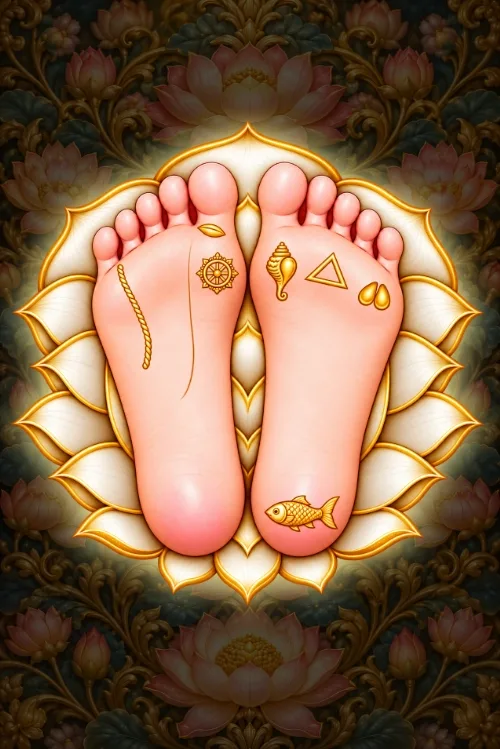
The sacred markings of Śrī Advaita Ācārya, their connection with Kṛṣṇa and Mahā-Viṣṇu, and the extraordinary devotion that called the golden Lord into the world.
What kind of power could summon the Supreme Lord into the world? According to Gauḍīya Vaiṣṇava literature, Śrī Advaita Ācārya accomplished something extraordinary with the simplest possible offerings: a few tulasī leaves, a palmful of Ganges water, and a heart overwhelmed with compassion.
The scriptures identify Advaita Ācārya as an incarnation of Mahā-Viṣṇu, the divine manifestation associated with the creation of innumerable universes. Yet instead of displaying His cosmic authority, He appeared as a humble worshiper of Kṛṣṇa. Seeing the spiritual suffering of humanity, He prayed so intensely for the Lord’s descent that His calls are described as penetrating the boundaries of the universe and resounding in the spiritual world.
Within the Gauḍīya Vaiṣṇava devotional tradition, Advaita’s divine form is also associated with a distinctive collection of auspicious markings. Eight sacred symbols adorn His lotus feet, and twenty markings are traditionally described upon His lotus hands. They include the disc of Viṣṇu, the conchshell, barleycorn, fish, cow’s hoofprint, drum, lotus, and a particularly intriguing emblem: a rope.
These symbols belong to a wider Vaiṣṇava tradition of recognizing divine personalities through auspicious bodily signs. Some correspond directly to markings described on Kṛṣṇa’s feet, while others invite reflection upon Advaita’s exceptional theological identity and His role in the appearance of Śrī Caitanya Mahāprabhu.
The precise eight-footmark and twenty-handmark arrangement is preserved in devotional iconographic compilations. Its complete original Sanskrit or Bengali textual source, however, has not yet been conclusively identified. The major Gauḍīya scriptures establish Advaita’s divine identity, His activities, and the importance of His lotus feet, but they do not provide a securely verified verse-by-verse enumeration of all twenty-eight markings.
This distinction is important. The sacred symbols can be appreciated without assigning unsupported scriptural authority to every individual interpretation.
More importantly, their deepest significance emerges not from their number alone, but from the extraordinary personality to whom they belong.
1. The Lotus Feet of the Lord Who Called Kṛṣṇa
Kṛṣṇadāsa Kavirāja Gosvāmī, the author of Śrī Caitanya-caritāmṛta, introduces Advaita Ācārya with a direct expression of reverence.
advaita ācārya — prabhura aṁśa-avatāra
tāṅra pāda-padme koṭi praṇati āmāra
Śrī Advaita Ācārya is a partial incarnation of the Supreme Lord. At His lotus feet I offer millions of respectful obeisances.
Śrī Caitanya-caritāmṛta, Ādi-līlā 1.39
The expression pāda-padme means at the lotus feet. In Vaiṣṇava theology, this is much more than a poetic description of the feet as beautiful or delicate. The lotus represents purity, spiritual beauty, transcendence, and the shelter offered by the Supreme Lord.
The lotus grows in water and mud without being stained by them. Similarly, the divine form is understood to be transcendental, untouched by the limitations and impurities of material nature.
But the significance of the lotus feet is also relational. To take shelter at someone’s feet expresses humility, surrender, reverence, and a willingness to serve. Within the language of bhakti, the feet of the Lord become the place where the devotee’s pride gives way to loving dependence.
This symbolism becomes especially meaningful in the case of Advaita Ācārya. He is identified as a divine manifestation possessing immense cosmic power, yet His own activities demonstrate the position of a devoted servant of Kṛṣṇa.
The feet that are worshiped by others belong to one whose heart is fixed upon the lotus feet of the Supreme Lord.
This apparent paradox is the key to understanding His sacred markings.
2. Who Is Śrī Advaita Ācārya?
Advaita Ācārya is one of the five principal personalities of the Pañca-tattva, the fivefold manifestation of divine reality described in Gauḍīya Vaiṣṇavism.
He was an eminent Vaiṣṇava teacher associated with Navadvīpa and Śāntipura in Bengal. The devotional histories describe Him as a respected elder, a learned exponent of scripture, and a spiritual authority deeply concerned with the declining devotion of society.
His wife, Śrī Sītā Ṭhākurāṇī, also occupies an honored place in the Caitanya tradition. Their household at Śāntipura became an important center of hospitality, worship, devotional discussion, and congregational chanting.
Yet the scriptures attribute to Advaita a significance far exceeding that of an ordinary religious teacher.
Advaita as an incarnation of Mahā-Viṣṇu
The Caitanya-caritāmṛta, Ādi-līlā 6.4, gives a direct Sanskrit declaration of His identity.
mahā-viṣṇur jagat-kartā
māyayā yaḥ sṛjaty adaḥ
tasyāvatāra evāyam
advaitācārya īśvaraḥ
Mahā-Viṣṇu is the creator of the cosmic manifestation, which He brings forth through His material energy. Śrī Advaita Ācārya is an incarnation of that Supreme Lord.
Śrī Caitanya-caritāmṛta, Ādi-līlā 6.4
Mahā-Viṣṇu occupies a central position in Vaiṣṇava cosmology. He is associated with the manifestation of innumerable universes and with the activation of material nature through divine energy.
The Caitanya-caritāmṛta further describes Advaita as a manifestation connected with the material and efficient causes of cosmic creation. He is not presented as an ordinary living being who has acquired extraordinary power through spiritual practice, but as belonging to the category of divine reality known as viṣṇu-tattva.
This explains why symbols such as the disc and conchshell are particularly appropriate to His traditional iconography. Both are closely associated with Viṣṇu and represent divine authority, sovereignty, and protection.
Nevertheless, Advaita’s cosmic identity is only one part of His theological significance.
Why He is called Advaita Ācārya
The next verse explains His name and spiritual role.
advaitaṁ hariṇādvaitād
ācāryaṁ bhakti-śaṁsanāt
bhaktāvatāram īśaṁ tam
advaitācāryam āśraye
Because He is nondifferent from Hari, the Supreme Lord, He is called Advaita. Because He teaches and propagates devotion, He is called Ācārya. He is the Supreme Lord appearing in the role of a devotee, and I take shelter of Śrī Advaita Ācārya.
Śrī Caitanya-caritāmṛta, Ādi-līlā 6.5
The name reveals three essential truths.
First, Advaita means nondifferent. In this context, the name establishes His nondifference from Lord Hari. It should not be confused with a claim that Advaita Ācārya taught the impersonal philosophy associated with Advaita Vedānta.
Second, Ācārya means a spiritual teacher who teaches by example as well as instruction. Advaita did not merely explain the supremacy of devotion. He personally demonstrated it through worship, prayer, humility, and concern for others.
Third, bhaktāvatāra means an incarnation appearing in the role of a devotee. This is the most remarkable dimension of His identity. Although He possesses divine authority, He takes the position of a worshiper to demonstrate the glory of loving service.
The final expression, advaitācāryam āśraye, means “I take shelter of Advaita Ācārya.”
The verse itself therefore directs attention toward the devotional relationship represented by His lotus feet.
3. Advaita Ācārya and Sadāśiva
A further dimension of Advaita’s identity appears in Kavi Karṇapūra’s Sanskrit work Śrī Gaura-gaṇoddeśa-dīpikā, which identifies associates of Caitanya Mahāprabhu with personalities from earlier divine pastimes.
Verse 76 states:
vraje āveśa-rūpatvād
vyūho yo ’pi sadāśivaḥ
sa evādvaita-gosvāmī
caitanyābhinna-vigrahaḥ
That Sadāśiva, who manifested in Vraja through a divinely empowered form, is now Advaita Gosvāmī, whose spiritual form is nondifferent from Śrī Caitanya.
Śrī Gaura-gaṇoddeśa-dīpikā 76
The following verses describe Sadāśiva’s desire to participate in Kṛṣṇa’s intimate pastimes among the cowherd boys of Vraja. Through Kṛṣṇa’s mercy, He receives the opportunity to experience those pastimes.
This adds another dimension to Advaita’s theological identity. The Gauḍīya tradition associates Him not only with Mahā-Viṣṇu but also with Sadāśiva, placing Him within a complex understanding of divine manifestations and their relationships.
These descriptions need not be treated as mutually exclusive. Vaiṣṇava theological literature recognizes different forms of manifestation, expansion, empowerment, and divine participation. The identity of Advaita is understood within that broader framework.
This connection is particularly interesting when considering two of His traditional symbols: the rope upon His right sole and the drum upon His left palm.
The drum, especially in its hourglass form known as the ḍamaru, is famously associated with Śiva. The rope or noose also appears in various forms of Indian sacred iconography.
However, the published catalogue simply names a rope and a drum. It does not establish that the drum is specifically a ḍamaru, nor does it provide a verified Sanskrit explanation identifying these symbols as references to Advaita’s Sadāśiva manifestation.
Their connection with Śaiva symbolism is therefore a meaningful possibility for devotional contemplation, not an established textual conclusion.
4. Advaita’s Position in the Pañca-tattva
The Caitanya-caritāmṛta, Ādi-līlā 7.6, presents the fivefold manifestation of the Supreme Lord.
pañca-tattvātmakaṁ kṛṣṇaṁ
bhakta-rūpa-svarūpakam
bhaktāvatāraṁ bhaktākhyaṁ
namāmi bhakta-śaktikam
I offer my obeisances to Kṛṣṇa, who manifests in five aspects: the form of a devotee, the expansion of a devotee, the incarnation of a devotee, the pure devotee, and the devotional potency.
Śrī Caitanya-caritāmṛta, Ādi-līlā 7.6
These five aspects are represented by Śrī Caitanya Mahāprabhu, Śrī Nityānanda Prabhu, Śrī Advaita Ācārya, Śrī Gadādhara Paṇḍita, and Śrī Śrīvāsa Ṭhākura.
Advaita occupies the position of bhaktāvatāra, the incarnation who teaches devotion by personally assuming the role of a devotee.
The significance is profound. His divine greatness is not diminished by His service to Kṛṣṇa. Rather, that service reveals the highest expression of His spiritual identity.
Within Gauḍīya theology, pure devotion is so exalted that the Lord Himself appears in the mood of a devotee to demonstrate its sweetness.
Advaita’s lotus feet therefore represent divine shelter, while His lotus hands become especially meaningful through the activities they perform: worshiping Kṛṣṇa, offering sacred substances, blessing devotees, and calling for divine mercy.
5. The Compassion That Called Caitanya Mahāprabhu Into the World
The most important narrative for understanding Advaita’s hands is the account of His prayers for the Supreme Lord’s appearance.
The Caitanya-caritāmṛta describes Advaita as deeply disturbed by the spiritual condition of society. People were absorbed in material enjoyment, social ambition, and religious activities lacking genuine devotion to Kṛṣṇa.
Advaita recognized that scholarship, ritual, and ordinary religious instruction alone would not awaken the transformation He desired.
His response was not condemnation but compassion.
loka-gati dekhi’ ācārya karuṇa-hṛdaya
vicāra karena, lokera kaiche hita haya
Seeing the condition of the world, Advaita Ācārya’s compassionate heart became deeply concerned. He began considering how the people might truly be benefited.
Śrī Caitanya-caritāmṛta, Ādi-līlā 3.98
The expression karuṇa-hṛdaya means compassionate-hearted. It identifies the motive behind Advaita’s extraordinary prayers.
He was not seeking greater power, personal recognition, or the satisfaction of His own religious ambitions. His concern was the welfare of living beings trapped in spiritual forgetfulness.
He concluded that if Kṛṣṇa personally appeared and demonstrated the path of devotion, people could awaken to their eternal relationship with the Supreme.
The Caitanya-bhāgavata, Ādi-khaṇḍa 2.80, expresses Advaita’s central teaching.
tribhuvane āche yata śāstrera pracāra
sarvatra vākhāne — kṛṣṇa-pāda-bhakti sāra
From all the scriptures known throughout the three worlds, Advaita Ācārya taught the same essential conclusion: devotion to the lotus feet of Kṛṣṇa is the highest purpose.
Śrī Caitanya-bhāgavata, Ādi-khaṇḍa 2.80
This establishes a direct connection between Advaita’s teaching and the sacred imagery of the lotus feet.
For Him, devotion was not merely one religious activity among many. It was the ultimate purpose toward which genuine spiritual knowledge should lead.
Why tulasī and Ganges water?
Advaita discovered the basis of His worship in a Sanskrit declaration quoted in Caitanya-caritāmṛta, Ādi-līlā 3.104, and attributed to the Gautamīya-tantra.
tulasī-dala-mātreṇa
jalasya culukena vā
vikrīṇīte svam ātmānaṁ
bhaktebhyo bhakta-vatsalaḥ
The Lord, who is deeply affectionate toward His devotees, gives Himself to one who offers merely a tulasī leaf and a palmful of water.
Gautamīya-tantra, quoted at Caitanya-caritāmṛta, Ādi-līlā 3.104
The expression bhakta-vatsalaḥ means affectionate toward devotees. The verse presents an extraordinary principle of bhakti: the Supreme Lord, who possesses everything, willingly becomes bound by the sincerity of loving devotion.
Advaita understood that the value of an offering is not determined principally by its material cost. A tiny offering made with genuine devotion can be spiritually greater than immense wealth presented without love.
The same principle is expressed by Kṛṣṇa in Bhagavad-gītā 9.26.
patraṁ puṣpaṁ phalaṁ toyaṁ
yo me bhaktyā prayacchati
tad ahaṁ bhakty-upahṛtam
aśnāmi prayatātmanaḥ
If someone offers Me with devotion a leaf, a flower, a fruit, or water, I accept that offering from the pure-hearted devotee.
Bhagavad-gītā 9.26
The essential word is bhaktyā—with devotion.
Kṛṣṇa does not require the devotee’s possessions for His own maintenance. He is complete in Himself. Yet He accepts loving offerings because the relationship between the Lord and the devotee is the true substance of worship.
Advaita acted upon this principle.
gaṅgā-jala, tulasī-mañjarī anukṣaṇa
kṛṣṇa-pāda-padma bhāvi’ kare samarpaṇa
Constantly remembering the lotus feet of Kṛṣṇa, Advaita offered tulasī buds together with water from the Ganges.
Śrī Caitanya-caritāmṛta, Ādi-līlā 3.108
This verse is particularly important when studying His sacred hands.
The hands performed the offering, while the mind remained absorbed in Kṛṣṇa’s lotus feet.
The Supreme Lord’s incarnation, associated with the creation of innumerable universes, appeared as a devotee offering the simplest substances with complete concentration.
The call that reached Vaikuṇṭha
The Caitanya-bhāgavata, Ādi-khaṇḍa 2.81–82, gives an especially vivid description.
tulasī-mañjarī-sahita gaṅgā-jale
niravadhi seve kṛṣṇe mahā-kutūhale
huṅkāra karaye kṛṣṇa-āveśera teje
ye dhvani brahmāṇḍa bhedi’ vaikuṇṭhete bāje
Advaita continually worshiped Kṛṣṇa with tulasī buds and Ganges water, filled with extraordinary eagerness. Overwhelmed by divine absorption, He called out so powerfully that His voice pierced the coverings of the universe and resounded in Vaikuṇṭha.
Śrī Caitanya-bhāgavata, Ādi-khaṇḍa 2.81–82
The imagery is astonishing. Advaita’s voice is described as crossing the boundaries of material creation and entering the spiritual realm.
His prayer is not presented as an ordinary request. It is the irresistible appeal of pure devotion, arising from intense compassion for the suffering world.
According to Gauḍīya Vaiṣṇava theology, this love moved the Supreme Lord to appear.
The Caitanya-caritāmṛta, Ādi-līlā 6.34, summarizes the outcome.
yāṅhāra tulasī-jale, yāṅhāra huṅkāre
sva-gaṇa sahite caitanyera avatāre
Through Advaita’s offerings of tulasī and water, and through His mighty calls, Śrī Caitanya Mahāprabhu descended into the world accompanied by His personal associates.
Śrī Caitanya-caritāmṛta, Ādi-līlā 6.34
This episode provides the central spiritual background for contemplating Advaita’s auspicious markings. The conch and drum can evoke His divine proclamation, while the lotus and other symbols recall the purity of His offerings.
Such correspondences are devotional interpretations rather than direct explanations of individual palm marks. Nevertheless, they illuminate the most important principle of His life: the Supreme Lord responds to pure love.
6. The Eight Auspicious Marks on Advaita Ācārya’s Lotus Feet
The traditional devotional catalogue attributes four auspicious markings to Advaita’s right foot and four to His left.
Right lotus foot
Barleycorn — Yava
Disc — Cakra
Upcurving line — Ūrdhva-rekhā
Rope — Rajju or pāśa, depending on its form
Left lotus foot
Conchshell — Śaṅkha
Triangle — Trikoṇa
Cow’s hoofprint — Goṣpada
Fish — Matsya or mīna
These Sanskrit words identify the corresponding objects. They should not be mistaken for terms recovered from a verified Sanskrit verse enumerating all eight marks of Advaita Ācārya.
Their arrangement closely resembles the traditional markings of Kṛṣṇa’s feet. Seven of Advaita’s eight symbols appear in Kṛṣṇa’s nineteen-mark catalogue, and all seven are associated with the same respective foot.
The rope is the distinctive exception.
The correspondence makes the eight-mark tradition particularly interesting, although it does not establish how or when the exact selection originated.
7. The Four Marks on Advaita’s Right Lotus Foot
1. Barleycorn — Yava: The nourishment of divine shelter
The barleycorn is traditionally associated with agricultural abundance, nourishment, prosperity, and sacred offerings.
Barley was an important grain in ancient Indian religious culture, and its presence among divine footmarks suggests sustenance and auspicious abundance.
The emblem also appears upon Kṛṣṇa’s right foot. Classical Vaiṣṇava explanations associate it with prosperity and the benefits obtained through divine shelter.
On Advaita’s foot, the barleycorn may be contemplated in the light of His mission. He was not primarily concerned with the economic poverty of the people around Him, but with their spiritual impoverishment—the loss of devotion and awareness of life’s ultimate purpose.
Just as grain nourishes the body, remembrance and service to Kṛṣṇa nourish the soul. Advaita’s prayers were intended to make this spiritual wealth available to the world.
The barleycorn therefore becomes a meaningful reminder that the highest prosperity is not the accumulation of temporary possessions, but the awakening of an enduring relationship with God.
This is a devotional application of traditional symbolism, rather than an independently verified explanation of Advaita’s individual mark.
2. Disc — Cakra: The power that removes spiritual obstacles
The disc is one of the most prominent attributes of Lord Viṣṇu.
Known as the Sudarśana-cakra, the divine disc represents sovereignty, protection, and the destruction of forces hostile to spiritual order.
Its presence on Advaita’s right foot is particularly meaningful because He is explicitly identified as an incarnation of Mahā-Viṣṇu.
Yet the disc’s symbolism reaches beyond cosmic authority.
Classical Gauḍīya explanations of Kṛṣṇa’s footmarks associate the disc with the destruction of six internal enemies: lust, anger, greed, delusion, pride, and envy.
These forces obstruct the development of pure devotion. They divert consciousness toward selfish desire, possessiveness, hostility, and false identification.
The disc can therefore be contemplated as the Lord’s power to remove the internal obstacles that prevent the soul from progressing toward spiritual realization.
In Advaita’s life, that power is expressed most strikingly through compassion. Rather than appearing as a warrior to destroy external enemies, He calls upon Kṛṣṇa to descend and awaken spiritual consciousness.
The symbol of divine power thus becomes connected with the highest purpose of mercy.
3. Upcurving line — Ūrdhva-rekhā: The ascent of consciousness
The Sanskrit word ūrdhva means upward, while rekhā means a line or marking.
An upward-running line appears among the classical auspicious marks on Kṛṣṇa’s right foot.
Its visual form naturally suggests ascent. As devotional symbolism, it can represent the elevation of consciousness from material identification toward spiritual awareness.
This interpretation resonates strongly with Advaita’s mission.
The Caitanya-caritāmṛta describes Him as deeply concerned about a society absorbed in temporary pursuits. He sought to awaken people to the eternal significance of devotion.
The ascending line may therefore be contemplated as a reminder that spiritual progress involves a transformation of life’s direction.
It is not enough to acquire knowledge, status, or religious accomplishment. The highest movement of consciousness is toward loving service to Kṛṣṇa.
The line’s upward form provides an appropriate visual metaphor for that movement, although the specific interpretation has not been established from a primary description of Advaita’s footmarks.
4. Rope — Rajju or Pāśa: The mystery of bondage and shelter
The rope is perhaps the most distinctive emblem in Advaita’s entire eight-mark catalogue.
Unlike the barleycorn, disc, and rising line, it is not separately named among the standard nineteen footmarks of Kṛṣṇa.
Its presence therefore deserves particular attention.
Two Sanskrit words may be relevant. Rajju generally means a rope or cord, while pāśa denotes a noose, snare, or bond. Without an identified original textual source and a clear depiction of the emblem, neither designation can be established as its definitive ancient name.
A rope can carry very different symbolic meanings.
It may bind and restrain, but it can also rescue, support, and draw someone to safety. These contrasting functions make it a rich image for reflecting upon the relationship between material bondage and spiritual liberation.
The Bhagavad-gītā 7.14 describes the difficulty of overcoming material illusion.
daivī hy eṣā guṇa-mayī
mama māyā duratyayā
mām eva ye prapadyante
māyām etāṁ taranti te
This divine energy of Mine, composed of the three modes of material nature, is difficult to overcome. But those who surrender to Me cross beyond it.
Bhagavad-gītā 7.14
The verse does not mention Advaita’s rope. It establishes a broader theological principle: the conditioned soul cannot overcome the binding influence of material illusion through independent strength alone. Divine shelter makes liberation possible.
Within this context, the rope can be contemplated as an image of the distinction between bondage and rescue.
Another devotional association is found in Kṛṣṇa’s Dāmodara pastime, when mother Yaśodā binds Him with a rope through the power of her maternal love.
There, the rope does not primarily represent material bondage. It becomes a symbol of the extraordinary intimacy through which the Supreme Lord allows Himself to be bound by devotion.
This offers a beautiful parallel to Advaita’s own worship. The Lord associated with cosmic creation calls upon Kṛṣṇa through love, and Kṛṣṇa responds to that call.
Nevertheless, neither the Dāmodara association nor the symbolism of material bondage has been independently verified as the original meaning of Advaita’s specific rope mark.
The emblem remains an important subject for further textual and iconographic research.
8. The Four Marks on Advaita’s Left Lotus Foot
5. Conchshell — Śaṅkha: The call that awakens devotion
The conchshell is a traditional attribute of Lord Viṣṇu and an emblem of sacred proclamation, auspiciousness, and protection.
Its sound announces important religious ceremonies and is associated with the presence and victory of the divine.
For Advaita Ācārya, the conchshell offers an especially compelling devotional association.
His most celebrated activity was His mighty call for Kṛṣṇa to descend into the world. The Caitanya-bhāgavata describes those calls as penetrating the cosmic coverings and resounding in Vaikuṇṭha.
The conch can therefore be contemplated as an emblem of spiritual awakening, recalling Advaita’s determination to summon divine mercy for the benefit of all living beings.
The comparison is meaningful because it links the traditional symbolism of sacred sound with a directly attested activity of Advaita.
However, the original texts describing His calls do not explicitly state that the conchshell mark on His foot represents those prayers.
6. Triangle — Trikoṇa: Auspicious order and completeness
The triangle is a recognized feature of the traditional markings on Kṛṣṇa’s left foot.
In classical descriptions, it belongs to a larger arrangement involving waterpots and other auspicious symbols.
Its appearance upon Advaita’s left foot preserves that iconographic correspondence.
Geometrically, the triangle suggests ordered structure and stability. It can also invite reflection upon the many threefold classifications found in Indian philosophical literature.
Examples include the three modes of material nature—goodness, passion, and ignorance—and the three cosmic functions of creation, maintenance, and dissolution.
Such associations may seem especially relevant to Advaita’s Mahā-Viṣṇu identity, since Mahā-Viṣṇu is connected with the manifestation of material nature.
Nevertheless, no verified Sanskrit explanation establishes that Advaita’s triangle specifically represents these doctrines.
Its most secure identification is as an auspicious geometric mark shared with the traditional imagery of Kṛṣṇa’s left foot.
7. Cow’s hoofprint — Goṣpada: The ocean reduced to a footprint
The cow’s hoofprint is among the most beautiful emblems in Vaiṣṇava sacred imagery.
At one level, it recalls the pastoral world of Vraja, where Kṛṣṇa lives among cows, calves, cowherd boys, and gopīs.
This is the world of intimate divine love, where the Supreme Lord’s majesty becomes concealed beneath the sweetness of personal relationships.
At another level, the hoofprint introduces a profound scriptural image of liberation.
samāśritā ye pada-pallava-plavaṁ
mahat-padaṁ puṇya-yaśo murāreḥ
bhavāmbudhir vatsa-padaṁ paraṁ padaṁ
padaṁ padaṁ yad vipadāṁ na teṣām
For those who take shelter of the boat of the Lord’s tender lotus feet, the ocean of material existence becomes like water contained in a calf’s hoofprint. Their destination is the supreme spiritual abode, beyond the dangers of material life.
Śrīmad-Bhāgavatam 10.14.58
The contrast is striking.
Material existence is compared to an immense ocean, difficult to cross because of the continual suffering, uncertainty, and bondage associated with repeated birth and death.
Yet for one who has obtained the Lord’s shelter, that ocean becomes no greater than the small quantity of water remaining in a calf’s hoofprint.
The Sanskrit expression vatsa-padam means a calf’s hoofprint.
The imagery links spiritual liberation with the simple pastoral world of Kṛṣṇa, revealing how the highest theological truths can be expressed through the ordinary details of Vraja.
For Advaita Ācārya, this symbolism is especially appropriate. His compassionate prayers were directed toward delivering living beings from material suffering and awakening their devotion to Kṛṣṇa.
The cow’s hoofprint therefore becomes a natural reminder of His concern for the spiritual welfare of the world.
The Bhāgavatam verse, however, concerns the Lord’s lotus feet generally. It should not be presented as a direct textual explanation of Advaita’s individual mark.
8. Fish — Matsya or Mīna: Preservation amid the waters
The fish is another symbol found in the classical description of Kṛṣṇa’s left foot.
It may evoke Matsya, the divine fish incarnation associated with preservation and protection during a cosmic deluge.
More broadly, fish imagery suggests movement through water, life sustained amid changing currents, and the ability to navigate conditions that would overwhelm other creatures.
Within devotional contemplation, the fish can therefore represent the Lord’s ability to guide souls through the ocean of material existence.
This interpretation connects naturally with Advaita’s compassionate mission.
He desired that living beings should no longer remain helplessly carried along by the currents of material desire and spiritual forgetfulness. His prayers sought to make the shelter of Kṛṣṇa available to them.
As with several other marks, the symbolism is meaningful, but its application to Advaita’s fish should be understood as devotional reflection rather than an individually verified scriptural definition.
9. The Remarkable Correspondence with Kṛṣṇa’s Footmarks
The traditional list of Advaita’s eight footmarks contains an unusually precise correspondence with the nineteen auspicious marks attributed to Kṛṣṇa.
The Śrīmad-Bhāgavatam explicitly confirms that Kṛṣṇa’s footprints can be recognized through divine symbols.
padāni vyaktam etāni
nanda-sūnor mahātmanaḥ
lakṣyante hi dhvajāmbhoja-
vajrāṅkuśa-yavādibhiḥ
These footprints clearly belong to the glorious son of Nanda. They can be recognized by the marks of a flag, lotus, thunderbolt, elephant goad, barleycorn, and other auspicious symbols.
Śrīmad-Bhāgavatam 10.30.25
The gopīs recognize Kṛṣṇa’s footprints in the dust of Vṛndāvana by their distinctive marks. Classical Gauḍīya commentaries preserve more extensive descriptions, including the traditional enumeration of eleven marks on Kṛṣṇa’s right foot and eight upon His left.
When the Advaita catalogue is compared with this arrangement, seven of His eight marks correspond to Kṛṣṇa’s symbols on the same respective foot.
This is not merely a resemblance in the types of objects represented. The traditional right-and-left distribution also agrees for seven symbols.
The rope is the sole exception because it is absent from Kṛṣṇa’s standard nineteen-mark enumeration.
The correspondence is theologically suggestive, particularly because Advaita is identified as belonging to viṣṇu-tattva. Yet the pattern does not establish the historical origin of the eight-mark catalogue.
It remains possible that the smaller arrangement developed through selection from a broader vocabulary of auspicious Vaiṣṇava footmarks. Without a verified source documenting that development, such an explanation must remain a hypothesis.
The differences in the number of symbols should not be interpreted as indicating that Advaita possesses a lesser degree of spiritual perfection.
The scriptures establish His identity and greatness independently of these numerical catalogues.
The quantity of marks is not a scale by which divine greatness can be measured.
10. The Twenty Auspicious Marks on Advaita’s Lotus Hands
The traditional handmark catalogue identifies ten auspicious markings on each palm, for a combined total of twenty.
These markings differ from the footmarks in several respects.
The feet primarily invite meditation upon shelter, surrender, and the Lord’s divine presence. The hands naturally direct attention toward activity: worship, protection, offering, blessing, and service.
This distinction is particularly meaningful for Advaita Ācārya, whose extraordinary role in the Caitanya tradition is inseparable from His acts of worship.
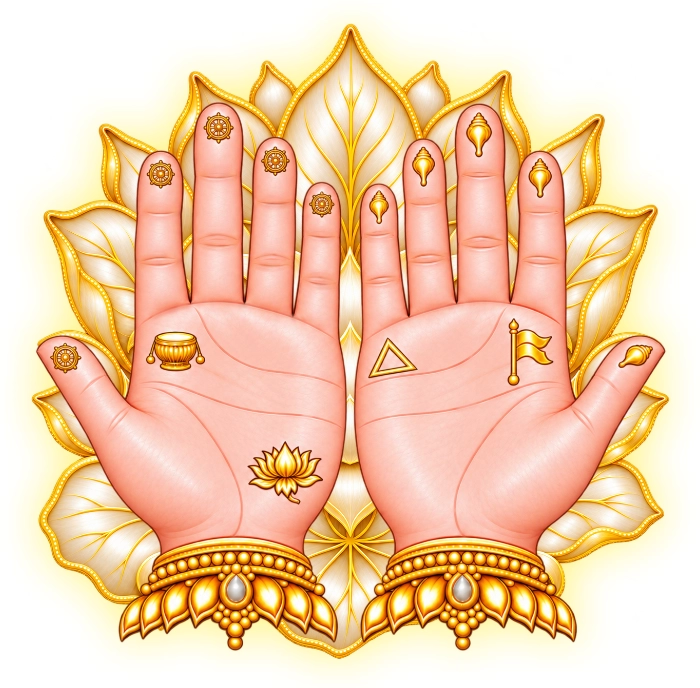
Left lotus hand: Ten auspicious marks
Disc
Disc
Disc
Disc
Disc
Drum
Lotus
Life line
Fate line
Good fortune or enjoyment line
Right lotus hand: Ten auspicious marks
Conchshell
Conchshell
Conchshell
Conchshell
Conchshell
Triangle
Victory flag
Life line
Fate line
Good fortune or enjoyment line
The total of twenty is produced by ten fingertip emblems, four additional palm symbols, and six palm lines.
Thus, twenty does not mean twenty entirely different symbolic objects. The five discs and five conchshells are counted individually because they occupy separate fingertips.
The three major palm lines also appear on both hands and are counted separately.
This is the enumeration preserved in the extended devotional catalogue. Its precise original textual source has not been identified with the same certainty as the classical descriptions of Kṛṣṇa’s auspicious footmarks.
11. The Meaning of Advaita’s Lotus-Hand Markings
Five discs on the left fingertips: Divine power expressed through action
The five fingertips of Advaita’s left hand are traditionally described as bearing five discs.
The disc is among the most recognizable attributes of Viṣṇu. It represents divine sovereignty, protection, and the power to destroy obstacles to spiritual order.
Its repetition upon all five fingertips suggests, as a devotional reflection, the presence of divine authority throughout the activities of the hand.
But Advaita’s life gives this imagery an unexpected significance.
The hands associated with cosmic power are engaged in simple devotional worship. Rather than demonstrating sovereignty through domination, He uses His divine position to inspire devotion and call for mercy.
This transforms the meaning of power.
In the highest devotional understanding, greatness is not measured simply by the ability to command or destroy, but by the ability to serve and uplift others.
The repeated discs can therefore be contemplated as symbols of divine power dedicated to compassionate action.
The drum: Sacred sound and the call of devotion
The drum is one of the most distinctive emblems upon Advaita’s left palm.
In Indian religious culture, drums are associated with sacred rhythm, worship, celebration, dancing, and proclamation.
Within Gauḍīya Vaiṣṇavism, percussion instruments are especially important in nāma-saṅkīrtana, the congregational chanting of the holy names.
The drum consequently provides a natural devotional connection with Advaita’s mission.
His powerful calls for Kṛṣṇa’s descent were among the defining events preceding Caitanya Mahāprabhu’s appearance. Later, the congregational chanting of the holy names became the central public expression of the movement Advaita had prayed to establish.
The drum may therefore be contemplated as an emblem of spiritual sound spreading through the world.
A second possible association arises from Advaita’s identification with Sadāśiva. The ḍamaru, an hourglass-shaped drum, is a familiar attribute of Śiva.
However, the traditional Advaita handmark list does not independently establish that His drum is specifically the ḍamaru. Nor does the verified Sanskrit text of Gaura-gaṇoddeśa-dīpikā directly interpret a palm marking in this way.
The connection remains suggestive rather than conclusive.
The lotus: Purity in the act of worship
The lotus upon Advaita’s left palm represents beauty, purity, and transcendence.
A lotus remains unstained despite growing in muddy water. Similarly, devotional action is understood to become spiritually purified when performed for the satisfaction of the Supreme Lord.
The lotus on Advaita’s hand is especially meaningful when considered alongside His offerings of tulasī and Ganges water.
His hands were not merely instruments of power. They were engaged in worship.
The emblem can therefore be contemplated as a reminder that spiritual purity is expressed through intention and loving service, rather than through outward appearance alone.
Five conchshells on the right fingertips: The proclamation of divine mercy
The five fingertips of the right hand traditionally bear five conchshell emblems.
The conch is associated with auspicious sound, protection, and sacred proclamation.
Its repetition suggests a pervasive divine quality associated with the hand, and the pattern closely resembles the fingertip arrangement attributed to Kṛṣṇa in extended devotional handmark catalogues.
In relation to Advaita Ācārya, the conchshells naturally recall His extraordinary calls for Kṛṣṇa’s appearance.
The Caitanya-bhāgavata describes His voice as penetrating the boundaries of material creation. The conch is therefore an attractive image for meditating upon the proclamation of spiritual truth and the awakening of devotion.
Yet the text does not explicitly identify the five fingertip conches as representations of His call. That connection belongs to devotional interpretation.
The triangle: Ordered form and cosmic relationships
The triangle upon Advaita’s right palm is another auspicious geometric emblem.
As with the triangle upon His left sole, its basic shape invites reflection upon structure, stability, and completeness.
It may also recall the three modes of material nature or the three cosmic functions of creation, preservation, and dissolution.
Such associations can be considered in light of Advaita’s Mahā-Viṣṇu identity, but no verified original Sanskrit passage establishes them as the precise meaning of this particular palm mark.
The distinction between established identity and interpretive symbolism remains necessary.
The victory flag: The triumph of devotion
The flag, or dhvaja, represents sovereignty, victory, and auspicious accomplishment.
On Advaita’s palm, it may be contemplated as an emblem of the triumph of devotion over spiritual ignorance.
His mission was not directed toward worldly conquest. He prayed for the transformation of human consciousness through divine love.
The highest victory in this context is therefore not the defeat of another person. It is the awakening of pure devotion within the heart.
Through His prayers, Advaita helped prepare the way for the saṅkīrtana movement of Caitanya Mahāprabhu, in which spiritual transformation is pursued through the chanting of the holy names.
The flag becomes a fitting reminder of that mission.
The three lines on each palm
The remaining six entries are the life line, fate line, and good fortune or enjoyment line, each appearing on both palms.
These labels come from the vocabulary of traditional palm interpretation.
Their inclusion requires special care because they differ from the emblematic objects found elsewhere in the catalogue.
In ordinary palmistry, such lines may be interpreted as indicators of lifespan, destiny, prosperity, or personal circumstances. Applying these categories literally to Advaita Ācārya would be theologically problematic, because the Gauḍīya tradition identifies Him as a divine manifestation rather than an ordinary conditioned soul governed by karma.
The lines are therefore best understood as elements of the transmitted iconographic arrangement.
They may invite devotional reflection upon eternal existence, auspicious purpose, and spiritual fulfillment, but these interpretations should not be confused with independently verified classical explanations.
The exact traditional Sanskrit names of the three lines, as applied specifically to Advaita’s palms, have not been established from an original source.
12. The Hands That Offered Tulasī, Water, and Food
The deepest scriptural explanation of Advaita’s hands is found in what He actually did with them.
Through His offerings of tulasī and Ganges water, He demonstrated that the Supreme Lord responds not to material opulence alone, but to the sincerity of loving devotion.
His activities at Śāntipura provide another example.
After Caitanya Mahāprabhu accepted the renounced order of life, He was brought to Advaita’s home. The Caitanya-caritāmṛta, Madhya-līlā, Chapter 3, describes the extraordinary hospitality offered there.
Advaita welcomed Caitanya and Nityānanda, arranged elaborate food offerings to Kṛṣṇa, and personally served Them.
His wife, Sītā Ṭhākurāṇī, prepared numerous dishes, and the household became a center of worship, hospitality, and ecstatic congregational chanting.
The account reveals Advaita’s generosity in practical action.
The same personality who had called Kṛṣṇa into the world now expressed His love through washing feet, offering food, serving guests, and arranging devotional celebrations.
The episode also provides an important correction to any one-sided understanding of divine sovereignty.
Advaita’s greatness was not demonstrated only through extraordinary prayers or cosmic theological identity. It was equally visible through the ordinary-looking acts of service that filled His household.
In Vaiṣṇava theology, those actions become spiritually extraordinary because they are performed for the pleasure of the Supreme Lord.
Thus, the hands bearing discs, conchshells, a lotus, and a victory flag are ultimately celebrated because they serve.
13. When the Supreme Lord Bows to His Own Devotee
One of the most remarkable exchanges in the Caitanya-caritāmṛta concerns the relationship between Advaita Ācārya and Caitanya Mahāprabhu.
laukika-līlāte dharma-maryādā-rakṣaṇa
stuti-bhaktye karena tāṅra caraṇa vandana
To preserve proper religious conduct within His earthly pastimes, Caitanya Mahāprabhu offers prayers and reverentially bows at the feet of Advaita Ācārya.
Śrī Caitanya-caritāmṛta, Ādi-līlā 6.41
Caitanya honors Advaita as an exalted elder and spiritual teacher.
Yet Advaita adopts the opposite position.
caitanya-gosāñike ācārya kare ‘prabhu’-jñāna
āpanāke karena tāṅra ‘dāsa’-abhimāna
Advaita Ācārya regards Caitanya Mahāprabhu as His Lord and Master, while considering Himself His servant.
Śrī Caitanya-caritāmṛta, Ādi-līlā 6.42
The exchange reveals the spiritual beauty of their relationship.
Caitanya Mahāprabhu honors Advaita, while Advaita finds His happiness in serving Caitanya.
Each expresses devotion through the relationship appropriate to His divine role.
The theological lesson is profound. The Supreme Lord’s manifestations do not merely possess spiritual power. They participate in relationships of service, affection, reverence, and love.
Advaita’s position as Mahā-Viṣṇu is not contradicted by His attitude of servitude. Within Gauḍīya theology, loving service is understood to be a manifestation of the highest spiritual fulfillment.
The one whose feet are revered by others delights in worshiping the feet of Kṛṣṇa.
This is perhaps the clearest explanation of why the study of Advaita’s sacred markings must ultimately lead beyond iconography toward the theology of bhakti.
14. Why Eight Footmarks and Twenty Handmarks?
The differing numbers of auspicious markings attributed to divine personalities can create confusion when several devotional catalogues are compared.
Traditional descriptions of Kṛṣṇa’s lotus feet identify nineteen principal emblems, while the expanded list associated with Gaurāṅga contains thirty-two. Advaita’s catalogue preserves only eight.
Similarly, the extended handmark lists contain differing numbers of symbols for Kṛṣṇa, Rādhā, Gaurāṅga, Nityānanda, and Advaita.
These differences should not be used to establish a numerical hierarchy of divine greatness.
The identity of Advaita as Mahā-Viṣṇu is explained directly in the Caitanya-caritāmṛta. His spiritual position does not depend upon whether a particular diagram contains eight, nineteen, or thirty-two markings.
Different devotional traditions may preserve different sets of emblems, and the historical development of these arrangements is not equally documented.
The similarity between Advaita’s eight footmarks and Kṛṣṇa’s nineteen-mark arrangement is particularly interesting. Seven symbols correspond on the same respective foot, while the rope remains distinctive.
The palm arrangement also shares familiar features with the traditional handmark catalogues of Kṛṣṇa, especially the discs upon the left fingertips and conchshells upon the right.
These correspondences show that Advaita’s iconography belongs to a recognizable Vaiṣṇava vocabulary of sacred symbols.
They do not, by themselves, prove that the lists were composed by a particular author, derived from a single classical source, or transmitted unchanged over many centuries.
The published eight-and-twenty-mark catalogue is documented in devotional compilations and illustrated works. An edition of Pāda-sevanam, compiled by Īśvara Dāsa, contains dedicated sections on Advaita’s footprints and handprints. The work was already advertised in the Vaiṣṇava magazine Back to Godhead in 2000, establishing a printed witness to this iconographic material by that date.
Nevertheless, the complete primary textual origin of the exact enumeration remains insufficiently established.
A responsible presentation must therefore distinguish between three levels of evidence: what scripture explicitly states, what later devotional iconography preserves, and what contemplative interpretation may reasonably suggest.
These distinctions do not diminish the devotional importance of the symbols. They prevent uncertain claims from obscuring the stronger teachings that are genuinely established in the classical literature.
15. The Spiritual Practice of Contemplating the Lotus Feet
Meditation upon the divine feet belongs to the broader Vaiṣṇava discipline of devotional service.
Prahlāda Mahārāja identifies service to the lotus feet, or pāda-sevanam, among the nine principal practices of bhakti.
śravaṇaṁ kīrtanaṁ viṣṇoḥ
smaraṇaṁ pāda-sevanam
arcanaṁ vandanaṁ dāsyaṁ
sakhyam ātma-nivedanam
Hearing about Viṣṇu, chanting His glories, remembering Him, serving His lotus feet, worshiping Him, offering prayers, serving as His servant, cultivating friendship with Him, and surrendering oneself completely—these are the nine principal forms of devotion.
Śrīmad-Bhāgavatam 7.5.23
The next verse explains that when these activities are sincerely offered to the Supreme Lord, they represent the highest development of spiritual learning.
Within this framework, contemplation of Advaita’s sacred feet is not primarily an exercise in identifying religious symbols.
It is an opportunity to remember His qualities, activities, and relationship with Kṛṣṇa.
The barleycorn may recall the nourishment of spiritual life. The disc brings to mind divine protection and the removal of inner obstacles. The rising line suggests the elevation of consciousness, while the rope invites reflection upon bondage, shelter, and the liberating power of devotion.
The conchshell recalls Advaita’s call for divine mercy. The cow’s hoofprint evokes the shelter of Kṛṣṇa’s feet, which makes the ocean of material existence easy to cross. The fish suggests preservation amid dangerous currents, while the triangle remains an auspicious emblem whose more elaborate meaning requires further textual verification.
The same method applies to the hands.
The discs and conchshells recall divine authority and proclamation. The drum suggests sacred sound, and the lotus reminds the practitioner of purity in action. The victory flag evokes the triumph of devotion, while the palm lines belong to the traditional iconographic depiction without requiring speculative predictions of destiny.
The symbols become meaningful when connected with the personality to whom they belong.
Their purpose is smaraṇa, remembrance, not the mechanical manipulation of spiritual power through geometric figures.
The highest meditation leads beyond admiration toward practical transformation: greater humility, deeper faith, compassion for others, sincerity in worship, and the willingness to serve the Supreme Lord.
Advaita’s own example makes the principle unmistakable. His most extraordinary achievement was accomplished through loving devotion, expressed in the simplest possible offering.
16. The Mystery of Divine Power and Divine Humility
The life of Advaita Ācārya presents an extraordinary theological contrast.
He is identified as Mahā-Viṣṇu, associated with the creation of innumerable universes. He is also identified with Sadāśiva in Gaura-gaṇoddeśa-dīpikā. His divine form is traditionally depicted with symbols of sovereignty, protection, sacred sound, and auspiciousness.
Yet His most celebrated activity is not cosmic creation, the destruction of enemies, or a display of supernatural power.
It is worship.
Seeing humanity absorbed in material life, Advaita’s heart became filled with compassion. He understood that the deepest suffering of the living being arises from forgetfulness of the Supreme Lord.
He therefore offered tulasī leaves and Ganges water, meditated upon Kṛṣṇa’s lotus feet, and called for the Lord to appear.
According to Gauḍīya tradition, those prayers were answered through the descent of Śrī Caitanya Mahāprabhu, who inaugurated the widespread distribution of pure love of God through nāma-saṅkīrtana.
The entire narrative reverses ordinary assumptions about greatness.
The one associated with immeasurable cosmic power demonstrates that the simplest offering can become spiritually supreme when filled with love.
The Lord who is worthy of worship adopts the position of a worshiper.
The possessor of divine sovereignty finds His greatest happiness in service.
Advaita’s eight auspicious footmarks and twenty handmarks may be contemplated within this extraordinary theological relationship.
They point toward divine power, but also toward the purpose for which that power is expressed: the awakening of devotion.
17. The Treasure Beyond All Twenty-Eight Marks
Near the conclusion of his description of Advaita Ācārya, Kṛṣṇadāsa Kavirāja Gosvāmī offers a deeply personal expression of humility.
ācārya-caraṇe mora koṭi namaskāra
ithe kichu aparādha nā labe āmāra
At the lotus feet of Śrī Advaita Ācārya, I offer ten million respectful obeisances. May He kindly forgive any offense in this description.
Śrī Caitanya-caritāmṛta, Ādi-līlā 6.116
Having explained Advaita’s extraordinary identity and pastimes, the author concludes not with intellectual triumph, but with surrender.
This reveals the proper spirit in which the sacred markings are understood.
Their purpose is not merely to satisfy curiosity about divine anatomy, establish numerical comparisons, or assign elaborate meanings to every geometric form.
They invite remembrance of the divine personality whose feet and hands they adorn.
Advaita’s feet represent shelter. His hands represent service. His prayers reveal the extraordinary power of pure devotion.
The disc speaks of divine authority, yet His hands offer tulasī and water. The conch evokes sacred proclamation, yet His voice cries out for the spiritual welfare of the world. The cow’s hoofprint recalls the ocean of material existence reduced to something easily crossed through divine shelter.
The rope remains a particularly intriguing emblem, inviting further research into the history of the traditional diagram. The drum suggests sacred sound and possibly His Sadāśiva identity, though the precise classical interpretation remains unverified.
Yet the central message does not depend upon resolving every iconographic question.
The Lord associated with the creation of innumerable universes appeared as a compassionate devotee, offering the simplest gifts and calling for Kṛṣṇa to descend.
His example reveals a truth at the heart of Gauḍīya Vaiṣṇava theology: the highest expression of divine greatness is inseparable from loving service.
The eight marks upon His feet and twenty upon His hands ultimately direct the heart toward a single treasure—the devotion that moved the Supreme Lord to appear and distribute divine love throughout the world.
Sources and Textual References
Primary scriptures and classical Gauḍīya works
- Śrī Caitanya-caritāmṛta — Ādi-līlā, Chapter 6: The Glories of Śrī Advaita Ācārya The principal theological source for Advaita’s identification with Mahā-Viṣṇu, His role as bhaktāvatāra, His devotional relationship with Caitanya Mahāprabhu, and the author’s obeisances at His lotus feet. Especially verses 6.4–5, 6.20–35, 6.41–43, and 6.115–116.
- Śrī Caitanya-caritāmṛta — Ādi-līlā, Chapter 3 Describes Advaita’s compassion for humanity, His determination to call Kṛṣṇa into the world, His worship with tulasī and Ganges water, and the Sanskrit quotation attributed to the Gautamīya-tantra. Especially verses 3.92–110.
- Śrī Caitanya-caritāmṛta — Ādi-līlā, Chapter 7 Describes the fivefold manifestation of the Supreme Lord, known as the Pañca-tattva, including Advaita’s position as bhaktāvatāra.
- Śrī Caitanya-bhāgavata — Ādi-khaṇḍa, Chapter 2 Vṛndāvana Dāsa Ṭhākura’s description of Advaita’s teaching, worship with tulasī and Ganges water, mighty calls for Kṛṣṇa’s descent, and compassion for the world. Especially verses 2.78–95.
- Śrī Gaura-gaṇoddeśa-dīpikā — Kavi Karṇapūra Verses 76–85 describe Advaita’s connection with Sadāśiva and the theological background of His divine manifestation. An accessible Sanskrit transliteration is available through the Indira Gandhi National Centre for the Arts.
- Śrī Caitanya-caritāmṛta — Madhya-līlā, Chapter 3 Describes Caitanya Mahāprabhu’s visit to Advaita’s home at Śāntipura, the hospitality of Advaita and Sītā Ṭhākurāṇī, offerings to Kṛṣṇa, and devotional celebrations.
- Śrīmad-Bhāgavatam 10.30.25 Describes the divine footmarks of Kṛṣṇa recognized by the gopīs. Its classical commentarial tradition provides a foundation for the broader symbolism of Vaiṣṇava auspicious footmarks.
- Śrīmad-Bhāgavatam 10.14.58 Compares the Lord’s lotus feet to a boat across the ocean of material existence, which becomes no greater than water contained in a calf’s hoofprint.
- Śrīmad-Bhāgavatam 7.5.23–24 Prahlāda Mahārāja’s description of the nine forms of devotional service, including pāda-sevanam, service to the Lord’s lotus feet.
- Bhagavad-gītā 7.14 and 9.26 Establish the principles of transcending material illusion through surrender and the Supreme Lord’s acceptance of simple offerings made with devotion.
Devotional iconography and comparative sources
- Pāda-sevanam: Meditations on the Lotus Feet and Hands of Their Lordships — compiled by Īśvara Dāsa A devotional publication containing illustrations and descriptions of the hands and feet of major Gauḍīya personalities. Its contents include sections specifically devoted to Advaita Ācārya’s footprints and handprints, beginning on pages 41 and 45 respectively. The work was advertised in Back to Godhead in 2000; a more recent edition is also available. It is an important printed witness to the iconographic tradition, although an examination of its full textual apparatus is still needed to establish the original sources of every emblem.
- The Lotus Feet and Hands of Nitai Gaura, Rādhā and Kṛṣṇa — Sastra Caksusa A devotional compilation published in 2009 that contains the exact eight-footmark and twenty-handmark arrangement associated with Advaita Ācārya.
- ISKCON Desire Tree — The Lotus Feet and Hands of the Lords A devotional compilation published in 2011 that reproduces the traditional markings of Advaita Ācārya alongside those associated with Gaurāṅga, Nityānanda, Rādhā, and Kṛṣṇa.
Note on textual authenticity
The divine identity, theological position, devotion, and activities of Advaita Ācārya are explicitly described in classical Gauḍīya Vaiṣṇava scriptures.
The eight-footmark and twenty-handmark arrangement is documented in devotional iconographic works, but its complete original Sanskrit or Bengali textual source remains insufficiently verified.
The symbolic explanations presented in this article consequently distinguish direct scriptural teachings from broader Vaiṣṇava symbolism and devotional contemplation. The classical quotations establish the theological context; they should not be interpreted as individually authenticating all twenty-eight markings or their proposed meanings.
This distinction preserves both the devotional richness of the tradition and the scholarly integrity necessary for a reliable account.