

When the Supreme Brahman Plays in Nanda’s Courtyard
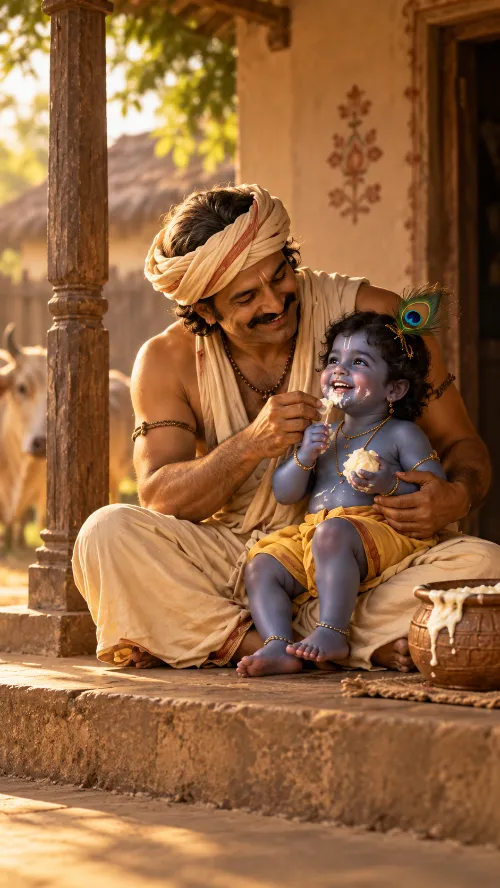
Raghupati Upādhyāya’s vision of the Absolute in a cowherd’s house
Some people turn to the Vedas because they fear saṁsāra. Others seek guidance in Smṛti. Others immerse themselves in the Mahābhārata. Raghupati Upādhyāya says: let them.
He wants Nanda Mahārāja. Why? Because the very Supreme Brahman toward whom the scriptures ultimately point is already inside Nanda’s household. This startling theological reversal is compressed into one of the most memorable verses quoted in the Caitanya-caritāmṛta.
श्रुतिमपरे स्मृतिमितरे
भारतमन्ये भजन्तु भवभीताः ।
अहमिह नन्दं वन्दे
यस्यालिन्दे परं ब्रह्म ॥
śrutim apare smṛtim itare
bhāratam anye bhajantu bhava-bhītāḥ
aham iha nandaṁ vande
yasyālinde paraṁ brahma
“Let some who fear material existence take shelter of the Śruti, others of the Smṛti, and still others of the Mahābhārata. As for me, I bow to Nanda—in whose veranda is the Supreme Brahman.”
Caitanya-caritāmṛta, Madhya-līlā 19.96
Later included by Rūpa Gosvāmī in Padyāvalī 126.
A. C. Bhaktivedanta Swami Prabhupāda renders the last image more explicitly: “As far as I am concerned, I worship Kṛṣṇa’s father, Mahārāja Nanda, in whose courtyard the Supreme Personality of Godhead, the Absolute Truth, is playing.”
That translation captures the Vraja setting beautifully. But the Sanskrit itself is even more audacious. It does not actually say “playing.” It simply says:
यस्यालिन्दे परं ब्रह्म
yasyālinde paraṁ brahma
“In whose ālinda is the Supreme Brahman.”
The Absolute is simply there. In Nanda’s house.
First, an Important Attribution
The verse is often introduced as: Rūpa Gosvāmī’s Padyāvalī 126. That is true as far as its later preservation is concerned, but it can give the mistaken impression that Rūpa Gosvāmī composed it.
The Caitanya-caritāmṛta says otherwise. Immediately before Raghupati recites the verse, Kṛṣṇadāsa Kavirāja writes:
নিজ-কৃত কৃষ্ণলীলা-শ্লোক পড়িল ।
শুনি’ মহাপ্রভুর মহা প্রেমাবেশ হৈল ॥
nija-kṛta kṛṣṇa-līlā-śloka paḍila
śuni’ mahāprabhura mahā premāveśa haila
“Raghupati Upādhyāya recited verses about Kṛṣṇa’s pastimes that he himself had composed. Hearing them, Śrī Caitanya Mahāprabhu became overwhelmed with ecstatic love.”
Caitanya-caritāmṛta, Madhya 19.95
The decisive expression is: nija-kṛta “personally composed.” So the most precise attribution is: A verse composed and recited by Raghupati Upādhyāya before Śrī Caitanya Mahāprabhu, later collected by Rūpa Gosvāmī as Padyāvalī 126.
That distinction is worth preserving.
Who Was Raghupati Upādhyāya?
Raghupati Upādhyāya appears in Caitanya-caritāmṛta Madhya 19 during Mahāprabhu’s stay in the Prayāga region—the same chapter in which Caitanya gives Rūpa Gosvāmī his celebrated teachings on bhakti and rasa.
Kṛṣṇadāsa describes Raghupati as a learned brāhmaṇa and Vaiṣṇava possessing extraordinary poetic insight into Kṛṣṇa-līlā. His verses immediately affect Caitanya Mahāprabhu.
That itself tells us something. These are not merely clever literary epigrams. They express precisely the kind of Vraja-centered theological vision that Mahāprabhu relishes.
And Rūpa Gosvāmī’s later preservation of them in the Padyāvalī confirms their importance within the developing Gauḍīya tradition.
The Verse Begins With Fear
The first half says:
śrutim apare smṛtim itare
bhāratam anye bhajantu bhava-bhītāḥ
The crucial expression is: bhava-bhītāḥ
bhava
literally “becoming,” but in this context:
- conditioned worldly existence,
- the recurring process of birth and death,
- saṁsāra.
bhīta
afraid, frightened. Thus: bhava-bhītāḥ means: “those who are afraid of worldly existence.” These people are not fools. They are spiritually serious enough to recognize that saṁsāra is dangerous.
They understand: birth ends in death, possessions disappear, relationships change, bodies deteriorate, karma binds, and worldly pleasure does not produce lasting freedom.
So they turn toward sacred knowledge. Raghupati does not condemn them. But he stands somewhere else.
Śruti, Smṛti, and the Mahābhārata
Raghupati deliberately names three enormous categories of sacred authority.
Śruti
Śruti literally means: “that which is heard.” It refers to the foundational Vedic revelation: the Vedas, Brāhmaṇas, Āraṇyakas, and especially the Upaniṣadic revelation of ultimate reality.
For the seeker frightened by saṁsāra, Śruti offers:
- knowledge of the eternal,
- discrimination between self and matter,
- teachings concerning Brahman,
- and paths beyond mortality.
Smṛti
Smṛti means: “that which is remembered.” It includes a broad body of authoritative tradition rooted in Vedic revelation: Dharmaśāstra, ritual and social instruction, theological teaching, and many later sacred compositions.
Smṛti translates transcendent revelation into lived religious culture.
Bhārata
bhāratam here means: the Mahābhārata. The Mahābhārata contains: dharma, philosophy, politics, sacred history, devotion, and of course the Bhagavad-gītā. Thus Raghupati has effectively surveyed the great landscape of authoritative Sanskrit religious literature: Śruti.
Smṛti. Mahābhārata. And then he suddenly abandons the library.
“Let Them Take Shelter There”
The verb is: bhajantu from the root √bhaj. It can mean: to serve, honor, worship, devote oneself to, resort to, seek refuge in. Thus “worship the Vedic literature” is possible, but the idea need not be literal worship of physical books.
The sense is more naturally: “Let those frightened by saṁsāra devote themselves to Śruti, Smṛti, or Mahābhārata.” Or: “Let them seek shelter there.” Then comes the turn: aham iha “As for me—here…”
Raghupati declares his own choice.
“I Bow to Nanda”
अहमिह नन्दं वन्दे
aham iha nandaṁ vande
Not: kṛṣṇaṁ vande “I worship Kṛṣṇa.” But: nandaṁ vande “I bow to Nanda.” That is the first great surprise of the verse. If Kṛṣṇa is the Supreme Brahman, why not worship Kṛṣṇa directly?
Because Raghupati’s attention has shifted from merely asking: “Who is the Absolute?” to asking: “What kind of devotee has such a relationship with the Absolute that the Absolute lives in his house as his child?”
The poem is therefore simultaneously: Kṛṣṇa-mahimā — glorification of Kṛṣṇa, and: bhakta-mahimā — glorification of His devotee. Nanda’s greatness lies in the astonishing intimacy of his relationship with Kṛṣṇa.
Ālinda: The Supreme Brahman on the Front Veranda
The final phrase is brilliant: yasyālinde paraṁ brahma The word: ālinda can denote: a veranda, terrace, porch, entrance-space, or covered area adjoining a house. “Courtyard” captures the domestic mood, but “veranda” or “front porch” brings out the lexical force more precisely.
Thus the verse gives us an almost shocking juxtaposition:
That is the theological joke. And it is deadly serious.
The Sanskrit Does Not Say “Playing”
This deserves emphasis. The verse contains no: krīḍati “He plays,” or: līlate “He sports.” It merely says: paraṁ brahma “the Supreme Brahman” is: yasyālinde “in whose veranda.”
Why then does the traditional translation add “playing”? Because the identity of this Brahman is child Kṛṣṇa of Vraja. In Nanda’s house, Kṛṣṇa is not sitting like a remote metaphysical principle.
He is: walking, running, eating, stealing butter, playing with calves, getting dirty, laughing, crying, and being scolded. So “playing” accurately draws out the implied scene.
Yet the austerity of the original Sanskrit has its own force: Brahman is there. That alone is astonishing enough.
Why Call Kṛṣṇa Paraṁ Brahma?
The expression: paraṁ brahma is among the strongest possible Sanskrit terms for ultimate reality. It means: the Supreme Brahman, the ultimate Absolute Truth. This language immediately recalls Arjuna’s declaration in the Bhagavad-gītā.
अर्जुन उवाच
परं ब्रह्म परं धाम
पवित्रं परमं भवान् ।
पुरुषं शाश्वतं दिव्यम्
आदिदेवमजं विभुम् ॥
arjuna uvāca
paraṁ brahma paraṁ dhāma
pavitraṁ paramaṁ bhavān
puruṣaṁ śāśvataṁ divyam
ādi-devam ajaṁ vibhum
āhus tvām ṛṣayaḥ sarve
devarṣir nāradas tathā
asito devalo vyāsaḥ
svayaṁ caiva bravīṣi me
“You are the Supreme Brahman, the supreme abode, the supreme purifier. You are the eternal divine Person, the original Lord, unborn and all-pervading. All the great sages declare this—Nārada, Asita, Devala and Vyāsa—and You Yourself now declare it to me.”
Bhagavad-gītā 10.12–13
Notice the conjunction: paraṁ brahma and: puruṣaṁ śāśvatam the Supreme Brahman is simultaneously: the eternal Person. This is essential to the Vaiṣṇava reading. Brahman is not necessarily exhausted by impersonal abstraction.
The Supreme Brahman can be Puruṣa—Person. Raghupati then takes the next step. The eternal Person is: Nanda’s son.
Brahman, Paramātmā, and Bhagavān
The Śrīmad-Bhāgavatam gives the classic Vaiṣṇava framework:
वदन्ति तत्तत्त्वविदस्तत्त्वं यज्ज्ञानमद्वयम् ।
ब्रह्मेति परमात्मेति भगवानिति शब्द्यते ॥
vadanti tat tattva-vidas
tattvaṁ yaj jñānam advayam
brahmeti paramātmeti
bhagavān iti śabdyate
“Those who know reality describe the one nondual Absolute Truth as Brahman, Paramātmā, and Bhagavān.”
Śrīmad-Bhāgavatam 1.2.11
The reality is: advaya nondual. But it may be apprehended as: Brahman — unlimited spiritual being, Paramātmā — the indwelling Supreme, Bhagavān — the same Absolute in the fullness of divine personality and relationship.
Raghupati intentionally uses the philosophically massive word Brahman for the little cowherd boy. That is what makes the verse sparkle.
The Absolute Has Entered Relationship
The theological transformation can be represented simply:
Nothing has been lost. The infinite has not become finite. The Absolute has not ceased to be Absolute. Something has been added to our realization: relationship.
The Brahman sought by philosophy is not less than infinite consciousness. But in Vraja He is revealed as possessing: name, form, qualities, activity, affection, and reciprocal love.
The Infinite becomes intimate.
Parīkṣit Asks Exactly the Same Question About Nanda
The Bhāgavata itself expresses astonishment at Nanda’s position.
श्रीराजोवाच
नन्दः किमकरोद् ब्रह्मन्
श्रेय एवं महोदयम् ।
यशोदा च महाभागा
पपौ यस्याः स्तनं हरिः ॥
śrī-rājovāca
nandaḥ kim akarod brahman
śreya evaṁ mahodayam
yaśodā ca mahā-bhāgā
papau yasyāḥ stanaṁ hariḥ
King Parīkṣit asks: “O learned brāhmaṇa, what extraordinary auspicious act did Nanda perform to attain such exalted fortune? And how immensely fortunate is Yaśodā, whose breast Hari Himself drank?”
Śrīmad-Bhāgavatam 10.8.46
The question is almost identical in spirit to Raghupati’s poem. Everyone knows Hari is great. The mystery is: How did these cowherds acquire such intimacy with Him?
Brahmā Himself Is Stunned by Vraja
After Brahmā attempts to test Kṛṣṇa and discovers the immeasurable divinity of the cowherd boy, he exclaims:
अहो भाग्यमहो भाग्यं
नन्दगोपव्रजौकसाम् ।
यन्मित्रं परमानन्दं
पूर्णं ब्रह्म सनातनम् ॥
aho bhāgyam aho bhāgyaṁ
nanda-gopa-vrajaukasām
yan-mitraṁ paramānandaṁ
pūrṇaṁ brahma sanātanam
“Oh, what fortune! What extraordinary fortune belongs to Nanda, the cowherds and the residents of Vraja, for their friend is supreme bliss itself—the complete, eternal Brahman.”
Śrīmad-Bhāgavatam 10.14.32
Again the language is enormous: pūrṇaṁ brahma sanātanam “the complete eternal Brahman.” And what has this Brahman become? mitram their friend. This is perhaps the clearest Bhāgavata commentary on Raghupati’s: yasyālinde paraṁ brahma.
The Supreme Brahman Is Someone’s Friend
This is easy to read too quickly. Consider what is being claimed. The Absolute sought through Upaniṣadic contemplation— the foundation of reality, the source of consciousness, the eternal Brahman— is being wrestled with by cowherd boys.
They climb on His shoulders. They joke with Him. They steal food from one another. They race Him through the forest. They sometimes defeat Him in games and demand that He carry them.
The Bhāgavata does not present these activities as occurring beneath divine reality. It presents them as revealing a dimension of divine reality inaccessible through majesty alone.
Nanda Does Not “Know Brahman” in the Ordinary Philosophical Sense
This is one of the most fascinating aspects of Vraja theology. A jñānī may think: “I have realized Brahman.” Nanda does not walk around thinking: “I am currently raising the ontological ground of all existence.”
He thinks: “Kṛṣṇa is my boy.” He worries whether Kṛṣṇa has eaten. Whether He has wandered too far. Whether He is safe among the cows. Whether He has been fighting with the other children.
Whether He is telling the truth. This is vatsalya-rasa—parental love. And according to Gauḍīya theology, Nanda’s relative lack of explicit awareness of Kṛṣṇa’s cosmic majesty is not necessarily a spiritual defect.
It enables greater intimacy.
Aiśvarya and Mādhurya
This leads to one of the central distinctions of Gauḍīya theology.
Aiśvarya
aiśvarya means: majesty, lordship, divine grandeur. In an aiśvarya-dominated relationship, the devotee strongly perceives: “He is God.” This naturally produces: reverence, awe, distance, formal worship.
Mādhurya
mādhurya means: sweetness. In Vraja, Kṛṣṇa’s majesty is not absent. It is covered by intimacy. Nanda does not constantly bow before Kṛṣṇa. He picks Him up. Yaśodā does not merely chant hymns to Him.
She breastfeeds Him. The cowherd boys do not salute Him as ruler of the cosmos. They wrestle Him to the ground. The gopīs do not primarily contemplate Him as creator. They love Him.
That is mādhurya.
The Collision of Two Worlds
Raghupati’s phrase deliberately contains both theological poles:
Yaśodā Goes Even Further: She Binds the Absolute
The most famous example comes from the Dāmodara-līlā. Yaśodā catches naughty Kṛṣṇa and attempts to tie Him to a wooden mortar. After her repeated effort, Kṛṣṇa finally allows Himself to be bound.
The Bhāgavata then states:
एवं सन्दर्शिता ह्यङ्ग
हरिणा भृत्यवश्यता ।
स्ववशेनापि कृष्णेन
यस्येदं सेश्वरं वशे ॥
evaṁ sandarśitā hy aṅga
hariṇā bhṛtya-vaśyatā
sva-vaśenāpi kṛṣṇena
yasyedaṁ seśvaraṁ vaśe
“Thus Hari displayed His quality of becoming subordinate to His devotee. Although Kṛṣṇa is completely under His own control and the whole universe, together with its rulers, is under His control, He nevertheless becomes subject to His devotee.”
Śrīmad-Bhāgavatam 10.9.19
The crucial term is: bhṛtya-vaśyatā the Lord’s quality of becoming subordinate to His devotee. This is one of the theological foundations of Raghupati’s fascination with Nanda.
The One Who Controls Everything Allows Himself to Be Controlled
Ordinary omnipotence means: God controls everyone. Vraja reveals another possibility: God is so completely free that He can voluntarily permit love to control Him. This is not a failure of omnipotence.
Within Gauḍīya theology it is a greater demonstration of divine freedom. Kṛṣṇa cannot be overcome by force. But He chooses to be conquered by prema. That is why the rope of Yaśodā succeeds where cosmic power cannot.
Brahmā, Śiva, and Lakṣmī Do Not Obtain Yaśodā’s Privilege
The next verse makes the hierarchy startlingly explicit.
नेमं विरिञ्चो न भवो
न श्रीरप्यङ्गसंश्रया ।
प्रसादं लेभिरे गोपी
यत्तत्प्राप विमुक्तिदात् ॥
nemaṁ viriñco na bhavo
na śrīr apy aṅga-saṁśrayā
prasādaṁ lebhire gopī
yat tat prāpa vimuktidāt
“Neither Brahmā, nor Śiva, nor even Śrī, the goddess of fortune who remains intimately associated with the Lord, obtained the mercy that this cowherd woman received from Him who grants liberation.”
Śrīmad-Bhāgavatam 10.9.20
Notice Kṛṣṇa’s title: vimukti-dāt “the giver of liberation.” Liberation is something He can give. But Yaśodā receives something else. She receives: Kṛṣṇa as her son. She can chase the giver of liberation around the courtyard with a stick.
That is the theological world of Raghupati’s poem.
Liberation Is Not the Highest Possible Relationship
This is a major Gauḍīya theme. From one perspective, liberation appears to be the great spiritual prize. Escape saṁsāra. Transcend karma. Escape birth and death. Realize Brahman.
But Raghupati’s verse quietly asks: What if there is something beyond merely escaping? What if the Absolute can be: loved, served, embraced, fed, befriended? Then liberation becomes almost secondary.
Kṛṣṇa as Yaśodā’s Son Is Not Easily Attained by Jñānīs
The Bhāgavata says:
नायं सुखापो भगवान्
देहिनां गोपिकासुतः ।
ज्ञानिनां चात्मभूतानां
यथा भक्तिमतामिह ॥
nāyaṁ sukhāpo bhagavān
dehināṁ gopikā-sutaḥ
jñānināṁ cātma-bhūtānāṁ
yathā bhaktimatām iha
“This Bhagavān, the son of the cowherd woman, is not as easily obtained by those identified with the body, nor even by self-realized jñānīs, as He is by those endowed with bhakti.”
Śrīmad-Bhāgavatam 10.9.21
The crucial title is: gopikā-sutaḥ “the son of the cowherd woman.” Not merely: “the Supreme Being.” The particular Kṛṣṇa being discussed is: Yaśodā’s child. That relational identity is central.
Fear and Love Are Different Spiritual Motivations
Return now to Raghupati’s: bhava-bhītāḥ those frightened by saṁsāra. Fear can be spiritually useful. A person recognizes: “This world cannot finally protect me.” So he seeks: mokṣa, Brahman, God, scripture.
That is legitimate. But Vraja-bhakti moves from: “How can I escape suffering?” toward: “How can I love Kṛṣṇa?” The center shifts.
From Negative Salvation to Positive Attraction
Liberation-oriented spirituality may begin: I do not want death. I do not want suffering. I do not want rebirth. Vraja-bhakti increasingly becomes: I want Kṛṣṇa. That is a different structure of consciousness.
Not merely freedom from something. Belonging to someone. This helps explain Raghupati’s almost playful dismissal: Let those afraid of saṁsāra pursue the great scriptural paths.
I bow to Nanda.
Is Raghupati Anti-Scripture?
Absolutely not. The verse would collapse if it were. How does Raghupati know that the boy in Nanda’s house is: paraṁ brahma? Through precisely the theological tradition preserved in śāstra.
Moreover, Raghupati himself is portrayed as a learned brāhmaṇa and Vaiṣṇava. So the contrast is not: scripture versus irrational emotion. It is: scripture as a path toward the Absolute versus: the fulfillment of scripture in direct loving relation with the Absolute.
The destination does not invalidate the map. It fulfills it.
The Scriptures Lead Toward Someone
This is one of the most important ways to understand the verse. The Upaniṣads investigate: What is ultimate reality? The Bhagavad-gītā says of Kṛṣṇa: paraṁ brahma. The Bhāgavata then shows that Brahman: running barefoot through Vraja, stealing butter, playing with cowherd boys, being fed by Yaśodā, and living in Nanda’s home.
Thus scripture is not discarded. It reaches its astonishing conclusion.
From the Library to the Courtyard
The rhetoric of the verse is almost cinematic. First: Śruti. Then: Smṛti. Then: Mahābhārata. We imagine: ancient texts, learned teachers, philosophical study, ascetics, ritual, Vedānta.
Then suddenly: Nanda’s veranda. A village house. A child. And the child is: Para-brahman. The movement is from: cosmic abstraction to: domestic intimacy. That is what makes the verse unforgettable.
The Supreme Absolute Has Become Somebody’s Son
This is perhaps the most radical formulation. A philosopher seeks to: know Brahman. A yogī seeks to: realize Brahman. A renunciant seeks freedom through: Brahman realization.
Nanda: raises Brahman. He calls Brahman home for supper. He worries about Brahman. He sends Brahman out with the calves. He celebrates Brahman’s birthday. He fears that Brahman might get hurt.
He loves Brahman without constantly thinking: “This is Brahman.” That is vatsalya.
Does Nanda’s Love Make Him Ontologically Greater Than God?
No. The hierarchy is relational, not ontological. Kṛṣṇa remains: paraṁ brahma the Supreme Absolute. He remains: sva-vaśa fully independent. But that independence includes the freedom to enter genuine reciprocal relationships.
Thus Kṛṣṇa’s subordination to Nanda and Yaśodā is: voluntary, loving, līlā-based. He is not defeated by a superior power. He chooses to be conquered by love.
Divine Greatness Is Not Reduced by Intimacy
This is one of the deepest philosophical assumptions of Gauḍīya theology. Ordinary objects lose greatness when reduced. If a king ceases being powerful, he becomes less kingly.
But Kṛṣṇa does not lose omnipotence by becoming a child. Rather, another dimension of omnipotence appears: The Infinite can enter perfect finitude-like intimacy without ceasing to be infinite.
That is mādhurya. Divinity is not merely the ability to remain infinitely distant. It is also the ability to become infinitely close.
Raghupati Pushes the Idea Even Further
After hearing the Nanda verse, Caitanya Mahāprabhu becomes overwhelmed and encourages Raghupati to continue. Raghupati then recites another astonishing verse.
कं प्रति कथयितुमीशे
सम्प्रति को वा प्रतीतिमायातु ।
गोपति-तनयाकुञ्जे
गोपवधूटी-विटं ब्रह्म ॥
kaṁ prati kathayitum īśe
samprati ko vā pratītim āyātu
go-pati-tanayā-kuñje
gopa-vadhūṭī-viṭaṁ brahma
“To whom can I tell this, and who would believe me—that in a grove beside the daughter of the sun, the Yamunā, Brahman is the gallant lover of the cowherd girls?”
Caitanya-caritāmṛta, Madhya 19.98
The progression is deliberate.
Raghupati takes the most abstract possible theological term— brahma —and places it within increasingly intimate Vraja relationships. That is exactly why his poetry strikes Caitanya so deeply.
“Who Would Believe Me?”
Raghupati himself recognizes how outrageous this theology sounds. ko vā pratītim āyātu “Who would believe it?” Because “Brahman” evokes: infinity, unchangeability, transcendence, the ground of being.
And now Raghupati says: Brahman is wandering in a Yamunā grove as the beloved of village girls. The contradiction is intentional. Gauḍīya theology resolves it by saying: transcendence does not exclude personality, relationship, beauty, or rasa.
Rather, those may constitute the fullest revelation of transcendence.
Mahāprabhu Then Asks for Raghupati’s Highest Conclusion
The conversation continues. Caitanya asks Raghupati about the supreme: form, abode, age, and rasa. The answer is later summarized in the famous verse:
श्याममेव परं रूपं
पुरी मधुपुरी वरा ।
वयः कैशोरकं ध्येयम्
आद्य एव परो रसः ॥
śyāmam eva paraṁ rūpaṁ
purī madhu-purī varā
vayaḥ kaiśorakaṁ dhyeyam
ādya eva paro rasaḥ
“Śyāmasundara is the supreme form; Madhu-purī is the supreme sacred abode; Kṛṣṇa’s fresh youth is the age most worthy of meditation; and the original conjugal rasa is the supreme rasa.”
Caitanya-caritāmṛta, Madhya 19.106
This is later preserved by Rūpa Gosvāmī in the Padyāvalī as well. The trajectory of Raghupati’s theology is now unmistakable. From: Brahman toward: Śyāmasundara. From: metaphysical liberation toward: rasa.
From: reverence toward: Vraja intimacy.
Why Rūpa Gosvāmī Preserved These Verses
It is easy to understand why Rūpa later placed these verses in his Padyāvalī. His own theological project would systematically articulate: bhakti, rasa, specific devotional relationships, and the unique sweetness of Vraja Kṛṣṇa.
Raghupati’s poetry compresses that entire theological movement into a few lines. The Absolute is not only: sat existence, or: cit consciousness. The Absolute is also capable of: relationship, love, play, and rasa.
Vraja Does Not Deny Brahman—It Reveals More
This distinction is critical. The verse does not mean: “Brahman is false.” Nor: “The Upaniṣads are wrong.” Rather: The Brahman sought through the Upaniṣads possesses a fullness not exhausted by impersonal realization.
The Gauḍīya conclusion is not: Brahman or Kṛṣṇa. It is: Kṛṣṇa is Para-brahman. Therefore His childhood in Vraja is not beneath metaphysics. It is metaphysics entering līlā.
The Great Theological Reversal
A conventional spiritual movement might be represented as: human being → scripture → knowledge → liberation → Brahman. Raghupati reverses our perspective. He looks at Nanda and sees: Para-brahman → has become Nanda’s child.
So instead of asking: “How do I attain the Absolute?” he asks: “How can I approach the devotee whose love already possesses the Absolute in this intimate way?” That is why: nandaṁ vande “I bow to Nanda.”
The Greatness of the Devotee
This is a recurring Vaiṣṇava principle. Bhagavān is great. But the greatness of Bhagavān makes another greatness possible: the greatness of bhakti. The omnipotent Lord voluntarily allows devotion to bind Him.
Therefore the devotee’s exalted position does not compete with God. It demonstrates God’s nature. Nanda’s greatness reveals Kṛṣṇa’s love. Yaśodā’s power over Kṛṣṇa reveals Kṛṣṇa’s bhṛtya-vaśyatā.
The cowherd boys’ familiarity reveals His friendship. The gopīs’ intimacy reveals the furthest reach of reciprocal prema.
The Real Contrast: Escape or Relationship?
The verse can therefore be read as contrasting two spiritual orientations.
The first seeks freedom from bondage. The second seeks prema. These are not necessarily enemies. But they are not identical goals.
Freedom Is Not Yet Love
Suppose someone escapes prison. That is wonderful. But freedom from prison does not yet tell us: where the person will go, whom he will love, what he will live for. Similarly, liberation from saṁsāra answers: What are we freed from?
Bhakti asks: What are we freed for? Raghupati’s answer is: relationship with Kṛṣṇa. And Nanda represents one of its most astonishing forms.
Vatsalya Is Not Inferior Because It Forgets Majesty
Imagine Nanda suddenly becoming constantly conscious: “My son is the creator, sustainer and destroyer of countless universes.” The mood would change. He might become afraid to: reprimand Him, pick Him up, worry about Him, tell Him what to do.
Thus Vraja-prema includes a remarkable kind of forgetfulness of majesty. Not ignorance in the ordinary sense. Rather, love becomes so dominant that awareness of divinity no longer structures the relationship.
This is why mādhurya can surpass aiśvarya in intimacy.
Brahman Becomes a Child Without Ceasing to Be Brahman
This is the paradox at the heart of the poem. Kṛṣṇa does not pretend to be Nanda’s child in a meaningless theatrical sense. The parental relationship is spiritually real.
Yet Kṛṣṇa simultaneously remains: paraṁ brahma. Thus two apparently incompatible truths coexist:
- He is infinite.
- He is Nanda’s little boy.
Gauḍīya theology refuses to sacrifice either side. That is one expression of its broader preference for theological paradox rather than reduction.
The Infinite Becomes Intimate
This may be the deepest phrase with which to summarize the entire verse. Much religious philosophy assumes transcendence must mean: distance, abstraction, formlessness, otherness.
Raghupati proposes something radically different. What if the Supreme is so unlimited that He is not limited even by transcendental distance? What if He can become: close, personal, touchable, embraceable, playful— without ceasing to be infinite?
Then Nanda’s courtyard becomes a theological revelation.
A More Literal Translation
To preserve the astonishing simplicity of Raghupati’s Sanskrit, one could translate: “Let some who fear saṁsāra take shelter of Śruti; let others take shelter of Smṛti, and still others of the Mahābhārata. I, here, bow to Nanda—in whose veranda is the Supreme Brahman.”
That is probably the cleanest literal translation. A more interpretive Vraja rendering would be: “Let those frightened by material existence seek refuge in Śruti, Smṛti, or the Mahābhārata. I bow instead to Nanda—for the Supreme Brahman plays around his doorstep.”
The second adds what the context makes obvious.
Raghupati Upādhyāya is not laughing at scripture. He is marveling at what scripture ultimately reveals. Śruti seeks the Absolute. The Upaniṣads speak of Brahman. The Bhagavad-gītā identifies Kṛṣṇa: paraṁ brahma.
The Śrīmad-Bhāgavatam then shows that Brahman:
- drinks Yaśodā’s milk,
- plays with cowherd boys,
- allows Himself to be tied to a mortar,
- becomes the friend of Vraja,
- and lives as Nanda’s child.
Brahmā himself can only exclaim:
अहो भाग्यमहो भाग्यं
aho bhāgyam aho bhāgyam
“Oh, what fortune! What extraordinary fortune!”
Because:
पूर्णं ब्रह्म सनातनम्
pūrṇaṁ brahma sanātanam
the complete eternal Brahman has become: mitram their friend. Raghupati looks at all of this and draws a startling conclusion. Let others approach the Absolute primarily because they are afraid of birth and death.
Let them seek liberation. Let them study the great roads that lead toward transcendence. He bows to Nanda. Why? Because Nanda has something more astonishing than an abstract knowledge of Brahman.
Nanda wakes up and sees Brahman in his house. He feeds Him. Protects Him. Calls Him home. Loves Him as his son. That is why the final phrase lands with such force:
यस्यालिन्दे परं ब्रह्म
yasyālinde paraṁ brahma
“In whose veranda is the Supreme Brahman.”
The infinite has not stopped being infinite. The Absolute has not stopped being Absolute. The infinite has become intimate. And in the Gauḍīya vision, that is not a reduction of divinity.
It is one of its highest revelations.
Primary Texts Discussed
- Caitanya-caritāmṛta, Madhya-līlā
19.95
19.96
19.98
19.106 - Rūpa Gosvāmī, Padyāvalī
126
and related verses preserved from Raghupati Upādhyāya - Bhagavad-gītā
10.12–13 - Śrīmad-Bhāgavatam
1.2.11
10.8.46
10.9.19–21
10.14.32
Source Sites
- Bhaktivedanta VedaBase — vedabase.io
For the Bengali text of Caitanya-caritāmṛta Madhya 19.95, the Sanskrit and traditional translation of Madhya 19.96, and the explicit note that Raghupati’s verse was later included by Rūpa Gosvāmī in Padyāvalī 126. - Bhaktivedanta VedaBase — vedabase.io
For Bhagavad-gītā 10.12–13 and the identification of Kṛṣṇa as paraṁ brahma and the eternal divine puruṣa. - Bhaktivedanta VedaBase — vedabase.io
For Śrīmad-Bhāgavatam 10.8.46, Parīkṣit’s astonishment at the fortune of Nanda and Yaśodā. - Bhaktivedanta VedaBase — vedabase.io
For Śrīmad-Bhāgavatam 10.14.32 and Brahmā’s description of the residents of Vraja as extraordinarily fortunate because the complete eternal Brahman has become their friend. - Bhaktivedanta VedaBase — vedabase.io
For Śrīmad-Bhāgavatam 10.9.19–21 on Kṛṣṇa’s bhṛtya-vaśyatā, Yaśodā’s exceptional mercy, and the special accessibility of Kṛṣṇa as gopikā-suta, the son of the cowherd woman, through bhakti. - Bhaktivedanta VedaBase — vedabase.io
For Raghupati Upādhyāya’s subsequent verse describing Brahman as the beloved of the cowherd girls and for the later Madhya 19.106 conclusion concerning Śyāmasundara, Mathurā, Kṛṣṇa’s youthful form, and rasa.