

Why Rāmānanda Recognized What Others Could Not
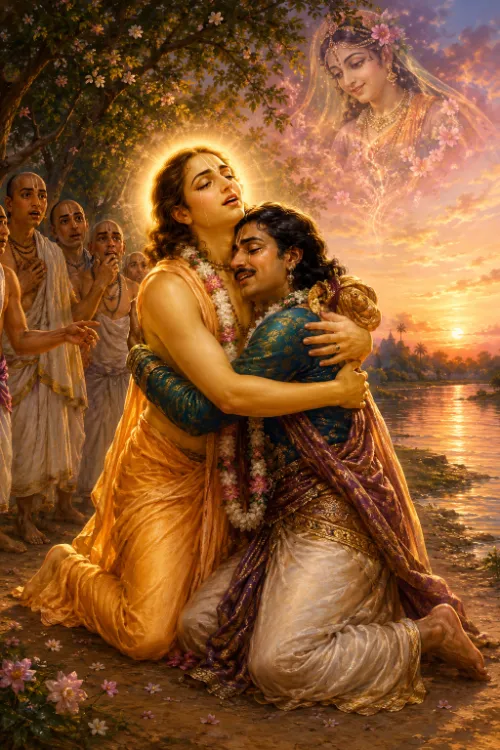
Why Rāmānanda Recognized What Others Could Not: Was Rāmānanda Rāya Really Viśākhā?
When Śrī Caitanya Mahāprabhu met Rāmānanda Rāya on the bank of the Godāvarī, the two men did not behave like strangers. Their love awakened immediately. They embraced, fell unconscious, and manifested powerful symptoms of spiritual ecstasy. To the brāhmaṇas watching them, the scene was bewildering: why would a young brāhmaṇa-sannyāsī embrace a government official of socially lower status?
A. C. Bhaktivedanta Swami Prabhupāda answers in his purport to Caitanya-caritāmṛta, Madhya 8.23:
“Śrīla Rāmānanda Rāya was an incarnation of the gopī Viśākhā.”
The statement is authentic: it appears exactly there. But it is a statement in Prabhupāda’s purport, not in the Bengali verse itself. Its meaning also requires care. “Incarnation” here does not mean that Rāmānanda is an avatāra of God or a form of Viṣṇu. It means that, according to a prominent Gauḍīya understanding, Viśākhā—one of Śrī Rādhā’s most intimate eternal companions—reappeared in male form within Caitanya-līlā as Rāmānanda Rāya.
The textual history is richer than a single uncomplicated identification. Dhyānacandra Gosvāmī explicitly identifies Viśākhā with Rāmānanda in Sanskrit. Bhaktivinoda Ṭhākura reads their meeting in the same way. Another text attributed to Viśvanātha Cakravartī identifies Rāmānanda as Arjunīyā, an expansion of Viśākhā. Yet Kavi Karṇapūra’s Gaura-gaṇoddeśa-dīpikā preserves additional identities connected with Rāmānanda and elsewhere associates Viśākhā with Svarūpa Dāmodara.
The careful conclusion, therefore, is not that every Gauḍīya source gives one rigid, one-to-one identity chart. Rather, Prabhupāda’s identification belongs to a real and well-attested Gauḍīya tradition—one that powerfully explains Rāmānanda’s role, knowledge, emotional intimacy, and unique qualification in Caitanya-līlā.
The exact passage: what Madhya 8.23 actually says
The Bengali verse describes the first meeting between Caitanya Mahāprabhu and Rāmānanda Rāya:
স্বাভাবিক প্রেম দোঁহার উদয় করিলা ।
দুঁহা আলিঙ্গিয়া দুঁহে ভূমিতে পড়িলা ॥ ২৩ ॥
svābhāvika prema doṅhāra udaya karilā
duṅhā āliṅgiyā duṅhe bhūmite paḍilā
“The natural love of both of them awakened. They embraced one another, and both fell to the ground.”
The word svābhāvika is crucial. It means natural, inherent, spontaneous, or arising from one’s own nature. Kṛṣṇadāsa Kavirāja does not say that a new affection gradually developed between two recently introduced religious figures. He says that an already natural love awakened—udaya karilā, literally “arose” or “dawned.”
Prabhupāda’s purport explains why:
- Rāmānanda Rāya was Viśākhā in Kṛṣṇa’s Vraja pastimes.
- Śrī Caitanya is Kṛṣṇa appearing with the mood and golden radiance of Śrī Rādhā.
- Viśākhā is a principal companion of Rādhā and an intimate participant in the love of Rādhā and Kṛṣṇa.
- Their encounter was therefore a recognition within līlā, not merely the first meeting of two historical personalities.
This reading makes the verse’s wording exact rather than decorative. Their love was “natural” because its roots preceded the visible meeting on the Godāvarī. The next verse describes the result:
স্তম্ভ, স্বেদ, অশ্রু, কম্প, পুলক, বৈবর্ণ্য ।
দুঁহার মুখেতে শুনি’ গদ্গদ ‘কৃষ্ণ’বর্ণ ॥ ২৪ ॥
stambha, sveda, aśru, kampa, pulaka, vaivarṇya
duṅhāra mukhete śuni’ gadgada ‘kṛṣṇa’ varṇa
“Stunning, perspiration, tears, trembling, horripilation and change of color appeared in them both, and the name ‘Kṛṣṇa’ came falteringly from their mouths.”
These are not introduced as theatrical signs performed for observers. Indeed, Mahāprabhu soon restrains His ecstasy when He notices that outsiders cannot understand it. The experience belongs to what the text calls a shared, intimate devotional category.
Verdict: correct, but with three necessary qualifications
The proposed statement is substantially correct, provided three distinctions are kept clear.
It comes from the purport, not the wording of verse 8.23
The Bengali verse says only that the two experienced an awakening of natural love, embraced, and fell. It does not name Viśākhā. The purport identifies the eternal relationship that explains the event.
“Incarnation” does not mean an avatāra of Bhagavān
Rāmānanda is not being placed in the category of Kṛṣṇa, Rāma, Nṛsiṁha, or other forms of the Supreme Lord. In this context “incarnation” is being used broadly for the earthly manifestation of an eternal divine associate, a nitya-pārṣada—an eternally perfected companion of the Lord.
More exact English would be:
“According to a prominent Gauḍīya tradition, Viśākhā-sakhī appeared in Caitanya-līlā as Śrī Rāmānanda Rāya.”
The wider tradition preserves layered identifications
Some texts identify Rāmānanda directly as Viśākhā; others call him an appearance of Arjunīyā, a portion of Viśākhā; still others connect him with Lalitā or with Arjuna identities. These are not all identical claims. A responsible article should acknowledge them rather than pretending the textual tradition is uniform.
The source map: where the claim actually comes from
The evidence becomes much clearer when the sources are kept in chronological and literary order:
This hierarchy prevents two opposite mistakes. One should not claim that the Bengali words of Madhya 8.23 literally say “Viśākhā.” But one should not dismiss the purport as an unsupported invention either. The sentence is a concise modern expression of an older interpretive tradition whose clearest explicit Sanskrit witness is Dhyānacandra’s paddhati.
The clearest Sanskrit source: Dhyānacandra Gosvāmī
One of the most direct Sanskrit witnesses occurs in Dhyānacandra Gosvāmī’s Gaura-govindārcana-smaraṇa-paddhati. The preceding verses describe Viśākhā—her bower, service, appearance, age and family. The text then says:
पतिर्यस्या बाहुकाख्योऽप्यसौ गौररसे पुनः ।
रायरामानन्दतया विख्याताभूत्कलौ युगे ॥
patir yasyā bāhukākhyo ’py asau gaura-rase punaḥ
rāya-rāmānandatayā vikhyātābhūt kalau yuge
“She whose husband is named Bāhuka became renowned again, within Gaura’s rasa in the age of Kali, as Rāya Rāmānanda.”
Gaura-govindārcana-smaraṇa-paddhati 213
The grammatical subject remains Viśākhā from the preceding passage. The feminine form vikhyātā, “she became renowned,” confirms that the text is saying Viśākhā herself became known as Rāmānanda Rāya.
The expression gaura-rase is also important. It does not treat the identification as ordinary biological reincarnation. It places Rāmānanda within Gaura-rasa, the spiritual world of relationships surrounding Śrī Gaurāṅga. Viśākhā’s Vraja identity is manifested in a new dramatic role suited to Caitanya’s pastimes.
Verse numbers differ slightly among electronic and printed arrangements; the passage appears as 213 in the GRETIL text and as 214 in some editions. The wording and location in the Viśākhā section are nevertheless clear.
Bhaktivinoda Ṭhākura’s reading of the meeting
In his Amṛta-pravāha-bhāṣya on Madhya 8.23, Bhaktivinoda Ṭhākura explains that the love awakened between Mahāprabhu and Rāmānanda was the love Viśākhā bears for Rādhā and Kṛṣṇa and the love They bear for her.
That observation does more than attach an identity label. It interprets the emotional grammar of the meeting:
- Caitanya is Kṛṣṇa filled with Rādhā’s mood.
- Rāmānanda approaches with Viśākhā’s intimacy toward both Rādhā and Kṛṣṇa.
- The encounter activates both sides of that relationship simultaneously.
This helps explain why Prabhupāda’s purport speaks first of Viśākhā’s love for Kṛṣṇa but then immediately emphasizes that she is a principal assistant of Śrī Rādhā. Rāmānanda is not merely meeting Kṛṣṇa again; he is meeting the united mystery of Rādhā and Kṛṣṇa.
A later reconciliation: Arjunīyā as an expansion of Viśākhā
A text attributed to Viśvanātha Cakravartī, the Gaura-gaṇa-svarūpa-tattva-candrikā, gives a more differentiated identity:
विशाखास्वांशभूता या श्रीयुतार्जुनिका सखी ।
अधुनाभूद्रायरामानन्दश्चैतन्यवल्लभः ॥
viśākhā-svāṁśa-bhūtā yā śrī-yutārjunikā sakhī
adhunābhūd rāya-rāmānandaś caitanya-vallabhaḥ
“The illustrious sakhī Arjunīyā, who is a personal expansion of Viśākhā, has now become Rāmānanda Rāya, dear to Śrī Caitanya.”
Gaura-gaṇa-svarūpa-tattva-candrikā 79
This formulation offers a natural bridge between two traditions. Rāmānanda can be called Viśākhā because Arjunīyā is described as Viśākhā-svāṁśa-bhūtā, “an own portion or personal expansion of Viśākhā.” Yet the identity need not mean a mathematically exclusive equation in which no other associated personality is present.
This text became widely known only through relatively recent manuscript work, and its attribution has been discussed by modern editors. It should therefore be treated as a valuable later witness rather than made the sole historical foundation of the doctrine.
The complication: Kavi Karṇapūra preserves other identities
Kavi Karṇapūra’s Gaura-gaṇoddeśa-dīpikā, an influential early catalogue of the Kṛṣṇa-līlā identities of Caitanya’s associates, associates Rāmānanda with more than one figure. In the passage traditionally numbered 120–124, the relevant identities include:
- an Arjuna among Kṛṣṇa’s intimate cowherd companions;
- Pāṇḍava Arjuna;
- a gopī named Arjunīyā;
- and a tradition identifying Rāmānanda with Lalitā.
Prabhupāda himself acknowledges the variety in his purport to Caitanya-caritāmṛta, Ādi 10.134: Rāmānanda is described as formerly Arjuna; some regard him as Lalitā; others as Viśākhā.
The same Gaura-gaṇoddeśa-dīpikā tradition contains a widely transmitted reading that associates Viśākhā with Svarūpa Dāmodara:
कलामशिक्षयद्राधां या विशाखा व्रजे पुरा ।
साद्य स्वरूपगोस्वामी तत्तद्भावविलासवान् ॥
kalām aśikṣayad rādhāṁ yā viśākhā vraje purā
sādya svarūpa-gosvāmī tat-tad-bhāva-vilāsavān
“She who formerly taught Rādhā the arts in Vraja—that Viśākhā—is now Svarūpa Gosvāmī, who delights in those corresponding moods.”
traditionally numbered Gaura-gaṇoddeśa-dīpikā 160
The exact readings and numbering of this work vary among editions, so the verse should be cited with textual caution. Nevertheless, the broader point is secure: Gauḍīya identity traditions are not always simple one-person-to-one-person equations.
This does not make Prabhupāda’s statement “wrong.” It means that sacred identity in the tradition is sometimes expressed through:
- direct reappearance;
- partial expansion;
- the combined presence of more than one associate;
- shared devotional mood;
- or multiple manifestations of one spiritual personality in different members of Caitanya’s circle.
Such fluidity is familiar in līlā theology. The aim is not to construct a modern reincarnation database. It is to reveal how the service identity, emotional competence, and relational function of Vraja reappear in Gaura-līlā.
Who is Viśākhā?
To understand what the identification means, one must know more than the name “Viśākhā.” She is not merely one gopī among thousands. Rūpa Gosvāmī places her among the eight parama-preṣṭha-sakhīs, Śrī Rādhā’s dearmost principal companions:
परमप्रेष्ठसख्यस्तु ललिता सविशाखिका ।
सचित्रा चम्पकलता तुङ्गविद्येन्दुलेखिका ।
रङ्गदेवी सुदेवी चेत्यष्टौ सर्वगणाग्रिमाः ॥
parama-preṣṭha-sakhyas tu lalitā sa-viśākhikā
sa-citrā campakalatā tuṅgavidyendulekhikā
raṅgadevī sudevī cety aṣṭau sarva-gaṇāgrimāḥ
“The supremely beloved sakhīs are Lalitā together with Viśākhā, Citrā, Campakalatā, Tuṅgavidyā, Indulekhā, Raṅgadevī and Sudevī. These eight are foremost among all the groups.”
Ujjvala-nīlamaṇi 4.54
The order is meaningful. Lalitā and Viśākhā are regularly named first and paired together as the two foremost leaders immediately surrounding Rādhā. Rūpa Gosvāmī describes Viśākhā more particularly:
विशाखात्र द्वितीया स्यादेकाचारगुणव्रता ।
प्रियसख्या जनिर्यत्र तत्रैषाभ्युदिता क्षणे ॥
viśākhātra dvitīyā syād ekācāra-guṇa-vratā
priya-sakhyā janir yatra tatraiṣābhyuditā kṣaṇe
“Viśākhā is second among them. She shares the conduct, qualities and resolve of her beloved friend. At the very moment that dear friend was born, she too appeared.”
Rādhā-kṛṣṇa-gaṇoddeśa-dīpikā, Bṛhad-bhāga 83
The “beloved friend” is Śrī Rādhā. Viśākhā is therefore traditionally understood to have appeared at the same moment as Rādhā and to be essentially the same age. The expression ekācāra-guṇa-vratā is deeper than a biographical detail:
- eka-ācāra — corresponding in conduct or manner;
- eka-guṇa — corresponding in qualities;
- eka-vrata — corresponding in resolve, commitment, or inner orientation.
Viśākhā understands Rādhā not from the outside but from extraordinary inward affinity. That makes her capable of recognizing moods that have not yet been spoken, carrying messages whose literal wording conceals their deepest meaning, and serving the movement of Rādhā’s love with perfect timing.
Rūpa also describes her radiant appearance:
तारावलिदुकूलेयं विद्युन्निभतनुद्युतिः ।
पितुः पावनतो जाता मुखरायाः स्वसुः सुतात् ॥
tārāvali-dukūleyaṁ vidyun-nibha-tanu-dyutiḥ
pituḥ pāvanato jātā mukharāyāḥ svasuḥ sutāt
“Her fine garment resembles a cluster of stars, and the radiance of her body is like lightning. She was born to Pāvana, the son of Mukharā’s sister.”
Rādhā-kṛṣṇa-gaṇoddeśa-dīpikā, Bṛhad-bhāga 84
The image is not merely a color chart. Lightning suggests brilliance, immediacy, energy and a presence that illuminates in a single flash—qualities that fit Viśākhā’s renowned intelligence and swift perception.
What does a sakhī actually do?
The ordinary Sanskrit word sakhī means a female friend or companion. In Gauḍīya rasa theology, it denotes a highly developed spiritual office. The intimate sakhīs do not merely observe the love of Rādhā and Kṛṣṇa. They nourish, interpret, protect and expand it.
Their services include:
- arranging meetings and forest bowers;
- carrying messages whose language must remain hidden from outsiders;
- dressing and ornamenting Rādhā and Kṛṣṇa;
- understanding glances, silences and gestures;
- defending Rādhā’s dignity;
- teasing, challenging or persuading Kṛṣṇa;
- protecting or intensifying Rādhā’s loving jealous anger, māna;
- deciding when reconciliation will enrich love and when separation should be allowed to deepen it;
- and sharing the joy of the Divine Couple more intensely than they seek independent enjoyment for themselves.
This is why “principal gopī companion” is accurate but incomplete. Viśākhā is an expert mediator of divine love, a theologian of emotion whose understanding is expressed through service.
The sakhīs as expansions of Rādhā’s spiritual being
During the Rāmānanda-saṁvāda, Rāmānanda himself explains the ontological position of Rādhā’s companions:
‘মহাভাব-চিন্তামণি’ রাধার স্বরূপ ।
ললিতাদি সখী — তাঁর কায়ব্যূহরূপ ॥ ১৬৫ ॥
mahābhāva-cintāmaṇi rādhāra svarūpa
lalitādi sakhī—tāṅra kāya-vyūha-rūpa
“Rādhā’s very nature is the wish-fulfilling jewel of mahābhāva. The sakhīs beginning with Lalitā are expansions of Her spiritual body.”
The term kāya-vyūha literally suggests an array or expansion of one body. It does not erase the sakhīs’ individual personalities. It explains their extraordinary correspondence with Rādhā: they are distinct persons whose entire being unfolds from and serves Her love.
The Sanskrit verse quoted immediately before this Bengali explanation is Brahma-saṁhitā 5.37:
आनन्दचिन्मयरसप्रतिभाविताभिस्
ताभिर्य एव निजरूपतया कलाभिः ।
गोलोक एव निवसत्यखिलात्मभूतो
गोविन्दमादिपुरुषं तमहं भजामि ॥
ānanda-cinmaya-rasa-pratibhāvitābhis
tābhir ya eva nija-rūpatayā kalābhiḥ
goloka eva nivasaty akhilātma-bhūto
govindam ādi-puruṣaṁ tam ahaṁ bhajāmi
“I worship Govinda, the original person, the soul of all, who dwells in Goloka with those companions who are permeated by blissful spiritual rasa and who are expansions of His own spiritual potency.”
Within the Caitanya-caritāmṛta’s sequence, these companions are Rādhā and the sakhīs who embody the extensions of Her bliss potency. This makes Viśākhā’s identity theological rather than merely legendary. She belongs to the internal architecture of divine love.
Who was Rāmānanda Rāya in visible history?
Rāmānanda’s outward life makes his inner identity especially striking. He was:
- a son of Bhavānanda Rāya;
- a member of Odisha’s educated karaṇa administrative community;
- a householder rather than a renunciant;
- a senior government officer under King Pratāparudra;
- a poet and dramatist, traditionally credited with the Jagannātha-vallabha-nāṭaka;
- and an accomplished director of devotional dramatic performance.
From the viewpoint of conventional religious hierarchy, he was an unlikely instructor for Caitanya Mahāprabhu. He was not a saffron-clad sannyāsī and was not socially accepted as a brāhmaṇa. Before Mahāprabhu met him, Sārvabhauma Bhaṭṭācārya therefore issued a remarkable warning:
শূদ্র বিষয়ি-জ্ঞানে উপেক্ষা না করিবে ।
আমার বচনে তাঁরে অবশ্য মিলিবে ॥
śūdra viṣayi-jñāne upekṣā nā karibe
āmāra vacane tāṅre avaśya milibe
“Please do not neglect him by thinking him a śūdra or a worldly official. On my word, You must certainly meet him.”
Caitanya-caritāmṛta, Madhya 7.63
The episode is designed to overturn superficial measurement. The supposedly worldly governor becomes the authority on the most confidential spiritual love, while the brāhmaṇa-sannyāsī becomes the eager questioner.
Mahāprabhu later states the governing principle:
কিবা বিপ্র, কিবা ন্যাসী, শূদ্র কেনে নয় ।
যেই কৃষ্ণতত্ত্ববেত্তা, সেই ‘গুরু’ হয় ॥ ১২৮ ॥
kibā vipra, kibā nyāsī, śūdra kene naya
yei kṛṣṇa-tattva-vettā, sei ‘guru’ haya
“Whether one is a brāhmaṇa, a renunciant, or even considered a śūdra—whoever knows the truth of Kṛṣṇa is a guru.”
Caitanya-caritāmṛta, Madhya 8.128
Rāmānanda’s hidden identity and his visible social position serve the same theological purpose: spiritual authority is recognized by realized knowledge and devotion, not by costume, caste, profession, or public expectation.
Why the Viśākhā identity fits the Rāmānanda-saṁvāda
The long conversation of Madhya chapter 8 is not a random theological interview. Its content mirrors Viśākhā’s Vraja function.
Rāmānanda guides the discussion from duty to love
Mahāprabhu repeatedly asks Rāmānanda to go deeper. The conversation advances through:
- social and religious duty;
- offering one’s work to Kṛṣṇa;
- renunciation of conventional claims;
- devotion mixed with knowledge;
- pure devotion free from the attempt to dominate God through knowledge;
- love in servitude, friendship and parental affection;
- the gopīs’ conjugal love;
- the unique supremacy of Rādhā’s love;
- the role of the sakhīs;
- and the mystery called prema-vilāsa-vivarta, the astonishing transformation of divine love.
This movement is precisely from external structure toward the inner emotional world of Rādhā and Kṛṣṇa. Rāmānanda does not merely know doctrines about that world; he speaks like one who knows its internal logic.
The opening Sanskrit verse of the chapter portrays the exchange as an ocean empowering a cloud:
सञ्चार्य रामाभिधभक्तमेघे
स्वभक्तिसिद्धान्तचयामृतानि ।
गौराब्धिरेतैरमुना वितीर्णैस्
तज्ज्ञत्वरत्नालयतां प्रयाति ॥
sañcārya rāmābhidha-bhakta-meghe
sva-bhakti-siddhānta-cayāmṛtāni
gaurābdhir etair amunā vitīrṇais
taj-jñatva-ratnālayatāṁ prayāti
“The ocean of Gaura placed the collected nectars of His own conclusions about bhakti into the devotee-cloud named Rāma. Showered back by that cloud, the ocean became a treasury of jewels displaying complete knowledge of those truths.”
Caitanya-caritāmṛta, Madhya 8.1
Mahāprabhu is not an ignorant student who needs information. He is the ocean from whom the cloud receives its water. Yet He chooses to hear His own truth voiced through Rāmānanda. The exchange is reciprocal revelation: the Lord empowers His devotee to articulate what the Lord Himself desires to taste.
Rāmānanda explains why only the sakhīs can enter this mystery
Near the summit of the dialogue, Rāmānanda says:
রাধাকৃষ্ণের লীলা এই অতি গূঢ়তর ।
দাস্য-বাৎসল্যাদি-ভাবে না হয় গোচর ॥ ২০১ ॥
সবে এক সখীগণের ইহাঁ অধিকার ।
সখী হৈতে হয় এই লীলার বিস্তার ॥ ২০২ ॥
সখী বিনা এই লীলা পুষ্ট নাহি হয় ।
সখী লীলা বিস্তারিয়া, সখী আস্বাদয় ॥ ২০৩ ॥
rādhā-kṛṣṇera līlā ei ati gūḍhatara
dāsya-vātsalyādi-bhāve nā haya gocara
sabe eka sakhī-gaṇera ihāṅ adhikāra
sakhī haite haya ei līlāra vistāra
sakhī vinā ei līlā puṣṭa nāhi haya
sakhī līlā vistāriyā, sakhī āsvādaya
“The pastimes of Rādhā and Kṛṣṇa are supremely confidential and are not accessible through the moods of servitude, parental affection and the other rasas. Only the sakhīs possess qualification here; through them these pastimes expand. Without the sakhīs, these pastimes cannot be nourished. The sakhīs expand the līlā, and the sakhīs relish it.”
Read by itself, this is an extraordinary theological claim. Read beside the tradition that Rāmānanda is Viśākhā, it becomes self-revelatory. A principal sakhī is explaining why the sakhīs possess the unique qualification to understand and nourish Rādhā-Kṛṣṇa-līlā.
He recognizes Caitanya as Rādhā and Kṛṣṇa united
At the culmination of their meeting, Rāmānanda sees beneath Mahāprabhu’s external appearance:
রাধিকার ভাবকান্তি করি’ অঙ্গীকার ।
নিজরস আস্বাদিতে করিয়াছ অবতার ॥ ২৭৯ ॥
rādhikāra bhāva-kānti kari’ aṅgīkāra
nija-rasa āsvādite kariyācha avatāra
“You have accepted Rādhikā’s inner mood and radiant complexion and have descended in order to taste Your own rasa.”
Mahāprabhu then tells him:
মোর তত্ত্বলীলা-রস তোমার গোচরে ।
অতএব এইরূপ দেখাইলুঁ তোমারে ॥ ২৮৬ ॥
mora tattva-līlā-rasa tomāra gocare
ataeva ei-rūpa dekhāiluṅ tomāre
“The truth, pastimes and rasa that belong to Me are within your understanding. Therefore I have shown you this form.”
This is perhaps the strongest narrative evidence for the theological point. Rāmānanda is not merely clever enough to solve a metaphysical puzzle. He is relationally qualified to recognize the united form of the very persons whose love Viśākhā eternally serves.
Viśākhā and Rāmānanda: the functional parallels
These parallels do not independently prove a metaphysical identity. They show why the identification is theologically apt rather than arbitrary.
Rāmānanda’s later role in Purī
Rāmānanda eventually left government service and joined Mahāprabhu at Jagannātha Purī. There he became, with Svarūpa Dāmodara, one of the Lord’s closest companions during the final years of intense separation from Kṛṣṇa.
The Caitanya-caritāmṛta places him among only “three and a half” exceptionally intimate recipients of Rādhā’s inner devotional mood:
প্রভু লেখা করে যারে — রাধিকার ‘গণ’ ।
জগতের মধ্যে ‘পাত্র’ — সাড়ে তিন জন ॥ ১০৫ ॥
স্বরূপ গোসাঞি, আর রায় রামানন্দ ।
শিখি-মাহিতি — তিন, তাঁর ভগিনী — অর্ধজন ॥ ১০৬ ॥
prabhu lekhā kare yāre—rādhikāra gaṇa
jagatera madhye pātra—sāḍe tina jana
svarūpa gosāñi, āra rāya rāmānanda
śikhi-māhiti—tina, tāṅra bhaginī—ardha-jana
“The Lord accepted her as one of Rādhikā’s companions. In the whole world, three and a half persons were [such confidential] recipients. The three were Svarūpa Gosāñi, Rāya Rāmānanda and Śikhi Māhiti; Śikhi Māhiti’s sister was the half person.”
Caitanya-caritāmṛta, Antya 2.105–106
The pronoun “her” refers to Mādhavī-devī, Śikhi Māhiti’s sister, mentioned in the preceding verse. The bracketed word “confidential” draws out the contextual force of pātra, literally a “receptacle,” “recipient,” or qualified vessel.
The unusual “half” is not a judgment of human worth. It indicates the degree to which confidential ecstatic participation was outwardly manifest in the narrative. In another episode, Mahāprabhu sends the learned brāhmaṇa Pradyumna Miśra to hear Kṛṣṇa-kathā from Rāmānanda. Kṛṣṇadāsa Kavirāja summarizes the reversal of conventional status:
‘ভক্তি’, ‘প্রেম’, ‘তত্ত্ব’ কহে রায়ে করি’ ‘বক্তা’ ।
আপনি প্রদ্যুম্নমিশ্র-সহ হয় ‘শ্রোতা’ ॥ ৮৫ ॥
bhakti, prema, tattva kahe rāye kari’ vaktā
āpani pradyumna-miśra-saha haya śrotā
“Making Rāmānanda Rāya the speaker, the Lord taught bhakti, prema and spiritual truth; He Himself, together with Pradyumna Miśra, became the listener.”
Caitanya-caritāmṛta, Antya 5.85
Again the pattern of Madhya 8.1 appears: the Lord teaches through the devotee. Rāmānanda’s authority is simultaneously his own realized qualification and Mahāprabhu’s empowerment.
His artistic service—and why it must not be imitated
Rāmānanda personally trained young female performers for his devotional drama, instructing them in gesture, expression, singing and dance. The text emphasizes that he remained entirely undisturbed by bodily attraction. Mahāprabhu comments:
এক রামানন্দের হয় এই অধিকার ।
তাতে জানি অপ্রাকৃত-দেহ তাঁহার ॥ ৪২ ॥
eka rāmānandera haya ei adhikāra
tāte jāni aprākṛta-deha tāṅhāra
“Rāmānanda alone possesses such qualification. From this I understand that his body is spiritual, beyond material nature.”
Caitanya-caritāmṛta, Antya 5.42
This episode is repeatedly accompanied by a warning: it is descriptive, not imitative. It is offered as evidence of Rāmānanda’s extraordinary state, not as permission for practitioners to claim transcendence while ignoring ordinary ethical safeguards.
The Viśākhā identification again gives the artistic work a deeper context. In Vraja, Viśākhā serves through dress, ornament, expressive speech and the choreography of emotion. In Purī, Rāmānanda transforms dramaturgy, music, costume and gesture into service for Lord Jagannātha. The outward medium changes; the service genius remains recognizable.
What “incarnation” should mean here
The English word incarnation can mislead because it collapses several Sanskrit theological categories into one.
It does not mean Viṣṇu-tattva
Rāmānanda is not identified as the Supreme Godhead descending through His own divine form. He is honored as an eternal associate of the Lord. Calling him “an incarnation of Viśākhā” means that Viśākhā’s eternal personal and devotional identity becomes manifest in Caitanya’s earthly līlā.
It is not ordinary karmic rebirth
The tradition does not imagine Viśākhā dying, losing her previous identity, and being forced by karma into another body. Eternal associates accompany Bhagavān by divine arrangement. Their appearance is līlā, not compulsory transmigration.
It is not primarily a statement about material gender
Viśākhā appears as a female cowherd companion in Vraja and Rāmānanda as a male government officer in sixteenth-century India. The continuity lies not in material anatomy but in spiritual identity, rasa, intimacy and service-function.
It need not be exclusive in a modern numerical sense
Gauḍīya texts sometimes present one associate as embodying more than one earlier personality or one earlier personality as present through several later associates. The tradition’s categories include full appearance, partial manifestation, empowerment, shared mood and combined identity. Forcing every statement into an exclusive reincarnation chart can distort the literature.
It is a confessional theological claim
Historians can establish that Gauḍīya authors made this identification and can study its textual development. Historical method by itself cannot prove or disprove an eternal Vraja identity. The claim belongs to the sacred self-understanding of the Gauḍīya tradition. A careful article should neither disguise it as secularly demonstrable history nor flatten it into “mere symbolism.”
What the identification reveals about authority
The story deliberately combines apparent opposites:
- a sannyāsī listens to a householder;
- a brāhmaṇa learns from someone socially classified as a śūdra;
- the Supreme Lord asks questions of His devotee;
- a powerful governor speaks with radical humility;
- a male administrator embodies the service identity of an intimate gopī;
- and the deepest theology is communicated not from an institutional seat but in private conversation beside a river.
The point is not that learning, renunciation or social discipline are worthless. It is that none of them can manufacture eligibility for rasa. Rāmānanda’s qualification comes from realized devotion, inner affinity with Rādhā’s service, scriptural mastery, purity of consciousness, and Mahāprabhu’s empowerment.
This is why Madhya 8.128 does not merely promote social equality in a modern political sense. It gives an epistemic principle: the knower of Kṛṣṇa-tattva is guru because truth has become realized in that person, regardless of the external category by which society measures him.
What should not be concluded
Several common exaggerations should be avoided.
“Madhya 8.23 itself says Rāmānanda is Viśākhā”
Not exactly. The verse describes natural love awakening; Prabhupāda’s purport supplies the identification.
“All Gauḍīya texts unanimously identify Rāmānanda only as Viśākhā”
No. Dhyānacandra gives a direct Viśākhā identification, and Bhaktivinoda and Prabhupāda follow that understanding. Other respected materials preserve Rāmānanda’s relation to Arjunīyā, Lalitā and Arjuna identities, while one received passage connects Viśākhā with Svarūpa Dāmodara.
“Rāmānanda is an avatāra of God”
No. He is a divine associate, not Bhagavān Himself.
“The identity is just a poetic metaphor”
That is also too weak. Traditional authors present these identities as realities of eternal līlā, not merely literary comparisons. Functional resemblance helps explain the identification, but the theological claim goes beyond resemblance.
“Because Rāmānanda transcended ordinary bodily disturbance, advanced practitioners may imitate him”
The text explicitly prevents this conclusion. His conduct is presented as a unique sign of extraordinary realization. Imitation without that realization is self-deception and can become exploitation.
“His social background was spiritually degrading”
The narrative cites social prejudice in order to defeat it. Its conclusion is not that Rāmānanda became spiritually acceptable despite remaining inferior. Its conclusion is that external classification never measured his actual Vaiṣṇava stature.
A fuller and more precise formulation
The original statement may be expanded as follows:
According to the Gauḍīya tradition followed by Bhaktivinoda Ṭhākura and A. C. Bhaktivedanta Swami Prabhupāda—and stated explicitly in Dhyānacandra Gosvāmī’s Sanskrit Gaura-govindārcana-smaraṇa-paddhati—Śrī Rāmānanda Rāya is the manifestation of Viśākhā-sakhī in Śrī Caitanya’s pastimes. Viśākhā is one of Śrī Rādhā’s eight principal companions and, together with Lalitā, stands at the head of Her intimate circle. Her special function is to understand, mediate, protect, nourish and expand the love of Rādhā and Kṛṣṇa. That same service identity becomes visible in Rāmānanda: he explains the highest reaches of Rādhā-Kṛṣṇa prema, reveals the indispensable role of the sakhīs, recognizes Rādhā and Kṛṣṇa united in Caitanya, serves through poetry and dramatic art, and becomes one of Mahāprabhu’s most confidential companions. The term “incarnation” here means the reappearance of an eternal divine associate, not an avatāra of God and not ordinary karmic rebirth. Other Gauḍīya sources preserve overlapping identities involving Arjunīyā, Lalitā and Arjuna, so the tradition should be presented as layered rather than mechanically uniform.
Final conclusion
Prabhupāda’s statement is not an unsupported embellishment. It rests on a genuine Gauḍīya interpretive lineage, with an explicit Sanskrit precedent in Dhyānacandra Gosvāmī and support in Bhaktivinoda Ṭhākura’s reading of the Godāvarī meeting.
At the same time, the most authentic treatment must acknowledge the larger textual landscape. Rāmānanda’s eternal identity is described in more than one way, and Viśākhā herself is connected with more than one associate in received identity catalogues. Rather than invalidating the tradition, this reveals how Gauḍīya līlā theology thinks: eternal personalities can manifest through expansions, combined identities, shared moods and multiple complementary roles.
The heart of Madhya 8.23 is therefore not a label but a moment of recognition. The governor and the sannyāsī meet outwardly for the first time, yet their love is called svābhāvika—natural, inherent, already belonging to them. Rāmānanda can guide the conversation where ordinary scholarship cannot go because he is not standing outside the mystery he explains. In the Viśākhā tradition, he speaks from within the intimate circle of Rādhā and Kṛṣṇa.
That is why he recognizes what others cannot. That is why the Lord listens to him. And that is why a brief purport—“Rāmānanda Rāya was an incarnation of the gopī Viśākhā”—opens into an entire theology of eternal companionship, realized knowledge and service to divine love.
Principal texts discussed
- Kṛṣṇadāsa Kavirāja Gosvāmī, Śrī Caitanya-caritāmṛta, Madhya 7.63; 8.1, 8.23–24, 8.128, 8.163–165, 8.201–203, 8.279, 8.286; Antya 2.105–106; 5.42, 5.85
- A. C. Bhaktivedanta Swami Prabhupāda, purports to Caitanya-caritāmṛta, Madhya 8.23 and Ādi 10.134
- Bhaktivinoda Ṭhākura, Amṛta-pravāha-bhāṣya on Caitanya-caritāmṛta, Madhya 8.23
- Dhyānacandra Gosvāmī, Gaura-govindārcana-smaraṇa-paddhati 210–221, especially 213
- Rūpa Gosvāmī, Ujjvala-nīlamaṇi 4.54
- Rūpa Gosvāmī, Rādhā-kṛṣṇa-gaṇoddeśa-dīpikā, Bṛhad-bhāga 83–84
- Kavi Karṇapūra, Gaura-gaṇoddeśa-dīpikā 120–124 and the passage traditionally numbered 160
- Gaura-gaṇa-svarūpa-tattva-candrikā, attributed to Viśvanātha Cakravartī, verse 79
- Śrī Brahma-saṁhitā 5.37