

The Sequential Sleep of the Gods
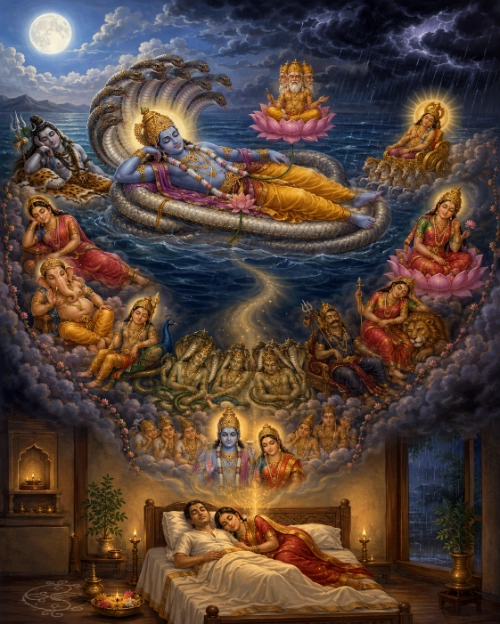
Ritual Time, Dakṣiṇāyana and the Aśūnyaśayana Vrata
Chapter 17 of the Vāmana Purāṇa preserves an unusual ritual-cosmological scheme in which Viṣṇu, Śiva, Brahmā, Viśvakarmā, Pārvatī, Gaṇeśa, Skanda, Sūrya, Lakṣmī, the Yakṣas, Nāga kings, Sādhyas and other divine beings successively enter a state of sleep.
Abstract
The sequence begins in the bright fortnight while the Sun is in Mithuna and continues, after the full moon and the Sun’s entrance into Karkaṭa, through the dark fortnight. The text explicitly identifies this solar transition with Dakṣiṇāyana, “the night of the immortals,” and immediately associates the sleeping gods with the arrival of the rainy season. The passage therefore presents divine sleep not as a collection of independent observances attached arbitrarily to lunar dates, but as an ordered cosmological withdrawal marking the beginning of the Cāturmāsya period. Of particular importance is Kṛṣṇa Dvitīyā, when Viśvakarmā sleeps. This tithi is designated Aśūnyaśayana, “the non-empty bed,” and becomes the occasion for a vrata centered on Viṣṇu and Lakṣmī together, with the explicit purpose of protecting the continuity of household and conjugal life.
1. Textual Context
The relevant material occurs in Vāmana Purāṇa 17.3–29, and particularly in verses 17.6–19. The electronic Sanskrit text available through GRETIL is based on Anand Swarup Gupta’s edition published by the All India Kashiraj Trust in Varanasi in 1967. GRETIL itself cautions that its electronic conversion requires further proofreading, so minor orthographic irregularities in the digital text should not automatically be regarded as readings of the printed edition.
The chapter is framed as a dialogue between Nārada and Pulastya. Nārada asks for the proper procedure concerning the divine beings as they enter their state of repose, with Janārdana—Viṣṇu—placed first. Pulastya responds by presenting an ordered series of lunar dates.
The important point is that this is not a general statement that each deity sleeps on the corresponding tithi every lunar month. The dates belong to a particular seasonal sequence. The passage follows the movement of the Sun from Mithuna into Karkaṭa, identifies this transition with Dakṣiṇāyana, and links the resulting divine repose with the coming of the rains.
2. Viṣṇu and the Beginning of Divine Sleep
The sequence begins with Viṣṇu:
मिथुनाभिगते सूर्ये शुक्लपक्षे तपोधन ।
एकादश्यां जगत्स्वामी शयनं परिकल्पयेत् ॥
“When the Sun has entered Mithuna, during the bright fortnight, O ascetic, on Ekādaśī one should prepare the sleeping-place of the Lord of the universe.”
Vāmana Purāṇa 17.6
The following verse specifies that Viṣṇu’s couch is fashioned from the coils of Śeṣa, the great cosmic serpent. The rite continues into Dvādaśī, when, after the prescribed worship and Brahmanical observances, the deity is ceremonially brought to sleep.
This introduces an important textual nuance. It is convenient to summarize the tradition as “Viṣṇu sleeps on Śukla Ekādaśī,” but the Vāmana Purāṇa is more precise: the śayana is prepared on Ekādaśī and the ritual act of bringing Viṣṇu into sleep continues on Dvādaśī.
The imagery of Viṣṇu reclining upon Śeṣa places the seasonal rite within the larger Purāṇic conception of Viṣṇu’s cosmic repose. “Sleep” here therefore functions as a cosmological and ritual category rather than merely denoting physiological unconsciousness.
3. From Kāma to Śiva: The Bright-Fortnight Sequence
After Viṣṇu, other divine and semi-divine beings enter repose one after another.
On Trayodaśī, Kāma or Kāmadeva sleeps upon a couch prepared from fragrant kadamba blossoms. On Caturdaśī, the Yakṣas sleep upon a pleasantly cool couch furnished with golden lotuses and comfortable bedding. On Pūrṇimā, Umānātha—Śiva, “the Lord of Umā”—lies upon animal skins, including a tiger skin, with his matted hair bound up.
The descriptions are not generic. The character of each sleeping-place corresponds to the identity of its occupant.
Kāma, the divine personification of desire and attraction, is associated with flowers and fragrance. The Yakṣas, beings repeatedly connected in Indian religious literature with abundance and treasure, receive golden lotuses and luxurious bedding. Śiva, by contrast, retains the material vocabulary of the ascetic: skins, tiger hide, and matted hair.
Thus the gods do not lose their identities when they enter sleep. Rather, their characteristic modes of being are translated into the imagery of repose.
4. Dakṣiṇāyana as the “Night of the Immortals”
After Śiva sleeps on the full-moon day, the text introduces the astronomical-cosmological turning point:
ततोऽमराणां रजनी भवते दक्षिणायनम् ॥
“Then Dakṣiṇāyana becomes the night of the immortals.”
Vāmana Purāṇa 17.12
Immediately before this statement, the Purāṇa says that the Sun proceeds into Karkaṭa, Cancer.
This verse provides the interpretive key to the entire sequence. The sleeping of the gods is being coordinated with a cosmic nightfall. Human calendrical time, the solar course, lunar tithis, seasonal change, and divine activity are treated as interconnected aspects of a single temporal order.
The gods do not all fall asleep simultaneously. Divine withdrawal unfolds progressively through sacred time.
The full moon therefore creates a structural division:
Śukla Ekādaśī → Trayodaśī → Caturdaśī → Pūrṇimā
followed by:
Kṛṣṇa Pratipadā → Dvitīyā → Tṛtīyā … → Kṛṣṇa Ekādaśī.
5. The Dark-Fortnight Sequence
After Dakṣiṇāyana has begun, Brahmā is the first deity explicitly assigned to the following fortnight.
On Pratipadā, Brahmā sleeps upon a couch of blue lotuses. Significantly, the text adds that even while reclining he shows the worlds the supreme path. His repose therefore does not imply the complete cessation of divine function.
The subsequent sequence is compressed into three verses:
The Sanskrit specifically calls the serpents bhujagendrāḥ, “lords or kings of serpents,” rather than simply sarpa. They are further characterized as vāyubhojanāḥ, “those whose food is air.” The final group, sleeping on Kṛṣṇa Ekādaśī, is the Sādhyas, an ancient class of celestial beings.
The dark-fortnight specification for the concluding Ekādaśī is explicit: ekādaśyāṃ tu kṛṣṇāyām. It must therefore be distinguished from the Śukla Ekādaśī with which Viṣṇu’s śayana began.
6. The Arrival of the Rainy Season
After completing the divine sequence, Pulastya explains its seasonal significance. Verse 17.17 states that this is the order of their sleeping and then immediately declares that, while the gods were sleeping, the rainy season (prāvṛṭ-kāla) arrived.
This juxtaposition is fundamental.
The divine sleep belongs to the Purāṇic representation of the rainy-season transformation of the world. The passage combines:
- the movement of the Sun;
- Dakṣiṇāyana;
- lunar tithis;
- divine repose;
- changes in animal behaviour;
- the onset of the rains;
- and religious observance.
Verse 17.18 even turns from the gods to birds and seasonal behaviour, describing cranes, herons, and crows. Cosmic, ritual, and ecological time are therefore deliberately brought together.
The episode should consequently be read as a seasonal cosmology, not merely as a list of deity–tithi correspondences.
7. Viśvakarmā and Aśūnyaśayana Dvitīyā
The text then returns to one particular member of the sequence: Viśvakarmā.
द्वितीया सा शुभा पुण्या अशून्यशयनोदिता ॥
“That Dvitīyā is auspicious and meritorious and is declared [the observance of] Aśūnyaśayana.”
Vāmana Purāṇa 17.19
The preceding half of the verse specifies that this is the tithi on which Viśvakarmā Prajāpati falls asleep.
The name Aśūnyaśayana is transparent: a-śūnya-śayana, “a sleeping-place that is not empty,” “the non-empty bed.”
Yet the vrata that follows is not principally a cult of Viśvakarmā. On this Dvitīyā the worshipper is instructed to worship Hari together with Lakṣmī, with Viṣṇu depicted as four-armed, bearing the Śrīvatsa mark, and sharing a couch with the goddess.
This shift from Viśvakarmā’s cosmic sleep to the conjugal image of Viṣṇu and Lakṣmī reveals the ritual meaning of the observance.
8. “May My Bed Never Be Empty”
Verses 17.22–23 contain the theological center of the Aśūnyaśayana vrata. The worshipper addresses Viṣṇu on the basis of his inseparability from Lakṣmī and asks that, by the same principle, his own sleeping-place may never become empty. The prayer then explicitly asks that the worshipper’s gārhasthya, household or married life, should not be destroyed.
The symbolism is therefore quite precise.
The “non-empty bed” is not primarily a prayer for material furniture, comfortable sleep, or even fertility in isolation. It represents the preservation of conjugal union and the continuity of the household.
Viṣṇu and Lakṣmī supply the divine paradigm: because the divine couple remains united, the worshipper requests an analogous continuity within human married life.
Verse 17.29 confirms the purpose by declaring that one who performs the vrata will not experience viyoga, separation.
Aśūnyaśayana can therefore be described as a Purāṇic vrata concerned with non-separation, marital continuity, and the integrity of the gṛhastha state.
9. Cāturmāsya
The text explicitly connects the procedure with Cāturmāsya: anena tu vidhānena cāturmāsyavrataṃ caret — “By this procedure one should observe the Cāturmāsya vow.”
It subsequently speaks of the gods awakening again in sequence (kramaśaḥ kramaśaḥ).
This confirms that the sleep-list belongs to a larger temporal structure:
divine withdrawal → rainy-season observance → Cāturmāsya → divine awakening.
The sequence therefore expresses one of the characteristic features of Purāṇic sacred time: cosmic processes are reproduced through ritual. The devotee does not merely observe the changing season externally. Religious practice is synchronized with the changing condition of the divine cosmos.
10. The Meaning of “Sleep”
The repeated verbs svapiti, “sleeps,” and prasvapiti, “falls asleep,” should not be interpreted too narrowly.
The passage itself prevents such an interpretation. Brahmā, even while sleeping, continues to show the worlds their path. Sūrya is likewise said to sleep, although his cosmic function obviously remains indispensable within the same calendrical system.
“Sleep” therefore signifies a ritualized withdrawal or reduction of manifest divine activity.
The image corresponds particularly well to the rainy season. Movement contracts, ascetic travel traditionally decreases, the environment changes, and a period of religious restraint begins. The cosmos itself is represented as entering a state of repose.
The sequence can consequently be understood as a Purāṇic theology of seasonal inwardness.
11. Structural Significance of the Sequence
The passage has a striking architecture.
It begins with the Lord of the universe, Viṣṇu, reclining upon the cosmic serpent Śeṣa. It then moves through desire, nature spirits, Śiva, Brahmā, divine craftsmanship, the Goddess, Gaṇeśa, Dharma, martial power, solar power, prosperity, Nāgas, and finally a collective class of celestial beings.
Rather than describing the sleep of one sectarian pantheon, the text progressively places multiple domains of cosmic agency into repose.
The cumulative effect is more important than any individual pairing.
Creation, desire, prosperity, judgment, warfare, solar vitality, craftsmanship, divine femininity, chthonic power, and celestial society all participate in the same transition into cosmic night.
The list consequently represents the progressive quieting of an entire divine world.
Vāmana Purāṇa 17 preserves a sophisticated integration of lunar ritual time, solar movement, seasonality, theology, and domestic religious practice.
The divine sleep begins with Viṣṇu in the bright fortnight. Kāma, the Yakṣas, and Śiva follow. With the Sun’s entrance into Karkaṭa, Dakṣiṇāyana becomes the “night of the immortals.” Brahmā and a succession of other divine beings then enter repose through the dark fortnight, ending with the Sādhyas on Kṛṣṇa Ekādaśī. The Purāṇa immediately associates this collective repose with the arrival of the rainy season and subsequently identifies the prescribed observance with Cāturmāsya.
Within this grand cosmological withdrawal, Aśūnyaśayana Dvitīyā introduces a deliberately human concern. The day on which Viśvakarmā sleeps becomes the occasion for worshipping Viṣṇu together with Lakṣmī and praying that one’s own bed remain “non-empty” — that husband and wife remain united and the household state endure.
The theological contrast is particularly elegant: the divine cosmos progressively enters repose, while the human householder prays that relationship and household continuity will not be interrupted.
Thus the passage is considerably more than a calendrical list of “which god sleeps when.” It is a compact Purāṇic model of cosmic withdrawal, seasonal sacred time, and the preservation of human order within the larger rhythms of the universe.