

The Ministers of Daśaratha

Royal Government in the Vālmīki Rāmāyaṇa
King Daśaratha Mahārāja of Ayodhyā did not rule alone. At the very beginning of the Vālmīki Rāmāyaṇa, before the birth of Rāma is narrated, Vālmīki devotes an entire chapter to the men surrounding the king and to the qualities required of those entrusted with government.
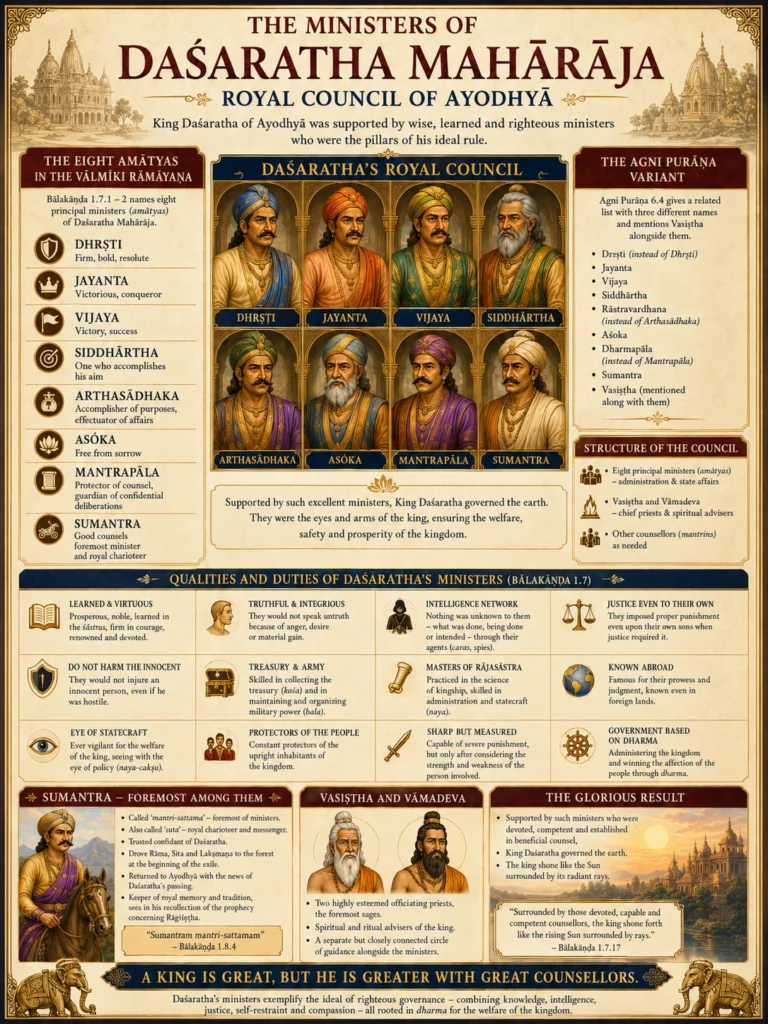
The eight amātyas, their duties, and the Purāṇic variants on one sheet.
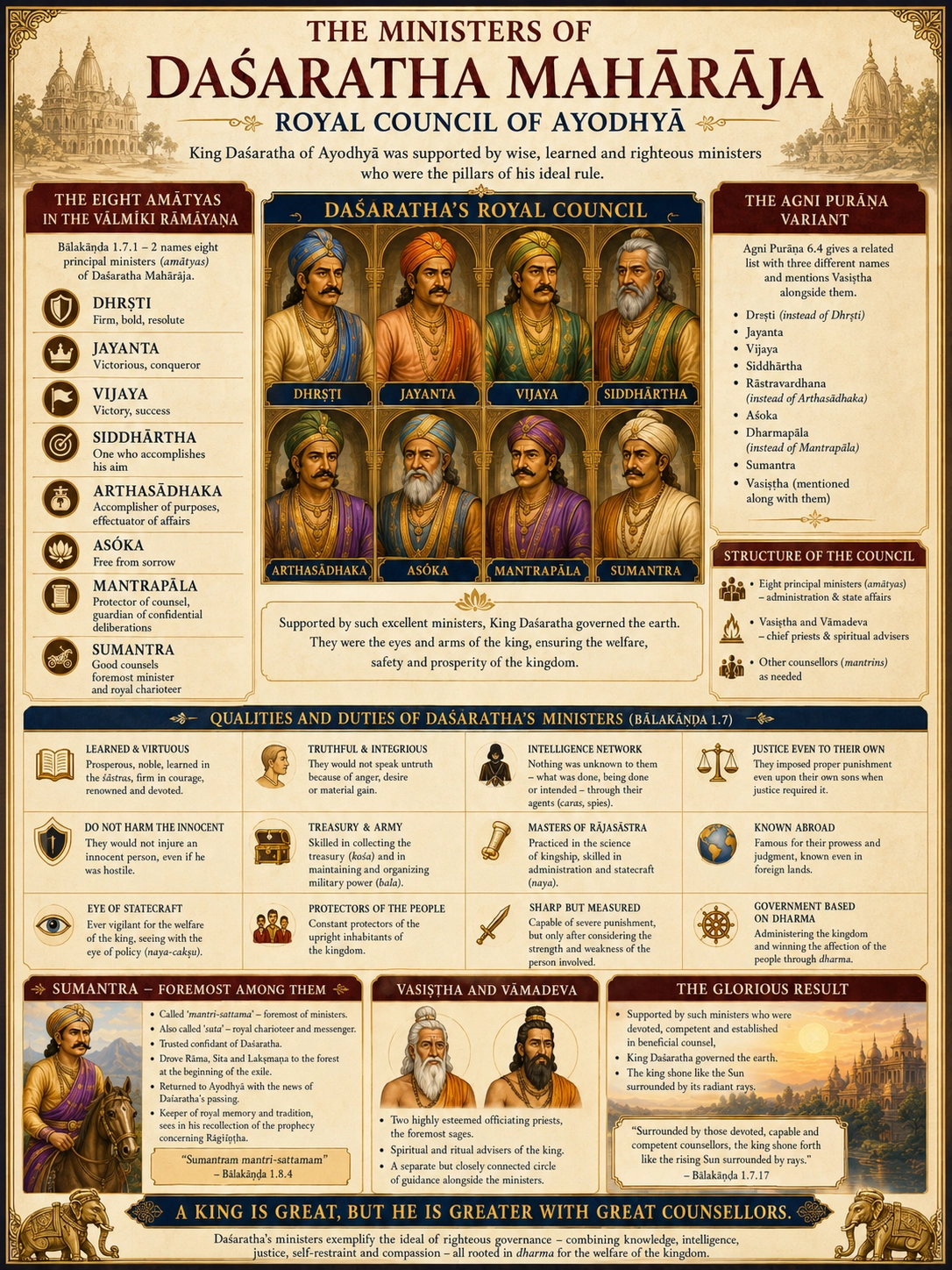
This material is remarkable because it gives far more than a list of names. Bālakāṇḍa 7 presents an idealized model of royal administration in which ministers are expected to combine:
- knowledge of the śāstras;
- political intelligence;
- personal integrity;
- mastery of judicial procedure;
- control of treasury and military resources;
- an intelligence network of cāras, agents or spies;
- proportional punishment;
- protection of innocent people;
- knowledge of foreign affairs;
- loyalty to the ruler without abandoning truth;
- and constant concern for the welfare of the kingdom.
The Vālmīki Rāmāyaṇa names eight principal ministers, or amātyas, of Daśaratha:
- Dhṛṣṭi
- Jayanta
- Vijaya
- Siddhārtha
- Arthasādhaka
- Aśoka
- Mantrapāla
- Sumantra
Later Purāṇic versions preserve a related but significantly different list. These variants explain why modern books and websites sometimes give Sṛṣṭi, Rāṣṭravardhana, and Dharmapāla instead of Dhṛṣṭi, Arthasādhaka, and Mantrapāla.
The traditions should not be treated as simple copying errors. They represent different textual transmissions of Daśaratha’s royal council.
The Eight Ministers in the Vālmīki Rāmāyaṇa
Vālmīki first states that Daśaratha possessed eight distinguished ministers:
अष्टौ बभूवुर्वीरस्य तस्यामात्या यशस्विनः ।
शुचयश्चानुरक्ताश्च राजकृत्येषु नित्यशः ॥
aṣṭau babhūvur vīrasya tasyāmātyā yaśasvinaḥ |
śucayaś cānuraktāś ca rājakṛtyeṣu nityaśaḥ ||
“That heroic king had eight renowned ministers, pure in conduct, devoted to him, and constantly engaged in the affairs of the kingdom.”
Vālmīki Rāmāyaṇa, Bālakāṇḍa 1.7.1
The important word is अमात्य — amātya. In ancient Indian political vocabulary, an amātya is considerably more than a personal servant or casual adviser. The term denotes a high-ranking officer of government—one entrusted with royal administration, counsel, policy, and affairs of state.
Vālmīki immediately names the eight:
धृष्टिर्जयन्तो विजयः सिद्धार्थोऽर्थसाधकः ।
अशोको मन्त्रपालश्च सुमन्त्रश्चाष्टमोऽभवत् ॥
dhṛṣṭir jayanto vijayaḥ siddhārtho ’rthasādhakaḥ |
aśoko mantrapālaś ca sumantraś cāṣṭamo ’bhavat ||
“Dhṛṣṭi, Jayanta, Vijaya, Siddhārtha, Arthasādhaka, Aśoka, Mantrapāla, and Sumantra was the eighth.”
Bālakāṇḍa 1.7.2
Thus the primary Vālmīki list is unambiguous.
1. Dhṛṣṭi
The first minister is Dhṛṣṭi. The name is related to ideas of boldness, confidence, firmness, or audacity. However, the Rāmāyaṇa does not assign him a specific governmental portfolio.
This is important throughout the list: the names should not automatically be converted into modern offices such as “minister of defence” or “finance minister.” Vālmīki presents the eight collectively as highly qualified administrators.
2. Jayanta
Jayanta means approximately “victorious” or “one who conquers.”
He should not automatically be identified with other mythological figures named Jayanta, including the better-known divine Jayanta, son of Indra. Within this chapter, Jayanta is simply one of Daśaratha’s eight principal amātyas.
3. Vijaya
Vijaya means “victory” or “success.” Like Jayanta, his name has an auspicious royal and martial resonance, but the text does not specify a particular administrative department under his authority.
4. Siddhārtha
Siddhārtha literally suggests one “whose objective has been accomplished” or “one who successfully achieves an aim”:
- siddha — accomplished, fulfilled;
- artha — aim, purpose, object.
Such a name is particularly appropriate for a royal adviser, although Vālmīki does not explain whether it is descriptive or simply personal.
5. Arthasādhaka
Arthasādhaka is an especially striking name. It can mean “one who accomplishes purposes,” “one who successfully carries out affairs,” or “one who brings objectives to completion.”
The word artha can denote purpose, practical interest, wealth, political advantage, or material affairs depending upon context.
Again, however, the text does not explicitly state that Arthasādhaka was a “finance minister.” His name is suggestive of practical effectiveness, but assigning a precise modern office would go beyond the evidence.
6. Aśoka
Aśoka literally means “without sorrow”: a-śoka, “free from grief.”
Aśoka is the one name, apart from Sumantra, that remains unchanged across the major lists discussed here. He should of course not be confused with the much later Mauryan emperor Aśoka.
7. Mantrapāla
Mantrapāla is perhaps the most politically evocative name in the list: mantra, counsel, deliberation, confidential policy; pāla, protector, guardian.
Thus Mantrapāla means approximately “guardian of counsel” or “protector of confidential deliberation.”
In ancient Indian statecraft, mantra often refers not to a sacred formula but to secret political consultation and policy deliberation. The name therefore fits perfectly within a royal council in which secrecy, intelligence, and careful consultation were essential.
8. Sumantra
The eighth is Sumantra, by far the most prominent of Daśaratha’s ministers in the narrative. His name itself is meaningful: su-mantra, “good counsel,” “wise counsel,” or “one possessing good counsel.”
Unlike most of the other seven, Sumantra repeatedly appears as an individual character in the Rāmāyaṇa. He is:
- one of the eight principal ministers;
- a trusted confidant of Daśaratha;
- repeatedly called a sūta;
- the king’s charioteer;
- a royal messenger;
- a participant in confidential discussions;
- and later the charioteer who carries Rāma, Sītā, and Lakṣmaṇa away from Ayodhyā at the beginning of the exile.
Calling Sumantra merely “Daśaratha’s charioteer” therefore understates his status considerably.
Sumantra as “Foremost of Ministers”
In the very next chapter, when Daśaratha begins considering the sacrifice through which he hopes to obtain sons, Vālmīki explicitly calls Sumantra:
सुमन्त्रं मन्त्रिसत्तमम्
sumantraṁ mantri-sattamam
“Sumantra, the foremost of ministers.”
Bālakāṇḍa 1.8.4
Daśaratha orders him to summon his teachers and priests. Immediately afterward, however, Vālmīki calls him सूतः — sūtaḥ.
Thus Sumantra simultaneously occupies two roles that a modern reader might expect to be separate: senior minister and royal charioteer/herald.
This combination reflects the broader social and political function of the sūta in epic society. A sūta could be involved in charioteering, heraldry, diplomacy, communication, royal memory, and courtly affairs.
Sumantra’s knowledge is demonstrated when he recounts an old prophecy attributed to Sanatkumāra concerning Ṛśyaśṛṅga and the future birth of Daśaratha’s sons.
He is therefore not merely a driver of the royal chariot. He possesses political memory, traditional knowledge, access to confidential counsel, and the confidence of the king.
Vasiṣṭha and Vāmadeva: A Separate Advisory Layer
Immediately after naming the eight ministers, Vālmīki introduces two other extremely important figures:
ऋत्विजौ द्वावभिमतौ तस्यास्तामृषिसत्तमौ ।
वसिष्ठो वामदेवश्च मन्त्रिणश्च तथापरे ॥
ṛtvijau dvāv abhimatau tasyāstām ṛṣisattamau |
vasiṣṭho vāmadevaś ca mantriṇaś ca tathāpare ||
“He had two highly esteemed officiating priests, the foremost of sages, Vasiṣṭha and Vāmadeva, as well as other counsellors.”
Bālakāṇḍa 1.7.3
This verse is crucial. Vasiṣṭha and Vāmadeva are not two more names added to the eight amātyas. They are specifically called ऋत्विजौ — ṛtvijau, “two officiating priests.”
Thus Daśaratha’s governing structure contains several overlapping circles of authority:
The categories are not entirely rigid. Vālmīki subsequently uses mantrin more broadly for members of the king’s advisory body. But the text deliberately distinguishes the eight named amātyas from the two chief ṛtvij sages.
What Made an Ideal Minister?
After giving their names, Vālmīki devotes most of the chapter not to their individual biographies but to their collective character. This is arguably more important than the list itself.
The ministers are described as:
श्रीमन्तश्च महात्मानः शास्त्रज्ञा दृढविक्रमाः ।
कीर्तिमन्तः प्रणिहिता यथावचनकारिणः ॥
śrīmantaś ca mahātmānaḥ śāstrajñā dṛḍhavikramāḥ |
kīrtimantaḥ praṇihitā yathāvacanakāriṇaḥ ||
“They were prosperous, noble-minded, learned in the śāstras, firm in courage, renowned, attentive, and capable of carrying out instructions properly.”
Bālakāṇḍa 1.7.4
The term शास्त्रज्ञ — śāstrajña means “one who knows the śāstras.” Thus governmental competence was expected to rest upon education and systematic knowledge, not simply personal loyalty.
Truthfulness Above Anger, Desire, and Wealth
Vālmīki then makes an extraordinary statement about their integrity:
तेजःक्षमायशःप्राप्ताः स्मितपूर्वाभिभाषिणः ।
क्रोधात्कामार्थहेतोर्वा न ब्रूयुरनृतं वचः ॥
tejaḥ-kṣamā-yaśaḥ-prāptāḥ smita-pūrvābhibhāṣiṇaḥ |
krodhāt kāmārtha-hetor vā na brūyur anṛtaṁ vacaḥ ||
“They possessed dignity, patience, and fame and spoke with pleasant composure. Neither because of anger, desire, nor material interest would they utter an untruth.”
Bālakāṇḍa 1.7.5
The three temptations are significant: krodha, anger; kāma, desire; artha, material interest or advantage.
An ideal minister must therefore remain truthful even when pressured by personal hostility, personal desire, or financial and political gain. Royal loyalty is not presented as permission to lie.
Daśaratha’s Intelligence Network
One of the most fascinating verses concerns information gathering:
तेषामविदितं किंचित्स्वेषु नास्ति परेषु वा ।
क्रियमाणं कृतं वापि चारेणापि चिकीर्षितम् ॥
teṣām aviditaṁ kiṁ cit sveṣu nāsti pareṣu vā |
kriyamāṇaṁ kṛtaṁ vāpi cāreṇāpi cikīrṣitam ||
“Nothing was unknown to them, whether among their own people or among others—what was being done, what had already been done, or even what was intended—through their agents.”
Bālakāṇḍa 1.7.6
The crucial term is चार — cāra. In a political context, a cāra is a roaming agent, observer, informant, or spy.
This reveals that Daśaratha’s ministers maintained systematic intelligence concerning both sveṣu, “their own,” the internal realm, and pareṣu, “others,” outsiders or foreign powers.
The verse distinguishes three levels of intelligence:
In modern terms, this corresponds roughly to historical intelligence, current intelligence, and assessment of intentions. It is one of the clearest indications that Vālmīki imagines sophisticated intelligence gathering as an essential function of good government.
Justice Even Against Their Own Sons
The next verse describes their judicial competence:
कुशला व्यवहारेषु सौहृदेषु परीक्षिताः ।
प्राप्तकालं यथा दण्डं धारयेयुः सुतेष्वपि ॥
kuśalā vyavahāreṣu sauhṛdeṣu parīkṣitāḥ |
prāptakālaṁ yathā daṇḍaṁ dhārayeyuḥ suteṣv api ||
“They were skilled in legal and practical affairs and proven in loyalty; when the proper occasion arose, they would impose the appropriate punishment even upon their own sons.”
Bālakāṇḍa 1.7.7
The word daṇḍa is fundamental to ancient Indian political thought. Literally it means “rod,” but politically it signifies punishment, coercive authority, law enforcement, and governmental power.
The ministers are praised because family attachment did not override justice. Even suteṣv api, “even toward their sons,” they would apply the lawful penalty. This is an ideal of impartial government.
But the Innocent Must Not Be Harmed
The very next verse prevents this description from becoming an endorsement of indiscriminate severity:
कोशसंग्रहणे युक्ता बलस्य च परिग्रहे ।
अहितं चापि पुरुषं न विहिंस्युरदूषकम् ॥
kośasaṁgraheṇe yuktā balasya ca parigrahe |
ahitaṁ cāpi puruṣaṁ na vihiṁsyur adūṣakam ||
“They were competent in collecting the treasury and maintaining the forces; yet they would not injure an innocent man, even if he were hostile.”
Bālakāṇḍa 1.7.8
This verse unites three major governmental responsibilities: kośa, the treasury and financial resources of the state; bala, military force or organized power; and daṇḍa constrained by innocence — the state may punish the guilty, but may not harm the innocent.
The last principle is striking: na vihiṁsyur adūṣakam, “they would not harm one who was without fault.” Even an ahita, a hostile or unfriendly person, remained protected if he had committed no punishable offence. Thus hostility alone did not justify punishment.
Treasury and Military Power
Vālmīki specifically says the ministers were skilled in कोशसंग्रहण — kośasaṁgrahaṇa, “the gathering or maintenance of the treasury,” and बलस्य परिग्रह — balasya parigraha, “the maintenance, organization, or control of military force.”
This makes the chapter an important description of royal administration. A functioning kingdom required at minimum revenue, military capacity, judicial authority, information, and policy. But all these powers were to operate inside a framework of dharma.
Masters of Rājaśāstra
The ministers are further described as:
वीरांश्च नियतोत्साहा राजशास्त्रमनुष्ठिताः ।
vīrāṁś ca niyatotsāhā rājaśāstram anuṣṭhitāḥ
“They were courageous, disciplined in their exertions, and practiced in the science of kingship.”
Bālakāṇḍa 1.7.9
The expression राजशास्त्र — rājaśāstra means the science or discipline of kingship and government. Thus Daśaratha’s advisers are not merely morally respectable courtiers. They are depicted as trained practitioners of political science.
Punishment According to Capacity and Circumstance
Another subtle principle occurs when Vālmīki says that they exercised severe authority only after examining the strength and weakness of the person concerned:
सुतीक्ष्णदण्डाः संप्रेक्ष्य पुरुषस्य बलाबलम् ॥
sutīkṣṇa-daṇḍāḥ saṁprekṣya puruṣasya balābalam
“They were capable of sharp punishment, having first considered the strength and weakness of the person.”
Bālakāṇḍa 1.7.10
The important word is saṁprekṣya, “having carefully considered.” Thus daṇḍa is ideally deliberative, not impulsive. Punishment is not simply inflicted because the state has power. Relevant circumstances must first be examined.
Protection of the Population
Vālmīki also describes the ministers as protectors of those living throughout the realm:
शुचीनां रक्षितारश्च नित्यं विषयवासिनाम् ॥
śucīnāṁ rakṣitāraś ca nityaṁ viṣayavāsinām
“They were constant protectors of the upright inhabitants of the realm.”
Bālakāṇḍa 1.7.9
The purpose of royal government is therefore not simply the preservation of the king. The administration exists to protect the population.
Foreign Affairs and Reputation Abroad
Vālmīki also says:
गुरौ गुणगृहीताश्च प्रख्याताश्च पराक्रमैः ।
विदेशेष्वपि विज्ञाताः सर्वतो बुद्धिनिश्चयात् ॥
gurau guṇagṛhītāś ca prakhyātāś ca parākramaiḥ |
videśeṣv api vijñātāḥ sarvato buddhi-niścayāt ||
“They respected the virtues of their superiors, were renowned for their prowess, and were known even in foreign lands because of the firmness and excellence of their judgment.”
Bālakāṇḍa 1.7.14
The word विदेशेषु — videśeṣu literally means “in foreign countries or regions.” Thus the ministers were not merely locally competent. Their political stature was recognized beyond Ayodhyā.
This implies a world of diplomatic relations, interstate reputation, foreign intelligence, military comparison, and political communication between kingdoms.
Naya: The “Eye” of Statecraft
Vālmīki gives a particularly elegant metaphor:
हितार्थं च नरेन्द्रस्य जाग्रतो नयचक्षुषा ॥
hitārthaṁ ca narendrasya jāgrato naya-cakṣuṣā
“They remained vigilant for the welfare of the king, seeing with the eye of statecraft.”
Bālakāṇḍa 1.7.13
The compound नयचक्षुस् — naya-cakṣus literally means “having policy or statecraft as one’s eye.” Naya can denote political method, prudence, policy, guidance, or statecraft.
The metaphor is powerful: good government sees through political wisdom. The ministers are the eyes through which the king perceives dangers, opportunities, and conditions that he cannot personally observe.
The Ministers and Daśaratha’s Successful Rule
After describing their qualities, Vālmīki concludes:
ईदृशैस्तैरमात्यैस्तु राजा दशरथोऽनघः ।
उपपन्नो गुणोपेतैरन्वशासद्वसुंधराम् ॥
īdṛśais tair amātyais tu rājā daśaratho ’naghaḥ |
upapanno guṇopetair anvaśāsad vasuṁdharām ||
“Supported by such ministers, endowed with these virtues, the blameless King Daśaratha governed the earth.”
Bālakāṇḍa 1.7.15
The implication is important: Daśaratha’s excellence as king is inseparable from the excellence of his advisers. The ideal ruler does not demonstrate greatness by refusing counsel. His greatness partly consists in selecting excellent counsellors and governing through them.
Intelligence, Dharma, and Popular Welfare
The following verse brings several themes together:
अवेक्षमाणश्चारेण प्रजा धर्मेण रञ्जयन् ॥
avekṣamāṇaś cāreṇa prajā dharmeṇa rañjayan
“Observing through his agents and winning the affection of his subjects through dharma…”
Bālakāṇḍa 1.7.16
Two instruments of kingship stand side by side: cāra, intelligence and observation; and dharma, righteous government.
The king must know what is occurring in his realm, but knowledge alone does not make good government. The population is to be governed dharmeṇa, “through dharma.”
This combination is central to Vālmīki’s picture of Daśaratha’s state: effective administration without dharma is insufficient; dharma without practical knowledge is also insufficient.
The Final Image: The King Surrounded by His Ministers
The chapter ends with a poetic image:
तैर्मन्त्रिभिर्मन्त्रहितैर्निविष्टैः
वृतोऽनुरक्तैः कुशलैः समर्थैः ।
स पार्थिवो दीप्तिमवाप युक्तस्
तेजोमयैर्गोभिरिवोदितोऽर्कः ॥
tair mantribhir mantra-hitair niviṣṭaiḥ
vṛto ’nuraktaiḥ kuśalaiḥ samarthaiḥ |
sa pārthivo dīptim avāpa yuktas
tejomayair gobhir ivodito ’rkaḥ ||
“Surrounded by those devoted, capable, and competent counsellors, established in beneficial deliberation, the king shone forth like the rising Sun surrounded by radiant rays.”
Bālakāṇḍa 1.7.17
The metaphor summarizes the entire chapter. Daśaratha is the Sun. The ministers are his rays.
Royal brilliance is therefore not imagined as solitary. The power of the king manifests outward through a circle of trustworthy and competent advisers.
The Agni Purāṇa Variant
The Agni Purāṇa preserves a closely related but different list:
सृष्टिर्जयन्तो विजयः सिद्धार्थो राष्ट्रवर्धनः ।
अशोको धर्मपालश्च सुमन्त्रः सवसिष्ठकः ॥
sṛṣṭir jayanto vijayaḥ siddhārtho rāṣṭravardhanaḥ |
aśoko dharmapālaś ca sumantraḥ sa-vasiṣṭhakaḥ ||
“Sṛṣṭi, Jayanta, Vijaya, Siddhārtha, Rāṣṭravardhana, Aśoka, Dharmapāla, and Sumantra, together with Vasiṣṭha.”
Agni Purāṇa 6.4
The principal differences are:
Jayanta, Vijaya, Siddhārtha, Aśoka and Sumantra are identical in both lists.
The Purāṇic names are themselves meaningful: Rāṣṭravardhana, “one who increases or prospers the kingdom”; Dharmapāla, “protector of dharma.”
The Agni Purāṇa also mentions Vasiṣṭha directly alongside the group. This differs from Vālmīki’s more explicit structural distinction between eight amātyas and the chief priestly advisers.
The Padma Purāṇa Variant
The Padma Purāṇa preserves yet another closely related form:
विष्टिर्जयंतो विजयः सिद्धार्थो राष्ट्रवर्धनः ।
अशोको धर्मपालश्च सुमंत्रश्च महाबलः ॥
viṣṭir jayanto vijayaḥ siddhārtho rāṣṭravardhanaḥ |
aśoko dharmapālaś ca sumantraś ca mahābalaḥ ||
“Viṣṭi, Jayanta, Vijaya, Siddhārtha, Rāṣṭravardhana, Aśoka, Dharmapāla, and the mighty Sumantra.”
Padma Purāṇa 1.37.93
Here the first name is Viṣṭi rather than Dhṛṣṭi (Rāmāyaṇa) or Sṛṣṭi (Agni Purāṇa). Thus the first minister alone survives in at least three forms:
Dhṛṣṭi — Sṛṣṭi — Viṣṭi
This may reflect textual transmission, scribal variation, or independent retelling traditions.
Which List Should Be Used?
If the subject is specifically “The Ministers of Daśaratha in the Vālmīki Rāmāyaṇa,” the correct primary list is:
- Dhṛṣṭi
- Jayanta
- Vijaya
- Siddhārtha
- Arthasādhaka
- Aśoka
- Mantrapāla
- Sumantra
If discussing the broader Rāma narrative tradition, the Purāṇic variants should also be mentioned:
None of these versions needs to be dismissed as simply “wrong.” They represent different textual traditions.
Daśaratha’s Government as a System
What makes Bālakāṇḍa 7 particularly valuable is that it permits us to reconstruct the ideal functions of the royal council. Daśaratha’s ministers collectively concern themselves with:
Taken together, this is remarkably close to a theory of integrated state administration.
The Deeper Principle
The most interesting feature of Vālmīki’s account is that political effectiveness and ethical restraint are never separated.
The ministers are expected to be effective enough to know what has happened, what is happening, and what enemies intend to do. They must maintain treasury, army, intelligence, law, and punishment.
But at the same time:
- they must not lie for money;
- they must punish their own sons when justice requires it;
- they must not injure an innocent enemy;
- they must protect the inhabitants;
- and they must govern according to dharma.
Thus Vālmīki’s ideal minister is neither merely a moral philosopher nor merely an efficient political operator. He must be both.
The ministers of Daśaratha are easily overlooked because most of them do not become major characters in the later story of Rāma. Yet Bālakāṇḍa 7 gives their description extraordinary prominence.
Before Vālmīki tells us how Daśaratha obtained his four sons, he first tells us what kind of kingdom Daśaratha ruled and what kind of men enabled him to rule it.
The primary Vālmīki Rāmāyaṇa tradition names eight principal ministers: Dhṛṣṭi, Jayanta, Vijaya, Siddhārtha, Arthasādhaka, Aśoka, Mantrapāla and Sumantra. Vasiṣṭha and Vāmadeva form a related but distinct priestly advisory layer.
Among the ministers, Sumantra emerges as the most visible individual: simultaneously amātya, mantrin, sūta, counsellor, messenger, and royal charioteer.
Later the Agni Purāṇa and Padma Purāṇa preserve related but variant lists, replacing several names and thereby demonstrating the continuing development of the Rāma tradition.
But the deepest significance of the chapter does not lie in the names. It lies in its conception of government. Vālmīki portrays successful kingship as requiring a combination of knowledge, truthfulness, intelligence, secrecy, justice, financial competence, military strength, diplomacy, proportional punishment, protection of the innocent, and dharma.
The king stands at the center of this system, but he does not rule effectively by himself. Vālmīki’s final metaphor says it best: the righteous king surrounded by excellent ministers shines like the Sun surrounded by its radiant rays.
Principal Scriptural Passages
- Vālmīki Rāmāyaṇa, Bālakāṇḍa 1.7.1–17 — the eight ministers, Vasiṣṭha and Vāmadeva, and the qualities of Daśaratha’s administration.
- Vālmīki Rāmāyaṇa, Bālakāṇḍa 1.8–9 — Sumantra as mantri-sattama and sūta, and his account of Ṛśyaśṛṅga.
- Agni Purāṇa 6.4 — the Purāṇic minister list beginning with Sṛṣṭi and including Rāṣṭravardhana and Dharmapāla.
- Padma Purāṇa 1.37.93 — the related list beginning with Viṣṭi.