

Mahāprabhu’s South India Yātrā
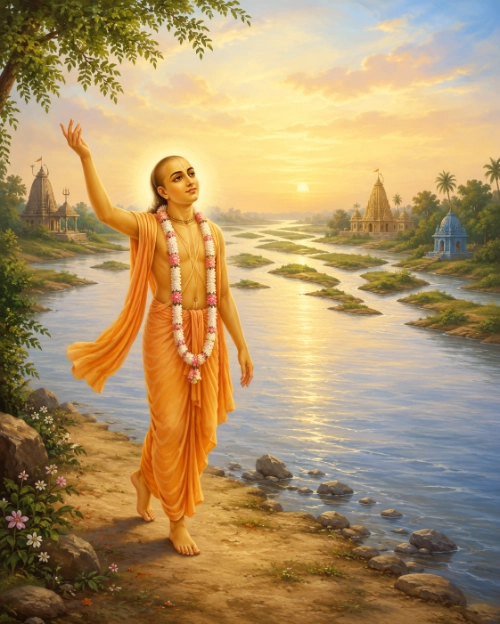
Mahāprabhu's South India Yātrā: Sapta-Godāvarī, Ananya-bhakti, the Devas, and Undivided Faith
The lecture opens with the origin of the Sapta-Godāvarī and then uses Caitanya Mahāprabhu’s South India pilgrimage to ask a much larger question: what does exclusive devotion to Kṛṣṇa actually mean? Its answer is that ananya-bhakti concerns where a person’s faith and shelter reside — not merely which external activities they perform.
The practical questions the class works through are these:
- Can a Vaiṣṇava visit temples of Śiva, Gaṇeśa or Devī?
- Can a devotee take part in family religious traditions?
- Can one use medicine, astrology, crystals or other practical remedies?
- At what point does respectful participation become divided faith?
- What distinguishes mixed devotion from ananya-bhakti?
- How does a pure devotee see Kṛṣṇa everywhere while remaining exclusively surrendered to him?
Gautama Ṛṣi and the Origin of the Sapta-Godāvarī
Varuṇa’s boon
Varuṇa grants Gautama Ṛṣi a boon: he is told to dig, and where water emerges it will never dry up. Gautama digs, a pond forms, and he and his disciples use the water for irrigation, agriculture and cultivation, so that the whole community prospers. His wife is Ahalyā.
A trivial dispute
Ahalyā asks the disciples to fetch water, and at the pond they meet the wives of the other six ṛṣis — the setting being the Sapta-ṛṣis, seven sages in all. The other wives refuse to let Gautama’s disciples draw water before them. The lecturer stresses how petty the original quarrel is.
Rather than escalating it, Ahalyā simply goes and fetches the water herself. And that peaceful response only deepens the other women’s resentment. The first moral is already in place: these narratives exist to show how a great personality responds under provocation — grievance and retaliation on one side, humility and forbearance on the other.
The six ṛṣis, and the cow
The six wives press their husbands to have Gautama and Ahalyā removed. The ṛṣis pray to Gaṇeśa for help, and Gaṇeśa warns them plainly that the request is unjust: it is largely because of Gautama that the community has water and prosperity at all, and now they want him expelled. They persist.
Gaṇeśa finally takes the form of a cow and grazes near Gautama’s āśrama. Gautama, wanting only to move her off the cultivated ground, throws a little soft darbha grass towards her — grass that could not ordinarily harm anyone. The cow falls as though dead.
The other ṛṣis at once accuse him of go-hatyā, the killing of a cow, and insist that he and Ahalyā leave and undergo atonement. What matters to the lecturer is Gautama’s reaction: falsely accused, he does not rebel. He accepts the situation and goes.
Śiva’s verdict, and Gautama’s answer to it
Gautama performs repeated pradakṣiṇā of Brahmagiri and worships Śiva, who eventually appears and tells him the truth: he is sinless, the cow was Gaṇeśa, no cow was killed, there is no go-hatyā, and he may return in peace.
Gautama’s reply is the heart of the story. Although he did not physically commit the sin, he says, he is still carrying its burden mentally — and so he still desires purification.
The practical lesson drawn from this: we sometimes discover later that a conflict or an offence was not actually our fault. Even then, rather than settling at I was right,
Vaiṣṇava culture asks whether there is still something in oneself to be corrected. Gautama is offered as an example of radical self-examination rather than defensiveness.
Gaṅgā Becomes Godāvarī
Śiva therefore tells Gautama that he will order Gaṅgā to descend there — which opens a digression on where Gaṅgā comes from at all. When Vāmanadeva became Trivikrama, his step pierced the shell of the universe; water from outside entered and became Gaṅgā. The lecturer identifies that water with the waters of the Kṣīra-sāgara, and so calls Gaṅgā non-different from them.
The descending water had tremendous force, and Śiva received and restrained her within his jaṭā, his matted locks — which is the explanation given for his familiar iconography as Gaṅgādhara, the bearer of Gaṅgā. When he asks her to descend for Gautama, she agrees on one condition: that Śiva himself remain there.
So Śiva manifests as Tryambakeśvara — tri, three, and ambaka, eye: the three-eyed Lord — at the place near Nashik. From that region emerges the Godāvarī, which the lecturer describes as non-different from Gaṅgā.
Why there are seven streams
Then Gautama makes a remarkable request. He asks that the river also flow towards the residences of the six ṛṣis who had falsely accused him.
The man who was envied, framed, publicly accused and expelled uses the blessing he receives for the benefit of his accusers. The Godāvarī reaches the Bay of Bengal through seven branches, and the lecturer connects those seven with Gautama’s prayer that all seven hermitages receive her mercy.
His saintliness is not revealed simply because he tolerated injustice. It is revealed because, once empowered, he blessed the people who harmed him.
The Journey Along the Godāvarī
Mahāprabhu travelled extensively along the Godāvarī, and the lecturer notes how consistently ancient civilisations grew along rivers — for water, food, transport, agricultural fertility and routes of communication. He compares it with Roman London growing beside the Thames.
The speaker speculates that the name Thames may derive from Sanskrit tamas, darkness. This is his own aside and should be treated as speculation rather than an established derivation.
He remarks that the Godāvarī basin is vast, comparing its area to roughly that of the United Kingdom and the Republic of Ireland combined. The point for the narrative is that Mahāprabhu’s journey along it was not a short local excursion but a passage through a major civilisational corridor.
Two encounters at Govardhana
To illustrate the unexpected devotion one meets in holy places, he tells two stories from his own experience.
He reads the child’s unusual attraction to Govardhana as something that probably did not begin in this life.
Five Purposes of the South India Yātrā
On the Brahma-saṁhitā, the lecturer argues it cannot simply be dismissed as a late Gauḍīya invention, since verses from it are cited in pre-Caitanya Vaiṣṇava literature, including material he associates with Madhvācārya’s Vedānta commentary. That is his argument for its antiquity.
The fifth purpose is tied to a line attributed to Mahāprabhu after all that travelling:
eta tīrtha kailuṅ paryaṭana
tomā-sama vaiṣṇava nā dekhilu eka jana
“I have travelled to so many holy places, but I have not seen a single Vaiṣṇava like you.”
Why So Many Different Temples?
Mahāprabhu visited hundreds of sacred places — temples of Gaṇeśa, Durgā, Śiva, Narasiṁhadeva, Rāmacandra, Lakṣmī-Nārāyaṇa, Viṣṇu and Kṛṣṇa. Which raises the practical question the class exists to answer: should a Gauḍīya Vaiṣṇava visit temples of the devas?
The lecturer is explicit that these are different legitimate sampradāya positions, and that he is not condemning any of them.
The Gauḍīya answer he presents comes from Prabhupāda’s purport around Caitanya-caritāmṛta Madhya 9.360 — everyone should follow in the footsteps of Śrī Caitanya Mahāprabhu and visit all temples.
So: yes, respect and visit. Which immediately produces the harder question — does visiting imply placing faith in every deity as an independent source of fulfilment? No.
Practical Remedies and Spiritual Shelter
The lecturer had recently had health problems, and someone advised him to wear a particular crystal to improve them. This becomes his example of an upāya — a remedy, means or method. Should a devotee accept such things, or say only Kṛṣṇa, Harināma and Vaiṣṇavas
?
His answer is subtle: one may use an external means without placing ultimate faith in it. Suppose someone says it is going to rain and you should take an umbrella. Should you refuse because you are surrendered to Kṛṣṇa? No — take the umbrella. But can the umbrella guarantee protection? Also no. It can break, blow away, fail.
So: use the practical means, but do not transfer your faith to the means. The attitude is this may work or may not; I use it, but Kṛṣṇa controls the result.
It is one of the most useful distinctions in the class.
Three Categories of Devotee
The threefold classification is attributed to Baladeva Vidyābhūṣaṇa, especially through the Govinda-bhāṣya and Gītā-bhūṣaṇa.
The point about the first category is sharp. Externally such a devotee may attend the temple, worship Kṛṣṇa, sing kīrtana, give classes, perform major service and hold leadership responsibility — while internally the faith remains distributed among Kṛṣṇa, Śiva, Gaṇeśa, astrology, crystals, worldly authorities and other sources of security. The problem is not the external activity. It is divided śraddhā. Baladeva Vidyābhūṣaṇa relates the first six chapters of the Gītā particularly to this category.
For householders and devotees living in ordinary society, the lecturer sums the middle position up with a Christian phrase: in the world, but not of the world.
Family Ceremonies
The example: someone becomes a Gauḍīya Vaiṣṇava, but their Bengali family continues to celebrate Durgā Pūjā. Should they attend? Baladeva’s answer, as given here, is to attend if refusing would unnecessarily disturb close family or cause them to criticise a Vaiṣṇava. Two principles are at work — jīva-dayā, compassion towards living beings, and the avoidance of vaiṣṇava-aparādha, not needlessly putting someone in a position where resentment makes them criticise devotional life.
With one crucial condition: attend without transferring your faith to the ritual.
An audience member adds a teaching attributed to Bhaktivinoda Ṭhākura — that Vaiṣṇava brāhmaṇas may sometimes take part in traditional yajñas because their Kṛṣṇa-conscious presence can redirect the intention of the activity. The lecturer accepts this as consistent with the broader principle: external participation is not internal shelter.
What jīva-dayā actually requires
An audience member presses the point: if disturbing someone’s mind is wrong, must a devotee attend every invitation, including a drinking party? No. His working definition is narrower — do not unnecessarily disturb those who are genuinely dependent upon, or deeply attached to, you. That means parents, close relatives, immediate family, people with whom one has real relational duties. A workplace drinking party can usually be declined politely without disturbing anyone.
He may attend a family wedding briefly, particularly around the time of prasāda, while avoiding the parts of a ritual he finds spiritually distracting. The larger principle is not to become needlessly confrontational. Sometimes the right response is simply thank you very much; please enjoy, but kindly excuse me.
One maintains one’s principles without using them as a weapon.
During this section the lecturer makes a humorous wordplay on svāhā and dogs. It functions as a joke in context and should not be taken as a lexical derivation of the Vedic ritual word.
Prabhupāda and the Fisherman
From Prabhupāda’s walks at Venice Beach: an elderly fisherman who often saw him became attracted to him and wanted to give him something, and offered him a large fish. Rather than rejecting him angrily, Prabhupāda reportedly smiled and said thank you very much; we do not take fish, but you can enjoy.
After the man had walked away, he quietly added: and then suffer.
The point is not that eating fish is acceptable. It is about Vaiṣṇava dealings — a teacher can hold the principle without humiliating someone who is acting from ignorance but with genuine goodwill.
Ananya-bhakti
The lecturer reads Mahāprabhu’s South India journey as an enactment of undivided devotion.
ananya-cetāḥ satataṁ
yo māṁ smarati nityaśaḥ
tasyāhaṁ sulabhaḥ pārtha
nitya-yuktasya yoginaḥ
Bhagavad-gītā 8.14
So ananya-bhakti is undivided faith — and the emphasis that follows is blunt: do not divide your faith. Have faith in Kṛṣṇa, the holy name, devotional service, the association of devotees and Hari-kathā. These are what carry the jīva across.
The daṇḍa, and what people actually follow
A story about Radhanath Swami and Śikṣāṣṭakam Prabhu. Thousands of villagers had gathered to touch the feet of a sādhu, and seeing the saffron and the sannyāsa-daṇḍa they rushed towards him. Radhanath Swami quietly handed the daṇḍa to Śikṣāṣṭakam Prabhu and stepped aside — whereupon the crowd rushed towards whoever was holding the daṇḍa, having mistaken the symbol for the criterion of saintliness.
The lecturer uses it against obsession with labels — sannyāsī, temple president, authority, senior, prestigious service. When one finally stands before Kṛṣṇa, none of it will matter. The only qualification will be the love one has for him. The purity of a devotee can therefore be measured by the exclusivity of their faith.
Three modes of seeing
Why the Gopīs Worship Kātyāyanī
The Bhāgavatam itself describes the gopīs worshipping Kātyāyanī Devī. If pure devotees have exclusive faith in Kṛṣṇa, how is that possible? The answer lies entirely in what they ask her for.
kātyāyani mahā-māye
mahā-yoginy adhīśvari
nanda-gopa-sutaṁ devi
patiṁ me kuru te namaḥ
“O Kātyāyanī, O Mahāmāyā, O great yoginī and sovereign goddess, please make the son of Nanda our husband.”
The decisive phrase is nanda-gopa-sutam — the son of Nanda. They do not approach her for money, for a worldly marriage, for health, for power or for any independent fulfilment. They approach her for Kṛṣṇa. So this apparently “other” worship is itself an expression of exclusive Kṛṣṇa-bhakti.
A related anecdote from ISKCON’s early years: someone suggested the movement lacked funds because it was not worshipping Gaṇeśa, and devotees asked whether Gaṇeśa could go on the main altar. Prabhupāda’s answer, as reported here, was no — not the main altar; Gaṇeśa could be honoured separately; worship Kṛṣṇa first, then offer Kṛṣṇa’s mahāprasāda to Gaṇeśa. The devotees did so, and the lecturer says financial support increased. His theological point is not worship Gaṇeśa for money
but that the devas are understood through their relationship with Kṛṣṇa, not as independent powers competing with him.
How a Pure Devotee Sees the World
sthāvara-jaṅgama dekhe, nā dekhe tāra mūrti
sarvatra haya nija iṣṭa-deva-sphūrti
Caitanya-caritāmṛta, Madhya 8.274
A pure devotee sees moving beings, non-moving beings, places and objects — but does not become absorbed merely in their external forms. Everywhere there is iṣṭa-deva-sphūrti, a manifestation or remembrance of one’s worshipable Lord. The pure devotee sees Kṛṣṇa everywhere, in everything.
rādhā-kṛṣṇa tomāra mahā-prema haya
yāhā tāhā rādhā-kṛṣṇa tomāra sphuraya
Because Rāmānanda possesses profound love for Rādhā and Kṛṣṇa, wherever he looks he experiences Rādhā and Kṛṣṇa.
This is not pantheism in the simplistic sense that everything is literally identical with God. It is that everything stimulates remembrance of one’s iṣṭa-deva.
The Progression of Faith
The developmental model runs from divided to undivided śraddhā:
The key transition is not primarily doing fewer worldly things. It is believing less and less that worldly things are what sustain us.
And mixed faith shows. A person may give eloquent classes, perform beautiful kīrtana, hold significant service and appear advanced — but if the heart’s deepest faith rests in money, entertainment, prestige, sensual enjoyment or worldly success, the potency of that speech and kīrtana is diminished. External expression reflects internal consciousness.
The lecturer recounts asking Jananivāsa Prabhu about his first encounters with Śrīla Prabhupāda. Jananivāsa said he initially had difficulty understanding Prabhupāda’s accent — yet he immediately understood something more important: he was a Vaikuṇṭha man, and what he was saying was the absolute truth.
A pure devotee’s potency does not depend on rhetorical polish.
Can Śiva Worship Be Ananya-bhakti?
An audience member asks whether one may worship another deity specifically in order to come closer to Kṛṣṇa. Yes, the lecturer answers — if the intention is absolutely clear. Śiva is the principal example.
If that is the consciousness, he says, then it is perfect.
But there must be no grey area. If a person secretly thinks perhaps Śiva independently can give me the thing I really want,
exclusive faith has already been compromised. Hence:
akāmaḥ sarva-kāmo vā
mokṣa-kāma udāra-dhīḥ
tīvreṇa bhakti-yogena
yajeta puruṣaṁ param
Whether one has no material desires, or many, or desires liberation, one should intensely worship the Supreme Person.
Even one’s desires are to be carried to the Supreme Lord.
What Determines Faith?
Asked whether faith ultimately means what we believe will make us happy, the lecturer essentially agrees. The Gītā teaches that one’s śraddhā is conditioned by svabhāva, one’s nature, and by the guṇas influencing consciousness. So devotees may all be devotees while holding very different intensities of faith. One may require bahūnāṁ janmanām ante, many births of development; another may be very near the entrance to Goloka. What differentiates them, in this model, is the quality and exclusivity of faith.
And faith is tied to where a person believes rasa is. He invokes raso vai saḥ — the Supreme is rasa — while conditioned beings presently experience apparent rasa in innumerable worldly things. Sādhana is therefore the gradual discovery that the rasa we seek elsewhere is found in the Supreme: a work of refinement, of anartha-nivṛtti, of purifying misplaced attachment and concentrating faith on one point.
How does faith itself change? His answer is one word: association. He says the Sixth Canto makes the principle especially clear — association changes faith, and there is no other way.
An Unresolved Question
An audience member asks about Gopāla Bhaṭṭa Gosvāmī’s Sat-kriyā-sāra-dīpikā, recalling an introduction that appears to instruct Vaiṣṇavas not to worship devas, offer obeisances, or give them devotional attention — which is hard to square with Mahāprabhu visiting Śiva temples and with everything just said.
The lecturer does not invent an answer. He says he has not encountered the statement in the text and would need to investigate, and another participant notes the words may belong to a modern introduction rather than to Gopāla Bhaṭṭa himself. The question is left unresolved in the class, and is left unresolved here.
What he does say is that Gopāla Bhaṭṭa’s ritual reform often replaces Vedic mantras addressed to devas with Kṛṣṇa-centred mantras — so the strategy is not to reject ritual structure but to reorient its centre.
He then makes a further claim: that the Hari-bhakti-vilāsa prescribes the observance of Śivarātri for Vaiṣṇavas. And he immediately adds a pastoral caveat — he is not proposing a revolution, and devotees should stay consistent with the standards given by Śrīla Prabhupāda rather than extracting isolated prescriptions from older ritual texts and abruptly changing community practice. It is a methodological point worth keeping: historical śāstric prescription and present sampradāya practice have to be handled responsibly.
The Model in One Table
The opening story and the closing theology are connected. Gautama is falsely accused — and because his inner identity does not depend on reputation, on winning the argument, on proving others wrong or on retaliating, he remains spiritually free. He even uses the mercy he receives to bless his accusers.
Mahāprabhu likewise travels among different religions, devas, temples, communities, philosophers and ritual systems, and none of it divides his centre. That is the ideal the class is describing: be respectful without becoming spiritually dependent; participate where compassion or duty requires it without shifting your shelter; use practical means without worshipping the means; see Kṛṣṇa’s relationship with everything without confusing everything with Kṛṣṇa.
The progression is subtler than “many gods to one God,” and subtler than “many activities to only temple activities.” It runs from I believe happiness and security come from many independent sources, through other means are subordinate, to I may interact with many people, duties and practical means, but my shelter is not divided — and finally to the vision in which everything stimulates remembrance of one’s beloved Lord.
Which resolves the apparent paradox. The pure devotee can respect everything precisely because the pure devotee takes shelter of only Kṛṣṇa.