

When Kṛṣṇa Plays the Flute
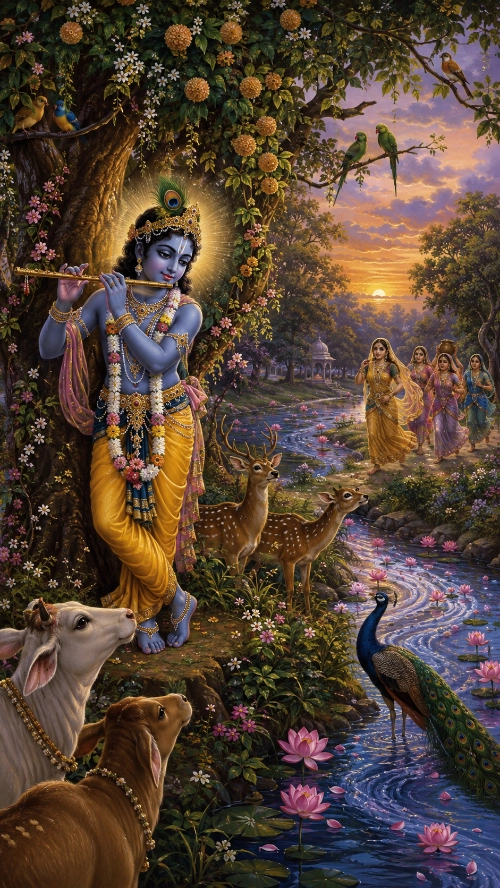
When Kṛṣṇa Plays the Flute: The Instruments, the Eight Melodies, and the Sound Only Its Hearer Can Hear
The first class in a new series, Vraja-smaraṇam, on the objects that belong to Kṛṣṇa — and it begins with the one He is never without. Rāsa Līlā d.d. sets out what the ācāryas say about the flute: the three kinds and their measurements, the named instruments, the eight melodies and what each one does, and the strange rule that the sound reaches only whoever it was played for. It ends with Rādhārāṇī asking to be made of bamboo.
Hare Kṛṣṇa, dear devotees, please accept my obeisances. Today we are beginning an interesting new series. The Lord inspires meditation on His līlās, and the idea came to meditate on the Lord’s attributes — the objects He uses — and describe them by the mercy of the spiritual teachers. In particular, today I will be drawing from a lecture by Śrīla Indradyumna Swami, who has given many lectures about Vraja.
So we are beginning a new series, a playlist describing the pastimes of Vṛndāvana. This series is called Vraja-smaraṇam. Smaraṇam means remembrance, and Vraja means Vraja. Let us therefore begin with auspicious prayers. First, the prayer glorifying the mercy of the spiritual master:
oṁ ajñāna-timirāndhasya
jñānāñjana-śalākayā
cakṣur unmīlitaṁ yena
tasmai śrī-gurave namaḥ
“I was born in the darkest ignorance, and my spiritual master opened my eyes with the torch of knowledge. I offer my respectful obeisances unto him.”
And let us also recite a prayer to Lord Kṛṣṇa:
he kṛṣṇa karuṇā-sindho
dīna-bandho jagat-pate
gopeśa gopikā-kānta
rādhā-kānta namo ’stu te
“O Kṛṣṇa, ocean of mercy, friend of all who suffer, Lord of creation, master of the cowherds and beloved of the gopīs — O beloved of Rādhā, I bow deeply before You.”
And, of course, a prayer to Śrīmatī Rādhārāṇī:
tapta-kāñcana-gaurāṅgi
rādhe vṛndāvaneśvari
vṛṣabhānu-sute devi
praṇamāmi hari-priye
“I bow before Śrīmatī Rādhārāṇī, whose complexion is like molten gold and who is the queen of Vṛndāvana. You are the daughter of King Vṛṣabhānu, and You are very dear to Lord Kṛṣṇa.”
And we also bow to Śrīla Prabhupāda:
nama oṁ viṣṇu-pādāya
kṛṣṇa-preṣṭhāya bhū-tale
śrīmate bhaktivedānta-
svāmin iti nāmine
“I offer my respectful obeisances unto His Divine Grace A. C. Bhaktivedanta Swami, who is very dear to Lord Kṛṣṇa, having taken shelter at His lotus feet.”
namas te sārasvate deve
gaura-vāṇī-pracāriṇe
nirviśeṣa-śūnyavādi-
pāścātya-deśa-tāriṇe
“Our respectful obeisances unto you, O servant of Sarasvatī Gosvāmī. You are kindly preaching the message of Lord Caitanyadeva and delivering the Western countries, which are filled with impersonalism and voidism.”
Tadīya: What Is Dear to Him
So we will be speaking about objects connected with Kṛṣṇa, with His devotees, or with the process of devotional service. In Sanskrit such things are called tadīya. Tadīya means that which is dear to Lord Kṛṣṇa.
Such objects awaken love within our hearts. Meditation upon them is attractive: by meditating on them we become attracted to the Lord and feel a connection with Śrīmatī Rādhārāṇī and Kṛṣṇa. They possess immense spiritual potency, because in the spiritual world every object is a conscious personality. It serves the Lord and possesses the desire to satisfy Him. All these objects are companions of the Lord, and they can awaken our love and divine consciousness.
Today we will speak about one of the most beloved objects, one of the attributes that always accompanies Kṛṣṇa. And what do you think it is? His flute. Or, more precisely, we will speak not so much about the flute itself as about the sound produced by the flute.
The Sound That Wakes the Sleeper
This is a magical sound. It possesses tremendous power in Vṛndāvana and affects all the devotees. We know that sound has extraordinary power in spiritual life. Sound can transform desire. Sound can open the spiritual reality to us. And, taking advantage of this principle, we make an alarm clock based on sound. When we sleep, all our senses are asleep, but hearing is the one sense that can awaken while we are sleeping and receive sound. Thus, through sound, we can awaken not only from physical sleep at night, but from material life into spiritual life.
I once heard a story about Bhakti Tīrtha Swami. He was here in Māyāpur and was once giving an evening class, sitting in the temple room before Rādhā-Mādhava. Suddenly he stopped, struck his fist on the table with a feeling of deep regret and bitterness, and said:
“There stands Mādhava on the altar. There stands Śrīmatī Rādhārāṇī. There are the gopīs. Mādhava is playing His flute — and I cannot hear it.”
Ultimately, when we awaken from our material sleep, we too will hear the sound of Kṛṣṇa’s flute.
What Happens to Those Who Hear It
One Vaiṣṇava poet, Pramānanda Dāsa [name as heard in the lecture], describes what happens to those who hear the sound of the flute:
“O sakhī, when Kṛṣṇa brings His flute to His sweet, nectarean lips, all human beings, demigods and living entities fortunate enough to hear it stop breathing out of overwhelming emotion.
“When He begins playing, filling it with His transcendental breath, all living beings who are able to hear it properly, as well as the demigods, become intoxicated. When He reaches the fifth note, all those fortunate enough to hear it begin manifesting all the symptoms of ecstasy. And when Kṛṣṇa plays the seventh and highest note on His flute, He revives the soul of everyone.
“What more can be said, O sakhī? With the final note of His flute-song, all kings place their royal crowns at the feet of that flute. Beautiful women surrender their beauty to it, the demigods offer it their powers, and Sarasvatī becomes its maidservant.”
Thus the poet prays: “I give everything to this flute — everything I possess — because it is capable of drowning the whole world in ecstasy.”
Rūpa Gosvāmī also describes Kṛṣṇa’s flute in the Bhakti-rasāmṛta-sindhu. He says that the vibration of this astonishing instrument is capable of interrupting the meditation of the greatest sages. In this way Kṛṣṇa challenges Cupid and proclaims His transcendental glory throughout the entire world.
We also know that in Brahma-saṁhitā 5.30 Lord Brahmā, the first guru in our sampradāya, mentions the flute:
veṇuṁ kvaṇantam aravinda-dalāyatākṣaṁ
barhāvataṁsam asitāmbuda-sundarāṅgam
kandarpa-koṭi-kamanīya-viśeṣa-śobhaṁ
govindam ādi-puruṣaṁ tam ahaṁ bhajāmi
“I worship Govinda, the original Lord, who expertly plays upon His flute. His blossoming eyes resemble lotus petals, His head is decorated with a peacock feather, His beautiful form has the hue of a fresh rain cloud, and His incomparable beauty enchants millions of Cupids.” — Brahma-saṁhitā 5.30
Three Kinds of Flute
So what kinds of flutes does Kṛṣṇa have? There are three principal kinds.
Kṛṣṇa’s flutes differ from one another. They are often decorated with precious jewels. Sometimes they are made of marble, sometimes from hollow bamboo. Several have names of their own.
Kṛṣṇa also likes to play different rāgas on His flute. Rāgas are melodic forms suited to different times of day and different occasions. He especially likes the Gauḍī and Gurjarī rāgas.
Only the One He Plays For Can Hear
There is another remarkable characteristic of the flute: its sound can be heard only by the person or group for whom Kṛṣṇa intends it. Kṛṣṇa may play specifically for one person or for one particular group, and only those persons can hear the sound. This is the mystical nature of Kṛṣṇa’s flute playing. Kṛṣṇa is the supreme mystic yogī, the Lord of all mystics. [A title pronounced in the recording here is unclear.]
If Kṛṣṇa plays His flute for the cows, only the cows can hear it. If Kṛṣṇa plays His flute for the gopīs, only the gopīs can hear it. Then the gopīs abandon all their household duties, run out of their homes, and hurry to meet Kṛṣṇa in the forest. The other members of their families cannot understand what has happened, because they hear nothing. Suddenly the gopīs simply begin running away, and their relatives ask: “Where are you going? Why are you running away?”
The ācāryas describe one gopī who was cooking a roṭī. She had cooked it on only one side. Suddenly she heard Kṛṣṇa’s flute and immediately ran away. She did not even turn the roṭī over or serve it to her husband, who was sitting with his plate waiting for it. But her husband could not hear the flute. He had no idea what was happening.
These are truly mystical manifestations of Kṛṣṇa’s flute. Only Kṛṣṇa can do something like this.
Ṭera-kadamba: Calling the Cows by Name
He also plays special melodies for the cows. There is a sacred place called Ṭera-kadamba, described here as the original cowherding place of Vṛndāvana, where the cows of Vraja graze. When the time comes for the cows to return home, Kṛṣṇa climbs one of the many kadamba trees growing there and plays His flute, calling all the cows home.
He calls each cow by name. The flute is somehow capable of playing their names. He begins playing: “Candrikā! Devalī! Ivalī!” [names as heard in the lecture] — and each cow hears her own name and runs toward Kṛṣṇa.
Those who have visited Ṭera-kadamba know that it is not far from Nandagrāma. There is a kadamba tree there upon which Kṛṣṇa is said to sit and play. The sādhus who live at this sacred place — where Rūpa Gosvāmī also resided and wrote his beautiful works — sometimes jokingly say that Kṛṣṇa has a mobile phone, and that mobile phone is His flute. He dials particular numbers in the form of particular sounds, makes the call, and then the cows, or others, come running.
Thus the flute plays an extraordinarily important role for Kṛṣṇa. He is always afraid of losing it. Because Kṛṣṇa has such intimate relationships with His flute, He is known by many names connected with it: Veṇugopāla, Vaṁśīlāla, Muralī, Muralīdhara.
The Eight Melodies
Kṛṣṇa plays different melodies upon His flute for different purposes, and there is a certain sequence to them.
How Kṛṣṇa Found the Melody
Indradyumna Swami then tells a story about how Kṛṣṇa learned to play the flute in a particular way. One day Kṛṣṇa had an idea: He wanted to play His flute in such a way that it would attract the gopīs to the particular place in the forest where He was standing. He thought: “How can I invent such a melody that the gopīs of Śrīmatī Rādhārāṇī will understand that I am here and that they must come to Me?”
So He decided: “I will play a melody that will bewilder Rādhārāṇī’s gopīs. They will run here. I simply need to find the particular sound to which these girls will be most receptive — the sound that will attract their senses.” He began experimenting with different flute melodies, with only one purpose: to attract the gopīs of Śrīmatī Rādhārāṇī.
One day He played a melody and noticed that His cows became completely still. They stopped eating grass and simply stood motionless, listening to the flute. They raised their ears, drinking the song of His flute through them, and gazed at Kṛṣṇa without blinking, absorbed in the sweetness of His face. But that melody did not bring Rādhā’s gopīs to Him.
So the next day He began experimenting with another melody. This time the forest animals and birds became completely motionless, as though confined within an invisible cage. But again the melody did not attract the gopīs of Śrīmatī Rādhārāṇī.
On the third day Kṛṣṇa’s melody attracted the deer. Whole herds rushed toward Him. They became enchanted by His form and offered Him their worship, their eyes filled with love.
On the fourth day Kṛṣṇa played another melody that attracted the devīs, the celestial goddesses from Svarga-loka. It bewildered them so profoundly that their garments loosened and their ornaments fell from their bodies.
Then, on the fifth day, Kṛṣṇa played an immensely powerful melody, and something extraordinary happened. All animate beings lost consciousness, while inanimate things came to life. Such was the mystical power of Kṛṣṇa’s flute.
But even these melodies did not affect the gopīs as Kṛṣṇa desired. The Yamunā, however, became deeply agitated. When she heard the song of the flute on that fifth day, she stopped flowing and became utterly bewildered. Her waves rose, her waters trembled, and she changed her current’s direction. She began flowing toward Kṛṣṇa’s lotus feet and brought Him lotus flowers.
Imagine how powerful the sound of that flute was. Yet even this immensely powerful melody did not attract Śrīmatī Rādhārāṇī’s gopīs.
So Kṛṣṇa continued trying new melodies, day after day. Those melodies enchanted the clouds over Vṛndāvana. They enchanted the mountains of Vṛndāvana and Govardhana Hill. Some time passed in this way. And finally He found the right melody.
It happened at exactly the right moment, because by then the gopīs were already experiencing extremely intense separation from Kṛṣṇa. They desperately wanted to meet Him. Their fathers-in-law and mothers-in-law looked at them and thought: “My goodness! Our sons have married mad women.” Indeed, the gopīs appeared mad because they were constantly thinking of Kṛṣṇa, while their relatives could not understand what was happening.
Rādhārāṇī’s Prayer to Become the Flute
Among all the gopīs, the separation of Śrīmatī Rādhārāṇī was the most intense. At one point She thought: “How can I become this bamboo flute?”
She considered the flute extremely fortunate because, being masculine in grammatical gender [as presented in the lecture], it did not have to feel the shyness the gopīs experienced. It could rest freely in Kṛṣṇa’s hands. It could receive the nectar of Kṛṣṇa’s lips and transform that nectar into a beautiful melody — a melody by which rivers overflow their banks and the bamboo growing on the Yamunā’s shore sheds tears in the form of nectarean honey. Imagine: through the mystical power of that flute melody, even bamboo can exude honey.
Śrīmatī Rādhārāṇī therefore prays that She might obtain the body of a flute — a bamboo flute — and reject this body of a so-called respectable woman. In no other body, She says, is it possible to taste what the flute tastes when Kṛṣṇa plays upon it with desire and love. She says:
“On the day when I become a flute, surely my consciousness will disappear. Undoubtedly I will forget who I am. But Kṛṣṇa will remember Me as that gopī who, because of suffering in separation from Him, became a piece of wood.”
Such is the desire and love of Śrīmatī Rādhārāṇī. She desires so intensely to be close to Kṛṣṇa. And ultimately this overwhelming desire of Śrīmatī Rādhārāṇī and the gopīs — to be together with Kṛṣṇa — was fulfilled. The rāsa dance took place. Then Kṛṣṇa played His flute at Vaṁśīvaṭa, calling the gopīs and Śrīmatī Rādhārāṇī to the rāsa dance. They all came running to Him. And there they danced with Kṛṣṇa throughout a night as long as a night of Lord Brahmā.
So today we have begun our meditation on tadīya — those intimate objects and attributes that accompany the Lord and His devotees and are exceedingly dear to Him. By thinking about these objects and learning these details, we may enter more deeply into the mystery of Vraja and engage in smaraṇam, remembrance. Thus we begin our series Vraja-smaraṇam. Thank you, dear devotees. Until we meet again.