

Kṛṣṇa’s Four Chariot Horses
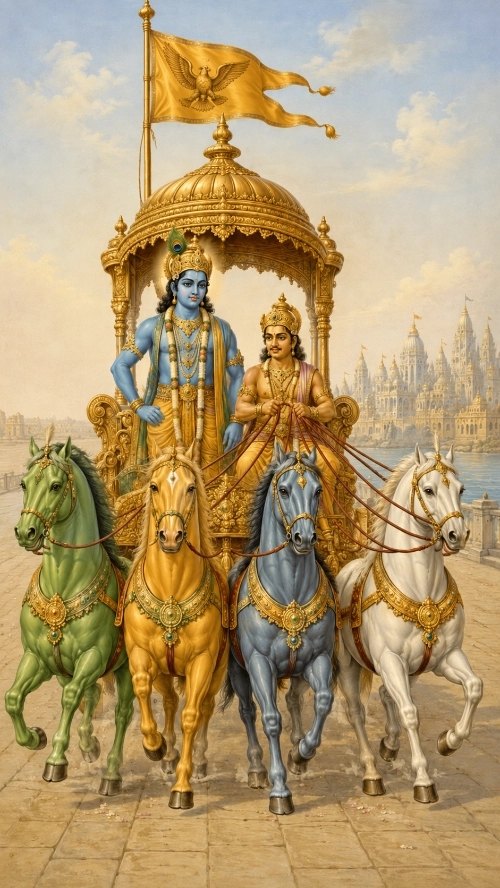
Kṛṣṇa’s Four Chariot Horses: Śaibya, Sugrīva, Meghapuṣpa and Balāhaka
Four horses draw Kṛṣṇa’s royal chariot, and the tradition remembers all four by name — Śaibya, Sugrīva, Meghapuṣpa and Balāhaka. They are not incidental animals hired for one journey. The same four names recur in the Śrīmad-Bhāgavatam and the Mahābhārata, their colours are recorded, their positions in the team are recorded, and Viśvanātha Cakravartī Ṭhākura explains that they descended from Vaikuṇṭha to take part in Kṛṣṇa’s earthly pastimes.
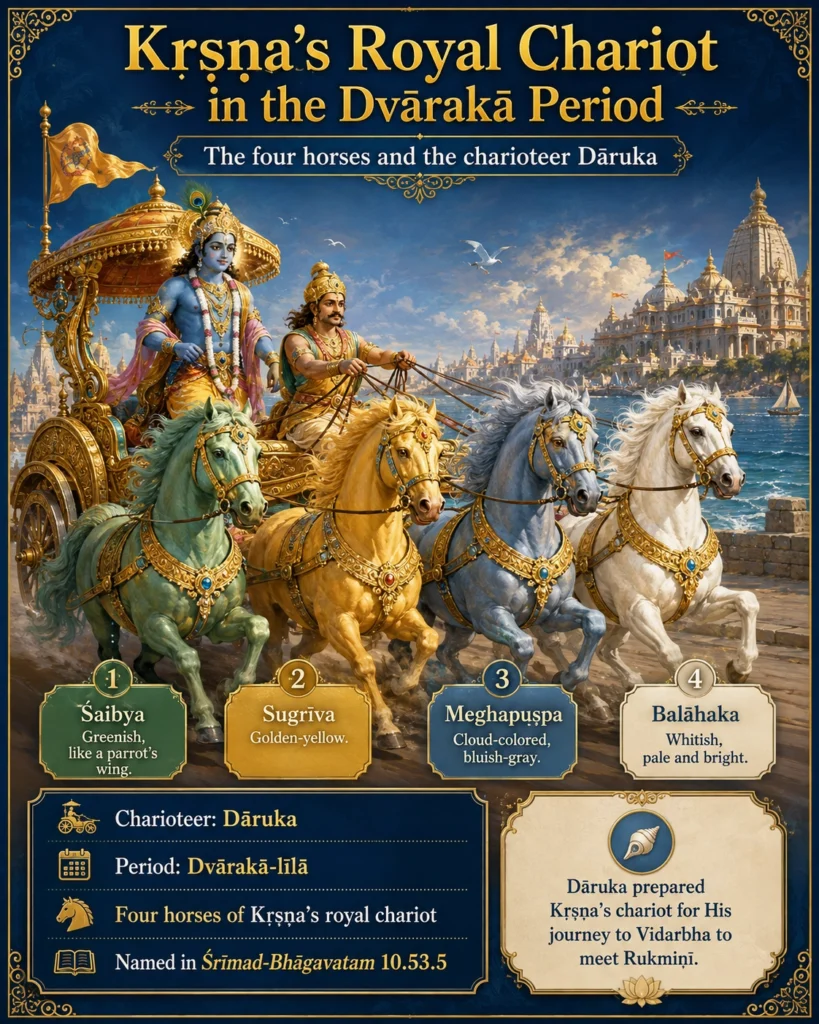
The four horses in their traditional colours, with Dāruka at the reins and Dvārakā behind.
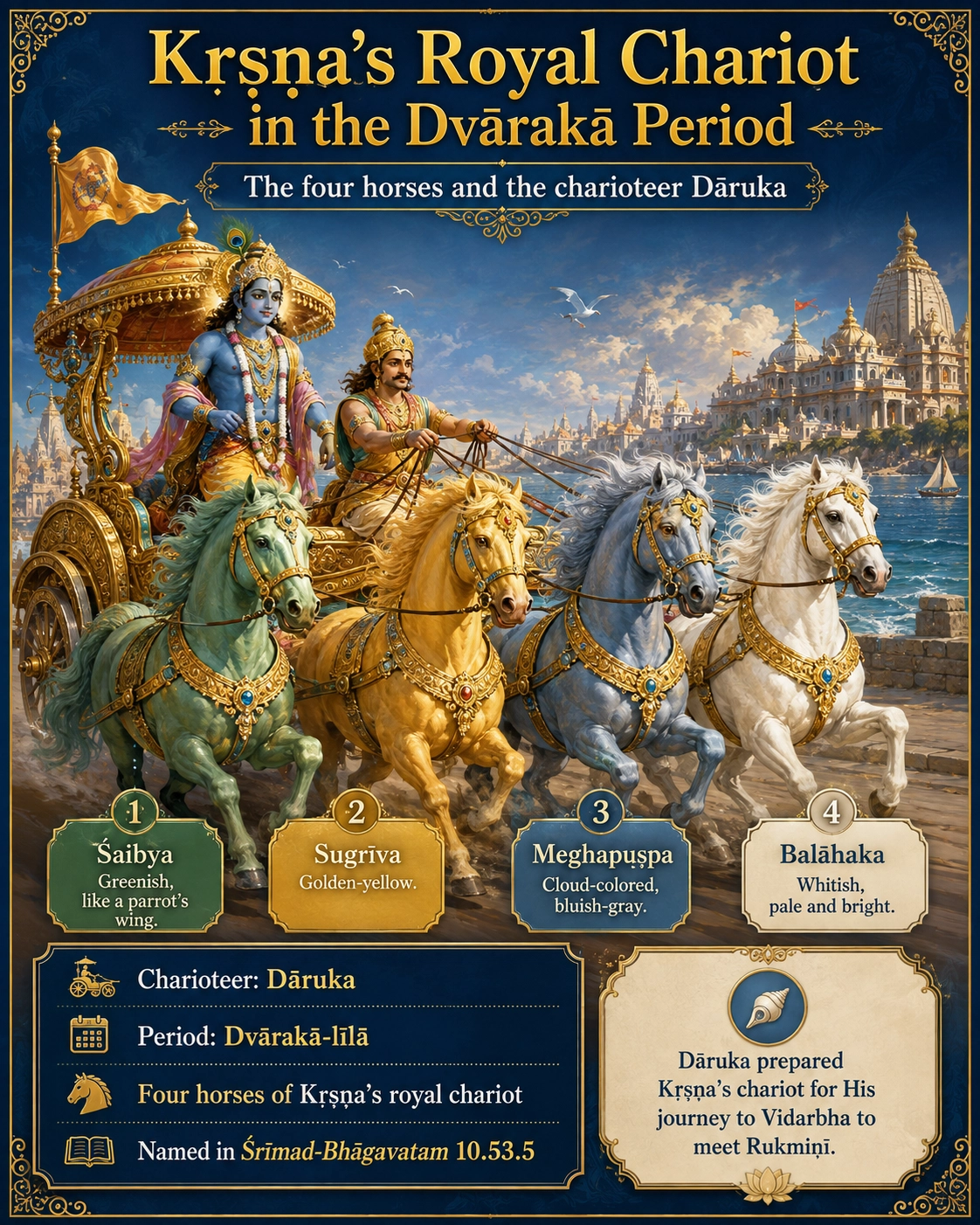
Śaibya, Sugrīva, Meghapuṣpa and Balāhaka belong to the recognizable royal iconography of Kṛṣṇa’s Dvārakā-līlā, together with His charioteer Dāruka and His Garuḍa-bannered chariot. What follows gathers what the texts actually say about them — and marks clearly where the tradition stops and later invention begins.
The Four Horses in the Śrīmad-Bhāgavatam
Their best-known appearance occurs during the story of Rukmiṇī. When Kṛṣṇa receives Rukmiṇī’s confidential message and learns that her marriage to Śiśupāla is imminent, He immediately orders His personal charioteer to prepare the chariot:
रथः संयुज्यतामाशु दारुकेत्याह सारथिम् ।
rathaḥ saṁyujyatām āśu
dārukety āha sārathim
“Let the chariot be yoked immediately, Dāruka!” — Śrīmad-Bhāgavatam 10.53.4
Dāruka obeys:
स चाश्वैः शैब्यसुग्रीव-
मेघपुष्पबलाहकैः ।
युक्तं रथमुपानीय
तस्थौ प्राञ्जलिरग्रतः ॥
sa cāśvaiḥ śaibya-sugrīva-
meghapuṣpa-balāhakaiḥ
yuktaṁ ratham upānīya
tasthau prāñjalir agrataḥ
“Dāruka brought the Lord’s chariot, yoked with the horses Śaibya, Sugrīva, Meghapuṣpa and Balāhaka, and stood before Him with joined palms.” — Śrīmad-Bhāgavatam 10.53.5
The identification is explicit, and the four names are given as a single compound — a fixed set rather than a list assembled for the occasion.
Their Colours
In his commentary to Bhāgavatam 10.53.5, Viśvanātha Cakravartī Ṭhākura quotes the Padma Purāṇa:
शैब्यस्तु शुकपत्राभः
सुग्रीवो हेमपिङ्गलः ।
मेघपुष्पस्तु मेघाभः
पाण्डुरो हि बलाहकः ॥
śaibyas tu śuka-patrābhaḥ
sugrīvo hema-piṅgalaḥ
meghapuṣpas tu meghābhaḥ
pāṇḍuro hi balāhakaḥ
This is an unusually vivid description. Instead of four visually identical horses, Kṛṣṇa’s team consists of four distinctly coloured steeds.
A Colour Variant in the Mahābhārata
The Mahābhārata preserves a closely related description, but gives a different comparison for Sugrīva:
शैब्यस्तु शुकपत्राभः सुग्रीवः किंशुकप्रभः ।
मेघपुष्पो मेघवर्णः पाण्डरस्तु बलाहकः ॥
śaibyas tu śuka-patrābhaḥ
sugrīvaḥ kiṁśuka-prabhaḥ
meghapuṣpo megha-varṇaḥ
pāṇḍaras tu balāhakaḥ
Śaibya again resembles a parrot’s wing, Meghapuṣpa is cloud-coloured and Balāhaka is pale — but Sugrīva is kiṁśuka-prabha, radiant like the brilliant kiṁśuka or palāśa blossom.
The sources therefore preserve slightly different colour traditions for Sugrīva: the Padma Purāṇa citation has hema-piṅgala, “golden-tawny,” while this Mahābhārata passage has kiṁśuka-prabha, evoking the brilliant reddish-orange palāśa flower. It is better to preserve the variation than to force the two descriptions into a single colour.
Their Exact Positions in the Team
The Mahābhārata gives a detail the Bhāgavatam does not supply: the arrangement of the horses. Immediately after describing their colours, it says:
दक्षिणं चावहच्छैब्यः
सुग्रीवः सव्यतोऽवहत् ।
पृष्ठवाहौ रथस्यास्तां
मेघपुष्पबलाहकौ ॥
dakṣiṇaṁ cāvahac chaibyaḥ
sugrīvaḥ savyato ’vahat
pṛṣṭhavāhau rathasyāstāṁ
meghapuṣpa-balāhakau
An especially well-informed depiction of Kṛṣṇa’s chariot should therefore not merely show four appropriately coloured horses; it can also preserve their traditional arrangement.
Their Extraordinary Speed
After Dāruka prepares the chariot, Kṛṣṇa seats the brāhmaṇa messenger beside Him and departs at once:
आरुह्य स्यन्दनं शौरिर्
द्विजमारोप्य तूर्णगैः ।
आनर्तादेकरात्रेण
विदर्भानगमद्धयैः ॥
āruhya syandanaṁ śaurir
dvijam āropya tūrṇa-gaiḥ
ānartād eka-rātreṇa
vidarbhān agamad dhayaiḥ
Kṛṣṇa mounted the chariot, took the brāhmaṇa with Him, and with those swift horses travelled from Ānarta to Vidarbha in a single night. — Śrīmad-Bhāgavatam 10.53.6
The important expression is tūrṇa-gaiḥ, “swift-going.” Their speed is not merely a feature of later storytelling; the Bhāgavatam itself emphasizes it.
They Were Kṛṣṇa’s Personal Horses
Śaibya, Sugrīva, Meghapuṣpa and Balāhaka were not simply four horses assembled for the sake of Rukmiṇī’s rescue. The Bhāgavatam later gives a glimpse of Kṛṣṇa’s ordinary royal routine in Dvārakā: each day His driver would bring His extraordinary chariot, described as yoked with Sugrīva and the other horses, and Kṛṣṇa would mount it with Uddhava and Sātyaki. Even more decisively, the four reappear together near the end of the Tenth Canto.
The Horses Travel Beyond the Universe
When Kṛṣṇa and Arjuna set out to recover the missing sons of a brāhmaṇa, their journey carries them past ordinary terrestrial geography and into cosmic regions. Reaching the immense darkness beyond the illuminated worlds, the text again names the horses:
तत्राश्वाः शैब्यसुग्रीव-
मेघपुष्पबलाहकाः ।
तमसि भ्रष्टगतयो
बभूवुर्भरतर्षभ ॥
tatrāśvāḥ śaibya-sugrīva-
meghapuṣpa-balāhakāḥ
tamasi bhraṣṭa-gatayo
babhūvur bharatarṣabha
“There, in the darkness, the horses Śaibya, Sugrīva, Meghapuṣpa and Balāhaka lost their way, O best of the Bharatas.”
Kṛṣṇa then sends His Sudarśana cakra ahead of the chariot:
तान् दृष्ट्वा भगवान् कृष्णो
महायोगेश्वरेश्वरः ।
सहस्रादित्यसङ्काशं
स्वचक्रं प्राहिणोत् पुरः ॥
tān dṛṣṭvā bhagavān kṛṣṇo
mahā-yogeśvareśvaraḥ
sahasrāditya-saṅkāśaṁ
sva-cakraṁ prāhiṇot puraḥ
The Sudarśana shines before them like thousands of suns, opening a path through the cosmic darkness. — Śrīmad-Bhāgavatam 10.89.48–49
This passage establishes beyond reasonable doubt that these are Kṛṣṇa’s characteristic personal chariot horses. The same team that carries Him through the roads of India toward Rukmiṇī later carries Kṛṣṇa and Arjuna toward the very limits of the material cosmos.
They Descended from Vaikuṇṭha
The most important theological information comes from Viśvanātha Cakravartī Ṭhākura’s commentary on this cosmic journey. He explains that Kṛṣṇa’s horses had descended from Vaikuṇṭha in order to participate in His earthly pastimes.
Their becoming disoriented in the cosmic darkness therefore does not imply that they were ordinary animals lacking divine power. Viśvanātha interprets the episode as part of the līlā: just as Kṛṣṇa appears to behave like a finite human prince, His transcendental horses also enact the role the drama requires of them.
This gives the horses a much deeper identity. They are not equipment. They are participants in Bhagavān’s līlā, and their perfection is sevā — they exist to carry Kṛṣṇa wherever His pastimes require Him to go.
A Deeper Symbolism: the Four Puruṣārthas
A particularly beautiful interpretation appears in the Marathi Harivaradā commentary on Bhāgavatam 10.53 by the Vaiṣṇava author Śrī Kṛṣṇadayārṇava. After the verse naming the four horses, he comments:
जैसे कां चार्ही पुरुषार्थ ।
तैशा वारुवीं जुंपिला रथ ॥
jaise kāṁ cā-rhī puruṣārtha
taisā vāruvīṁ jumpilā ratha
“As though they were the four puruṣārthas, such were the horses yoked to the chariot.” — Harivaradā on Śrīmad-Bhāgavatam 10.53
The four puruṣārthas, the traditional aims of human life, are:
Kṛṣṇadayārṇava does not match an individual horse to an individual puruṣārtha. A scheme such as “Śaibya = dharma” or “Balāhaka = mokṣa” should not be invented. The comparison concerns the team collectively.
And from a bhakti perspective the image is powerful: the four conventional goals of human existence themselves appear harnessed to Kṛṣṇa’s chariot. The ordinary person pursues dharma, artha, kāma and mokṣa as destinations. Here, figuratively, those very goals have become servants of Bhagavān. It expresses a fundamental principle of Vaiṣṇava theology — that even mokṣa, liberation, is not the ultimate treasure when set beside loving service to Kṛṣṇa.
What Do the Horses’ Names Mean?
The texts do not provide a systematic esoteric explanation of each name. Their Sanskrit meanings nevertheless contain interesting imagery.
Śaibya — शैब्य
Śaibya means “belonging or relating to the Śibis” and can designate a descendant of the famous Śibi lineage. Sanskrit lexicons also record Śaibya specifically as the name of one of Viṣṇu’s four horses. No secure traditional commentary is known to us that turns this etymology into a particular spiritual symbolism, so it is better not to invent one.
Sugrīva — सुग्रीव
The name is transparent: su, good or excellent, and grīvā, neck — “beautiful-necked.” The same name is famous as that of the monkey king in the Rāmāyaṇa, but the lexicons independently identify Sugrīva as one of Kṛṣṇa or Viṣṇu’s four horses. For the horse, the name may simply praise its exceptionally graceful appearance.
Meghapuṣpa — मेघपुष्प
A wonderfully poetic compound: megha, cloud, and puṣpa, flower — literally “cloud-flower.” The word can itself denote water produced by a cloud, including rain or river-water, the “flower” of the cloud. The imagery corresponds neatly with the horse’s traditional appearance: meghapuṣpas tu meghābhaḥ, “Meghapuṣpa resembled a cloud.”
Balāhaka — बलाहक
Balāhaka is itself an old Sanskrit word for a cloud, particularly a rain- or thundercloud, and is likewise recorded as the name of one of Viṣṇu’s four horses. Two members of the team therefore carry strong cloud and rain imagery: Meghapuṣpa, “cloud-flower,” and Balāhaka, the thundercloud.
One may find this evocative in contemplating a divine chariot whose steeds eventually carry Kṛṣṇa toward the cosmic regions — but the texts do not say that the two horses “symbolize clouds.” That should remain a poetic observation rather than a doctrinal claim.
Kṛṣṇa’s Garuḍa-Bannered Chariot
The horses belong to an equally distinctive chariot. The Bhāgavatam calls Kṛṣṇa’s vehicle garuḍa-dhvajam (गरुडध्वजम्), “bearing Garuḍa upon its banner.” When Kṛṣṇa travels to Indraprastha, we read:
सूतोपनीतं स्वरथमारुहद् गरुडध्वजम्
sūtopanītaṁ sva-ratham
āruhad garuḍa-dhvajam
He mounted His own chariot, brought by His driver, whose banner bore the emblem of Garuḍa. — Śrīmad-Bhāgavatam 10.71.13
The Mahābhārata gives an even more magnificent description. Immediately after describing Śaibya, Sugrīva, Meghapuṣpa and Balāhaka, it describes the chariot’s jewelled construction and the figure of Vainateya — Garuḍa — upon its banner, rising brilliantly above the vehicle. Elsewhere Rukmiṇī recalls:
दारुकश्चोदयामास
काञ्चनोपस्करं रथम्
dārukaś codayām āsa
kāñcanopaskaraṁ ratham
“Dāruka drove the chariot with its golden fittings.” — Śrīmad-Bhāgavatam 10.83.33
The resulting image is very specific: Kṛṣṇa upon His royal, gold-adorned chariot; Garuḍa upon the banner; Dāruka alone controlling the reins; and the four horses Śaibya, Sugrīva, Meghapuṣpa and Balāhaka drawing the vehicle.
Who Is Dāruka?
Dāruka (दारुक) is Kṛṣṇa’s established personal sārathi, or charioteer, and he appears repeatedly in that role. When Kṛṣṇa prepares to rescue Rukmiṇī, He calls specifically for Dāruka. When Kṛṣṇa enters battle against Śālva, He again gives orders directly to Dāruka, who drives the Lord’s chariot toward the enemy. During Kṛṣṇa’s regular royal activities in Dvārakā, his driver brings the chariot and stands before Him. Dāruka is not an incidental driver but part of Kṛṣṇa’s characteristic Dvārakā entourage.
And this produces one of the most beautiful reversals in the Mahābhārata. Kṛṣṇa’s charioteer is Dāruka — but at Kurukṣetra, Arjuna’s charioteer is Kṛṣṇa Himself. The Supreme Lord who is ordinarily carried by His own transcendental horses and served by His personal driver voluntarily takes up the reins for His devotee and becomes Pārtha-sārathi, the charioteer of Arjuna.
Two Outward Forms of Kṛṣṇa’s Līlā
The four horses also throw into relief the contrast between Kṛṣṇa’s Vraja and Dvārakā pastimes.
Yet the same Kṛṣṇa appears in both. In Vṛndāvana He walks through the forest behind His cows. In Dvārakā He stands upon a royal chariot drawn by four extraordinary horses. And eventually those same horses carry Him beyond earthly kingdoms altogether, into the darkness surrounding the cosmos.
Are the Four Horses the Four Senses?
This popular interpretation should be treated cautiously. The Kaṭha Upaniṣad certainly contains the famous chariot allegory:
आत्मानं रथिनं विद्धि
शरीरं रथमेव तु ।
बुद्धिं तु सारथिं विद्धि
मनः प्रग्रहमेव च ॥
ātmānaṁ rathinaṁ viddhi
śarīraṁ ratham eva tu
buddhiṁ tu sārathiṁ viddhi
manaḥ pragraham eva ca
Know the self as the rider in the chariot, the body as the chariot, the intelligence as the charioteer and the mind as the reins.
And further:
इन्द्रियाणि हयानाहुः
indriyāṇi hayān āhuḥ
“The senses, they say, are the horses.”
This is one of the great chariot metaphors of Indian philosophy. But it is a general Upaniṣadic allegory concerning the embodied self. It does not identify Śaibya, Sugrīva, Meghapuṣpa and Balāhaka with individual senses, nor does it claim that Kṛṣṇa’s four horses represent four senses.
Statements such as “Śaibya represents sight,” “Sugrīva represents hearing,” or “the four horses represent the four senses” should not be presented as śāstric explanations unless an actual traditional source can be produced. The symbolic reading that can presently be documented is Kṛṣṇadayārṇava’s comparison of the team collectively with the four puruṣārthas.
The deepest meaning of Kṛṣṇa’s horses may be simpler than any elaborate symbolic code. Śaibya, Sugrīva, Meghapuṣpa and Balāhaka are described by the tradition as transcendental participants in Kṛṣṇa’s līlā who descended from Vaikuṇṭha to serve Him. Their colours are remembered. Their names are remembered. Their positions in the team are remembered. Their charioteer is remembered.
They accompany Kṛṣṇa when He rushes through the night to Rukmiṇī, appear as part of His regular royal life, occur again in the Mahābhārata, and finally carry Kṛṣṇa and Arjuna beyond the familiar universe. A later Vaiṣṇava commentator then sees in them an image of the four puruṣārthas themselves yoked to Kṛṣṇa’s service. In ordinary life the human being runs after dharma, artha, kāma and mokṣa; in bhakti, even dharma, artha, kāma and mokṣa stand before Kṛṣṇa ready to carry Him.
The horses therefore represent something central to the Vaiṣṇava understanding of spiritual existence — not because each animal must secretly encode an abstract category, but because their own identity is defined by sevā. They are glorious because they belong to Kṛṣṇa. And their perfection is that they carry Him.