

The Three Nectarean Baths of Śrī Rādhā
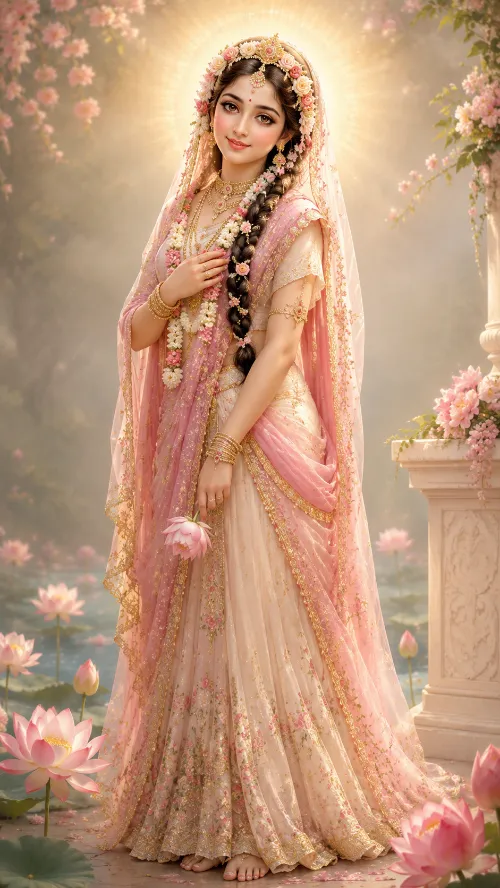
The Three Nectarean Baths of Śrī Rādhā: Kāruṇya, Tāruṇya and Lāvaṇya
One of the most beautiful descriptions of Śrī Rādhā’s transcendental form in Gauḍīya Vaiṣṇava literature portrays Her as taking three extraordinary baths — in the nectar of compassion, the nectar of fresh youth, and the nectar of radiant loveliness. These are not ordinary substances, nor three kinds of water. They belong to an extended poetic theology in which Rādhā’s inner qualities, emotions and relationships are described as the cosmetics, garments, perfumes and ornaments decorating Her body.
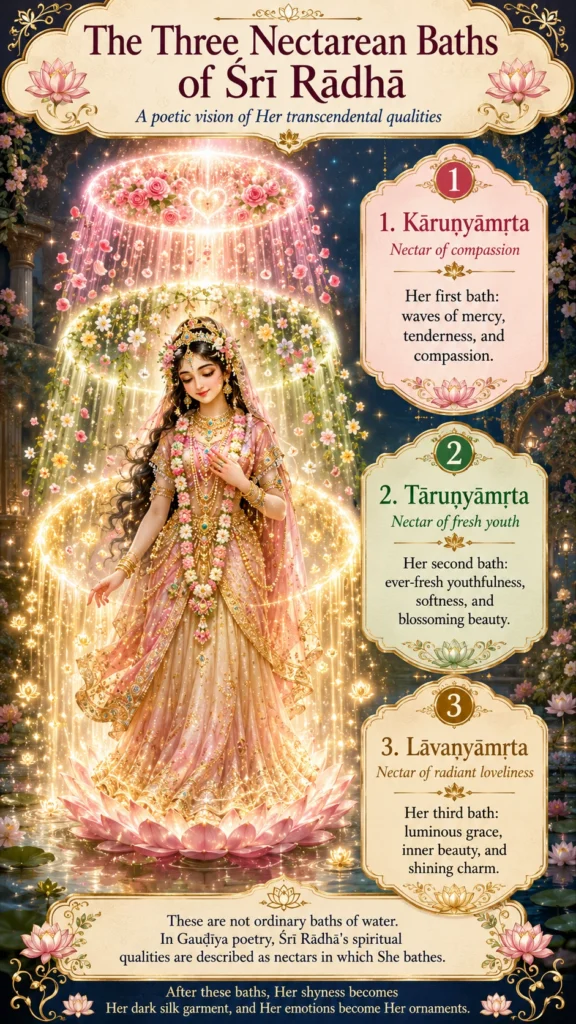
The three nectarean baths, with the quality each one names.
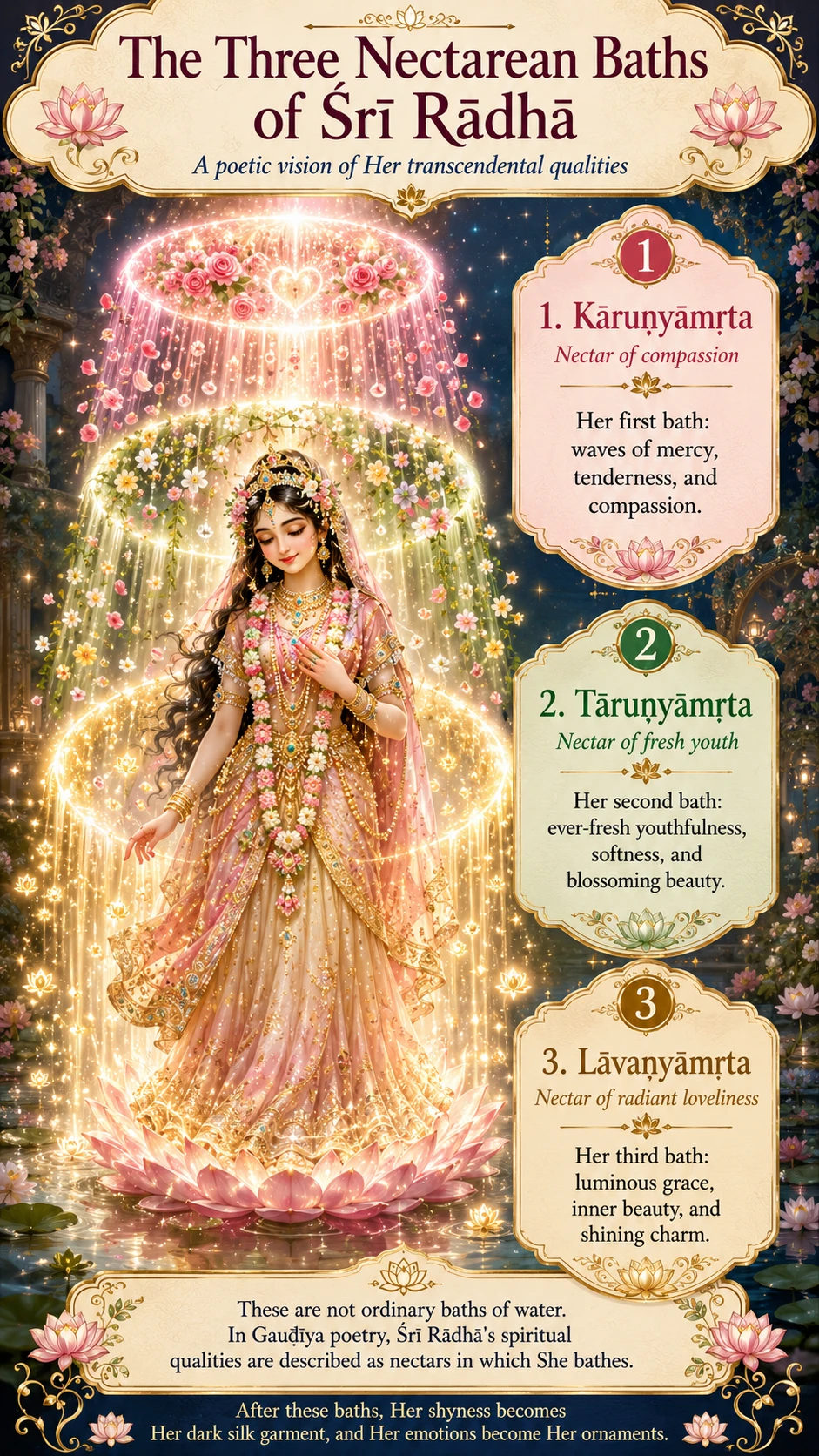
To understand why this imagery matters, it helps to begin slightly earlier in the Caitanya-caritāmṛta.
Rādhā as the Embodiment of Mahābhāva
In the famous conversation between Śrī Caitanya Mahāprabhu and Rāmānanda Rāya, the discussion progresses from ordinary religious practice to the highest manifestations of divine love. The Caitanya-caritāmṛta first explains:
হ্লাদিনীর সার অংশ, তার ‘প্রেম’ নাম ।
আনন্দচিন্ময়রস প্রেমের আখ্যান ॥
hlādinīra sāra aṁśa, tāra ‘prema’ nāma
ānanda-cinmaya-rasa premera ākhyāna
“The essential portion of the hlādinī potency is called prema. Prema is the spiritual rasa composed of transcendental bliss.” — Caitanya-caritāmṛta, Madhya 8.159
Then:
প্রেমের পরম-সার ‘মহাভাব’ জানি ।
সেই মহাভাবরূপা রাধা-ঠাকুরাণী ॥
premera parama-sāra ‘mahābhāva’ jāni
sei mahābhāva-rūpā rādhā-ṭhākurāṇī
“The supreme essence of prema is known as mahābhāva, and Śrī Rādhā is the very embodiment of that mahābhāva.” — Caitanya-caritāmṛta, Madhya 8.160
The Sanskrit quotation that immediately follows, taken from Rūpa Gosvāmī’s Ujjvala-nīlamaṇi, makes Rādhā’s position explicit:
तयोरप्युभयोर्मध्ये
राधिका सर्वथाधिका ।
महाभावस्वरूपेयं
गुणैरतिवरीयसी ॥
tayor apy ubhayor madhye
rādhikā sarvathādhikā |
mahābhāva-svarūpeyaṁ
guṇair ativarīyasī ||
“Of the two foremost heroines, Rādhikā is superior in every respect. She is the very embodiment of mahābhāva and is exceedingly distinguished by Her qualities.” — Ujjvala-nīlamaṇi, Rādhā-prakaraṇa 3; quoted at Caitanya-caritāmṛta, Madhya 8.161
This theological statement is essential for everything that follows. Rādhā is not merely a person who possesses intense prema. She is mahābhāva-svarūpa — the very embodiment, the intrinsic form, of the highest conceivable state of divine love. The subsequent description of Her bathing, dressing and ornamentation is therefore a poetic way of showing what mahābhāva looks like when personified as Śrī Rādhā.
Before the Baths: Affection Becomes Perfumed Unguent
The bathing sequence actually begins one verse earlier:
রাধা-প্রতি কৃষ্ণ-স্নেহ — সুগন্ধি উদ্বর্তন ।
তাঁতে অতি সুগন্ধি দেহ — উজ্জ্বল-বরণ ॥
rādhā-prati kṛṣṇa-sneha—sugandhi udvartana
tā’te ati sugandhi deha—ujjvala-varaṇa
“Kṛṣṇa’s affection for Rādhā is the fragrant cosmetic paste with which Her body is massaged. By it Her body becomes exceedingly fragrant and brilliantly radiant.” — Caitanya-caritāmṛta, Madhya 8.166
The word udvartana refers to a fragrant paste rubbed over the body before bathing. The imagery therefore follows the order of an elaborate traditional toilette — anointing, bathing, garments, cosmetics, hairstyle, ornaments, fragrance, flowers — but almost every physical item has been transformed into an emotion or a spiritual quality. That is the key to reading the entire passage.
The Three Baths in the Caitanya-caritāmṛta
Kṛṣṇadāsa Kavirāja writes:
কারুণ্যামৃত-ধারায় স্নান প্রথম ।
তারুণ্যামৃত-ধারায় স্নান মধ্যম ॥
kāruṇyāmṛta-dhārāya snāna prathama
tāruṇyāmṛta-dhārāya snāna madhyama
“Her first bath is in a shower of the nectar of compassion; Her second bath is in a shower of the nectar of youth.” — Caitanya-caritāmṛta, Madhya 8.167
লাবণ্যামৃত-ধারায় তদুপরি স্নান ।
নিজ-লজ্জা-শ্যাম-পট্টসাটি-পরিধান ॥
lāvaṇyāmṛta-dhārāya tad-upari snāna
nija-lajjā-śyāma-paṭṭasāṭi-paridhāna
“Beyond these She bathes in the shower of the nectar of lāvaṇya, and then wears Her own shyness as a dark silk sari.” — Caitanya-caritāmṛta, Madhya 8.168
But there is an older Sanskrit formulation behind these Bengali verses.
The Sanskrit Source: Premāmbhoja-maranda-stava-rāja
Raghunātha dāsa Gosvāmī describes Rādhā in his Sanskrit Premāmbhoja-maranda-stava-rāja, preserved in his Stavāvalī. Its second verse reads:
कारुण्यामृतवीचिभिस्तारुण्यामृतधारया ।
लावण्यामृतवन्याभिः स्नपितां ग्लप्तेन्दिराम् ॥
kāruṇyāmṛta-vīcibhis tāruṇyāmṛta-dhārayā |
lāvaṇyāmṛta-vanyābhiḥ snapitāṁ glaptendirām ||
“Bathed in waves of the nectar of compassion, in a stream of the nectar of youth, and in floods of the nectar of loveliness — She causes even Indirā, Lakṣmī, to fade in comparison.” — Premāmbhoja-maranda-stava-rāja 2
This verse is especially revealing, because it contains a poetic progression that is less obvious in the Bengali. Raghunātha does not simply repeat “stream” three times:
The imagery grows in intensity. Rādhā is touched by the waves of compassion; She stands beneath the stream of fresh youth; and finally She is overwhelmed by a flood of lāvaṇya. The third bath is not merely another bath — it is an inundation.
Kāruṇyāmṛta — the Nectar of Compassion
कारुण्य, kāruṇya, means compassion, tenderness, pity, merciful feeling — the condition of having one’s heart moved by another. In the context of Rādhā it should not be understood as ordinary sympathy; Her compassion is part of Her fundamental spiritual disposition. So kāruṇyāmṛta-vīcibhiḥ (कारुण्यामृतवीचिभिः) means literally “by waves of the nectar of compassion.”
Compassion is not simply an ornament Rādhā wears. She is immersed in it, and the metaphor suggests that mercy continually moves through Her like water. This is especially significant in Gauḍīya theology, where Rādhā is understood as the supreme manifestation of Kṛṣṇa’s hlādinī-śakti, the divine potency of bliss and love. Her compassion is inseparable from Her prema.
Tāruṇyāmṛta — the Nectar of Fresh Youth
The second bath is tāruṇyāmṛta-dhārayā (तारुण्यामृतधारया), “in the stream of the nectar of youth.” Tāruṇya does not merely mean that Rādhā has a particular biological age. In Sanskrit devotional and aesthetic literature it evokes freshly blossoming youthfulness — beauty that is continually new, tender, vibrant and full of the power of attraction.
The metaphor suits Rādhā because Her beauty is not regarded as static. It is eternally nava-navāyamāna, ever new; every moment seems to reveal something that had never appeared before. Her youth is therefore amṛta — not youth moving inevitably toward age, but an inexhaustible nectar of ever-fresh youthfulness.
Lāvaṇyāmṛta — the Nectar of Lāvaṇya
The third bath is the hardest to translate: lāvaṇyāmṛta-vanyābhiḥ (लावण्यामृतवन्याभिः), “in floods of the nectar of lāvaṇya.” Simply rendering lāvaṇya as “beauty” loses an important distinction, because classical Sanskrit aesthetics gives it a more precise meaning. Rūpa Gosvāmī defines it in the Ujjvala-nīlamaṇi:
मुक्ताफलेषु छायायास्तरलत्वमिवान्तरा ।
प्रतिभाति यदङ्गेषु लावण्यं तदिहोच्यते ॥
muktāphaleṣu chāyāyās taralatvam ivāntarā |
pratibhāti yad aṅgeṣu lāvaṇyaṁ tad ihocyate ||
“That which appears within the limbs like the fluid sheen visible from within a pearl is called lāvaṇya.” — Ujjvala-nīlamaṇi 10.28
This is an exceptionally beautiful definition. Lāvaṇya is not physical symmetry or attractiveness; it is something closer to the living radiance that seems to shine from within a beautiful form. A pearl does not merely have a painted surface — its sheen appears to move beneath the surface. In the same way, lāvaṇya is the almost liquid brilliance that seems to flow through the body.
So lāvaṇyāmṛta may be understood as the nectar of radiant loveliness, of living beauty, of luminous grace. And Raghunātha does not give Rādhā merely a little of it: he describes a lāvaṇyāmṛta-vanyā, a flood.
Why Amṛta?
All three compounds end in अमृत, amṛta. Literally the word means “deathless” or “immortal,” and commonly denotes the divine nectar of immortality. In devotional poetry it also conveys something inexhaustibly sweet, life-giving, divine, and impossible to become satiated with.
Rādhā therefore possesses not merely compassion, youth and beauty, but nectarean compassion, nectarean youthfulness and nectarean radiant beauty. The compounds imply qualities so concentrated and spiritually sweet that ordinary words such as “beautiful,” “young” or “merciful” are insufficient.
The Sanskrit Imagery Is Richer than the Bengali
There is a fascinating textual difference between Raghunātha dāsa Gosvāmī’s Sanskrit and the Caitanya-caritāmṛta. The Bengali uses dhārā, “stream” or “shower,” for all three baths — kāruṇyāmṛta-dhārā, tāruṇyāmṛta-dhārā, lāvaṇyāmṛta-dhārā. Raghunātha instead writes vīci, dhārā and vanyā, producing a deliberate crescendo: wave, stream, inundation. That poetic escalation is worth preserving in translation.
A Second Difference
Raghunātha’s preceding Sanskrit verse says:
महाभावोज्ज्वलच्चिन्तारत्नोद्भावितविग्रहाम् ।
सखीप्रणयसद्गन्धवरोद्वर्तनसुप्रभाम् ॥
mahā-bhāvojjvalac-cintā-ratnodbhāvita-vigrahām |
sakhī-praṇaya-sad-gandha-varodvartana-suprabhām ||
It describes Rādhā’s form as arising from the radiant jewel of mahābhāva, and as made splendid by a fragrant unguent consisting of the love of Her sakhīs.
The Caitanya-caritāmṛta adapts the image: there the fragrant cosmetic paste is rādhā-prati kṛṣṇa-sneha, Kṛṣṇa’s affection toward Rādhā, rather than the love of Her sakhīs. Kṛṣṇadāsa Kavirāja is not mechanically translating Raghunātha’s Sanskrit; he creatively elaborates and reorganizes an inherited poetic-theological image. That distinction matters when tracing the passage’s textual history.
After the Baths: Rādhā Dresses in Emotions
After the three baths the metaphor expands dramatically, and ordinary dressing and cosmetics become aspects of Rādhā’s emotional life. Her shyness becomes Her dark silk sari — নিজ-লজ্জা-শ্যাম-পট্টসাটি-পরিধান, nija-lajjā-śyāma-paṭṭasāṭi-paridhāna. Her intense attachment to Kṛṣṇa becomes a second garment, কৃষ্ণ-অনুরাগ দ্বিতীয় অরুণ-বসন, kṛṣṇa-anurāga dvitīya aruṇa-vasana, “Her anurāga for Kṛṣṇa is Her second, reddish garment.” Her praṇaya and māna become a bodice covering Her breast, প্রণয়-মান-কঞ্চুলিকায় বক্ষ আচ্ছাদন, praṇaya-māna-kañculikāya vakṣa ācchādana.
Here māna means the subtle loving indignation, or offended pride, that is so important in the intimate relationship of Rādhā and Kṛṣṇa.
Her Cosmetics Are Also Emotions
সৌন্দর্য — কুঙ্কুম, সখী-প্রণয় — চন্দন ।
স্মিত-কান্তি — কর্পূর, তিনে — অঙ্গে বিলেপন ॥
saundarya—kuṅkuma, sakhī-praṇaya—candana
smita-kānti—karpūra, tine—aṅge vilepana
“Her beauty is kuṅkuma; Her affection for Her sakhīs is sandalwood; the radiance of Her smile is camphor. These three are smeared upon Her body.” — Caitanya-caritāmṛta, Madhya 8.170
Notice what has happened. Rādhā is no longer merely beautiful and wearing cosmetics. Beauty itself has become Her kuṅkuma; love for Her friends has become Her sandal paste; Her smile has become camphor. The boundary between the person and Her emotional qualities has disappeared.
Ujjvala-rasa Becomes Musk
কৃষ্ণের উজ্জ্বল-রস — মৃগমদ-ভর ।
সেই মৃগমদে বিচিত্রিত কলেবর ॥
kṛṣṇera ujjvala-rasa—mṛgamada-bhara
sei mṛgamade vicitrita kalevara
“Kṛṣṇa’s ujjvala-rasa is an abundance of musk, and with that musk Her entire body is decorated.” — Caitanya-caritāmṛta, Madhya 8.171
Ujjvala-rasa is the radiant conjugal devotional rasa centred upon Kṛṣṇa. Here even rasa itself becomes something visible: fragrant black musk painted upon Rādhā’s body.
Her Loving Complexity Becomes Hair and Kajal
The description grows more subtle. Her concealed māna and Her vāmya — the contrary, resistant tendency of a beloved who does not immediately submit to her lover — are compared to the arrangement of Her hair. Her lips are reddened by the tāmbūla of rāga, intense attachment. And Her eye cosmetic is প্রেম-কৌটিল্য, prema-kauṭilya—netra-yugale kajjala, “the crookedness of love is the kajal around Her two eyes.”
This expression is important. Kauṭilya, crookedness, does not mean moral dishonesty here. Love does not always move in a straight line: Rādhā may approach and withdraw, desire and refuse, look and avert Her eyes, speak indirectly, become jealous, display anger — and yet be entirely filled with love. The crookedness of prema is therefore one of its aesthetic beauties, and Jayadeva’s Gīta-govinda, Rūpa Gosvāmī’s dramas and the later Gauḍīya literature all explore precisely this emotional complexity.
Her Ecstasies Become Jewellery
The metaphor then moves from cosmetics to ornaments. The Caitanya-caritāmṛta says that Rādhā is decorated with সুদ্দীপ্ত-সাত্ত্বিক ভাব, হর্ষাদি সঞ্চারী — sūddīpta-sāttvika bhāva, harṣādi sañcārī: Her intensely blazing sāttvika-bhāvas and the various sañcārī-bhāvas, beginning with joy, become the ornaments adorning Her body. These terms belong to Sanskrit rasa theory; among the involuntary sāttvika transformations are trembling, tears, horripilation, perspiration, faltering of the voice, stunning and changes of bodily colour.
Raghunātha’s Sanskrit poem turns these ecstatic reactions into jewels:
कम्पाश्रुपुलकस्तम्भस्वेदगद्गदरक्तताः ।
उन्मादो जाड्यमित्येतै रत्नैर्नवभिरुत्तमैः ॥
kampāśru-pulaka-stambha-sveda-gadgada-raktatāḥ |
unmādo jāḍyam ity etai ratnair navabhir uttamaiḥ ||
“Trembling, tears, horripilation, paralysis, perspiration, faltering speech, flushing, divine madness and stupor — these are Her nine excellent jewels.”
Rādhā does not simply wear gems. Her ecstasies are the gems.
Her Qualities Become a Flower Garland
Raghunātha continues by describing Her as गुणालीपुष्पमालिनीम्, guṇālī-puṣpa-mālinīm, “wearing a flower garland composed of multitudes of virtues.” The same idea appears in the Caitanya-caritāmṛta: Her innumerable spiritual qualities constitute the flower garland decorating Her entire body.
Again the distinction between who Rādhā is and what Rādhā wears has collapsed. Her ornaments are Her emotions, Her cosmetics are Her relationships, Her perfume is love, Her clothing is modesty and attachment, Her jewels are ecstasies, Her garland is Her virtues.
Kṛṣṇa Himself Becomes Her Ornament
The culmination is more striking still. The Caitanya-caritāmṛta says that Kṛṣṇa’s name, qualities and fame become Her earrings, while the same name, qualities and fame continually flow through Her speech. Rādhā’s entire identity is thus directed toward Kṛṣṇa — yet simultaneously the passage presents Kṛṣṇa’s love for Rādhā as something that beautifies Her.
The relationship is reciprocal: Rādhā exists wholly for Kṛṣṇa, and Kṛṣṇa’s affection itself becomes one of Rādhā’s adornments. This reciprocal structure is fundamental to Gauḍīya Rādhā-Kṛṣṇa theology.
The Whole Transformation
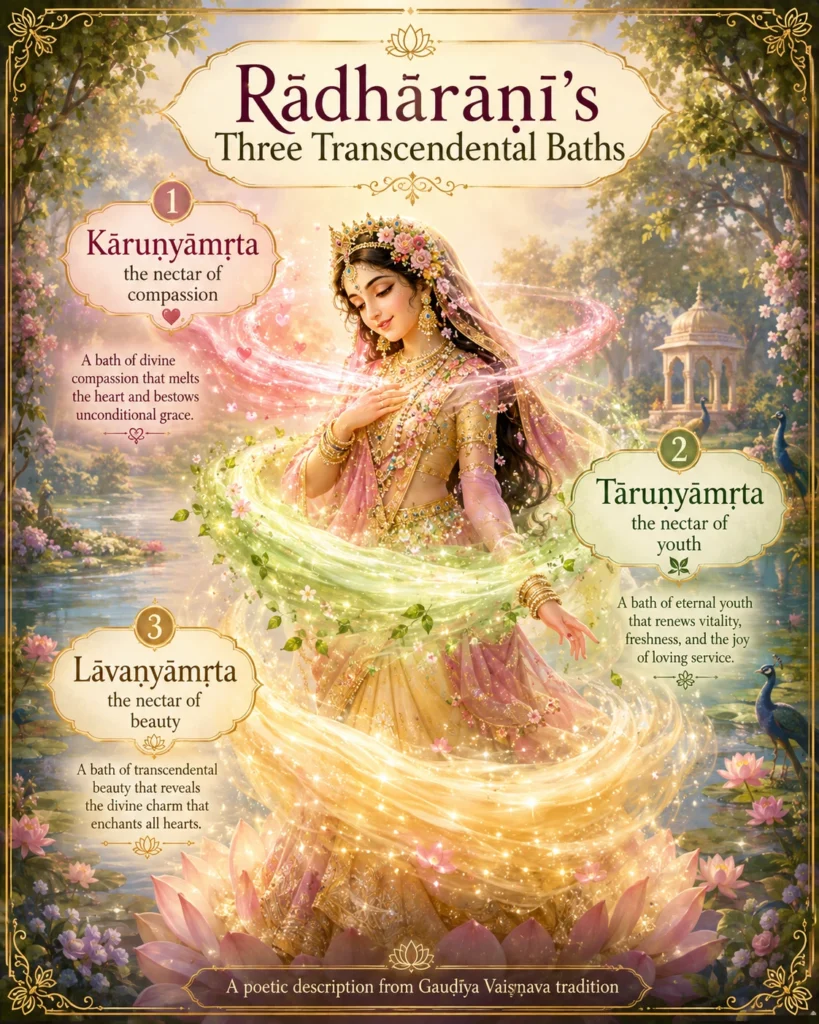
The same three nectars, laid out around Rādhā in the garden.
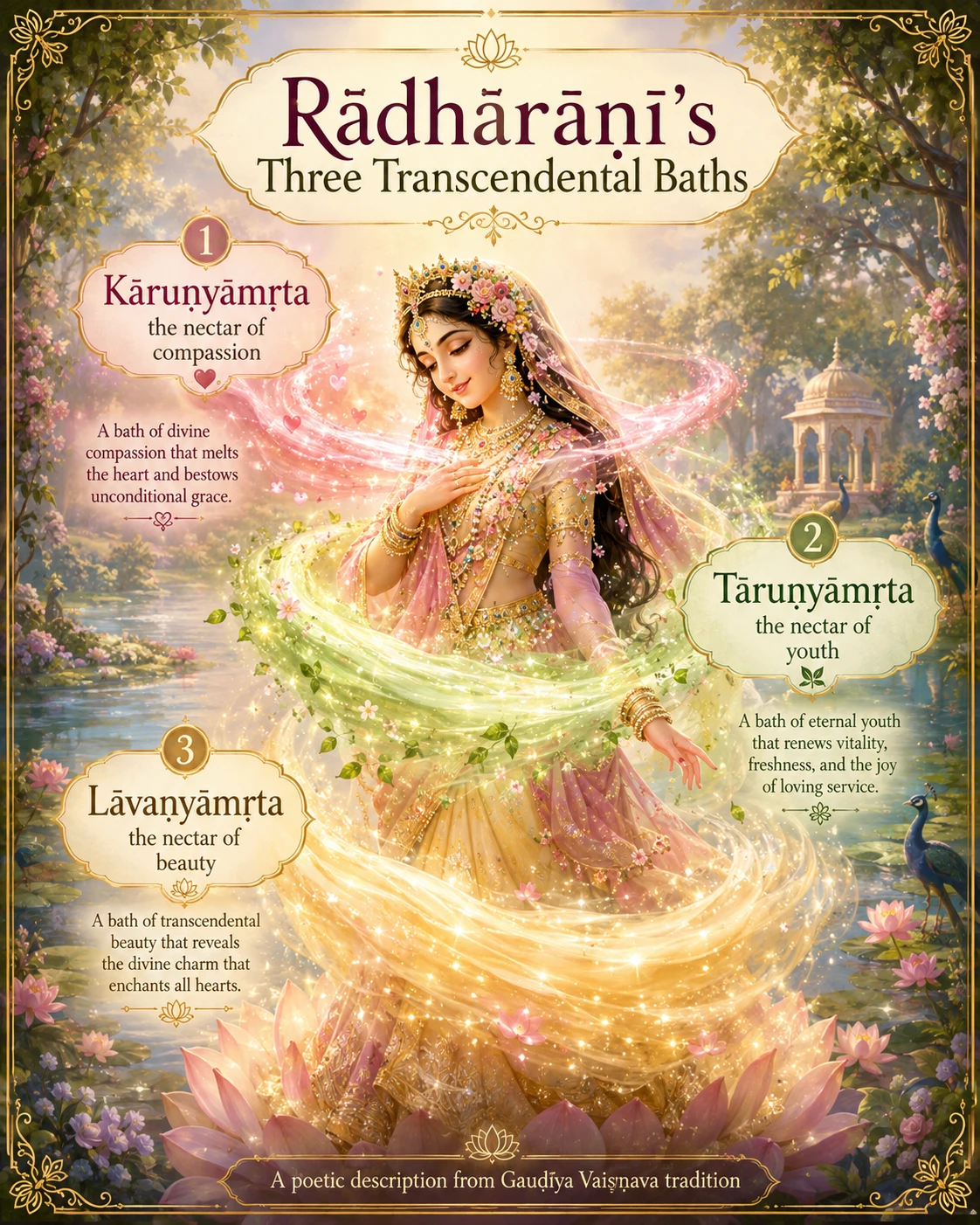
The three baths should not be isolated from the surrounding passage; they belong to one enormous poetic conception. The text does not simply say that Rādhā is compassionate, youthful and beautiful. It imagines these qualities as oceans of nectar so abundant that She can bathe in them — and then the same transformation continues throughout:
This is much more than decorative poetry. It is a statement about Rādhā’s ontological identity.
Rādhā Does Not Merely Possess Prema
This is perhaps the most important point. An ordinary person may possess a quality — someone has compassion, someone has beauty, someone feels love. The Gauḍīya description of Rādhā is far more radical. The Caitanya-caritāmṛta has already said প্রেমের ‘স্বরূপ-দেহ’ — প্রেম-বিভাবিত, premera ‘svarūpa-deha’—prema-vibhāvita: Her very svarūpa-deha, Her essential spiritual form, is constituted and permeated by prema.
The decorative metaphor then makes that theological idea visible. Rādhā does not simply wear ornaments while experiencing mahābhāva; Her very body, garments, perfume, cosmetics and ornaments are poetic manifestations of mahābhāva itself. This is why the passage must be read as more than an elaborate description of a beautiful divine woman. It is Gauḍīya rasa theology expressed through the language of bathing and adornment.
A Beautiful Progression
The three nectarean baths therefore represent only one portion of a much greater vision. Rādhā first appears immersed in compassion, in ever-fresh youth, and in radiant lāvaṇya; then every subsequent act of dressing reveals another dimension of Her love.
Śrī Rādhā is not beautiful merely because She possesses extraordinary physical beauty. In this Gauḍīya poetic vision Her beauty is the visible expression of Her prema, and Her body is adorned by the very emotions through which She loves Kṛṣṇa. That is why the metaphor can go so far: for Rādhā, prema is not merely something within the heart. Prema has become Her very form.