

Śrī Rādhā’s Beloved Animals in Vraja
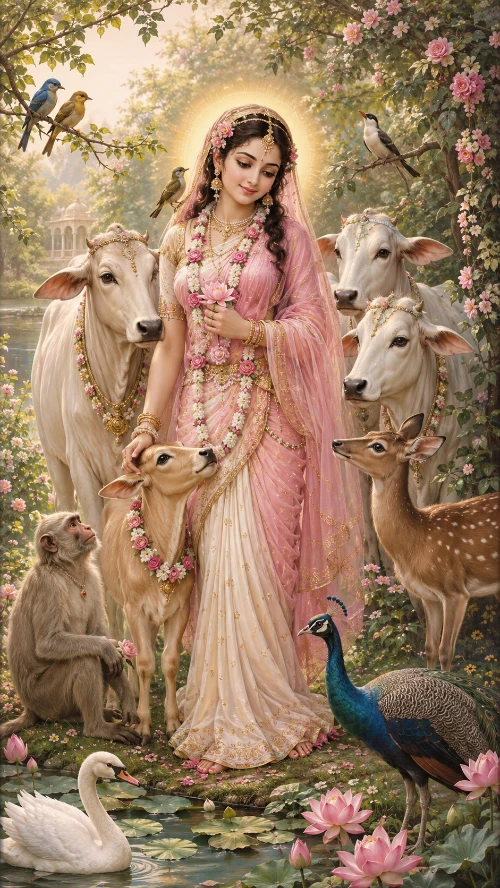
Śrī Rādhā’s Beloved Animals and Birds in Vraja
The devotional literature of Vṛndāvana presents a world in which nature is not merely the background to the pastimes of Śrī Rādhā and Kṛṣṇa. Cows, calves, deer, monkeys, parrots, mynahs, swans, peacocks, bees, flowering trees and creepers all belong to the living emotional landscape of Vraja — and some of these creatures are known by personal names. They are much more than decorative pets: some listen to poetry, repeat Lalitā-devī’s compositions, awaken Rādhā at dawn, and even act as intelligent messengers in the organization of the Divine Couple’s pastimes.
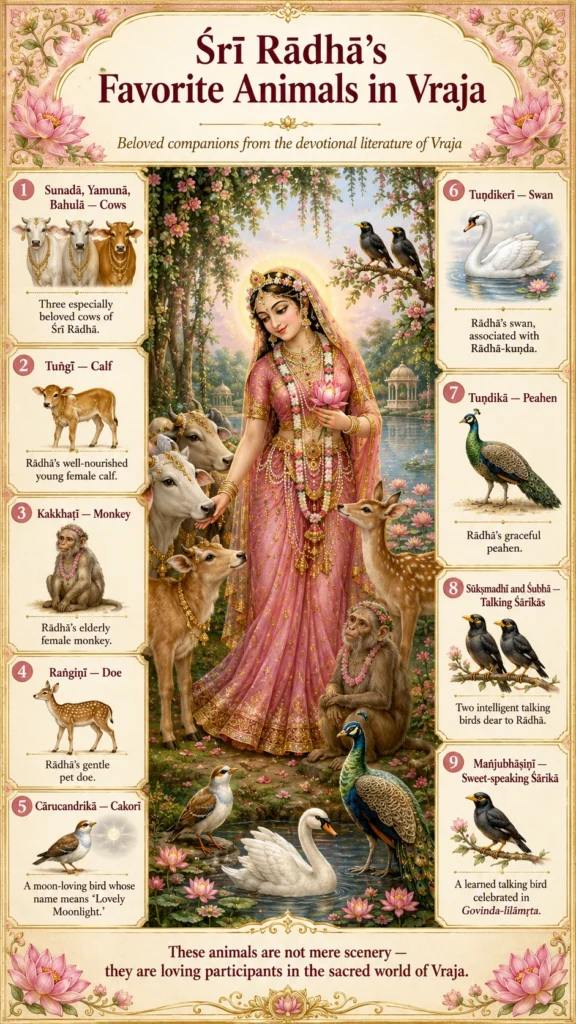
Rādhā’s named companions, with the corrected readings for the peahen and the two śārikās.
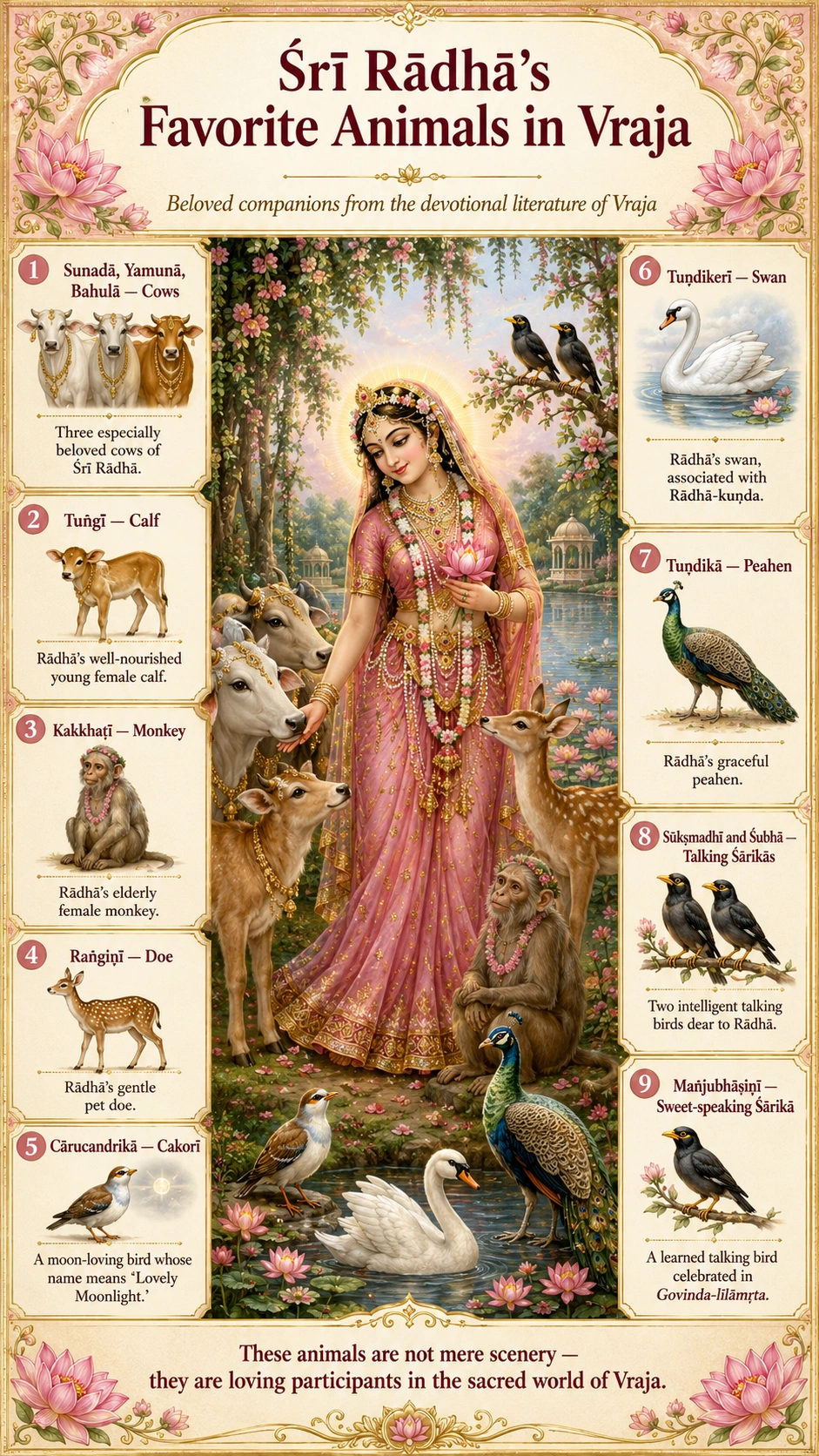
A particularly valuable catalogue is preserved in the Śrī Rādhā-Kṛṣṇa-gaṇoddeśa-dīpikā, traditionally attributed to Śrī Rūpa Gosvāmī. This Sanskrit work identifies numerous relatives, friends, attendants, servants, animals, birds, ornaments and other associates belonging to the intimate world of Rādhā and Kṛṣṇa. Among Śrī Rādhā’s beloved animals and birds it names:
A Note About the Verse Numbers
The numbering of the relevant verses in the Rādhā-Kṛṣṇa-gaṇoddeśa-dīpikā varies substantially between editions. Some older English editions give the animal passages as approximately 197–199, while another modern edition numbers them around 200–202, and Sanskrit compilations may use still another sequence. For this reason the Sanskrit wording itself is more reliable for identification than the verse number alone.
The Core Sanskrit Description
The first passage names Rādhā’s cows and several of Her smaller animal companions:
पीना वत्सतरी तुङ्गी कक्खटी वृद्धमर्कटी ।
कुरङ्गी रङ्गिणी ख्याता चकोरी चारुचन्द्रिका ॥
pīnā vatsatarī tuṅgī kakkhaṭī vṛddha-markaṭī |
kuraṅgī raṅgiṇī khyātā cakorī cāru-candrikā ||
“Tuṅgī is the well-nourished young female calf; Kakkhaṭī is the elderly female monkey. The doe is known as Raṅgiṇī, and the female cakora as Cārucandrikā.”
Immediately before this, the text names Sunadā, Yamunā and Bahulā among Rādhā’s cows. The next verse continues:
निजकुण्डचरी तुण्डीकेरी नाम मरालिका ।
मयूरी तुण्डिका नाम्ना शारिके सूक्ष्मधीशुभे ॥
nija-kuṇḍa-carī tuṇḍīkerī nāma marālikā |
mayūrī tuṇḍikā nāmnā śārike sūkṣmadhī-śubhe ||
“The female swan named Tuṇḍikerī moves upon Her own lake. The peahen is named Tuṇḍikā, and the two śārikā birds are Sūkṣmadhī and Śubhā.”
These short Sanskrit lines settle several questions that have become confused in popular retellings.
Sunadā, Yamunā and Bahulā — Rādhā’s Cows
Three cows are especially associated with Śrī Rādhā: सुनदा Sunadā, यमुना Yamunā and बहुला Bahulā. They belong naturally within the pastoral world of Vraja, where tending cows is not simply an economic activity but one of the defining features of Kṛṣṇa’s identity — He is Govinda and Gopāla, the protector and beloved of the cows. Rādhā’s own association with named cows therefore places Her within the same intimate pastoral environment.
Many devotional English descriptions call these Surabhi cows. Within the theology of eternal Goloka-Vraja that is understandable, but the safest text-critical formulation is simply that Sunadā, Yamunā and Bahulā are especially beloved cows associated with Śrī Rādhā. The word surabhi is not required to identify them in the Sanskrit line under discussion.
Tuṅgī — Rādhā’s Female Calf
Rūpa Gosvāmī’s text is unusually specific — पीना वत्सतरी तुङ्गी, pīnā vatsatarī tuṅgī, “Tuṅgī, the well-nourished young female calf.” Three words matter:
The two ideas should not be confused: Tuṅgī does not itself mean “chubby.” That sense comes from the adjective pīnā.
Popular summaries sometimes say that Bahulā is Tuṅgī’s mother. The Sanskrit passage under discussion does not make that identification — it lists Bahulā among Rādhā’s cows and then separately names Tuṅgī as Her female calf. Unless another primary source is produced, it is safer to say simply that Tuṅgī is Rādhā’s beloved female calf.
Kakkhaṭī — the Elderly Female Monkey
One of the most endearing details in the list is कक्खटी वृद्धमर्कटी, kakkhaṭī vṛddha-markaṭī, “Kakkhaṭī, the old female monkey.” Here the Sanskrit is completely explicit: vṛddha, old or aged, and markaṭī, female monkey. The detail that Kakkhaṭī is elderly is therefore not a later embellishment; it belongs directly to the Sanskrit description.
This seemingly small detail gives the world of Vraja an unusual intimacy. Rādhā is not surrounded only by splendid, youthful or exotic creatures. She also has affection for an old monkey with an individual name. It is precisely such details that make the līlā-world described by the Gosvāmīs feel inhabited rather than symbolic.
The exact etymology of Kakkhaṭī is less certain. Some later explanations attempt to derive a meaning such as “firm” or “determined,” but this should not be presented as securely established.
Raṅgiṇī — Rādhā’s Doe
The Sanskrit says कुरङ्गी रङ्गिणी ख्याता, kuraṅgī raṅgiṇī khyātā, “the doe is known as Raṅgiṇī.” Kuraṅgī unmistakably means a female deer. The name Raṅgiṇī derives from the rich Sanskrit root associated with raṅga, which depending on context can indicate colour, delight, play, pleasure, passion, dramatic performance or emotional enjoyment. Raṅgiṇī may therefore be understood as “the colourful one,” “the charming one,” or “she who delights in play” — interpretive nuances rather than definitions explicitly supplied by Rūpa.
Deer in the Sacred Ecology of Vraja
A pet doe is particularly fitting, because deer occupy an important place in Sanskrit descriptions of Vṛndāvana. The gopīs themselves say in the Śrīmad-Bhāgavatam:
धन्याः स्म मूढगतयोऽपि हरिण्य एता
या नन्दनन्दनमुपात्तविचित्रवेषम् ।
आकर्ण्य वेणुरणितं सहकृष्णसाराः
पूजां दधुर्विरचितां प्रणयावलोकैः ॥
dhanyāḥ sma mūḍha-gatayo ’pi hariṇya etā
yā nanda-nandanam upātta-vicitra-veśam |
ākarṇya veṇu-raṇitaṁ saha-kṛṣṇa-sārāḥ
pūjāṁ dadhur viracitāṁ praṇayāvalokaiḥ ||
“Blessed indeed are these does. Hearing the sound of the flute of Nanda’s son, beautifully adorned, they approach together with their black-antelope mates and worship Him with loving glances.” — Śrīmad-Bhāgavatam 10.21.11
The remarkable expression is प्रणयावलोकैः, praṇayāvalokaiḥ, “with loving glances.” The animals of Vraja are not represented as emotionally inert. They respond to Kṛṣṇa.
Cārucandrikā — the Moon-Loving Cakorī
Rūpa writes चकोरी चारुचन्द्रिका, cakorī cāru-candrikā, “the female cakora is Cārucandrikā.” The name is wonderfully chosen: cāru, beautiful, lovely or charming, and candrikā, moonlight or lunar radiance — so Cārucandrikā means approximately “Lovely Moonlight” or “Beautiful Moonbeam.”
This is especially appropriate because the cakora has a celebrated literary identity in Sanskrit poetry: poets traditionally imagine the bird as living upon, or drinking, the rays of the moon. That is a poetic convention rather than zoological behaviour, but it became so deeply embedded in Sanskrit imagery that the cakora and the moon are almost inseparable. Naming Rādhā’s cakora “Lovely Moonlight” is therefore a deliberate play between the bird and the object of its legendary longing.
Tuṇḍikerī — the Swan of Rādhā-kuṇḍa
The next identification is exceptionally beautiful — निजकुण्डचरी तुण्डीकेरी नाम मरालिका, nija-kuṇḍa-carī tuṇḍīkerī nāma marālikā, “the female swan named Tuṇḍikerī moves upon Her own lake.” The important expression is nija-kuṇḍa-carī: nija, one’s own; kuṇḍa, sacred pond or lake; carī, she who moves, wanders or sports. Within the context of Rādhā’s associates, “Her own kuṇḍa” is naturally understood as Śrī Rādhā-kuṇḍa.
Tuṇḍikerī is therefore not merely a swan owned by Rādhā. She is a swan of Rādhā-kuṇḍa itself. The Sanskrit मरालिका, marālikā, denotes a female marāla, a graceful swan-like waterbird; Sanskrit poetry repeatedly employs the swan as a symbol of grace, discrimination, beauty and elegant movement, which makes it particularly suitable for Rādhā’s sacred lake.
Tuṇḍikā — Rādhā’s Peahen
The Sanskrit continues मयूरी तुण्डिका नाम्ना, mayūrī tuṇḍikā nāmnā, “the peahen is named Tuṇḍikā.” Mayūrī means a female peacock. This line corrects one of the most persistent errors in popular English lists of Rādhā’s animals.
The “Madhurī the Elephant” Error
Numerous older websites and English compilations give “Madhurī — Rādhā’s pet elephant.” This does not agree with the Sanskrit passage, which reads मयूरी तुण्डिका, mayūrī tuṇḍikā, “the peahen Tuṇḍikā.” The erroneous elephant apparently arose through a mistranslation or corruption in which mayūrī was somehow lost and a name resembling Madhurī entered the English rendering; the mistake was then reproduced repeatedly in derivative lists.
Another reason it may have gone unnoticed is that Mādhurī is a perfectly plausible feminine name and occurs elsewhere in Gauḍīya literature. But this particular animal catalogue contains no elephant. The corrected entry is: Tuṇḍikā, Rādhā’s peahen.
Peacocks in Vṛndāvana
The presence of Tuṇḍikā is especially fitting, because peacocks are among the most characteristic creatures of Kṛṣṇa’s Vṛndāvana. The gopīs describe them in the Bhāgavata:
वृन्दावनं सखि भुवो वितनोति कीर्तिं
यद्देवकीसुतपदाम्बुजलब्धलक्ष्मि ।
गोविन्दवेणुमनु मत्तमयूरनृत्यं
प्रेक्ष्याद्रिसान्ववरतान्यसमस्तसत्त्वम् ॥
vṛndāvanaṁ sakhi bhuvo vitanoti kīrtiṁ
yad devakī-suta-padāmbuja-labdha-lakṣmi |
govinda-veṇum anu matta-mayūra-nṛtyaṁ
prekṣyādri-sānv-avaratānya-samasta-sattvam ||
“O friend, Vṛndāvana spreads the glory of the earth, having received the treasure of Kṛṣṇa’s lotus feet. When Govinda plays His flute, the intoxicated peacocks dance, while the other creatures upon the mountain slopes become still and watch.” — Śrīmad-Bhāgavatam 10.21.10
The peacock does not simply decorate Kṛṣṇa’s environment; it responds to His music through dance. Kṛṣṇa’s famous peacock feather can be understood within precisely this intimate relationship between the Lord and the creatures of Vraja.
Sūkṣmadhī and Śubhā — the Talking Birds
The Sanskrit identifies शारिके सूक्ष्मधीशुभे, śārike sūkṣmadhī-śubhe, “the two śārikā birds, Sūkṣmadhī and Śubhā.” This requires an important correction to many English summaries, which describe them as “Rādhā’s two parrots.” Rūpa Gosvāmī actually calls them शारिका, śārikā — a celebrated Indian talking bird, usually identified with a mynah or starling-like bird renowned for imitating human speech.
This matters because Rūpa knows perfectly well how to say parrot. Elsewhere, describing Kṛṣṇa’s parrots Dakṣa and Vicakṣaṇa, he uses शुकौ, śukau, “the two parrots.” The more textually accurate description is therefore that Sūkṣmadhī and Śubhā are Rādhā’s two learned talking śārikā birds. Traditional English translations calling them parrots can still be understood as devotional convention, but “talking mynahs” is closer to the Sanskrit.
The Birds Recite Lalitā-devī’s Poetry
Rūpa Gosvāmī does not stop after giving their names; he explains what these extraordinary birds do. The following verse describes them reciting the witty, beautiful compositions of Lalitā-devī concerning Rādhā and Kṛṣṇa, reproducing the verses so astonishingly that the sakhīs themselves become amazed. The central idea is contained in the description of the two birds:
… ललितादेव्या … स्वनाथयोः
पठन्त्यौ चित्रया वाचा …
… lalitā-devyā … sva-nāthayoḥ
paṭhantyau citrayā vācā …
“With extraordinary voices the two recite [the compositions] of Lalitā-devī concerning their Mistress and Master…”
Their sva-nāthau, “their own Mistress and Master,” are Rādhā and Kṛṣṇa. Sūkṣmadhī and Śubhā are therefore not simply amusing talking pets. They are listeners, memorizers, reciters, performers and transmitters of Rādhā-Kṛṣṇa-kathā, and their recitation itself contributes to the rasa experienced by the sakhīs.
Mañjubhāṣiṇī — “She Who Speaks Sweetly”
Another famous talking bird appears prominently in Kṛṣṇadāsa Kavirāja’s Govinda-līlāmṛta: मञ्जुभाषिणी, Mañjubhāṣiṇī. The name divides into mañju, lovely, sweet, charming or melodious, and bhāṣiṇī, a female speaker — “she who speaks sweetly,” or “the charming speaker.” At dawn the Govinda-līlāmṛta describes her:
अथ तौ स्फुरत्कनकपिञ्जरस्थिता
वृषभानुजातिदयिता सुपण्डिता ।
अवदन्निशानिखिलकेलिसाक्षिणी
गृहसारिकाप्युषसि मञ्जुभाषिणी ॥
atha tau sphurat-kanaka-piñjara-sthitā
vṛṣabhānu-jāti-dayitā supaṇḍitā |
avadan niśā-nikhila-keli-sākṣiṇī
gṛha-śārikāpy uṣasi mañjubhāṣiṇī ||
“At dawn Mañjubhāṣiṇī, the highly learned household śārikā, dear to the daughter of Vṛṣabhānu, sitting within a shining golden cage and having witnessed the night’s pastimes, addressed the Divine Couple.” — Govinda-līlāmṛta 1.22
Why Does She Speak at Dawn?
The setting is part of the niśānta-līlā, the pastimes occurring at the end of night. Rādhā and Kṛṣṇa have spent the night together in a secluded bower, but dawn is approaching and They must separate before the elders discover their absence. The birds therefore become part of the machinery by which the night līlā transitions into the morning līlā. Mañjubhāṣiṇī helps awaken and alert the Divine Couple — which makes her a participant in sevā. She is not watching out of curiosity. She has a function.
Sūkṣmadhī Appears Again in the Govinda-līlāmṛta
Sūkṣmadhī, already named by Rūpa Gosvāmī, receives an even more developed personality in the Govinda-līlāmṛta, where she is described as having learned from Vṛndā-devī:
वृन्दावक्त्रादधिगतविद्या
सारी हारीकृतबहुपद्या ।
राधास्नेहोच्चयमधुमत्ता
तस्या निद्रापनयनयत्ता ॥
vṛndā-vaktrād adhigata-vidyā
sārī hārī-kṛta-bahu-padyā |
rādhā-snehoccaya-madhu-mattā
tasyā nidrāpanayana-yattā ||
“Having acquired learning from the mouth of Vṛndā, the śārikā has made many verses into a necklace held in memory. Intoxicated by the increasing honey of affection for Rādhā, she endeavours to drive away Her sleep.”
कलवाक्सूक्ष्मधी नाम्नी प्रेमोत्फुल्लतनूरुहा ।
स्वरसज्ञा रङ्गभूमौ ततो वाणीमनर्तयत् ॥
kalavāk sūkṣmadhī nāmnī premotphulla-tanūruhā |
svarasajñā raṅga-bhūmau tato vāṇīm anartayat ||
“The sweet-voiced bird named Sūkṣmadhī, whose feathers stood erect through prema and who understood musical notes, then made her voice dance upon the stage.” — Govinda-līlāmṛta 1.33–34
The imagery is extraordinary. Sūkṣmadhī has been educated by Vṛndā-devī, knows many verses, loves Rādhā, experiences bodily symptoms of prema, understands musical notes, and sings to awaken Her. The phrase वाणीमनर्तयत्, vāṇīm anartayat, literally suggests that she “made her speech dance.” She is therefore almost a tiny court poet and musician serving within Vṛndāvana.
The Talking Birds Act as Messengers
Later in the Govinda-līlāmṛta the role becomes more remarkable still. Vṛndā sends Sūkṣmadhī and Śubhā in different directions to gather information useful for arranging the Divine Couple’s meeting. The Sanskrit introduces them as सूक्ष्मधियं शुभां च … शारिके सुचतुरा, sūkṣmadhiyam śubhāṁ ca … śārike sucaturā — the two exceedingly clever śārikās. One is sent in connection with Abhimanyu’s mother, the other toward the area associated with Candrāvalī.
The birds thus function as observers, messengers, scouts and assistants of Vṛndā-devī. The world of Vraja has become so personalized that even its birds participate intelligently in organizing divine love.
Even Birds, Deer and Trees Are Drawn by Kṛṣṇa
This vision is not restricted to Rūpa Gosvāmī or the Govinda-līlāmṛta. Kṛṣṇadāsa Kavirāja summarizes a fundamental principle of Vraja in the Caitanya-caritāmṛta:
পক্ষী, মৃগ, বৃক্ষ, লতা, চেতনাচেতন ।
প্রেমে মত্ত করি’ আকর্ষয়ে কৃষ্ণগুণ ॥
pakṣī, mṛga, vṛkṣa, latā, cetanācetana
preme matta kari’ ākarṣaye kṛṣṇa-guṇa
“Kṛṣṇa’s qualities attract birds, animals, trees, creepers, the conscious and even the apparently unconscious, making them intoxicated with prema.” — Caitanya-caritāmṛta, Madhya 24.58
This is an important key to interpreting all the animal descriptions. The animals of Vraja are not included simply because rural India happens to contain cows, monkeys and birds. They belong to a theological landscape in which Kṛṣṇa’s attractiveness penetrates the entire environment.
Caitanya Encounters the Living Vṛndāvana
Kṛṣṇadāsa Kavirāja makes the same idea visible when describing Śrī Caitanya’s journey through Vṛndāvana. The birds respond to Him:
শুক, পিক, ভৃঙ্গ প্রভুরে দেখি’ ‘পঞ্চম’ গায় ।
শিখিগণ নৃত্য করি’ প্রভু-আগে যায় ॥
śuka, pika, bhṛṅga prabhure dekhi’ ‘pañcama’ gāya
śikhi-gaṇa nṛtya kari’ prabhu-āge yāya
“Seeing the Lord, parrots, cuckoos and bumblebees sang in the fifth musical note, while the peacocks danced and moved before Him.” — Caitanya-caritāmṛta, Madhya 17.199
Even the trees and creepers respond:
প্রভু দেখি’ বৃন্দাবনের বৃক্ষ-লতাগণে ।
অঙ্কুর-পুলক, মধু-অশ্রু বরিষণে ॥
prabhu dekhi’ vṛndāvanera vṛkṣa-latā-gaṇe
aṅkura pulaka, madhu-aśru variṣaṇe
“Seeing the Lord, the trees and creepers of Vṛndāvana manifested sprouts like hairs standing on end and poured forth honey like tears.” — Caitanya-caritāmṛta, Madhya 17.200
The language deliberately gives vegetation symptoms analogous to devotional ecstasy: sprouting buds become horripilation, and flowing honey becomes tears.
Cows and Calves Listening to the Flute
The Bhāgavata Purāṇa gives an even more intimate description:
गावश्च कृष्णमुखनिर्गतवेणुगीत-
पीयूषमुत्तभितकर्णपुटैः पिबन्त्यः ।
शावाः स्नुतस्तनपयःकवलाः स्म तस्थुर्
गोविन्दमात्मनि दृशाश्रुकलाः स्पृशन्त्यः ॥
gāvaś ca kṛṣṇa-mukha-nirgata-veṇu-gīta-
pīyūṣam uttabhita-karṇa-puṭaiḥ pibantyaḥ |
śāvāḥ snuta-stana-payaḥ-kavalāḥ sma tasthur
govindam ātmani dṛśāśru-kalāḥ spṛśantyaḥ ||
“The cows drink the nectar of the flute-song issuing from Kṛṣṇa’s mouth with the vessels of their uplifted ears. The calves stand motionless, mouthfuls of their mothers’ flowing milk still within them, while with tear-filled eyes they embrace Govinda within their hearts.” — Śrīmad-Bhāgavatam 10.21.13
The imagery is remarkable. The cows do not merely hear — they drink the flute music, and their ears become vessels. The calves stop drinking milk, their eyes fill with tears, and through those eyes they inwardly touch Govinda.
The Birds Are Compared to Sages
प्रायो बताम्ब विहगा मुनयो वनेऽस्मिन्
कृष्णेक्षितं तदुदितं कलवेणुगीतम् ।
आरुह्य ये द्रुमभुजान्रुचिरप्रवालान्
शृण्वन्ति मीलितदृशो विगतान्यवाचः ॥
prāyo batāmba vihagā munayo vane ’smin
kṛṣṇekṣitaṁ tad-uditaṁ kala-veṇu-gītam |
āruhya ye druma-bhujān rucira-pravālān
śṛṇvanti mīlita-dṛśo vigatānya-vācaḥ ||
“O mother, these birds in the forest must surely be sages. Sitting upon the beautiful branches of the trees, they hear Kṛṣṇa’s sweet flute-song with closed eyes and abandon every other sound.” — Śrīmad-Bhāgavatam 10.21.14
The gopīs compare the birds to munis — because they sit silently upon branches, close their eyes and become completely absorbed in hearing Kṛṣṇa. The forest itself has become an assembly of contemplatives.
Animals Are Not Scenery in Vraja
This is the deeper principle underlying Rādhā’s named companions. In ordinary literature an author might mention a deer in a forest, a swan upon a lake, a peacock beneath a tree — they provide atmosphere. The Gosvāmī literature does something much more radical: the deer has a name, Raṅgiṇī; the swan has a name, Tuṇḍikerī; the peahen has a name, Tuṇḍikā; the old monkey is Kakkhaṭī; the calf is Tuṅgī; the talking birds are Sūkṣmadhī and Śubhā. And another bird, Mañjubhāṣiṇī, possesses education, memory, musical skill and a specific service at dawn. They are individuals within the līlā.
The Living Ecology of Rādhā-Kṛṣṇa Līlā
Every level of the landscape participates — humans, animals, birds, insects, trees, creepers, rivers, lakes, hills and flowers. Vṛndāvana is not merely the location in which Rādhā and Kṛṣṇa perform Their līlā. Vṛndāvana participates in the līlā.
A Corrected Catalogue
The names of Rādhā’s animals may initially appear to be charming peripheral details. They are actually evidence of something much larger: the Vraja envisioned by Rūpa Gosvāmī and later Gauḍīya authors is completely personal, and nothing exists merely to fill space. The cow knows affection. The deer responds with loving glances. The peacock dances. The bird listens, remembers poetry, sings, carries messages. The tree blossoms in ecstasy and the creeper sheds honey like tears.
Sunadā, Yamunā, Bahulā, Tuṅgī, Kakkhaṭī, Raṅgiṇī, Cārucandrikā, Tuṇḍikerī, Tuṇḍikā, Sūkṣmadhī, Śubhā and Mañjubhāṣiṇī are not simply items in a mythological inventory. They help reveal what Vṛndāvana itself means in the Gauḍīya devotional imagination: a living world in which every creature can participate in prema, and every element of nature can become an instrument of sevā.
Primary Sources
Textual caution. Older online lists derived from a widely circulated English translation frequently reproduce two inaccuracies. First, Madhurī as Rādhā’s pet elephant — the Sanskrit instead reads mayūrī tuṇḍikā, “the peahen Tuṇḍikā.” Second, Sūkṣmadhī and Śubhā as parrots — the Sanskrit specifically calls them śārikās, whereas Rūpa uses śuka elsewhere when he actually means parrots. For source-accurate presentation, prefer the corrected readings.