

Command of the Kaurava Army
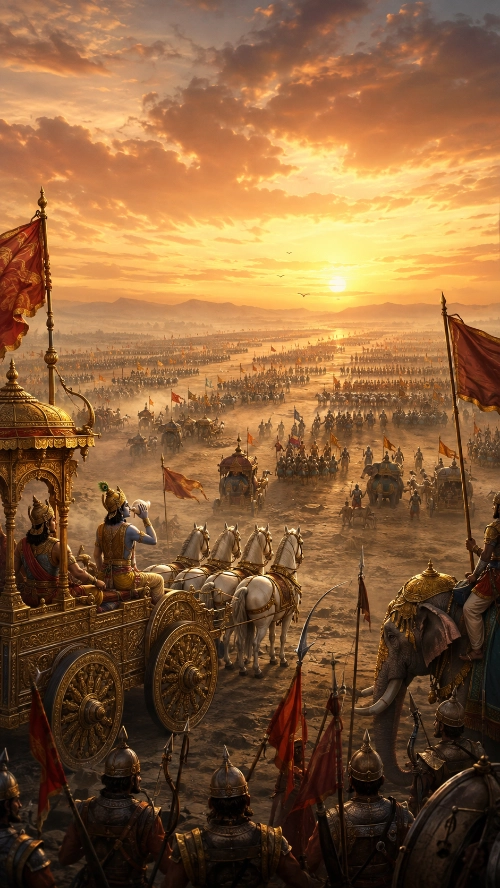
Command of the Kaurava Army during the 18-Day Kurukṣetra War
During the eighteen-day battle of Kurukṣetra, command of the Kaurava army passed successively through several of the greatest warriors of the Mahābhārata — Bhīṣma, then Droṇa, then Karṇa, then Śalya, and finally, after the conventional field battle had effectively ended, Aśvatthāmā. The epic itself gives a remarkably concise summary of the principal sequence near its beginning, in the Parvasaṁgraha-parvan of the Ādi-parvan.
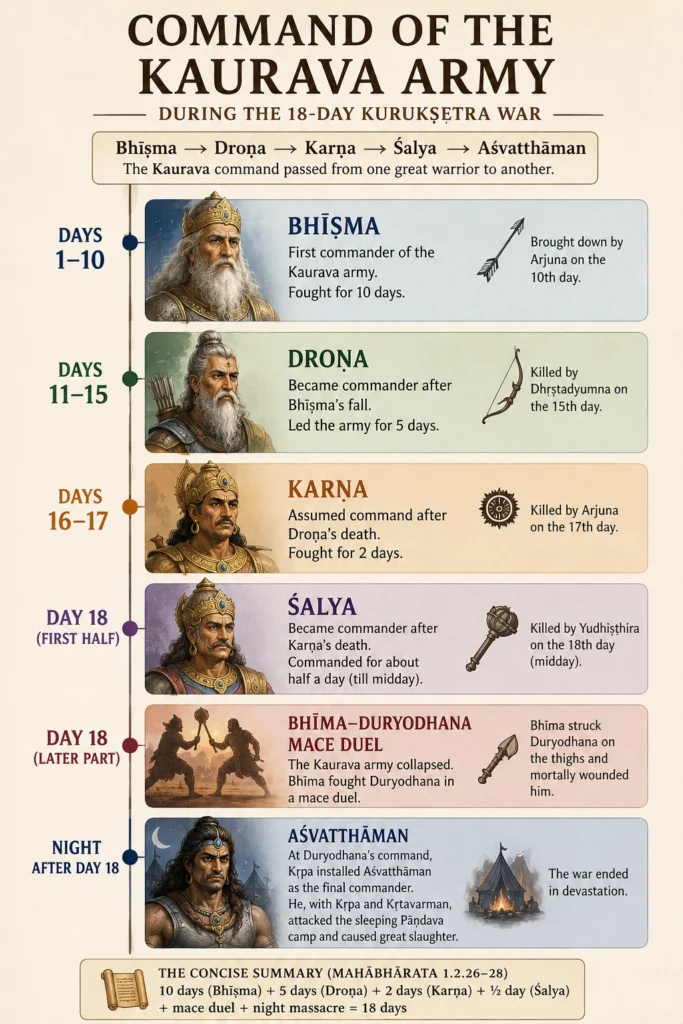
The five commanders, day by day, with the mace duel and the night raid.
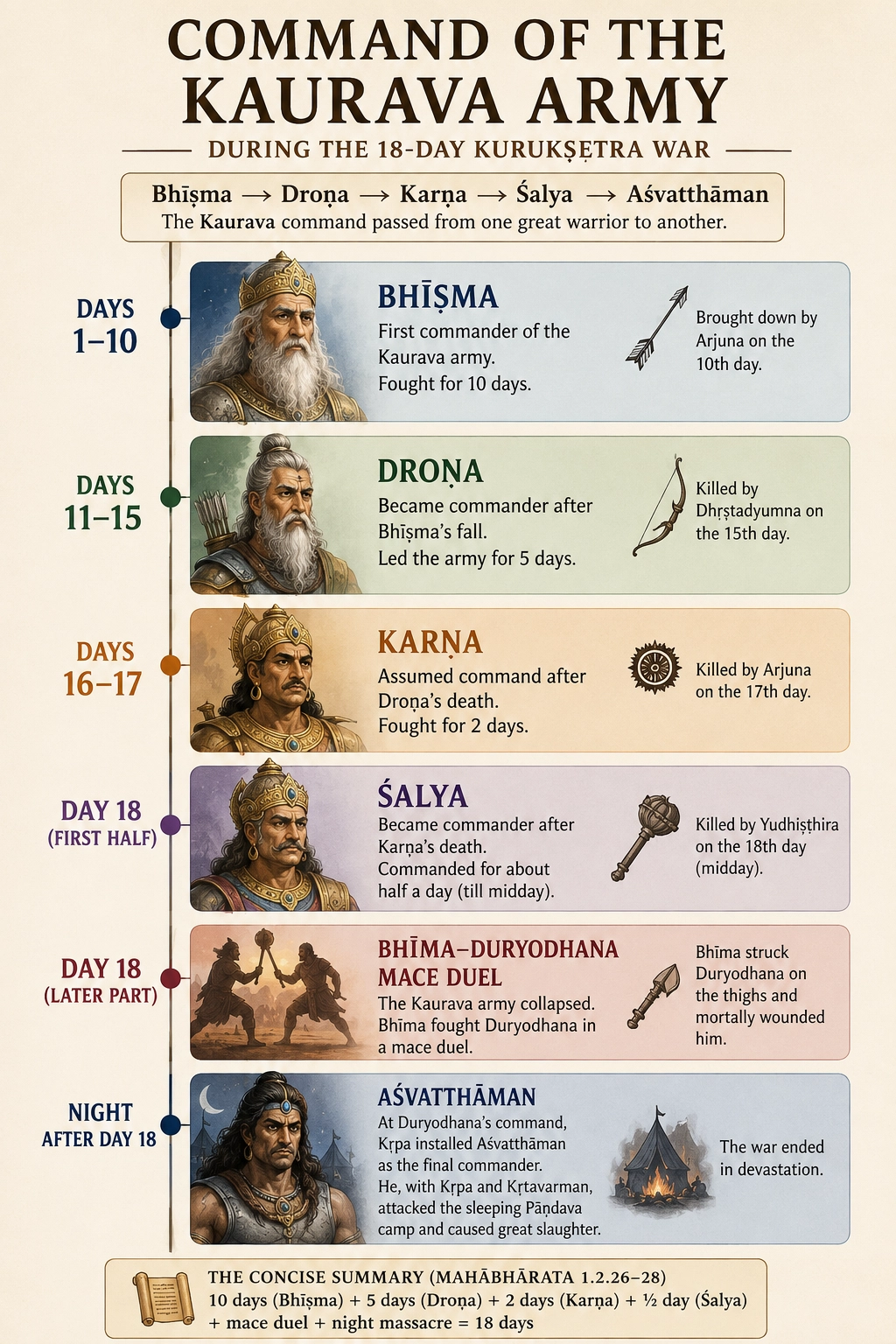
Bhīṣma — Days 1 to 10
Bhīṣma, son of Śāntanu and Gaṅgā, was the first commander-in-chief of Duryodhana’s forces, and he commanded the Kaurava army for the first ten days. The Mahābhārata summarizes:
अहानि युयुधे भीष्मो दशैव परमास्त्रवित् ।
अहानि पञ्च द्रोणस्तु ररक्ष कुरुवाहिनीम् ॥
ahāni yuyudhe bhīṣmo
daśaiva paramāstravit |
ahāni pañca droṇas tu
rarakṣa kuru-vāhinīm ||
“Bhīṣma, the supreme knower of weapons, fought for ten days; Droṇa protected the Kuru army for five days.” — Mahābhārata, Ādi-parvan 1.2.26
Bhīṣma was not killed on the tenth day. He was brought down and placed upon his famous bed of arrows. Because he would not fight Śikhaṇḍin, whom he regarded in accordance with Śikhaṇḍin’s former identity as female, the Pāṇḍavas placed Śikhaṇḍin before Arjuna; Bhīṣma lowered his weapons, and Arjuna pierced him with innumerable arrows.
Bhīṣma remained alive after the battle, possessing the boon of icchā-mṛtyu, the power to choose the time of his death, and did not leave his body until the Sun began its northward course.
A significant detail: Karṇa did not participate in the fighting during Bhīṣma’s ten-day command. He entered the war in full force only after Bhīṣma had fallen.
Droṇa — Days 11 to 15
After Bhīṣma’s fall, Droṇācārya was formally invested as commander of the Kaurava forces; the Droṇa-parvan explicitly describes Duryodhana and the assembled kings installing him according to the prescribed rites. Droṇa commanded for five days, days 11 through 15, and his period of command includes some of the most catastrophic episodes of the war:
Droṇa was extraordinarily difficult to defeat while armed. The Pāṇḍavas therefore resorted to the stratagem involving the announcement aśvatthāmā hataḥ, “Aśvatthāmā is dead.” Bhīma had killed an elephant named Aśvatthāmā, and when Droṇa asked Yudhiṣṭhira whether his son had truly died, Yudhiṣṭhira uttered the famous ambiguous statement.
Believing his son dead, Droṇa lost the desire to continue fighting and laid aside his weapons. At that point Dhṛṣṭadyumna, who according to the epic had been born specifically for Droṇa’s destruction, killed him. Droṇa’s five-day command thus ended on the fifteenth day.
Karṇa — Days 16 to 17
After Droṇa’s death the surviving Kaurava leaders met and considered who should command next. Aśvatthāmā recommended Karṇa, and Duryodhana formally installed him as commander-in-chief. Karṇa assured Duryodhana, “I shall become your commander. In this there is no doubt.” The Parvasaṁgraha summarizes:
अहनी युयुधे द्वे तु कर्णः परबलार्दनः ।
ahanī yuyudhe dve tu
karṇaḥ para-balārdanaḥ
“Karṇa, the destroyer of enemy forces, fought for two days.” — Mahābhārata 1.2.27
These are days 16 and 17. Karṇa’s command culminated in the long-awaited confrontation between Karṇa and Arjuna, and on the seventeenth day Karṇa was killed by Arjuna. With his death Duryodhana lost the last warrior upon whom he had placed his greatest hope of defeating Arjuna and reversing the course of the war.
Śalya — Day 18
After Karṇa’s death the shattered remains of the Kaurava leadership gathered again. At Aśvatthāmā’s recommendation Duryodhana appointed Śalya, king of Madra, as the new commander-in-chief, and Śalya accepted, declaring that his life, kingdom and wealth were at Duryodhana’s service. His command lasted only part of the final day:
शल्योऽर्धदिवसं त्वासीद्
गदायुद्धमतः परम् ॥
śalyo ’rdha-divasaṁ tv āsīd
gadā-yuddham ataḥ param ||
“Śalya [commanded] for half a day; after that came the mace battle.” — Mahābhārata 1.2.27
The Śalya-parvan makes the chronology still clearer: Śalya was killed by Yudhiṣṭhira at midday. This is noteworthy, because Yudhiṣṭhira is usually remembered for righteousness and kingship rather than as one of the great aggressive warriors of the epic — yet it is he who kills the final commander of the organized Kaurava army. After Śalya’s death the Kaurava military formation effectively disintegrated.
Duryodhana and the Mace Duel
With Śalya dead and almost his entire army destroyed, Duryodhana fled the battlefield and concealed himself in a lake, using his powers to remain beneath its waters. The Pāṇḍavas discovered his location and challenged him to emerge, and he eventually agreed to fight one of them with the weapon in which he was most expert — the gadā, the mace. So began the famous gadā-yuddha between Bhīma and Duryodhana. Both had been trained in mace fighting by Balarāma, and Duryodhana was regarded as exceptionally skilled in the technical discipline of gadā combat.
The duel continued into the later part of the day; the Mahābhārata explicitly describes the combat taking place toward the close of day. Eventually Bhīma struck Duryodhana upon the thighs. The blow fulfilled Bhīma’s old vow to break the thigh that Duryodhana had insultingly exposed to Draupadī after the dice game — but it was also contrary to the formal rules of mace combat, which prohibited blows below the waist.
Duryodhana fell with his thighs shattered, but he did not die immediately. He remained alive on the battlefield into the night — which is what makes the final appointment possible.
The Final Commander: Aśvatthāmā
This is the episode often omitted from simplified lists of Kaurava commanders. As Duryodhana lay mortally wounded, the three major Kaurava warriors who still survived came to him — Aśvatthāmā, Kṛpa and Kṛtavarman. Duryodhana then asked Kṛpa to formally install Aśvatthāmā as commander-in-chief, and the Śalya-parvan explicitly says that Kṛpa performed the installation: “At the king’s command, Kṛpa installed Droṇa’s son as generalissimo.”
Aśvatthāmā is therefore technically the fifth and final Kaurava commander. But his command was fundamentally different from those of Bhīṣma, Droṇa, Karṇa and Śalya: there was no longer an organized Kaurava field army for him to command. Instead, Aśvatthāmā, Kṛpa and Kṛtavarman went during the night to the camp of their enemies.
The Night Massacre
The Parvasaṁgraha continues immediately after its description of Śalya and the mace fight:
तस्यैव तु दिनस्यान्ते
हार्दिक्यद्रौणिगौतमाः ।
प्रसुप्तं निशि विश्वस्तं
जघ्नुर्यौधिष्ठिरं बलम् ॥
tasyaiva tu dinasyānte
hārdikya-drauṇi-gautamāḥ |
prasuptaṁ niśi viśvastaṁ
jaghnur yaudhiṣṭhiraṁ balam ||
“At the end of that very day, Hārdikya (Kṛtavarman), Drauṇi (Aśvatthāmā) and Gautama (Kṛpa) attacked by night the unsuspecting army of Yudhiṣṭhira while it slept.” — Mahābhārata 1.2.28
This nocturnal assault forms the central event of the Sauptika-parvan, the “Book of the Sleeping Warriors.” Aśvatthāmā entered the camp and killed, among others, Dhṛṣṭadyumna, commander of the Pāṇḍava army; Śikhaṇḍin; many surviving Pāñcāla warriors; and the five sons of Draupadī, the Upapāṇḍavas. The five Pāṇḍava brothers themselves were not sleeping in that camp and survived.
The ordinary eighteen-day field battle had ended, but the violence continued through the night.
The Complete Chain of Command
The familiar shorthand is therefore 10 + 5 + 2 + ½ = 17½ days under the four great field commanders, followed by the destruction of the Kaurava army and the gadā-yuddha during the remainder of the eighteenth day.
It is common to express this mnemonically as 10 + 5 + 2 + ½ + ½ = 18, but the Sanskrit itself does not explicitly assign “half a day” to the mace duel. It says only śalyo ’rdha-divasaṁ tv āsīd gadā-yuddham ataḥ param — “Śalya lasted half a day; after that came the mace battle.”
The Pāṇḍava Side Was Different
An interesting contrast is that the Pāṇḍavas did not repeatedly replace their commander-in-chief. Before the battle Yudhiṣṭhira appointed seven leaders over his seven akṣauhiṇīs and placed Dhṛṣṭadyumna above them all as commander of the entire Pāṇḍava army.
Dhṛṣṭadyumna survived the battlefield itself, only to be killed by Aśvatthāmā during the night raid.
The Succession Tells the Story of the War
The sequence of commanders is more than a convenient chronology. It mirrors the gradual destruction of Duryodhana’s hopes. Bhīṣma represents the ancient authority and strength of the Kuru dynasty. After Bhīṣma falls, Duryodhana turns to Droṇa, the supreme military teacher. After Droṇa dies, he places his hopes in his closest friend and greatest champion, Karṇa. After Karṇa falls, the surviving army turns to Śalya, whose command lasts only until midday. And after even the army itself has ceased to exist as an organized force, the title of commander passes to Aśvatthāmā, whose “command” no longer consists of directing armies in open battle but of leading three survivors into a catastrophic act of nocturnal vengeance.
The succession Bhīṣma → Droṇa → Karṇa → Śalya → Aśvatthāmā is almost a structural summary of the destruction of the Kaurava cause itself — from the authority of the dynasty, through its teacher and its champion, to a half-day appointment, and finally to a commander with no army left to command.