Chapter 8
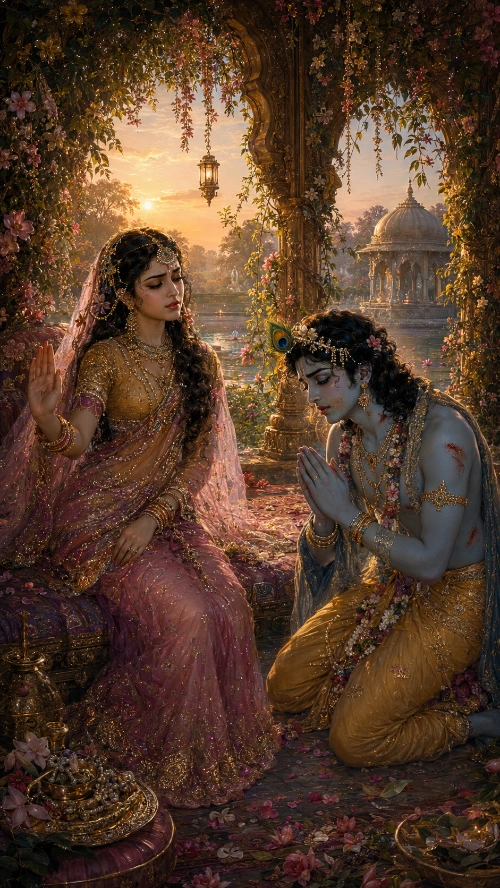
Dawn in a flowering bower beside the river. Rādhā sits on cushions in rose and gold, her face turned away and one hand raised flat in refusal. Kṛṣṇa kneels before her with his palms joined and his head lowered, peacock feather in his hair and a garland at his chest; faint scratch marks and stains show on his arm and cheek. A lantern hangs above them, and a domed pavilion stands across the water in the sunrise.

Śrī Gīta-govinda, Sarga VIII — Vilakṣya-Lakṣmīpati: The Abashed Lord of Lakṣmī

Synopsis

Short, and dramatically enormous. Rādhā has waited all night, convinced that Kṛṣṇa’s absence could mean only one thing. Then morning comes and he actually appears — bowing, conciliatory, ready to speak. And Rādhā looks at his body. His eyes are red from a sleepless night, his lip bitten, his chest marked with lac, his skin scratched. To her these are not innocent details but evidence, and everything she imagined in the night now seems written on him. The single Aṣṭapadī that carries the canto is one of the most famous rebukes in Sanskrit love poetry: go, Mādhava, go, Keśava, and do not speak deceitful words. This is the canto of the khaṇḍitā, the woman betrayed.

Chapter 8

51

अथ कथमपि यामिनीं विनीय
स्मरशरजर्जरितापि सा प्रभाते ।
अनुनयवचनं वदन्तमग्रे
प्रणतमपि प्रियमाह साभ्यसूयम् ॥ ५१ ॥

atha katham api yāminīṁ vinīya
smara-śara-jarjaritāpi sā prabhāte |
anunaya-vacanaṁ vadantam agre
praṇatam api priyam āha sābhyasūyam || 51 ||

Then, having somehow passed the night, though shattered by the arrows of Love, Rādhā saw her beloved before her at dawn. Though he bowed and spoke words of conciliation, she addressed him with jealous indignation.

Commentary

Somehow— Rādhā survived the night. Kāma’s arrows had left her exhausted and wounded. Then morning came. And at last Kṛṣṇa appeared. He stood before her. He bowed. He tried to soothe her with gentle words. But Rādhā looked at him— and instead of relief, anger rose within her.

Jayadeva carefully says: प्रणतमपि — praṇatam api “even though he bowed.” Kṛṣṇa is already submissive. Nevertheless Rādhā is not ready to forgive. The emotional category has changed. She is no longer merely the woman who was deceived at the rendezvous. She is now the woman whose lover returns bearing suspicious signs upon his body.

Song 17

Rajani-janita-guru-jāgara-rāga — bhairavī rāga — yati tāla

हरि हरि याहि माधव याहि केशव
मा वद कैतववादम् ।
तामनुसर सरसीरुहलोचन
या तव हरति विषादम् ॥

hari hari yāhi mādhava yāhi keśava
mā vada kaitava-vādam |
tām anusara sarasīruha-locana
yā tava harati viṣādam ||

Refrain: “Hari! Hari! Go, Mādhava — go, Keśava! Do not speak deceitful words. Lotus-eyed one, go back to that woman who takes away your sorrow.”

Commentary

Go, Mādhava! Go, Keśava!

The whole canto turns on this one song, and the refrain is more sophisticated than plain rejection. Rādhā does not say she has stopped loving him; she says tām anusara, “go to her.” That distinction matters. If she felt nothing there would be no jealousy, and the violence of the dismissal measures the strength of the attachment behind it.

S17.1

रजनिजनितगुरुजागररागकषायितमलसनिवेशम् ।
वहति नयनमनुरागमिव स्फुटमुदितरसाभिनिवेशम् ॥

rajani-janita-guru-jāgara-rāga-kaṣāyitam alasa-niveśam |
vahati nayanam anurāgam iva sphuṭam udita-rasābhiniveśam ||

Your eyes are reddened from the intense wakefulness of the night and rest languidly, openly displaying—as though outwardly—the passion and absorption in rasa that arose within you. Hari! Hari! Go, Mādhava. Go, Keśava. Do not tell me deceitful stories. O lotus-eyed one, follow that woman who removes your sorrow.

Commentary

Look at your eyes, Kṛṣṇa. Red from an entire night without sleep. Heavy. Languid. Still saturated with the pleasure you experienced. And now you expect me to believe your words? No. Go, Mādhava. Go, Keśava. Do not lie to me. Go back to the woman who kept you happy through the night.

Rāga

Jayadeva exploits the richness of: राग — rāga It can mean: redness, passion, attachment, erotic colouring. Thus Kṛṣṇa’s eyes literally bear rāga because they are red— while simultaneously revealing rāga, passion for another woman.

Textual Note

Some transmitted texts read: अलसनिमेषम् — alasa-nimeṣam “with languid blinking / heavy eyelids,” where the recension followed here has: अलसनिवेशम् — alasa-niveśam “languidly set.” The former is particularly vivid and widespread in performance traditions; both convey Kṛṣṇa’s exhausted, heavy-eyed appearance after the night.

S17.2

कज्जलमलिनविलोचनचुम्बनविरचितनीलिमरूपम् ।
दशनवसनमरुणं तव कृष्ण तनोति तनोरनुरूपम् ॥

kajjala-malina-vilocana-cumbana-viracita-nīlima-rūpam |
daśana-vasanam aruṇaṁ tava kṛṣṇa tanoti tanor anurūpam ||

O Kṛṣṇa, your red lip—the covering of your teeth—has acquired a dark-blue colouring made by kissing eyes blackened with collyrium. It has thereby become fittingly similar in colour to your dark body. Go, Mādhava. Go, Keśava. Do not speak deceitful words to me.

Commentary

Another Woman’s Kohl Is on His Lips

And your lips— what happened to them? They should be red. But they are darkened. Someone’s black eye-paint has rubbed onto them while you kissed her eyes. How appropriate, Kṛṣṇa. Now even your lips have become dark— just like the rest of you. Go. Do not explain.

Rādhā now becomes a forensic observer. Kṛṣṇa’s darkened lip tells an entire story: another woman’s eyes were painted with kajjala, black collyrium; Kṛṣṇa kissed those eyes; the pigment transferred to his lips. Whether this reconstruction is objectively correct matters less than Rādhā’s certainty. His body has become a text she knows how to read.

S17.3

वपुरनुहरति तव स्मरसङ्गरखरनखरक्षतरेखम् ।
मरकतशकलकलितकलधौतलिपेरिव रतिजयलेखम् ॥

vapur anuharati tava smara-saṅgara-khara-nakhara-kṣata-rekham |
marakata-śakala-kalita-kaladhauta-liper iva rati-jaya-lekham ||

The sharp nail-scratches upon your body, received in the battle of Love, resemble an inscription proclaiming Rati’s victory— as though golden writing had been engraved upon a tablet of emerald. Go, Mādhava. Go, Keśava. Do not speak deceitful words to me.

Commentary

Nail Marks Become an Inscription of Victory

The Image

Jayadeva produces an extraordinarily luxurious metaphor. Kṛṣṇa’s dark body becomes: marakata-śakala a slab of emerald. The pale-red or golden scratch marks become: kaladhauta-lipi writing in gold. And what has been written there? rati-jaya-lekha “the inscription of Love’s victory.” In other words: Kṛṣṇa’s own body publicly announces that someone has conquered him in erotic battle. He does not need to confess. The scratches confess for him.

Textual Note

Where the reading followed here has कलधौतलिपेरिव — kaladhauta-liper iva “as though of golden writing,” some Devanāgarī editions read कलधौतलिपिरेव — kaladhauta-lipir eva, “is indeed golden writing.” The sense of the image is unaffected.

S17.4

चरणकमलगलदलक्तकसिक्तमिदं तव हृदयमुदारम् ।
दर्शयतीव बहिर्मदनद्रुमनवकिसलयपरिवारम् ॥

caraṇa-kamala-galad-alaktaka-siktam idaṁ tava hṛdayam udāram |
darśayatīva bahir madana-druma-nava-kisalaya-parivāram ||

Your broad chest is stained with the red lac that flowed from her lotus feet. It seems to display outwardly the tender new red shoots of the tree of Love growing within your heart. Go, Mādhava. Go, Keśava. Do not speak deceitful words.

Commentary

Lac from Her Feet Stains His Chest

And look at your chest. It is red. The lac from her lotus-feet has rubbed onto you. Your body is exposing your heart, Kṛṣṇa. The tree of desire growing secretly inside you has sent its new red leaves outward— and I can see them.

A Brilliant Interior–Exterior Metaphor

The key idea is: बहिः दर्शयति — bahir darśayati “it displays outwardly.” Rādhā interprets the stain on Kṛṣṇa’s chest as an external manifestation of his inner passion. Thus: inside: the tree of desire; outside: red shoots appearing as lac stains. Again, Kṛṣṇa’s body betrays what his words attempt to conceal.

S17.5

दशनपदं भवदधरगतं मम जनयति चेतसि खेदम् ।
कथयति कथमधुनापि मया सह तव वपुरेतदभेदम् ॥

daśana-padaṁ bhavad-adhara-gataṁ mama janayati cetasi khedam |
kathayati katham adhunāpi mayā saha tava vapur etad abhedam ||

The mark of teeth upon your lip causes anguish in my heart. How can this body of yours now continue to proclaim its non-difference, its intimate unity, with me? Go, Mādhava. Go, Keśava. Do not speak deceitful words.

Commentary

The Bite-Mark on His Lip

There is a bite-mark on your lip. Do not tell me I imagined that. It hurts merely to look at it. And after showing me this, how can you still speak as though you and I remain inseparably one? Your body belongs to another woman’s signs tonight. Go, Kṛṣṇa.

Abheda

The word: अभेद — abheda literally means “non-difference,” “unity,” “absence of separation.” In an erotic context it can suggest the lovers’ intimate sense that: “you and I are one.” Rādhā attacks precisely this claim. If another woman’s teeth have marked Kṛṣṇa’s lip, how can he still speak of exclusive unity with Rādhā?

S17.6

बहिरिव मलिनतरं तव कृष्ण मनोऽपि भविष्यति नूनम् ।
कथमथ वञ्चयसे जनमनुगतमसमशरज्वरदूनम् ॥

bahir iva malinataraṁ tava kṛṣṇa mano ’pi bhaviṣyati nūnam |
katham atha vañcayase janam anugatam asama-śara-jvara-dūnam ||

O Kṛṣṇa, surely your mind must be even darker than your outward body. Otherwise, how could you deceive one who followed you faithfully and who is already tormented by the fever of the incomparable arrows of Love? Go, Mādhava. Go, Keśava. Do not speak deceitful words.

Commentary

“Your Heart Must Be Darker Than Your Body”

The Cruel Pun on Kṛṣṇa’s Colour

This is a sharp verbal blow. Kṛṣṇa is physically: kṛṣṇa dark. Rādhā says his mind is darker still. The comparison works simultaneously on the physical and moral levels: dark body → dark heart. Of course this is Rādhā speaking in anger, not a theological judgement by the poet. It is the rhetoric of the khaṇḍitā, the offended heroine.

S17.7

भ्रमति भवानबलाकवलाय वनेषु किमत्र विचित्रम् ।
प्रथयति पूतनिकैव वधूवधनिर्दयबालचरित्रम् ॥

bhramati bhavān abalā-kavalāya vaneṣu kim atra vicitram |
prathayati pūtanikaiva vadhū-vadha-nirdaya-bāla-caritram ||

You roam through the forests to make helpless women your prey—what is surprising about that? Pūtanā herself already proclaims your merciless childhood history of destroying women. Go, Mādhava. Go, Keśava. Do not speak deceitful words.

Commentary

The Pūtanā Accusation

Why should I be surprised? You roam these forests hunting women. You began early enough. Pūtanā herself is evidence: even as an infant you were already merciless toward a woman. So why should your behaviour surprise me now? Go, Kṛṣṇa.

The Dark Humour of the Verse

This is one of Jayadeva’s boldest mythological jokes. According to the Kṛṣṇa tradition, the demoness Pūtanā attempted to kill the infant Kṛṣṇa by offering him a poisoned breast. Kṛṣṇa instead sucked out her life. Rādhā maliciously rewrites the sacred story. Her logic is intentionally outrageous: “You killed a woman when you were an infant. Apparently destroying women has always been your nature.” Traditional commentators explicitly recognize this as the rhetoric of the khaṇḍitā nāyikā—the furious heroine exaggerating the beloved’s faults. It should therefore not be flattened into literal biography. It is a brilliant weapon of angry love.

S17.8

श्रीजयदेवभणितरतिवञ्चितखण्डितयुवतिविलापम् ।
शृणुत सुधामधुरं विबुधा विबुधालयतोऽपि दुरापम् ॥

śrī-jayadeva-bhaṇita-rati-vañcita-khaṇḍita-yuvati-vilāpam |
śṛṇuta sudhā-madhuraṁ vibudhā vibudhālayato ’pi durāpam ||

O wise ones, listen to this lament of the young khaṇḍitā, deceived in love, composed by Śrī Jayadeva. It is sweeter than nectar and difficult to obtain even in the dwelling place of the gods.

Commentary

Jayadeva Identifies the Khaṇḍitā

Jayadeva himself identifies Rādhā here as: रतिवञ्चितखण्डितयुवति rati-vañcita-khaṇḍita-yuvati “the khaṇḍitā young woman deceived in love.” This gives us the classical aesthetic category governing the canto.

Who Is the Khaṇḍitā Nāyikā?

The khaṇḍitā is one of the eight classical heroines, the aṣṭa-nāyikās. She is the woman whose lover arrives late— usually in the morning— and whose physical appearance reveals that he has apparently spent the night with another woman. The classical signs include precisely those Jayadeva gives Kṛṣṇa: sleepless or reddened eyes; nail marks upon the body; disordered appearance; traces of another woman’s cosmetics; bite marks; suspicious stains. The khaṇḍitā does not collapse into tears before the lover. She interrogates him. She is angry, proud, perceptive and verbally devastating. Thus Sarga VII and Sarga VIII portray two related but distinct states: Sarga VII — Vipralabdhā “He promised to come, but he did not.” Sarga VIII — Khaṇḍitā “Now he has come—and his body tells me where he has been.”

Rādhā’s Method: The Body Against the Word

This is perhaps the deepest poetic structure of Aṣṭapadī 17. Kṛṣṇa arrives with: anunaya-vacanam “words of conciliation.” But Rādhā refuses to listen. Why? Because she believes the body is more truthful than speech. Kṛṣṇa’s words say: “Forgive me.” His eyes say: “I did not sleep.” His lips say: “I kissed someone.” His scratches say: “Someone embraced me passionately.” His chest says: “Her feet were against me.” His bitten lip says: “There was intimate love-play.” Thus every stanza creates the same opposition: Kṛṣṇa’s speech versus Kṛṣṇa’s body. And Rādhā repeatedly chooses the body as evidence. That is why the refrain says: मा वद कैतववादम् mā vada kaitava-vādam “Do not speak deceitful words.” She has already reached her verdict.

Rādhā’s Final Statement

After the song she looks again at the red stain upon Kṛṣṇa’s chest.

52

तदेवं पश्यन्त्याः प्रसरदनुरागं बहिरिव
प्रियापादालक्तच्छुरितमरुणच्छायहृदयम् ।
ममाद्य प्रख्यातप्रणयभरभङ्गेन कितव
त्वदालोकः शोकादपि किमपि लज्जां जनयति ॥ ५२ ॥

tad evaṁ paśyantyāḥ prasarad-anurāgaṁ bahir iva
priyā-pādālaktac-churitam aruṇa-cchāya-hṛdayam |
mamādya prakhyāta-praṇaya-bhara-bhaṅgena kitava
tvad-ālokaḥ śokād api kim api lajjāṁ janayati || 52 ||

O deceiver! As I see your chest tinted red by the lac from your beloved’s feet—as though your passion for her were spreading visibly outward— the sight of you today, after the breaking of the fullness of our well-known love, causes me something even beyond grief: shame.

Commentary

Look at yourself, deceiver. Her red lac is still upon your chest. Your secret attachment has become visible outside your body. And now, after what everyone knew to be the depth of our love has been broken— seeing you does something worse than making me sad. It humiliates me.

The Crucial Word: Lajjā

Until now Rādhā’s dominant responses have been: longing; jealousy; anger; grief. Now Jayadeva introduces: लज्जा — lajjā shame. Why? Because Kṛṣṇa’s apparent betrayal does not merely wound her privately. It seems to make a mockery of their publicly recognized intimacy: प्रख्यातप्रणयभर — prakhyāta-praṇaya-bhara “the celebrated fullness of our love.” Rādhā feels not only abandoned but displaced. This explains why simple apology is insufficient.

Textual Note

For तदेवं पश्यन्त्याः — tad evaṁ paśyantyāḥ, the Kāvyamālā text prints तवेदं — tavedaṁ, “this chest of yours,” which the Devanāgarī editions record as a variant. The sense is essentially unchanged.

A Closing Benediction

The dramatic core is followed by a benedictory stanza:

Benediction

अन्तर्मोहनमौलिघूर्णनचलन्मन्दारविस्रंशन-
स्तब्धाकर्षणदृष्टिहर्षणमहामन्त्रः कुरङ्गीदृशाम् ।
दृप्यद्दानवदूयमानदिविषद्दुर्वारदुःखापदां
भ्रंशः कंसरिपोर्व्यपोहयतु वः श्रेयांसि वंशीरवः ॥

antar-mohana-mauli-ghūrṇana-calan-mandāra-visraṁśana-
stabdhākarṣaṇa-dṛṣṭi-harṣaṇa-mahā-mantraḥ kuraṅgī-dṛśām |
dṛpyad-dānava-dūyamāna-diviṣad-durvāra-duḥkhāpadāṁ
bhraṁśaḥ kaṁsa-ripor vyapohayatu vaḥ śreyāṁsi vaṁśī-ravaḥ ||

May the sound of the flute of Kaṁsa’s enemy bring you blessedness— that great enchantment-mantra which captivates the hearts of doe-eyed women, makes their heads turn until the flowers fall from their hair, arrests and draws their gaze, and fills their eyes with joy; that sound which also destroys the unbearable sufferings inflicted upon the gods by arrogant demons.

Commentary

This benediction restores the larger identity of Kṛṣṇa after Rādhā’s devastating accusations. The man she has just denounced as a deceitful lover is also: Kaṁsa’s enemy, protector of the gods, and wielder of the world-enchanting flute. Jayadeva never allows either dimension to abolish the other.

Textual Note

The closing verb is व्यपोहयतु — vyapohayatu, “may it drive away,” as printed in the Kāvyamālā text; the long-vowel form vyāpohayatu will not scan in śārdūlavikrīḍita. Devanāgarī editions vary widely in this stanza, reading स्तब्धाकर्षणलोचनोत्सव — stabdhākarṣaṇa-locanotsava for the second quarter and प्ररोपयतु — praropayatu for the verb.

Colophon

इति श्रीगीतगोविन्दे खण्डितावर्णने विलक्ष्यलक्ष्मीपतिर्नाम अष्टमः सर्गः ॥ ८ ॥

iti śrī-gīta-govinde khaṇḍitā-varṇane vilakṣya-lakṣmīpatir nāma aṣṭamaḥ sargaḥ || 8 ||

Thus ends the eighth sarga, named Vilakṣya-Lakṣmīpati, in the description of the khaṇḍitā heroine, of the illustrious Gīta-govinda.

Commentary

The Dramatic Meaning of Sarga VIII

Sarga VIII is built upon an extraordinary reversal of power. Kṛṣṇa arrives. But arrival does not restore his authority. He bows. Rādhā remains seated in judgement. He speaks. Rādhā refuses his words. He is the supreme Lord— yet his own body becomes evidence against him. The entire canto could be summarized as: Kṛṣṇa tries to speak; Rādhā reads. She reads his eyes. She reads his lips. She reads his chest. She reads the scratches. She reads the bite marks. And she interprets each physical sign as a sentence in the story of his betrayal.

“Go Back to Her”

The refrain is psychologically more sophisticated than simple rejection. Rādhā does not say: “I no longer love you.” She says: तामनुसर tām anusara “Go to her.” This distinction matters enormously. If Rādhā truly felt nothing, there would be no jealousy. Her command sends Kṛṣṇa toward the rival precisely because Rādhā herself still wants him. The violence of the rejection therefore measures the intensity of attachment.

The Rival Has Moved from Imagination to Kṛṣṇa’s Body

In Sarga VII the other woman existed inside Rādhā’s imagination. Rādhā imagined: Kṛṣṇa kissing her; her nails scratching him; her feet touching him; Kṛṣṇa adorning her after love-play. Now compare Sarga VIII. Rādhā sees: signs of kissing; nail scratches; red lac from feet; bodily traces of intimacy. The correspondence is extraordinary. What Rādhā imagined in Sarga VII seems to have become physically visible in Sarga VIII. Whether Jayadeva intends every sign as objective proof is less important than the dramatic effect: for Rādhā, imagination has become evidence.

The Pūtanā Joke Reveals the Extremity of Her Anger

The stanza invoking Pūtanā is easy to misunderstand if separated from the aesthetic situation. Rādhā is not offering a sober theological interpretation of Kṛṣṇa’s childhood. She is a furious khaṇḍitā. Therefore she takes one of Kṛṣṇa’s most celebrated heroic acts— the killing of the murderous demoness Pūtanā— and maliciously reverses its meaning: “You killed women even as a baby. Why should I expect anything different now?” This is deliberate hyperbole. Its very absurdity makes the accusation powerful. The more sacred Kṛṣṇa’s deed, the more outrageous Rādhā’s reinterpretation becomes. And Kṛṣṇa has to endure it.

Why Kṛṣṇa Does Not Simply Leave

This is an important point. Rādhā repeatedly says: याहि — yāhi “Go!” Yet the narrative does not end with Kṛṣṇa abandoning her. Why? Because the accusation itself reveals that Rādhā remains deeply invested in him. Her anger is māna—offended love. The task is therefore not to create love where none exists. It is to remove the obstruction created by hurt. That is precisely the problem the next cantos will solve.

Why Vilakṣya-Lakṣmīpati?

The title now becomes especially beautiful. Lakṣmīpati is majestic. He is the Lord of Śrī. The supreme divine male. But Rādhā has transformed him into: vilakṣya— awkward, exposed, embarrassed. He cannot invoke cosmic authority. He cannot simply command her affection. He must somehow persuade Rādhā to forgive him. The theology implicit in Jayadeva’s erotic drama is striking: divinity does not exempt Kṛṣṇa from the demands of love. Within love, he must answer to the beloved.

From Sarga VIII to Sarga IX

At the end of Sarga VIII, reconciliation seems almost impossible. Rādhā has told Kṛṣṇa to leave. She rejects his explanations. She interprets every mark upon him as proof of betrayal. And she says that merely seeing him now causes not only sorrow but shame. Direct persuasion has failed. Therefore the mediator must intervene again. This leads into: Sarga IX — Manda-Mukunda Subdued Mukunda The sakhī turns once more toward Rādhā. But this time her task is different. Earlier she persuaded Rādhā: “Go to Kṛṣṇa because he is waiting.” Now she must persuade her: “Do not let your anger destroy the love you still desire.” The emotional progression therefore becomes: Sarga VII “He has betrayed me.” ↓ Sarga VIII “Go away, Kṛṣṇa.” ↓ Sarga IX “Rādhā, is maintaining this anger really bringing you happiness?” The great struggle of the poem is now no longer simply: union versus separation. It has become: love versus pride. And for the lovers to reunite, māna must finally begin to soften.

Full synopsis

Chapter 8

The reversal of power

The canto is built on a reversal. Kṛṣṇa arrives, and arrival does not restore his authority. He bows; Rādhā stays seated in judgement. He speaks; she refuses the words. He is the supreme Lord, and his own body has become the evidence against him. The whole canto can be summarised in five words: Kṛṣṇa tries to speak, Rādhā reads. She reads his eyes, his lips, his chest, the scratches, the bite-marks, and interprets each mark as a sentence in the story of his betrayal.

Imagination has become evidence

Set the two cantos side by side. In the seventh Rādhā imagined the other woman kissing him, her nails scratching him, her feet touching him, Kṛṣṇa adorning her afterwards. In the eighth she sees signs of kissing, nail-scratches, red lac from feet, the bodily traces of intimacy. The correspondence is exact. Whether Jayadeva means every mark as objective proof matters less than the dramatic effect: for Rādhā, what she imagined has become what she can see.

The Pūtanā accusation

One stanza is easy to misread if it is taken out of the aesthetic situation. Rādhā invokes Pūtanā — and she is not offering a sober theological reading of Kṛṣṇa’s childhood. She is a furious khaṇḍitā, and she takes one of his most celebrated heroic acts, the killing of the murderous demoness, and reverses its meaning: you killed women even as an infant, so why should I expect anything else now? It is deliberate hyperbole, and its absurdity is what gives it force. The more sacred the deed, the more outrageous the reinterpretation — and Kṛṣṇa has to stand and take it.

Why he does not simply leave

Rādhā says yāhi, go, again and again, and the narrative does not end with Kṛṣṇa going. The reason is that the accusation itself shows how deeply invested in him she remains. Her anger is māna, offended love, not indifference. Nothing has to be created; something has to be removed. That is the problem the remaining cantos exist to solve.

Why Vilakṣya-Lakṣmīpati

Lakṣmīpati is a majestic name — the Lord of Śrī, the supreme divine male. Rādhā has reduced him to vilakṣya: awkward, exposed, embarrassed. He cannot invoke cosmic authority here and he cannot command her affection. He can only try to persuade her to forgive him, and in this canto he does not succeed.