

Who May Describe the Līlā
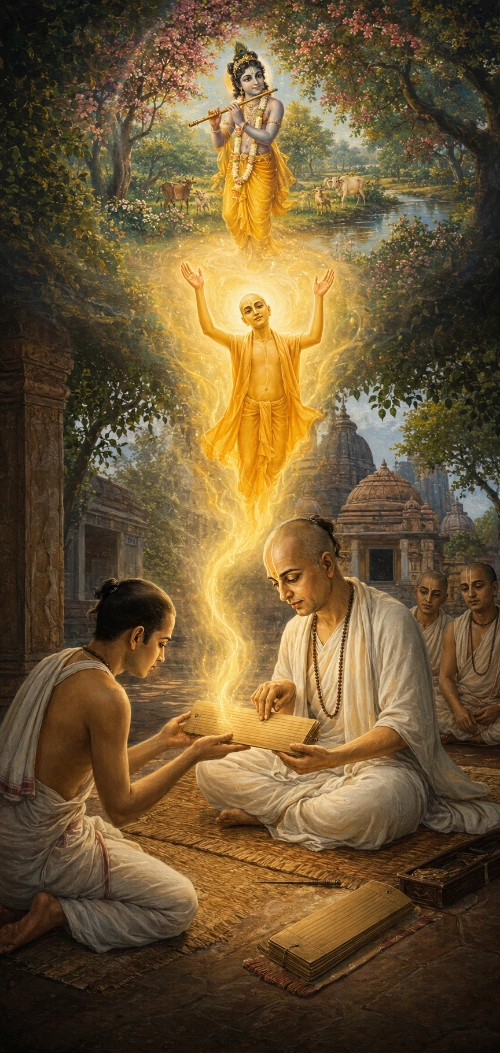
Who Is Qualified to Write About Kṛṣṇa?
One verse of the Caitanya-caritāmṛta is quoted, often, as a simple authorisation to write about Kṛṣṇa: if Śrī Caitanya is your life and soul, you may describe Kṛṣṇa and Caitanya. There is truth in that reading, and it is incomplete. Verse 106 does not stand alone. It falls in the middle of a serious warning by Svarūpa Dāmodara about what goes wrong when someone writes about Kṛṣṇa without understanding theology, rasa, scripture and the nature of the Lord.
কৃষ্ণলীলা, গৌরলীলা সে করে বর্ণন ।
গৌর-পাদপদ্ম যাঁর হয় প্রাণ-ধন ॥ ১০৬ ॥
kṛṣṇa-līlā, gaura-līlā se kare varṇana
gaura-pāda-padma yāṅra haya prāṇa-dhana
“That person describes Kṛṣṇa-līlā and Gaura-līlā for whom the lotus feet of Gaura are the treasure of life.” — Śrī Caitanya-caritāmṛta, Antya-līlā 5.106
The chapter around it does something more interesting still. In its first half we meet a man who looks unqualified and is in fact deeply qualified. In its second half we meet a man who looks qualified and is not yet qualified. The first is Rāmānanda Rāya; the second is an unnamed Bengali poet. Put the two together and the lesson of Antya-līlā 5 comes clear: when speaking or writing about Kṛṣṇa, outward appearance, sincerity and literary beauty are not enough — one must also understand what one is talking about. And at the same time, ignorance does not place a person beyond mercy. That balance is the heart of the chapter.
Two Men, Two Opposite Mistakes
The fifth chapter of the Antya-līlā opens with Pradyumna Miśra, who wants to hear about Kṛṣṇa. Śrī Caitanya does something surprising: instead of speaking to him himself, he sends him to Rāmānanda Rāya. When Pradyumna Miśra arrives, what he sees disturbs him. Rāmānanda is training two young temple dancers, teaching them to sing and dance the songs of a drama he composed himself.
সেই দুঁহে লঞা রায় নিভৃত উদ্যানে ।
নিজ-নাটক-গীতের শিখায় নর্তনে ॥ ১৪ ॥
sei duṅhe lañā rāya nibhṛta udyāne
nija-nāṭaka-gītera śikhāya nartane
“Taking those two with him into a secluded garden, Rāya instructed them in dancing to the songs of his own drama.” — Antya-līlā 5.14
To an ordinary observer the situation looks questionable, and Pradyumna Miśra returns without hearing anything. Śrī Caitanya sends him back. Rāmānanda’s consciousness cannot be judged by outward appearances: he is wholly absorbed in spiritual rasa and remains internally untouched while doing something that would disturb an ordinary practitioner. Śrī Caitanya himself hears Kṛṣṇa-kathā from him. So the first lesson of the chapter is that a person may look unqualified to ordinary eyes and be profoundly qualified.
Then the chapter turns the situation around. A Bengali brāhmaṇa arrives in Purī with a drama about Śrī Caitanya. The work sounds excellent. Devotees hear it, like it, praise it, and everyone wants Mahāprabhu to hear it. This time the apparent qualification is the misleading thing, because the poet has made a serious theological mistake. The second lesson is the exact opposite of the first: a person may sound qualified and still misunderstand the very subject he is describing.
The two stories belong together. Rāmānanda’s outward situation looks dangerous while his inner understanding is pure; the Bengali poet’s words sound beautiful while underneath them lies a mistaken conception of God. That is the setting in which Antya 5.106 should be read.
The Poet Arrives in Purī
Kṛṣṇadāsa Kavirāja never gives the poet’s name. He tells us only that a brāhmaṇa from Bengal arrived with a drama about Śrī Caitanya.
বঙ্গদেশী এক বিপ্র প্রভুর চরিতে ।
নাটক করি’ লঞা আইল প্রভুকে শুনাইতে ॥ ৯১ ॥
baṅga-deśī eka vipra prabhura carite
nāṭaka kari’ lañā āila prabhuke śunāite
“A certain brāhmaṇa from Bengal composed a drama about the Lord’s activities and came to have the Lord hear it.” — Antya-līlā 5.91
The poet stays with Bhagavān Ācārya, who hears the drama and likes it. Other devotees listen as well, and their judgement is enthusiastic.
সবেই প্রশংসে নাটক ‘পরম উত্তম’ ।
মহাপ্রভুরে শুনাইতে সবার হৈল মন ॥ ৯৪ ॥
sabei praśaṁse nāṭaka ‘parama uttama’
mahāprabhure śunāite sabāra haila mana
“Everyone praised the drama as supremely excellent, and they all desired that Mahāprabhu hear it.” — Antya-līlā 5.94
This matters. These are not hostile critics. They are devotees, they hear something devotional and beautiful, and they sincerely approve. Sincere approval is not always enough.
Everything Passed Through Svarūpa First
There was a safeguard in Purī. Anyone who brought a new song, poem, book or drama about Śrī Caitanya presented it first to Svarūpa Dāmodara.
গীত, শ্লোক, গ্রন্থ, কবিত্ব — যেই করি’ আনে ।
প্রথমে শুনায় সেই স্বরূপের স্থানে ॥ ৯৫ ॥
স্বরূপ-ঠাঞি উত্তরে যদি, লঞা তাঁর মন ।
তবে মহাপ্রভু-ঠাঞি করায় শ্রবণ ॥ ৯৬ ॥
gīta, śloka, grantha, kavitva — yei kari’ āne
prathame śunāya sei svarūpera sthāne
svarūpa-ṭhāñi uttare yadi, lañā tāṅra mana
tabe mahāprabhu-ṭhāñi karāya śravaṇa
“Whoever brought a song, Sanskrit verse, book or poem first had it heard before Svarūpa. If Svarūpa approved it, then it could be presented for Mahāprabhu to hear.” — Antya-līlā 5.95–96
Why was such a filter necessary? Because devotional literature can carry two dangerous kinds of error.
‘রসাভাস’ হয় যদি ‘সিদ্ধান্তবিরোধ’ ।
সহিতে না পারে প্রভু, মনে হয় ক্রোধ ॥ ৯৭ ॥
rasābhāsa haya yadi siddhānta-virodha
sahite nā pāre prabhu, mane haya krodha
“If there is rasābhāsa or contradiction of siddhānta, the Lord cannot tolerate it.” — Antya-līlā 5.97
Svarūpa Dāmodara’s Warning
Bhagavān Ācārya asks Svarūpa to hear the new drama. Svarūpa refuses at first, and then explains why.
‘যদ্বা-তদ্বা’ কবির বাক্যে হয় ‘রসাভাস’ ।
সিদ্ধান্তবিরুদ্ধ শুনিতে না হয় উল্লাস ॥ ১০২ ॥
‘রস’, ‘রসাভাস’ যার নাহিক বিচার ।
ভক্তিসিদ্ধান্ত-সিন্ধু নাহি পায় পার ॥ ১০৩ ॥
yadvā-tadvā kavira vākye haya rasābhāsa
siddhānta-viruddha śunite nā haya ullāsa
rasa, rasābhāsa yāra nāhika vicāra
bhakti-siddhānta-sindhu nāhi pāya pāra
“In the words of an undiscerning poet, rasābhāsa may arise, and there is no joy in hearing something contrary to siddhānta. One who cannot distinguish rasa from rasābhāsa cannot cross the ocean of devotional conclusions.” — Antya-līlā 5.102–103
The load-bearing word is vicāra — discernment, careful judgement. Svarūpa’s complaint is not that the poet lacks talent. It is deeper than that: he does not yet know how to tell the true from the false in the very matters he is trying to describe. Then Svarūpa raises technical learning as well.
vyākaraṇa nāhi jāne, nā jāne alaṅkāra
nāṭakālaṅkāra-jñāna nāhika yāhāra
kṛṣṇa-līlā varṇite nā jāne sei chāra
viśeṣe durgama ei caitanya-vihāra
“One who does not know grammar, does not know poetic ornament and has no knowledge of the literary principles of drama does not know how to describe Kṛṣṇa-līlā. The pastimes of Caitanya are especially difficult to understand.” — Antya-līlā 5.104–105
And the famous verse follows immediately on that. Read in place, its meaning changes. Svarūpa has not said “you need only devotion.” He has just spoken about rasa, rasābhāsa, siddhānta, grammar, poetry, drama and the exceptional difficulty of understanding Caitanya-līlā — and then he adds the deepest condition of all: Gaura’s lotus feet must be one’s prāṇa-dhana, the treasure of one’s life. The technical and the devotional belong together.
Verse 106 Is Bengali, Not Sanskrit
A small textual point is worth making, because this verse is sometimes presented as though it were a Sanskrit śloka. It is not. Most of the Caitanya-caritāmṛta is written in Bengali couplets with Sanskrit verses inserted throughout, and 5.106 belongs to Kṛṣṇadāsa Kavirāja’s Bengali narration.
Its vocabulary is heavily Sanskrit-derived — kṛṣṇa-līlā, gaura-līlā, varṇana, pāda-padma, prāṇa-dhana — but its grammar is Bengali: se kare, “that person does or describes”; yāṅra haya, “for whom it is.” This matters mainly for accurate reading. The sentence is Kṛṣṇadāsa Kavirāja’s own theological statement in Bengali, not an embedded Sanskrit quotation from an older scripture.
What the Verse Actually Says
Why Gaura Matters When Writing About Kṛṣṇa
In Gauḍīya theology, Caitanya is not simply another saint teaching people about Kṛṣṇa. He is Kṛṣṇa himself, seeking to taste Śrī Rādhā’s love. Kṛṣṇadāsa Kavirāja states the idea at the very beginning of the Caitanya-caritāmṛta.
श्रीराधायाः प्रणयमहिमा कीदृशो वानयैवा-
स्वाद्यो येनाद्भुतमधुरिमा कीदृशो वा मदीयः ।
सौख्यञ्चास्या मदनुभवतः कीदृशं वेति लोभा-
त्तद्भावाढ्यः समजनि शचीगर्भसिन्धौ हरीन्दुः ॥ ६ ॥
śrī-rādhāyāḥ praṇaya-mahimā kīdṛśo vānayaivā-
svādyo yenādbhuta-madhurimā kīdṛśo vā madīyaḥ
saukhyaṁ cāsyā mad-anubhavataḥ kīdṛśaṁ veti lobhāt
tad-bhāvāḍhyaḥ samajani śacī-garbha-sindhau harīnduḥ
“Longing to understand the greatness of Śrī Rādhā’s love, the sweetness in himself that she alone tastes through that love, and the happiness she experiences in tasting him, Hari appeared from the ocean of Śacī’s womb, enriched with her mood.” — Caitanya-caritāmṛta, Ādi-līlā 1.6
This is why Gaura’s shelter carries such weight in the tradition. Through Caitanya the devotee learns how Gauḍīyas understand the particular sweetness of Kṛṣṇa in Vraja, the unique love of Śrī Rādhā, the moods of Kṛṣṇa’s intimate devotees, the proper way of approaching these subjects at all, and the difference between spiritual love and ordinary material emotion.
So verse 106 is not saying: love Caitanya, then write whatever comes into your mind. It says something closer to this — that genuine description of Kṛṣṇa and Gaura arises from a life deeply rooted in the shelter of Gaura, and the surrounding verses show what such shelter must grow into.
The Standard Is Rūpa Gosvāmī
গ্রাম্য-কবির কবিত্ব শুনিতে হয় ‘দুঃখ’ ।
বিদগ্ধ-আত্মীয়-বাক্য শুনিতে হয় ‘সুখ’ ॥ ১০৭ ॥
grāmya-kavira kavitva śunite haya duḥkha
vidagdha-ātmīya-vākya śunite haya sukha
“Hearing the poetry of a mundane poet brings pain; hearing the words of a refined intimate brings joy.” — Antya-līlā 5.107
Grāmya here should not be read as “someone who lives in a village.” It carries the sense of the mundane, the ordinary, the worldly. And then Svarūpa gives a concrete example of what he means by a qualified devotional dramatist.
রূপ যৈছে দুই নাটক করিয়াছে আরম্ভে ।
শুনিতে আনন্দ বাড়ে যার মুখবন্ধে ॥ ১০৮ ॥
rūpa yaiche dui nāṭaka kariyāche ārambhe
śunite ānanda bāḍe yāra mukha-bandhe
“Consider the two dramas begun by Rūpa: even hearing their introductory portions increases joy.” — Antya-līlā 5.108
The two dramas are Rūpa Gosvāmī’s Vidagdha-mādhava and Lalita-mādhava. With that, the shape of the argument running through 5.102–108 is easy to see.
- One must distinguish rasa from rasābhāsa.
- One must not contradict siddhānta.
- One should understand the literary form one is using.
- Gaura’s feet must be the treasure of one’s life.
- Rūpa Gosvāmī is given as the positive example.
Verse 106 is therefore not an isolated licence. It is one clause in a description of qualification.
“Explain What You Mean”
Bhagavān Ācārya keeps pressing, and eventually Svarūpa agrees to hear the work. The poet recites his opening Sanskrit invocation and everyone likes it. What Svarūpa does next is very revealing: he does not condemn the verse. He asks the poet to explain it.
শ্লোক শুনি’ সর্বলোক তাহারে বাখানে ।
স্বরূপ কহে, — ‘এই শ্লোক করহ ব্যাখ্যানে’ ॥ ১১৩ ॥
śloka śuni’ sarva-loka tāhāre vākhāne
svarūpa kahe — ei śloka karaha vyākhyāne
“Hearing the verse, everyone praised him. Svarūpa said, ‘Explain this verse.’” — Antya-līlā 5.113
That question is what exposes the problem.
কবি কহে, — “জগন্নাথ — সুন্দর-শরীর ।
চৈতন্য-গোসাঞি — শরীরী মহাধীর ॥ ১১৪ ॥
kavi kahe — jagannātha sundara-śarīra
caitanya-gosāñi śarīrī mahā-dhīra
“The poet said: ‘Jagannātha is the beautiful body, and Caitanya Gosāñi is the great person who possesses that body.’” — Antya-līlā 5.114
শুনিয়া সবার হৈল আনন্দিত-মন ।
দুঃখ পাঞা স্বরূপ কহে সক্রোধ বচন ॥ ১১৬ ॥
śuniyā sabāra haila ānandita-mana
duḥkha pāñā svarūpa kahe sakrodha vacana
“Hearing this, everyone’s mind became joyful. Svarūpa, however, became pained and spoke angrily.” — Antya-līlā 5.116
The whole lesson of the chapter sits in that one contrast. Everyone likes the verse. Svarūpa understands what it implies.
What Was Wrong With the Poet’s Idea
The poet had separated Jagannātha from Jagannātha’s body: Jagannātha is the body, Caitanya is the conscious person occupying it. It sounds poetic, and Svarūpa sees a serious theological problem in it.
That kind of distinction does hold in our conditioned experience. I have a body; my body changes; it can grow old or diseased; eventually it dies while the soul continues. For an ordinary embodied being, the person and the material body are not identical. Gauḍīya theology does not apply that structure to Bhagavān.
পূর্ণানন্দ-চিৎস্বরূপ জগন্নাথ-রায় ।
তাঁরে কৈলি জড়-নশ্বর-প্রাকৃত-কায় ॥ ১১৮ ॥
pūrṇānanda-cit-svarūpa jagannātha-rāya
tāṅre kaili jaḍa-naśvara-prākṛta-kāya
“Lord Jagannātha is by nature full consciousness and full bliss, yet you have made him into a dull, perishable material body.” — Antya-līlā 5.118
And then he states the charge explicitly.
আর এক করিয়াছ পরম ‘প্রমাদ’ ।
দেহ-দেহি-ভেদ ঈশ্বরে কৈলে ‘অপরাধ’ ॥ ১২১ ॥
ঈশ্বরের নাহি কভু দেহ-দেহি-ভেদ ।
স্বরূপ, দেহ, — চিদানন্দ, নাহিক বিভেদ ॥ ১২২ ॥
āra eka kariyācha parama pramāda
deha-dehi-bheda īśvare kaile aparādha
īśvarera nāhi kabhu deha-dehi-bheda
svarūpa, deha — cid-ānanda, nāhika vibheda
“You have made another very serious mistake: you have created a distinction between the Lord and his body. In the Lord there is never a distinction between body and embodied person. His nature and his form are consciousness and bliss, without division.” — Antya-līlā 5.121–122
The same principle has its most famous expression in the Brahma-saṁhitā.
ईश्वरः परमः कृष्णः
सच्चिदानन्दविग्रहः ।
अनादिरादिर्गोविन्दः
सर्वकारणकारणम् ॥
īśvaraḥ paramaḥ kṛṣṇaḥ
sac-cid-ānanda-vigrahaḥ
anādir ādir govindaḥ
sarva-kāraṇa-kāraṇam
“Kṛṣṇa is the Supreme Lord, whose very form is eternal being, consciousness and bliss. He is beginningless, the origin of all, Govinda, the cause of all causes.” — Brahma-saṁhitā 5.1
The word doing the work is vigraha, form. Kṛṣṇa does not possess a material body in the way we do; his divine form is itself sat-cit-ānanda. So the Bengali poet’s problem was not a lack of devotion. His problem was that a beautiful metaphor carried a false idea about Bhagavān.
Good Poetry Can Still Say Something False
This is one of the most useful lessons in the chapter. The verse was not crude. It was devotional, people enjoyed it, and the author plainly meant to praise Jagannātha and Caitanya. Yet his own explanation showed that he did not fully understand the theological meaning of his own words — which is precisely why Svarūpa asked him to explain them. The problem was not the sentence. It was the conception behind the sentence.
A metaphor does not become true because it is beautiful, and a statement does not become theologically sound because its author means well. This is what knowledge of siddhānta is for.
Śāstra Is Not the Enemy of Devotion
Rūpa Gosvāmī makes a related point in the Bhakti-rasāmṛta-sindhu by quoting the Brahma-yāmala.
श्रुतिस्मृतिपुराणादि-
पञ्चरात्रविधिं विना ।
ऐकान्तिकी हरेर्भक्तिर्
उत्पातायैव कल्पते ॥
śruti-smṛti-purāṇādi-
pañcarātra-vidhiṁ vinā
aikāntikī harer bhaktir
utpātāyaiva kalpate
“Exclusive devotion to Hari that disregards the guidance of śruti, smṛti, the Purāṇas and the Pañcarātra becomes a disturbance.” — Brahma-yāmala, quoted at Bhakti-rasāmṛta-sindhu 1.2.101
Worth being exact here: this is often called “a verse by Rūpa Gosvāmī.” Rūpa quotes it, and he explicitly attributes it to the Brahma-yāmala.
The principle is simple enough. Devotion does not mean that whatever I sincerely feel must therefore be true. Śāstra is what protects devotion from becoming private imagination.
But What About Imperfect Writing?
At this point a reasonable objection arises. Does the Śrīmad-Bhāgavatam not say that even badly composed glorification of Hari is accepted by saintly people? It does. Nārada says to Vyāsa:
न यद्वचश्चित्रपदं हरेर्यशो
जगत्पवित्रं प्रगृणीत कर्हिचित् ।
तद्वायसं तीर्थमुशन्ति मानसा
न यत्र हंसा निरमन्त्युशिक्क्षयाः ॥
na yad vacaś citra-padaṁ harer yaśo
jagat-pavitraṁ pragṛṇīta karhicit
tad vāyasaṁ tīrtham uśanti mānasā
na yatra haṁsā niramanty uśik-kṣayāḥ
“Words that do not proclaim the world-purifying glory of Hari, however beautifully composed, are regarded by the pure-minded as a place fit for crows rather than swans.” — Śrīmad-Bhāgavatam 1.5.10
तद्वाग्विसर्गो जनताघविप्लवो
यस्मिन्प्रतिश्लोकमबद्धवत्यपि ।
नामान्यनन्तस्य यशोऽङ्कितानि यत्
शृण्वन्ति गायन्ति गृणन्ति साधवः ॥
tad-vāg-visargo janatāgha-viplavo
yasmin prati-ślokam abaddhavaty api
nāmāny anantasya yaśo-‘ṅkitāni yat
śṛṇvanti gāyanti gṛṇanti sādhavaḥ
“But that creation of words which brings about a revolution in the sinful lives of people — where the names of the Infinite Lord and his glories appear verse after verse, even if the composition is imperfect — is heard, sung and repeated by saintly persons.” — Śrīmad-Bhāgavatam 1.5.11
Does this contradict Svarūpa? No — the two passages address different kinds of imperfection. The Bhāgavatam forgives poor literary craftsmanship: awkward wording, imperfect metre, an author who is no literary genius. None of that makes genuine glorification of Hari worthless. Svarūpa is dealing with something else, a false conception about the nature of Bhagavān. A simple poem can be true and a brilliant poem can be false. Literary weakness and theological error are not the same thing.
Sarasvatī Rescues Words the Poet Misunderstood
Svarūpa’s response is severe, and the story does not end in condemnation. After correcting the poet, he shows that the man’s own words can nevertheless be read in an orthodox sense.
তুমি যৈছে-তৈছে কহ, না জানিয়া রীতি ।
সরস্বতী সেই-শব্দে করিয়াছে স্তুতি ॥ ১৩৫ ॥
tumi yaiche-taiche kaha, nā jāniyā rīti
sarasvatī sei-śabde kariyāche stuti
“You have spoken without properly understanding the method, but Sarasvatī has nevertheless produced praise through those very words.” — Antya-līlā 5.135
Svarūpa then gives examples of people who spoke against Kṛṣṇa and whose words could still be understood in a glorifying sense, and finally he returns to the poet’s verse. Jagannātha and Caitanya are not to be understood as a material body and the soul occupying it; they are the same Kṛṣṇa appearing in two ways. Jagannātha remains in the temple, Caitanya moves among people, and in this way those who cannot come to Jagannātha may still be reached by the Lord.
The distinction being drawn here is subtle and important. Svarūpa does not say that the mistaken idea was secretly correct because the poet was sincere. He says something more merciful than that: your understanding was mistaken, and your words can nevertheless be understood truthfully. Sincerity did not turn error into truth. Grace found truth even inside imperfect words.
Hearing Comes Before Independent Description
Earlier in the chapter Kṛṣṇadāsa quotes one of the most famous verses concerning the rāsa-līlā.
विक्रीडितं व्रजवधूभिरिदं च विष्णोः
श्रद्धान्वितोऽनुशृणुयादथ वर्णयेद्यः ।
भक्तिं परां भगवति प्रतिलभ्य कामं
हृद्रोगमाश्वपहिनोत्यचिरेण धीरः ॥
vikrīḍitaṁ vraja-vadhūbhir idaṁ ca viṣṇoḥ
śraddhānvito ‘nuśṛṇuyād atha varṇayed yaḥ
bhaktiṁ parāṁ bhagavati pratilabhya kāmaṁ
hṛd-rogam āśv apahinoty acireṇa dhīraḥ
“The sober person who faithfully hears or describes this play of Viṣṇu with the women of Vraja attains supreme devotion to Bhagavān and quickly casts away lust, the disease of the heart.” — Śrīmad-Bhāgavatam 10.33.39, quoted at Antya-līlā 5.48
We should be careful not to make the Sanskrit say more than it does. The verse speaks of hearing and describing; the word atha does not by itself establish a rigid chronological rule that everyone must first hear and only afterwards speak.
The larger Gauḍīya principle is unmistakable all the same: Kṛṣṇa-līlā is something received, not invented. By the end of the chapter Svarūpa makes that principle completely explicit.
Svarūpa Does Not Tell the Poet to Stop
This may be the most important part of the story. Svarūpa has exposed the error. What now? He does not say “you have no right to speak about Kṛṣṇa again.” He gives the man a path forward.
যাহ, ভাগবত পড় বৈষ্ণবের স্থানে ।
একান্ত আশ্রয় কর চৈতন্য-চরণে ॥ ১৩১ ॥
yāha, bhāgavata paḍa vaiṣṇavera sthāne
ekānta āśraya kara caitanya-caraṇe
“Go. Study the Bhāgavata in the presence of a Vaiṣṇava, and take exclusive shelter of Caitanya’s feet.” — Antya-līlā 5.131
চৈতন্যের ভক্তগণের নিত্য কর ‘সঙ্গ’ ।
তবেত জানিবা সিদ্ধান্তসমুদ্র-তরঙ্গ ॥ ১৩২ ॥
caitanyera bhakta-gaṇera nitya kara saṅga
tabeta jānibā siddhānta-samudra-taraṅga
“Constantly associate with the devotees of Caitanya. Then you will understand the waves of the ocean of siddhānta.” — Antya-līlā 5.132
তবেত পাণ্ডিত্য তোমার হইবে সফল ।
কৃষ্ণের স্বরূপ-লীলা বর্ণিবা নির্মল ॥ ১৩৩ ॥
tabeta pāṇḍitya tomāra ha-ibe saphala
kṛṣṇera svarūpa-līlā varṇibā nirmala
“Then your learning will become fruitful, and you will describe Kṛṣṇa’s nature and pastimes purely.” — Antya-līlā 5.133
This is not a rejection of scholarship. Svarūpa does not say “forget your learning”; he says your learning can become fruitful. What it needs is a sequence.
Shelter, then hearing, then association, then understanding, then purified description. That is Svarūpa’s curriculum.
Verse 106 in Its Place
We can now return to the verse. It does not mean that anyone who feels love for Caitanya may confidently invent descriptions of Kṛṣṇa; nor does it mean that only trained Sanskrit scholars may speak about him. Both conclusions miss the story. The chapter asks for an inner qualification and an outer discipline at once.
The inner qualification is devotion — gaura-pāda-padma yāṅra haya prāṇa-dhana, Gaura’s feet as the treasure of one’s life. The outer discipline includes hearing, scripture, Vaiṣṇava association, siddhānta, discernment of rasa, and, where it applies, literary knowledge. Technical skill by itself is not sufficient. Devotional sincerity by itself is no guaranteed protection against theological error. The two have to meet.
Why the First Half of the Chapter Matters
We can now see why the story of Rāmānanda Rāya comes first. He is not a random figure placed before the Bengali poet. He is very nearly the poet’s mirror image. Rāmānanda is also a dramatist; he composes devotional drama, he trains performers, he understands emotional expression in extraordinary detail — and from the outside his behaviour makes Pradyumna Miśra doubt him.
The Bengali poet is the reverse. From the outside everything looks excellent: he is a brāhmaṇa, he has written a devotional drama, devotees praise it, his Sanskrit invocation sounds impressive. And Svarūpa finds that the conception underneath is wrong.
So the chapter issues two warnings at once. Do not reject spiritual qualification merely because appearances confuse you; and do not assume spiritual qualification merely because something looks impressive and devotional. In the first case an ordinary observer mistrusts the genuine article. In the second an entire room of devotees initially trusts something defective. The answer to both mistakes is the same: deeper discernment.
What “Gaura’s Feet Are My Life” Includes
Read in context, prāṇa-dhana turns out to be much richer than emotional enthusiasm. It includes at least the following.
The Poet’s Response
The poet could have argued. He could have taken offence. He could have said that everyone else liked his drama. He does none of it.
তবে সেই কবি সবার চরণে পড়িয়া ।
সবার শরণ লৈল দন্তে তৃণ লঞা ॥ ১৫৬ ॥
tabe sei kavi sabāra caraṇe paḍiyā
sabāra śaraṇa laila dante tṛṇa lañā
“Then the poet fell at everyone’s feet and took shelter of them all, holding straw between his teeth.” — Antya-līlā 5.156
Straw between the teeth is a traditional gesture of extreme humility. And then something remarkable happens.
তবে সব ভক্ত তারে অঙ্গীকার কৈলা ।
তার গুণ কহি’ মহাপ্রভুরে মিলাইলা ॥ ১৫৭ ॥
tabe saba bhakta tāre aṅgīkāra kailā
tāra guṇa kahi’ mahāprabhure milāilā
“Then all the devotees accepted him, spoke of his good qualities and brought him to Mahāprabhu.” — Antya-līlā 5.157
The poet reaches Caitanya. The narrative does not say that his drama was subsequently approved or presented; it tells us that the poet himself was accepted. That distinction is a beautiful one. A person can be mistaken without being rejected, correction is not the opposite of mercy, and in this story correction becomes the road to mercy.
Kṛṣṇadāsa’s Final Judgement
প্রস্তাবে কহিলুঁ কবির নাটক-বিবরণ ।
অজ্ঞ হঞা শ্রদ্ধায় পাইল প্রভুর চরণ ॥ ১৬১ ॥
prastāve kahiluṅ kavira nāṭaka-vivaraṇa
ajña hañā śraddhāya pāila prabhura caraṇa
“In passing I have told the account of the poet’s drama. Though ignorant, through faith he obtained the Lord’s feet.” — Antya-līlā 5.161
This may be the most important verse to set beside 5.106. The poet is called ajña, ignorant; Kṛṣṇadāsa does not pretend the mistake was harmless or secretly correct. But the same man possesses śraddhā, faith — and through that faith, expressed as humility and a willingness to take shelter, he reaches the Lord’s feet.
So the lesson is neither that sincerity makes whatever you write correct, nor that a theological mistake disqualifies you from devotion. The chapter teaches something more balanced than either: faith can bring an ignorant person to the Lord, and faith is also what makes that person willing to learn.
What This Means for Devotional Writing Today
The situation described in Antya-līlā 5 has only become more relevant. Anyone can publish instantly. A story can be copied thousands of times before anyone asks where it came from. A beautiful quotation circulates without a source. A traditional oral story slowly comes to be presented as a verse from the Bhāgavatam. An author’s meditation turns into “what happened in Kṛṣṇa-līlā” after enough people repeat it. Artificial intelligence makes this easier still: a fluent text can look learned and authentic while quietly mixing scripture, commentary, folklore and invention.
Svarūpa’s principle offers a practical remedy. A devotional writer should make plain what kind of statement is being made.
- directly stated in scripture;
- explained in a recognised commentary;
- found in a later devotional text;
- preserved in a particular oral tradition;
- a literary reconstruction;
- a personal meditation or imaginative expansion.
Devotional creativity is not the problem. Poetry, drama and imaginative literature have always existed within Vaiṣṇava traditions — Rūpa Gosvāmī wrote dramas, and so did Rāmānanda Rāya. The problem is confusing what we received with what we added ourselves. If a dialogue is invented for literary purposes, it should not quietly become “the words Kṛṣṇa spoke.” If scenery is reconstructed, it should not be presented as though the Bhāgavatam describes it. If a detail comes from a later text, it should not be attributed to an earlier one. Keeping those boundaries visible is one modern way of practising the care Svarūpa demanded in Purī.
Principal Scriptural Sources
Antya-līlā 5.106 is a beautiful verse and should not be weakened — but neither should it be separated from the conversation in which Svarūpa Dāmodara speaks it. The person for whom Gaura’s lotus feet are the treasure of life describes Kṛṣṇa-līlā and Gaura-līlā. What such shelter looks like in practice, the same chapter answers: study the Bhāgavata, hear from Vaiṣṇavas, remain in the company of devotees, learn siddhānta, learn to distinguish rasa from rasābhāsa, accept correction, let learning become fruitful, and then describe Kṛṣṇa purely. The unnamed Bengali poet fails the test at first and does not fail the story. He is corrected, he becomes humble, he takes shelter, the devotees accept him, and he reaches Mahāprabhu. The error is not accepted, but the person is. One should therefore neither distrust genuine spiritual depth because it does not fit one’s expectations, nor trust beautiful devotional language merely because it moves the heart. Devotion needs truth, learning needs devotion, and sincere devotional writing grows where the two meet.