

“This Sweetness Is Not Even in Nārāyaṇa”
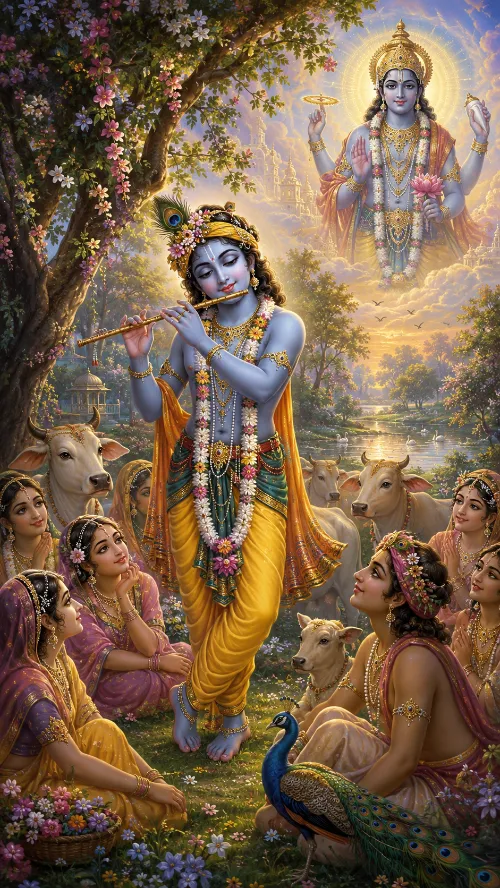
When God Allows His Own Majesty to Recede
Śrī Caitanya Mahāprabhu tells Sanātana Gosvāmī:
যে মাধুরীর ঊর্ধ্ব আন, নাহি যার সমান,
পরব্যোমে স্বরূপের গণে ।
যেঁহো সব-অবতারী, পরব্যোম-অধিকারী,
এ মাধুর্য নাহি নারায়ণে ॥
ye mādhurīra ūrdhva āna, nāhi yāra samāna,
paravyome svarūpera gaṇe
yeṅho saba-avatārī, paravyoma-adhikārī,
e mādhurya nāhi nārāyaṇe
Śrī Caitanya-caritāmṛta, Madhya 21.115
A fairly close translation would be: “There is no sweetness above this sweetness, nor anything equal to it among the Lord’s personal forms in the spiritual sky. Even Nārāyaṇa — the Lord of the spiritual sky and the source of the avatāras within His expansionary order — does not manifest this particular mādhurya.” A.C. Bhaktivedanta Swami Prabhupāda translates more interpretively:
“The sweetness of Kṛṣṇa’s beauty enjoyed by the gopīs is unparalleled. Nothing is equal to or greater than such ecstatic sweetness. Even the predominating Deities of the Vaikuṇṭha planets, the Nārāyaṇas, do not possess such sweetness. Indeed, none of the incarnations of Kṛṣṇa up to Nārāyaṇa possess such transcendental beauty.”
The reference to the gopīs does not occur explicitly in the Bengali words of the verse; it comes from the preceding lines, so the translation is contextual rather than strictly word-for-word. But what exactly does Mahāprabhu mean by e mādhurya nāhi nārāyaṇe, “this mādhurya is not even manifest in Nārāyaṇa”? Surely Nārāyaṇa is infinitely beautiful. The answer lies in the Gauḍīya distinction between divine majesty and divine sweetness expressed through intimacy.
What Does Mādhurya Mean?
The key word is:
মাধুর্য
mādhurya
Literally it can mean sweetness, charm, loveliness, delightful beauty. But in Gauḍīya theology mādhurya means much more than attractive physical appearance. It describes a mode of divine self-revelation in which Bhagavān’s infinite majesty becomes concealed beneath extraordinary intimacy.
Kṛṣṇa remains the Supreme Lord. Yet in Vraja Yaśodā binds Him with rope, Nanda worries about Him, His cowherd friends climb upon His shoulders, the gopīs quarrel with Him and Śrī Rādhā becomes angry with Him. He steals butter, herds cows, plays the flute, decorates Himself with forest flowers, and allows Himself to become dependent upon the love of His devotees.
His aiśvarya, divine majesty, has not disappeared. But it no longer dominates the relationship: it recedes behind affection, familiarity, playfulness, belonging and prema. That concealment of majesty within intimacy is one of the deepest meanings of Vraja-mādhurya.
Mādhurya as the Essence of Bhagavattā
Immediately before this section Mahāprabhu makes an astonishing statement:
মাধুর্য ভগবত্তা-সার, ব্রজে কৈল পরচার ।
mādhurya bhagavattā-sāra, vraje kaila paracāra
“Mādhurya is the essence of Bhagavattā, and it is manifested in Vraja.”
Caitanya-caritāmṛta, Madhya 21.110
One might expect the highest display of Godhood to consist in the greatest possible display of power — creating universes, possessing infinite majesty, commanding cosmic energies, receiving universal worship. Gauḍīya theology gives a surprising answer. The deepest revelation of Bhagavān is not merely that He possesses unlimited power, but that the unlimited Lord can enter relationships so intimate that His devotees are not psychologically dominated by awareness of His Godhood.
And in Gauḍīya rasa-theology mādhurya does not destroy aiśvarya. It contains it, while allowing love to become more prominent than majesty.
The Bhāgavata Foundation
Mahāprabhu does not introduce this idea without scriptural foundation. Just before the verse He quotes a celebrated line spoken by the women of Mathurā when they see Kṛṣṇa in the wrestling arena:
गोप्यस्तपः किमचरन् यदमुष्य रूपं
लावण्यसारमसमोर्ध्वमनन्यसिद्धम् ।
दृग्भिः पिबन्त्यनुसवाभिनवं दुराप-
मेकान्तधाम यशसः श्रिय ऐश्वरस्य ॥
gopyas tapaḥ kim acaran yad amuṣya rūpaṁ
lāvaṇya-sāram asamordhvam ananya-siddham
dṛgbhiḥ pibanty anusavābhinavaṁ durāpam
ekānta-dhāma yaśasaḥ śriya aiśvarasya
“What austerities must the gopīs have performed? With their eyes they continually drink Kṛṣṇa’s form—the essence of loveliness, without equal or superior, dependent on nothing else for its perfection, ever newly beautiful, exceedingly difficult to attain, and the unique abode of glory, beauty and opulence.”
Śrīmad-Bhāgavatam 10.44.14
Four expressions in it illuminate the claim directly.
Lāvaṇya-sāram — the essence of loveliness
The Bhāgavata calls Kṛṣṇa’s form:
लावण्यसारम्
lāvaṇya-sāram
— not merely “very beautiful.” Beauty itself seems to have been distilled to its essence and then to have taken personal form as Kṛṣṇa.
Asamordhvam — without equal or superior
The next expression is the crucial one:
असमोर्ध्वम्
asamordhvam
It conveys no equal and nothing higher. Mahāprabhu’s Bengali almost unfolds this Sanskrit compound:
ye mādhurīra ūrdhva āna, nāhi yāra samāna
“There is nothing above this sweetness and nothing equal to it.”
The verse is therefore not introducing an unrelated theological claim. It expands the Bhāgavata’s asamordhvam.
Ananya-siddham — self-perfect beauty
Another extraordinary expression is:
अनन्यसिद्धम्
ananya-siddham
— literally “not perfected by another.” Kṛṣṇa’s beauty does not become complete because jewels, garments, cosmetics or flowers are placed upon Him. Rather, the ornaments themselves become more beautiful because they touch Him. His beauty is self-perfect: He does not require ornamentation to become attractive. The ornaments require Him.
Anusavābhinavam — beauty that is ever new
Kṛṣṇa’s beauty is also:
अनुसवाभिनवम्
anusavābhinavam
— ever fresh, new again and again. Ordinary beauty tends to become familiar; even something extraordinary gradually loses some of its novelty when repeatedly seen. Kṛṣṇa’s beauty is described as working in the opposite way: the more He is seen, the more unprecedented He appears, and each vision produces a deeper thirst for another. That is why the gopīs dṛgbhiḥ pibanti, “drink Him with their eyes” — and are never satisfied.
Mahāprabhu Enters the Astonishment of the Verse
After quoting the Bhāgavata, Mahāprabhu becomes emotionally absorbed in it:
সখি হে, কোন্ তপ কৈল গোপীগণ ।
কৃষ্ণরূপ-সুমাধুরী, পিবি’ পিবি’ নেত্র ভরি’,
শ্লাঘ্য করে জন্ম-তনু-মন ॥
sakhi he, kon tapa kaila gopī-gaṇa
kṛṣṇa-rūpa-sumādhurī, pibi’ pibi’ netra bhari’
ślāghya kare janma-tanu-mana
“O friend! What austerities did the gopīs perform? Again and again they fill their eyes by drinking the exquisite sweetness of Kṛṣṇa’s form and thus consider their birth, body and mind glorious.”
Madhya 21.114
The Bhāgavata verse was originally spoken by the women of Mathurā. But Mahāprabhu enters their astonishment so deeply that He speaks in their voice — sakhi he, “O friend!” The claim about Nārāyaṇa is the theological conclusion arising out of that absorption, not a detached comparison.
Why Compare Kṛṣṇa With Nārāyaṇa?
The comparison is extraordinary because Mahāprabhu does not measure Kṛṣṇa against an ordinary attractive person, or against a demigod. The standard of comparison is Śrī Nārāyaṇa, the Lord of Vaikuṇṭha, who possesses infinite divine beauty, majesty, glory and perfection. And still He says e mādhurya nāhi nārāyaṇe.
The demonstrative e — “this” — is doing a great deal of work. Mahāprabhu is not saying “Nārāyaṇa possesses no sweetness.” The statement is that this particular mādhurya is not manifested in Nārāyaṇa. The comparison concerns a specific mode and degree of divine sweetness, manifested fully in Kṛṣṇa of Vraja.
Kṛṣṇa and Nārāyaṇa Are Not Two Competing Gods
This distinction is essential, and Mahāprabhu states it elsewhere without ambiguity:
কৃষ্ণ-নারায়ণ, যৈছে একই স্বরূপ ।
kṛṣṇa-nārāyaṇa, yaiche eka-i svarūpa
“Kṛṣṇa and Nārāyaṇa are one and the same svarūpa.”
Madhya 9.153
And:
এক ঈশ্বর — ভক্তের ধ্যান-অনুরূপ ।
একই বিগ্রহে করে নানাকার রূপ ॥
eka īśvara — bhaktera dhyāna-anurūpa
eka-i vigrahe kare nānākāra rūpa
“There is one Lord. According to the meditation and loving disposition of His devotees, that one divine form manifests in various forms.”
Madhya 9.155
Gauḍīya theology therefore holds two propositions together — ontological unity and distinction in rasa. Kṛṣṇa and Nārāyaṇa are not rival deities. Yet the relational possibilities manifested in Kṛṣṇa’s Vraja form are not identical with those foregrounded in Vaikuṇṭha. Rūpa Gosvāmī gives the formula precisely:
सिद्धान्ततस्त्वभेदेऽपि श्रीशकृष्णस्वरूपयोः ।
रसेनोत्कृष्यते कृष्णरूपमेषा रसस्थितिः ॥
siddhāntatas tv abhede ’pi
śrīśa-kṛṣṇa-svarūpayoḥ
rasenotkṛṣyate kṛṣṇa-rūpam
eṣā rasa-sthitiḥ
“Although according to philosophical conclusion there is no difference between the forms of Śrīśa [Nārāyaṇa] and Kṛṣṇa, nevertheless Kṛṣṇa’s form excels through rasa. Such is the nature of rasa.”
Bhakti-rasāmṛta-sindhu 1.2.59
The two halves must stay together: siddhāntatas tv abhede ’pi, “although in philosophical truth there is no difference”, yet rasenotkṛṣyate kṛṣṇa-rūpam, “Kṛṣṇa’s form excels through rasa.” The superiority asserted here is specifically a rasa-superiority.
Aiśvarya and Mādhurya
The gopīs do not primarily approach Him as the sovereign Lord of Vaikuṇṭha. He is their beloved. This is not ignorance in the ordinary material sense; it is the work of Kṛṣṇa’s internal potency, through which love becomes so intimate that awareness of divine hierarchy no longer obstructs the relationship.
The Absolute Truth Becomes a Playmate
The Bhāgavata deliberately juxtaposes these perspectives:
इत्थं सतां ब्रह्मसुखानुभूत्या
दास्यं गतानां परदैवतेन ।
मायाश्रितानां नरदारकेण
साकं विजह्रुः कृतपुण्यपुञ्जाः ॥
itthaṁ satāṁ brahma-sukhānubhūtyā
dāsyaṁ gatānāṁ para-daivatena
māyāśritānāṁ nara-dārakeṇa
sākaṁ vijahruḥ kṛta-puṇya-puñjāḥ
Śrīmad-Bhāgavatam 10.12.11
The same Kṛṣṇa is experienced by contemplatives as the source of Brahman realization, by reverential devotees as the Supreme Deity, and by the materially conditioned as an ordinary human child. But the cowherd boys? They play with Him. That is the astonishing contribution of Vraja-mādhurya: the Absolute Truth becomes someone’s playmate.
Kṛṣṇa’s Four Extraordinary Sweetnesses
Rūpa Gosvāmī identifies four characteristics unique in their fullness to Govinda:
लीला प्रेम्णा प्रियाधिक्यं
माधुर्यं वेणुरूपयोः ।
इत्यसाधारणं प्रोक्तं
गोविन्दस्य चतुष्टयम् ॥
līlā premṇā priyādhikyaṁ
mādhuryaṁ veṇu-rūpayoḥ
ity asādhāraṇaṁ proktaṁ
govindasya catuṣṭayam
“Four extraordinary characteristics are declared unique to Govinda: His incomparable līlā, the extraordinary abundance of beloved devotees endowed with prema, and the sweetness of His flute and His form.”
Bhakti-rasāmṛta-sindhu 2.1.43
(2.1.44 in some editions); quoted in Caitanya-caritāmṛta Madhya 23.84
The verse under discussion belongs especially to rūpa-mādhurya, but all four dimensions contribute to the larger Gauḍīya understanding of Kṛṣṇa’s uniqueness.
Manmatha-manmatha: He Who Bewilders Cupid
The Bhāgavata gives one of its boldest descriptions when Kṛṣṇa reappears before the gopīs:
तासामाविरभूच्छौरिः
स्मयमानमुखाम्बुजः ।
पीताम्बरधरः स्रग्वी
साक्षान्मन्मथमन्मथः ॥
tāsām āvirabhūc chauriḥ
smayamāna-mukhāmbujaḥ
pītāmbara-dharaḥ sragvī
sākṣān manmatha-manmathaḥ
“Kṛṣṇa appeared before them, His lotus face smiling, wearing yellow garments and a flower garland—He who directly bewilders even Cupid.”
Śrīmad-Bhāgavatam 10.32.2
The expression manmatha-manmathaḥ is extraordinary. Manmatha, Cupid, is “he who agitates the mind” — and Kṛṣṇa is the agitator of the agitator of minds, or poetically, Cupid’s Cupid. Material erotic attraction is not the standard against which His beauty is measured; the image is reversed, and whatever attractive force Cupid represents is itself surpassed.
The Visual Grammar of Mādhurya
Another celebrated Bhāgavata verse gives the iconic Vraja image:
बर्हापीडं नटवरवपुः कर्णयोः कर्णिकारं
बिभ्रद् वासः कनककपिशं वैजयन्तीं च मालाम् ।
रन्ध्रान् वेणोरधरसुधयापूरयन् गोपवृन्दै-
र्वृन्दारण्यं स्वपदरमणं प्राविशद् गीतकीर्तिः ॥
barhāpīḍaṁ naṭa-vara-vapuḥ karṇayoḥ karṇikāraṁ
bibhrad vāsaḥ kanaka-kapiśaṁ vaijayantīṁ ca mālām
randhrān veṇor adhara-sudhayāpūrayan gopa-vṛndair
vṛndāraṇyaṁ sva-pada-ramaṇaṁ prāviśad gīta-kīrtiḥ
“Wearing a peacock feather upon His head, flowers at His ears, golden-yellow garments and a Vaijayantī garland, displaying the form of the finest dancer, Kṛṣṇa filled the holes of His flute with the nectar of His lips and entered Vṛndāvana surrounded by the cowherd boys.”
Śrīmad-Bhāgavatam 10.21.5
This is not imperial iconography. There is no royal throne, no scepter, no crown displaying universal sovereignty — only a peacock feather, forest flowers, a flute, cowherd companions and Vṛndāvana. That is the visual grammar of mādhurya.
Lakṣmī Herself Desires This Sweetness
Immediately after the verse Mahāprabhu offers an extraordinary witness:
তাতে সাক্ষী সেই রমা, নারায়ণের প্রিয়তমা,
পতিব্রতাগণের উপাস্যা ।
তিঁহো যে মাধুর্যলোভে, ছাড়ি’ সব কামভোগে,
ব্রত করি’ করিলা তপস্যা ॥
tāte sākṣī sei ramā, nārāyaṇera priyatamā
pativratā-gaṇera upāsyā
tiṅho ye mādhurya-lobhe, chāḍi’ saba kāma-bhoge
vrata kari’ karilā tapasyā
“The witness to this is Ramā—Lakṣmī herself, the dearest beloved of Nārāyaṇa and worshipable among faithful wives. Becoming eager for this mādhurya, she undertook vows and austerities.”
Madhya 21.116
The key expression is mādhurya-lobha, intense longing for that sweetness — and here too Mahāprabhu draws directly on the Bhāgavata. After Kṛṣṇa dances upon Kāliya’s hoods, Kāliya’s wives say:
कस्यानुभावोऽस्य न देव विद्महे
तवाङ्घ्रिरेणुस्परशाधिकारः ।
यद्वाञ्छया श्रीर्ललनाचरत्तपो
विहाय कामान् सुचिरं धृतव्रता ॥
kasyānubhāvo ’sya na deva vidmahe
tavāṅghri-reṇu-sparaśādhikāraḥ
yad-vāñchayā śrīr lalanācarat tapo
vihāya kāmān su-ciraṁ dhṛta-vratā
“O Lord, we do not know by what extraordinary fortune Kāliya became qualified to receive the touch of the dust of Your feet—the very thing for which Śrī, the goddess of fortune, performed austerities for a long time, abandoning other desires and maintaining her vow.”
Śrīmad-Bhāgavatam 10.16.36
The claim about Lakṣmī is therefore not a rhetorical flourish. It is an interpretation of an explicit Bhāgavata statement.
Yet Lakṣmī Does Not Receive the Gopīs’ Rāsa Intimacy
Uddhava later says:
नायं श्रियोऽङ्ग उ नितान्तरतेः प्रसादः
स्वर्योषितां नलिनगन्धरुचां कुतोऽन्याः ।
रासोत्सवेऽस्य भुजदण्डगृहीतकण्ठ-
लब्धाशिषां य उदगाद् व्रजवल्लभीनाम् ॥
nāyaṁ śriyo ’ṅga u nitānta-rateḥ prasādaḥ
svar-yoṣitāṁ nalina-gandha-rucāṁ kuto ’nyāḥ
rāsotsave ’sya bhuja-daṇḍa-gṛhīta-kaṇṭha-
labdhāśiṣāṁ ya udagād vraja-vallabhīnām
“The special grace attained by the beloved women of Vraja during the rāsa festival, when Kṛṣṇa embraced their necks with His arms, was not obtained even by Śrī, the goddess of fortune, though she is eternally intimate with Him.”
Śrīmad-Bhāgavatam 10.47.60
The point is not that Lakṣmī is spiritually deficient — she is the eternal goddess of fortune and the beloved of Nārāyaṇa. The point is that Vraja-rasa contains a form of relational intimacy distinct from the majestic devotional atmosphere of Vaikuṇṭha.
Mahāprabhu and Veṅkaṭa Bhaṭṭa
The Caitanya-caritāmṛta develops precisely this question during Mahāprabhu’s stay with the Śrī Vaiṣṇava Veṅkaṭa Bhaṭṭa. Mahāprabhu asks, jokingly: if Lakṣmī eternally resides on Nārāyaṇa’s chest and is the supreme model of chastity, why did she perform austerities desiring Kṛṣṇa?
Veṅkaṭa Bhaṭṭa gives the correct ontological answer — Kṛṣṇa and Nārāyaṇa are the same Lord, so Lakṣmī’s attraction compromises nothing. Mahāprabhu accepts the point. But then He turns from tattva to rasa, and asks why Lakṣmī did not enter Kṛṣṇa’s rāsa-līlā. That question exposes the whole distinction: in tattva Kṛṣṇa and Nārāyaṇa are one, while in rasa Vraja and Vaikuṇṭha do not manifest identical structures of intimacy.
Even Nārāyaṇa Cannot Replace Nanda’s Son for the Gopīs
The same principle appears dramatically during Kṛṣṇa’s disappearance from the rāsa dance. He manifests a magnificent four-armed Nārāyaṇa form before the gopīs; they bow respectfully — and their hearts are not satisfied. They ask for Kṛṣṇa.
The Caitanya-caritāmṛta discusses this at Madhya 9.148–150, explaining that the four-armed manifestation could not awaken the gopīs’ particular ecstatic attachment in the same way, and quoting Rūpa Gosvāmī’s Lalita-mādhava on their exclusive attachment to Nanda-nandana, the son of Nanda. This is theologically striking. Nārāyaṇa is fully divine — yet the gopīs are not searching merely for “God.” They are searching for their Kṛṣṇa. Rasa is relationally specific: the devotee loves Bhagavān within a particular eternal relationship.
Why Vraja-Mādhurya Is Unique
The uniqueness of Vraja can now be stated more precisely. Divine power produces awe; prema produces something else — voluntary intimacy.
- The omnipotent Lord becomes Yaśodā’s frightened child.
- The omniscient Lord participates in the emotional uncertainty of love.
- The self-satisfied Absolute plays His flute because He desires the company of His devotees.
- The possessor of all universes steals butter from village homes.
- The worshipable Lord becomes subject to Rādhā’s loving displeasure.
- The source of avatāras ornaments Himself with flowers gathered in a forest.
Kṛṣṇa is not “less God” in Vraja. He is so fully Bhagavān that He possesses the freedom to let His Godhood recede from the foreground of relationship. That is the paradox of mādhurya.
Prema Makes Majesty Recede
Within Vaikuṇṭha, divine greatness remains a prominent feature of the devotional relationship. Within Vraja, prema becomes so intimate that majesty is no longer the dominant psychological fact. Kṛṣṇa’s throne has not ceased to exist — but pure love can make awareness of that throne disappear from the foreground.
This is the force of mādhurya bhagavattā-sāra, “mādhurya is the essence of Bhagavattā.” The glory of God is not only that all beings must bow before Him. It is also that He can freely allow perfect love to remove the distance which divine majesty ordinarily creates.
What the Verse Is Really Saying
Mahāprabhu’s statement should not be reduced to “Kṛṣṇa is prettier than Nārāyaṇa” — that would trivialize the theology. The actual claim is much larger. Kṛṣṇa possesses a mode of self-revelation in Vraja in which His beauty is without equal or superior, His youth is ever fresh, His flute creates a uniquely intimate attraction, His associates possess extraordinary prema, His līlās conceal formal divine majesty, and His relationships become so intimate that the usual psychological distance between the Infinite and the finite is overcome by love.
Nārāyaṇa reveals the magnificence of Bhagavān with incomparable perfection. Kṛṣṇa of Vraja reveals something additionally astonishing: what happens when Bhagavān allows perfect love to become more visible than His magnificence. That is mādhurya.
The Scriptural Chain
The theology can be traced through a remarkably coherent sequence.
The verse is not merely praising Kṛṣṇa’s physical beauty. It expresses one of the central claims of Gauḍīya Vaiṣṇava theology: the fullest revelation of Bhagavān is found not only where His majesty is most visible, but where His sweetness permits the deepest possible intimacy of love. Kṛṣṇa and Nārāyaṇa are not competing gods, and not separate Absolute Truths — yet the same Supreme Reality does not manifest identical relational possibilities in every divine form.
Nārāyaṇa reveals divine sovereignty in incomparable perfection. Kṛṣṇa of Vraja reveals something additionally astonishing: the sovereign Lord becoming the intimate possession of His devotees. The Infinite becomes Yaśodā’s child; Parabrahman becomes Subala’s friend; the Lord of Lakṣmī becomes Śrī Rādhā’s beloved; and the source of all existence stands beneath a Vṛndāvana tree with a peacock feather in His hair, forest flowers upon His body, and a flute at His lips.
This is not a diminishment of Godhead. It is a revelation of what infinite Godhead becomes when infinite power gives way, by its own freedom, to infinite intimacy. That is Vraja-mādhurya — and it is why Mahāprabhu says:
e mādhurya nāhi nārāyaṇe
“This mādhurya is not even manifest in Nārāyaṇa.”
Principal Scriptural and Theological Sources
The passages drawn on above, gathered by text. Each is quoted in full — in its own script, with transliteration and translation — at the point where it is discussed.
Śrīmad-Bhāgavatam
Rūpa Gosvāmī — Bhakti-rasāmṛta-sindhu
Śrī Caitanya-caritāmṛta
Verse numbering in the Bhakti-rasāmṛta-sindhu varies between printed and electronic recensions — the four-sweetnesses verse appears as 2.1.43 in some editions and 2.1.44 in others. The passages above are reproduced as supplied; anyone citing them in formal scholarship should check them against the specific edition they are working from.