

The Teacher Who Knows and Is Established
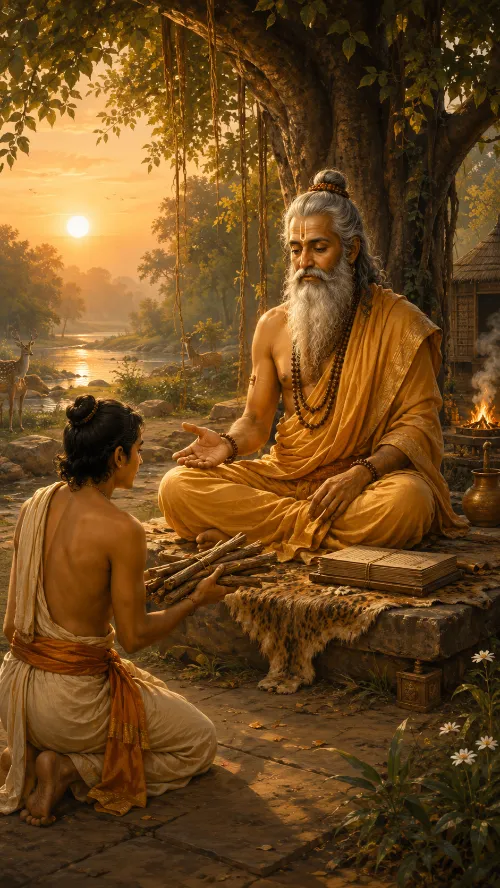
Muṇḍaka Upaniṣad on Guru, Revelation, and Realization
The verse is usually compressed into a slogan — you need a guru. What the Upaniṣad actually does is far more demanding: it makes the seeker examine the limits of achievement first, and then, having sent him to a teacher, immediately specifies two qualifications that teacher must meet. A title satisfies neither of them.
परीक्ष्य लोकान् कर्मचितान् ब्राह्मणो
निर्वेदमायान्नास्त्यकृतः कृतेन ।
तद्विज्ञानार्थं स गुरुमेवाभिगच्छेत्
समित्पाणिः श्रोत्रियं ब्रह्मनिष्ठम् ॥
parīkṣya lokān karma-citān brāhmaṇo
nirvedam āyān nāsty akṛtaḥ kṛtena
tad-vijñānārthaṁ sa gurum evābhigacchet
samit-pāṇiḥ śrotriyaṁ brahma-niṣṭham
“Having examined the worlds attained through karma, the discerning seeker should become dispassionate, recognizing that the uncreated cannot be attained through what is produced by action. For the realization of That, one should indeed approach a guru, carrying sacrificial fuel in hand—a teacher learned in revelation and firmly established in Brahman.”
Muṇḍaka Upaniṣad 1.2.12
The last two lines are what get quoted:
तद्विज्ञानार्थं स गुरुमेवाभिगच्छेत्
समित्पाणिः श्रोत्रियं ब्रह्मनिष्ठम्
tad-vijñānārthaṁ sa gurum evābhigacchet
samit-pāṇiḥ śrotriyaṁ brahma-niṣṭham
“For the realization of That, one should indeed approach a guru, carrying sacrificial fuel in hand—a teacher learned in revelation and firmly established in Brahman.”
But read whole rather than from its famous conclusion, the mantra lays out a progression. The seeker examines what worldly and religious action can actually produce; recognizes that everything produced by action stays within the category of the produced, and so cannot be the eternal, uncreated Reality; and from that recognition spiritual dispassion arises. Only then is he told to approach a guru — and told at once what kind. Four principles in a single verse: the limits of finite achievement, the awakening of serious inquiry, the necessity of qualified instruction, and the necessity of a qualified teacher.
Inquiry Begins by Examining the Limits of Karma
परीक्ष्य लोकान् कर्मचितान्
parīkṣya lokān karma-citān
“Having examined the worlds attained through karma…”
Parīkṣya means having examined, investigated, carefully considered — and that is significant, because the Upaniṣadic seeker is not told to believe. He is told to examine. What can action produce? What can ritual accomplish? What can wealth, prestige, sensual enjoyment, social success, religious merit or even heavenly attainment ultimately give? Karma-citān describes worlds accumulated or constructed through action, and the Upaniṣad does not deny that karma produces results. It asks something more radical: can anything produced by action become the Eternal? Its answer is one of the most concentrated phrases in the mantra:
नास्त्यकृतः कृतेन
nāsty akṛtaḥ kṛtena
“The uncreated cannot be attained through what is produced.”
Action can produce a result, a condition, an experience, merit, purification, movement from one state to another. But if Brahman is eternal and uncreated, Brahman cannot be manufactured as the final product of sufficiently accumulated karma. No quantity of finite action turns the Infinite into a product.
Which does not make karma meaningless. Action disciplines the person, purifies intention, reshapes character, cultivates favorable conditions and prepares consciousness for higher inquiry. What it cannot do is manufacture the Absolute by technique.
Nirveda: When Finite Achievement Stops Looking Ultimate
निर्वेदमायात्
nirvedam āyāt
“One should come to dispassion.”
Nirveda can express disillusionment, disenchantment or detachment — and here it is best understood as spiritual disillusionment with the finite rather than depression or nihilism. The mature seeker begins asking what happens if he obtains everything ordinary action can give: wealth, status, knowledge, influence, pleasure, religious merit, even residence in a heavenly world. If all of it remains temporary, can any of it answer a longing for what is not temporary? The question changes from what else can I obtain to what is ultimately real.
That transition is why the guru enters the mantra at all. Not because the tradition is fond of teachers, but because the seeker has reached the limits of acquisition and now wants knowledge of what cannot be produced.
Higher Knowledge Is Not More Information
Earlier the same Upaniṣad distinguishes two kinds of knowledge:
द्वे विद्ये वेदितव्ये इति ह स्म
यद्ब्रह्मविदो वदन्ति परा चैवापरा च ॥
dve vidye veditavye iti ha sma
yad brahma-vido vadanti parā caivāparā ca
“Knowers of Brahman say that two kinds of knowledge are to be known: the higher and the lower.”
Muṇḍaka Upaniṣad 1.1.4
अथ परा यया तदक्षरमधिगम्यते ॥
atha parā yayā tad akṣaram adhigamyate
“The higher knowledge is that by which the Imperishable is realized.”
Muṇḍaka Upaniṣad 1.1.5
This distinction has to be handled carefully, because the Upaniṣad is śāstra and is not declaring scripture useless. It distinguishes between possessing sacred knowledge as information and realizing the Imperishable toward which that knowledge points. A person may know grammar, ritual, philosophy, doctrine, terminology and vast quantities of scripture and still remain at the level of intellectual possession.
तद्विज्ञानार्थम्
tad-vijñānārtham
“for the sake of knowing or realizing That.”
And vijñāna should not be mechanically opposed to jñāna as realization against theory — Sanskrit usage is more flexible than that. In this context the seeker plainly wants more than religious information: he wants knowledge of what karma cannot produce, so “for the realization of That” carries the force well.
Gurum Eva Abhigacchet
स गुरुमेवाभिगच्छेत्
sa gurum evābhigacchet
“That seeker should indeed approach a guru.”
The particle eva gives emphasis — indeed, precisely, certainly — and abhigacchet has prescriptive force: one should approach. So the guru is not an optional spiritual accessory; a person seeking tad-vijñāna is directed into a living relationship of instruction. Not because books contain no truth, obviously: the instruction to approach a guru appears inside a sacred text. The point is that possessing words and understanding reality are not the same. A competent teacher exposes misunderstanding, challenges selective interpretation, corrects misapplication, answers questions, and distinguishes memorized doctrine from assimilated understanding.
So the guru does not replace śāstra — he helps the disciple understand and live it. The Chāndogya Upaniṣad makes the same point through a parable: a man is carried away from Gandhāra with his eyes bound, and when someone removes the blindfold and points him in the right direction, he travels from village to village asking his way until he reaches home.
एवमेवेहाचार्यवान्पुरुषो वेद
evam eveha ācāryavān puruṣo veda
“In just this way, here, a person who has an ācārya comes to know.”
Chāndogya Upaniṣad 6.14.2
The teacher does not walk every step for the student. He supplies correct orientation; the disciple must still hear, inquire, understand, practice and travel.
Samit-pāṇiḥ: How the Disciple Arrives
समित्पाणिः
samit-pāṇiḥ
Literally, with sacrificial fuel in hand. The image belongs to a world in which a student approached the teacher’s āśrama prepared not merely to receive instruction but to participate in a disciplined life of study and service — so the firewood expresses a posture. The disciple does not arrive saying entertain me spiritually. He arrives ready to listen, serve, participate, practice, be corrected and be trained.
A later symbolic reading takes the fuel sticks as the disciple’s readiness to offer ego, false certainty and self-deception into the fire of spiritual discipline. That is beautiful, and it is not the mantra’s literal meaning. Literally, samit-pāṇiḥ is carrying sacrificial fuel; spiritually, it embodies readiness.
The Two Qualifications
The Upaniṣad does not stop at “approach a guru.” It qualifies the teacher immediately:
श्रोत्रियं ब्रह्मनिष्ठम्
śrotriyaṁ brahma-niṣṭham
“one learned in revelation and firmly established in Brahman.”
Two words that form one of the most concise criteria for spiritual authority in Vedānta. The guru must possess both revelation and realization.
श्रोत्रियम्
śrotriyam
The term belongs to the world of śruti — revealed teaching heard and transmitted. A śrotriya is not merely an intelligent or charismatic person; the word implies someone properly trained in the received tradition and competent to understand and transmit it. Which excludes the idea that anyone becomes a trustworthy guide by being popular, eloquent, charismatic, emotionally compelling, mystical-looking or personally confident. The teacher has to know what the tradition actually teaches, and that means scriptural competence and accountability to revelation rather than unrestricted private invention.
ब्रह्मनिष्ठम्
brahma-niṣṭham
Niṣṭhā conveys firm establishment, steadfastness, abiding dedication — so brahma-niṣṭha is “firmly established in Brahman.” This is the qualification that stops spiritual teaching from becoming merely academic. A person may have extraordinary memory, extensive Sanskrit, sophisticated arguments and deep familiarity with scripture while the Reality under discussion remains external to his own life. The Upaniṣad demands more than knowledge about Brahman. It requires establishment in Brahman.
Why Both, and Not Either
The two qualifications guard against opposite failures.
And the same Upaniṣad that requires a śrotriya refuses to equate accumulated learning with realization:
नायमात्मा प्रवचनेन लभ्यो
न मेधया न बहुना श्रुतेन ।
यमेवैष वृणुते तेन लभ्यस्
तस्यैष आत्मा विवृणुते तनूं स्वाम् ॥
nāyam ātmā pravacanena labhyo
na medhayā na bahunā śrutena
yam evaiṣa vṛṇute tena labhyas
tasyaiṣa ātmā vivṛṇute tanūṁ svām
“This Self is not attained merely through eloquent exposition, nor through intellect, nor through much hearing. It is attained by the one whom the Self chooses; to such a person the Self reveals its own nature.”
Muṇḍaka Upaniṣad 3.2.3
So the guru cannot be reduced either to a scholar without realization or to a self-proclaimed mystic without scriptural grounding. The standard is both together. The Bhagavad-gītā gives a striking parallel:
तद्विद्धि प्रणिपातेन
परिप्रश्नेन सेवया ।
उपदेक्ष्यन्ति ते ज्ञानं
ज्ञानिनस्तत्त्वदर्शिनः ॥
tad viddhi praṇipātena
paripraśnena sevayā
upadekṣyanti te jñānaṁ
jñāninas tattva-darśinaḥ
“Learn that truth through respectful submission, thorough inquiry, and service. Those who possess knowledge and have seen the truth will instruct you in that knowledge.”
Bhagavad-gītā 4.34
Which matters because the scriptural model is neither blind submission nor arrogant interrogation — the disciple is expected to ask, with humility and a sincere wish to understand. And the teachers are described as jñāninaḥ, those who possess knowledge, and tattva-darśinaḥ, those who have seen truth. The correspondence is exact: śrotriya and brahma-niṣṭha, knowledge and realization, in both texts.
The Disciple Is Qualified Too
The next mantra is routinely skipped, and it is essential:
तस्मै स विद्वानुपसन्नाय सम्यक्
प्रशान्तचित्ताय शमान्विताय ।
येनाक्षरं पुरुषं वेद सत्यं
प्रोवाच तां तत्त्वतो ब्रह्मविद्याम् ॥
tasmai sa vidvān upasannāya samyak
praśānta-cittāya śamānvitāya
yenākṣaraṁ puruṣaṁ veda satyaṁ
provāca tāṁ tattvato brahma-vidyām
“To that student who has properly approached him, whose mind is peaceful and who is endowed with self-control, the learned teacher explains according to truth that brahma-vidyā by which the true, imperishable Puruṣa is known.”
Muṇḍaka Upaniṣad 1.2.13
This prevents an unbalanced doctrine of guru. Scripture does not say find the perfect teacher and your own character stops mattering. Spiritual learning requires receptivity, seriousness, self-control, humility, inquiry and practice. There is guru qualification, and there is disciple qualification.
And the same mantra binds the teacher as well:
प्रोवाच तां तत्त्वतो ब्रह्मविद्याम्
provāca tāṁ tattvato brahma-vidyām
“He teaches that brahma-vidyā according to truth.”
तत्त्वतः
tattvataḥ
“according to reality,” “truthfully,” “as it actually is.”
That is a real limitation on spiritual authority. The guru is not the proprietor of brahma-vidyā but its servant and transmitter — his task is not to make private preference equivalent to revelation, cultivate unnecessary psychological dependence, or place his personality above truth. His responsibility is to communicate tattva as tattva. The disciple is accountable to the guru; the guru remains accountable to śāstra and to truth.
The Bhāgavata Reinforces the Standard
तस्माद् गुरुं प्रपद्येत
जिज्ञासुः श्रेय उत्तमम् ।
शाब्दे परे च निष्णातं
ब्रह्मण्युपशमाश्रयम् ॥
tasmād guruṁ prapadyeta
jijñāsuḥ śreya uttamam
śābde pare ca niṣṇātaṁ
brahmaṇy upaśamāśrayam
“Therefore one who desires to inquire into the highest good should take shelter of a guru who is deeply versed in revealed śabda and in the Supreme Reality, and who has taken shelter of spiritual tranquility in Brahman.”
Śrīmad-Bhāgavatam 11.3.21
The Vaiṣṇava text does not soften the Upaniṣadic criterion; it reinforces it. And it is equally specific about who should be looking:
जिज्ञासुः श्रेय उत्तमम्
jijñāsuḥ śreya uttamam
“one who desires to inquire into the highest good.”
The relationship begins with jijñāsā, serious inquiry — not fashion, not social identity, not spiritual entertainment. The question is what the highest good actually is.
The term brahma-niṣṭha is shared across Vedānta schools while its theological interpretation differs. Advaita reads establishment in Brahman through its nondual metaphysics; Vaiṣṇava Vedānta accepts Brahman language while understanding the Absolute as ultimately personal, so brahma-niṣṭha is not taken to require only impersonal realization. Within Gauḍīya theology realization culminates in Bhagavān.
वदन्ति तत्तत्त्वविदस्
तत्त्वं यज्ज्ञानमद्वयम् ।
ब्रह्मेति परमात्मेति
भगवानिति शब्द्यते ॥
vadanti tat tattva-vidas
tattvaṁ yaj jñānam advayam
brahmeti paramātmeti
bhagavān iti śabdyate
“Knowers of truth describe that nondual Absolute Reality as Brahman, Paramātmā, and Bhagavān.”
Śrīmad-Bhāgavatam 1.2.11
Devotion to Guru, and the Discernment It Requires
यस्य देवे परा भक्तिर्
यथा देवे तथा गुरौ ।
तस्यैते कथिता ह्यर्थाः
प्रकाशन्ते महात्मनः ॥
yasya deve parā bhaktir
yathā deve tathā gurau
tasyaite kathitā hy arthāḥ
prakāśante mahātmanaḥ
“For that great soul who possesses supreme devotion to the Divine and, as toward the Divine, so also toward the guru, the meanings of these teachings become revealed.”
Śvetāśvatara Upaniṣad 6.23
Here the relationship is plainly more than academic — it is devotional. But this verse has to be read together with the qualification given in 1.2.12, because deep devotion to the guru does not mean abandoning discrimination about who is qualified to occupy that role. The teacher toward whom such devotion is rightly directed is already expected to be śrotriya and brahma-niṣṭha. The two principles protect each other: qualification without devotion reduces spiritual teaching to academics, and devotion without qualification becomes dangerous.
Verses glorifying the guru become dangerous precisely when they are detached from the verses defining his qualifications. The Vedic pattern is not “anyone called guru must be obeyed absolutely.” It is: the seeker desires the highest truth; he approaches a qualified teacher; the teacher is rooted in śāstra; the teacher is spiritually established; the disciple approaches humbly; the disciple asks sincere questions; the disciple serves and practices; and the guru teaches tattvataḥ, according to truth.
A title does not establish qualification. The statement I am guru does not itself demonstrate either śrotriyatva or brahma-niṣṭhā — these are qualities, not titles. So guru cannot become a theological justification for deception, exploitation, arbitrary domination, or conduct contrary to śāstra. The guru stands under truth, not above it.
Inquiry Is Part of Surrender
परिप्रश्नेन
paripraśnena
“through thorough inquiry.”
A disciple is supposed to ask, and questions are not inherently rebellious. What is the self? What creates bondage? What is liberation? How is this practiced? How should apparently divergent passages be reconciled? All of that is traditional spiritual learning, and submission does not mean the extinction of intelligence — a serious disciple brings humility and intelligence together.
Questioning has its own discipline, though. A person may claim to be inquiring while refusing to let any answer challenge what he already believes, and that is not inquiry. The purpose of paripraśna is understanding, not winning. The balance is humility without gullibility, and inquiry without arrogance.
The Gauḍīya tradition preserves the same structure. Kṛṣṇadāsa Kavirāja lists the beginning practices of bhakti as guru-pādāśraya, taking shelter of the guru; gurura sevana, service to him; and śikṣā-pṛcchā, inquiry for instruction — service and questioning held together:
গুরুপাদাশ্রয়, দীক্ষা, গুরুর সেবন ।
সদ্ধর্মশিক্ষা-পৃচ্ছা, সাধুমার্গানুগমন ॥
guru-pādāśraya, dīkṣā, gurura sevana
sad-dharma-śikṣā-pṛcchā, sādhu-mārgānugamana
“One takes shelter at the feet of the guru, receives initiation, serves the guru, inquires in order to learn true dharma, and follows the path of the sādhus.”
Caitanya-caritāmṛta, Madhya 22.115
ব্রহ্মাণ্ড ভ্রমিতে কোন ভাগ্যবান্ জীব ।
গুরু-কৃষ্ণ-প্রসাদে পায় ভক্তিলতা-বীজ ॥
brahmāṇḍa bhramite kona bhāgyavān jīva
guru-kṛṣṇa-prasāde pāya bhakti-latā-bīja
“While wandering throughout the universe, some fortunate jīva, by the mercy of guru and Kṛṣṇa, receives the seed of the creeper of bhakti.”
Caitanya-caritāmṛta, Madhya 19.151
Here the guru is more than an intellectual instructor; he becomes a channel of mercy. And his function remains to connect the disciple with Kṛṣṇa rather than to turn the disciple’s spiritual life into a cult of his own personality. The healthy movement runs guru → śāstra → Bhagavān. The guru points beyond himself.
Received, Not Reinvented
एवं परम्पराप्राप्तम्
इमं राजर्षयो विदुः ।
स कालेनेह महता
योगो नष्टः परन्तप ॥
evaṁ paramparā-prāptam
imaṁ rājarṣayo viduḥ
sa kāleneha mahatā
yogo naṣṭaḥ parantapa
“Thus received through paramparā, the saintly kings understood this yoga. But through the passage of great time, that succession became broken and the yoga was obscured.”
Bhagavad-gītā 4.2
This is why śrotriya matters: spiritual truth is not expected to be reinvented from nothing by each generation but received, understood, practiced, realized and transmitted. Which is not mechanical repetition without understanding — the ideal is faithful living transmission. One may take formal initiation from one teacher and important instruction from others, and Gauḍīya Vaiṣṇavism accordingly distinguishes dīkṣā-guru from śikṣā-guru. So the point of gurum evābhigacchet is not that a seeker may never learn from more than one saintly person. It is that ultimate realization is not treated as isolated self-invention.
One further safeguard. Calling a teacher brahma-niṣṭha does not mean he has infallible expertise in every ordinary field — spiritual realization does not confer technical mastery of medicine, engineering, economics, history, politics, psychology or every practical question of life. His authority concerns the sphere in which he is guru: tattva, dharma, sādhana, bhakti and spiritual realization. Confusing that with universal mundane omniscience produces serious distortions, and the Upaniṣadic standard is exalted enough without inflating it beyond what the text says.
What the Mantra Does and Does Not Say
A simple analogy holds the two qualifications together. One person may own an excellent map of a mountain and never have climbed it. Another may claim to have climbed some mountain while possessing no reliable map and being unable to establish where he actually went. The trustworthy guide has both — and spiritually, śrotriya means the map is authentic, while brahma-niṣṭha means the teaching has become lived establishment.
The seeker first examines the world of finite attainment and discovers that what is uncreated cannot be produced by what is made. That recognition changes the direction of a life: he stops asking what he can acquire and starts asking what is ultimately real and how it can be known. For that he is sent to a teacher — but not to anyone bearing the title. The teacher must be grounded in revelation and established in the Reality revelation describes, while the disciple approaches with humility, self-control, service and sincere questions, and the guru teaches tattvataḥ, according to truth. So the relationship is not built on the destruction of reason but on its purification and proper direction inside a living tradition; and it is not built on personality, but on the meeting of śāstra and realization. A genuine guru must know what revelation teaches, and must be established in the Reality it describes. He must know the map — and know the terrain.
श्रोत्रियं ब्रह्मनिष्ठम्
śrotriyaṁ brahma-niṣṭham
“learned in revelation and firmly established in Brahman.”