

But Kṛṣṇa Is Bhagavān Himself
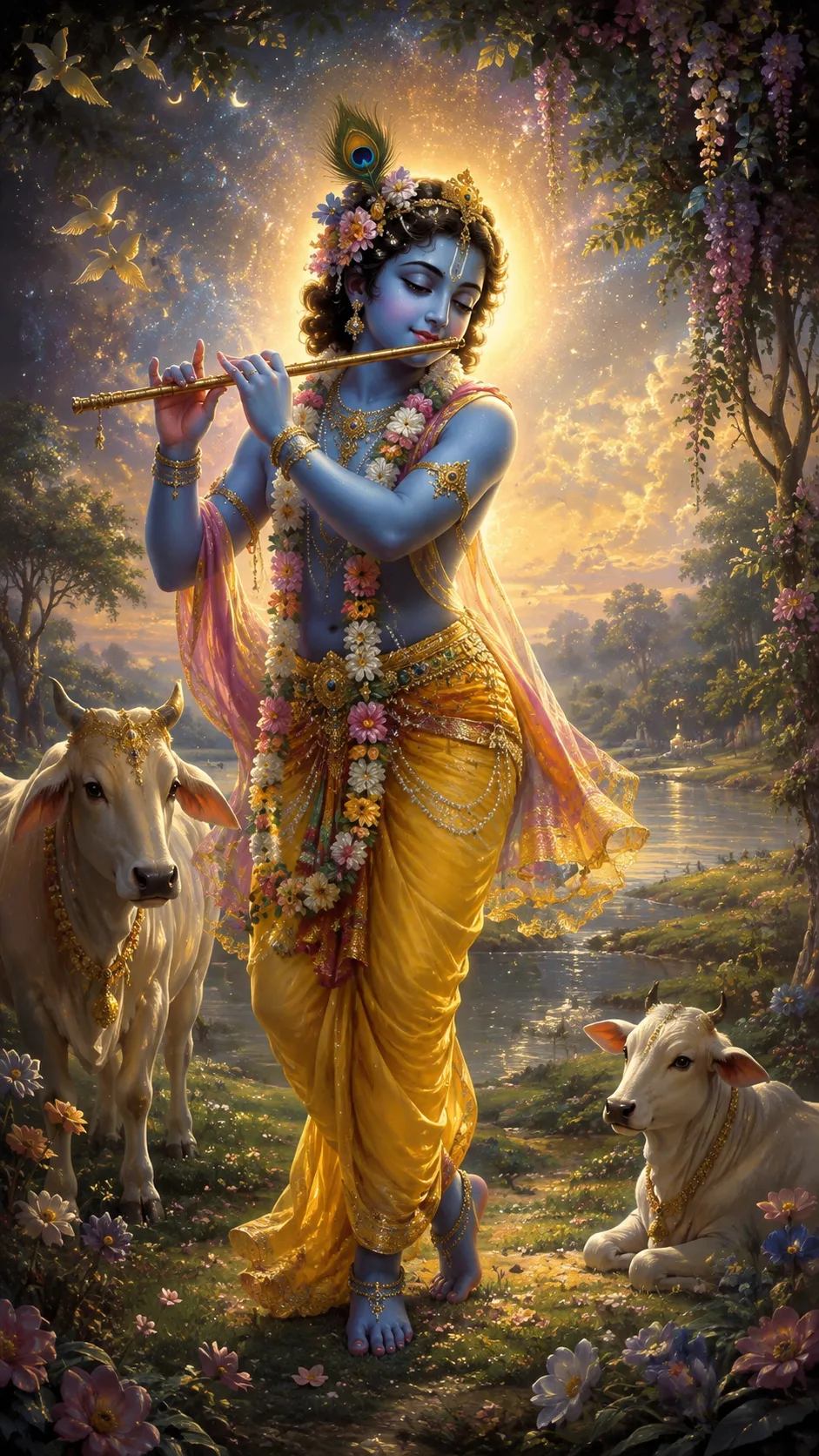
How One Particle in the Bhāgavatam Founded the Doctrine of Svayaṁ Bhagavān
Few Sanskrit particles have carried as much theological weight as the word tu. The Bhāgavatam’s third chapter lists divine manifestation after divine manifestation, declares them innumerable, summarizes them as portions and secondary expansions — and then, with one adversative syllable, sets Kṛṣṇa outside the category it has just built. An entire theology of Vraja follows from that.
एते चांशकलाः पुंसः
कृष्णस्तु भगवान् स्वयम् ।
इन्द्रारिव्याकुलं लोकं
मृडयन्ति युगे युगे ॥
ete cāṁśa-kalāḥ puṁsaḥ
kṛṣṇas tu bhagavān svayam
indrāri-vyākulaṁ lokaṁ
mṛḍayanti yuge yuge
“All these are portions or secondary manifestations of the Puruṣa; Kṛṣṇa, however, is Bhagavān Himself. Age after age they graciously bring relief to the world when it is disturbed by the enemies of Indra.”
Śrīmad-Bhāgavatam 1.3.28
Śrīla A. C. Bhaktivedanta Swami Prabhupāda gives the familiar Gauḍīya rendering: “All of the above-mentioned incarnations are either plenary portions or portions of the plenary portions of the Lord, but Lord Śrī Kṛṣṇa is the original Personality of Godhead.” That expresses the developed doctrine clearly — and textual precision requires one distinction to be kept visible alongside it.
The Sanskrit contains no word meaning “original,” and indrāri does not literally mean “atheist.” The direct statement is kṛṣṇas tu bhagavān svayam — “Kṛṣṇa, however, is Bhagavān Himself.” The theological conclusion arises from the contrast the whole sentence creates, not from a lexical equivalence. Keeping translation and theology on separate levels is what makes the Gauḍīya case checkable rather than merely asserted.
Kṛṣṇa Appears Inside the Avatāra Catalog
The chapter describes a succession of manifestations, and Kṛṣṇa appears within that sequence:
एकोनविंशे विंशतिमे
वृष्णिषु प्राप्य जन्मनी ।
रामकृष्णाविति भुवो
भगवानहरद्भरम् ॥
ekonaviṁśe viṁśatime
vṛṣṇiṣu prāpya janmanī
rāma-kṛṣṇāv iti bhuvo
bhagavān aharad bharam
“In the nineteenth and twentieth manifestations, Bhagavān took birth among the Vṛṣṇis as Rāma and Kṛṣṇa and removed the burden of the earth.”
Śrīmad-Bhāgavatam 1.3.23
On a first reading that seems to settle the matter in the opposite direction — Kṛṣṇa as one avatāra among many. But the chapter has not finished classifying. Before reaching the decisive verse it refuses to let the preceding list be treated as exhaustive:
अवतारा ह्यसङ्ख्येया
हरेः सत्त्वनिधेर्द्विजाः ।
यथाविदासिनः कुल्याः
सरसः स्युः सहस्रशः ॥
avatārā hy asaṅkhyeyā
hareḥ sattva-nidher dvijāḥ
yathāvidāsinaḥ kulyāḥ
sarasaḥ syuḥ sahasraśaḥ
“O brāhmaṇas, the avatāras of Hari, the inexhaustible reservoir of pure being, are innumerable, like thousands of streams flowing from an inexhaustible lake.”
Śrīmad-Bhāgavatam 1.3.26
The image does the work: the avatāras are streams, the divine source an inexhaustible reservoir. Then the category widens further still:
ऋषयो मनवो देवा
मनुपुत्रा महौजसः ।
कलाः सर्वे हरेरेव
सप्रजापतयः स्मृताः ॥
ṛṣayo manavo devā
manu-putrā mahaujasaḥ
kalāḥ sarve harer eva
sa-prajāpatayaḥ smṛtāḥ
“The ṛṣis, Manus, devas, powerful sons of Manu, together with the Prajāpatis, are all remembered as kalās or manifestations of Hari.”
Śrīmad-Bhāgavatam 1.3.27
Only after establishing innumerable manifestations, in differing modes and degrees of empowerment, does the text distinguish Kṛṣṇa by svayam. The sequence is the argument.
The Grammar of the Declaration
Vaiṣṇava commentators often distinguish aṁśa and kalā hierarchically, and Prabhupāda’s “plenary portions or portions of the plenary portions” conveys that reading effectively. Philologically, though, kalā should not be treated as carrying one mechanically fixed mathematical value.
The verse could have said “these are portions of the Puruṣa, and Kṛṣṇa is Bhagavān.” It says kṛṣṇas tu. For Gauḍīya theologians that adversative particle is one of the principal grammatical foundations of the doctrine:
एते चांशकलाः पुंसः
कृष्णस्तु भगवान् स्वयम्
ete cāṁśa-kalāḥ puṁsaḥ
kṛṣṇas tu bhagavān svayam
“All these are portions or secondary manifestations of the Puruṣa; Kṛṣṇa, however, is Bhagavān Himself.”
And Bhagavān here does not mean merely “a god.” The Bhāgavatam gives its own threefold description of how the one Absolute is realized:
वदन्ति तत्तत्त्वविदस्
तत्त्वं यज्ज्ञानमद्वयम् ।
ब्रह्मेति परमात्मेति
भगवानिति शब्द्यते ॥
vadanti tat tattva-vidas
tattvaṁ yaj jñānam advayam
brahmeti paramātmeti
bhagavān iti śabdyate
“Knowers of truth describe that nondual Absolute Reality as Brahman, Paramātmā, and Bhagavān.”
Śrīmad-Bhāgavatam 1.2.11
For Gauḍīyas, Bhagavān names the fullest personal realization of that Absolute — so if the other manifestations are characterized as portions while Kṛṣṇa is identified as Bhagavān svayam, then within this structure Kṛṣṇa is not derivative. He is the source-form. “Bhagavān Himself” becomes the doctrinal category Svayaṁ Bhagavān.
Which is a theological translation arising from the relation between aṁśa-kalāḥ and svayam — not a word-for-word one, and not an arbitrary addition either. A careful treatment can hold both levels: the literal “Kṛṣṇa, however, is Bhagavān Himself,” and the Gauḍīya reading, “Kṛṣṇa is Svayaṁ Bhagavān, the original personal source from whom the other divine manifestations proceed.”
What the Doctrine Does Not Claim
This qualification is essential, and it is the one most often lost. The Gauḍīya position is not that Kṛṣṇa is God while Nārāyaṇa and Viṣṇu are lesser created beings. Nārāyaṇa and the Viṣṇu manifestations are fully divine; they belong to viṣṇu-tattva. The distinction concerns the internal relation of source and manifestation — not God versus non-God. Complete divinity and theological hierarchy are not treated as mutually exclusive.
Jīva Gosvāmī and the Verse as Paribhāṣā
Śrī Jīva Gosvāmī gives this verse extraordinary weight in his systematic theology, particularly in the Kṛṣṇa-sandarbha, where it functions as a paribhāṣā — a governing interpretive principle that reconciles apparently divergent descriptions of Kṛṣṇa across the Bhāgavatam. Where one passage presents Kṛṣṇa within a list of avatāras and another attributes absolute divine status to Him, the tradition reads both through this declaration.
So Kṛṣṇa can appear inside an avatāra catalog because He descends into the world — while ontologically being understood not as avatāra, one who descends, but as avatārī, the source from whom avatāras proceed. The familiar formulation “Viṣṇu appears as Kṛṣṇa” is thereby reversed at the deepest Gauḍīya level. Again: this does not deny Viṣṇu’s divinity, but describes an internal order of manifestation. Brahmā’s prayer supplies a key supporting text:
नारायणस्त्वं न हि सर्वदेहिनाम्
आत्मास्यधीशाखिललोकसाक्षी ।
नारायणोऽङ्गं नरभूजलायनात्
तच्चापि सत्यं न तवैव माया ॥
nārāyaṇas tvaṁ na hi sarva-dehinām
ātmāsy adhīśākhila-loka-sākṣī
nārāyaṇo ’ṅgaṁ nara-bhū-jalāyanāt
tac cāpi satyaṁ na tavaiva māyā
“Are You not Nārāyaṇa, O Lord, since You are the indwelling Self of all embodied beings and the witness of all worlds? The Nārāyaṇa who lies upon the cosmic waters is Your aṅga, Your manifestation; yet that form too is real and is not merely a product of illusion.”
Śrīmad-Bhāgavatam 10.14.14
The phrase nārāyaṇo ‘ṅgam — “Nārāyaṇa is Your aṅga,” Your member or manifestation — read together with 1.3.28, becomes part of the scriptural basis for placing Kṛṣṇa at the source of the Nārāyaṇa manifestations. The Gītā adds a second:
अहं सर्वस्य प्रभवो
मत्तः सर्वं प्रवर्तते ।
इति मत्वा भजन्ते मां
बुधा भावसमन्विताः ॥
ahaṁ sarvasya prabhavo
mattaḥ sarvaṁ pravartate
iti matvā bhajante māṁ
budhā bhāva-samanvitāḥ
“I am the source of everything; from Me everything proceeds. Knowing this, the wise worship Me with deep devotion.”
Bhagavad-gītā 10.8
Ahaṁ sarvasya prabhavaḥ — “I am the source of everything” — understood in the fullest sense: not merely the source of material beings but the personal source of the divine hierarchy itself. And the Brahma-saṁhitā makes explicit what Gauḍīyas take to be compressed into four words:
ईश्वरः परमः कृष्णः
सच्चिदानन्दविग्रहः ।
अनादिरादिर्गोविन्दः
सर्वकारणकारणम् ॥
īśvaraḥ paramaḥ kṛṣṇaḥ
sac-cid-ānanda-vigrahaḥ
anādir ādir govindaḥ
sarva-kāraṇa-kāraṇam
“Kṛṣṇa is the Supreme Lord. His form is eternal, conscious, and blissful. Govinda is beginningless yet the beginning of all, the cause of all causes.”
Brahma-saṁhitā 5.1
तस्मात् कृष्ण एव परो देवः
तं ध्यायेत् तं रसयेत् तं भजेत् तं यजेत् ॥
tasmāt kṛṣṇa eva paro devaḥ
taṁ dhyāyet taṁ rasayet taṁ bhajet taṁ yajet
“Therefore Kṛṣṇa alone is the supreme Deity. One should meditate upon Him, relish Him, worship Him, and offer sacrifice to Him.”
Gopāla-tāpanī Upaniṣad, Pūrva section
Manuscript and edition numbering for the Gopāla-tāpanī varies considerably, so formal citation should identify the edition used rather than give a bare verse number.
স্বয়ং ভগবান্ কৃষ্ণ একলে ঈশ্বর ।
অদ্বিতীয়, নন্দাত্মজ, রসিক-শেখর ॥
svayaṁ bhagavān kṛṣṇa ekale īśvara
advitīya, nandātmaja, rasika-śekhara
“Kṛṣṇa is Svayaṁ Bhagavān, the one Supreme Lord without a second, the son of Nanda and the crown jewel of those who relish divine rasa.”
Caitanya-caritāmṛta, Ādi-līlā 7.7
Notice what Kṛṣṇadāsa Kavirāja combines: Kṛṣṇa is Svayaṁ Bhagavān and simultaneously Nandātmaja, the son of Nanda. The Supreme Absolute is identified not with cosmic majesty but with the cowherd child of Vraja. That is where the doctrine becomes distinctly Gauḍīya.
Not a Ranking Chart
The whole discussion can be misread as an attempt to settle which divine form ranks highest, and that is not really the Gauḍīya interest. The doctrine matters because of rasa. If Kṛṣṇa is Svayaṁ Bhagavān, then His intimate Vṛndāvana relationships are not spiritually secondary episodes occurring in some lesser manifestation of God — they belong to the fullest revelation of divine personality. The Supreme is Yaśodā’s child, Nanda’s son, the friend of the cowherd boys, the beloved of the gopīs, the lover of Śrī Rādhā. That is the theological revolution inside the verse.
He is the source of all worlds, and Yaśodā ties Him with rope. He is Bhagavān Himself, and His cowherd friends climb on His shoulders. He is worshiped by Brahmā, and He steals butter. He is the Absolute, and love conquers Him. For Gauḍīyas these are not reductions of divinity but demonstrations of divine freedom: the Supreme does not become less divine by concealing majesty, but reveals dimensions of relationship that majesty alone cannot disclose.
Rūpa Gosvāmī supplies the qualification that keeps this from collapsing into a crude hierarchy:
सिद्धान्ततस्त्वभेदेऽपि
श्रीशकृष्णस्वरूपयोः ।
रसेनोत्कृष्यते कृष्ण-
रूपमेषा रसस्थितिः ॥
siddhāntatas tv abhede ’pi
śrīśa-kṛṣṇa-svarūpayoḥ
rasenotkṛṣyate kṛṣṇa-
rūpam eṣā rasa-sthitiḥ
“Although from the standpoint of siddhānta there is no difference between the forms of Śrīśa, Nārāyaṇa, and Kṛṣṇa, the form of Kṛṣṇa excels through rasa. Such is the nature of rasa.”
Bhakti-rasāmṛta-sindhu 1.2.59
So the claim is subtler than “Kṛṣṇa is God, Nārāyaṇa is less than God.” It concerns the fullness of divine relational manifestation. Ordinarily greatness is associated with distance — a ruler seems more impressive when inaccessible — and Gauḍīya theology reverses the expectation. Yaśodā does not continually think this child is the omnipotent Absolute; she thinks he is my son. The cowherd boys do not stand before Kṛṣṇa with folded hands; they run and wrestle and eat with Him. The gopīs relate to Him through intimacy rather than awe. The tradition does not regard those relationships as ignorance awaiting correction, but as exalted manifestations of prema.
The Half of the Verse Nobody Quotes
Almost all the attention falls on the first line. The verse continues:
इन्द्रारिव्याकुलं लोकं
मृडयन्ति युगे युगे
indrāri-vyākulaṁ lokaṁ
mṛḍayanti yuge yuge
“Age after age they graciously bring relief to the world when it is disturbed by the enemies of Indra.”
The manifestations do not descend to demonstrate metaphysical status. They appear in response to a distressed world — vyākulam suggesting disturbance, distress, disorder, and mṛḍayanti conveying mercy, blessing, relief and restoration. So the verse ends not on divine hierarchy but on divine compassion.
Two renderings deserve correction here. Indrāri is Indra + ari and literally means “enemy of Indra”; “atheists” conveys the theological character of hostile asuric powers but is not what the compound says. And mṛḍayanti is warmer than “destroy” — the emphasis falls on relieving and restoring a suffering world. Avatāra theology is also a theology of mercy.
The phrase yuge yuge, age after age, places the verse inside the wider Vaiṣṇava theology of descent:
यदा यदा हि धर्मस्य
ग्लानिर्भवति भारत ।
अभ्युत्थानमधर्मस्य
तदात्मानं सृजाम्यहम् ॥
yadā yadā hi dharmasya
glānir bhavati bhārata
abhyutthānam adharmasya
tadātmānaṁ sṛjāmy aham
“Whenever there is a decline of dharma, O Bhārata, and a rise of adharma, at that time I manifest Myself.”
परित्राणाय साधूनां
विनाशाय च दुष्कृताम् ।
धर्मसंस्थापनार्थाय
सम्भवामि युगे युगे ॥
paritrāṇāya sādhūnāṁ
vināśāya ca duṣkṛtām
dharma-saṁsthāpanārthāya
sambhavāmi yuge yuge
“For the protection of the sādhus, the destruction of evildoers, and the reestablishment of dharma, I appear age after age.”
Bhagavad-gītā 4.7–8
And the very next verse of the Bhāgavatam turns the whole classification toward devotion:
जन्म गुह्यं भगवतो
य एतत्प्रयतो नरः ।
सायं प्रातर्गृणन् भक्त्या
दुःखग्रामाद्विमुच्यते ॥
janma guhyaṁ bhagavato
ya etat prayato naraḥ
sāyaṁ prātar gṛṇan bhaktyā
duḥkha-grāmād vimucyate
“One who attentively recites with devotion, morning and evening, these mysterious appearances of Bhagavān becomes freed from the multitude of sufferings.”
Śrīmad-Bhāgavatam 1.3.29
The manifestations are janma guhyam, mysterious divine births, and they are to be remembered and recited bhaktyā, with devotion. The study of avatāra culminates in bhakti; ontology is not the destination.
Other Traditions Read It Differently
A serious treatment has to preserve this. The Gauḍīya interpretation is coherent, sophisticated and foundational — and it is not the only traditional Vaiṣṇava reading. Other schools fully affirm Kṛṣṇa’s divinity without construing the Kṛṣṇa–Nārāyaṇa relation in the later Gauḍīya manner: Śrī Vaiṣṇava theology normally places Nārāyaṇa at the center of its system while fully accepting Kṛṣṇa as Bhagavān; Madhva traditions emphasize the complete divinity and essential non-difference of Viṣṇu’s forms without constructing the same source-and-expansion hierarchy; and Śrīdhara Svāmī’s reading need not be identified in every respect with the later systematic doctrine.
So the careful claim is that Śrīmad-Bhāgavatam 1.3.28 is the foundational scriptural declaration from which Gauḍīya Vaiṣṇavas develop the doctrine of Svayaṁ Bhagavān — rather than that the Sanskrit permits no other traditional interpretation. Acknowledging the difference does not weaken the Gauḍīya reading. It lets the tradition speak more precisely.
From the Gauḍīya side several features converge, and it is their convergence rather than any single line that carries the argument: Kṛṣṇa first appears within an avatāra catalog; the text summarizes those manifestations as aṁśas and kalās; tu creates the contrast; Kṛṣṇa alone is called bhagavān svayam; Brahmā calls Nārāyaṇa His aṅga; Kṛṣṇa declares Himself the source of everything; and the Brahma-saṁhitā names Govinda the cause of all causes. Not isolated prooftexts, on this reading, but a pattern.
What Kṛṣṇa Does With Supremacy
The doctrine reaches its point only when one asks what He does with it — and the answer is that He does not spend the Vraja-līlā displaying omnipotence. He becomes a son, a friend, a cowherd, a flute-player, a beloved. He allows Yaśodā to bind Him. He eats with the cowherd boys, tends cows, dances with the gopīs. The source of the divine manifestations hides majesty beneath sweetness, which produces the central paradox: the greatest revelation of divine supremacy may be the freedom not to display it. His mādhurya is possible precisely because His divinity is unlimited.
Which is why the verse is not peripheral for Gauḍīyas. Were Kṛṣṇa a subordinate temporary manifestation, His Vraja relationships could be read as spiritually secondary. If He is Svayaṁ Bhagavān, then His relationship with Yaśodā reveals something ultimate about divine parenthood, His friendship with the cowherd boys something ultimate about divine friendship, His relationship with the gopīs something ultimate about divine love — and His relationship with Śrī Rādhā becomes the highest revelation of prema. Four words open into the entire theology of Rādhā and Kṛṣṇa.
The chapter has described manifestation after manifestation, declared the avatāras innumerable, spoken of aṁśas and kalās — and then says Kṛṣṇa, however, and concludes Bhagavān Himself. For Jīva Gosvāmī and those who follow his system that becomes a governing key to the whole Bhāgavatam. Yet the deepest meaning of the doctrine is not that Kṛṣṇa occupies the highest position on a celestial organizational chart. It is what He reveals from that position. The source of the divine manifestations becomes Yaśodā’s son; the cause of all causes herds cows; the Lord of unlimited universes plays the flute in Vṛndāvana; the Supreme becomes the friend of cowherd boys; and Bhagavān Himself is conquered by prema. The movement from ete cāṁśa-kalāḥ to kṛṣṇas tu bhagavān svayam leads finally past ontology altogether: the fullest manifestation of divinity is not supreme power but supreme intimacy, sweetness and love.
कृष्णस्तु भगवान् स्वयम्
kṛṣṇas tu bhagavān svayam
“Kṛṣṇa, however, is Bhagavān Himself”