

When God Wants to Be Treated Like a Friend
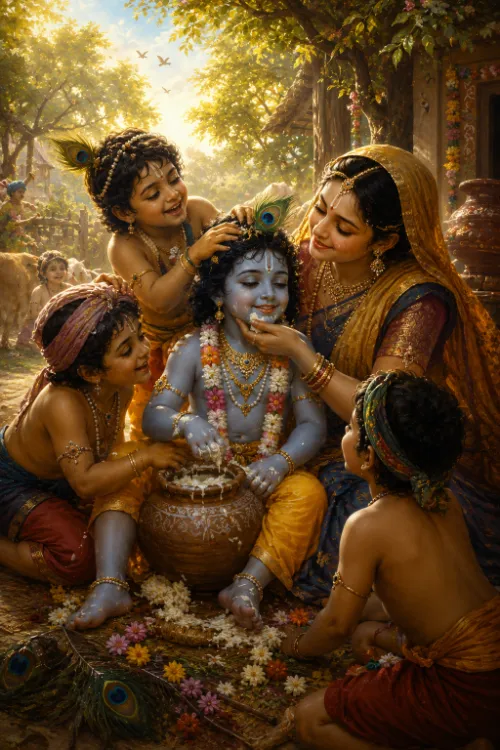
When God Wants to Be Treated Like a Friend: Why Kṛṣṇa Prefers the Intimacy of Vraja to Love Dominated by Awe
Can love become too conscious of greatness? At first the question sounds strange. Surely the more completely a devotee understands God’s omnipotence, majesty, sovereignty, and divinity, the deeper devotion should become.
Gauḍīya Vaiṣṇava theology gives a surprising answer. Knowledge of Kṛṣṇa’s divinity is completely true. Reverence for Him is completely legitimate. Yet if consciousness of His greatness dominates every moment of the relationship, a certain kind of intimacy becomes impossible.
A servant who constantly remembers that he stands before the emperor cannot casually climb onto the emperor’s shoulders. A subject cannot tie up the king for misbehaving.
A worshiper overwhelmed by divine majesty cannot naturally quarrel with God as an equal friend. And a lover standing in awe before the Supreme Being cannot freely sulk, rebuke Him, or demand that He apologize.
Yet these are precisely the relationships Kṛṣṇa enjoys in Vṛndāvana. That is why Śrī Caitanya-caritāmṛta places a remarkable statement in Kṛṣṇa’s own voice:
ঐশ্বর্য-জ্ঞানেতে সব জগৎ মিশ্রিত ।
ঐশ্বর্য-শিথিল-প্রেমে নাহি মোর প্রীত ॥
aiśvarya-jñānete saba jagat miśrita
aiśvarya-śithila-preme nāhi mora prīta
“The whole world is permeated with awareness of My majesty; love whose intimacy is weakened by that awareness of majesty does not give Me the particular pleasure I desire.”
Śrī Caitanya-caritāmṛta, Ādi 4.17
This verse is fundamental for understanding Vraja-bhakti. Kṛṣṇa is not saying: “My divinity is false.” Nor: “Reverential worship is wrong.” He is saying something subtler: “When My supremacy governs the relationship, love cannot become as unrestricted as the love I taste in Vraja.”
That distinction opens the door to the entire Gauḍīya theology of aiśvarya and mādhurya, reverence and intimacy, Vaikuṇṭha and Vṛndāvana, vidhi-bhakti and rāga-bhakti.
The Crucial Phrase: Aiśvarya-jñāna
The first expression is:
ঐশ্বর্য-জ্ঞান
aiśvarya-jñāna
Literally: “knowledge or awareness of majesty.” The Sanskrit-derived word: aiśvarya comes from the idea of īśvara—lordship, sovereignty, divine authority. It can include awareness that Kṛṣṇa is: the Supreme Lord, the cause of all causes, omniscient, omnipotent, the controller of creation, the object of Vedic worship, and the source of all divine manifestations.
None of these things are false. Gauḍīya Vaiṣṇavism emphatically accepts them. The problem is not truth. The question is what happens when that truth becomes the dominant emotional lens through which the devotee relates to Kṛṣṇa.
What Does Aiśvarya-śithila-prema Actually Mean?
This compound deserves care. śithila means: loosened, slackened, relaxed, weakened. Thus: aiśvarya-śithila-prema does not most literally mean: “love in which awareness of majesty itself has become weakened.”
Rather, the syntax points toward: love whose freedom or intimacy becomes slackened by the influence of awareness of majesty. That is why Prabhupāda glosses the phrase in terms of love becoming weakened by consciousness of Kṛṣṇa’s opulence.
But the positive Vraja condition may indeed be described as one in which awareness of Kṛṣṇa’s divinity becomes: secondary, backgrounded, relationally unobtrusive, or eclipsed by intimacy.
So two ideas should be distinguished:
Literal force of the compound
Awareness of divine majesty weakens unrestricted intimacy.
Positive Vraja condition
Prema becomes so dominant that awareness of majesty no longer governs the relationship. This distinction clarifies the theology.
Why Is Kṛṣṇa Even Discussing This?
The preceding verses explain the context. Kṛṣṇa desires:
প্রেমরস-নির্যাস করিতে আস্বাদন ।
রাগমার্গ ভক্তি লোকে করিতে প্রচারণ ॥
prema-rasa-niryāsa karite āsvādana
rāga-mārga bhakti loke karite pracāraṇa
“He desired to taste the concentrated essence of prema-rasa and to propagate in the world devotion on the path of spontaneous loving attachment.”
Caitanya-caritāmṛta, Ādi 4.15
Then:
রসিক-শেখর কৃষ্ণ পরম-করুণ ।
এই দুই হেতু হৈতে ইচ্ছার উদ্গম ॥
rasika-śekhara kṛṣṇa parama-karuṇa
ei dui hetu haite icchāra udgama
“Kṛṣṇa is the supreme connoisseur of rasa and supremely merciful; from these two causes His desire arose.”
Ādi 4.16
So 4.17 is not an attack on reverential religion. It belongs to a larger question: What form of love allows Kṛṣṇa to experience the greatest intimacy?
Reverence Creates Distance
The next verse makes the logic explicit:
আমারে ঈশ্বর মানে, আপনাকে হীন ।
তার প্রেমে বশ আমি না হই অধীন ॥
āmāre īśvara māne, āpanāke hīna
tāra preme vaśa āmi nā ha-i adhīna
“If someone regards Me as the Supreme Lord and himself as subordinate, I do not become fully controlled by that person’s love.”
Ādi 4.18
This is an extraordinary statement. Kṛṣṇa is not rejecting: humility, service, or reverence. He is describing a relational consequence. If the devotee constantly thinks: “You are infinitely great, and I am infinitely subordinate,”
then a distance remains. It is sacred distance. But it is distance nonetheless. And certain rasas require that distance to disappear.
Kṛṣṇa Wants to Be Conquered
The very next principle is reciprocity:
আমাকে ত’ যে যে ভক্ত ভজে যেই ভাবে ।
তারে সে সে ভাবে ভজি,—এ মোর স্বভাবে ॥
āmāke ta’ ye ye bhakta bhaje yei bhāve
tāre se se bhāve bhaji — e mora svabhāve
“In whatever mood a devotee worships Me, I reciprocate with that devotee in that same mood. This is My nature.”
Ādi 4.19
This reflects Kṛṣṇa’s statement in the Bhagavad-gītā:
ये यथा मां प्रपद्यन्ते
तांस्तथैव भजाम्यहम् ।
मम वर्त्मानुवर्तन्ते
मनुष्याः पार्थ सर्वशः ॥
ye yathā māṁ prapadyante
tāṁs tathaiva bhajāmy aham
mama vartmānuvartante
manuṣyāḥ pārtha sarvaśaḥ
“As people surrender to Me, I reciprocate with them accordingly. Everyone follows My path in every respect, O Pārtha.”
Bhagavad-gītā 4.11
Kṛṣṇa does not demand that every devotee relate to Him through one single emotional form. He allows the devotee’s love to shape the relationship. And in Vraja, that principle reaches extraordinary extremes.
“He Is My Son, My Friend, My Beloved”
Kṛṣṇa continues:
মোর পুত্র, মোর সখা, মোর প্রাণপতি ।
এইভাবে যেই মোরে করে শুদ্ধভক্তি ॥
mora putra, mora sakhā, mora prāṇa-pati
ei-bhāve yei more kare śuddha-bhakti
“One who renders pure devotion to Me thinking, ‘He is my son, He is my friend, He is my beloved…’”
Then:
আপনাকে বড় মানে, আমারে সম-হীন ।
সেই ভাবে হই আমি তাহার অধীন ॥
āpanāke baḍa māne, āmāre sama-hīna
sei bhāve ha-i āmi tāhāra adhīna
“…may regard himself as greater and Me as equal or even subordinate; in that mood I become subordinate to such love.”
Ādi 4.21–22
This is the heart of Vraja-bhakti. The devotee does not continually stand before Kṛṣṇa saying: “O omnipotent Supreme Reality, I am insignificant.” Yaśodā thinks: “This child needs me.”
A cowherd boy thinks: “Kṛṣṇa is my friend. Why should He always win?” A gopī may think: “Kṛṣṇa has offended Me. He must make amends.” Divinity is still there. But divinity is no longer the social rulebook of the relationship.
Mother Yaśodā: The Supreme Lord Becomes a Helpless Child
Kṛṣṇa gives the first example:
মাতা মোরে পুত্রভাবে করেন বন্ধন ।
অতিহীন-জ্ঞানে করে লালন-পালন ॥
mātā more putra-bhāve karena bandhana
ati-hīna-jñāne kare lālana-pālana
“My mother binds Me because she sees Me as her son. Thinking Me utterly helpless, she nourishes and protects Me.”
Ādi 4.24
This is one of the great paradoxes of Vaiṣṇava theology. Who is being bound? The Lord who binds all beings through material nature. Who is feeding Him? A village mother. Who worries that He might be injured?
Yaśodā. Who believes He needs protection? Yaśodā. Who chases Him with a stick? Yaśodā. Gauḍīyas do not regard this as insufficient theological education. They regard it as extraordinary prema.
The Bhāgavatam Says Even Lakṣmī Did Not Receive Yaśodā’s Mercy
After Yaśodā binds Kṛṣṇa, the Bhāgavatam says:
नेमं विरिञ्चो न भवो
न श्रीरप्यङ्गसंश्रया ।
प्रसादं लेभिरे गोपी
यत्तत्प्राप विमुक्तिदात् ॥
nemaṁ viriñco na bhavo
na śrīr apy aṅga-saṁśrayā
prasādaṁ lebhire gopī
yat tat prāpa vimukti-dāt
“Neither Brahmā, nor Śiva, nor even Śrī, the goddess of fortune who eternally associates with the Lord, obtained the mercy that this cowherd mother received from the giver of liberation.”
Śrīmad-Bhāgavatam 10.9.20
This comparison is deliberate. Brahmā knows Kṛṣṇa’s greatness. Śiva knows His greatness. Lakṣmī knows His greatness. Yaśodā does something apparently far less majestic: she ties Him to a mortar.
Yet the Bhāgavatam says she receives something extraordinary. That is the Gauḍīya hierarchy of intimacy.
The Lord of Liberation Becomes “The Son of a Cowherd Woman”
The next verse says:
नायं सुखापो भगवान्
देहिनां गोपिकासुतः ।
ज्ञानिनां चात्मभूतानां
यथा भक्तिमतामिह ॥
nāyaṁ sukhāpo bhagavān
dehināṁ gopikā-sutaḥ
jñānināṁ cātma-bhūtānāṁ
yathā bhaktimatām iha
“This Bhagavān, the son of the cowherd mother, is not as easily attained by those absorbed in bodily life, nor by jñānīs and self-realized yogīs, as He is by those endowed with bhakti.”
Śrīmad-Bhāgavatam 10.9.21
The name matters: gopikā-sutaḥ “the son of the cowherd woman.” The Supreme is being identified through relationship. Not merely: Lord, Creator, Controller, Absolute. But: someone’s son.
That is mādhurya.
The Cowherd Boys: “You and I Are Equal”
Kṛṣṇa gives the second example:
সখা শুদ্ধ-সখ্যে করে স্কন্ধে আরোহণ ।
তুমি কোন্ বড় লোক,—তুমি আমি সম ॥
sakhā śuddha-sakhye kare skandhe ārohaṇa
tumi kon baḍa loka — tumi āmi sama
“My friends climb onto My shoulders in pure friendship and say, ‘What kind of important person are You? You and I are equals.’”
Ādi 4.25
Imagine saying to the Supreme Being: “Who do You think You are?” In reverential worship, this would be outrageous. In Vraja-sakhya, it is love. The cowherd boys may wrestle with Kṛṣṇa.
Defeat Him. Make Him carry them. Steal His food. Laugh at Him. Challenge Him. The more they calculate His supremacy, the less spontaneous this friendship could become.
The Bhāgavatam Reveals Who Their Playmate Actually Is
Śukadeva Gosvāmī says:
इत्थं सतां ब्रह्मसुखानुभूत्या
दास्यं गतानां परदैवतेन ।
मायाश्रितानां नरदारकेण
साकं विजह्रुः कृतपुण्यपुञ्जाः ॥
itthaṁ satāṁ brahma-sukhānubhūtyā
dāsyaṁ gatānāṁ para-daivatena
māyāśritānāṁ nara-dārakeṇa
sākaṁ vijahruḥ kṛta-puṇya-puñjāḥ
“Those boys who had accumulated vast spiritual merit played intimately with Him—the one experienced by sages as the bliss of Brahman, worshiped by servants as the Supreme Deity, and regarded by those under māyā as an ordinary human child.”
Śrīmad-Bhāgavatam 10.12.11
This verse almost contains the entire theology of Ādi 4.17. The same Kṛṣṇa is experienced differently according to relationship. To the jñānī: brahma-sukha the bliss of Brahman.
To the reverential devotee: para-daivata the Supreme Deity. To the materially deluded: nara-dāraka an ordinary human child. To the cowherd boys: friend. The cowherd boys receive no less of Kṛṣṇa.
They receive Him through a more intimate rasa.
Brahmā Is Astonished by Vraja
After being bewildered by Kṛṣṇa’s pastimes, Brahmā prays:
अहो भाग्यमहो भाग्यं
नन्दगोपव्रजौकसाम् ।
यन्मित्रं परमानन्दं
पूर्णं ब्रह्म सनातनम् ॥
aho bhāgyam aho bhāgyaṁ
nanda-gopa-vrajaukasām
yan-mitraṁ paramānandaṁ
pūrṇaṁ brahma sanātanam
“Oh, what great fortune! What extraordinary fortune belongs to Nanda, the cowherds, and the residents of Vraja, for the eternal complete Brahman, the source of supreme bliss, has become their friend.”
Śrīmad-Bhāgavatam 10.14.32
The astonishing contrast is: pūrṇaṁ brahma sanātanam “the eternal complete Absolute” and: mitram “friend.” The ultimate theological truth has become a village companion. For Gauḍīyas, that does not diminish Brahman.
It reveals another depth of Bhagavān.
Then Comes the Most Radical Example: Kṛṣṇa’s Beloved
Kṛṣṇa continues:
প্রিয়া যদি মান করি’ করয়ে ভর্ৎসন ।
বেদস্তুতি হৈতে হরে সেই মোর মন ॥
priyā yadi māna kari’ karaye bhartsana
veda-stuti haite hare sei mora mana
“If My beloved reproaches Me in loving sulkiness, that steals My mind away from the hymns of praise offered by the Vedas.”
Ādi 4.26
This is perhaps the most radical verse in the sequence. The Vedas praise Kṛṣṇa as: the Absolute, the Supreme Cause, the omnipotent Lord, the source of everything. Their glorification is true.
Yet Kṛṣṇa says: the reproach of His beloved attracts His mind even more. Why? Because perfect praise from a distance cannot provide the same rasa as intimate love.
Truth and Rasa Are Not the Same Question
This distinction is essential. Aiśvarya and mādhurya are not two competing doctrines where: one is correct, the other false. Aiśvarya answers: Who is Kṛṣṇa ontologically?
He is Bhagavān. Mādhurya asks: How can Bhagavān be experienced in the most intimate relationship? Kṛṣṇa remains: omniscient, omnipotent, unlimited, the source of everything.
But these truths need not dominate every exchange. In Vraja, relational identity becomes emotionally primary.
Vaikuṇṭha: Majesty Is Foregrounded
In Vaikuṇṭha, the devotee knows: “This is Nārāyaṇa, the Supreme Lord.” There is love. Service. Devotion. Liberation. Spiritual perfection. But reverence remains prominent.
The devotee stands before greatness. That atmosphere naturally supports dāsya, reverential service.
It does not naturally produce:
- Yaśodā threatening the Lord with a stick,
- cowherd boys wrestling Him to the ground,
- or a beloved turning away until Kṛṣṇa begs forgiveness.
These exchanges require another atmosphere.
Vṛndāvana: Majesty Becomes Background
In Vraja, aiśvarya is not ontologically absent. It is relationally backgrounded.
That produces:
- vātsalya — parental love;
- sakhya — intimate friendship;
- mādhurya — conjugal love;
- in extraordinarily unrestricted forms.
The devotee no longer thinks primarily: “What behavior is appropriate before God?” The heart simply acts according to love.
Mādhurya Has Two Meanings That Should Not Be Confused
The term: mādhurya can be used in two ways.
Broad theological sense
sweetness, intimacy, human-like accessibility of Kṛṣṇa. In this sense, Yaśodā’s parental love and the cowherd boys’ friendship are mādhurya-dominant.
Specific rasa sense
mādhurya-rasa or conjugal love. This refers specifically to the romantic relationship of Kṛṣṇa and the gopīs. Thus not every use of mādhurya means romantic devotion. This distinction matters enormously when discussing Vraja theology.
Aiśvarya Is Not Inferior in the Sense of Being False
A devotee of Nārāyaṇa in Vaikuṇṭha is not spiritually mistaken. Reverential devotion is genuine devotion. The issue is rasa, not truth versus error. A servant loves the king differently from the king’s mother.
The mother does not necessarily possess more accurate information about government. She possesses another relationship. Likewise, Gauḍīya theology evaluates Vraja-prema according to intimacy, not merely doctrinal cognition.
This Is Why Kṛṣṇa Says Love Can Make Him Adhīna
The word:
অধীন
adhīna
means: subordinate, dependent, under another’s control. When Kṛṣṇa says: sei bhāve ha-i āmi tāhāra adhīna He means: “In that mood I become subordinate to that devotee.” Does Kṛṣṇa stop being omnipotent?
No. The paradox is deeper. His omnipotence includes the freedom to become conquered by love. The Absolute is not diminished by intimacy. His ability to enter intimacy reveals another dimension of His fullness.
The Unconquerable Becomes Conquered
Kṛṣṇa’s name is sometimes connected with being: unconquerable, independent, self-sufficient. Yet bhakti literature repeatedly celebrates: bhakta-vaśyatā or: bhṛtya-vaśyatā the Lord’s willingness to become controlled by His devotee.
The rope around Kṛṣṇa’s waist in Dāmodara-līlā therefore means more than punishment. It symbolizes a theological truth: prema can bind the One whom nothing else can bind.
Vraja’s Apparent Ignorance Is Not Material Ignorance
This distinction is absolutely essential. A materialist says: “Kṛṣṇa is only an ordinary human being.” Yaśodā may also not continuously think: “This is the Supreme Lord.”
But these are not equivalent. The materialist fails to recognize Kṛṣṇa because of: māyā. Yaśodā does not foreground Kṛṣṇa’s majesty because of: prema. One is below realization.
The other is beyond reverential calculation. The outward similarity conceals an inward opposite.
The Bhāgavatam Distinguishes These Two Conditions
Again, ŚB 10.12.11 is crucial. It says the materially conditioned regard Kṛṣṇa as:
नरदारकेण
nara-dārakeṇa
“an ordinary human child.” But His cowherd friends also experience Him simply as a boy. The difference is not merely the thought: “He looks human.” The difference is the consciousness from which that perception arises.
The conditioned person sees ordinariness because ignorance hides divinity. The Vrajavāsī sees intimacy because divinity is overwhelmed by prema.
A Useful Human Analogy
Imagine a famous world leader visiting his mother. Everyone else sees: the president, security details, political authority, international power. His mother may say: “You look tired. Sit down and eat.”
She is not necessarily unaware of his office. But his office is not the most fundamental fact in her relationship with him. That is a faint analogy for Vraja. The Vrajavāsīs’ relationship with Kṛṣṇa is so ancient, complete, and intimate that: “Supreme Godhead”
does not function as the emotional center of every interaction.
Vraja Love Is Therefore Not Theological Stupidity
The residents of Vraja are not exalted because they failed an examination in Vedānta. Their apparent lack of reverential calculation is itself produced by extraordinarily deep love.
Theology has not been disproved. It has been transcended at the level of relational spontaneity. One might say: they do not deny Kṛṣṇa’s greatness; they possess something emotionally stronger than the need to calculate it.
This Leads Directly to Rāga-mārga
The whole discussion begins with Kṛṣṇa’s desire to propagate:
রাগমার্গ ভক্তি
rāga-mārga bhakti
devotion governed by spontaneous attraction. Rūpa Gosvāmī defines rāga:
इष्टे स्वारसिकी रागः
परमाविष्टता भवेत् ।
तन्मयी या भवेद्भक्तिः
सात्र रागात्मिकोदिता ॥
iṣṭe svārasikī rāgaḥ
paramāviṣṭatā bhavet
tan-mayī yā bhaved bhaktiḥ
sātra rāgātmikoditā
“Rāga is a natural, deeply relishable attachment to one’s beloved object that produces complete absorption. Bhakti thoroughly permeated by such attachment is called rāgātmikā.”
Bhakti-rasāmṛta-sindhu 1.2.272
This is not devotion performed primarily because: “Scripture says I must.” The heart itself runs toward Kṛṣṇa.
Where Does Rāgātmikā-bhakti Reach Full Expression?
Rūpa says:
विराजन्तीमभिव्यक्तां
व्रजवासिजनादिषु ।
रागात्मिकामनुसृता
या सा रागानुगोच्यते ॥
virājantīm abhivyaktāṁ
vraja-vāsi-janādiṣu
rāgātmikām anusṛtā
yā sā rāgānugocyate
“Rāgātmikā-bhakti shines fully among the inhabitants of Vraja; devotion that follows after that love is called rāgānugā.”
Bhakti-rasāmṛta-sindhu 1.2.270
Thus Ādi 4.17 is not merely a beautiful thought about intimacy. It belongs to the theological foundation of rāgānugā-bhakti.
Vidhi and Rāga Are Different Motivational Structures
Kṛṣṇadāsa says elsewhere:
সকল জগতে মোরে করে বিধি-ভক্তি ।
বিধি-ভক্ত্যে ব্রজভাব পাইতে নাহি শক্তি ॥
sakala jagate more kare vidhi-bhakti
vidhi-bhaktye vraja-bhāva pāite nāhi śakti
“Throughout the world people worship Me according to scriptural regulation, but merely through regulated devotion one cannot attain the bhāva of Vraja.”
Caitanya-caritāmṛta, Ādi 3.15
Then:
ঐশ্বর্যজ্ঞানে বিধি-ভজন করিয়া ।
বৈকুণ্ঠকে যায় চতুর্বিধ মুক্তি পাঞা ॥
aiśvarya-jñāne vidhi-bhajana kariyā
vaikuṇṭhake yāya catur-vidha mukti pāñā
“By regulated worship performed with awareness of the Lord’s majesty, one may attain Vaikuṇṭha and the four kinds of liberation.”
Ādi 3.17
Again: Vaikuṇṭha is not being rejected. A distinction of destination and rasa is being made.
Vṛndāvana Is Not Merely Vaikuṇṭha With Different Scenery
Kṛṣṇa says:
এই শুদ্ধভক্ত লঞা করিমু অবতার ।
করিব বিবিধবিধ অদ্ভুত বিহার ॥
ei śuddha-bhakta lañā karimu avatāra
kariba vividha-vidha adbhuta vihāra
“Taking these pure devotees with Me, I shall descend and perform many wonderful pastimes.”
Then:
বৈকুণ্ঠাদ্যে নাহি যে যে লীলার প্রচার ।
সে সে লীলা করিব, যাতে মোর চমৎকার ॥
vaikuṇṭhādye nāhi ye ye līlāra pracāra
se se līlā kariba, yāte mora camatkāra
“I shall perform those pastimes not manifested even in Vaikuṇṭha—pastimes by which even I Myself become amazed.”
Ādi 4.27–28
That is an extraordinary statement. Vraja permits exchanges that are not simply ordinary Vaikuṇṭha worship relocated to a rural environment. The emotional structure itself is different.
The Gopīs Represent the Extreme Limit of Intimacy
Uddhava says:
नायं श्रियोऽङ्ग उ नितान्तरतेः प्रसादः
स्वर्योषितां नलिनगन्धरुचां कुतोऽन्याः ।
रासोत्सवेऽस्य भुजदण्डगृहीतकण्ठ-
लब्धाशिषां य उदगाद् व्रजवल्लभीनाम् ॥
nāyaṁ śriyo ’ṅga u nitānta-rateḥ prasādaḥ
svar-yoṣitāṁ nalina-gandha-rucāṁ kuto ’nyāḥ
rāsotsave ’sya bhuja-daṇḍa-gṛhīta-kaṇṭha-
labdhāśiṣāṁ ya udagād vraja-vallabhīnām
“The favor received by the beloved women of Vraja during the rāsa festival, when Kṛṣṇa embraced their necks with His arms, was not obtained even by Śrī, the goddess of fortune, despite her intimate relationship with Him—what then to speak of others?”
Śrīmad-Bhāgavatam 10.47.60
Again the comparison is deliberate. Lakṣmī is no ordinary devotee. Yet the gopīs experience another kind of intimacy.
Uddhava Wants the Dust of Their Feet
He continues:
आसामहो चरणरेणुजुषामहं स्यां
वृन्दावने किमपि गुल्मलतौषधीनाम् ।
या दुस्त्यजं स्वजनमार्यपथं च हित्वा
भेजुर्मुकुन्दपदवीं श्रुतिभिर्विमृग्याम् ॥
āsām aho caraṇa-reṇu-juṣām ahaṁ syāṁ
vṛndāvane kim api gulma-latauṣadhīnām
yā dustyajaṁ sva-janam ārya-pathaṁ ca hitvā
bhejur mukunda-padavīṁ śrutibhir vimṛgyām
“Oh, let me become some bush, creeper, or herb in Vṛndāvana so that I may receive the dust of the feet of these gopīs, who gave up everything difficult to abandon and attained Mukunda’s feet, which are sought even by the Vedas.”
Śrīmad-Bhāgavatam 10.47.61
Uddhava is: learned, devoted, intimate with Kṛṣṇa, and theologically sophisticated. Yet after witnessing Vraja-prema, he does not pray: “May these village women learn more about Kṛṣṇa’s supreme position.”
He wants: their dust. That tells us how Bhāgavata theology evaluates their prema.
Knowing Who God Is Is Not the Same as Knowing How Deeply God Can Be Loved
This may be one of the simplest ways to state the Gauḍīya point. Aiśvarya-jñāna can answer: Who is Kṛṣṇa? The Supreme Lord. But rasa asks: What relationships can that Supreme Person enter?
Can the Supreme have a mother? Can omnipotence be defeated in wrestling? Can the Absolute become jealous? Can Bhagavān apologize to His beloved? Can the Lord of liberation cry because His mother threatens Him?
Gauḍīya theology answers: Yes. And these are not limitations imposed on God. They are manifestations of His fullness.
Divine Greatness Includes the Ability to Hide Greatness
A ruler who constantly needs to display power may actually be insecure. Kṛṣṇa does not require constant demonstration. He can lift Govardhana. He can reveal the universal form.
He can destroy cosmic enemies. But He can also: steal butter, run from Yaśodā, lose wrestling matches, eat lunch with cowherd boys, beg Rādhā for forgiveness. His divinity is not threatened by intimacy.
It is capable of intimacy.
Mādhurya Does Not Remove Aiśvarya Ontologically
This point must be stated precisely. Kṛṣṇa never ceases to be Bhagavān. When Yaśodā binds Him: He remains Bhagavān. When Śrīdāma climbs on Him: He remains Bhagavān. When Rādhā rebukes Him: He remains Bhagavān.
The change is not in Kṛṣṇa’s ontology. It is in how His potency allows the relationship to function. One could say: aiśvarya remains true but becomes non-dominant. That is one of the best definitions of Vraja-mādhurya.
The Role of Yogamāyā
This connects naturally with the theology of Yogamāyā. Yogamāyā can veil Kṛṣṇa’s overwhelming majesty so that intimacy becomes possible. If Yaśodā continuously experienced: “This is the omnipotent cause of innumerable universes,”
her maternal instinct would be overwhelmed by reverence. If the cowherd boys constantly remembered: “We are wrestling with the source of Mahā-Viṣṇu,” the friendship would become formal.
Yogamāyā therefore does not simply conceal truth. She can conceal one dimension of truth so that another dimension becomes fully manifest.
Concealment Can Be a Higher Revelation
This sounds paradoxical, but it is central to Vraja theology. Kṛṣṇa’s majesty may be concealed. But what is revealed? His: sweetness, vulnerability within love, dependence upon devotees, friendship, childhood, romantic intimacy.
Thus concealment is not always lack of revelation. Sometimes: majesty is hidden so intimacy can be revealed. That is why mādhurya is not less divine than aiśvarya. It is divinity experienced through another mode.
Why Kṛṣṇa Prefers This Particular Love
The word in 4.17 is:
প্রীত
prīta
pleased, satisfied, delighted. Kṛṣṇa is speaking about His own relish of relationship. The issue is not simply: “What is spiritually valid?” It is: “What gives Kṛṣṇa a particular kind of pleasure?”
A reverential devotee serves beautifully. But the relationship remains structured. In Vraja: love becomes unpredictable, spontaneous, mutually binding. That provides rasa unavailable in formal reverence.
This Is Why the Vedas Cannot Compete With a Beloved’s Reproach
The Vedas may say: “You are Supreme.” Rādhā may say: “Go away.” The first is metaphysically sublime. The second may carry a far more intimate emotional charge. Kṛṣṇa does not reject Vedic truth.
But He says: “That loving sulkiness captures My mind.” Rasa has entered where ontology alone cannot go.
Māna : Loving Sulkiness Is Not Ordinary Anger
The word behind such romantic displeasure is often: māna a refined form of loving sulkiness, jealous indignation, or offended affection. It is not ordinary hatred. It exists within intense prema.
The beloved turns away precisely because the relationship matters so deeply. Thus even apparent opposition can become part of devotion. This is almost unimaginable in heavily reverential worship.
But in Vraja it becomes a source of rasa.
The Hierarchy Is Therefore a Hierarchy of Intimacy
A dangerous simplification would be: Vaikuṇṭha = bad. Vraja = good. That is not the theology. A better model is:
Vaikuṇṭha
perfect devotion with majesty foregrounded.
Vraja
perfect devotion with intimacy foregrounded. The Gauḍīya claim is not that Vaikuṇṭha lacks devotion. It is that Vraja allows forms of reciprocal intimacy that reverence itself restricts.
The Deepest Point of Ādi 4.17
The verse finally reveals something about Kṛṣṇa Himself. We often imagine religion entirely from the human side: What should I do? How should I worship? How can I attain liberation?
But Kṛṣṇa’s question in Ādi 4 is different: “What kind of love do I want to taste?” He is not merely the object of devotion. He is: rasika-śekhara the supreme relisher of rasa.
That transforms the theology. Bhakti is not merely the soul approaching God. It is also God desiring particular relationships with the soul.
What Ādi 4.17 Does Not Mean
The verse does not mean that:
- Kṛṣṇa is not actually God;
- knowledge of His divinity is false;
- Vaikuṇṭha devotion is defective or useless;
- reverence is spiritually bad;
- devotees should artificially imitate familiarity with Kṛṣṇa;
- beginners should deliberately think themselves equal to God;
- rāgānugā-bhakti means abandoning śāstra;
- Vraja’s apparent familiarity is material disrespect;
- Yaśodā, the cowherd boys, and the gopīs are ignorant in the ordinary sense;
- or divine intimacy removes Kṛṣṇa’s omnipotence.
Those would be serious misunderstandings.
What the Verse Does Mean
Ādi 4.17 teaches that:
- Kṛṣṇa’s majesty is fully real;
- awareness of that majesty naturally produces reverence;
- reverence establishes relational distance;
- some forms of prema require that distance to become secondary;
- Vraja-prema is characterized by intimacy so strong that aiśvarya no longer governs every exchange;
- Yaśodā can therefore treat Kṛṣṇa as dependent;
- the cowherd boys can treat Him as equal;
- His beloved can rebuke Him;
- and Kṛṣṇa finds Himself especially captivated by such unrestricted love.
A Precise Translation of the Core Idea
A useful explanatory rendering of Ādi 4.17 would be: “The whole world is permeated with awareness of My supreme majesty, but when love is constrained and its intimacy slackened by that awareness of majesty, it does not give Me the particular pleasure I seek.”
And the positive Vraja principle could be expressed as: “In Vraja, Kṛṣṇa’s supremacy remains ontologically true, but prema becomes so intimate that awareness of supremacy no longer governs the relationship.”
That preserves both sides: aiśvarya is true;
mādhurya is intimate.
The central contrast of Ādi 4.17 is not: God versus non-God. Nor: knowledge versus ignorance. It is: majesty versus intimacy. Kṛṣṇa is always: Bhagavān, the cause of all causes, the Lord of unlimited universes, the object of Vedic praise.
But in Vraja something extraordinary happens. The Lord of everything becomes: Yaśodā’s child. The Supreme Brahman becomes: the cowherd boys’ friend. The object of all Vedic hymns becomes: Rādhā’s beloved.
And the resulting relationships do something formal reverence cannot. They make Kṛṣṇa: adhīna subordinate to love. That is why He says:
আমারে ঈশ্বর মানে, আপনাকে হীন ।
তার প্রেমে বশ আমি না হই অধীন ॥
āmāre īśvara māne, āpanāke hīna
tāra preme vaśa āmi nā ha-i adhīna
“If someone sees Me primarily as the Supreme Lord and himself as subordinate, I do not become fully controlled by that love.”
Yet Yaśodā binds Him. The cowherd boys climb on Him. His beloved rebukes Him. The unrestricted Lord voluntarily accepts restriction from prema. And perhaps that is the deepest meaning of Vraja-mādhurya: Kṛṣṇa is not less God in Vṛndāvana.
He is so completely God that He does not need to remain visibly God. He can set aside the display of sovereignty. He can become someone’s son. Someone’s friend. Someone’s beloved.
And in doing so He reveals a dimension of divinity that sheer majesty can never reveal: the Supreme Person’s desire not merely to be worshiped—but to be loved so intimately that His greatness is forgotten.
Primary Texts Cited
Śrī Caitanya-caritāmṛta , Ādi-līlā
Śrīmad-Bhāgavatam
Bhagavad-gītā
Rūpa Gosvāmī, Bhakti-rasāmṛta-sindhu
Digital Texts and Reference Sites Consulted
Vedabase.io — Bengali, Sanskrit, transliterations, translations, and Gauḍīya commentarial material for the cited passages from Caitanya-caritāmṛta, Śrīmad-Bhāgavatam, Bhagavad-gītā, and quotations from Bhakti-rasāmṛta-sindhu.
Vanisource — Bengali textual material and Prabhupāda’s explanatory discussions of aiśvarya-jñāna, Vraja-bhakti, Yaśodā, sakhya, and mādhurya. For formal academic publication, Rūpa Gosvāmī’s Sanskrit passages and technical rasa terminology should additionally be checked against a specified printed edition of Bhakti-rasāmṛta-sindhu and its classical commentaries.