

The Subject Behind Every Subject
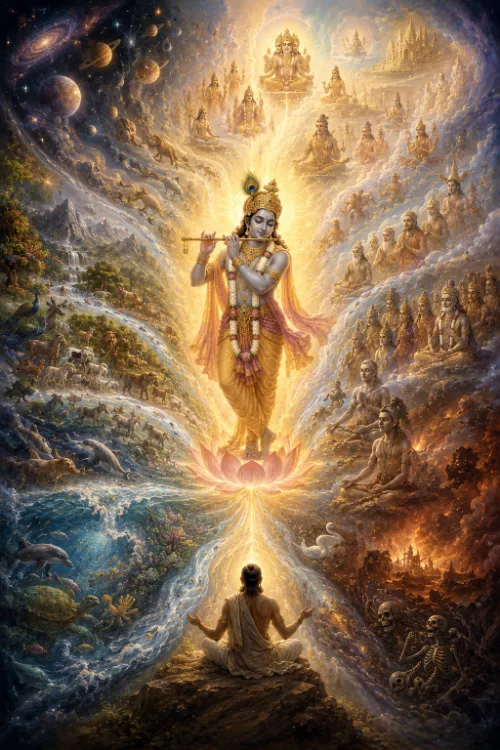
The Subject Behind Every Subject: Why Śrīmad-Bhāgavatam Lists Nine Kinds of Knowledge Only to Reveal the Tenth
Caitanya-caritāmṛta, Ādi 2.91–92 does not quote only Śrīmad-Bhāgavatam 2.10.1; it reproduces two consecutive verses, 2.10.1 and 2.10.2. The distinction matters because the two verses perform different functions: the first names ten subjects, while the second explains why they are being named.
The accurate citation is therefore:
Caitanya-caritāmṛta, Ādi 2.91–92, quoting Śrīmad-Bhāgavatam 2.10.1–2.
The first verse gives the ten subjects of the Bhāgavatam. The second provides the key to the whole list: the first nine are described so that the tenth—āśraya, the ultimate source, support, and refuge—may be clearly known. Without verse 2.10.2, the passage can look like a simple catalogue of Purāṇic topics. With it, the list becomes a theological argument about dependence and the ultimate shelter of everything that exists.
The familiar English rendering in A. C. Bhaktivedanta Swami Prabhupāda’s edition of the Caitanya-caritāmṛta conveys the Gauḍīya conclusion accurately. It is, however, an interpretive theological translation rather than a strictly word-for-word rendering. A close reading preserves its conclusion while adding several important refinements:
- The Sanskrit says mahātmānaḥ, “the great souls” or “great sages,” whereas the published translation uses the related theological term “mahājanas.” The word does not necessarily refer specifically to the canonical list of twelve mahājanas.
- Manvantara means first of all a reign or period of a Manu; the Bhāgavatam then identifies its spiritual content as sad-dharma, true or enduring dharma.
- Īśānukathā includes both the deeds of the Lord’s incarnations and the deeds of His followers. “A description of the incarnations” is therefore true but incomplete.
- Ūti is not simply neutral “initiative.” The text defines it as karma-vāsanā, the desire or latent disposition that impels karmic action.
- Mukti is more than release from gross and subtle bodies. The Bhāgavatam defines it positively: abandoning an imposed identity and becoming established in one’s own true nature.
- Daśamasya means “of the tenth [topic].” The grammar of 2.10.2 does not by itself mean “the Tenth Canto.” The explicit link between the tenth topic and the Tenth Canto is made immediately afterward in Caitanya-caritāmṛta Ādi 2.95 through a verse from Śrīdhara Svāmī.
The central claim is therefore stronger than “God is the last item on a list.” The first nine subjects describe dependent realities; the tenth identifies the reality upon which all nine depend. The nine are not rivals to the tenth. They are the evidence by which the tenth is recognized.
The real source: two verses, not one
In its original setting, the speaker is Śukadeva Gosvāmī. The Caitanya-caritāmṛta reproduces the two verses but omits the introductory words śrī-śuka uvāca, “Śrī Śuka said.”
श्रीशुक उवाच
अत्र सर्गो विसर्गश्च स्थानं पोषणमूतयः ।
मन्वन्तरेशानुकथा निरोधो मुक्तिराश्रयः ॥ १ ॥
दशमस्य विशुद्ध्यर्थं नवानामिह लक्षणम् ।
वर्णयन्ति महात्मानः श्रुतेनार्थेन चाञ्जसा ॥ २ ॥
śrī-śuka uvāca
atra sargo visargaś ca
sthānaṁ poṣaṇam ūtayaḥ
manvantareśānukathā
nirodho muktir āśrayaḥ
daśamasya viśuddhy-arthaṁ
navānām iha lakṣaṇam
varṇayanti mahātmānaḥ
śrutenārthena cāñjasā
Śrī Śuka said: “Here are treated primary creation, secondary creation, ordered maintenance, nurture and protection, the impulses to action, the reigns of the Manus, accounts of the Lord, dissolution, liberation, and the ultimate shelter. For the clear discernment of the tenth, the great souls describe here the defining characteristics of the nine—through revealed utterance, through their intended meaning, and directly.”
Śrīmad-Bhāgavatam 2.10.1–2
This close translation is deliberately compact. The verses that follow—2.10.3–7—supply the fuller definitions. The published Caitanya-caritāmṛta translation reads:
Here [in Śrīmad-Bhāgavatam] ten subjects are described: (1) the creation of the ingredients of the cosmos, (2) the creations of Brahmā, (3) the maintenance of the creation, (4) special favor given to the faithful, (5) impetuses for activity, (6) prescribed duties for law-abiding men, (7) a description of the incarnations of the Lord, (8) the winding up of the creation, (9) liberation from gross and subtle material existence, and (10) the ultimate shelter, the Supreme Personality of Godhead.
The tenth item is the shelter of all the others. To distinguish this ultimate shelter from the other nine subjects, the mahājanas have described these nine, directly or indirectly, through prayers or direct explanations.
That translation is doctrinally faithful and appropriately explanatory. The rest of this article shows which phrases are literal, which are traditional expansions, and how the following Sanskrit definitions fill out the ten short labels.
Why the fused word still contains two items
The compound-looking expression manvantareśānukathā can make the list appear to contain only nine entries. The sandhi must be separated as:
manvantarāṇi ca īśānukathāś ca
“the reigns of the Manus, and accounts of the Lord”
Thus manvantara is item six and īśānukathā is item seven. Jīva Gosvāmī explicitly makes this grammatical separation in Tattva-sandarbha 56.
What the ten subjects actually mean
The best guard against vague interpretation is the Bhāgavatam itself. Verses 2.10.3–7 define the ten terms in sequence.
sarga
Not yet Brahmā’s population of the universe; it is the production of the cosmic ingredients and principles
visarga
The universe’s ingredients are assembled into moving and nonmoving forms
sthāna
More than static “planetary systems”; it is the divinely maintained right ordering of creation
poṣaṇa
Especially the Lord’s preserving care for those who take shelter of Him
ūti
Not merely inventiveness; it is the interior motive that keeps action and consequence moving
manvantara
“Duties for law-abiding people” is an application, not the term’s whole meaning
īśānukathā
The devotees belong inside sacred history; it is not only a catalogue of avatāras
nirodha
Not sheer nonbeing; manifestation is withdrawn into its causal ground
mukti
Liberation is positive restoration, not annihilation of the self
āśraya
In the Gauḍīya reading, the full personal referent is Bhagavān, ultimately Śrī Kṛṣṇa
This is not merely an index of Purāṇic subject matter. It is an argument. The first nine describe everything conditioned, dependent, protected, narrated, withdrawn, or liberated. The tenth answers the question: What makes all of that possible?
The Bhāgavatam’s definitions in its own words
1–2. Primary and secondary creation
भूतमात्रेन्द्रियधियां जन्म सर्ग उदाहृतः ।
ब्रह्मणो गुणवैषम्याद्विसर्गः पौरुषः स्मृतः ॥ ३ ॥
bhūta-mātrendriya-dhiyāṁ
janma sarga udāhṛtaḥ
brahmaṇo guṇa-vaiṣamyād
visargaḥ pauruṣaḥ smṛtaḥ
The arising of the elements, subtle sense-objects, senses, and cognitive faculties is called primary creation. The secondary creation associated with Brahmā, proceeding through the differentiation of the material qualities, is known as visarga.
Śrīmad-Bhāgavatam 2.10.3
The distinction matters. Sarga supplies the cosmic alphabet; visarga composes that alphabet into worlds and bodies. Brahmā is a great secondary creator, but he does not manufacture the original principles from an independent source. This already points beyond Brahmā to āśraya.
3–6. Order, grace, motive, and sacred time
स्थितिर्वैकुण्ठविजयः पोषणं तदनुग्रहः ।
मन्वन्तराणि सद्धर्म ऊतयः कर्मवासनाः ॥ ४ ॥
sthitir vaikuṇṭha-vijayaḥ
poṣaṇaṁ tad-anugrahaḥ
manvantarāṇi sad-dharma
ūtayaḥ karma-vāsanāḥ
Stable order is the victory of the Lord of Vaikuṇṭha; protection is His grace. The reigns of the Manus embody true dharma, and the impulses to action are the desires latent in karma.
Śrīmad-Bhāgavatam 2.10.4
This verse turns apparently impersonal categories into relational ones. Maintenance is the triumph of divine order. Protection is grace. Sacred time is measured by the transmission of dharma. Activity begins not only with outer circumstances but with desire.
The published translation’s “special favor given to the faithful” captures the devotional force of poṣaṇa, although the Sanskrit itself is broader: tad-anugrahaḥ, “His favor” or “His grace.” The special protection of devotees is the paradigmatic form of that grace.
Divine history includes the devotees
अवतारानुचरितं हरेश्चास्यानुवर्तिनाम् ।
पुंसामीशकथाः प्रोक्ता नानाख्यानोपबृंहिताः ॥ ५ ॥
avatārānucaritaṁ
hareś cāsyānuvartinām
puṁsām īśa-kathāḥ proktā
nānākhyānopabṛṁhitāḥ
Accounts of God consist of the deeds of Hari’s descents and of the persons who follow Him, amplified through many narratives.
Śrīmad-Bhāgavatam 2.10.5
This is a major enlargement of that short English gloss. The stories of Prahlāda, Dhruva, Ambarīṣa, the Pāṇḍavas, Uddhava, the residents of Vraja, and other devotees are not pious digressions from theology. Their responses disclose who the Lord is. Love, fidelity, dependence, rescue, separation, and surrender become modes of revelation.
8–9. Dissolution and the positive meaning of liberation
निरोधोऽस्यानुशयनमात्मनः सह शक्तिभिः ।
मुक्तिर्हित्वान्यथारूपं स्वरूपेण व्यवस्थितिः ॥ ६ ॥
nirodho ’syānuśayanam
ātmanaḥ saha śaktibhiḥ
muktir hitvānyathā rūpaṁ
sva-rūpeṇa vyavasthitiḥ
Dissolution is the repose of the living beings, together with the Lord’s energies, in Him. Liberation is the settled condition in one’s own true form after abandoning an imposed, other form.
Śrīmad-Bhāgavatam 2.10.6
The second half is among the Bhāgavatam’s most concise definitions of liberation:
muktir hitvānyathā rūpaṁ sva-rūpeṇa vyavasthitiḥ
“Liberation is giving up the form of misidentification and becoming established in one’s own true nature.”
The phrase does not say that the self disappears. What disappears is anyathā-rūpa—a form, identity, or condition that is “otherwise” than the self’s proper nature. Prabhupāda’s explanation in the Caitanya-caritāmṛta purport identifies this with freedom from gross and subtle coverings and restoration to spiritual service. Liberation is therefore not blankness. It is recovered identity and right relation.
The definition of āśraya
आभासश्च निरोधश्च यतोऽस्त्यध्यवसीयते ।
स आश्रयः परं ब्रह्म परमात्मेति शब्द्यते ॥ ७ ॥
ābhāsaś ca nirodhaś ca
yato ’sty adhyavasīyate
sa āśrayaḥ paraṁ brahma
paramātmeti śabdyate
He from whom the manifestation and its withdrawal arise and are determined is the shelter. He is called the Supreme Brahman and the Paramātmā.
Śrīmad-Bhāgavatam 2.10.7
The grammar moves from processes to a source: manifestation and withdrawal are from whom—yataḥ. The shelter is not merely the last safe place after the universe ends. It is the causal and sustaining ground at every stage.
The following verses sharpen the point through a contrast between interdependence and independence. Sense, sense-object, embodied observer, and presiding power are mutually correlated. None is absolute. The Supreme knower of their whole relation is therefore called:
एकमेकतराभावे यदा नोपलभामहे ।
त्रितयं तत्र यो वेद स आत्मा स्वाश्रयाश्रयः ॥ ९ ॥
ekam ekatarābhāve
yadā nopalabhāmahe
tritayaṁ tatra yo veda
sa ātmā svāśrayāśrayaḥ
Since, when one member is absent, another is not apprehended, the three are interdependent. The Self who knows this triad is the shelter whose support is in Himself.
Śrīmad-Bhāgavatam 2.10.9
The dense expression svāśrayāśrayaḥ points to ultimate nondependence: the final shelter is not held up by another shelter behind it. In ordinary experience everything borrows existence, power, context, or intelligibility from something else. Āśraya ends the regress.
Why describe nine things if the tenth is the point?
The second verse answers this with the compound viśuddhy-artham: “for the sake of clear determination,” “for purified understanding,” or “in order to distinguish.” The nine are described so that the tenth will not be confused with them.
This is the architecture of the passage:
- Creation shows that the world has an originating cause.
- Secondary creation shows that even exalted cosmic agents work with received powers and materials.
- Maintenance shows continuing dependence, not merely an event in the remote past.
- Protection reveals the source as gracious and relational.
- Impulse exposes the inner machinery of bondage.
- The Manus show that cosmic order includes moral and spiritual direction.
- Divine narratives reveal the source through action and relationship.
- Dissolution shows that finite arrangements return to a deeper ground.
- Liberation shows the self restored when false superimposition ends.
- The shelter is the one reality presupposed by every previous category.
The first nine answer questions about dependent reality. The tenth answers the question of dependence itself.
Jīva Gosvāmī’s precise reading
In Tattva-sandarbha 56, Jīva Gosvāmī glosses the key phrase in a remarkably compact way:
तत्र च दशमस्य विशुद्ध्यर्थं तत्त्वज्ञानार्थं नवानां लक्षणं स्वरूपं वर्णयन्ति ।
tatra ca daśamasya viśuddhy-arthaṁ tattva-jñānārthaṁ navānāṁ lakṣaṇaṁ svarūpaṁ varṇayanti
“For the clear discernment of the tenth—that is, for knowledge of its truth—they describe the defining nature of the nine.”
Jīva also explains the modes of description. In hymns and praises, the text can state the Lord’s supremacy openly; in stories, the same truth is often conveyed through the narrative’s governing purport. “Direct” and “indirect” therefore do not mean “reliable” and “unreliable.” They name two ways a literary work communicates its center:
- Explicitly: declarations, prayers, philosophical teaching, and direct identification.
- By narrative import: events whose meaning becomes clear when their cause, dependence, resolution, and devotional purpose are grasped.
A cosmological chapter can therefore speak about Kṛṣṇa without mentioning the pastoral form of Kṛṣṇa in every line. A narrative of a devotee can reveal the āśraya by showing what divine protection, remembrance, or love looks like in lived experience.
The immediate Bengali argument in the Caitanya-caritāmṛta
Kṛṣṇadāsa Kavirāja does not quote Bhāgavatam 2.10.1–2 as an isolated encyclopedia entry. He is arguing that Kṛṣṇa is the source of all avatāras. Immediately before the quotation he writes:
তৈছে সব অবতারের কৃষ্ণ সে কারণ ।
আর এক শ্লোক শুন, কুব্যাখ্যা–খণ্ডন ॥ ৯০ ॥
taiche saba avatārera kṛṣṇa se kāraṇa
āra eka śloka śuna, kuvyākhyā-khaṇḍana
“In the same way, Kṛṣṇa is the cause of all the avatāras. Now hear another verse that refutes mistaken explanations.”
Caitanya-caritāmṛta, Ādi 2.90
He then cites the two Bhāgavatam verses as Ādi 2.91–92 and immediately supplies their interpretive key:
আশ্রয় জানিতে কহি এ নব পদার্থ ।
এ নবের উৎপত্তি–হেতু সেই আশ্রয়ার্থ ॥ ৯৩ ॥
āśraya jānite kahi e nava padārtha
e navera utpatti-hetu sei āśrayārtha
“The nine categories are spoken so that the shelter may be known. That which is the cause of the arising of these nine is what ‘shelter’ means.”
Caitanya-caritāmṛta, Ādi 2.93
Then comes the Gauḍīya identification of that shelter:
কৃষ্ণ এক সর্বাশ্রয়, কৃষ্ণ সর্বধাম ।
কৃষ্ণের শরীরে সর্ব–বিশ্বের বিশ্রাম ॥ ৯৪ ॥
kṛṣṇa eka sarvāśraya, kṛṣṇa sarva-dhāma
kṛṣṇera śarīre sarva-viśvera viśrāma
“Kṛṣṇa alone is the shelter of all; Kṛṣṇa is the abode of everything. All the universes find their resting place in Kṛṣṇa’s body.”
Caitanya-caritāmṛta, Ādi 2.94
The logic is now unmistakable:
Nine dependent categories → their originating shelter → Kṛṣṇa as the shelter of all.
This is why the quotation appears in Ādi-līlā chapter 2, a chapter devoted to identifying Śrī Caitanya Mahāprabhu with the original Supreme Person, Kṛṣṇa. The cosmological list serves an identity argument within Gauḍīya theology: trace every divine manifestation back to its final personal source.
The tenth topic and the Tenth Canto
The Sanskrit of Bhāgavatam 2.10.2 says daśamasya, “of the tenth [topic].” It does not itself say “in the Tenth Canto.” But the Caitanya-caritāmṛta immediately makes that literary-theological connection by quoting Śrīdhara Svāmī:
दशमे दशमं लक्ष्यमाश्रिताश्रयविग्रहम् ।
श्रीकृष्णाख्यं परं धाम जगद्धाम नमामि तत् ॥
daśame daśamaṁ lakṣyam
āśritāśraya-vigraham
śrī-kṛṣṇākhyaṁ paraṁ dhāma
jagad-dhāma namāmi tat
“In the Tenth [Canto], the tenth object is revealed: the embodied shelter of all who are sheltered, the supreme abode known as Śrī Kṛṣṇa, the abode of the worlds. To Him I bow.”
Caitanya-caritāmṛta, Ādi 2.95
The wordplay is deliberate:
- daśame — “in the Tenth [Canto]”
- daśamam — “the tenth [topic]”
The Tenth Canto is thus not simply the tenth box in a filing system. It brings the ultimate subject into concentrated view: the source of the cosmic order appears as Kṛṣṇa, acting in intimate personal relationships.
That intimacy is not a retreat from metaphysics. It is the climax of metaphysics. The being upon whom universes rest is the same person who becomes Yaśodā’s son, the cowherd boys’ friend, and the beloved of the people of Vraja. Gauḍīya theology sees the majesty of āśraya reaching fullness not in distance but in reciprocal love.
Do not force a one-topic-per-canto scheme
Prabhupāda’s purport offers a helpful broad teaching map: the first nine categories prepare the reader, and the Tenth Canto gives special prominence to Kṛṣṇa as āśraya. That should not be hardened into the claim that each of the first nine cantos contains only one corresponding topic.
Jīva Gosvāmī explicitly cautions against such a rigid sequence in Tattva-sandarbha 61:
अतः प्रायशः सर्वेऽर्थाः सर्वेष्वेव स्कन्धेषु गुणत्वेन वा मुख्यत्वेन वा निरूप्यन्त इत्येव तेषामभिमतम् ।
ataḥ prāyaśaḥ sarve ’rthāḥ sarveṣv eva skandheṣu guṇatvena vā mukhyatvena vā nirūpyanta ity eva teṣām abhimatam
“Thus their view is that virtually all these subjects are treated in all the cantos, sometimes as subordinate themes and sometimes as principal ones.”
The Tenth Canto has a special concentration on the āśraya, but the shelter is present throughout the whole work. Likewise, creation, protection, motive, dharma, and liberation do not vanish when the reader reaches the Tenth Canto.
The Bhāgavatam itself gives a related second list of ten Purāṇic characteristics in 12.7.9–10—using terms such as vṛtti, rakṣā, vaṁśa, and apāśraya. This is not a contradiction. The lists classify the Purāṇic field from different angles. Their shared structural insight is that the many histories and processes culminate in an ultimate support.
Āśraya is ontological—and devotional
English “shelter” can sound merely emotional: a place one goes when frightened. The Sanskrit āśraya is wider. In this context it carries at least five connected senses.
Origin
Everything emerges from the āśraya. This echoes the opening definition of the Absolute in the Bhāgavatam:
जन्माद्यस्य यतः
janmādy asya yataḥ
“From whom arise the birth, continuance, and dissolution of this [universe].”
Śrīmad-Bhāgavatam 1.1.1, opening phrase
The Bhāgavatam begins where 2.10.7 later arrives: the ultimate subject is known through the dependence of the cosmos upon Him.
Sustaining basis
The source does not create and depart. Sthāna and poṣaṇa reveal continuous dependence: order holds, beings are sustained, and devotees receive grace.
Final resolution
At nirodha, the manifest energies are withdrawn. What remains is not nothing. The celebrated four-verse revelation immediately preceding chapter 2.10 says:
अहमेवासमेवाग्रे नान्यद् यत् सदसत् परम् ।
पश्चादहं यदेतच्च योऽवशिष्येत सोऽस्म्यहम् ॥ ३३ ॥
aham evāsam evāgre
nānyad yat sad-asat param
paścād ahaṁ yad etac ca
yo ’vaśiṣyeta so ’smy aham
“I alone existed before [creation], when nothing else—neither effect nor cause—was beyond Me. What appears afterward is also I, and whatever remains at the end, that also am I.”
Śrīmad-Bhāgavatam 2.9.33
Chapter 2.10’s list follows directly after this revelation. The ten topics are therefore a way of unfolding the declaration “I alone” across creation, duration, and dissolution.
Ground of intelligibility
The nine become fully intelligible only in relation to their source. Creation studied without āśraya yields mechanisms without final meaning. Protection without āśraya becomes luck. Sacred history without āśraya becomes legend. Liberation without āśraya risks becoming mere negation.
The tenth subject does not erase the first nine. It places them in their true relation.
Personal refuge
In Gauḍīya Vaiṣṇavism, metaphysical support becomes devotional refuge. The one from whom everything arises is also the one to whom a person can surrender. Āśraya answers both “What supports reality?” and “Whom can I trust completely?”
This double force explains why “ultimate shelter” is a better translation than an abstract word such as “substrate.” The Sanskrit argument is about being, but it is meant to culminate in devotion.
Brahman, Paramātmā, Bhagavān—and why the Caitanya-caritāmṛta says Kṛṣṇa
Bhāgavatam 2.10.7 explicitly calls the āśraya “Supreme Brahman” and “Paramātmā.” Why does the Gauḍīya reading identify the same shelter as Bhagavān Śrī Kṛṣṇa? The answer rests on the Bhāgavatam’s own theology of one nondual reality known in three aspects:
वदन्ति तत्तत्त्वविदस्तत्त्वं यज्ज्ञानमद्वयम् ।
ब्रह्मेति परमात्मेति भगवानिति शब्द्यते ॥ ११ ॥
vadanti tat tattva-vidas
tattvaṁ yaj jñānam advayam
brahmeti paramātmeti
bhagavān iti śabdyate
“Knowers of truth speak of that nondual reality as Brahman, Paramātmā, and Bhagavān.”
Śrīmad-Bhāgavatam 1.2.11
The three names do not designate three competing absolutes. They express realizations of one nondual truth. Gauḍīya theologians hold that Bhagavān is the fullest disclosure because the personal source includes, rather than excludes, the all-pervading Brahman and indwelling Paramātmā features.
The Bhāgavatam then makes the identification that governs Kṛṣṇadāsa Kavirāja’s argument:
एते चांशकलाः पुंसः कृष्णस्तु भगवान् स्वयम् ।
इन्द्रारिव्याकुलं लोकं मृडयन्ति युगे युगे ॥ २८ ॥
ete cāṁśa-kalāḥ puṁsaḥ
kṛṣṇas tu bhagavān svayam
indrāri-vyākulaṁ lokaṁ
mṛḍayanti yuge yuge
“These are portions or portions of portions of the Supreme Person, but Kṛṣṇa is Bhagavān Himself. Age after age they protect the worlds when these are troubled by the enemies of the gods.”
Śrīmad-Bhāgavatam 1.3.28
This is the bridge from general metaphysics to the specific Gauḍīya claim:
- The tenth topic is the ultimate shelter.
- The ultimate shelter is the nondual Absolute known as Brahman, Paramātmā, and Bhagavān.
- The Bhāgavatam identifies Kṛṣṇa as Bhagavān svayam.
- Therefore Kṛṣṇa is the personal fullness of the āśraya disclosed throughout the Bhāgavatam.
That is what Caitanya-caritāmṛta Ādi 2.91–95 is arguing.
A second tenfold list—and why it does not overturn the first
Readers may encounter another list in Śrīmad-Bhāgavatam 12.7.9–10:
सर्गोऽस्याथ विसर्गश्च वृत्तिरक्षान्तराणि च ।
वंशो वंशानुचरितं संस्था हेतुरपाश्रयः ॥ ९ ॥
दशभिर्लक्षणैर्युक्तं पुराणं तद्विदो विदुः ।
केचित् पञ्चविधं ब्रह्मन् महदल्पव्यवस्थया ॥ १० ॥
sargo ’syātha visargaś ca
vṛtti-rakṣāntarāṇi ca
vaṁśo vaṁśānucaritaṁ
saṁsthā hetur apāśrayaḥ
daśabhir lakṣaṇair yuktaṁ
purāṇaṁ tad-vido viduḥ
kecit pañca-vidhaṁ brahman
mahad-alpa-vyavasthayā
“Those who know the subject understand a Purāṇa to possess ten characteristics: creation, secondary creation, livelihood and maintenance, protection, the eras of the Manus, dynasties, accounts of dynasties, dissolution, the motive of embodied existence, and the supreme support. Some describe a Purāṇa as fivefold, O brāhmaṇa, according to the distinction between major and minor works.”
This later list emphasizes the formal characteristics of Purāṇic literature—dynasties and dynastic narratives, for example—whereas 2.10.1–2 organizes the Bhāgavatam’s own theological disclosure. The vocabularies overlap substantially: sarga, visarga, manvantara, dissolution, motive, and ultimate support all recur. In both lists, diverse histories and processes lead to a ground beyond themselves.
Verse 12.7.19 defines apāśraya, the final term of that second list, in a way that confirms the same structure: the Absolute is present within all changing states yet remains distinct from them. Dependence does not reduce God to the world, and transcendence does not sever God from it.
What the published translation gets right—and where it can be stronger
The published rendering is sound as a theological translation. Its ten English glosses follow Prabhupāda’s Caitanya-caritāmṛta edition and correctly culminate in “the ultimate shelter, the Supreme Personality of Godhead.” Its sentence about the tenth being the shelter of the other nine also reflects the immediate Bengali explanation in Ādi 2.93–94.
Still, a careful editor should preserve three distinctions.
Citation versus interpretation
Bhāgavatam 2.10.1 names āśraya as the tenth item. Verse 2 says the nine are described for the clear understanding of the tenth. The fuller statement “the tenth item is the shelter of all the others” is the traditional interpretation of that syntax, explicitly confirmed by Kṛṣṇadāsa Kavirāja in the next two Bengali verses. It is accurate, but it is exposition, not a woodenly literal translation of every Sanskrit word.
Content label versus scriptural definition
Short labels are useful, but verses 3–7 control their meaning. Thus “incarnations” must be expanded to include devotees; “impetus” must be tied to karmic desire; “liberation” must be understood as establishment in svarūpa; and “shelter” must include source, support, final resolution, and refuge.
The tenth subject versus the Tenth Canto
The words are related by a deliberate traditional reading, but they are not grammatically identical. Daśamasya in 2.10.2 refers to the tenth subject. Śrīdhara Svāmī’s daśame daśamam then locates that tenth subject with special force in the Tenth Canto. Keeping the distinction makes the wordplay more—not less—powerful.
The deeper theological pattern
The ten subjects can be read as a movement from dependence to shelter:
- What exists? Created principles and created forms—sarga and visarga.
- Why does it continue? Order and grace—sthāna and poṣaṇa.
- Why do beings keep acting? Karmic inclination—ūti.
- How is life directed? Sacred eras and true dharma—manvantara.
- How is the divine known in history? The deeds of the Lord and His devotees—īśānukathā.
- What happens to the cosmos? Withdrawal—nirodha.
- What happens to the bound self? Restoration to its true nature—mukti.
- What makes all these processes possible and meaningful? The ultimate shelter—āśraya.
The sequence is not merely cosmic. It is existential. Human beings inhabit a world they did not create, inherit motives they barely understand, depend on protection they cannot guarantee, and face the dissolution of every temporary arrangement. The Bhāgavatam does not answer those facts by dismissing the world. It teaches the reader to trace each dependent reality toward its source.
The result is a theological hermeneutic: read every subject until its dependence becomes visible. Creation points to origin. Order points to sustainer. grace points to giver. Sacred history points to the person revealed in action. Liberation points to the true self and its proper relation. When read this way, the nine subjects continually open into the tenth.
Final conclusion
The marginal note “2.10.1” should be corrected to “2.10.1–2.” That is the straightforward bibliographical fact. But the more important correction is interpretive. Śrīmad-Bhāgavatam 2.10.1 is not complete without 2.10.2, because the second verse tells us what the list is for. The first nine subjects are not nine distractions before theology begins. They are the means by which theology comes into focus.
The tenth subject, āśraya, is:
- the source from whom the nine arise,
- the power by which they continue,
- the ground into which they are withdrawn,
- the truth by which liberation is intelligible,
- and the refuge in whom the soul finds its proper relation.
In the immediate Gauḍīya reading of Caitanya-caritāmṛta Ādi 2.93–95, that shelter is not left as an abstraction. Kṛṣṇadāsa Kavirāja names Him: Kṛṣṇa is sarvāśraya, the shelter of all.
The heart of the passage can therefore be stated in one sentence:
The Bhāgavatam describes everything that depends so that the reader may know the One upon whom everything depends.
Primary texts and classical commentaries cited
- Śrīmad-Bhāgavatam 1.1.1; 1.2.11; 1.3.28; 2.9.33; 2.10.1–9; 12.7.9–10, 19.
- Kṛṣṇadāsa Kavirāja Gosvāmī, Śrī Caitanya-caritāmṛta, Ādi-līlā 2.90–95.
- Śrīdhara Svāmī, Bhāvārtha-dīpikā, introductory verses to the Tenth Canto, as quoted in Caitanya-caritāmṛta Ādi 2.95.
- Jīva Gosvāmī, Tattva-sandarbha 56 and 61.
- A. C. Bhaktivedanta Swami Prabhupāda, translations and purports to Śrī Caitanya-caritāmṛta Ādi 2.91–95 and Śrīmad-Bhāgavatam 2.10.1–9.