

The One Spiritual Power Behind Reality, Knowledge, and Love
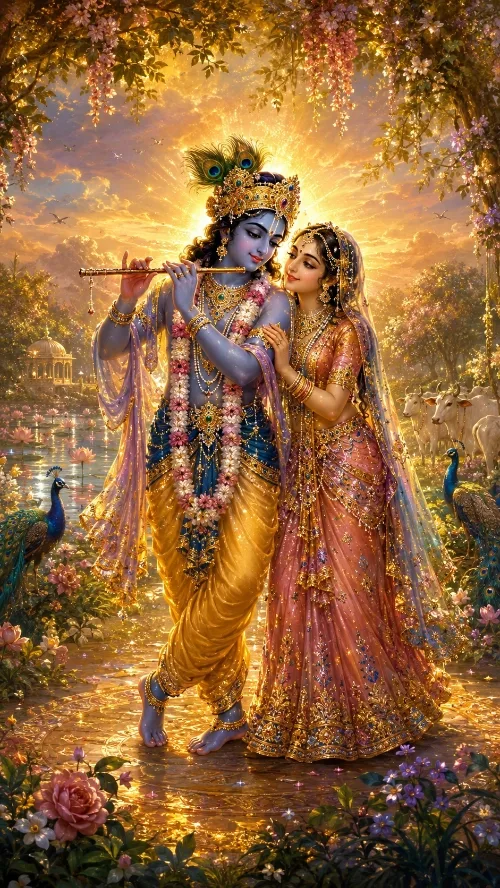
The One Spiritual Power Behind Reality, Knowledge, and Love: Sac-cid-ānanda, Sandhinī, Saṁvit, and Hlādinī
What does it mean to say that Kṛṣṇa is sac-cid-ānanda?
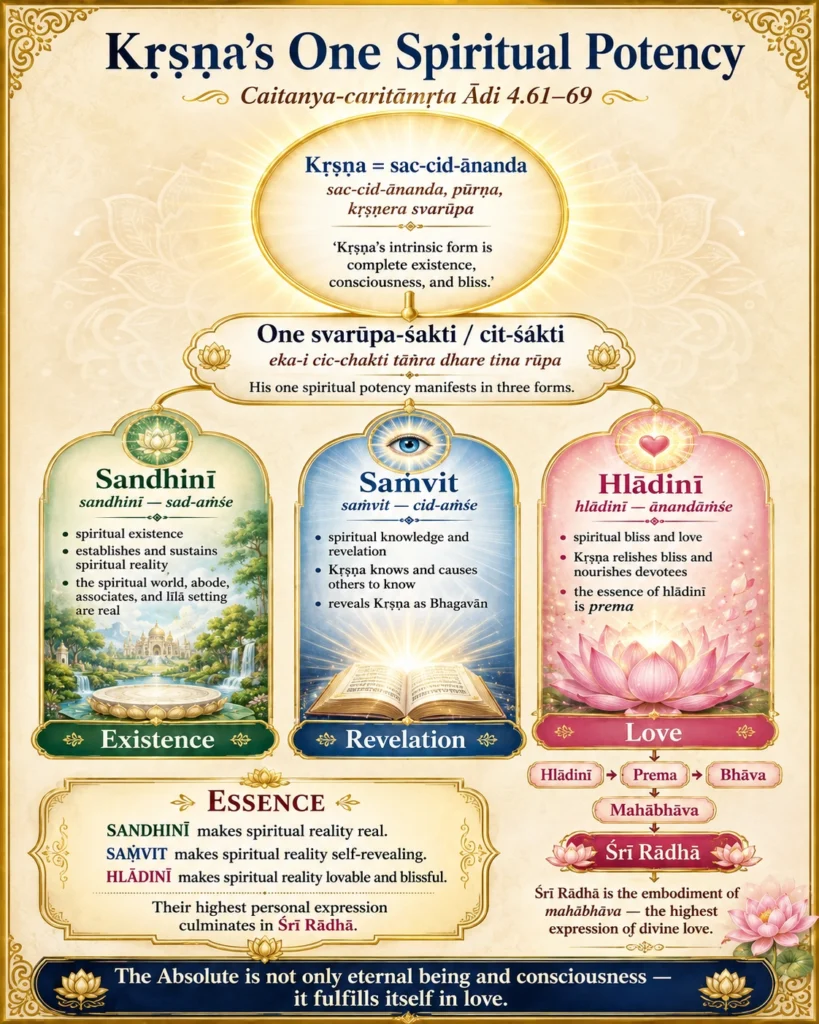
A single sheet mapping Kṛṣṇa’s one svarūpa-śakti into sandhinī, saṁvit and hlādinī — existence, revelation and love — and tracing hlādinī through prema and bhāva to mahābhāva in Śrī Rādhā.
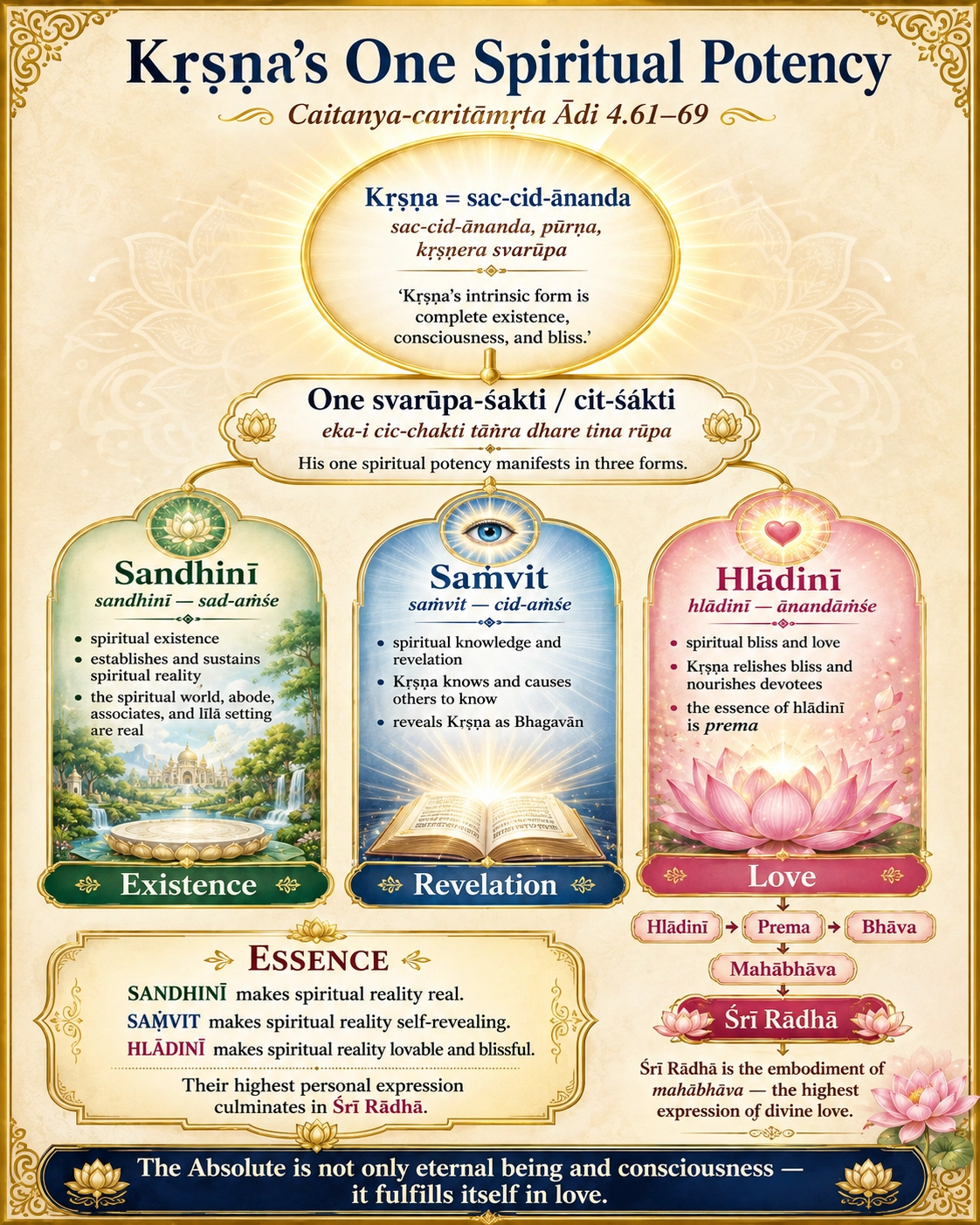
The phrase is so familiar in Vaiṣṇava theology that it can easily become a slogan: Kṛṣṇa is eternal. Kṛṣṇa is conscious. Kṛṣṇa is blissful. But Śrī Caitanya-caritāmṛta Ādi 4.61 takes the idea much further.
Kṛṣṇadāsa Kavirāja does not merely say that Kṛṣṇa possesses eternity, consciousness, and bliss as three attributes. He says that Kṛṣṇa’s very svarūpa—His intrinsic identity and form—is complete sac-cid-ānanda.
Then he makes a second statement: Kṛṣṇa possesses one spiritual potency, yet that one potency appears analytically in three principal forms.
The next verse identifies them:
- sandhinī — the potency of spiritual existence;
- saṁvit — the potency of spiritual knowledge and revelation;
- hlādinī — the potency of spiritual bliss and love.
This is not an abstract digression. Kṛṣṇadāsa is building toward one of the central theological conclusions of Gauḍīya Vaiṣṇavism: Śrī Rādhā is the supreme personal embodiment of Kṛṣṇa’s hlādinī-śakti, and the union of Rādhā and Kṛṣṇa is revealed as Śrī Caitanya Mahāprabhu.
Thus Ādi 4.61 is a hinge. It links metaphysics with rasa. Being with relationship. Consciousness with revelation. Bliss with prema. And ultimately: sac-cid-ānanda with Rādhā-Kṛṣṇa.
The Foundational Verse
Śrī Caitanya-caritāmṛta, Ādi 4.61
সচ্চিদানন্দ, পূর্ণ, কৃষ্ণের স্বরূপ ।
একই চিচ্ছক্তি তাঁর ধরে তিন রূপ ॥
sac-cid-ānanda, pūrṇa, kṛṣṇera svarūpa
eka-i cic-chakti tāṅra dhare tina rūpa
“Kṛṣṇa’s intrinsic form is complete existence, consciousness, and bliss. His one spiritual potency manifests in three forms.”
The verse contains four crucial ideas: sac-cid-ānanda pūrṇa svarūpa and: eka-i cic-chakti —“one spiritual potency.” Everything that follows depends upon understanding those four expressions correctly.
Svarūpa Means More Than “Body”
A common published translation renders the first line: “Lord Kṛṣṇa’s body is eternal, full of knowledge and full of bliss.” That is doctrinally sound. But:
স্বরূপ
svarūpa
is richer than the English word body. It means: one’s own intrinsic form, essential nature, proper identity, what something is in itself. So Kṛṣṇadāsa is not saying merely: “Kṛṣṇa possesses a very extraordinary spiritual body.”
He is saying: Kṛṣṇa’s form and Kṛṣṇa’s essential being are sac-cid-ānanda. There is no deeper, invisible Kṛṣṇa hidden underneath an external divine shell. His form is His spiritual nature.
His personality is not enclosed inside a body produced by something else. That distinction separates Bhagavān sharply from the conditioned jīva.
Kṛṣṇa Does Not Have a Body in the Way We Have Bodies
For an embodied jīva there is an important distinction between: deha — the body, and: dehin — the conscious being who inhabits the body. The body: changes, ages, becomes diseased, and dies.
The jīva remains the conscious subject experiencing those changes. Kṛṣṇa’s form is not like that. It is not: produced by karma, assembled from matter, given by material nature, or temporarily inhabited by Him.
The Brahma-saṁhitā states this explicitly:
ईश्वरः परमः कृष्णः
सच्चिदानन्दविग्रहः ।
अनादिरादिर्गोविन्दः
सर्वकारणकारणम् ॥
īśvaraḥ paramaḥ kṛṣṇaḥ
sac-cid-ānanda-vigrahaḥ
anādir ādir govindaḥ
sarva-kāraṇa-kāraṇam
“Kṛṣṇa, Govinda, is the Supreme Lord. His form is existence, consciousness, and bliss. He has no beginning, yet He is the beginning of all and the cause of all causes.”
Brahma-saṁhitā 5.1
The crucial word is:
विग्रह
vigraha
“form.” Kṛṣṇa does not merely possess: sat, cit, and ānanda. His very vigraha is sac-cid-ānanda.
Pūrṇa : Complete, Not Composite
Kṛṣṇadāsa says:
পূর্ণ
pūrṇa
complete, full, perfect. This prevents another misunderstanding. Kṛṣṇa should not be imagined as constructed from three metaphysical ingredients: one part sat, one part cit, one part ānanda.
Sac-cid-ānanda is not a chemical formula. The three terms describe the one indivisible spiritual reality from three angles. Kṛṣṇa is fully: sat — spiritual existence; fully: cit — consciousness; fully: ānanda — bliss.
None can be removed from the others. Spiritual existence is conscious. Spiritual consciousness is blissful. Spiritual bliss is real and conscious. The distinctions are analytical.
The reality is one.
The Upaniṣadic Background
The exact compound: sac-cid-ānanda-vigraha is famously explicit in the Brahma-saṁhitā. But the theological components have deep Upaniṣadic roots. The Taittirīya Upaniṣad says:
सत्यं ज्ञानम् अनन्तं ब्रह्म ।
satyam jñānam anantaṁ brahma
“Brahman is reality, knowledge, and infinity.”
Taittirīya Upaniṣad 2.1.1
Later it states:
आनन्दो ब्रह्मेति व्यजानात् ।
ānando brahmeti vyajānāt
“He realized that Brahman is bliss.”
Taittirīya Upaniṣad 3.6.1
The Gauḍīya formulation therefore gathers together ancient Vedāntic themes: the Absolute is not temporary; not unconscious; not dependent; not miserable; not materially conditioned.
But Gauḍīya theology then makes the decisive move from: the qualities of the Absolute to: the personal Absolute—Kṛṣṇa.
One Spiritual Potency
The second line of Ādi 4.61 is crucial:
একই চিচ্ছক্তি তাঁর ধরে তিন রূপ
eka-i cic-chakti tāṅra dhare tina rūpa
“His one spiritual potency manifests in three forms.” The emphatic word is: eka-i “one indeed,” “one and the same.” Kṛṣṇadāsa does not propose three unrelated spiritual substances existing beside Kṛṣṇa.
He teaches: one internal potency which can be understood according to three predominant functions. This internal potency is commonly called: cit-śakti svarūpa-śakti or: antaraṅga-śakti —Kṛṣṇa’s intrinsic spiritual potency.
The Next Verse Gives the Threefold Structure
Śrī Caitanya-caritāmṛta, Ādi 4.62
আনন্দাংশে হ্লাদিনী, সদংশে সন্ধিনী ।
চিদংশে সম্বিৎ—যারে জ্ঞান করি’ মানি ॥
ānandāṁśe hlādinī, sad-aṁśe sandhinī
cid-aṁśe samvit — yāre jñāna kari’ māni
“In relation to bliss it is hlādinī; in relation to existence it is sandhinī; and in relation to consciousness it is saṁvit, which is understood as knowledge.”
The mapping is therefore:
But this should not be interpreted as three sealed compartments. Sandhinī is conscious and blissful. Saṁvit exists and is blissful. Hlādinī exists and is conscious.
All belong to one indivisible spiritual potency.
The Sanskrit Foundation: Viṣṇu Purāṇa
Kṛṣṇadāsa immediately supports the doctrine with an older Sanskrit verse:
ह्लादिनी सन्धिनी संवित्
त्वय्येका सर्वसंस्थितौ ।
ह्लादतापकरी मिश्रा
त्वयि नो गुणवर्जिते ॥
hlādinī sandhinī saṁvit
tvayy ekā sarva-saṁsthitau
hlāda-tāpa-karī miśrā
tvayi no guṇa-varjite
“Hlādinī, sandhinī, and saṁvit exist in You as one potency, O You in whom everything is established. The mixed potency that produces material pleasure and suffering does not exist in You, who are free from the material guṇas.”
Viṣṇu Purāṇa 1.12.69, quoted in Caitanya-caritāmṛta Ādi 4.63
Again the decisive word is:
एका
ekā
“one.” The text is explicit. Hlādinī, sandhinī, and saṁvit are not three independent ultimate principles. They are three distinguishable functions of one spiritual potency.
A Textual Note on the Viṣṇu Purāṇa Verse
There is a genuine textual variation in this verse. Some editions read:
सर्वसंस्थितौ
sarva-saṁsthitau
“in whom everything is established.” Some Gauḍīya quotations transmit:
सर्वसंश्रये
sarva-saṁśraye
“in the shelter of everything.” The theological direction is similar: Bhagavān is the one in whom all realities stand and upon whom they depend. Verse numbering also varies between editions.
A critical edition commonly gives: Viṣṇu Purāṇa 1.12.69 while traditional references may differ slightly. That is an editorial matter, not a doctrinal difference.
What Does Guṇa-varjita Mean?
The Viṣṇu Purāṇa calls Bhagavān:
गुणवर्जित
guṇa-varjita
literally: “free from guṇas.” That must not be misunderstood as: “Kṛṣṇa possesses no qualities.” In this context: guṇa means the material modes: sattva rajas tamas Thus: guṇa-varjita means: free from the qualities of material prakṛti.
It does not mean: formless, qualityless, personalityless, or devoid of beauty, knowledge, will, and relationship. Vaiṣṇava uses of terms such as: nirguṇa often mean: beyond material qualities rather than: without qualities whatsoever.
The Material Potency Is Different
The second half of the Viṣṇu Purāṇa verse contrasts the internal potency with:
ह्लादतापकरी मिश्रा
hlāda-tāpa-karī miśrā
the mixed potency producing: pleasure, pain, and combinations of the two. That is the world of conditioned material experience. Material pleasure is temporary. Material suffering is temporary.
Even material goodness remains part of the changing guṇas. But Kṛṣṇa’s internal potency is not a refined version of material nature. It belongs to an entirely spiritual order.
This is why spiritual bliss cannot be reduced to an intensified sensory pleasure.
Jīva Gosvāmī States the Principle Precisely
Śrī Jīva Gosvāmī systematizes the doctrine in Bhagavat-sandarbha:
प्रथमं तावद् एकस्यैव तत्त्वस्य
सच्चिदानन्दत्वाच्छक्तिरप्येका त्रिधा भिद्यते ।
prathamaṁ tāvad ekasyaiva tattvasya
sac-cid-ānandatvāc chaktir apy ekā tridhā bhidyate
“First, because the one Reality is existence, consciousness, and bliss, its one potency is likewise distinguished threefold.”
Jīva Gosvāmī, Bhagavat-sandarbha
The numbering of this discussion varies between editions. In some modern Sanskrit arrangements it appears around anuccheda 117, while Prabhupāda cites a different section number in his purport.
The doctrine, however, is clear: ekasyaiva tattvasya one Reality; śaktir apy ekā one potency; tridhā bhidyate distinguished threefold.
Sandhinī: The Power of Spiritual Existence
The word: sandhinī is connected with the function of establishing or sustaining reality. A useful way to understand it is: sandhinī is the potency through which spiritual existence is concretely manifest and sustained.
This includes not merely Kṛṣṇa’s own existence—Kṛṣṇa does not require some external substrate beneath Himself—but the manifestation of: His abode, His associates, His dwelling places, His paraphernalia, His relationships, His līlā environments.
In other words: Vṛndāvana is not a material stage temporarily constructed so that spiritual actors can perform upon it. The spiritual environment itself belongs to: svarūpa-śakti.
Spiritual Reality Is Variegated
This point is important. Sometimes transcendence is imagined as the disappearance of all differentiation. No forms. No places. No colors. No relationships. No activities.
But sandhinī allows Gauḍīya Vedānta to affirm a real spiritual world. There can be: a spiritual forest, spiritual rivers, spiritual homes, spiritual cows, spiritual friends, spiritual parents, spiritual music, spiritual līlā— without reducing them to material copies.
Their reality is grounded in: sandhinī-śakti.
Sandhinī and Śuddha-sattva
In the verses following 4.63, Kṛṣṇadāsa connects sandhinī with: śuddha-sattva or: viśuddha-sattva pure spiritual existence. This must not be confused with: sattva-guṇa the material mode of goodness.
Material sattva is still part of prakṛti. It may produce: clarity, peace, knowledge, and virtue, but it remains conditioned and temporary. Śuddha-sattva belongs beyond material nature.
Thus Kṛṣṇa’s: abode, parents, seat, bed, home, associates, and līlā are not manifestations of purified matter. They are spiritual.
Saṁvit: The Power of Knowing and Revealing
Jīva Gosvāmī gives an exceptionally concise definition:
तथा संविद्रूपोऽपि
यया संवेत्ति संवेदयति च सा संवित् ।
tathā saṁvid-rūpo ’pi
yayā saṁvetti saṁvedayati ca sā saṁvit
“Although He is Himself the form of consciousness, that potency by which He knows and causes others to know is saṁvit.”
Jīva Gosvāmī, Bhagavat-sandarbha
This is a profound statement. Saṁvit is not merely: information. It is the spiritual power of: awareness and: revelation. Kṛṣṇa knows. And Kṛṣṇa makes Himself knowable.
Bhagavān Is Not Merely an Object of Investigation
This changes the epistemology. If Kṛṣṇa is the Supreme conscious Person, we cannot think of Him merely as an inert object waiting to be conquered by enough intellectual analysis.
Reason matters. Śāstra matters. Study matters. Memory matters. Philosophical discrimination matters. But complete knowledge of Bhagavān ultimately requires: self-disclosure.
Even in ordinary personal relationships, knowing facts about someone is not the same as knowing the person. One can know: their date of birth, profession, address, education, and biography without possessing real personal intimacy.
Personal knowledge involves: revelation, trust, reciprocity, relationship. Gauḍīya theology applies that principle to the Absolute.
Saṁvit Reaches Its Essence in Knowledge of Kṛṣṇa as Bhagavān
A few verses later Kṛṣṇadāsa says:
কৃষ্ণে ভগবত্তা-জ্ঞান—সংবিতের সার ।
ব্রহ্মজ্ঞানাদিক সব তার পরিবার ॥
kṛṣṇe bhagavattā-jñāna — saṁvitera sāra
brahma-jñānādika saba tāra parivāra
“Knowledge of Bhagavānhood in Kṛṣṇa is the essence of saṁvit; knowledge of Brahman and related realizations are its surrounding retinue.”
Caitanya-caritāmṛta, Ādi 4.67
This is the full theological function of saṁvit. It does not merely produce: consciousness in general. At its fullest it reveals: who the Absolute is. And the Gauḍīya answer is: Kṛṣṇa is Bhagavān.
Brahman Knowledge Is Not Called False
The word:
পরিবার
parivāra
is important. It means: family, retinue, entourage, surrounding circle. Kṛṣṇadāsa does not call Brahman-realization: mithyā false. He places it inside the spiritual domain but subordinate in completeness to Bhagavān-realization.
The Bhāgavatam itself says:
वदन्ति तत्तत्त्वविदस्
तत्त्वं यज्ज्ञानमद्वयम् ।
ब्रह्मेति परमात्मेति
भगवानिति शब्द्यते ॥
vadanti tat tattva-vidas
tattvaṁ yaj jñānam advayam
brahmeti paramātmeti
bhagavān iti śabdyate
“Knowers of truth describe the one nondual Reality as Brahman, Paramātmā, and Bhagavān.”
Śrīmad-Bhāgavatam 1.2.11
The reality is one. The modes of disclosure differ.
Brahman, Paramātmā, Bhagavān
From a Gauḍīya perspective:
Brahman
The Absolute realized as unlimited spiritual being and consciousness without full disclosure of personal form and relationship.
Paramātmā
The Absolute realized as the indwelling witness, cosmic regulator, and all-pervading Lord.
Bhagavān
The same nondual Absolute fully revealed as: Person, form, qualities, energies, will, beauty, associates, līlā, and reciprocal love. Bhagavān-realization is therefore considered fuller not because Brahman is false, but because personal revelation includes dimensions that impersonal realization does not disclose.
Why Kṛṣṇa?
Gauḍīya theology then takes a further step. The Bhāgavatam declares:
एते चांशकलाः पुंसः
कृष्णस्तु भगवान् स्वयम् ।
इन्द्रारिव्याकुलं लोकं
मृडयन्ति युगे युगे ॥
ete cāṁśa-kalāḥ puṁsaḥ
kṛṣṇas tu bhagavān svayam
indrāri-vyākulaṁ lokaṁ
mṛḍayanti yuge yuge
“These are portions or portions of portions of the Supreme Person, but Kṛṣṇa is Bhagavān Himself. Age after age they protect the world when disturbed by the enemies of the gods.”
Śrīmad-Bhāgavatam 1.3.28
Thus saṁvit reaches its fullest theological disclosure when it reveals:
- not merely that there is an Absolute,
- not merely that the Absolute is conscious,
- not merely that Bhagavān exists,
but: Kṛṣṇa is Svayaṁ Bhagavān.
Hlādinī: The Power of Bliss
Immediately before Ādi 4.61, Kṛṣṇadāsa explains hlādinī:
হ্লাদিনী করায় কৃষ্ণে আনন্দাস্বাদন ।
হ্লাদিনীর দ্বারা করে ভক্তের পোষণ ॥
hlādinī karāya kṛṣṇe ānandāsvādana
hlādinīra dvārā kare bhaktera poṣaṇa
“The hlādinī potency enables Kṛṣṇa to relish bliss, and through hlādinī He nourishes His devotees.”
Caitanya-caritāmṛta, Ādi 4.60
At first this creates an obvious philosophical question: If Kṛṣṇa is already: ānanda why does He need a potency in order to experience bliss? The answer is: hlādinī is not something external added to an incomplete Kṛṣṇa.
It is His own intrinsic bliss potency.
Bliss Is Dynamic
Hlādinī shows that divine bliss is not merely a passive condition like: “God feels pleasant forever.” It is dynamic. Bliss can be: experienced, relished, exchanged, shared, intensified through relationship.
Thus hlādinī is the spiritual capacity by which: Kṛṣṇa relishes bliss, and: His devotees participate in that bliss. This takes ānanda from metaphysical abstraction into: rasa.
The Three Potencies Are Better Understood as Three Questions
A simple way to remember the entire structure is:
Being, Knowing, Loving
The scheme can therefore be expressed even more simply: sandhinī — being saṁvit — knowing hlādinī — loving and delighting This reveals how relational Gauḍīya metaphysics really is.
Ultimate reality does not merely: exist. It knows. It reveals. It loves. It delights. It enters relationship. This is why the metaphysics of sac-cid-ānanda naturally develops into the theology of Rādhā-Kṛṣṇa.
The Immediate Context Is Śrī Rādhā
This is perhaps the most important contextual fact. Ādi 4.61 is not introduced because Kṛṣṇadāsa suddenly decided to give a neutral philosophical lecture. He is explaining: Who is Rādhā?
Two verses earlier:
রাধিকা হয়েন কৃষ্ণের প্রণয়-বিকার ।
স্বরূপশক্তি—‘হ্লাদিনী’ নাম যাঁহার ॥
rādhikā hayena kṛṣṇera praṇaya-vikāra
svarūpa-śakti — ‘hlādinī’ nāma yāṅhāra
“Śrī Rādhikā is the transformation of Kṛṣṇa’s love. She is His intrinsic potency known as hlādinī.”
Caitanya-caritāmṛta, Ādi 4.59
So the whole threefold potency discussion is inserted because Kṛṣṇadāsa wants to establish the theological identity of Śrī Rādhā.
Why Explain Sandhinī and Saṁvit if the Real Subject Is Rādhā?
Because Rādhā cannot simply be described as: “a very exalted devotee.” Kṛṣṇadāsa wants to place Her within the architecture of Kṛṣṇa’s own svarūpa-śakti. He therefore establishes: Kṛṣṇa’s nature is sac-cid-ānanda.
His internal potency is one. That potency is understood as: sandhinī, saṁvit, hlādinī. Then he shows that hlādinī reaches its most concentrated personal expression in: prema and ultimately: Śrī Rādhā.
Thus Rādhā is situated not outside Kṛṣṇa’s divine reality but within His most intimate intrinsic potency.
Hlādinī Culminates in Prema
Kṛṣṇadāsa says:
হ্লাদিনীর সার ‘প্রেম’, প্রেমসার ‘ভাব’ ।
ভাবের পরমকাষ্ঠা, নাম—‘মহাভাব’ ॥
hlādinīra sāra ‘prema’, prema-sāra ‘bhāva’
bhāvera parama-kāṣṭhā, nāma — ‘mahābhāva’
“The essence of hlādinī is prema; the essence of prema is bhāva; and the highest limit of bhāva is called mahābhāva.”
Caitanya-caritāmṛta, Ādi 4.68
This is a progression of increasing concentration:
- hlādinī
- prema
- bhāva
- mahābhāva
And then comes the climax.
মহাভাবস্বরূপা শ্রীরাধা-ঠাকুরাণী ।
সর্বগুণখনি কৃষ্ণকান্তা-শিরোমণি ॥
mahābhāva-svarūpā śrī-rādhā-ṭhākurāṇī
sarva-guṇa-khani kṛṣṇa-kāntā-śiromaṇi
“Śrī Rādhā Ṭhākurāṇī is the embodiment of mahābhāva, the mine of all virtues and the crown jewel among Kṛṣṇa’s beloveds.”
Caitanya-caritāmṛta, Ādi 4.69
So the theological movement is now complete:
- Kṛṣṇa is ānanda.
- His bliss potency is hlādinī.
- The essence of hlādinī is prema.
- The highest concentration of prema is mahābhāva.
- The embodiment of mahābhāva is:
Śrī Rādhā. This is why Ādi 4.61 cannot be understood fully without 4.69.
Rādhā Is Not an External Source of Kṛṣṇa’s Bliss
This distinction is essential. One must not imagine: “Kṛṣṇa is incomplete and needs an external goddess named Rādhā to supply Him with happiness.” That would contradict: pūrṇa and: sac-cid-ānanda.
Rādhā is identified precisely as: svarūpa-śakti Kṛṣṇa’s own intrinsic spiritual potency. A famous verse says:
राधा कृष्णप्रणयविकृतिर् ह्लादिनी शक्तिरस्माद्
एकात्मानावपि भुवि पुरा देहभेदं गतौ तौ ।
चैतन्याख्यं प्रकटमधुना तद्द्वयं चैक्यमाप्तं
राधाभावद्युतिसुवलितं नौमि कृष्णस्वरूपम् ॥
rādhā kṛṣṇa-praṇaya-vikṛtir hlādinī śaktir asmād
ekātmānāv api bhuvi purā deha-bhedaṁ gatau tau
caitanyākhyaṁ prakaṭam adhunā tad-dvayaṁ caikyam āptaṁ
rādhā-bhāva-dyuti-suvalitaṁ naumi kṛṣṇa-svarūpam
“Rādhā is the transformation of Kṛṣṇa’s love, His hlādinī potency. Although Rādhā and Kṛṣṇa are one in identity, They eternally assumed two forms. Now those two have again become one as Śrī Caitanya, adorned with Rādhā’s mood and luster. I bow to that form of Kṛṣṇa.”
Caitanya-caritāmṛta, Ādi 1.5
This gives the larger theological destination of the entire discussion.
One in Identity, Two for Love
The phrase:
एकात्मानावपि
ekātmānāv api
means: “although They are one in identity.” Yet:
देहभेदं गतौ तौ
deha-bhedaṁ gatau tau
They take two forms. Why? Because love requires: lover, beloved, exchange, reciprocity. Kṛṣṇa is the object of Rādhā’s love. Rādhā is the supreme embodiment of love for Kṛṣṇa.
Their distinction enables the fullest exchange of prema. Thus plurality within divine reality is not fragmentation. It is relational expression.
This Is Also Why the Chapter Explains Caitanya
If Rādhā and Kṛṣṇa are one spiritual reality appearing in two forms for the sake of love, then Caitanya represents another extraordinary movement: the two become one again.
Kṛṣṇa desires to experience:
- Rādhā’s love,
- Rādhā’s vision of Him,
- and the happiness She experiences through loving Him.
Therefore He accepts: rādhā-bhāva Rādhā’s mood, and: rādhā-dyuti Her luster. Thus the doctrine of: sandhinī, saṁvit, hlādinī ultimately helps explain: why Kṛṣṇa appears as Caitanya.
The Chapter Moves From Ontology to Love
The sequence is remarkably deliberate.
Does Saṁvit Conflict With Vraja’s Forgetfulness of Majesty?
A subtle question arises. If the essence of saṁvit is knowledge that Kṛṣṇa is Bhagavān, why do Vraja devotees sometimes appear to forget that He is God? Yaśodā treats Him as a helpless child.
His friends climb on Him. The gopīs treat Him as their beloved. Earlier in the same chapter Kṛṣṇa says:
ঐশ্বর্য-জ্ঞানেতে সব জগৎ মিশ্রিত ।
ঐশ্বর্য-শিথিল-প্রেমে নাহি মোর প্রীত ॥
aiśvarya-jñānete saba jagat miśrita
aiśvarya-śithila-preme nāhi mora prīta
“The whole world is permeated by awareness of My majesty, but love whose intimacy is weakened by that majesty does not satisfy Me.”
Then:
আমারে ঈশ্বর মানে, আপনাকে হীন ।
তার প্রেমে বশ আমি না হই অধীন ॥
āmāre īśvara māne, āpanāke hīna
tāra preme vaśa āmi nā ha-i adhīna
“If someone regards Me primarily as the Supreme Lord and himself as subordinate, I do not become fully controlled by that love.”
Ādi 4.17–18
Is this a contradiction? No.
Two Levels Must Be Distinguished
Ontological level
Saṁvit reveals the truth: Kṛṣṇa is Bhagavān. The Vrajavāsīs are not loving an ordinary material boy under a false religious projection. Their Kṛṣṇa really is: Svayaṁ Bhagavān.
Relational level
Yogamāyā can allow awareness of His majesty to recede so that intimacy becomes complete. Yaśodā’s failure to continually think: “This is the Supreme Controller” is not material ignorance.
It is an arrangement of spiritual love. The truth remains intact. Reverential distance disappears.
Material Ignorance and Yogamāyā Are Opposites
Material ignorance hides reality and creates bondage. Yogamāyā can selectively hide: majesty in order to reveal: sweetness. A materialist sees Kṛṣṇa as ordinary because he fails to perceive divine reality.
Yaśodā sees Kṛṣṇa as her child because her relationship with the divine reality is extraordinarily intimate. One is: ignorance below realization. The other is: love beyond reverential calculation.
Thus the highest operation of saṁvit does not require the devotee to repeat mentally every second: “Kṛṣṇa is the Supreme God.” It means the relationship is grounded in His true spiritual identity and revealed through His own potency.
The Highest Knowledge Is Not Necessarily the Greatest Distance
This gives Gauḍīya epistemology a striking conclusion. We often imagine that the more accurately one knows God, the more distant and reverential God must appear. But Vraja suggests something different.
Knowledge reaches such intimacy that: the Absolute becomes one’s child, one’s friend, one’s beloved. Metaphysical truth is not abandoned. It becomes the foundation for personal nearness.
The fullness of knowledge is therefore not always: maximum distance from mystery. Sometimes it is: maximum nearness to the Person known.
Saṁvit and Hlādinī Work Together
Another important point follows. Knowledge alone does not constitute the highest spiritual life. Saṁvit reveals: who Kṛṣṇa is. Hlādinī brings the devotee into: loving participation in who Kṛṣṇa is.
The Bhagavad-gītā says:
भक्त्या मामभिजानाति
यावान्यश्चास्मि तत्त्वतः ।
ततो मां तत्त्वतो ज्ञात्वा
विशते तदनन्तरम् ॥
bhaktyā mām abhijānāti
yāvān yaś cāsmi tattvataḥ
tato māṁ tattvato jñātvā
viśate tad-anantaram
“Through bhakti one knows Me in truth—who I am and the extent of My being. Then, having known Me in truth, one enters into Me.”
Bhagavad-gītā 18.55
Thus knowledge of Bhagavān reaches fulfillment through: bhakti.
Knowledge Becomes Relational
A person can know propositions: Kṛṣṇa is Bhagavān. Kṛṣṇa possesses unlimited potency. Kṛṣṇa is the cause of all causes. But the theology of hlādinī asks: Do you love Him?
Saṁvit without hlādinī could remain descriptive. Hlādinī turns revelation into: relationship, attachment, service, rasa. Thus the spiritual goal is not merely: accurate metaphysics.
It is: truth illuminated by love.
Cit-śakti Is Not the Jīva’s Ordinary Intelligence
Another misunderstanding must be avoided. Because: cit means consciousness, one might conclude that the jīva’s ordinary conscious faculty is itself the total saṁvit-śakti of Bhagavān.
That is not the doctrine. The jīva is conscious. But the jīva is finite. Bhagavān’s internal potency is unlimited and intrinsic to Him. The conditioned jīva knows through: limited senses, mind, memory, language, inference, and conditioned cognition.
Saṁvit in the theological sense is Bhagavān’s intrinsic power of spiritual awareness and self-revelation. The jīva knows Kṛṣṇa fully only when that revelation illuminates consciousness.
Three Levels of Knowing
A useful distinction is:
Material cognition
We know objects through conditioned senses and mind. This knowledge can be accurate but remains limited.
Transcendental but incomplete realization
One may realize Brahman beyond material differentiation. That realization is genuine. But according to Gauḍīya theology, it does not yet disclose the fullness of personal form, qualities, relationships, and līlā.
Personal revelation of Bhagavān
Saṁvit reveals the Absolute positively and personally: His form, qualities, energies, abode, associates, activities, relationships. This is not merely more information. It is another mode of access.
Why Personal Form Does Not Limit the Absolute
One objection might be: “If the Absolute has a form, does that not make Him finite?” Gauḍīya theology says no. A material form is limiting because it occupies one material location and excludes another.
A spiritual form does not function under those constraints. The Brahma-saṁhitā describes Kṛṣṇa as simultaneously: sac-cid-ānanda-vigraha having form, and: sarva-kāraṇa-kāraṇam the cause of all causes.
Thus divine form and infinity are not contradictory. Kṛṣṇa’s form is the self-expression of unlimited spiritual power.
Sac-cid-ānanda Is Therefore Intensely Personal
This may be the most important philosophical result. Sometimes sac-cid-ānanda is imagined as: eternal abstract being, impersonal consciousness, featureless bliss. But Kṛṣṇadāsa interprets the triad dynamically.
Sat opens into: the real spiritual world. Cit opens into: self-awareness and revelation. Ānanda opens into: love and rasa. Then ānanda culminates in: Rādhā’s mahābhāva. So the ultimate reality of sac-cid-ānanda is not less personal than Kṛṣṇa.
For Gauḍīya Vaiṣṇavas: Kṛṣṇa is the personal fullness of sac-cid-ānanda.
Spiritual Reality Is Ultimately Relational
This is where Gauḍīya metaphysics becomes distinctive. The highest Reality is not simply: something that exists eternally. It is: Person. That Person knows. That Person loves.
That Person is loved. Thus ultimate reality contains: relationship, reciprocity, beauty, emotion, service, play, rasa. Rādhā-Kṛṣṇa līlā is therefore not decorative mythology added to a serious philosophical Absolute.
Within this theology, it reveals the deepest relational structure of the Absolute itself.
What Ādi 4.61 Does Not Mean
The verse does not mean that:
- Kṛṣṇa has a material body possessing spiritual attributes;
- Kṛṣṇa is composed from three separate substances called sat, cit, and ānanda;
- sandhinī, saṁvit, and hlādinī are three independent ultimate powers;
- the three are separate from Kṛṣṇa;
- cit-śakti is simply human consciousness;
- hlādinī supplies happiness to an otherwise incomplete God;
- guṇa-varjita means Kṛṣṇa has no qualities;
- śuddha-sattva is simply purified material goodness;
- Brahman-realization is false;
- Vraja’s apparent forgetfulness of Kṛṣṇa’s supremacy is ordinary ignorance;
- or the passage is an isolated metaphysical discussion unrelated to Rādhā and Caitanya.
Those readings miss the context.
What Ādi 4.61 Does Mean
The verse teaches that:
- Kṛṣṇa’s svarūpa is fully sac-cid-ānanda;
- His form and essential identity are spiritual and inseparable;
- He is pūrṇa, complete;
- His internal spiritual potency is fundamentally one;
- that one potency can be analytically distinguished according to three predominant functions;
- sandhinī manifests and sustains spiritual existence;
- saṁvit manifests spiritual knowledge and revelation;
- hlādinī manifests spiritual bliss and love;
- all three are beyond material nature;
- saṁvit reaches its essence in revelation of Kṛṣṇa as Bhagavān;
- hlādinī reaches its essence in prema;
- prema reaches its highest concentration in mahābhāva;
- Śrī Rādhā is the embodiment of that mahābhāva;
- and the theology ultimately helps explain the identity of Śrī Caitanya as Rādhā and Kṛṣṇa united.
Caitanya-caritāmṛta Ādi 4.61 begins with a compact metaphysical statement:
সচ্চিদানন্দ, পূর্ণ, কৃষ্ণের স্বরূপ ।
একই চিচ্ছক্তি তাঁর ধরে তিন রূপ ॥
sac-cid-ānanda, pūrṇa, kṛṣṇera svarūpa
eka-i cic-chakti tāṅra dhare tina rūpa
“Kṛṣṇa’s intrinsic form is complete existence, consciousness, and bliss. His one spiritual potency manifests in three forms.”
At first, this sounds like a philosophical classification. But Kṛṣṇadāsa Kavirāja immediately turns it into something much more alive. Spiritual existence becomes: sandhinī.
Spiritual consciousness becomes: saṁvit. Spiritual bliss becomes: hlādinī. Sandhinī means that spiritual reality is not imaginary. It truly exists. Saṁvit means that spiritual reality is not unconscious.
It knows and reveals itself. Hlādinī means that spiritual reality is not emotionally empty. It loves, relishes, and shares bliss. Then the argument rises further: the essence of hlādinī is: prema.
The highest intensification of prema is: mahābhāva. And mahābhāva becomes personally embodied as: Śrī Rādhā. Thus the sequence is not merely: sat → cit → ānanda. It becomes: existence → revelation → love.
And finally: Rādhā-Kṛṣṇa. That is why Ādi 4.61 is so important. It shows that, in Gauḍīya Vaiṣṇava theology, the Absolute is not fulfilled as a remote metaphysical principle.
The Absolute is fully alive. Fully conscious. Fully blissful. Fully relational. And the one spiritual potency of that Absolute manifests everything necessary for divine life: Sandhinī makes spiritual reality real.
Saṁvit makes spiritual reality self-revealing. Hlādinī makes spiritual reality lovable and blissful. And the highest personal manifestation of that loving potency is: Śrī Rādhā—whose love for Kṛṣṇa becomes the theological key to understanding Śrī Caitanya Mahāprabhu Himself.
Primary Texts Cited
Śrī Caitanya-caritāmṛta , Ādi-līlā
Brahma-saṁhitā
Viṣṇu Purāṇa
Śrīmad-Bhāgavatam
Bhagavad-gītā
Taittirīya Upaniṣad
Jīva Gosvāmī
Digital Texts and Reference Sites Consulted
- For formal academic publication, quotations from Bhagavat-sandarbha and the Viṣṇu Purāṇa should be keyed to a specified printed or critical edition because section and verse numbering vary among textual traditions.