

Vyāsa: The Sage Who Organized the Vedic World
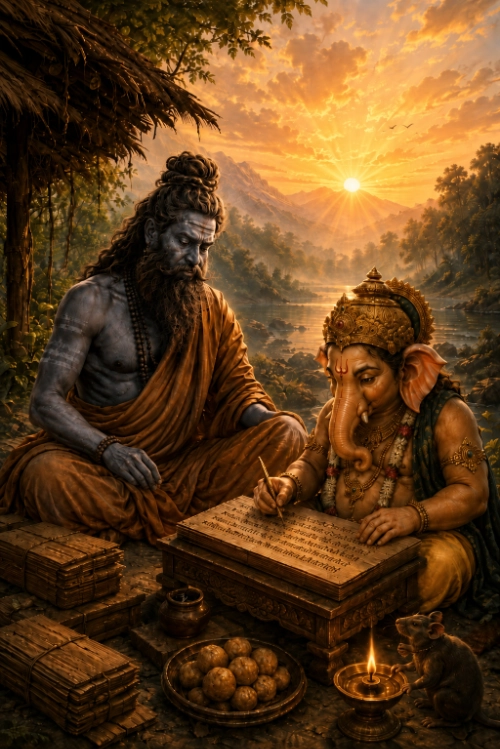
Vyāsa: The Sage Who Organized the Vedic World — Veda, Mahābhārata, Vedānta, Purāṇa, and the Life of Kṛṣṇa-dvaipāyana
Few figures stand as close to the foundations of Hindu sacred literature as Vyāsa. The name appears almost everywhere. The Vedas are traditionally said to have been divided and organized by him.
The Mahābhārata is attributed to him. The Bhagavad-gītā survives inside that epic. The Brahma-sūtra is traditionally attributed to Bādarāyaṇa, whom Vedāntic tradition identifies with Vyāsa.
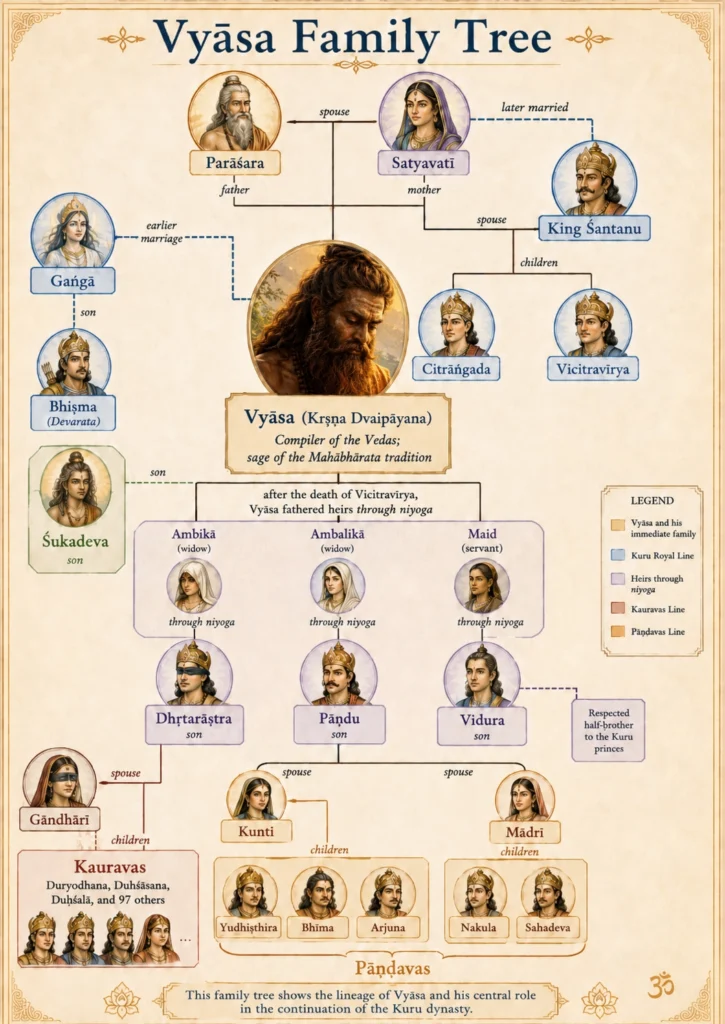
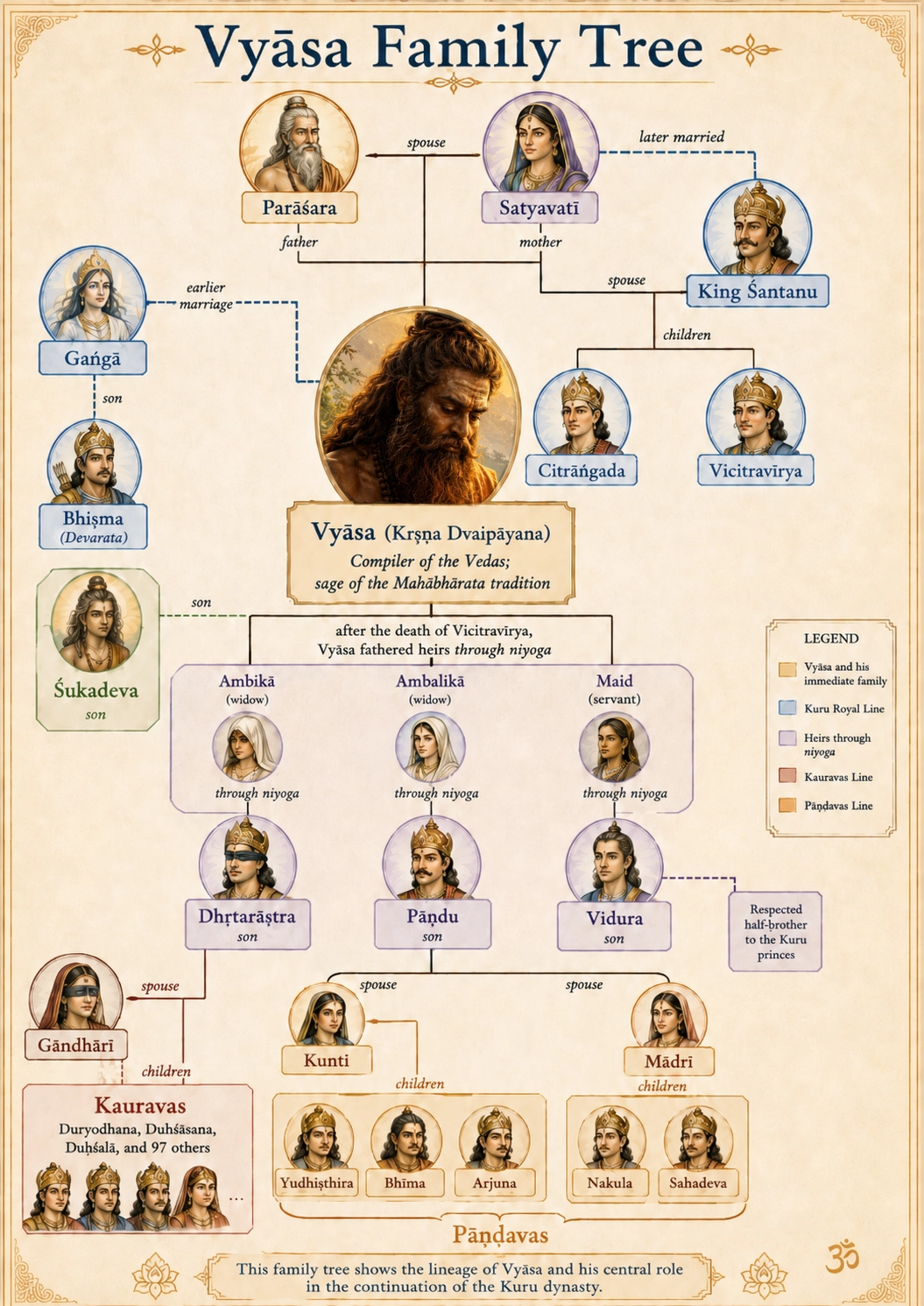
A single sheet placing Vyāsa in the Kuru lineage — Parāśara and Satyavatī above him, Śuka his son, and below him Dhṛtaṣṭra, Pāṇḍu and Vidura fathered through niyoga, from whom the Kauravas and Pāṇḍavas descend.
The Purāṇas are linked with his work of compilation and transmission. Within Vaiṣṇava tradition, the Śrīmad-Bhāgavatam presents itself as the mature culmination of his spiritual realization.
And Vyāsa is not merely imagined as an author standing outside these texts. He appears inside the Mahābhārata as a participant in the very family history he preserves. He is therefore simultaneously: sage, compiler, teacher, ancestor, philosopher, narrator, theologian, and sacred archetype of scriptural transmission.
To understand Vyāsa is to understand something about how the Hindu tradition understands scripture itself.
His Full Name: Kṛṣṇa-dvaipāyana Vyāsa
His traditional name is:
कृष्णद्वैपायन व्यास
kṛṣṇa-dvaipāyana vyāsa
Each part is meaningful. Kṛṣṇa means “dark” and refers traditionally to his dark complexion. Dvaipāyana comes from dvīpa, “island.” He is “the island-born one,” because the traditional birth narrative places his birth on an island in a river, commonly identified with the Yamunā.
Vyāsa means division, arrangement, expansion, or compilation. Thus Veda-vyāsa means: “the arranger or divider of the Veda.” This title is not merely honorary. It describes what tradition sees as one of his central missions: to organize revelation so that human beings of declining memory and capacity could still receive it.
His Parents: Parāśara and Satyavatī
Vyāsa is traditionally the son of the sage Parāśara and Satyavatī. Satyavatī later married King Śantanu, ruler of the Kuru dynasty. That one marriage connects Vyāsa directly to the genealogy of the Mahābhārata.
Satyavatī and Śantanu had two sons: Citrāṅgada and Vicitravīrya. When both died without successfully continuing the royal line, the Kuru dynasty entered a succession crisis.
Satyavatī then summoned her earlier son, Vyāsa.
Vyāsa Becomes an Ancestor of Both Sides of the Mahābhārata War
According to the ancient institution of niyoga, Vyāsa was asked to father heirs for the deceased Vicitravīrya. From this arose three crucial figures: Dhṛtarāṣṭra — later father of the Kauravas; Pāṇḍu — later father of the Pāṇḍavas; Vidura — one of the Mahābhārata’s most respected voices of wisdom and dharma.
This produces an extraordinary literary situation. Vyāsa is not simply: “the author of a war story.” He is an ancestor of the two families whose conflict becomes the Kurukṣetra war.
The man who preserves history is himself woven into it. That makes the Mahābhārata profoundly self-referential. Its authoritative sage is at once: observer, teacher, family elder, intervener, and narrator.
Vyāsa and the One Veda
Traditional Hindu accounts describe the Veda as originally one great body of revelation. As human capacities declined, Vyāsa divided and arranged it into four principal collections: Ṛg Veda Yajur Veda Sāma Veda Atharva Veda Śrīmad-Bhāgavatam describes the theological reason for this work.
ततः सप्तदशे जातः
सत्यवत्यां पराशरात् ।
चक्रे वेदतरोः शाखा
दृष्ट्वा पुंसोऽल्पमेधसः ॥
tataḥ saptadaśe jātaḥ
satyavatyāṁ parāśarāt
cakre veda-taroḥ śākhā
dṛṣṭvā puṁso ’lpa-medhasaḥ
“Then, appearing through Parāśara in Satyavatī, Vyāsa divided the tree of the Veda into branches, seeing that human beings had diminished intellectual capacity.”
Śrīmad-Bhāgavatam 1.3.21
The metaphor is beautiful: veda-taruḥ “the tree of the Veda.” Vyāsa does not destroy the tree. He makes its branches accessible.
Vyāsa Is a Compiler, Not the Inventor of Revelation
This distinction is central. Traditional theology does not generally portray Vyāsa as a literary genius who simply invented the Vedas from his own imagination. Rather: the Veda is revelation; Vyāsa organizes revelation.
His greatness lies in: collecting, dividing, arranging, teaching, preserving, and transmitting. He adapts the form of sacred knowledge to human limitation without reducing its divine source.
The Four Great Disciples
Śrīmad-Bhāgavatam gives a specific transmission scheme. After dividing the Veda, Vyāsa entrusted the major collections to disciples.
Śrīmad-Bhāgavatam 1.4 and 12.6
Paila received the Ṛg Veda. Vaiśampāyana received the Yajur Veda. Jaimini received the Sāma Veda. Sumantu received the Atharva Veda. The disciples then divided these collections further among their own students.
Thus Vedic transmission becomes a branching lineage. One Veda becomes four great streams. Those streams become schools. The schools become śākhās—branches of recitation and interpretation.
This gives another meaning to Vyāsa’s role: he is not only a compiler of books; he is an architect of transmission.
Itihāsa and Purāṇa as the Fifth Veda
The same Bhāgavata passage adds another striking principle:
ऋग्यजुःसामाथर्वाख्या
वेदाश्चत्वार उद्धृताः ।
इतिहासपुराणं च
पञ्चमो वेद उच्यते ॥
ṛg-yajuḥ-sāmātharvākhyā
vedāś catvāra uddhṛtāḥ
itihāsa-purāṇaṁ ca
pañcamo veda ucyate
“The Vedas known as Ṛg, Yajur, Sāma and Atharva were divided into four, while Itihāsa and Purāṇa are called the fifth Veda.”
Śrīmad-Bhāgavatam 1.4.20
This helps explain why Vyāsa’s work extends far beyond the four Vedas. The terse revelation of the Veda must also be: explained, narrated, applied, remembered, and brought into human moral experience.
That is the function of Itihāsa and Purāṇa.
The Mahābhārata
Vyāsa is traditionally regarded as the author and compiler of the Mahābhārata. It is one of the largest epic compositions preserved from the ancient world. But calling it simply an “epic” scarcely captures its scope.
The Mahābhārata contains: history, dynastic genealogy, political theory, ethics, ritual, pilgrimage traditions, cosmology, philosophy, ascetic teaching, law, devotion, myth, and profound debates about dharma.
A famous traditional summary declares:
धर्मे चार्थे च कामे च
मोक्षे च भरतर्षभ ।
यदिहास्ति तदन्यत्र
यन्नेहास्ति न तत्क्वचित् ॥
dharme cārthe ca kāme ca
mokṣe ca bharatarṣabha
yad ihāsti tad anyatra
yan nehāsti na tat kvacit
“Whatever is found here concerning dharma, prosperity, desire, and liberation may also be found elsewhere; what is not found here is nowhere to be found.”
The claim is deliberately immense. The Mahābhārata presents itself almost as a map of human existence.
The Bhagavad-gītā Is Inside Vyāsa’s Mahābhārata
The most famous philosophical dialogue in Hindu literature is not an independent book in its original literary setting. The Bhagavad-gītā appears inside the Mahābhārata. It is spoken by Kṛṣṇa to Arjuna on the battlefield of Kurukṣetra just before war begins.
Thus the Gītā exists inside the broader Vyāsic architecture. This is important. The Gītā’s questions— What is duty? What is the self? What is action? What is renunciation?
What is yoga? Who is God? What is surrender? —are not asked in a classroom. They arise inside a catastrophic conflict of family, politics, justice, responsibility, violence, and grief.
That larger setting is part of the teaching.
The Popular Story of Vyāsa and Gaṇeśa
One of the most beloved stories about the Mahābhārata tells how Gaṇeśa became Vyāsa’s scribe. Vyāsa wished to dictate the epic. Gaṇeśa agreed to write it down, but imposed a condition: Vyāsa must dictate continuously without stopping.
Vyāsa accepted, but added his own condition: Gaṇeśa must understand every verse before writing it. Vyāsa could therefore occasionally compose extraordinarily difficult verses.
While Gaṇeśa paused to understand them, Vyāsa gained time to prepare the next portion. It is a brilliant story about: composition, intelligence, oral transmission, writing, and the relationship between poet and scribe.
But one historical caution is important. The Gaṇeśa episode is widely regarded by modern Mahābhārata scholarship as a later addition to the epic tradition. The Critical Edition does not include it in the reconstructed main text.
That does not make the story culturally unimportant. It means simply that we should distinguish: the traditional reception history of the Mahābhārata from the oldest recoverable textual stratum.
Both are worth studying.
Vyāsa and the Brahma-sūtra
Vyāsa is also traditionally identified with Bādarāyaṇa, the author of the Brahma-sūtra, also known as the Vedānta-sūtra. Its famous first aphorism is:
अथातो ब्रह्मजिज्ञासा ॥
athāto brahma-jijñāsā
“Now, therefore, inquiry into Brahman.”
This tiny sentence opens one of the most influential philosophical texts in Indian history. The Brahma-sūtra attempts to systematize the teachings of the Upaniṣads concerning: Brahman, the self, creation, knowledge, liberation, scripture, and the ultimate reality.
One Text, Many Vedāntas
The extraordinary thing about the Brahma-sūtra is that major Vedānta traditions agree on its authority while disagreeing radically about its meaning. Among the great commentators are: Śaṅkara — Advaita Vedānta; Rāmānuja — Viśiṣṭādvaita Vedānta; Madhva — Dvaita Vedānta; Nimbārka; Vallabha; Baladeva Vidyābhūṣaṇa; and many others.
They disagree about questions as basic as: Is Brahman personal? What is the relation between the individual self and God? Is the world ultimately real? What is liberation?
What role does bhakti play? Yet they all return to the same sūtras. Thus Vyāsa/Bādarāyaṇa becomes a kind of common gravitational center of Vedānta.
Traditional Identity and Historical Caution
Traditional Vedāntic theology identifies Bādarāyaṇa with Vyāsa. Modern academic scholarship usually speaks more cautiously. It analyzes the Brahma-sūtra as an ancient philosophical text attributed to Bādarāyaṇa and does not assume that historical-critical methods can demonstrate that the same individual personally produced every work later connected with the name Vyāsa.
This distinction should not be hidden. Traditional theology asks: Who is the authoritative sage through whom this revelation was systematized? Historical philology asks: How did these texts develop, and what can manuscripts tell us about their composition?
Those are different questions.
Vyāsa and the Purāṇas
Traditional Hindu literature links Vyāsa with the eighteen Mahāpurāṇas and numerous Purāṇic collections. This should not necessarily be imagined in the modern authorial sense: one historical individual sitting at a desk and personally composing every surviving line of every Purāṇa.
Purāṇic literature itself is highly stratified. Texts expanded. Sections were transmitted differently. Recensions developed. Material was retold and rearranged. The traditional title Vyāsa therefore carries a broader meaning: collector, arranger, transmitter, redactor, and authoritative source of sacred narrative.
This is entirely consistent with the fundamental meaning of the name.
Vyāsa Is Also an Office
The Viṣṇu Purāṇa takes the idea further. It describes a succession of Vyāsas appearing in different Dvāpara ages. Their function is to divide and organize Vedic knowledge for the age.
Kṛṣṇa-dvaipāyana is the Vyāsa of the present Dvāpara cycle. This is an extraordinary theological concept. Vyāsa is both a person and a recurring sacred function. The office exists because revelation must repeatedly be made accessible to humanity.
In that sense, “Vyāsa” is almost a cosmic vocation.
Vyāsa as Divine Compassion
The Bhāgavata goes further still. It includes Vyāsa within its avatāra theology.
ततः सप्तदशे जातः
सत्यवत्यां पराशरात् ।
चक्रे वेदतरोः शाखा
दृष्ट्वा पुंसोऽल्पमेधसः ॥
tataḥ saptadaśe jātaḥ
satyavatyāṁ parāśarāt
cakre veda-taroḥ śākhā
dṛṣṭvā puṁso ’lpa-medhasaḥ
“Then, as the seventeenth manifestation, He appeared through Parāśara in Satyavatī and divided the tree of the Veda into branches, seeing that people had diminished understanding.”
Śrīmad-Bhāgavatam 1.3.21
Within Vaiṣṇava theology, Vyāsa’s work is therefore not merely scholarship. It is compassion. Human beings are forgetting. Memory is declining. Understanding is becoming weaker.
Therefore revelation is reorganized for them.
But Then Something Extraordinary Happens: Vyāsa Becomes Dissatisfied
One of the most beautiful episodes in the entire Bhāgavata occurs after Vyāsa has already accomplished what should have made any scholar satisfied. He has organized Vedic revelation.
He has preserved vast sacred narratives. He has treated dharma, ritual, philosophy, renunciation, and liberation. And yet: he feels incomplete. This is one of the most powerful theological statements in the traditional biography of Vyāsa.
The greatest compiler of sacred knowledge discovers that knowledge itself has not yet reached its final form.
Nārada Diagnoses the Problem
Vyāsa’s guru, Nārada, explains the reason.
भवतानुदितप्रायं
यशो भगवतोऽमलम् ।
येनैवासौ न तुष्येत
मन्ये तद्दर्शनं खिलम् ॥
bhavatānudita-prāyaṁ
yaśo bhagavato ’malam
yenaivāsau na tuṣyeta
manye tad darśanaṁ khilam
Śrīmad-Bhāgavatam 1.5.8
A close translation: “You have not sufficiently and directly proclaimed the spotless glories of Bhagavān. I consider a presentation that does not satisfy Him to be incomplete.”
The word khilam carries the sense of incompleteness, deficiency, or something not brought to full fruit. That is a stunning judgment. The problem is not that Vyāsa knows too little.
He knows too much for his work to remain incomplete. The missing culmination is direct glorification of Bhagavān and pure bhakti.
Beautiful Words Without Hari Are Not Enough
Nārada becomes even more severe.
न यद्वचश्चित्रपदं हरेर्यशो
जगत्पवित्रं प्रगृणीत कर्हिचित् ।
तद्वायसं तीर्थमुशन्ति मानसा
न यत्र हंसा निरमन्त्युशिक्क्षयाः ॥
na yad vacaś citra-padaṁ harer yaśo
jagat-pavitraṁ pragṛṇīta karhicit
tad vāyasaṁ tīrtham uśanti mānasā
na yatra haṁsā niramanty uśik-kṣayāḥ
Śrīmad-Bhāgavatam 1.5.10
A close sense is: “Words may be beautifully ornamented, but if they do not proclaim the glories of Hari that purify the world, saintly persons regard them like a place for crows rather than a place where swans delight.”
The metaphor is deliberately sharp. Literary beauty alone is not the final criterion. Intellectual brilliance alone is not the final criterion. The question becomes: Does the knowledge awaken consciousness of Bhagavān?
Vyāsa Then Meditates Through Bhakti-yoga
Following Nārada’s instruction, Vyāsa enters deep meditation. The Bhāgavata describes what he sees.
भक्तियोगेन मनसि
सम्यक् प्रणिहितेऽमले ।
अपश्यत्पुरुषं पूर्णं
मायां च तदपाश्रयाम् ॥
bhakti-yogena manasi
samyak praṇihite ’male
apaśyat puruṣaṁ pūrṇaṁ
māyāṁ ca tad-apāśrayām
“With his pure mind perfectly concentrated through bhakti-yoga, he saw the complete Supreme Person and also māyā existing under His control.”
Śrīmad-Bhāgavatam 1.7.4
This verse is central to Gauḍīya readings of Vyāsa. He does not merely formulate a better theory. He sees. The text moves from: scholarship to meditation to realization.
What Vyāsa Sees
The vision contains two realities: puruṣaṁ pūrṇam the complete Supreme Person; and māyāṁ ca tad-apāśrayām māyā dependent upon Him. This gives the Bhāgavata its theological structure.
The Lord is not inside māyā as one conditioned being among others. Māyā is under Him. The jīva suffers because of misrelation to divine reality. And bhakti becomes the direct means by which that disorder is healed.
The Bhāgavatam Explains Why Vyāsa Composes the Bhāgavata
अनर्थोपशमं साक्षाद्
भक्तियोगमधोक्षजे ।
लोकस्याजानतो विद्वांश्
चक्रे सात्वतसंहिताम् ॥
anarthopaśamaṁ sākṣād
bhakti-yogam adhokṣaje
lokasyājānato vidvāṁś
cakre sātvata-saṁhitām
“Knowing that the unwanted sufferings of humanity can be directly brought to rest through bhakti-yoga directed toward the transcendent Lord, the learned Vyāsa composed the Sātvata-saṁhitā for people who did not know this.”
Śrīmad-Bhāgavatam 1.7.6
This is the Bhāgavata’s explanation of itself. Vyāsa sees the problem. He sees the Lord. He sees māyā. He sees bhakti as the remedy. Then he composes. Thus scripture arises here not merely from intellectual curiosity but from realization joined with compassion.
The Śrīmad-Bhāgavatam as the Mature Fruit of Vyāsa’s Work
Within Gauḍīya Vaiṣṇavism, this episode gives the Bhāgavata an extraordinary position. It is not simply: “one more Purāṇa written by Vyāsa.” It is regarded as the text composed after Vyāsa’s own dissatisfaction was resolved through realization.
That makes it, theologically, the mature culmination of the Vyāsic project. The movement is: Veda → dharma → Itihāsa → philosophy → Vedānta → realization → Bhāgavata → bhakti.
This progression is perhaps the deepest meaning of Vyāsa’s traditional biography.
Knowledge Must Culminate in Bhakti
The story therefore makes an astonishing claim: even enormous scholarship is incomplete until it reaches loving realization of Bhagavān. Vyāsa has: Vedic knowledge, philosophical knowledge, ritual knowledge, historical knowledge, ethical knowledge, and metaphysical knowledge.
Yet the Bhāgavata still allows him to feel empty. Why? Because knowledge has not yet reached its final prayojana, its ultimate purpose. That is exactly how Gauḍīya theology later summarizes the purpose of Vedic literature.
বেদশাস্ত্র কহে — ‘সম্বন্ধ’, ‘অভিধেয়,’ ‘প্রয়োজন’ ।
‘কৃষ্ণ’ — প্রাপ্য সম্বন্ধ, ‘ভক্তি’ — প্রাপ্ত্যের সাধন ॥
veda-śāstra kahe — ‘sambandha’, ‘abhidheya’, ‘prayojana’
‘kṛṣṇa’ — prāpya sambandha, ‘bhakti’ — prāptyera sādhana
“The Vedic scriptures teach sambandha, abhidheya, and prayojana: the soul’s relationship with Kṛṣṇa, the practice by which that relationship is realized, and the ultimate goal. Kṛṣṇa is the reality to be attained, and bhakti is the means of attaining Him.”
Caitanya-caritāmṛta, Madhya 20.124
This is almost a theological summary of Vyāsa’s journey.
Vyāsa and Śukadeva
Vyāsa’s son is Śukadeva Gosvāmī, one of the most extraordinary figures of the Bhāgavata tradition. Śukadeva is portrayed as spiritually realized from birth and largely indifferent to ordinary social identity.
He eventually receives and speaks the Bhāgavata. The great narrative setting is the final week of King Parīkṣit’s life. Parīkṣit has been cursed to die in seven days. Instead of spending those seven days trying desperately to preserve his body, he asks the ultimate question: What should a person hear, remember, and do when death is certain?
Śukadeva responds by speaking the Śrīmad-Bhāgavatam. Thus Vyāsa’s realization passes through his son into one of the most famous teaching scenes in the Purāṇic world.
A Lineage of Sacred Transmission
Vaiṣṇava traditions understand Vyāsa within a larger chain of revelation. The essential pattern is: Bhagavān → Brahmā → Nārada → Vyāsa → Śukadeva → Parīkṣit with later disciplic traditions extending the transmission further.
This matters because sacred knowledge is not imagined simply as information stored in a book. It is: heard, realized, transmitted, explained, and embodied. Vyāsa represents the pivotal moment when revelation becomes systematically organized for later ages.
Vyāsa in Gauḍīya Vaiṣṇavism
For Gauḍīya Vaiṣṇavas, Vyāsa is foundational. The school draws heavily upon: the Upaniṣadic world; the Bhagavad-gītā; Vedānta-sūtra; Mahābhārata; Purāṇic theology; and above all the Śrīmad-Bhāgavatam.
Gauḍīya theologians regard the Bhāgavata as the natural theological exposition of Vedānta. Thus Vyāsa stands at both ends: he is associated with the sūtras that compress Vedānta, and with the Bhāgavata that expands their devotional meaning.
Why the Bhāgavata Is So Central
The Caitanya tradition does not treat Vedic scripture as a random collection of unrelated religious texts. It sees a theological movement: sambandha — What is reality? What is the relationship between Bhagavān, the jīva, and the world?
abhidheya — What should the jīva do? prayojana — What is the final goal? Vyāsa’s corpus supplies the raw architecture for all three. And in Gauḍīya theology the answer ultimately becomes: Kṛṣṇa is the supreme object of relationship.
Bhakti is the means. Prema is the culmination.
Is Vyāsa an Incarnation of God?
Within Vaiṣṇava scripture, the answer is yes in an important theological sense. Śrīmad-Bhāgavatam includes Vyāsa in its avatāra sequence. This does not necessarily mean that every Vaiṣṇava theologian classifies Vyāsa in exactly the same subcategory of avatāra.
Some later traditions speak of him as an empowered manifestation, often compared with the idea of śaktyāveśa—a being specifically empowered for a divine mission. The mission here is clear: preservation and clarification of sacred knowledge.
His scholarship itself is therefore interpreted as divine service.
Vyāsa as a Living Archetype of the Guru
This helps explain why Vyāsa becomes more than an ancient author. He becomes the archetype of the guru as transmitter of revelation. A genuine teacher is not supposed to invent a new ultimate truth.
The teacher should: receive, understand, realize, organize, and transmit. That is the Vyāsa function.
Vyāsāsana: The Seat of Vyāsa
The traditional teacher’s seat is often called: vyāsāsana literally: “the seat of Vyāsa.” The meaning is not: “the teacher sitting there has become Vyāsa.” The meaning is: the teacher is expected to represent Vyāsa’s function.
He should speak as a faithful transmitter of śāstra rather than as an inventor of private doctrine. The seat therefore symbolizes accountability. To sit on Vyāsa’s seat is to inherit an obligation: do not distort what you have received.
Guru Pūrṇimā and Vyāsa Pūrṇimā
The full moon of the month of Āṣāḍha is widely known as Guru Pūrṇimā and also Vyāsa Pūrṇimā. On this day teachers and guru-paramparās are honored. The connection with Vyāsa is natural.
He represents the teacher who: collects divine knowledge, organizes it, understands it, preserves it, and passes it on. Thus honoring the guru becomes inseparable from honoring the principle of faithful transmission.
Is Vyāsa Still Alive?
Traditional Hindu literature often speaks of Vyāsa as an extraordinarily long-lived sage. He is frequently associated with Badarikāśrama in the Himalayas. Some traditions include him among the great cirañjīvins or long-lived sacred figures.
This belongs to the theological and traditional world of Hindu sacred history. Modern historical methods cannot verify such a claim in the ordinary biographical sense. A careful article should therefore distinguish: traditional sacred biography from historically demonstrable biography.
But one should not pretend that the traditional claim is unimportant simply because it is theological. For devotees, Vyāsa is not merely a dead author. He remains a spiritually present authority.
The Historical Question: Was There One Vyāsa Who Wrote Everything?
This is where traditional theology and modern textual scholarship diverge most sharply. Traditional Hindu accounts can attribute to Vyāsa: the organization of the Vedas; the Mahābhārata; the Brahma-sūtra; the Purāṇas; the Śrīmad-Bhāgavatam.
Modern scholarship usually approaches these corpora differently. The Mahābhārata shows evidence of long textual development. The Purāṇas contain multiple chronological layers.
The Brahma-sūtra is studied as a separate philosophical work attributed to Bādarāyaṇa. The Vedic corpus itself is far older than the classical epic and Purāṇic redactions.
From that perspective, it is difficult to treat every line in all these works as the product of one historical writer in the modern sense of authorship.
But “Vyāsa” Was Never Simply a Modern Authorial Concept
This is crucial. Traditional authorship does not always function like modern copyright authorship. “Vyāsa” can mean: source, arranger, compiler, redactor, transmitter, authoritative teacher, and sacred office.
Therefore the traditional claim may be doing something different from the modern question: “Which historical individual physically wrote each surviving sentence?” The two frameworks are not asking exactly the same thing.
Tradition and Philology Need Not Be Blurred
A strong account of Vyāsa should therefore say both: Traditional Hindu theology treats Kṛṣṇa-dvaipāyana Vyāsa as the great divinely empowered organizer of the Vedic corpus and attributes the major Vyāsic scriptures to him.
And: Modern philology sees several of these textual corpora as works with complex redactional histories extending across long periods. There is no benefit in pretending that these are identical claims.
The distinction makes the subject more, not less, interesting.
What Makes Vyāsa Unique
There are great poets in Indian tradition. There are great philosophers. There are great sages. There are great teachers. Vyāsa is unusual because tradition places all these functions in one figure.
If the traditional attribution is viewed as a whole, his sphere includes: Veda — arranged Vedic branches — transmitted Mahābhārata — compiled Bhagavad-gītā — preserved within the epic Vedānta-sūtra — systematized Purāṇa — compiled and transmitted Śrīmad-Bhāgavatam — composed as mature devotional realization No ordinary comparison really captures the scale of that role.
Vyāsa Is Not Merely the Man Who Preserved Texts
The deepest point is not quantitative. It is tempting to marvel at Vyāsa because of the enormous amount of literature connected with him. But his traditional biography makes a more profound claim.
The purpose of preserving revelation is not preservation itself. The purpose is realization. Vyāsa arranges the Veda. He presents dharma. He narrates history. He systematizes Vedānta.
Yet the Bhāgavata still allows him to ask: “Why am I not satisfied?” That question becomes the turning point.
The Final Movement: From Knowledge to Realization
Vyāsa’s story therefore forms a theological progression:
- Veda
- organization
- dharma
- history
- philosophy
- Vedānta
- dissatisfaction
- guru’s correction
- bhakti-yoga
- vision of Bhagavān
- Śrīmad-Bhāgavatam
- bhakti
This is why Vyāsa’s story can be read almost symbolically. Even sacred knowledge must arrive at its object. Even theology must become realization. Even perfect textual mastery must eventually ask: “What is all this knowledge for?”
The Bhāgavata’s Answer
The answer is not: more information. It is: Bhagavān. And the method is not simply: more classification. It is: bhakti-yoga. Thus the greatest traditional compiler of sacred knowledge becomes the example of a profound truth: Knowledge reaches completion when it becomes realized relationship with the reality it describes.
Why Vyāsa Matters Today
Vyāsa remains important because the problem he addresses never disappears. Human beings forget. Texts become difficult. Traditions become fragmented. Meaning becomes obscured.
Interpretations multiply.
The task of the teacher is therefore always Vyāsic:
- preserve without fossilizing;
- explain without distorting;
- organize without reducing;
- transmit without inventing;
- and lead knowledge toward realization.
That is why Vyāsa remains the archetype of the guru.
The Deepest Meaning of the Name “Veda-vyāsa”
At first, “divider of the Veda” sounds almost administrative. But the theological meaning is much greater. Vyāsa divides so that knowledge will not disappear. He compiles so that truth can be remembered.
He narrates so that principles can be lived. He systematizes so that revelation can be understood. He teaches so that knowledge can be transmitted. And finally, according to the Bhāgavata, he discovers that all of this must culminate in direct realization and glorification of Bhagavān.
Thus the title Veda-vyāsa represents a complete philosophy of sacred transmission.
Vyāsa stands at the center of the Hindu scriptural imagination because he represents more than authorship. He represents the making-accessible of revelation.
He is:
- the dark island-born sage;
- the son of Parāśara and Satyavatī;
- the ancestor of the Kuru dynasty;
- the organizer of the Vedas;
- the compiler of the Mahābhārata;
- the traditional author of Vedānta-sūtra;
- the great transmitter of Purāṇic knowledge;
- the father and teacher of Śukadeva;
- the divinely empowered sage of Vaiṣṇava theology;
- and the archetype behind the teacher’s vyāsāsana.
But perhaps the most important thing about Vyāsa is not the number of scriptures attached to his name. It is the spiritual arc of his life. He begins by organizing knowledge.
He ends by discovering its purpose.
His traditional biography says that even immense learning, correct dharma, philosophical system, and literary greatness remain incomplete until they culminate in realization of Bhagavān.
That is why the Bhāgavata does not remember Vyāsa merely as a scholar. It remembers him as a sage who saw. And once he saw, he wrote for those who had not yet seen. That may be the most beautiful definition of Vyāsa’s mission: He organized sacred knowledge so that later humanity, even with diminished memory and understanding, could still find its way from revelation to realization—and from realization to bhakti.
Primary texts and classical sources discussed
- Brahma-sūtra / Vedānta-sūtra, beginning with athāto brahma-jijñāsā.