

When Human Life Remains Animal Life
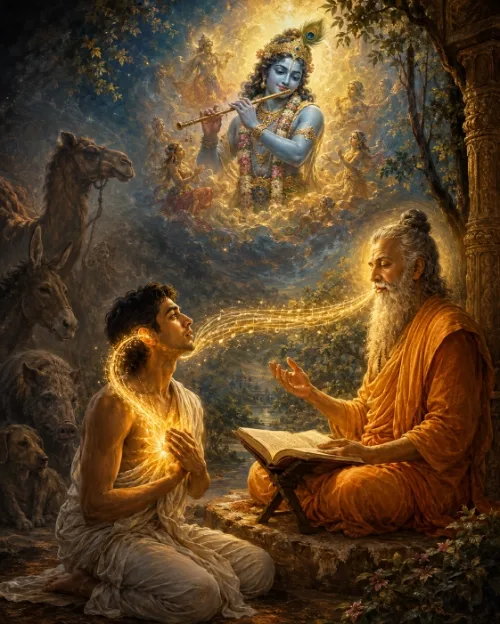
What the Bhāgavatam Really Means—and Why Hearing About Bhagavān Awakens Human Consciousness
Śrīmad-Bhāgavatam 2.3.19 is deliberately provocative. It compares certain human beings with dogs, stool-eating hogs, camels, and asses. Read casually, the verse can sound like little more than religious insult.
Read in context, however, it is doing something much more sophisticated. The Bhāgavatam is asking a fundamental question: What makes human life genuinely human? Is it simply being alive?
Animals are alive. Is it breathing? A bellows moves air. Is it eating, mating, defending oneself, working, and prolonging bodily existence? Animals already do all of these things.
The Bhāgavatam’s challenge is that a human being possesses a rare capacity for self-reflection, transcendental inquiry, conscious hearing, spiritual transformation, and relationship with Bhagavān. If that capacity is never awakened, then the biological human form has not yet fulfilled its specifically human potential.
The controversial verse belongs to a carefully constructed sequence about time, the senses, spiritual hearing, and the awakening of the heart.
The Verse
श्वविड्वराहोष्ट्रखरैः
संस्तुतः पुरुषः पशुः ।
न यत्कर्णपथोपेतो
जातु नाम गदाग्रजः ॥
śva-viḍ-varāhoṣṭra-kharaiḥ
saṁstutaḥ puruṣaḥ paśuḥ
na yat-karṇa-pathopeto
jātu nāma gadāgrajaḥ
Śrīmad-Bhāgavatam 2.3.19
A close translation is:
“That human being is in truth an animal, though praised by dogs, stool-eating hogs, camels, and asses, if the name of Gadāgraja has never even once entered the pathway of his ear.”
The verse is harsh by design. But almost every word matters.
Puruṣaḥ Paśuḥ : A Human Being Who Remains an Animal
The central expression is: puruṣaḥ paśuḥ literally: “a human being who is an animal.” The Bhāgavatam is not making a biological claim. It distinguishes between a human being and a hog.
Its point is functional and spiritual. A human body carries capacities that animal life does not manifest in the same reflective form:
- inquiry into ultimate reality,
- moral self-examination,
- philosophical reasoning,
- awareness of mortality,
- conscious spiritual practice,
- deliberate control of the senses,
- and the ability to hear and respond to revelation.
If those capacities remain unused, the person may be human in form while living almost entirely within the same basic program as animal life: eat, sleep, mate, defend, acquire, compete, survive.
That is the target of the verse.
The Previous Verse Makes the Argument Explicit
The Bhāgavatam prepares the comparison immediately beforehand.
तरवः किं न जीवन्ति
भस्त्राः किं न श्वसन्त्युत ।
न खादन्ति न मेहन्ति
किं ग्रामे पशवोऽपरे ॥
taravaḥ kiṁ na jīvanti
bhastrāḥ kiṁ na śvasanty uta
na khādanti na mehanti
kiṁ grāme paśavo ’pare
“Do trees not also live? Do bellows not also breathe? Do the animals in the village not also eat and reproduce?”
Śrīmad-Bhāgavatam 2.3.18
The rhetorical strategy is obvious. Simply saying— “I am alive” —is not enough. Trees live. “I breathe.” A bellows moves air. “I eat, reproduce, maintain myself, and struggle for survival.”
Animals do the same. So the Bhāgavatam asks: What additional possibility does human consciousness contain? Its answer is not merely greater technical intelligence. It is the possibility of transcendence.
The Argument Actually Begins With Time
One verse earlier, the discussion begins with mortality.
आयुर्हरति वै पुंसाम्
उद्यन्नस्तं च यन्नसौ ।
तस्यर्ते यत्क्षणो नीत
उत्तमश्लोकवार्तया ॥
āyur harati vai puṁsām
udyann astaṁ ca yann asau
tasyarte yat-kṣaṇo nīta
uttama-śloka-vārtayā
“With every rising and setting, the sun takes away the lifespan of human beings—except insofar as one’s time is spent in hearing and speaking about Uttamaśloka, the Supreme Lord.”
Śrīmad-Bhāgavatam 2.3.17
The image is striking. We ordinarily see sunrise as another day gained. The Bhāgavatam sees another side: another day has been spent. The sun rises. The sun sets. And part of the finite human opportunity has disappeared forever.
That leads naturally to the next question: What was that time used for?
The Whole Sequence Moves From Time to the Heart
Śrīmad-Bhāgavatam 2.3.17–24 forms an unusually tight progression. It moves through: time → life → animal existence → ears → tongue → head → hands → eyes → feet → body → heart.
The argument becomes progressively more inward. The question is not merely: “Do you possess human senses?” It is: “Have those senses awakened to their highest purpose?”
The Ear Is the First Gateway
Verse 2.3.19 says: na yat-karṇa-pathopetaḥ “which has not entered the pathway of the ear.” The phrase karṇa-patha is beautiful. karṇa — ear patha — road, path, pathway. The divine name travels into consciousness through the road of hearing.
This reflects one of the most fundamental principles of Bhāgavata spirituality: spiritual awakening begins through receptivity. Before one knows Bhagavān, one must hear. Before one remembers accurately, one must hear.
Before one speaks meaningfully about Him, one must hear. Before one develops devotion, something must first enter consciousness.
Why Nāma Matters
The Sanskrit does not merely say: “has never heard religious philosophy.” It specifically says: nāma gadāgrajaḥ “the name of Gadāgraja.” So the most literal object of hearing in 2.3.19 is the divine name.
This deserves emphasis because some English translations expand the verse toward hearing Kṛṣṇa’s pastimes generally. That expansion is justified by the surrounding verses, but the Sanskrit word here is specifically: nāma — name.
In Vaiṣṇava theology, the name is not merely an informational label attached to an absent deity. Divine sound is itself regarded as spiritually transformative.
Who Is Gadāgraja?
Gadāgraja is an epithet of Kṛṣṇa. Break it down: Gada — the name Gada; agraja — an elder brother, literally “one born before.” Thus: Gadāgraja means: “the elder brother of Gada.”
The name emphasizes something characteristic of Bhāgavata theology. The Absolute is not presented only through abstract terms such as: Brahman, Absolute Truth, Supreme Reality, or Transcendence.
Bhagavān has: family, relationships, names, deeds, affection, and personal history. Kṛṣṇa can therefore be remembered as: the son of Yaśodā, the son of Vasudeva, the friend of Arjuna, the beloved of the gopīs, or here, the elder brother of Gada.
The transcendent reality entering the ear is personal.
The Next Verse Expands From the Name to the Lord’s Deeds
बिले बतोरुक्रमविक्रमान् ये
न शृण्वतः कर्णपुटे नरस्य ।
जिह्वासती दार्दुरिकेव सूत
न चोपगायत्युरुगायगाथाः ॥
bile batorukrama-vikramān ye
na śṛṇvataḥ karṇa-puṭe narasya
jihvāsatī dārdurikā iva sūta
na copagāyaty urugāya-gāthāḥ
Śrīmad-Bhāgavatam 2.3.20
A close translation is:
“The ears of a person who do not hear the mighty deeds of Urukrama are like empty holes, and the tongue that does not sing the glories of Urugāya is like the tongue of a frog.”
Now the movement becomes broader. Verse 19 emphasizes: nāma — the divine name. Verse 20 adds: vikrama — the Lord’s extraordinary deeds and gāthā — songs and narrations of His glory.
So the wider devotional field is: nāma — name rūpa — form guṇa — qualities līlā — pastimes kathā — sacred narration.
Why Is the Tongue Compared to a Frog?
The frog is an especially sharp metaphor. A frog croaks loudly. But its sound does not necessarily improve its condition. Indeed, traditional commentators use the image to suggest that useless sound may even attract danger.
Similarly, the Bhāgavatam asks: What is the value of human speech if speech never reaches truth, gratitude, wisdom, or glorification of Bhagavān? A person may be: eloquent, witty, politically powerful, academically sophisticated, or endlessly talkative.
But quantity of speech is not the same as depth of speech.
Hearing Comes First in the Ninefold Practice of Bhakti
Prahlāda Mahārāja later gives the famous ninefold description of devotion.
श्रवणं कीर्तनं विष्णोः
स्मरणं पादसेवनम् ।
अर्चनं वन्दनं दास्यं
सख्यमात्मनिवेदनम् ॥
śravaṇaṁ kīrtanaṁ viṣṇoḥ
smaraṇaṁ pāda-sevanam
arcanaṁ vandanaṁ dāsyaṁ
sakhyam ātma-nivedanam
“Hearing about Viṣṇu, glorifying Him, remembering Him, serving His feet, worshiping Him, offering prayers, serving Him, befriending Him, and surrendering oneself are the principal forms of bhakti.”
Śrīmad-Bhāgavatam 7.5.23
The first word is: śravaṇam hearing. Then comes: kīrtanam speaking or glorifying. Then: smaraṇam remembering. There is a natural psychological sequence: hear → speak → remember → relate → serve.
Why Hearing Can Transform the Heart
Śrīmad-Bhāgavatam gives a theological explanation.
शृण्वतां स्वकथाः कृष्णः
पुण्यश्रवणकीर्तनः ।
हृद्यन्तःस्थो ह्यभद्राणि
विधुनोति सुहृत्सताम् ॥
śṛṇvatāṁ sva-kathāḥ kṛṣṇaḥ
puṇya-śravaṇa-kīrtanaḥ
hṛdy antaḥ-stho hy abhadrāṇi
vidhunoti suhṛt satām
“For those who hear His own kathā, Kṛṣṇa—whose hearing and glorification are purifying—being situated within the heart, cleanses what is inauspicious there.”
Śrīmad-Bhāgavatam 1.2.17
The point is not simply that religious stories contain good moral advice. The Bhāgavatam claims something stronger. Transcendental sound acts upon consciousness. Hearing is therefore not merely information transfer.
It is presented as a form of purification.
Gauḍīya Vaiṣṇavism Retains This Emphasis
Kṛṣṇadāsa Kavirāja later lists five especially powerful devotional practices.
সাধু-সঙ্গ, নাম-কীর্তন, ভাগবত-শ্রবণ ।
মথুরা-বাস, শ্রীমূর্তির শ্রদ্ধায় সেবন ॥
sādhu-saṅga, nāma-kīrtana, bhāgavata-śravaṇa
mathurā-vāsa, śrī-mūrtira śraddhāya sevana
“Association with sādhus, chanting the holy name, hearing the Bhāgavata, residing in Mathurā, and faithfully serving the sacred form of the Lord are especially powerful practices of bhakti.”
Caitanya-caritāmṛta, Madhya 22.128
Notice how closely this preserves the Bhāgavata emphasis: nāma-kīrtana and bhāgavata-śravaṇa. The ear and tongue remain central.
Why the Verse Names Four Animals
Verse 2.3.19 gives four intentionally unpleasant images: śva dog; viḍ-varāha stool-eating hog; uṣṭra camel; khara ass or donkey. The Sanskrit verse itself does not explain a complete symbolic psychology for each animal.
Those detailed applications are developed especially in later Vaiṣṇava commentary and preaching, notably by A. C. Bhaktivedanta Swami Prabhupāda. That distinction is worth preserving.
The animals are in the Sanskrit. The elaborate interpretation of what each animal represents is commentarial application.
The Dog: Intelligence Used Only for Maintenance
The dog becomes an image of dependence and servility. It obeys for food. It seeks shelter. It protects territory. It lives in dependence upon whoever maintains it. The criticism is not: “Employment is degrading.”
Bhagavad-gītā itself strongly values responsible work. The criticism is: What if all the extraordinary power of human intelligence is spent merely arranging bodily maintenance?
A person can spend decades acquiring: education, credentials, professional skill, income, property, security, and retirement provision, without ever asking what consciousness itself is for.
The dog image asks: Has intelligence served awakening—or only maintenance?
The Stool-Eating Hog: Appetite Without Discrimination
The Sanskrit is unusually graphic: viḍ-varāha literally: “stool-eating hog.” The image represents appetite operating without higher discrimination. The animal asks only: “Can this be consumed?”
Not: “Is this ennobling?” “Will this purify consciousness?” “Will this make me freer or more enslaved?” “Does this serve a meaningful life?” The Bhāgavata’s challenge is therefore particularly relevant to a civilization capable of enormous technological sophistication while still defining happiness largely through increasingly elaborate forms of consumption.
The tools become humanly sophisticated. The goal can remain animal.
The Camel: Enjoyment Entangled With Pain
Prabhupāda famously develops the camel into an image of self-injuring pleasure. The camel eats thorny vegetation, and the traditional analogy describes blood from its wounded mouth mixing with what it eats.
Whether or not one presses every zoological detail, the spiritual image is powerful. Human beings often pursue pleasures that simultaneously damage them. One may: destroy health for enjoyment, destroy peace for ambition, destroy relationships for gratification, destroy sleep for productivity, destroy freedom through addiction, or spend years suffering to maintain the very pleasures supposedly making life worthwhile.
The Bhāgavata asks: When does pleasure stop being pleasure? The camel does not know. A human being can know.
The Ass: Carrying Burdens Without Knowing Why
The ass is famous as a beast of burden. It carries. It works. It endures. But it does not ask for the philosophical meaning of its labor. The corresponding human tragedy is not hard work.
Hard work may be noble. The tragedy is: labor without knowledge of ultimate self-interest. A person may spend an entire life carrying: mortgages, career expectations, status competition, institutional burdens, social obligations, financial anxieties, and endless deadlines, while never asking: “What is all this finally for?”
The Bhāgavata wants work illuminated by knowledge of the worker.
Four Animal Images, One Problem
The four animals can therefore be read as four distortions of human potential: dog — dependence without higher freedom hog — appetite without discrimination camel — pleasure entangled with self-harm ass — labor without knowledge of ultimate purpose What unites them?
Each remains completely inside the immediate program of embodied survival. Human life becomes spiritually significant when consciousness begins asking questions beyond that program.
The Most Overlooked Word: Saṁstutaḥ
The verse does not merely describe an animalistic person. It says: saṁstutaḥ “praised, celebrated, glorified.” This turns the verse into a critique of society itself. A person may be: famous, powerful, wealthy, admired, politically influential, culturally fashionable, or surrounded by millions of followers.
The Bhāgavatam asks: Who is praising this person—and according to what conception of success? If both leader and followers define the good life entirely as: wealth, consumption, sexual success, status, comfort, power, and bodily security, then popularity proves very little spiritually.
Being Praised by Millions Does Not Establish Greatness
This is perhaps one of the most modern dimensions of the verse. Social approval feels like evidence. If many people admire someone, we assume that person must possess something valuable.
The Bhāgavatam refuses that conclusion. A society can celebrate the wrong things. A civilization can reward: greed, violence, vanity, sensuality, domination, or mindless productivity.
Thus: mass approval is not an independent measure of truth. The value system of the admirers matters. That is the sting of: śva-viḍ-varāhoṣṭra-kharaiḥ saṁstutaḥ “praised by dogs, hogs, camels, and asses.”
The Verse Is Not Permission to Dehumanize People
Because its rhetoric is severe, this qualification is essential. The Bhāgavatam is not saying: “Certain human beings have no dignity and should literally be treated like animals.”
The point is almost the reverse. The rebuke is possible precisely because human beings possess a higher potential. The verse says, in effect:
“You have been given a human capacity—do not spend it entirely at the level of instinct.”
It is a warning against wasted potential, not a license for cruelty. A genuine Vaiṣṇava reading should therefore turn the verse first toward self-examination, not contempt.
The question is not: “Who can I call a dog?” It is: “How much of my own life remains confined to eating, status, labor, pleasure, and survival?”
The Head: A Crown Does Not Make It Sacred
The sequence continues.
Śrīmad-Bhāgavatam 2.3.21
The verse teaches that even a head decorated with a beautiful crown remains spiritually burdensome if it never bows to Mukunda. Likewise, hands decorated with golden ornaments are compared to lifeless hands when they never engage in Hari’s service.
The point is profound: ornament does not sanctify an unused faculty. Status does not redeem pride. Wealth does not automatically sanctify hands. Power does not automatically sanctify the head.
The question remains: What are they used for?
The Eyes and Feet Must Also Awaken
Verse 2.3.22 continues the bodily theology. Eyes that never behold sacred forms related to Viṣṇu are compared to decorative eyes on a peacock feather. Legs that never move toward sacred places are compared to tree trunks.
Again, the criticism is functional. Eyes exist. But do they see spiritually? Feet move. But where do they take us? The Bhāgavatam is converting anatomy into spiritual philosophy.
A Living Corpse
The following verse uses perhaps the most severe expression in the entire sequence: jīvan śavaḥ “a living corpse.”
जीवञ्छवो भागवताङ्घ्रिरेणुं
न जातु मर्त्योऽभिलभेत यस्तु ।
श्रीविष्णुपद्या मनुजस्तुलस्याः
श्वसञ्छवो यस्तु न वेद गन्धम् ॥
jīvañ chavo bhāgavatāṅghri-reṇuṁ
na jātu martyo ’bhilabheta yas tu
śrī-viṣṇu-padyā manujas tulasyāḥ
śvasañ chavo yas tu na veda gandham
Śrīmad-Bhāgavatam 2.3.23
A close sense is: “A mortal who has never received the dust of the feet of a devotee is like a living corpse; similarly, one who breathes but has never experienced the fragrance of tulasī offered at Viṣṇu’s feet is like a breathing corpse.”
Again, the point is not literal death. Biological function continues. But spiritual consciousness remains dormant.
The Final Test Is the Heart
The sequence reaches its climax in verse 24.
तदश्मसारं हृदयं बतेदं
यद् गृह्यमाणैर्हरिनामधेयैः ।
न विक्रियेताथ यदा विकारो
नेत्रे जलं गात्ररुहेषु हर्षः ॥
tad aśma-sāraṁ hṛdayaṁ batedaṁ
yad gṛhyamāṇair hari-nāma-dheyaiḥ
na vikriyetātha yadā vikāro
netre jalaṁ gātra-ruheṣu harṣaḥ
“That heart is surely hard like stone if, even when the names of Hari are taken, it undergoes no transformation—no tears in the eyes, no awakening of spiritual emotion.”
Śrīmad-Bhāgavatam 2.3.24
The progression is now complete. The Bhāgavatam began with: the sun taking away life. Then: animals live. Then: animals eat and reproduce. Then: human ears should hear. The tongue should glorify.
The head should bow. The hands should serve. The eyes should see. The feet should travel toward sanctity. And finally: the heart should change. That is the destination.
External Religion Is Not the Final Test
This final verse prevents another misunderstanding. The purpose is not merely to accumulate devotional behaviors mechanically. One could: visit temples, wear sacred marks, hold beads, quote scripture, sing songs, and still remain inwardly untouched.
The Bhāgavata’s final criterion is: vikriyeta — transformation. Has consciousness changed? Has pride weakened? Has attachment shifted? Has the heart become responsive to Bhagavān?
That is the ultimate test.
This Same Principle Appears in Nārada’s Instruction to Vyāsa
Nārada famously tells Vyāsa that literary brilliance alone does not make speech spiritually valuable.
न यद्वचश्चित्रपदं हरेर्यशो
जगत्पवित्रं प्रगृणीत कर्हिचित् ।
तद्वायसं तीर्थमुशन्ति मानसा
न यत्र हंसा निरमन्त्युशिक्क्षयाः ॥
na yad vacaś citra-padaṁ harer yaśo
jagat-pavitraṁ pragṛṇīta karhicit
tad vāyasaṁ tīrtham uśanti mānasā
na yatra haṁsā niramanty uśik-kṣayāḥ
“Words may be beautifully ornamented, but if they do not proclaim the glories of Hari that purify the world, saintly persons regard them as a place for crows rather than a place where swans delight.”
Śrīmad-Bhāgavatam 1.5.10
Once again: beauty is not enough. eloquence is not enough. intelligence is not enough. prestige is not enough. The question remains: Where does consciousness go?
The Bhāgavata Is Not Anti-Intellectual
This is another important qualification. The text does not ask people to become less intelligent. It wants intelligence redirected toward deeper questions. The Bhāgavata is itself extraordinarily intellectual.
It contains: metaphysics, cosmology, psychology, ethics, philosophy, theology, logic, and sophisticated literary structure. Its criticism is not of thinking. It is of a human intelligence brilliant at manipulating the material environment while remaining ignorant of: the self, death, consciousness, Bhagavān, and ultimate purpose.
The Real Target: Sophisticated Animalism
Perhaps the best modern expression for 2.3.19 is: sophisticated animal life. A pig eats. Human beings build global culinary industries. Animals reproduce. Human civilizations develop enormous cultures of sexual stimulation.
Animals seek shelter. Humans construct extraordinary architecture and financial systems. Animals compete for territory. Humans develop geopolitical systems and weapons. Animals work for survival.
Humans create vast industrial economies. None of those human achievements is automatically wrong. The question is: Has the goal changed—or only the sophistication of the method?
If the end remains: food, sex, security, territory, status, and survival, then technological civilization may advance while the ultimate conception of life remains largely biological.
The Classic Fourfold Animal Program
A famous Sanskrit maxim, often cited in traditional discussions of human and animal life, summarizes the shared biological functions:
आहारनिद्राभयमैथुनं च
सामान्यमेतत् पशुभिर्नराणाम् ।
āhāra-nidrā-bhaya-maithunaṁ ca
sāmānyam etat paśubhir narāṇām
“Eating, sleeping, fear or defense, and mating are common to animals and human beings.”
The point is not that humans should stop eating, sleeping, protecting themselves, or forming families. Human embodied existence requires all four. The point is that they cannot be the complete definition of human success.
What Is Added in Human Life?
The human advantage is the capacity to ask: Who am I? Am I identical with this changing body? What is consciousness? Why am I dissatisfied even after attaining things I once desperately wanted?
Why does death make every material possession provisional? What is genuinely good? Does ultimate reality possess consciousness? Who is Bhagavān? Can He be known? Can He be loved?
What remains when everything temporary disappears? These are human questions in the deepest sense.
Hearing Is the Beginning of the Answer
This brings us back to the verse. Why does it not say: “the person has never solved metaphysics”? Why does it say: “the name has never entered the pathway of his ear”? Because revelation begins by breaking the closed circuit of self-reference.
If the mind knows only what it generates from: its own habits, its society, its senses, and its desires, it may never encounter a genuinely transcendent possibility. Śravaṇa opens the system.
Something comes from beyond the conditioned mental loop. The person hears. Then considers. Then remembers. Then responds.
Hearing Must Not Become Blind Credulity
This too deserves clarification. The Bhāgavata’s praise of hearing does not mean: “Believe every religious statement you hear.” Sacred hearing in the tradition occurs through: śāstra, guru, sādhu, context, reason, and disciplined practice.
The same Vaiṣṇava tradition repeatedly values: vicāra — examination and yukti — reasoning. Hearing is the beginning of spiritual knowledge, not the abolition of intelligence.
From Sound to Transformation
The full process can therefore be expressed as: śravaṇa hearing; ↓ kīrtana speaking and glorifying; ↓ smaraṇa remembering; ↓ vicāra reflection; ↓ sevā service; ↓ citta-parivartana transformation of consciousness.
The final aim is not information. It is transformation.
Why the Holy Name Is Especially Powerful
Later Vaiṣṇava theology places enormous emphasis on the divine name because it understands a unique relationship between: nāma — the name and nāmī — the one who possesses the name.
A celebrated Sanskrit verse cited in the Vaiṣṇava tradition says:
नाम चिन्तामणिः कृष्णश्
चैतन्यरसविग्रहः ।
पूर्णः शुद्धो नित्यमुक्तोऽभिन्नत्वान् नामनामिनोः ॥
nāma cintāmaṇiḥ kṛṣṇaś
caitanya-rasa-vigrahaḥ
pūrṇaḥ śuddho nitya-mukto
’bhinnatvān nāma-nāminoḥ
“The holy name of Kṛṣṇa is spiritual wish-fulfilling reality, a form of conscious rasa, complete, pure, and eternally liberated, because the name and the Named are nondifferent.”
Within this theology, the statement that Kṛṣṇa’s name enters the karṇa-patha, the pathway of the ear, becomes much more than metaphor. It describes a mode of divine encounter.
A Better Way to Read the Animal Comparison
The verse becomes most useful when turned inward. Instead of: “Those people are dogs and pigs.” ask: Where am I dog-like? Where is my intelligence reduced merely to economic dependence and survival?
Where am I hog-like? Where does appetite override discernment? Where am I camel-like? Which pleasures are simultaneously hurting me? Where am I ass-like? What burdens am I carrying without understanding why?
This is spiritually much closer to the Bhāgavata’s purpose.
Human Dignity Is Actually the Foundation of the Rebuke
Paradoxically, the verse’s severity depends upon an extremely high view of human beings. Why criticize someone for living like an animal unless human life is capable of more?
The Bhāgavata assumes that human consciousness can: hear revelation, understand truth, restrain instinct, transform desire, realize the self, know Bhagavān, and develop prema.
That is an enormous conception of human dignity. The rebuke exists because the potential is so great.
The Complete Argument of Śrīmad-Bhāgavatam 2.3.17–24
The sequence can now be read as one continuous meditation. Time is disappearing. ↓ Merely living is not enough; trees live. ↓ Merely breathing is not enough; bellows move air.
↓ Eating and mating are not enough; animals do these things. ↓ Therefore human ears should hear Bhagavān. ↓ The tongue should speak His glories. ↓ The head should bow. ↓ The hands should serve.
↓ The eyes should see sacred reality. ↓ The feet should move toward sanctity. ↓ The body should encounter devotees and worship. ↓ And finally: the heart should become transformed.
That is the real architecture behind the shocking animal verse.
What the Verse Does Not Mean
What the Verse Is Really Saying
Śrīmad-Bhāgavatam 2.3.19 is not fundamentally a verse about animals. It is a verse about human possibility. Its underlying question is:
What is the point of possessing human consciousness if that consciousness never rises beyond the biological priorities already present in animal life?
The answer of the Bhāgavata is that the human form becomes fully meaningful when consciousness opens toward the transcendent. And the first doorway is: hearing.
The verse’s most memorable words may not ultimately be the animals. They may be: karṇa-pathopetaḥ “entered the pathway of the ear.” The Bhāgavata is describing the moment when human life begins to change direction.
Until then, consciousness may remain completely occupied with: survival, consumption, pleasure, work, fear, competition, and status. Then something enters. A name. A story.
A question. A description of Bhagavān. A possibility that the self is more than the body. A possibility that reality is greater than what the senses immediately report. That hearing begins to work upon the heart.
And if it becomes genuine, the Bhāgavata says, the result should eventually be visible: the ears hear differently; the tongue speaks differently; the hands act differently; the feet move differently; the eyes see differently; and finally, the heart itself changes.
That is the true opposite of animal life. Not technological sophistication. Not fame. Not wealth. Not even intellectual brilliance by itself. But awakened consciousness.
So the deepest meaning of:
śva-viḍ-varāhoṣṭra-kharaiḥ
saṁstutaḥ puruṣaḥ paśuḥ
is not: “Despise those people.” It is:
“Do not waste the extraordinary possibility of being human.”
Primary texts discussed
- Traditional Vaiṣṇava sources concerning the non-difference of the divine name and the Named.
Websites and digital editions consulted
- Standard Sanskrit editions of the Śrīmad-Bhāgavatam and Bhakti-rasāmṛta-sindhu were also compared for the cited verses and terminology.