

Asita and Devala: One Sage or Two?
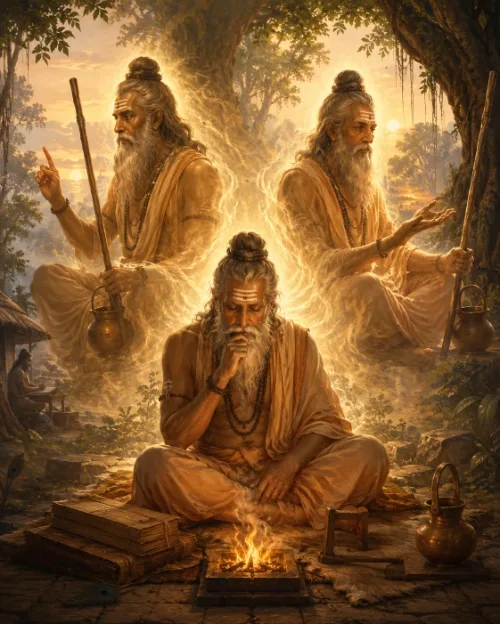
How the Mahābhārata, Bhagavad-gītā, Bhāgavata, and Purāṇas preserve two apparently contradictory traditions
A small line in the Bhagavad-gītā opens a surprisingly deep textual problem. When Arjuna names authorities who proclaim Kṛṣṇa’s divine identity, he says:
आहुस्त्वामृषयः सर्वे देवर्षिर्नारदस्तथा ।
असितो देवलो व्यासः स्वयं चैव ब्रवीषि मे ॥
āhus tvām ṛṣayaḥ sarve
devarṣir nāradas tathā |
asito devalo vyāsaḥ
svayaṃ caiva bravīṣi me ||
“All the sages declare this of You, as does the divine sage Nārada; Asita, Devala and Vyāsa also declare it, and You Yourself tell me the same.”
Bhagavad-gītā 10.13
Most familiar translations therefore present Asita and Devala as two different sages. Yet elsewhere the Mahābhārata tells a long story about a sage whom it calls Asita Devala. During that story the narrator freely alternates between Asita, Devala, and Asita Devala—all referring unmistakably to one man.
So which is correct? The answer is that both usages are genuinely present in Sanskrit tradition. The texts do not support a universal equation in either direction. Sometimes Asita and Devala are two sages; sometimes Asita Devala is one sage or one composite designation. Behind this lies an even older and more complicated history involving patronymics, lineages, repeated sage-names and competing genealogies.
Understanding that distinction resolves what at first looks like a contradiction.
The first mistake to avoid: grammar alone does not settle Bhagavad-gītā 10.13
The crucial sequence in the Gītā is:
असितो देवलो व्यासः
asito devalo vyāsaḥ
It is tempting to argue that because Asitaḥ, Devalaḥ and Vyāsaḥ are three nominative singular forms, they must denote three individuals. That is not sufficient. Sanskrit can place two nominative expressions in apposition, so asito devalaḥ can, depending on context, function as a designation such as “Asita Devala.” Nor does the Gītā insert an explicit ca, “and,” between Asita and Devala.
The bare Sanskrit therefore allows the question to be asked. The verse itself does not conclusively tell us whether “Asita Devala” is one designation or whether Asita and Devala are two names in a compressed list.
To decide how traditional readers understood the Gītā, we have to look at its commentators. But before doing that, the Mahābhārata gives us an extraordinary counterexample.
The Mahābhārata’s Jaigīṣavya story: here Asita and Devala are one person
In the Śalya-parvan, the Mahābhārata narrates the encounter of the accomplished yogin Jaigīṣavya with another sage. The story introduces that sage with the words:
गार्हस्थ्यं धर्ममास्थाय असितो देवलः पुरा ॥
gārhasthyaṃ dharmam āsthāya asito devalaḥ purā
“Formerly Asita Devala lived according to the dharma of a householder.”
Mahābhārata 9.49.1, Critical Edition numbering
The narrative then immediately begins calling him simply Devala. Jaigīṣavya stays:
देवलस्याश्रमे
devalasyāśrame
“in Devala’s hermitage.”
A little later, however, the very same character is again called Asita Devala:
असितो देवलो राजंश्चिन्तयामास बुद्धिमान् ।
asito devalo rājaṃś cintayām āsa buddhimān
“O King, the wise Asita Devala reflected…”
Mahābhārata 9.49.22
Notice the singular grammar: buddhimān, “the wise man,” and cintayām āsa, “he reflected.” There is only one subject. Then comes perhaps the clearest line in the entire problem:
ततोऽसितः सुसंरब्धो व्यवसायी दृढव्रतः ।
अपश्यद्वै दिवं यान्तं जैगीषव्यं स देवलः ॥
tato ‘sitaḥ susaṃrabdho vyavasāyī dṛḍhavrataḥ |
apaśyad vai divaṃ yāntaṃ jaigīṣavyaṃ sa devalaḥ ||
“Then Asita, resolute and firm in his vow—this Devala—saw Jaigīṣavya proceeding toward heaven.”
Mahābhārata 9.49.26
The verse begins by calling him Asita and concludes by identifying that same subject as sa Devalaḥ — “that Devala.” The story keeps doing this. At one moment:
ततो मुनिवरं भूयो जैगीषव्यमथासितः ।
tato munivaraṃ bhūyo jaigīṣavyam athāsitaḥ
“Then Asita again sought the excellent sage Jaigīṣavya…”
A little later:
सोऽचिन्तयन्महाभागो जैगीषव्यस्य देवलः ।
so ‘cintayan mahābhāgo jaigīṣavyasya devalaḥ
“The illustrious Devala reflected upon Jaigīṣavya…”
And when the perfected beings address him directly:
शृणु देवल
śṛṇu devala
“Listen, O Devala.”
No second sage named Asita ever enters the narrative. This is not an interpretation imposed by a translator. It is built into the continuity of the Sanskrit story.
The conclusion is unavoidable
In this episode: Asita = Devala = Asita Devala. Whatever the historical reason for the designation may have been, the literary character in the Jaigīṣavya narrative is one sage.
The preceding verse makes the case even stronger
Immediately before the Jaigīṣavya story, the Mahābhārata says:
असितो देवलश्चैव तस्मिन्नेव महातपाः ।
परमं योगमास्थाय ऋषिर्योगमवाप्तवान् ॥
asito devalaś caiva tasminn eva mahātapāḥ |
paramaṃ yogam āsthāya ṛṣir yogam avāptavān ||
“There also the great ascetic Asita Devala, undertaking the highest yoga, attained yogic perfection.”
Mahābhārata 9.48.23
The phrase asito devalaś caiva can look at first like “Asita and Devala.” But what follows is singular:
- mahātapāḥ — “the great ascetic”
- ṛṣiḥ — “the sage”
- avāptavān — “he attained”
Then the very next chapter introduces asito devalaḥ and tells the Jaigīṣavya story. Thus the narrative context strongly indicates that the verse is speaking about one Asita Devala, not two men jointly attaining yoga.
This is an excellent example of why a single word such as ca, “and/also,” cannot be isolated from the larger sentence and narrative.
Another Mahābhārata passage: suggestive, but genuinely ambiguous
At the beginning of the epic we find:
नारदोऽश्रावयद्देवानसितो देवलः पितॄन् ।
गन्धर्वयक्षरक्षांसि श्रावयामास वै शुकः ॥
nārado ‘śrāvayad devān asito devalaḥ pitṝn |
gandharva-yakṣa-rakṣāṃsi śrāvayām āsa vai śukaḥ ||
“Nārada recited it to the gods; Asita Devala [or: Asita and Devala] to the Pitṛs; Śuka recited it to the Gandharvas, Yakṣas and Rākṣasas.”
Mahābhārata 1.1.64
This passage is important precisely because it should not be used as decisive evidence either way. Some modern editions and scholars translate Asita Devala as a single sage. Others understand Asita and Devala.
Unlike the Jaigīṣavya narrative, there is no surrounding action here that forces one interpretation. So this verse belongs in the category: possible evidence for “Asita Devala” as one person, but not proof.
That distinction matters. A careful investigation must separate unambiguous, probable, and ambiguous occurrences instead of forcing every passage into one solution.
Bhagavad-gītā 10.13: the commentators strongly favor two sages
Now we can return to the Gītā. Although the Sanskrit asito devalo vyāsaḥ is not decisive by itself, several important classical commentators remove the ambiguity.
Śrīdhara Svāmī
Śrīdhara explicitly expands the compressed list:
असितश्च देवलश्च व्यासश्च
asitaś ca devalaś ca vyāsaś ca
“Asita and Devala and Vyāsa.”
This is unambiguous. Śrīdhara therefore understands Asita and Devala as two sages in Bhagavad-gītā 10.13. This testimony is especially significant in the Vaiṣṇava context because Śrīdhara Svāmī became one of the most authoritative classical commentators on the Śrīmad-Bhāgavatam and was highly respected in the Gauḍīya tradition.
Ānandagiri goes further: Asita is Devala’s father
Ānandagiri’s gloss is remarkably explicit:
असितो देवलस्य पिता ।
asito devalasya pitā
“Asita was Devala’s father.”
If this traditional identification is followed, the sequence in the Gītā is not merely a list of two unrelated sages. It is a father and son appearing side by side. Whatever one thinks about harmonizing every ancient genealogy, there is no ambiguity about Ānandagiri’s interpretation: Asita ≠ Devala.
Madhusūdana Sarasvatī also separates them
Madhusūdana Sarasvatī writes:
देवर्षिर्नारदः असितो देवलश्च … व्यासश्च
devarṣir nāradaḥ asito devalaś ca … vyāsaś ca
“The divine sage Nārada, Asita, Devala … and Vyāsa.”
He additionally identifies Devala as:
धौम्यस्य ज्येष्ठो भ्राता
dhaumyasya jyeṣṭho bhrātā
“the elder brother of Dhaumya.”
Again, Asita and Devala are plainly distinct individuals. Śaṅkara’s received interpretation likewise treats the names separately, and the widespread traditional translation of the verse reflects precisely this understanding.
Prabhupāda preserves both usages
A particularly instructive case is A. C. Bhaktivedanta Swami Prabhupāda. In his translation of Bhagavad-gītā 10.13, he gives: “Nārada, Asita, Devala and Vyāsa.” His word-for-word also separates:
- asitaḥ — Asita
- devalaḥ — Devala
- vyāsaḥ — Vyāsa
Thus for BG 10.13 he follows the traditional interpretation of two sages.
Yet elsewhere, commenting on Śrīmad-Bhāgavatam 1.9.6–7, he explicitly refers to an: “Asita Devala Ṛṣi.” This is not necessarily an inconsistency. Quite the opposite: it illustrates the real complexity of the Sanskrit tradition.
A writer can recognize a sage called Asita Devala in one context while interpreting “Asita” and “Devala” as two sages in another. That is precisely what the older literature itself requires us to do.
The Śrīmad-Bhāgavatam provides strong evidence for two distinct sages
Two Bhāgavata passages make the distinction especially difficult to deny.
Śrīmad-Bhāgavatam 6.15.12
A long catalogue of realized sages begins:
कुमारो नारद ऋभुरङ्गिरा देवलोऽसितः ।
अपान्तरतमा व्यासो मार्कण्डेयोऽथ गौतमः ॥
kumāro nārada ṛbhur
aṅgirā devalo ‘sitaḥ |
apāntaratamā vyāso
mārkaṇḍeyo ‘tha gautamaḥ ||
“Sanat-kumāra, Nārada, Ṛbhu, Aṅgirā, Devala, Asita, Apāntaratamā Vyāsa, Mārkaṇḍeya and Gautama…”
Here Devala and Asita occur as consecutive members of a catalogue containing numerous individual sages. Traditional word-for-word explanations likewise identify them separately.
Śrīmad-Bhāgavatam 10.84.3
At Kurukṣetra another gathering of sages is described:
द्वैपायनो नारदश्च च्यवनो देवलोऽसितः ।
विश्वामित्रः शतानन्दो भरद्वाजोऽथ गौतमः ॥
dvaipāyano nāradaś ca
cyavano devalo ‘sitaḥ |
viśvāmitraḥ śatānando
bharadvājo ‘tha gautamaḥ ||
“Dvaipāyana, Nārada, Cyavana, Devala, Asita, Viśvāmitra, Śatānanda, Bharadvāja and Gautama…”
Again, the natural traditional reading is a procession of distinct sages. Thus the Bhāgavata itself provides excellent evidence that Asita and Devala existed as separate ṛṣi-identities within the received tradition.
The Purāṇas make the problem even more interesting: Devala can be Asita’s son
The Kūrma Purāṇa preserves a genealogy that fits Ānandagiri’s statement remarkably well:
असितस्यैकपर्णायां ब्रह्मिष्ठः समपद्यत ।
नाम्ना वै देवलः पुत्रो योगाचार्यो महातपाः ॥
asitasyaikaparṇāyāṃ brahmiṣṭhaḥ samapadyata |
nāmnā vai devalaḥ putro yogācāryo mahātapāḥ ||
“From Asita and Ekaparṇā was born a man deeply established in Brahman—a son named Devala, a great ascetic and master of yoga.”
Kūrma Purāṇa, Pūrva-bhāga 19.5
The Brahmāṇḍa Purāṇa preserves a closely related genealogy:
असितस्यैकपर्णायां ब्रह्मिष्ठः समपद्यत ।
शाण्डिल्यानां वरः श्रीमान् देवलः सुमहायशाः ॥
asitasyaikaparṇāyāṃ brahmiṣṭhaḥ samapadyata |
śāṇḍilyānāṃ varaḥ śrīmān devalaḥ sumahāyaśāḥ ||
“From Asita and Ekaparṇā arose the illustrious and greatly renowned Devala, foremost among the Śāṇḍilyas.”
Here we have a perfectly coherent tradition: Asita + Ekaparṇā → Devala This may help explain how a designation such as Asita Devala arose: it could distinguish the Devala associated with or descended from Asita from other sages bearing the name Devala.
That explanation is attractive—but it should be presented as a reconstruction rather than as something demonstrable for every occurrence.
There was more than one Devala
This is probably the most important historical key. Ancient Sanskrit literature does not require every person called Devala to be the same individual. The Śrīmad-Bhāgavatam, for example, gives another genealogy:
कृशाश्वोऽर्चिषि भार्यायां धूमकेतुमजीजनत् ।
धिषणायां वेदशिरो देवलं वयुनं मनुम् ॥
kṛśāśvo ‘rciṣi bhāryāyāṃ
dhūmaketum ajījanat |
dhiṣaṇāyāṃ vedaśiro
devalaṃ vayunaṃ manum ||
“Kṛśāśva begot Dhūmaketu through his wife Arciṣ; through Dhiṣaṇā he begot Vedaśirā, Devala, Vayuna and Manu.”
Śrīmad-Bhāgavatam 6.6.20
Here a Devala is a son of Kṛśāśva and Dhiṣaṇā, not Asita. Other epic and Purāṇic genealogies connect a Devala with Pratyūṣa. A specialist study of the Devala traditions consequently concludes that the sources preserve several genealogical identities bearing the name Devala.
Once that is understood, much of the apparent contradiction disappears. The question should no longer be: “Which biography of Devala is the correct one?” but: “Which Devala tradition is this particular passage invoking?”
An older Vedic surprise: Asita Daivala
The history becomes even deeper in Vedic literature. The Tāṇḍya Mahābrāhmaṇa, or Pañcaviṃśa Brāhmaṇa, has:
असितो वा एतेन दैवलस्त्रयाणां लोकानां दृष्टिमपश्यत्
asito vā etena daivalas trayāṇāṃ lokānāṃ dṛṣṭim apaśyat
“By means of this, Asita Daivala obtained vision of the three worlds.”
The important form here is not Devala, but: Daivala That difference matters. In Sanskrit, forms of this type can function as patronymics, indicating descent or affiliation. The traditional explanation reported from Sāyaṇa understands Daivala as “son of Devala,” yielding: Asita Daivala = Asita, descendant or son of Devala.
This gives us an astonishing reversal. One traditional strand says: Devala → Asita while Purāṇic traditions say: Asita → Devala This would be absurd only if we insisted that all these names referred to one father and one son in one historical family.
But if Asita and Devala functioned as recurring lineage names among ancient seer families, the picture becomes much more intelligible.
“Asita Devala” and “Asita Daivala” should not be casually conflated
The distinction deserves emphasis.
Asita Devala
This is the form occurring prominently in the epic tradition: asito devalaḥ Depending on context it can refer to one person designated Asita Devala, or be parsed as Asita and Devala.
Asita Daivala
This is a specifically patronymic-looking Vedic form: asito daivalaḥ Traditionally interpreted as Asita descended from Devala. Those are not simply two spellings of the same thing.
The difference between Devala and Daivala preserves genealogical information and may represent an older stage in the development of these sage traditions.
A specialist study reaches exactly the same three-way division
A detailed academic study devoted to Devala’s identity examined the Vedic, epic, Purāṇic and Dharmaśāstra material and found that the evidence naturally falls into three classes:
- passages where Asita, Devala and Asita Devala clearly denote one personality;
- passages where Asita and Devala clearly denote two different sages;
- passages where the wording is genuinely ambiguous.
That classification is much more convincing than trying to force every passage into a single universal rule. The study also notes that Śrautasūtra and pravara traditions consistently preserve Asita and Devala as distinct lineage seers, while simultaneously preserving complicated relationships between names such as Asita-Daivala and Daivala-Asita.
In other words, the ambiguity is not a modern misunderstanding. It is embedded in the textual history itself.
So who is meant in Bhagavad-gītā 10.13?
We can now answer much more precisely. The Sanskrit of the verse: asito devalo vyāsaḥ does not by itself conclusively decide the matter. That sequence is compatible with the existence of a composite designation Asita Devala, and the Mahābhārata undeniably knows such a figure.
Nevertheless, the classical exegetical tradition of Bhagavad-gītā 10.13 strongly favors reading Asita and Devala as two distinct sages. Śrīdhara Svāmī explicitly writes: asitaś ca devalaś ca “Asita and Devala.”
Ānandagiri says: asito devalasya pitā “Asita was Devala’s father.” Madhusūdana Sarasvatī likewise separates them. And Prabhupāda follows the same interpretation. Therefore, when translating or explaining Bhagavad-gītā 10.13, the safest traditional rendering is: “Nārada, Asita, Devala and Vyāsa.”
It would be misleading to silently replace this with “Nārada, Asita Devala and Vyāsa” as though the latter were unquestionably what the Gītā intended.
But who is meant in the Jaigīṣavya story?
Here the answer reverses completely. In Mahābhārata 9.49, Asita Devala is one character. The epic itself alternates: Asita Devala → Devala → Asita → Devala → Asita while following the uninterrupted actions of one sage.
There is no legitimate reason to invent two sages in that narrative. So when writing about the Jaigīṣavya episode, the proper designation is: Ṛṣi Asita Devala and it is useful to explain that the text subsequently refers to him by either part of the designation.
The deeper lesson: ancient names are not modern identification numbers
Modern readers naturally expect one name to correspond to one individual. Ancient Sanskrit literature often works differently. A sage-name may function as:
- an individual personal name;
- a lineage name;
- a patronymic;
- an inherited ancestral designation;
- an epithet;
- or a traditional name attached to more than one person.
The same phenomenon appears with many famous ṛṣi names. A name such as Vasiṣṭha, Vyāsa, Gautama, Bhṛgu, or Devala cannot always be treated as though it were a modern passport identity.
That is why trying to create one continuous biography from every textual occurrence can produce impossible genealogies. The contradiction often disappears once we distinguish the textual traditions instead of forcing them into one individual.
Final verdict
The evidence allows a much sharper conclusion than either “they are one person” or “they are two persons.” Asita and Devala are two distinct sages in a substantial and ancient strand of Sanskrit tradition. The Śrīmad-Bhāgavatam lists them separately, classical Gītā commentators distinguish them, and some Purāṇic genealogies explicitly make Devala the son of Asita.
At the same time, “Asita Devala” is also a genuine single-sage designation. The Mahābhārata’s Jaigīṣavya episode proves this beyond reasonable doubt by calling one continuous character alternately Asita, Devala and Asita Devala.
Older Vedic literature complicates the history still further through Asita Daivala, a patronymic tradition linking Asita to Devala in the opposite genealogical direction.
The most defensible synthesis is therefore: There was not one universal “Asita versus Devala” identity throughout Sanskrit literature. The corpus preserves multiple sages, lineages and overlapping traditions. In some passages Asita and Devala are distinct; in others Asita Devala is one sage; and in still others the wording remains genuinely ambiguous.
For practical reading:
That distinction preserves both the Sanskrit text and the traditional commentarial evidence without forcing either side of the tradition to disappear.
A note on the original-language quotations
The evidence for this question comes almost entirely from Sanskrit Vedic, epic, Purāṇic and Sanskrit commentarial literature. I have therefore not inserted a Bengali quotation merely for ornament. There does not appear to be a Bengali primary source that materially resolves the identity question; adding one would make the article feel more authentic while actually making the research less precise.
Sources and texts consulted
- Primary and traditional sources: Bhagavad-gītā 10.13 with the Sanskrit commentaries of Śaṅkara, Śrīdhara Svāmī, Ānandagiri, Madhusūdana Sarasvatī and others on IIT Kanpur’s Gita Supersite.
- Mahābhārata: Critical Edition passages from Ādi-parvan 1.1.64 and Śalya-parvan 9.48–49, checked through Sanskrit Documents, GRETIL, Ambuda and Sanskrit-text resources.
- Śrīmad-Bhāgavatam: 6.6.20, 6.15.12–15 and 10.84.3, checked through Vedabase and Sanskrit editions.
- Purāṇic genealogy: Kūrma Purāṇa Pūrva 19.5, Brahmāṇḍa Purāṇa 2.8.32 and related Vāyu-Purāṇa material.
- Vedic evidence: Tāṇḍya/Pañcaviṃśa Brāhmaṇa 14.11.18–19, including Asita Daivala.
- Specialist study: the chapter “Devala—His Bio-Data” from a critical study of the Devala-smṛti, particularly its classification of one-person, two-person and ambiguous Asita–Devala references and its discussion of the Śrautasūtra and genealogical traditions.
- Prabhupāda / Gauḍīya usage: Bhagavad-gītā 10.12–13 and Śrīmad-Bhāgavatam 1.9.6–7 on Vedabase, where the two contextual usages—Asita and Devala versus Asita Devala Ṛṣi—can be compared.