

The Knowers of Truth Call It by Three Names
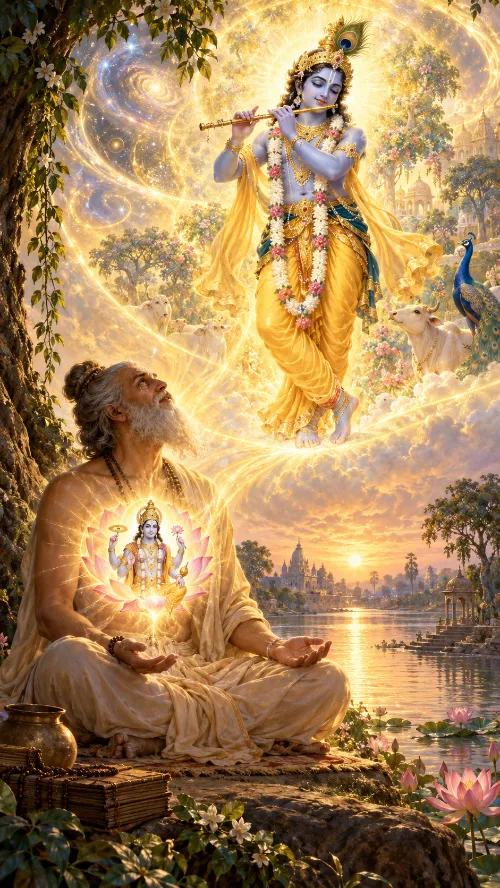
Tattva, Advaya-jñāna, and Why Nonduality Does Not Erase Relationship
Few verses state the metaphysics of the Śrīmad-Bhāgavatam as compactly as 1.2.11:
वदन्ति तत्तत्त्वविदस्तत्त्वं यज्ज्ञानमद्वयम् ।
ब्रह्मेति परमात्मेति भगवानिति शब्द्यते ॥
vadanti tat tattva-vidas
tattvaṁ yaj jñānam advayam
brahmeti paramātmeti
bhagavān iti śabdyate
“Those who know the Truth describe that Reality, which is nondual consciousness, as Brahman, Paramātmā, and Bhagavān.”
Śrīmad-Bhāgavatam 1.2.11
A.C. Bhaktivedanta Swami Prabhupāda translates: “Learned transcendentalists who know the Absolute Truth call this nondual substance Brahman, Paramātmā or Bhagavān.” The translation is sound. But beneath the apparently simple statement lies an entire theology.
The verse is saying something more sophisticated than either: “There are three different versions of God,” or: “Brahman, Paramātmā, and Bhagavān are merely three interchangeable words meaning exactly the same thing.”
The Bhāgavatam presents one Absolute Reality—tattvam—which is nondual, yet which can be known as Brahman, Paramātmā, and Bhagavān. The classical Gauḍīya commentators then take the next step: these are genuine revelations of the same Absolute, but not equally complete disclosures of everything contained within that Reality.
Brahman is real. Paramātmā is real. Bhagavān is real. But Bhagavān is the same Absolute manifest in the fullness of His energies, attributes, form, relationships, and līlā.
This distinction is essential for understanding how Gauḍīya Vaiṣṇavism can simultaneously affirm nonduality and the eternal reality of Kṛṣṇa, His devotees, His energies, His form, and loving relationships with Him.
The Verse Answers the Central Question of Human Life
ŚB 1.2.11 does not appear as an isolated philosophical definition. The previous verse has just explained what human life is ultimately meant for:
कामस्य नेन्द्रियप्रीतिर्लाभो जीवेत यावता ।
जीवस्य तत्त्वजिज्ञासा नार्थो यश्चेह कर्मभिः ॥
kāmasya nendriya-prītir
lābho jīveta yāvatā
jīvasya tattva-jijñāsā
nārtho yaś ceha karmabhiḥ
“Life’s desires should not be directed toward mere sense gratification. One should maintain life as necessary, for the purpose of the living being is inquiry into Reality; no other ultimate purpose should be sought through one’s activities.”
Śrīmad-Bhāgavatam 1.2.10
The crucial expression is:
तत्त्वजिज्ञासा
tattva-jijñāsā
“inquiry into tattva—ultimate Reality.”
So verse 1.2.10 effectively asks: What should a human being ultimately investigate? Reality itself. Then 1.2.11 answers the obvious next question: What is that Reality? It is:
ज्ञानमद्वयम्
jñānam advayam
Brahman, Paramātmā, and Bhagavān. The following verse then explains how this Reality becomes realized:
तच्छ्रद्दधाना मुनयो
ज्ञानवैराग्ययुक्तया ।
पश्यन्त्यात्मनि चात्मानं
भक्त्या श्रुतगृहीतया ॥
tac chraddadhānā munayo
jñāna-vairāgya-yuktayā
paśyanty ātmani cātmānaṁ
bhaktyā śruta-gṛhītayā
“Faithful sages, endowed with knowledge and detachment, behold that Reality within themselves through bhakti received through hearing revealed knowledge.”
Śrīmad-Bhāgavatam 1.2.12
There is therefore a deliberate progression:
This context matters enormously. The Bhāgavatam is not merely constructing an abstract ontology. It is showing the human being what to seek, what the goal actually is, and how it becomes known.
What Does Tattva Mean?
The Sanskrit word:
तत्त्व
tattva literally carries the sense of “thatness”—what something actually is. It means reality, truth, principle, or the actual nature of something. Thus:
तत्त्वविद्
tattva-vit means: “one who knows reality as it is.” The plural used here is:
तत्त्वविदः
tattva-vidaḥ
“knowers of Reality.”
The verse therefore does not present Brahman, Paramātmā, and Bhagavān as three contradictory theories proposed by mutually confused philosophers. It says that those who actually know tattva speak of the same Reality through these three designations.
This is why Śrīdhara Svāmī emphasizes that there is no contradiction between the terms. He explains that it is:
तस्यैव तत्त्वस्य नामान्तरैरभिधानात्
tasyaiva tattvasya nāmāntarair abhidhānāt
“that very same Reality which is designated by different names.”
That single statement prevents one major misunderstanding: There are not three independent Absolute Truths. There is:
तत्त्वम्
tattvam singular.
The Three Iti s Matter
The Sanskrit structure is elegant:
ब्रह्म इति
brahma iti “as ‘Brahman’”
परमात्मा इति
paramātmā iti
“as ‘Paramātmā’”
भगवान् इति
bhagavān iti
“as ‘Bhagavān.’”
Then:
शब्द्यते
śabdyate
“is designated, named, spoken of.”
The verse therefore says: one tattva is designated in these three ways. But that does not yet tell us whether the three realizations disclose the Absolute with identical completeness.
That question is answered by the broader Bhāgavata theology and especially by commentators such as Jīva Gosvāmī and Viśvanātha Cakravartī.
What Does Jñānam Advayam Mean?
The heart of the verse is:
ज्ञानमद्वयम्
jñānam advayam
“nondual substance.”
That successfully communicates the theological point that Brahman, Paramātmā, and Bhagavān are not separate substances or rival absolutes. But jñānam literally means: knowledge, cognition, consciousness.
Jīva Gosvāmī makes the intended metaphysical meaning explicit:
ज्ञानं चिदेकरूपम्
jñānaṁ cid-eka-rūpam
“Jñāna is of the one nature of consciousness—cit.”
So a particularly useful philosophical translation of jñānam advayam is: “nondual conscious Reality.” This avoids a possible misunderstanding created by the modern word “substance.”
The Absolute is not an impersonal metaphysical material out of which a personal God is later constructed. The Absolute is intrinsically conscious Reality.
What Does “Nondual” Actually Mean?
The word:
अद्वय
advaya means: “not two,” “without a second,” “nondual.” But this immediately raises a difficult question. If Reality is nondual, how can there also be: Kṛṣṇa, His form, His energies, His devotees, His abode, His qualities, His līlā, and relationships between the Lord and His servants?
Would not every distinction introduce “two”? This is precisely where Gauḍīya Vedānta differs from a simple equation of nonduality with absolute undifferentiation. For Jīva Gosvāmī, advaya means fundamentally that nothing constitutes an independent second Absolute alongside the Supreme Reality.
The Lord’s energies are real. The jīvas are real. The spiritual world is real. Relationships are real. But none possesses an existence independent of the ultimate Reality from which all derive their being and power.
Jīva explains the Absolute’s nonduality in terms of the absence of another independently self-established reality and the inseparability of the Lord from His own śakti. Thus Gauḍīya nonduality does not require the destruction of divine variety.
Unity Does Not Require the Erasure of Relationship
Viśvanātha Cakravartī makes this especially powerful. He speaks of the eternal:
सेव्य-सेवक-सेवादि-विभाग
sevya-sevaka-sevādi-vibhāga
“distinction between the one who is served, the servant, the service, and so forth.”
These distinctions can remain eternally real without destroying:
अद्वयत्वम्
advayatvam “nonduality.” This is vital. The servant does not have to become the Lord for Reality to be one. Service does not need to vanish. Love does not need to collapse into identity.
Relationship itself does not constitute an independent second Absolute. Thus the Gauḍīya conception permits something extraordinarily rich: real unity without abolishing difference, and real difference without absolute separation.
This eventually becomes central to the theology known as:
अचिन्त्यभेदाभेद
acintya-bhedābheda
“inconceivable simultaneous difference and non-difference.”
Brahman, Paramātmā, and Bhagavān: Jīva Gosvāmī’s Precise Explanation
Jīva Gosvāmī gives one of the most important explanations of ŚB 1.2.11 in Bhagavat-sandarbha. His basic distinction can be summarized through three formulations.
Brahman
He describes Brahman as:
शक्ति-वर्ग-लक्षण-तद्धर्मातिरिक्तं केवलं ज्ञानं ब्रह्मेति शब्द्यते
śakti-varga-lakṣaṇa-tad-dharmātiriktaṁ kevalaṁ jñānaṁ brahmeti śabdyate
“The pure conscious Reality considered apart from the manifested characteristics and functions of its various potencies is designated ‘Brahman.’”
This does not mean that Brahman is something existing separately from Bhagavān. It means that the Absolute is apprehended without the fuller manifestation of the divine distinctions contained within it.
Brahman realization encounters the limitless spiritual nature of Reality.
Paramātmā
Jīva then describes Paramātmā in relation to the Absolute’s manifestation as the indwelling regulator.
Paramātmā is the Supreme Reality encountered as:
- the witness,
- the inner governor,
- the indwelling Lord,
- the presence of the Supreme within living beings,
- and the regulator of cosmic manifestation.
Kṛṣṇa describes this in the Bhagavad-gītā:
ईश्वरः सर्वभूतानां
हृद्देशेऽर्जुन तिष्ठति ।
भ्रामयन्सर्वभूतानि
यन्त्रारूढानि मायया ॥
īśvaraḥ sarva-bhūtānāṁ
hṛd-deśe ’rjuna tiṣṭhati
bhrāmayan sarva-bhūtāni
yantrārūḍhāni māyayā
“The Supreme Lord resides in the heart of all beings, O Arjuna, directing their wanderings as though they were mounted upon a machine made of material nature.”
Bhagavad-gītā 18.61
Kṛṣṇa also says:
सर्वस्य चाहं हृदि सन्निविष्टो
मत्तः स्मृतिर्ज्ञानमपोहनं च ।
sarvasya cāhaṁ hṛdi sanniviṣṭo
mattaḥ smṛtir jñānam apohanaṁ ca
“I am situated in everyone’s heart; from Me come remembrance, knowledge, and forgetfulness.”
Bhagavad-gītā 15.15
Calling Paramātmā “localized” must therefore be understood carefully. It does not mean that God becomes spatially confined. It means that the unlimited Supreme is specifically manifest as the indwelling Lord present with every living being.
Bhagavān
Jīva’s definition of Bhagavān is striking:
परिपूर्णसर्वशक्तिविशिष्टं भगवानिति
paripūrṇa-sarva-śakti-viśiṣṭaṁ bhagavān iti
“That which is distinguished by all potencies in their complete fullness is called Bhagavān.”
The decisive expression is:
परिपूर्णसर्वशक्ति
paripūrṇa-sarva-śakti
“all potencies in complete fullness.”
This is why the three terms are not simply interchangeable in Gauḍīya theology. The Reality is one. But Bhagavān reveals what is contained within that Reality in fullness.
Not merely infinite existence. Not merely universal consciousness. Not merely the indwelling witness. But: form, qualities, beauty, will, knowledge, śakti, relationships, associates, abode, and līlā.
Viśvanātha Cakravartī: Bhagavān Is the Root
Viśvanātha develops the point even more explicitly. For the jñānī, the Absolute may be apprehended principally as Brahman. For the yogī, the same Reality is apprehended as Paramātmā, the indwelling ruler.
For the devotee, the Absolute is realized as Bhagavān, possessing His inconceivable spiritual nature, form, attributes, and līlā. Viśvanātha describes these as:
अचिन्त्यानन्तचिदानन्दमयस्वरूपरूपगुणलीलादि
acintyānanta-cid-ānanda-maya-svarūpa-rūpa-guṇa-līlādi
“His inconceivable, infinite, consciousness-and-bliss nature, form, qualities, līlā, and so forth.”
He then draws the characteristically Vaiṣṇava conclusion:
भगवत्त्वमेव मूलम्
bhagavattvam eva mūlam
“Bhagavān-hood itself is the root.”
This is crucial. The Gauḍīya claim is not: “Brahman is false.” Nor: “Paramātmā is an illusion.” Rather: Brahman and Paramātmā belong to Bhagavān Himself. Bhagavān is the same Absolute in the fullness from which those other realizations are intelligible.
One Reality, Increasing Disclosure
A useful way to understand the three realizations is through increasing disclosure. Brahman reveals: The Absolute is infinite spiritual Reality. Paramātmā reveals: That Reality is conscious, witnessing, regulating, and present within beings.
Bhagavān reveals: That same Reality possesses complete spiritual individuality, form, attributes, powers, relationships, beauty, and līlā. Nothing genuine in Brahman disappears when Bhagavān is realized.
Nothing genuine in Paramātmā disappears. Rather, the Gauḍīya position is that Bhagavān contains and grounds what Brahman and Paramātmā reveal while disclosing dimensions not manifest with the same fullness in those realizations.
The Sun Analogy
A traditional Vaiṣṇava analogy compares these realizations to: sunlight, the solar disk, and the sun understood more fully. A person standing in sunlight genuinely encounters the sun’s energy.
He is not experiencing something unrelated to the sun. A person seeing the solar globe apprehends the same reality in a more localized form. Knowing the sun in greater completeness includes its source, structure, potency, and relation to its radiance.
The analogy is not perfect, but its point is useful: different degrees of realization do not require different ultimate sources. The same Absolute is being encountered. In Gauḍīya theology: Brahman resembles the all-pervading spiritual effulgence.
Paramātmā is the Supreme manifest as indwelling Lord. Bhagavān is the source in personal fullness.
Brahman Is Not Nothingness
Another misunderstanding must be avoided. Brahman is not: nothing, a material light, an empty void, or sheer nonexistence. It is spiritual Reality. The Brahma-saṁhitā gives a distinctly Vaiṣṇava description:
यस्य प्रभा प्रभवतो जगदण्डकोटि-
कोटीष्वशेषवसुधादिविभूतिभिन्नम् ।
तद् ब्रह्म निष्कलमनन्तमशेषभूतं
गोविन्दमादिपुरुषं तमहं भजामि ॥
yasya prabhā prabhavato jagad-aṇḍa-koṭi-
koṭīṣv aśeṣa-vasudhādi-vibhūti-bhinnam
tad brahma niṣkalam anantam aśeṣa-bhūtaṁ
govindam ādi-puruṣaṁ tam ahaṁ bhajāmi
“I worship Govinda, the original Person, whose effulgence is the unlimited and indivisible Brahman, extending throughout innumerable universes with their unlimited manifestations.”
Brahma-saṁhitā 5.40
The point is not to deny Brahman. It is to identify its source.
Caitanya-caritāmṛta: Brahman as Govinda’s Effulgence
Kṛṣṇadāsa Kavirāja states the same theology in Bengali:
কোটী কোটী ব্রহ্মাণ্ডে যে ব্রহ্মের বিভূতি ।
সেই ব্রহ্ম গোবিন্দের হয় অঙ্গকান্তি ॥
koṭī koṭī brahmāṇḍe ye brahmera vibhūti
sei brahma govindera haya aṅga-kānti
“The glory of Brahman extends throughout millions upon millions of universes; that Brahman is the bodily effulgence of Govinda.”
Caitanya-caritāmṛta, Ādi 2.15
This is the mature Gauḍīya interpretation: Brahman is not rejected. Brahman is located within the reality of Bhagavān.
Bhagavān’s Form Is Not Material Limitation
This also explains a major misunderstanding about Vaiṣṇava personalism. One may reason: “If the Absolute has a form, surely that makes Him limited. Therefore formless Brahman must be higher.”
But this argument assumes that every form must be material. The Bhāgavata tradition rejects that premise. Bhagavān’s form is not a material body imposed upon an otherwise higher impersonal Absolute.
His form belongs to His own spiritual nature. Viśvanātha explicitly includes:
स्वरूपरूपगुणलीला
svarūpa-rūpa-guṇa-līlā
“intrinsic nature, form, qualities, and līlā”
within the manifestation of Bhagavān. Personal form is therefore not a reduction of infinity. It is part of how spiritual infinity fully exists.
Jaḍa Bharata Gives a Remarkable Parallel
Another passage of the Bhāgavatam brings these ideas together beautifully:
ज्ञानं विशुद्धं परमार्थमेकम्
अनन्तरं त्वबहिर्ब्रह्म सत्यम् ।
प्रत्यक् प्रशान्तं भगवच्छब्दसंज्ञं
यद् वासुदेवं कवयो वदन्ति ॥
jñānaṁ viśuddhaṁ paramārtham ekam
anantaraṁ tv abahir brahma satyam
pratyak praśāntaṁ bhagavac-chabda-saṁjñaṁ
yad vāsudevaṁ kavayo vadanti
“Pure consciousness is the one supreme Reality, the true Brahman, without inner or outer division, inward and peaceful; it is designated by the word Bhagavān, and the wise call it Vāsudeva.”
Śrīmad-Bhāgavatam 5.12.11
Notice how the terminology converges:
- jñānam
- Brahman
- Bhagavān
- Vāsudeva
The terms are not describing unrelated metaphysical entities. They converge upon one supreme Reality.
Kṛṣṇa Is Directly Called Bhagavān, Brahman, and Paramātmā
The Bhāgavatam provides an even more direct demonstration. Varuṇa addresses Śrī Kṛṣṇa:
नमस्तुभ्यं भगवते
ब्रह्मणे परमात्मने ।
namas tubhyaṁ bhagavate
brahmaṇe paramātmane
“Obeisances unto You, Bhagavān, Brahman, and Paramātmā.”
Śrīmad-Bhāgavatam 10.28.6
One “You” is addressed as all three. That is practically ŚB 1.2.11 enacted in prayer. Kṛṣṇa does not cease to be Brahman when known as Bhagavān. He does not cease to be Paramātmā.
Rather, those designations belong to the one Supreme Reality.
“I Am the Foundation of Brahman”
The Bhagavad-gītā supplies another major Vaiṣṇava text:
ब्रह्मणो हि प्रतिष्ठाहम्
अमृतस्याव्ययस्य च ।
शाश्वतस्य च धर्मस्य
सुखस्यैकान्तिकस्य च ॥
brahmaṇo hi pratiṣṭhāham
amṛtasyāvyayasya ca
śāśvatasya ca dharmasya
sukhasyaikāntikasya ca
“I am the foundation of Brahman, which is immortal, imperishable, eternal, and the basis of ultimate happiness.”
Bhagavad-gītā 14.27
For Gauḍīya commentators, this becomes important evidence that personal Bhagavān should not be imagined as emerging secondarily from a more fundamental impersonal Brahman.
Kṛṣṇa says:
ब्रह्मणः प्रतिष्ठा अहम्
brahmaṇaḥ pratiṣṭhā aham
“I am the foundation of Brahman.”
The direction of dependence therefore runs the other way.
“Kṛṣṇa Is Bhagavān Himself”
The Bhāgavatam then makes its famous statement:
एते चांशकलाः पुंसः
कृष्णस्तु भगवान् स्वयम् ।
ete cāṁśa-kalāḥ puṁsaḥ
kṛṣṇas tu bhagavān svayam
“These are portions or portions of portions of the Puruṣa, but Kṛṣṇa is Bhagavān Himself.”
Śrīmad-Bhāgavatam 1.3.28
For Gauḍīya Vaiṣṇavism, this becomes decisive. ŚB 1.2.11 establishes the relation: Brahman — Paramātmā — Bhagavān and 1.3.28 identifies the fullest personal center as:
कृष्णस्तु भगवान् स्वयम्
kṛṣṇas tu bhagavān svayam
“Kṛṣṇa is Bhagavān Himself.”
Caitanya-caritāmṛta Gives the Full Gauḍīya Formula
Kṛṣṇadāsa Kavirāja later compresses almost the entire doctrine into a single Sanskrit verse:
यदद्वैतं ब्रह्मोपनिषदि तदप्यस्य तनुभा
य आत्मान्तर्यामी पुरुष इति सोऽस्यांशविभवः ।
षडैश्वर्यैः पूर्णो य इह भगवान् स स्वयमयं
न चैतन्यात् कृष्णाज्जगति परतत्त्वं परमिह ॥
yad advaitaṁ brahmopaniṣadi tad apy asya tanu-bhā
ya ātmāntar-yāmī puruṣa iti so ’syāṁśa-vibhavaḥ
ṣaḍ-aiśvaryaiḥ pūrṇo ya iha bhagavān sa svayam ayaṁ
na caitanyāt kṛṣṇāj jagati para-tattvaṁ param iha
“The nondual Brahman spoken of in the Upaniṣads is the effulgence of His body. The Puruṣa known as the indwelling Self is the manifestation of His plenary portion. He who is Bhagavān, complete in the six opulences, is this very Lord Himself. There is no higher Absolute Reality than Kṛṣṇa Caitanya.”
Caitanya-caritāmṛta, Ādi 2.5
This is essentially ŚB 1.2.11 unfolded into explicit Gauḍīya theology. Brahman is real—but is identified with His radiance. Paramātmā is real—but is understood as His indwelling expansion.
Bhagavān is the fullness of the same Reality.
What Does “Bhagavān” Actually Mean?
The word Bhagavān is not simply a vague equivalent of “God.” Traditional Vaiṣṇava literature connects it with the possession of bhaga—divine excellences or opulences. A famous definition lists:
ऐश्वर्यस्य समग्रस्य
वीर्यस्य यशसः श्रियः ।
ज्ञानवैराग्ययोश्चैव
षण्णां भग इतीङ्गना ॥
aiśvaryasya samagrasya
vīryasya yaśasaḥ śriyaḥ
jñāna-vairāgyayoś caiva
ṣaṇṇāṁ bhaga itīṅganā
“Complete sovereignty, strength, fame, beauty, knowledge, and detachment—these six are designated by the term bhaga.”
Thus Bhagavān means not merely “someone divine,” but the possessor of divine fullness. Another traditional formulation cited by Jīva Gosvāmī states:
ज्ञानशक्तिबलैश्वर्यवीर्यतेजांस्यशेषतः ।
भगवच्छब्दवाच्यानि विना हेयैर्गुणादिभिः ॥
jñāna-śakti-balaiśvarya-vīrya-tejāṁsy aśeṣataḥ
bhagavac-chabda-vācyāni vinā heyair guṇādibhiḥ
“Knowledge, potency, strength, sovereignty, valor, and splendor in their entirety are denoted by the word Bhagavān, free from all inferior qualities.”
The theological point is abundance, not limitation. Bhagavān means the Absolute possessing fullness.
Does Nonduality Mean the Jīva Is Bhagavān?
No. This is another important qualification. If tattva is nondual, someone might conclude: “The individual soul must simply be Bhagavān without knowing it. Once ignorance disappears, there is no eternal distinction.”
Jīva Gosvāmī specifically notices something important about ŚB 1.2.11. The verse says the one tattva is designated: Brahman, Paramātmā, Bhagavān . It does not add:
जीव इति
jīva iti
“as ‘jīva.’”
Jīva connects this to Vyāsa’s direct realization in samādhi. The Bhāgavatam describes it:
भक्तियोगेन मनसि
सम्यक् प्रणिहितेऽमले ।
अपश्यत् पुरुषं पूर्णं
मायां च तदपाश्रयम् ॥
bhakti-yogena manasi
samyak praṇihite ’male
apaśyat puruṣaṁ pūrṇaṁ
māyāṁ ca tad-apāśrayam
“With his purified mind perfectly fixed through bhakti-yoga, Vyāsa saw the complete Puruṣa and also His māyā-śakti, dependent upon Him.”
Śrīmad-Bhāgavatam 1.7.4
The following verse describes the jīva becoming bewildered by that potency. Thus Vyāsa’s realization preserves: the Supreme Person, His śakti, and the jīva affected by that śakti.
They are related, but not reduced to a single undifferentiated individual identity.
This Is Where Acintya-bhedābheda Becomes So Important
Gauḍīya Vedānta therefore resists two extremes. One extreme says: Difference is absolute. God, souls, and energies are ultimately unrelated realities. The other says: Difference is ultimately unreal. Only undifferentiated identity survives final realization.
Gauḍīya theology says neither. The jīva belongs to Kṛṣṇa’s śakti. It depends entirely upon Him. Nothing exists independently of Him. Therefore Reality is advaya—without a second independent Absolute.
Yet the jīva remains genuinely capable of relationship with Kṛṣṇa. Therefore distinction is also real. This is why eternal bhakti remains meaningful. If lover and beloved ultimately ceased to be distinguishable in every sense, then prema itself would disappear.
But in Gauḍīya theology, love is not a temporary symptom of ignorance. It belongs to ultimate Reality.
Nonduality Is Therefore Richer Than Homogeneity
This is perhaps the deepest philosophical implication of ŚB 1.2.11. Nonduality need not mean: no form, no qualities, no distinctions, no persons, no relationships, no activity.
That would be one particular interpretation of nonduality. The Bhāgavata tradition proposes another: nothing exists independently of the one Absolute Reality, yet that Reality contains real internal diversity through its śaktis.
The Absolute can therefore be simultaneously: one, conscious, personal, infinitely potent, internally differentiated, and relational. Its unity is not impoverished by diversity.
Its diversity exists within its unity.
Why Bhagavān Is Not Simply “One More Aspect”
This allows us to understand the precise Gauḍīya claim. It would be too weak to say merely: “Brahman, Paramātmā, and Bhagavān are three equally complete viewpoints.” That does not accurately represent Jīva or Viśvanātha.
Yet it would be equally wrong to say: “Brahman and Paramātmā are unreal.” They are genuine realizations of the same tattva. The more exact formulation is: Brahman and Paramātmā reveal true dimensions of the Absolute, while Bhagavān reveals the Absolute with the fullness of His divine potencies.
Thus Bhagavān is not another piece alongside Brahman and Paramātmā. Bhagavān is the full Reality from which the other manifestations become intelligible.
The Chapter Was Already Pointing Toward Vāsudeva
This conclusion is not artificially imported into the chapter from elsewhere. Only a few verses before 1.2.11, Sūta Gosvāmī says:
वासुदेवे भगवति
भक्तियोगः प्रयोजितः ।
जनयत्याशु वैराग्यं
ज्ञानं च यदहैतुकम् ॥
vāsudeve bhagavati
bhakti-yogaḥ prayojitaḥ
janayaty āśu vairāgyaṁ
jñānaṁ ca yad ahaitukam
“Bhakti-yoga directed toward Bhagavān Vāsudeva quickly produces causeless knowledge and detachment.”
Śrīmad-Bhāgavatam 1.2.7
The sequence of the chapter is revealing:
- Vāsudeva
- bhakti
- knowledge and detachment
- tattva-jijñāsā—inquiry into Reality
- Brahman, Paramātmā, Bhagavān
- realization through bhakti
So ŚB 1.2.11 is embedded from the beginning in a strongly devotional theological framework.
What the Verse Does Not Mean
Several common interpretations should therefore be avoided. It does not mean: “There are three different Absolute Truths.” The verse explicitly speaks of one tattvam. It does not mean: “Brahman and Paramātmā are false.”
They are genuine ways the Absolute is known. It does not simply mean: “All religious conceptions of God are equally complete.” The verse names three specific Vedāntic modes of realization, and the Gauḍīya commentators explicitly distinguish their degree of disclosure.
It does not mean: “Personal form is merely a temporary appearance projected upon impersonal Brahman.” Gauḍīya theology treats Bhagavān’s form, qualities, and līlā as intrinsically spiritual.
It does not mean: “Nonduality requires all individual distinction to disappear.” The Lord, His śakti, His devotees, and eternal service can remain genuinely distinct while belonging to one nondual Reality.
A Better Way to State the Teaching
The teaching of ŚB 1.2.11 can therefore be expressed on two levels. At the most textually cautious level: Those who know Reality describe one nondual conscious Absolute as Brahman, Paramātmā, and Bhagavān.
The classical Gauḍīya interpretation goes further: Brahman is the same Absolute apprehended in its undifferentiated spiritual nature; Paramātmā is that Absolute manifest as the indwelling witness and regulator; Bhagavān is that same Reality manifest with the complete fullness of His energies, form, attributes, relationships, and līlā.
And the wider Bhāgavata tradition identifies the fullest center of that Reality with: Śrī Kṛṣṇa.
The Deepest Insight of the Verse
The real brilliance of ŚB 1.2.11 is that it bridges two truths that are often assumed to be incompatible: The Absolute is one. And: The Absolute possesses unlimited personal variety.
The verse refuses to sacrifice either. If Brahman alone were real and all divine personality ultimately illusory, then the personal revelation of Bhagavān would have to disappear into something supposedly higher.
If Bhagavān were simply one separate deity among other independent realities, then the Absolute would no longer be advaya. The Bhāgavatam gives another possibility. Bhagavān is personal without ceasing to be infinite.
- He possesses form without becoming materially bounded.
- He possesses śakti without becoming divided.
- He enters every heart as Paramātmā without ceasing to exist in His own fullness.
His effulgence is Brahman without Brahman becoming an independent Absolute separate from Him. And His devotees can eternally love Him without creating a metaphysical rival to His nonduality.
That is why the short phrase:
ज्ञानमद्वयम्
jñānam advayam
“nondual conscious Reality”
is so important. It is not the destruction of spiritual variety. It is the metaphysical foundation that makes spiritual variety possible without producing competing Absolutes.
One Truth, Not One-Dimensional Truth
ŚB 1.2.11 therefore offers a far richer conception than the slogan: “Everything is one.” Its message is closer to: Reality is one—but Reality is not one-dimensional. The same Absolute can be encountered as the limitless spiritual reality called Brahman.
The same Absolute is present as the indwelling Lord called Paramātmā. And the same Absolute stands revealed in personal fullness as Bhagavān. For Gauḍīya Vaiṣṇavism, that fullness ultimately culminates in Kṛṣṇa—the source of Brahman radiance, the source of Paramātmā manifestations, and the Supreme Person in whom infinity does not abolish intimacy.
Thus the verse begins with metaphysics but ends, in the Bhāgavata vision, somewhere much more extraordinary. Ultimate Reality is not merely something to merge into, nor merely something to observe within the heart.
In its fullest revelation, Reality can be: known, seen, served, and ultimately— loved. And that is why the Bhāgavatam does not stop at:
ब्रह्म
Brahman, or even:
परमात्मा
Paramātmā. Its theological movement reaches:
भगवान्
Bhagavān—
the nondual Absolute revealed in the fullness of divine personality, power, beauty, relationship, and love.