

Kṛṣṇa’s Lotus Feet: The Nineteen Auspicious Marks
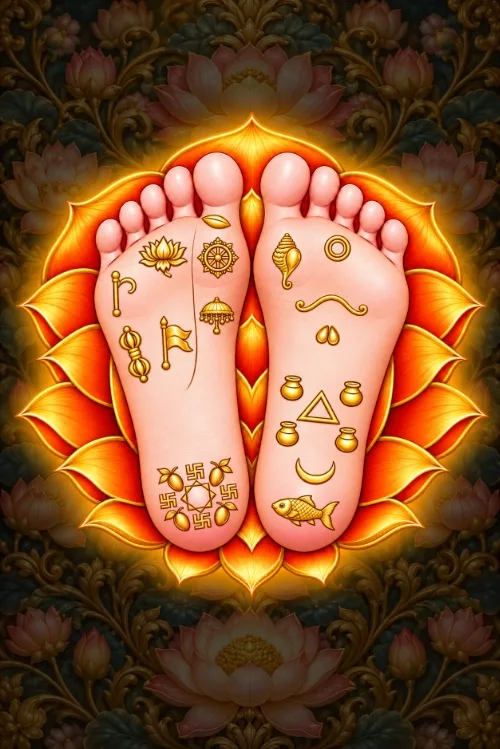
Their scriptural origins, spiritual symbolism, and extraordinary significance in the divine pastimes of Vṛndāvana
In the forests of Vṛndāvana, Lord Kṛṣṇa walks barefoot along the banks of the Yamunā, through flowering groves and across the soft earth of the cow pastures. Wherever He walks, His feet leave extraordinary impressions. They are not ordinary footprints. The soles of His feet bear auspicious symbols that reveal His divine identity.
According to the Gauḍīya Vaiṣṇava tradition, Śrī Kṛṣṇa’s lotus feet possess nineteen categories of auspicious marks: eleven on His right foot and eight on His left. These include the lotus, disc, thunderbolt, umbrella, elephant goad, conch, crescent moon, fish and other remarkable emblems.
Their significance extends far beyond decoration. Some represent Kṛṣṇa’s power to destroy ignorance and karmic bondage. Others symbolize the protection, nourishment and spiritual advancement of His devotees. Still others express His supreme beauty, His sovereignty over existence and the incomparable sweetness of His intimate relationships.
But the most extraordinary feature of these marks is not their number or symbolism. It is that the Supreme Lord, whose feet are worshiped by Brahmā, Śiva and the goddess of fortune, walks barefoot as a young cowherd boy through the forests of Vraja.
The Gopīs Recognize Kṛṣṇa’s Footprints
The most celebrated scriptural reference appears in the Tenth Canto of the Śrīmad-Bhāgavatam, during the description of Kṛṣṇa’s rāsa-līlā.
When Kṛṣṇa disappears from the assembly of the gopīs, the cowherd maidens wander through Vṛndāvana searching for Him. Overwhelmed by separation, they inquire about Him from the trees, creepers and flowers. Eventually, they discover a remarkable set of footprints in the forest dust.
पदानि व्यक्तमेतानि नन्दसूनोर्महात्मनः ।
लक्ष्यन्ते हि ध्वजाम्भोजवज्राङ्कुशयवादिभिः ॥
padāni vyaktam etāni
nanda-sūnor mahātmanaḥ
lakṣyante hi dhvajāmbhoja-
vajrāṅkuśa-yavādibhiḥ
“These are unmistakably the footprints of the glorious son of Nanda. They can be recognized by the marks of the flag, lotus, thunderbolt, elephant goad, barleycorn and other auspicious signs.”
Śrīmad-Bhāgavatam 10.30.25
The gopīs recognize Kṛṣṇa immediately. They do not require someone to identify His footprints because they already know His distinctive signs.
One Sanskrit expression is particularly important: yavādibhiḥ—”barleycorn and others.” The verse names five categories of marks but indicates that additional signs exist. It does not independently enumerate all nineteen.
The complete arrangement is preserved through the writings of the Gauḍīya Vaiṣṇava ācāryas, particularly Śrīla Sanātana Gosvāmī, Śrīla Jīva Gosvāmī and Śrīla Viśvanātha Cakravartī Ṭhākura.
In his commentary on this Bhāgavatam verse, Viśvanātha Cakravartī quotes passages attributed to the Skanda Purāṇa and draws upon the Vaiṣṇava-toṣaṇī tradition to explain the markings, their positions and some of their spiritual purposes.
The Sanskrit Verse That Enumerates All Nineteen Marks
One of the clearest traditional enumerations appears in Śrī Rūpa-cintāmaṇi, a devotional meditation attributed to Śrīla Viśvanātha Cakravartī Ṭhākura.
The first verse describes all nineteen categories.
candrārdhaṁ kalaśaṁ tri-koṇa-dhanuṣī
khaṁ goṣpadaṁ proṣṭhikaṁ
śaṅkhaṁ savya-pade ‘tha dakṣiṇa-pade
koṇāṣṭakaṁ svastikam
cakraṁ chatra-yavāṅkuśaṁ dhvaja-pavi-
jambūrdhva-rekhāmbujaṁ
bibhrāṇaṁ harim ūnaviṁśati-mahā-
lakṣmy-arcitāṅghriṁ bhaje
“I worship Lord Hari, whose lotus feet are adorned with nineteen great auspicious emblems. On His left foot are the crescent moon, waterpot, triangle, bow, sky, cow’s hoofprint, fish and conch. On His right foot are the eight-cornered figure, svastika, disc, umbrella, barleycorn, elephant goad, flag, thunderbolt, jambu fruit, upward line and lotus.”
Śrī Rūpa-cintāmaṇi, Verse 1
This verse is especially valuable because it provides an explicit Sanskrit foundation for the nineteen-mark classification widely used in Gauḍīya Vaiṣṇava iconography.
The detailed traditional arrangement is as follows.
Right lotus foot — 11 marks
- Lotus — Padma
- Upward line — Ūrdhva-rekhā
- Barleycorn — Yava
- Disc — Cakra
- Umbrella — Chatra
- Elephant goad — Aṅkuśa
- Thunderbolt — Vajra
- Flag — Dhvaja
- Four svastikas — Svastika
- Four jambu fruits — Jambu-phala
- Eight-cornered figure — Aṣṭa-koṇa
Left lotus foot — 8 marks
- Conch — Śaṅkha
- Sky — Kha or Ambara
- Unstrung bow — Dhanuṣ
- Cow’s hoofprint — Goṣpada
- Triangle — Tri-koṇa
- Crescent moon — Ardha-candra
- Waterpots — Kalaśa
- Fish — Matsya
A distinction is necessary: nineteen refers to categories of auspicious signs, not nineteen individual figures. Four svastikas, four jambu fruits and four waterpots are traditionally counted as three categories. The sky is represented by two concentric circles, while the crescent moon is accompanied by smaller triangular forms.
Consequently, a complete visual representation may contain considerably more than nineteen individual shapes.
The Eleven Auspicious Marks on Kṛṣṇa’s Right Lotus Foot
The right lotus foot combines emblems of divine beauty, authority, protection and spiritual purification. Some of their meanings are explicitly explained in Sanskrit passages quoted by the ācāryas. Other meanings arise from devotional symbolism and later meditative interpretations.
Lotus — Padma or Kamala
In Sanskrit literature, the lotus symbolizes purity, beauty, spiritual awakening and transcendence. Although its roots extend into mud, the flower rises above the water, remaining unstained by its surroundings. This provides a natural image for the Supreme Lord, who appears within the material world without becoming subject to material conditioning.
The Skanda Purāṇa, as quoted by Viśvanātha Cakravartī, explains that the lotus mark attracts the minds of devotees who meditate upon Kṛṣṇa.
madhyamāṅguli-mūle ca
dhatte kamalam acyutaḥ
“At the base of His middle toe, Lord Acyuta bears a lotus.”
The continuation of the verse compares meditating devotees to bees attracted by a beautiful lotus blossom. The analogy is important because spiritual absorption is presented not merely as the result of disciplined concentration, but as the natural response of the heart to divine beauty.
A bee remains near a flower because it discovers nectar there. Similarly, the devotee’s mind becomes attached to Kṛṣṇa’s lotus feet because they are understood to contain the nectar of divine love.
The lotus thus represents the attractive sweetness of Kṛṣṇa’s personality. His feet do not simply command reverence; they awaken affection.
Upward-Curving Line — Ūrdhva-rekhā
The Sanskrit expression ūrdhva-rekhā means “upward line.”
Traditional devotional explanations associate this mark with spiritual elevation and liberation from material bondage. It suggests that a person who takes genuine shelter of Kṛṣṇa is no longer destined to remain indefinitely entangled in the same cycle of worldly attachments.
The direction of the line is itself meaningful. Rather than pointing outward toward temporary objects, it leads upward, symbolizing the movement of consciousness toward transcendence.
Some devotional interpretations also describe this line as an expression of divine compassion reaching downward to rescue the fallen soul. The same emblem therefore invites contemplation of both spiritual ascent and descending grace.
These meanings are devotional interpretations of the mark rather than explicit explanations given in the Bhāgavatam’s brief enumeration.
Barleycorn — Yava
In ancient Indian society, barley was an important grain used for nourishment and sacrificial offerings. It naturally symbolized agricultural prosperity, fertility, sustenance and abundance.
A passage quoted from the Skanda Purāṇa states:
bhoga-sampan-mayaṁ dhatte
yavam aṅguṣṭha-parvaṇi
“At the joint of His great toe, He bears a barleycorn representing the fullness of enjoyable prosperity.”
The mark therefore possesses an explicitly stated association with abundance.
In a deeper devotional interpretation, ordinary nourishment becomes an analogy for spiritual sustenance. Just as grain maintains the body, remembrance of Kṛṣṇa nourishes the soul.
Some later explanations also compare the countless births of material existence to a single grain of barley. Once the soul discovers the eternal shelter of the Lord, the immense accumulation of previous worldly experience becomes insignificant beside that discovery.
The barleycorn does not promise limitless material wealth to everyone who worships the Lord. Rather, it represents the ultimate source of nourishment and the fulfillment of spiritual desire.
Disc — Cakra
Among Kṛṣṇa’s auspicious marks, the disc has one of the clearest Sanskrit explanations.
In the Skanda Purāṇa passage preserved by Viśvanātha Cakravartī, the disc is said to destroy the six internal enemies of the devotee.
These are traditionally called the ṣaḍ-ripu, the six enemies: lust (kāma), anger (krodha), greed (lobha), delusion (moha), pride or intoxication (mada) and envy (mātsarya).
Unlike ordinary enemies, these adversaries operate within consciousness. They distort perception, overpower judgment and prevent the awakening of pure love.
The disc signifies Kṛṣṇa’s power to destroy these obstacles.
Its symbolism also recalls the Sudarśana cakra, the divine disc associated with Lord Viṣṇu. Yet the mark upon Kṛṣṇa’s foot has an especially intimate devotional meaning: the Lord’s power is directed toward transforming the inner life of the surrendered soul.
The real victory of the cakra is not simply the defeat of an external adversary. It is the purification of the heart.
Umbrella — Chatra
Throughout Indian royal tradition, the ceremonial umbrella has been a sign of authority, dignity and sovereign protection. Its presence signifies the position of one who is honored and protected.
At Kṛṣṇa’s lotus feet, this emblem combines royalty with compassion.
An umbrella protects against scorching sunlight and heavy rain. Similarly, the shelter of the Lord’s feet is compared to protection from the suffering and disturbances of material existence.
For devotees familiar with the pastimes of Vṛndāvana, the umbrella naturally recalls Govardhana-līlā.
When Indra unleashed devastating rainfall upon the residents of Vraja, Kṛṣṇa lifted Govardhana Hill and held it above them like a great umbrella. Beneath the mountain, the cowherds, gopīs, children and animals found complete protection.
The umbrella mark thus evokes a defining feature of divine sovereignty: Kṛṣṇa’s supreme power expresses itself through personal care for those who love Him.
Elephant Goad — Aṅkuśa
The elephant goad is a hooked instrument traditionally used to guide and control elephants.
The Sanskrit tradition explicitly connects this mark with mastery over the mind.
bhakta-cittebha-vaśa-kāriṇam
“It brings the elephant-like minds of the devotees under control.”
The metaphor is remarkably precise. An elephant possesses enormous strength, but without proper guidance it can become difficult to manage. The human mind is similarly powerful, yet frequently wanders among conflicting desires, memories, fears and distractions.
The aṅkuśa represents divine guidance that gradually brings the mind under control through devotional absorption.
There is also an important iconographic distinction. Some Purāṇic descriptions place the elephant goad upon the heel. The Gauḍīya commentators distinguish this arrangement from the one specifically associated with Kṛṣṇa, explaining that the heel placement belongs to Nārāyaṇa and other divine expansions.
The subtle difference demonstrates that the ācāryas did not regard every depiction of Viṣṇu’s lotus feet as automatically interchangeable with the particular form of Śrī Kṛṣṇa.
Thunderbolt — Vajra or Pavi
In Vedic and Purāṇic literature, the vajra is famously associated with Indra and represents overwhelming power capable of breaking formidable obstacles.
The Sanskrit tradition gives a specific meaning to the thunderbolt on Kṛṣṇa’s sole:
kaniṣṭha-mūlato vajraṁ
bhakta-pāpādri-bhedanam
“At the base of His little toe is a thunderbolt that shatters the mountain of sinful reactions belonging to His devotees.”
The metaphor is significant. Accumulated sinful reactions and deeply rooted habits are compared to a mountain—something apparently immovable.
Yet the thunderbolt breaks what ordinary strength cannot overcome.
This symbolism is reinforced by Śrīmad-Bhāgavatam 3.28.22, which compares meditation upon the Lord’s feet to a thunderbolt striking the mountain of impurity accumulated within the mind.
The vajra therefore represents spiritual purification through divine grace. It is not a license to neglect moral responsibility, but an expression of the transformative power attributed to sincere devotion.
Flag — Dhvaja
In royal and military settings, a flag announces identity, authority and victory. It is raised to proclaim the triumph of a ruler or the successful completion of a campaign.
The flag on Kṛṣṇa’s foot symbolizes victory over spiritual obstacles.
The Sanskrit commentarial tradition specifically associates it with the conquest of anarthas—unwanted habits and tendencies that interfere with spiritual progress.
Anarthas may include pride, attachment to recognition, selfish ambition, envy, mechanical religiosity and other forms of inner resistance to devotion.
The flag therefore announces a different kind of conquest. The Lord’s victory is accomplished within the heart of the devotee.
Where the flag of Kṛṣṇa’s lotus foot is established, ignorance and spiritual discouragement no longer possess ultimate authority.
Four Svastikas — Svastika
The svastika is an ancient Indian auspicious emblem whose name is related to svasti, meaning welfare, well-being and blessing. Its sacred use in Hindu and other Indian religious traditions long predates its modern political appropriation.
In devotional symbolism, the four svastikas indicate auspiciousness extending in every direction.
Their arrangement suggests that Kṛṣṇa’s protection and blessings are not confined to one geographical region, social position or worldly condition.
They also communicate a distinctive understanding of good fortune. True auspiciousness is not merely freedom from unpleasant events; it is the awakening of consciousness toward the Supreme.
The svastikas therefore express the spiritual welfare that arises from establishing a relationship with Kṛṣṇa.
Four Jambu Fruits — Jambu-phala
The Sanskrit term jambu is commonly associated with the Indian jamun or Java plum. In English devotional translations, it also appears as “rose apple” or “Indian blackberry,” although these common botanical names are not always interchangeable.
The mark carries a cosmological association.
Purāṇic geography describes Jambūdvīpa as a principal continental region within the structure of the universe. Its name is traditionally connected with the jambu tree.
For this reason, the jambu fruits on Kṛṣṇa’s foot have been interpreted as indicating that the inhabitants of Jambūdvīpa should recognize the Supreme Lord’s feet as the highest object of worship.
The symbolism places the world itself in relationship with Kṛṣṇa.
Just as the disc and thunderbolt symbolize His power over inner obstacles, the jambu fruit suggests His connection with the wider cosmic order.
Eight-Cornered Figure — Aṣṭa-koṇa
The Sanskrit expression aṣṭa-koṇa literally means “eight-cornered” or “eight-angled.” It is represented in devotional illustrations as an octagonal or eight-pointed design.
Its form suggests the eight directions: north, northeast, east, southeast, south, southwest, west and northwest.
Traditional devotional interpretation consequently associates the emblem with divine protection extending throughout space.
Some later meditative explanations also connect the figure with the eight principal yogic perfections, known as aṣṭa-siddhi. This association should not be mistaken for an explicit explanation supplied in the principal Bhāgavatam verse.
Indeed, Gauḍīya Vaiṣṇava theology places loving devotion above the acquisition of extraordinary powers.
The eight-cornered figure is therefore best understood as a reminder that all directions, powers and attainments ultimately remain subordinate to the Supreme Lord.
The Eight Auspicious Marks on Kṛṣṇa’s Left Lotus Foot
The left lotus foot contains a different collection of emblems. They emphasize divine sound, transcendence, spiritual attraction, refuge and liberation.
The arrangement is described in Viśvanātha Cakravartī’s commentary and in the verses of Śrī Rūpa-cintāmaṇi.
Conch — Śaṅkha
In Vaiṣṇava tradition, the conch represents auspiciousness, sacred sound, divine authority and victory.
The conch is especially associated with Viṣṇu and His manifestations. Its sound announces the Lord’s presence and recalls the spiritual awakening produced by divine revelation.
In temple worship, conchshells are used both for sounding auspicious blasts and for holding water during ritual offerings.
These functions enrich the symbolic interpretation of the mark.
The conch is understood as calling the soul toward remembrance of Kṛṣṇa and as expressing His power to free the devotee from distress.
It is not merely a ceremonial object. It becomes a symbol of divine communication—a sacred call heard amid the distractions of material existence.
Sky — Kha or Ambara
The Sanskrit terms kha and ambara refer to space or sky.
The concentric circles are traditionally explained as representing the inner and outer sky, suggesting the all-pervading character of the Supreme Lord.
The philosophical symbolism is profound.
The sky accommodates the movements of clouds, winds and celestial bodies without becoming confined by them. In a similar way, Kṛṣṇa is understood to be present within existence while simultaneously transcending it.
In Gauḍīya theology, this is expressed through the Lord’s inconceivable relationship with His energies.
He is the foundation of the universe, yet the universe does not contain or limit Him. He is present within all beings, yet He remains the eternal cowherd boy of Vṛndāvana.
The sky mark therefore invites contemplation of divine transcendence without reducing the Supreme to an impersonal or formless abstraction.
Unstrung Bow — Dhanuṣ
In Śrī Rūpa-cintāmaṇi, it is described as a bow without a string. In another Sanskrit enumeration quoted by Jīva Gosvāmī, the corresponding emblem is called indra-cāpa, a rainbow.
The association with the bow of Kāmadeva, the deity of love and attraction, gives the symbol an especially interesting devotional significance.
In material consciousness, desire repeatedly draws the senses toward temporary experiences and objects. In devotion, the capacity for attraction becomes directed toward Kṛṣṇa.
The bow can therefore symbolize the transformation of desire into spiritual love.
Its unstrung condition has also been interpreted as freedom from the compulsive force of worldly attachment. The devotee no longer needs to be driven by the same impulses that dominate ordinary material life.
The distinction between an unstrung bow and a rainbow should be preserved when studying the Sanskrit sources. The two images are related in traditional terminology, but they are not identical descriptions.
Cow’s Hoofprint — Goṣpada
This emblem is particularly appropriate to Kṛṣṇa’s identity as Govinda, the protector and beloved companion of the cows.
Vṛndāvana is a pastoral world. Its paths are marked by the hooves of countless cows and calves, and Kṛṣṇa’s most intimate childhood pastimes unfold among them.
The hoofprint also evokes one of the most celebrated comparisons in the Śrīmad-Bhāgavatam.
समाश्रिता ये पदपल्लवप्लवं
महत्पदं पुण्ययशो मुरारेः ।
भवाम्बुधिर्वत्सपदं परं पदं
पदं पदं यद्विपदां न तेषाम् ॥
samāśritā ye pada-pallava-plavaṁ
mahat-padaṁ puṇya-yaśo murāreḥ
bhavāmbudhir vatsa-padaṁ paraṁ padaṁ
padaṁ padaṁ yad vipadāṁ na teṣām
“For those who have taken shelter of the boat of Murāri’s tender lotus feet, the ocean of material existence becomes like the water contained in a calf’s hoofprint. They attain the supreme destination, where the dangers encountered at every step in this world no longer exist.”
Śrīmad-Bhāgavatam 10.14.58
Here the word vatsa-padam means a calf’s hoofprint.
This verse does not specifically interpret the goṣpada mark among the nineteen emblems, but its imagery beautifully illuminates the devotional significance of such a sign.
The ocean of material existence represents the seemingly endless cycle of birth, death and suffering. It appears impossible to cross. Yet through the shelter of the Supreme Lord, that vast ocean becomes insignificant—no deeper than a puddle left by a calf’s hoof.
The hoofprint thus becomes an especially powerful image of liberation through divine shelter.
Triangle — Tri-koṇa
A triangle is a simple but symbolically rich geometric figure. Its three corners have inspired several devotional interpretations.
One concerns the three modes of material nature: sattva (goodness), rajas (passion) and tamas (ignorance).
Another concerns the threefold suffering of material existence: ādhyātmika (suffering arising from one’s own body and mind), ādhibhautika (suffering caused by other beings) and ādhidaivika (suffering arising from natural or cosmic forces).
In these interpretations, the triangle represents Kṛṣṇa’s transcendence of the three modes and His power to free the soul from the three kinds of material suffering.
Other symbolic readings connect the three points with the three worlds or with creation, maintenance and dissolution.
These are meaningful contemplative applications, although they should not all be presented as directly stated interpretations from the earliest textual descriptions of the mark.
Crescent Moon — Ardha-candra
Traditional descriptions also mention two small triangular shapes touching its ends.
Throughout Sanskrit poetry, the moon symbolizes cooling light, tenderness, beauty and relief from heat. It often represents the soothing influence of spiritual grace.
The devotional interpretation becomes especially poignant in the context of Kṛṣṇa’s relationship with the gopīs.
Their separation from Him is repeatedly described through the language of burning distress. His presence, by contrast, is the source of incomparable relief and joy.
The crescent moon therefore suggests the cooling power of Kṛṣṇa’s lotus feet upon the heart afflicted by material suffering or intense spiritual longing.
The moon also possesses a traditional connection with Lord Śiva, who bears the crescent upon his head. Devotional interpretation sometimes draws upon this association to emphasize the exalted status of the Lord’s feet, which are revered even by the greatest divine personalities.
Waterpots — Kalaśa or Kumbha
The fuller Gauḍīya arrangement generally depicts four waterpots, although some traditional descriptions mention three.
The waterpot is an ancient Indian symbol of prosperity, sacred fullness and auspiciousness.
In Hindu worship, a kalaśa filled with water often represents abundance and the presence of divine blessings. Water itself is associated with purification, nourishment and life.
When applied to Kṛṣṇa’s lotus feet, the waterpots become symbols of spiritual fulfillment.
The Lord is understood to possess inexhaustible divine opulence, but the highest fulfillment He offers is not merely material enjoyment. It is the experience of loving relationship with Him.
In this sense, the waterpots suggest reservoirs of spiritual nectar—the ever-fresh happiness of devotion.
Fish — Matsya or Proṣṭhika
The Sanskrit sources use fish-related terms such as matsya and proṣṭhika.
A fish depends completely upon water. Removed from its natural element, it cannot survive. This provides a powerful metaphor for the devotee whose spiritual life depends upon the remembrance and service of Kṛṣṇa.
Just as a fish moves naturally through water, the liberated soul is understood to find its true freedom within the ocean of divine love.
The emblem also recalls Matsya, the fish incarnation of Lord Viṣṇu, whose divine intervention preserves life and sacred knowledge during a cosmic deluge.
In this broader symbolic context, the fish represents protection, preservation and the soul’s dependence upon the Supreme.
For the Gauḍīya devotee, however, its sweetest meaning remains personal: Kṛṣṇa is not merely the protector of the universe, but the very life of those who love Him.
Why Do Some Sanskrit Sources Describe Sixteen Marks Instead of Nineteen?
The nineteen-mark arrangement is well established in Gauḍīya Vaiṣṇava tradition, but the history of the descriptions contains an important textual nuance.
Not every Sanskrit source enumerates the marks in precisely the same way.
In Kṛṣṇa-sandarbha, Anuccheda 82, Śrīla Jīva Gosvāmī quotes verses attributed to the Padma Purāṇa concerning the marks upon Kṛṣṇa’s feet.
षोडशैव तु चिह्नानि
मया दृष्टानि तत्पदे ।
दक्षिणेनाष्टचिह्नानि
इतरे सप्त एव च ॥
ṣoḍaśaiva tu cihnāni
mayā dṛṣṭāni tat-pade
dakṣiṇenāṣṭa-cihnāni
itare sapta eva ca
“Sixteen marks indeed have been observed upon His feet: eight marks on the right and seven on the other.”
At first glance, the arithmetic seems unusual: eight and seven total fifteen.
The quoted passage subsequently identifies the jambu-fruit mark as the sixteenth. The earlier eight and seven constitute the principal arrangement described before that additional emblem is introduced.
This shorter enumeration includes the flag, lotus, thunderbolt, elephant goad, barleycorn, svastika, upward line and eight-cornered figure on the right foot. On the left it names the rainbow, triangle, waterpot, crescent moon, sky, fish and cow’s hoofprint.
The fuller nineteen-category arrangement includes additional marks such as the disc, umbrella and conch, which are supported through other cited descriptions.
Jīva Gosvāmī also quotes further Purāṇic passages addressing the positions of the signs. In his discussion, the marks are connected with Kṛṣṇa’s distinctive divinity, while partial collections of auspicious signs may appear on the feet of His divine manifestations.
This comparison reveals something important about the formation of the tradition.
The nineteen-mark arrangement is not a single exhaustive list presented by one verse of the Bhāgavatam. It is a developed Gauḍīya synthesis of multiple scriptural and commentarial descriptions.
That does not diminish its devotional authority within the tradition. It clarifies how the complete iconography has been preserved and explained.
The more precise the textual distinction, the more meaningful the tradition becomes.
The Lotus Feet as the Beginning of Spiritual Meditation
The significance of Kṛṣṇa’s foot markings becomes clearer in the teachings of Lord Kapila, found in the Third Canto of the Śrīmad-Bhāgavatam.
Kapila describes meditation upon the form of the Supreme Lord, beginning with His lotus feet.
सञ्चिन्तयेद्भगवतश्चरणारविन्दं
वज्राङ्कुशध्वजसरोरुहलाञ्छनाढ्यम् ।
उत्तुङ्गरक्तविलसन्नखचक्रवाल-
ज्योत्स्नाभिराहतमहद्धृदयान्धकारम् ॥
sañcintayed bhagavataś caraṇāravindaṁ
vajrāṅkuśa-dhvaja-saroruha-lāñchanāḍhyam
uttuṅga-rakta-vilasan-nakha-cakravāla-
jyotsnābhir āhata-mahad-dhṛdayāndhakāram
“One should contemplate the Lord’s lotus feet, adorned with the signs of the thunderbolt, elephant goad, flag and lotus. The radiance of His beautiful reddish toenails resembles the light of the moon and dispels the dense darkness within the heart.”
Śrīmad-Bhāgavatam 3.28.21
This passage provides an explicit scriptural foundation for meditation upon the Lord’s distinctive marks.
The purpose of contemplating them is not simply visual memorization. The signs become objects of spiritual concentration that direct consciousness toward the Supreme Lord.
The thunderbolt reminds the meditator of the destruction of sinful tendencies. The elephant goad suggests control of the restless mind. The flag represents spiritual victory, and the lotus expresses the beauty that attracts the heart toward devotion.
The verse then moves beyond the emblems to describe the radiance of the Lord’s toenails, whose brilliance dispels spiritual ignorance.
It is important to distinguish these two aspects of the imagery: the auspicious marks are on the soles, while the toenails belong to the upper side of the toes. Both are described in the devotional literature, but they are not the same anatomical feature.
The following verse, Śrīmad-Bhāgavatam 3.28.22, deepens the meditation by comparing the Lord’s feet to a thunderbolt that destroys the mountain of impurity accumulated within the mind.
It also recalls the Gaṅgā, whose sanctity is associated with the water that washed the feet of the Supreme Lord.
The lotus feet are therefore presented as a source of purification, spiritual knowledge and liberation.
Why Vṛndāvana Is Glorified by Kṛṣṇa’s Footprints
The sacred importance of Kṛṣṇa’s feet is inseparable from the land upon which He walks.
In the Veṇu-gīta, the gopīs praise Vṛndāvana for its extraordinary good fortune.
वृन्दावनं सखि भुवो वितनोति कीर्तिं
यद्देवकीसुतपदाम्बुजलब्धलक्ष्मि ।
गोविन्दवेणुमनु मत्तमयूरनृत्यं
प्रेक्ष्याद्रिसान्ववरतान्यसमस्तसत्त्वम् ॥
vṛndāvanaṁ sakhi bhuvo vitanoti kīrtiṁ
yad devakī-suta-padāmbuja-labdha-lakṣmi
govinda-veṇum anu matta-mayūra-nṛtyaṁ
prekṣyādri-sānv-avaratānya-samasta-sattvam
“O friend, Vṛndāvana spreads the glory of the entire earth, for it has obtained the treasure of Kṛṣṇa’s lotus feet. When Govinda plays His flute, the delighted peacocks dance, while the other creatures watch in astonishment from the hills.”
Śrīmad-Bhāgavatam 10.21.10
The word lakṣmi here refers to splendor, fortune or treasure.
Vṛndāvana is glorious because it possesses the immeasurable treasure of contact with Kṛṣṇa’s feet.
Śrīla Sanātana Gosvāmī offers an especially beautiful explanation: Vṛndāvana receives a distinctive blessing because Kṛṣṇa walks barefoot there, directly placing the auspicious signs of His soles upon the earth.
The implication is profound.
The Supreme Lord, who is beyond the reach of material senses, allows the land of Vraja to receive the intimate touch of His feet. The dust, grass, stones and forest pathways become sanctified through contact with Him.
This is why the devotees of Vṛndāvana honor its dust so deeply. It is not merely the soil of a sacred geographical region; in devotional understanding, it is the dust touched by Kṛṣṇa during His eternal pastimes.
Akrūra’s Astonishment Before the Footprints
One of the most moving descriptions of Kṛṣṇa’s footprints occurs when Akrūra travels from Mathurā to Vraja.
Akrūra has been sent by Kaṁsa to bring Kṛṣṇa and Balarāma to Mathurā. Throughout his journey, however, his thoughts are absorbed in the happiness of seeing the Lord.
Upon reaching the cow pastures, he discovers footprints marked by the lotus, barleycorn and elephant goad.
The sight overwhelms him.
तद्दर्शनाह्लादविवृद्धसम्भ्रमः
प्रेम्णोर्ध्वरोमाश्रुकलाकुलेक्षणः ।
रथादवस्कन्द्य स तेष्वचेष्टत
प्रभोरमून्यङ्घ्रिरजांस्यहो इति ॥
tad-darśanāhlāda-vivṛddha-sambhramaḥ
premṇordhva-romāśru-kalākulekṣaṇaḥ
rathād avaskandya sa teṣv aceṣṭata
prabhor amūny aṅghri-rajāṁsy aho iti
“Overcome with increasing ecstasy upon seeing the Lord’s footprints, his hairs standing erect and his eyes filled with tears, Akrūra descended from his chariot and rolled upon the ground, exclaiming, ‘Ah! This is the dust touched by my Lord’s feet!'”
Śrīmad-Bhāgavatam 10.38.26
Akrūra has not yet seen Kṛṣṇa Himself. Nevertheless, the footprints are sufficient to awaken overwhelming love.
This episode reveals a fundamental feature of bhakti: anything intimately connected with the Lord becomes spiritually meaningful to the devotee.
The footprints are not regarded as objects separate from Kṛṣṇa. They are traces of His personal presence.
For Akrūra, recognizing the marks transforms an ordinary journey into an encounter with the divine.
Even Brahmā, Śiva and Lakṣmī Seek the Dust of His Feet
In the same episode in which the gopīs discover Kṛṣṇa’s footprints, they glorify the extraordinary sanctity of the dust surrounding them.
धन्या अहो अमी आल्यो गोविन्दाङ्घ्र्यब्जरेणवः ।
यान् ब्रह्मेशौ रमा देवी दधुर्मूर्ध्न्यघनुत्तये ॥
dhanyā aho amī ālyo
govindāṅghry-abja-reṇavaḥ
yān brahmeśau ramā devī
dadhur mūrdhny agha-nuttaye
“O friends, how blessed is the dust of Govinda’s lotus feet! Even Brahmā, Śiva and the goddess Ramā place that dust upon their heads for purification.”
Śrīmad-Bhāgavatam 10.30.29
The contrast is extraordinary.
Brahmā is the cosmic creator, Śiva is among the greatest divine personalities, and Ramā is the goddess of fortune. Yet all three are described as honoring the dust of Govinda’s feet.
This reverses the expectations of worldly hierarchy.
The highest cosmic authorities bow before the feet of a youthful cowherd who moves freely among the forests and pastures of Vraja.
In Gauḍīya theology, this is possible because Kṛṣṇa is understood as Svayaṁ Bhagavān, the original Supreme Personality of Godhead.
His apparent simplicity does not diminish His divinity. Instead, His intimate pastimes reveal the sweetness that lies beyond the ordinary experience of divine majesty.
The Lotus Feet Are More Valuable Than Liberation
The Śrīmad-Bhāgavatam goes further by declaring that those who genuinely attain the dust of Kṛṣṇa’s feet no longer desire even the greatest worldly or spiritual achievements.
After Kṛṣṇa subdues the serpent Kāliya, Kāliya’s wives offer extraordinary prayers.
They marvel that their husband has received the touch of Kṛṣṇa’s feet—an honor sought even by the goddess of fortune.
Then they declare:
न नाकपृष्ठं न च सार्वभौमं
न पारमेष्ठ्यं न रसाधिपत्यम् ।
न योगसिद्धीरपुनर्भवं वा
वाञ्छन्ति यत्पादरजःप्रपन्नाः ॥
na nāka-pṛṣṭhaṁ na ca sārva-bhaumaṁ
na pārameṣṭhyaṁ na rasādhipatyam
na yoga-siddhīr apunar-bhavaṁ vā
vāñchanti yat-pāda-rajaḥ-prapannāḥ
“Those who have obtained the dust of Your lotus feet desire neither heavenly enjoyment, universal sovereignty, the position of Brahmā, earthly dominion, yogic perfections, nor even freedom from repeated birth.”
Śrīmad-Bhāgavatam 10.16.37
This verse reveals the distinctive goal of pure devotion.
A person may approach religion seeking wealth, relief from suffering, power, knowledge or liberation. Yet the Bhāgavatam describes a state of devotion in which these aspirations lose their attraction.
The devotee has discovered something considered greater than all of them: loving relationship with Kṛṣṇa.
In this light, the nineteen auspicious marks should not be interpreted merely as nineteen promises of personal benefit.
They reveal the glory of the Lord, but their ultimate purpose is to attract the soul toward selfless devotion.
The Tenderness of Kṛṣṇa’s Feet: The Highest Mystery of Vraja
The most surprising descriptions of Kṛṣṇa’s lotus feet are not necessarily those that proclaim His cosmic power.
They are those that reveal His tenderness.
During the Gopī-gīta, the gopīs express profound anxiety as they remember Kṛṣṇa walking barefoot through the forest.
यत्ते सुजातचरणाम्बुरुहं स्तनेषु
भीताः शनैः प्रिय दधीमहि कर्कशेषु ।
तेनाटवीमटसि तद्व्यथते न किंस्वित्
कूर्पादिभिर्भ्रमति धीर्भवदायुषां नः ॥
yat te sujāta-caraṇāmburuhaṁ staneṣu
bhītāḥ śanaiḥ priya dadhīmahi karkaśeṣu
tenāṭavīm aṭasi tad vyathate na kiṁ svit
kūrpādibhir bhramati dhīr bhavad-āyuṣāṁ naḥ
“O beloved, Your lotus feet are so tender that we place them upon our breasts only with great care, fearing that even this contact may hurt them. Yet You wander through the forest, where stones and rough ground may cause them pain. Our minds are deeply troubled, for our very lives depend upon You.”
Śrīmad-Bhāgavatam 10.31.19
Here the full mystery of Vṛndāvana devotion becomes visible.
These are the same feet whose thunderbolt destroys mountains of sinful reactions. They are the feet whose dust is revered by Brahmā, Śiva and Lakṣmī. They are the feet upon which the cosmic order ultimately depends.
Yet the gopīs are concerned that a small pebble might hurt them.
Their love is so intimate that awareness of Kṛṣṇa’s divine power recedes behind the desire to protect His happiness.
This is the distinction between aiśvarya, awareness of God’s majesty and sovereignty, and mādhurya, the sweetness of intimate divine relationship.
In Vraja, the highest expression of devotion is not merely reverence before unlimited power. It is spontaneous love in which the devotee thinks of Kṛṣṇa’s pleasure before everything else.
The astonishing paradox is that the feet powerful enough to liberate the universe are also tender enough to awaken the protective affection of the gopīs.
Why Kṛṣṇa’s Nineteen Marks Are Compared With Rādhārāṇī’s
The Gauḍīya tradition also describes nineteen auspicious categories upon the lotus feet of Śrīmatī Rādhārāṇī.
The distribution is reversed.
Kṛṣṇa bears eleven categories on His right foot and eight on His left. Rādhā bears eight on Her right foot and eleven on Her left.
The markings are not identical.
Rādhā’s feet include such symbols as the sacrificial altar, mountain, chariot, earrings, spear, club, bracelet, flower and flowering creeper. Their distribution and forms are described in the traditional writings of the Gauḍīya Gosvāmīs.
A detailed description appears in the commentary to Śrīmad-Bhāgavatam 10.30.28, where Viśvanātha Cakravartī quotes Śrīla Rūpa Gosvāmī’s Ujjvala-nīlamaṇi.
The significance of this connection becomes clearer when the gopīs discover a second set of footprints beside those of Kṛṣṇa.
अनयाराधितो नूनं भगवान् हरिरीश्वरः ।
यन्नो विहाय गोविन्दः प्रीतो यामनयद्रहः ॥
anayārādhito nūnaṁ
bhagavān harir īśvaraḥ
yan no vihāya govindaḥ
prīto yām anayad rahaḥ
“Certainly this particular gopī has worshiped Lord Hari most perfectly, for Govinda is so pleased with Her that He has left the others and taken Her to a secluded place.”
Śrīmad-Bhāgavatam 10.30.28
Although Rādhā’s name is not directly spoken in the verse, Gauḍīya commentators identify the expression anayārādhitaḥ—”by Her He has been perfectly worshiped”—as an indirect revelation of Śrī Rādhā.
The shared number of nineteen signs thus becomes part of the devotional contemplation of the divine couple.
Their feet possess distinct emblems, yet both are celebrated as supremely beautiful and worthy of meditation.
The numerical correspondence should not be forced into an unsupported explanation of every individual symbol. Its significance lies in the complementary glorification of Rādhā and Kṛṣṇa within Gauḍīya devotional literature.
The Bengali Revelation: Love Beyond Divine Majesty
The Sanskrit scriptures establish the sanctity of Kṛṣṇa’s feet, but the Bengali devotional literature of Śrī Caitanya Mahāprabhu reveals the distinctive mood in which they are worshiped in Vraja.
In the Śrī Caitanya-caritāmṛta, Kṛṣṇadāsa Kavirāja Gosvāmī explains that the residents of Vṛndāvana relate to Kṛṣṇa through intimate love rather than constant awareness of His position as the Supreme Lord.
ব্রজলোকের ভাবে পাইয়ে তাঁহার চরণ ।
তাঁরে ঈশ্বর করি’ নাহি জানে ব্রজজন ॥
vraja-lokera bhāve pāiye tāṅhāra caraṇa
tāṅre īśvara kari’ nāhi jāne vraja-jana
“By entering into the devotional mood of the inhabitants of Vraja, one attains the shelter of Kṛṣṇa’s lotus feet. The residents of Vraja, however, do not approach Him primarily with the consciousness that He is the Supreme Lord.”
Caitanya-caritāmṛta, Madhya 9.128
The meaning is not that Kṛṣṇa lacks divine majesty. Rather, His majesty is overshadowed by the sweetness of the relationships He shares with His intimate devotees.
Mother Yaśodā thinks of Him as her child. His cowherd friends regard Him as their beloved companion. The gopīs relate to Him as the most cherished object of their love.
This principle is reinforced in another Bengali verse.
গোপী-আনুগত্য বিনা ঐশ্বর্যজ্ঞানে ।
ভজিলেহ নাহি পায় ব্রজেন্দ্রনন্দনে ॥
gopī-ānugatya vinā aiśvarya-jñāne
bhajileha nāhi pāya vrajendra-nandane
“Without following the devotional mood of the gopīs, one cannot attain the intimate service of Kṛṣṇa, the son of the King of Vraja, merely through worship dominated by awareness of His divine majesty.”
Caitanya-caritāmṛta, Madhya 8.230
This verse places the nineteen marks within their highest devotional context.
The emblems reveal Kṛṣṇa’s supremacy, but the residents of Vraja love Him for His personal sweetness.
The marks inspire reverence. His beauty awakens affection. His intimate pastimes attract the heart toward love.
The Footprints of the Divine Lord in Śrī Caitanya’s Childhood
The Bengali tradition also describes auspicious markings appearing in the footprints of Śrī Caitanya Mahāprabhu, whom Gauḍīya Vaiṣṇavas worship as Kṛṣṇa Himself appearing in a golden form.
In the Caitanya-caritāmṛta, the parents of the child Nimāi discover extraordinary small footprints within their home.
গৃহে দুই জন দেখি লঘুপদ–চিহ্ন ।
তাহে শোভে ধ্বজ, বজ, শঙ্খ, চক্র, মীন ॥
gṛhe dui jana dekhi laghupada-cihna
tāhe śobhe dhvaja, vajra, śaṅkha, cakra, mīna
“The two parents observed small footprints within their home, beautifully marked with the flag, thunderbolt, conch, disc and fish.”
Caitanya-caritāmṛta, Ādi 14.7
At first, the parents cannot understand whose footprints they are. Later, mother Śacī discovers the same signs upon her infant son’s feet.
This episode echoes the recognition of Kṛṣṇa’s footprints in Vṛndāvana.
In both narratives, the extraordinary markings reveal the divine nature of someone who outwardly appears as a child living within an ordinary household or village.
The specific lists are not complete nineteen-mark enumerations. Rather, the Bengali narrative demonstrates the continuing importance of these auspicious emblems in the theological imagination of Gauḍīya Vaiṣṇavism.
The Gopīs Want His Feet to Return to Vṛndāvana
The devotion of the gopīs is perhaps most clearly expressed in a short Bengali verse describing their longing for Kṛṣṇa’s return.
তোমার চরণ মোর ব্রজপুরঘরে ।
উদয় করয়ে যদি, তবে বাঞ্ছা পূরে ॥
tomāra caraṇa mora vraja-pura-ghare
udaya karaye yadi, tabe vāñchā pūre
“If Your lotus feet once again appear in our home in Vṛndāvana, then all our desires will be fulfilled.”
Caitanya-caritāmṛta, Madhya 1.82
The gopīs do not ask for sovereignty, prosperity, liberation or heavenly enjoyment.
They want Kṛṣṇa to return to Vṛndāvana so that they may again serve Him in the intimacy of their original relationships.
This is the culmination of the theology of the lotus feet.
The emblems describe divine qualities and powers, yet the greatest devotees are not principally attracted by the benefits those powers can bestow.
They seek Kṛṣṇa Himself.
The Dust of the Gopīs and the Highest Goal of Devotion
One final passage reveals how highly the Śrīmad-Bhāgavatam regards the love of the residents of Vraja.
When Uddhava witnesses the devotion of the gopīs, he develops a remarkable aspiration.
He does not pray to become a powerful ruler, an exalted demigod or even a great spiritual master.
Instead, he desires to become a small plant in Vṛndāvana, so that the dust of the gopīs’ feet might fall upon him.
आसामहो चरणरेणुजुषामहं स्यां
वृन्दावने किमपि गुल्मलतौषधीनाम् ।
या दुस्त्यजं स्वजनमार्यपथं च हित्वा
भेजुर्मुकुन्दपदवीं श्रुतिभिर्विमृग्याम् ॥
āsām aho caraṇa-reṇu-juṣām ahaṁ syāṁ
vṛndāvane kim api gulma-latauṣadhīnām
yā dustyajaṁ sva-janam ārya-pathaṁ ca hitvā
bhejur mukunda-padavīṁ śrutibhir vimṛgyām
“May I become some bush, creeper or herb in Vṛndāvana, so that I may receive the dust of the feet of these gopīs, who have forsaken everything difficult to abandon and taken shelter of Mukunda’s lotus feet—the very destination sought by the Vedic scriptures.”
Śrīmad-Bhāgavatam 10.47.61
The significance is extraordinary.
The gopīs worship Kṛṣṇa’s lotus feet, yet Uddhava desires the dust of the gopīs’ feet because their love for Kṛṣṇa is so exalted.
The devotee’s greatness is therefore not measured merely by the depth of philosophical knowledge, the perfection of ritual practice or the possession of mystical powers.
It is measured by the purity and intensity of loving devotion.
This explains why the Gauḍīya tradition places such extraordinary emphasis upon the inhabitants of Vṛndāvana. Their relationships with Kṛṣṇa embody the highest fulfillment of the spiritual principles that His auspicious marks symbolize.
How the Nineteen Marks Become a Spiritual Meditation
The nineteen emblems offer a structured means of contemplating Kṛṣṇa’s personality and the spiritual transformation described in devotional literature.
The lotus represents the beauty that attracts the heart. The upward line directs consciousness toward transcendence. The barleycorn signifies nourishment and spiritual abundance. The disc destroys the six internal enemies, while the umbrella offers refuge.
The elephant goad guides the restless mind. The thunderbolt breaks the mountain of karmic bondage. The flag proclaims victory over spiritual obstacles. The four svastikas express universal auspiciousness, the jambu fruits connect the Lord with the cosmic world, and the eight-cornered figure represents His protection throughout the directions.
The conch calls consciousness toward remembrance. The sky reveals transcendence beyond material limitations. The unstrung bow symbolizes the transformation of desire into devotion. The cow’s hoofprint recalls the crossing of the ocean of material existence, and the triangle evokes freedom from the threefold limitations of material nature.
The crescent moon represents soothing grace. The waterpots suggest spiritual fullness, and the fish reminds the devotee that genuine spiritual life depends entirely upon relationship with Kṛṣṇa.
These interpretations should not all be treated as individually prescribed meanings in the earliest Sanskrit verses. Some are expressly supported by Purāṇic passages preserved in commentaries; others are devotional contemplations developed around the traditional emblems.
Nevertheless, they are united by a coherent spiritual principle: the transformation of the heart through remembrance, surrender and loving service.
Meditation upon the marks is therefore not an isolated technique designed to acquire supernatural abilities or worldly advantages. Within Gauḍīya bhakti, it belongs to the wider practice of remembering the Lord’s form, qualities, names and pastimes.
The signs lead the mind toward Kṛṣṇa. Their ultimate purpose is fulfilled when contemplation of their beauty awakens genuine devotion.
The Supreme Mystery of Kṛṣṇa’s Lotus Feet
Kṛṣṇa’s nineteen auspicious marks bring together two dimensions of divinity that might otherwise seem impossible to reconcile.
One is unlimited majesty.
The Supreme Lord sustains the universe, protects His devotees, destroys ignorance, and possesses powers beyond ordinary comprehension. The disc, thunderbolt, umbrella and other emblems bear witness to these qualities.
The other is extraordinary sweetness.
The same Lord whose feet are glorified by the Vedas walks barefoot through Vṛndāvana. He leaves footprints beside the Yamunā, wanders among the cows, plays His flute beneath the trees and allows His intimate devotees to worry that the forest stones may injure His tender soles.
In the first dimension, His feet inspire awe.
In the second, they awaken love.
The Gauḍīya tradition finds its highest spiritual revelation in their union: the Supreme Reality is not merely an impersonal principle or distant sovereign, but a supremely beautiful person capable of entering into intimate relationships with His devotees.
The nineteen marks reveal His auspicious qualities, yet their deepest meaning becomes apparent in the lives of those who recognize them.
Akrūra sees the footprints and collapses in ecstasy. The gopīs discover them and follow them through the forest. Brahmā and Śiva honor their dust. Uddhava longs to receive the dust of those who love their owner. And the gopīs, knowing the extraordinary tenderness of those feet, become anxious that even a small pebble might cause Him pain.
The Lord whose feet can destroy the mountain of sin is also the beloved cowherd whose feet must be protected from the stones of Vṛndāvana.
This is the ultimate beauty of Kṛṣṇa’s lotus feet.
Their nineteen auspicious marks proclaim His divinity, but their highest glory lies in the love they awaken.
Principal Scriptural Sources and Further Reading
The original Sanskrit and Bengali passages, traditional enumerations and commentarial explanations in this article are based upon the following works. The English renderings have been prepared for clarity and readability. Interpretations not explicitly stated by an original verse have been distinguished from direct scriptural explanations.
1. Śrīmad-Bhāgavatam 10.30.25 — The Gopīs Recognize Kṛṣṇa’s Footprints
The principal Bhāgavatam passage identifying the flag, lotus, thunderbolt, elephant goad and barleycorn. Its commentary preserves the detailed nineteen-mark arrangement attributed to Viśvanātha Cakravartī, incorporating material from the Skanda Purāṇa and Vaiṣṇava-toṣaṇī.
2. Śrī Rūpa-cintāmaṇi — Śrīla Viśvanātha Cakravartī Ṭhākura
A devotional Sanskrit work containing the complete nineteen-mark enumeration, as well as meditations upon the forms of Rādhā and Kṛṣṇa. Verses 1–2 are especially important for comparison of Their lotus feet.
3. Kṛṣṇa-sandarbha — Śrīla Jīva Gosvāmī, Anuccheda 82
A foundational Gauḍīya theological text quoting Sanskrit material attributed to the Padma Purāṇa. It preserves the sixteen-mark enumeration and its further explanations, providing important evidence of variation among the traditional catalogues.
Sanskrit text, hosted by the Indira Gandhi National Centre for the Arts:
4. Śrīmad-Bhāgavatam 10.30.28 — Rādhārāṇī’s Footprints
The passage in which the gopīs recognize the special beloved companion of Kṛṣṇa. Its commentary quotes Rūpa Gosvāmī’s Ujjvala-nīlamaṇi to describe Rādhārāṇī’s nineteen auspicious marks.
5. Śrīmad-Bhāgavatam 3.28.21–22 — Meditation Upon the Lord’s Feet
Lord Kapila’s teachings on contemplation of the Supreme Lord’s lotus feet, their auspicious marks and their power to dispel ignorance.
6. Śrīmad-Bhāgavatam 10.14.58 — The Ocean Becomes a Calf’s Hoofprint
The celebrated metaphor comparing the ocean of material existence with a small quantity of water contained in a calf’s hoofprint.
7. Śrīmad-Bhāgavatam 10.21.10 — The Glory of Vṛndāvana
The gopīs praise Vṛndāvana for possessing the treasure of Kṛṣṇa’s lotus feet. Sanātana Gosvāmī’s explanation emphasizes that Kṛṣṇa walks barefoot in Vraja.
8. Śrīmad-Bhāgavatam 10.38.25–26 — Akrūra Discovers the Footprints
Akrūra recognizes Kṛṣṇa’s footprints in the cow pastures and becomes overwhelmed by devotional ecstasy.
9. Śrīmad-Bhāgavatam 10.30.29 — The Dust Worshiped by Brahmā and Śiva
The gopīs glorify the dust of Govinda’s lotus feet, honored by Brahmā, Śiva and the goddess of fortune.
10. Śrīmad-Bhāgavatam 10.16.36–37 — Beyond Liberation
The prayers of Kāliya’s wives describing the incomparable value of receiving the dust of Kṛṣṇa’s feet, above heavenly enjoyment, mystical powers and liberation.
11. Śrīmad-Bhāgavatam 10.31.19 — The Tenderness of Kṛṣṇa’s Feet
The climactic expression of the gopīs’ loving anxiety as they contemplate Kṛṣṇa walking barefoot through the forest.
12. Śrīmad-Bhāgavatam 10.47.61 — Uddhava’s Prayer
Uddhava glorifies the devotion of the gopīs and longs to receive the dust of their feet.
13. Śrī Caitanya-caritāmṛta — Bengali Devotional Sources
Madhya-līlā 9.128 and 8.230 explain the intimate devotional mood of Vraja and the distinction between love and awareness of divine majesty.
Ādi-līlā 14.7 describes auspicious marks appearing in the childhood footprints of Śrī Caitanya Mahāprabhu.
Madhya-līlā 1.82 expresses the gopīs’ longing for Kṛṣṇa’s lotus feet to return to Vṛndāvana.
14. Meaning of the Auspicious Marks on the Lotus Feet of Lord Krishna — Dandavats
A modern Gauḍīya devotional compilation of the symbolic interpretations associated with the nineteen auspicious marks. It is useful for comparative meditation, while its additional interpretations should be distinguished from those explicitly stated in the Sanskrit source passages.