

The Fortune-Teller of Varṣāṇā
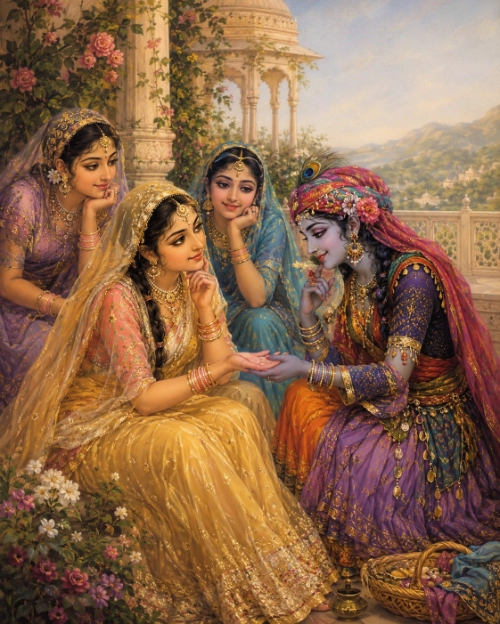
The Mystery of the Fortune-Teller in Varṣāṇā
Kṛṣṇa comes to Varṣāṇā dressed as a wandering fortune-teller, and Śrīmatī Rādhārāṇī, half-recognizing something in the stranger, puts five questions to her. The answers are the whole of the tradition in five lines — and they are also what gives Him away. Rāsa Līlā d.d. heard the story from Bhakti Vijñāna Gosvāmī in Varṣāṇā itself; he traced it to Jīva Gosvāmī.
Hare Kṛṣṇa, dear devotees. Please accept my obeisances. Today we continue our series of Kṛṣṇa-kathā talks for Puruṣottama-māsa, and first we will recite the auspicious prayers.
oṁ ajñāna-timirāndhasya
jñānāñjana-śalākayā
cakṣur unmīlitaṁ yena
tasmai śrī-gurave namaḥ
“I was born in the darkest ignorance, and my spiritual master opened my eyes with the torch of knowledge. I offer my respectful obeisances unto him.”
nama oṁ viṣṇu-pādāya
kṛṣṇa-preṣṭhāya bhū-tale
śrīmate bhaktivedānta-
svāmin iti nāmine
“I offer my respectful obeisances unto His Divine Grace A. C. Bhaktivedanta Swami, who is very dear to Lord Kṛṣṇa, having taken shelter at His lotus feet.”
This month, it is very important that we hear these stories and then retell them. In this way we gain the opportunity for smaraṇam, remembrance. So if you hear a story now, find a pair of ears and try to retell it to someone. You will see that your meditation on Kṛṣṇa and on the Lord’s pastimes will increase.
I heard this story from Śrīla Bhakti Vijñāna Gosvāmī Mahārāja when he was in Varṣāṇā with Parīkṣit. He said that the story comes from Jīva Gosvāmī.
Kṛṣṇa Dresses as a Fortune-Teller
And one day — as so many stories in Varṣāṇā seem to begin — Kṛṣṇa disguised Himself as a woman. In the Lord’s pastimes, Kṛṣṇa very often dresses as a woman. And when He does not dress Himself that way, the gopīs sometimes dress Him up themselves.
A deep tattva underlies Kṛṣṇa dressing as a woman, because in Varṣāṇā everything is permeated by the original feminine potency, Rādhā-śakti — the energy of love, kindness and warmth.
So Kṛṣṇa dressed as a woman. And not merely as an ordinary woman. He dressed as a fortune-teller. How does such a fortune-teller dress? Large earrings, bright and colorful garments, a wide skirt, a colorful shawl, large ornaments. So Kṛṣṇa put on a large, brightly patterned skirt and a colorful shawl and came to Varṣāṇā to tell fortunes.
Naturally, fortune-tellers are supposed to know how to predict the future. Jīva Gosvāmī describes that Kṛṣṇa arrived at exactly the moment when Śrīmatī Rādhārāṇī had gone out for a walk with Her friends. Kṛṣṇa saw Śrīmatī Rādhārāṇī approaching with the gopīs.
Rādhārāṇī suddenly noticed this strange fortune-teller and looked at her more carefully. Something about this woman seemed extremely familiar.
Seeing Śrīmatī Rādhārāṇī’s interest, the “fortune-teller” began boasting about everything she knew. She said she had studied astrology. She could read palms. She could see the future. She could lay out cards. She could even read coffee grounds. In other words, she described all her remarkable arts.
Then Śrīmatī Rādhārāṇī decided to ask her several questions. There were five questions. Try to remember the answers.
The Five Questions
The First Question
Śrīmatī Rādhārāṇī asked: “Living in what place does a person experience the greatest bliss?” This is a very good question, because all of us search throughout this world for some place where we will feel truly happy.
One might expect Kṛṣṇa, disguised as the fortune-teller, to answer: “Varṣāṇā. Varṣāṇā is the best place, where one experiences the greatest happiness.” But Kṛṣṇa did not say Varṣāṇā. He replied: “The place where Kṛṣṇa grazes His cows. There a person experiences the greatest bliss.” Śrīmatī Rādhārāṇī appreciated the answer.
The Second Question
Then She asked: “Dear fortune-teller, please tell Me: what is the very essence and purpose of life?” This is an important question. What is the meaning of life? Why do we live?
Kṛṣṇa answered: “The essence and purpose of life is to sing about the pastimes of Kṛṣṇa.” When a person sings about and listens to Kṛṣṇa’s līlās, understanding of the purpose of life naturally reveals itself from within the heart.
The Third Question
Śrīmatī Rādhārāṇī asked: “What brings a person the greatest good fortune?” We all want to be fortunate. We all want to receive good fortune. The fortune-teller replied: “The desire to attain Kṛṣṇa.”
If a person possesses the desire to come closer to Kṛṣṇa, to attain Him, then through that one desire all other desires gradually leave the heart. And all those other desires are connected with this material world and therefore become sources of suffering. So many misfortunes fall upon our heads because the heart contains so many different desires.
Therefore one should cultivate one powerful desire: “I want to become closer to Kṛṣṇa. I want to attain Kṛṣṇa.”
So Kṛṣṇa, as this fortune-teller, had clearly learned her art well. She knew all the right answers. The greatest good fortune is the desire to become closer to Kṛṣṇa.
The Fourth Question
Then Śrīmatī Rādhārāṇī asked: “What is the greatest wealth in this world?” The fortune-teller answered: “The beauty of Kṛṣṇa.”
The Fifth Question
Then Śrīmatī Rādhārāṇī asked: “What is the greatest achievement in this life? How can we measure whether a person has truly succeeded?” Without hesitation, the fortune-teller answered: “The criterion of success in human life is whether one has attained love for Kṛṣṇa.”
That is the greatest fortune. That is the greatest success. If a person possesses love for God, then nothing else is necessary.
The Answers
So these were the five questions Śrīmatī Rādhārāṇī asked. Do you remember the answers?
Rādhārāṇī Recognizes Him
Śrīmatī Rādhārāṇī listened to these answers and began thinking: “These answers somehow remind Me very strongly of someone…” She looked more carefully at the fortune-teller. She began noticing certain features belonging to the person She loved most dearly. And within this supposed fortune-teller, She recognized Kṛṣṇa. Now She understood exactly what kind of “fortune-teller” had come before Her.
Such playful līlās are common with Kṛṣṇa. He frequently disguises Himself, and we will hear other stories in which He dresses as different women. All of this intensifies the sweetness of the pastimes between Kṛṣṇa and Śrīmatī Rādhārāṇī.
And these pastimes are eternal. They are not merely events that happened once in the distant past. The līlā is taking place even now, within the Dhāma — in Varṣāṇā and Vṛndāvana.
When Will I Become Your Guest?
When we visit such places and enter the Dhāma, we may feel like outsiders intruding on a sacred atmosphere. But Prabodhānanda Sarasvatī says that even an outsider possesses one advantage. He expresses this in his prayers connected with Rādhā-rasa-sudhā-nidhi. He prays: “When will I become a guest in Your home?”
According to the laws of hospitality, especially within Vedic culture, a guest must be welcomed. A guest must be given a place to rest. A guest must be allowed to stay. Therefore Prabodhānanda Sarasvatī prays: “When will I become such a guest at the doorway of Your home, Śrīmatī Rādhārāṇī?”
This should also become our prayer: “When will I finally become Your guest? When will You accept me, Śrīmatī Rādhārāṇī? When will You accept me, Lord Kṛṣṇa?” Because a guest is meant to be welcomed. Therefore, when we enter the Dhāma, we should cultivate the mood of wanting to be accepted as a guest rather than remaining merely an outside observer.
The Blessing of the Vrajavāsīs
When Mahārāja spoke about their visit to Varṣāṇā, he said they met Vrajavāsīs who had lived there for a long time — Vinod Bihari Bābā, Ramesh Bābā and others. Mahārāja asked them to bless the entire group. Do you know what blessing they gave?
“May they attain Kṛṣṇa very soon.”
These are the kinds of blessings given by Vrajavāsīs who live there and perform very deep sādhana. Therefore, when we come to the Dhāma, we try to serve the Vrajavāsīs so that we may receive such blessings upon our heads: may we very soon attain Kṛṣṇa.
And so, when visiting sacred places, it is very important to understand the feelings experienced there by Lord Kṛṣṇa and Śrīmatī Rādhārāṇī. What līlā took place here? What was Their mood? And we must understand the siddhānta properly. These are not simply mundane romantic stories. They are not merely stories about a young man and a young woman. By hearing such narrations, we can awaken love for God. We can become closer to Kṛṣṇa. Hare Kṛṣṇa.