

The Flower Quarrel at Rādhā-kuṇḍa
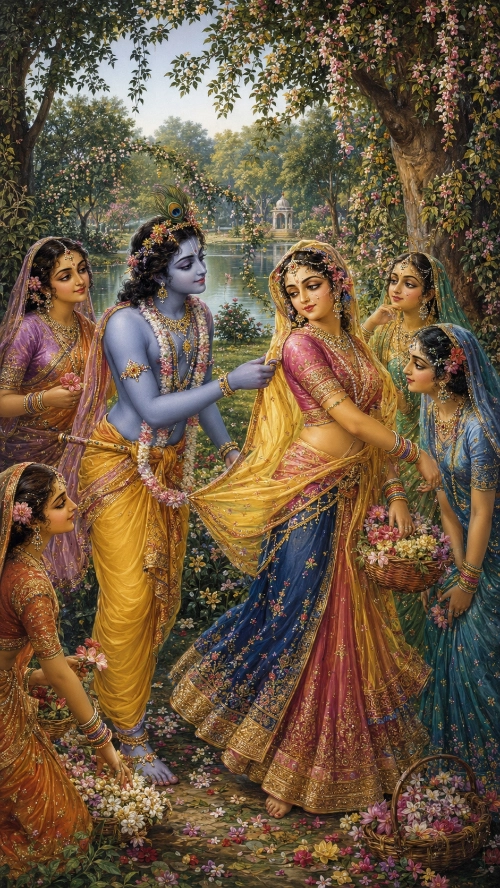
The Flower Quarrel at Rādhā-kuṇḍa: From Kṛṣṇadāsa Kavirāja Gosvāmī’s Govinda-līlāmṛta, Ninth Sarga
A quarrel about flowers that is not about flowers. Kṛṣṇa accosts Rādhā in the groves above Rādhā-kuṇḍa, claims to be the appointed guardian of Cupid’s forest, and charges Her with theft; Rādhā answers that the forest is Hers, that the flowers are for the Sun, and that He is the only thief present. Kṛṣṇadāsa Kavirāja builds the whole exchange out of puns, and lets it end where it was always going: each has stolen the other’s heart.
It was midday in Vraja. Śrī Rādhā had come with Her sakhīs to the beautiful groves surrounding Rādhā-kuṇḍa. The forest was laden with blossoms, and She began gathering flowers. Nearby stood a blossoming punnāga tree. As Rādhā raised Her graceful arm to reach its flowers, Kṛṣṇa watched Her.
Kṛṣṇadāsa Kavirāja describes the scene through an exquisite double meaning: the punnāga tree blossomed when touched by Rādhā, while Kṛṣṇa — the supreme puṁ-nāga, the greatest among men — also “blossomed” upon seeing Her raised arm.
Who Is Picking My Flowers?
Then Kṛṣṇa began a quarrel. “Who is this picking My flowers?” Rādhā answered as though He were a stranger. “Who are You?”
Kṛṣṇa declared that He was the protector of the flowers. The expression itself becomes a joke: puṣpapa may suggest one who protects flowers, while the same word can also evoke the bee who lives among them. Rādhā immediately turns His words against Him — if He is a bee, He should go find His bee-maiden rather than trouble Her.
Thus begins the playful dispute over who actually owns the forest.
The Forest of Smara
Kṛṣṇa insists that the forest belongs to Smara, Cupid, the emperor of love, and that Smara has personally appointed Him its guardian:
स्वामी वनस्य विदितः स्मरचक्रवर्ती
तेनार्पितं मयि मुदा विपिनावकत्वम् ।
svāmī vanasya viditaḥ smara-cakravartī
tenārpitaṁ mayi mudā vipināvakatvam
“The acknowledged lord of this forest is Emperor Smara, and he has joyfully entrusted its protection to Me.” — Govinda-līlāmṛta 9.26
Therefore, Kṛṣṇa argues, Rādhā is not merely picking flowers — She is stealing from the king’s domain.
Rādhā is unimpressed. She tells Him that She has gathered flowers from this forest every day and has never once seen such a supposed guardian. Nor has She heard anything about this mysterious emperor who has suddenly appointed Kṛṣṇa. Kṛṣṇa replies that precisely because His protection has always been so effective, no intruder has previously dared to enter. Only now has He finally caught the thief.
The Real Theft
But His accusation quickly changes meaning. The flowers are no longer the true object of the theft. Kṛṣṇa tells Rādhā that Her very body is a thief.
Everything beautiful in Vṛndāvana has been robbed of its treasure by Her beauty: the lotus has lost its splendor to Her feet, the deer to Her eyes, the elephant to Her gait, the creepers to Her arms, the moon to Her face, the flowers to Her lips, the bees to Her curling hair, and innumerable other creatures and objects have been impoverished because their finest qualities have all appeared in Her.
Rādhā listens to this elaborate accusation — which is actually Kṛṣṇa’s praise disguised as prosecution. Trying to conceal the emotions awakened within Her, She dismisses Him: “Who would keep the false words of such a passionate young man in her ears? I am leaving.” She casts a slightly contemptuous glance toward Her beloved and begins to walk away.
But Hari follows.
क्व चलसि ननु धूर्ते मामनादृत्य भङ्ग्या
हरिरिति स वदंस्तामंशुकान्ते दधार ॥
kva calasi nanu dhūrte mām anādṛtya bhaṅgyā
harir iti sa vadaṁs tām aṁśukānte dadhāra
“Where are you going, O clever girl, dismissing Me in this manner?” Saying this, Hari caught the end of Her garment. — Govinda-līlāmṛta 9.40
At His touch, many conflicting transformations of love arose in Rādhā. She turned Her neck sideways and looked toward Him. Her glance simultaneously expressed contempt, amusement, agitation, tears, anger and affection. Kṛṣṇadāsa Kavirāja presents these apparently contradictory emotions not as inconsistency, but as the extraordinary richness of Rādhā’s mahābhāva.
Rādhā’s Counter-Charge
Now Rādhā retaliated. Kṛṣṇa had accused Her of being a thief. She answered that He was the real thief. Whatever is sweet, beautiful, charming and delightful — whether belonging to this world or beyond it — Kṛṣṇa has stolen its beauty and gathered it into His own form. And yet, after committing this universal theft Himself, He walks around accusing others of stealing.
Then She mocks His claim of being a righteous guardian. She reminds Him of His reputation among the young women of Vraja and sarcastically praises Him as a great “brahmacārī.” She points out the absurdity of someone who has never planted even a single flowering creeper claiming to own the forest, while His cows regularly eat its vegetation.
The Forest on the Bank of Her Kuṇḍa
Finally Rādhā states Her own claim. The forest has been cultivated by Vṛndā, Her own sakhī. Vṛndāvana itself bears Vṛndā’s name. And this particular grove, Rādhā says, belongs especially to Her:
इदं त्वसाधारणमस्मदीयं
मत्कुण्डतीरोद्भवकेल्यरण्यम् ।
idaṁ tv asādhāraṇam asmadīyaṁ
mat-kuṇḍa-tīrodbhava-kely-araṇyam
“This extraordinary play-forest is Ours; it has arisen on the bank of My kuṇḍa.” — Govinda-līlāmṛta 9.53
This statement matters: in Govinda-līlāmṛta the flower quarrel is explicitly attached to Rādhā-kuṇḍa, not to some unnamed grove.
Flowers for the Sun
Rādhā then reveals why the sakhīs are gathering the flowers:
चिनुमः कुसुमं वयमिनसेवाविधये…
cinumaḥ kusumaṁ vayam ina-sevā-vidhaye…
“We are gathering flowers for the worship of the Sun.” — Govinda-līlāmṛta 9.55
Here ina means the Sun. The flowers are therefore being collected for Sūrya-pūjā. But Rādhā does not stop there. She orders Kṛṣṇa out of the flower garden:
बटो न ते कृत्यमिहास्ति पुष्पारामेऽबलास्वैरविहारधाम्नि ।
पशूनवन् त्वं पशुपालसङ्गी तच्चारणाय व्रज शाद्वलेषु ॥
baṭo na te kṛtyam ihāsti puṣpārāme ’balā-svaira-vihāra-dhāmni
paśūn avan tvaṁ paśupāla-saṅgī tac-cāraṇāya vraja śādvaleṣu
“O young cowherd, you have no business in this flower garden, the place where the girls freely enjoy themselves. You are a protector of cows and a companion of cowherds. Go to the grassy meadows of Vraja and tend your animals.” — Govinda-līlāmṛta 9.56
Kṛṣṇa does not leave. Instead, He drinks the nectar of Rādhā’s words. Kṛṣṇadāsa Kavirāja compares Kṛṣṇa to a cakora bird, drinking the stream of nectar flowing from the moon of Rādhā’s smiling face, while the sakhīs themselves feast upon the sight of Their exchange.
Rādhā again turns away, casting blue-lotus-like sidelong glances at Him. Kṛṣṇa follows and once more catches Her garment. Rādhā responds by bending Her brows like a bow and shooting the arrows of Her reddish sidelong glances. She even strikes Him repeatedly with the lotus in Her hand. Yet every apparent blow only increases Kṛṣṇa’s happiness.
What the Quarrel Was Really About
The quarrel has therefore revealed what it concealed from the beginning. There was never truly a dispute about flowers. Kṛṣṇa called Rādhā a thief because She had stolen His mind. Rādhā called Kṛṣṇa a thief because He had stolen the beauty of everything in existence — and Her heart with it. Kṛṣṇa claimed to guard Cupid’s kingdom, while Rādhā declared that the very forest in which He stood belonged to Her.
And the flowers ostensibly being gathered for Sūrya became the occasion for Rādhā and Kṛṣṇa to exchange the innumerable shades of māna, praṇaya, hāsya, pride, longing and prema that constitute Their midday līlā.
At last Lalitā enters between Them and restrains Kṛṣṇa. The playful dispute then passes into the more confidential kuñja pastimes that occupy the remainder of the chapter.
Thus the flower quarrel of Govinda-līlāmṛta is not a tale of Kṛṣṇa disguising Himself as a gardener. He does not require a disguise. He comes as Kṛṣṇa Himself, claims to be the guardian of Cupid’s forest, catches Rādhā stealing “His” flowers — and discovers that the supposed flower thief has already stolen something infinitely more valuable: His heart.