

Rādhā’s Afternoon Separation from Kṛṣṇa
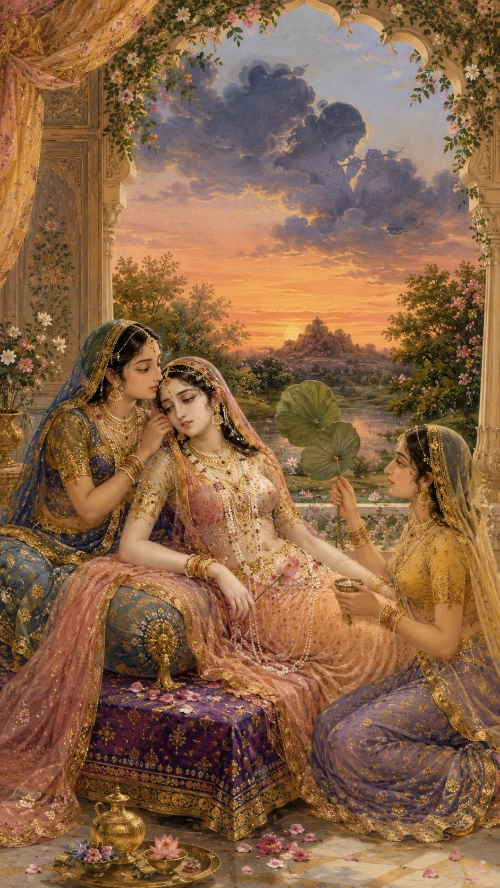
Śrī Rādhā’s Afternoon Separation from Kṛṣṇa: Aparāhna-līlā, Viraha and Divyonmāda
Kṛṣṇa comes back from the pastures at dusk, and for as long as He is in sight the fire in Vraja goes out. Then He turns toward Nandagrāma, and it relights. This is the aparāhna-līlā, the afternoon hour of the eightfold day, and it carries one of the most extreme states the tradition describes: divyonmāda, in which memory and present perception stop being distinguishable and Rādhā, waking on a flower bed, cannot tell whether it is morning or midnight, or whether She is asleep. An introduction to what the reader is looking at comes first; the meditation itself follows.
The text that follows is a Gauḍīya Vaiṣṇava meditation on Śrī Rādhā’s late-afternoon separation from Kṛṣṇa, traditionally situated within the aparāhna-līlā, the afternoon portion of the eternal eightfold daily cycle of Rādhā-Kṛṣṇa’s pastimes known as aṣṭa-kālīya-līlā.
It is not a single continuous passage from one scripture. Rather, it brings together several closely related classical sources that describe the same inner reality from different perspectives. The narrative setting is drawn especially from Viśvanātha Cakravartī Ṭhākura’s Kṛṣṇa-bhāvanāmṛta, where Rādhā returns from meeting Kṛṣṇa and becomes overwhelmed by separation when He goes back to Nandagrāma. Into this framework are woven verses from Kṛṣṇadāsa Kavirāja Gosvāmī’s Govinda-līlāmṛta, passages from the Caitanya-caritāmṛta, poetry from Jayadeva’s Gīta-govinda, and prayers of Rūpa Gosvāmī and Raghunātha dāsa Gosvāmī.
Viraha: Separation as a Form of Love
The central subject is viraha, separation from the beloved. In Gauḍīya theology, separation is not regarded as the opposite of love or as a diminution of it. At its highest intensity, separation becomes one of prema’s most concentrated manifestations. The beloved may be absent from sight, yet precisely because He is absent, the mind, senses, memory, imagination, speech and entire being become more completely absorbed in Him.
Divyonmāda: Divine Madness
Rādhā’s condition in this text reaches what the tradition calls divyonmāda, “divine madness.” This does not mean ordinary mental confusion. It refers to an extreme manifestation of mahābhāva, in which the force of prema becomes so overwhelming that distinctions between memory and immediate perception, past and present, waking and dream may temporarily dissolve.
Thus Rādhā remembers Kṛṣṇa touching Her on the road as though it were happening at that very moment; then She opens Her eyes and cannot determine where She is, what time of day it is, or whether She is asleep or awake.
Why Mahāprabhu Appears in This Text
This state is especially important in Gauḍīya theology because Śrī Caitanya Mahāprabhu is understood as Kṛṣṇa Himself experiencing the bhāva of Śrī Rādhā. For this reason, several of the most penetrating explanations of Rādhā’s separation appear in the Caitanya-caritāmṛta, where Mahāprabhu relishes verses originally spoken by Rādhā and expands their meaning in Bengali. The text therefore moves between Rādhā’s experience in Vraja and Mahāprabhu’s later revelation of that same experience.
The Fivefold Attraction
One of the most important themes is the fivefold attraction of Kṛṣṇa. His form attracts the eyes; His voice and flute attract the ears; His touch attracts the skin; His fragrance attracts the nose; and the sweetness of His lips attracts the tongue. Rādhā describes Her one mind as a single horse being pulled simultaneously in five directions by these five senses.
The metaphor expresses the totality of Kṛṣṇa’s attraction: He is not merely beautiful to look at — He completely possesses every faculty of perception.
The Language of Rasa
The same experience is then expressed through a series of extraordinary poetic images. Kṛṣṇa is a dark monsoon cloud, and Rādhā’s eyes are cātaka birds that can survive only on the rain from that cloud. His yellow garment becomes lightning, His pearl necklace a flight of white birds, His peacock feather and garland rainbows, and His flute the rumbling of thunder that makes Vṛndāvana’s peacocks dance. Elsewhere He becomes a hunter, while the gopīs are doe-like creatures caught by the snare of His beautiful face, the bait of His smile, and the poisoned arrows of His glances.
These images should not be read merely as decorative poetry. They are the language of rasa — a way of expressing spiritual emotion through nature, color, fragrance, sound, touch and movement. The external world itself becomes a vocabulary for Rādhā’s inner experience.
Separation Intensifies Service
At the same time, the text never loses the dimension of sevā, loving service. While Rādhā suffers in separation, Her companions cool Her body, speak Kṛṣṇa’s name into Her ear, carry sweets to His home, arrange messages and prepare for the next meeting. In Gauḍīya devotional literature, separation does not lead to passivity. It intensifies service.
The Movement of the Text
The movement of the text is therefore from darśana to separation, from separation to divyonmāda, from divyonmāda to remembrance, and from remembrance toward renewed hope of meeting. The final mood begins to shift from helpless viraha toward utkaṇṭhā, intense expectation, and then toward abhisāra, the journey to meet the beloved.
Read in this way, the text is not simply a description of emotional suffering. It is an exploration of the Gauḍīya understanding of the highest love: a love in which Kṛṣṇa becomes the very life of the senses, His absence fills consciousness even more completely than ordinary presence, and every experience — sight, sound, fragrance, touch, memory, pain, longing and service — becomes directed toward Him.
The essential movement can be expressed simply:
Śrī Rādhā’s Afternoon Separation from Kṛṣṇa
Aparāhna-līlā, viraha and divyonmāda. oṁ namo bhagavate vāsudevāya.
As the afternoon draws toward evening, Śrī Kṛṣṇa returns from the pasturing grounds surrounded by the cows and His cowherd companions. When the Moon of Gokula becomes visible again, the burning anxiety of the residents of Vraja is cooled. Their eyes blossom at His sight, their faces become radiant, and lives that had been scorched by separation revive.
Kṛṣṇadāsa Kavirāja describes this return in Govinda-līlāmṛta as the rising of both a wondrous sun and an eternally full moon: Kṛṣṇa’s appearance makes the lotus-like eyes and faces of the Vrajavāsīs blossom, while the darkness of separation retreats.
But such relief lasts only while He remains visible. Kṛṣṇa must eventually enter Nandagrāma and return to Nanda Mahārāja and Yaśodā. As Mukunda disappears from sight, the fire of separation immediately awakens again within Śrī Rādhā and Her companions. This is the late-afternoon aparāhna-līlā, and the movement from meeting to separation becomes the setting for one of the most extraordinary manifestations of Śrī Rādhā’s prema.
The Fire Enters the City of Her Heart
Viśvanātha Cakravartī Ṭhākura opens this portion of Kṛṣṇa-bhāvanāmṛta by describing how, although Rādhā’s love itself is perfectly steadfast, the departure of Her beloved takes away all steadiness from Her.
atha premṇaḥ sthemany api samajani sthairya-rahitā
priyā preyasy akṣṇor amala-kamala-dvandva-mahasaḥ
taṭāt svasyāvāsāt pravasati vidūre davathavo
balād ākramyāsyā hṛdaya-nagarīṁ bhettum aviśan
Although Her prema was perfectly steadfast, when Her beloved departed, the radiance of Rādhā’s spotless lotus eyes lost all steadiness. As He went far away toward His own dwelling, the fires of separation forcibly entered the city of Her heart.
The words of the sakhīs cannot extinguish that fire. A moment of separation expands into an immeasurable period of suffering. Her companions become absorbed in caring for Her. They repeatedly apply cooling sandalwood preparations to Her body and arrange moist lotus stems and leaves beneath Her, hoping somehow to reduce the fever of separation.
tad-ālīnāṁ pālyā samucita-saparyākula-dhiyāṁ
dravaiḥ paunaḥ-puṇyān malayaja-bhavair lipta-vapuṣaḥ
stṛtāyāś cābhīkṣṇaṁ visa-kisalayaiḥ saindhava-rasaiḥ
samīpe ’syāḥ prāyāt praṇaya-vikalā candanakalā
Her companions, anxious to render appropriate service, repeatedly anointed Her body with liquid sandalwood preparations and continually arranged cooling lotus-stem leaves beneath Her. — Kṛṣṇa-bhāvanāmṛta 16.3
The Only Medicine Is His Name
In the devotional meditation surrounding this scene, Tulasī Mañjarī remains close to Svāminī. The sandalwood dries almost as soon as it touches Rādhā’s fevered limbs, and fresh cooling preparations must again be applied. But there is another medicine: the name of Kṛṣṇa. Śrī Rūpa Gosvāmī describes the astonishing effect of the Divine Couple’s names upon one another:
kvāpy ānusaṅgikatayodita-rādhikākhya-
vismāritākhila-vilāsa-kalā-kalāpam
kṛṣṇeti-varṇa-yugala-śravaṇānubandha-
prādurbhavaj-jaḍima-ḍambara-saṁvitāṅgam
Somewhere, merely hearing the name “Rādhikā” causes Kṛṣṇa to forget the whole array of His playful arts; and merely hearing the two syllables Kṛṣ-ṇa causes Rādhā’s body to become overwhelmed by an extraordinary manifestation of ecstatic stillness. — Utkalikā-vallarī 14
Thus the meditation imagines Tulasī leaning close to Śrī Rādhā and softly repeating into Her ear: “Kṛṣṇa… Kṛṣṇa… Kṛṣṇa…”
Divyonmāda
Gradually Rādhā returns to a trace of external awareness. But what awakens is not ordinary consciousness. Separation has reached such intensity that memory, direct perception, dream, past and present begin to flow into one another. This state is known in Gauḍīya theology as divyonmāda — divine or transcendental madness arising from the extreme intensification of mahābhāva. Suddenly Rādhā cries out:
balāt pāṇiṁ nīvyām ahaha mama dhitsaty ayam ayaṁ
viśākhe tvaṁ vīthyāṁ kalayasi kim etat kutukinī
yad uccaiḥ krośantīm api na hi jahāty eṣa bata māṁ
satīnāṁ mūrdhanyāṁ tad iha kathayāryāṁ drutam itaḥ
“Viśākhe! This boy is forcibly trying to put His hand into the knot of My lower garment! Why are you merely standing there watching such a thing on the public road? Alas, even though I cry loudly, He refuses to release Me. Quickly go and tell that venerable lady who is the crown of chaste women!” — Kṛṣṇa-bhāvanāmṛta 16.36
The episode She remembers has passed, but to Her it has become present again. Then Her eyes open slightly.
pralapyaivaṁ rādhā dara-vikasitākṣī samudita-
klamā prāsvinnāṅgī vitata-davathur vepathumatī
tanūṁ vīkṣya svīyāṁ kusuma-śayana-nyasta-suṣamāṁ
vilakṣālīr āha smara-paribhavād gadgada-girā
Speaking deliriously in this way, Rādhā half opened Her eyes. Exhaustion arose; Her limbs were covered with perspiration; intense heat and trembling spread throughout Her body. Seeing Herself lying beautifully upon a flower bed, She addressed Her astonished companions in a voice broken by the overwhelming force of love. — Kṛṣṇa-bhāvanāmṛta 16.37
She looks around Her as though waking in an unknown world.
kva me preyān vīthyāṁ cakara kim ahaṁ niṣkuṭa-bhavaṁ
kim etad veśmāho sakhi guru-purasthaṁ bhavati kim
iyaṁ sandhyā prātaḥ kim ajani kim aho svid abhavan
niśīthaḥ kiṁ nidrāmy ahaha kimu jāgarmi vada tat
“Where is My beloved? What happened to Me on the road? How did I come into this garden? What house is this? My friend, am I in the dwelling of My elders? Is this evening? Is it morning? Has midnight come? Am I sleeping? Alas, am I awake? Tell Me!” — Kṛṣṇa-bhāvanāmṛta 16.38
Viśākhā gently tries to bring Her back into the present:
tvam ārāmād dhāmāmbuja-mukhi samāyāḥ priyatamo
rahaḥ-kuñje sa tvām aramayad athāgāt sva-bhavanam
cirāt khedaṁ pitror bhṛśam upaśamayyaiṣyati punar
vidhuḥ sa tvannetro-tpala-yuga-vikāśārtham adhunā
“O lotus-faced one, You have returned home from the garden. Your beloved delighted You in a secluded kuñja and then went to His own residence. After relieving the deep distress of His parents, that moon will return again to make the two blue lotuses of Your eyes blossom.” — Kṛṣṇa-bhāvanāmṛta 16.39
But reasoning cannot easily reach the place where Rādhā now resides. The pain of prema itself becomes an object of bewilderment. A verse spoken by Rādhā in Rāmānanda Rāya’s Jagannātha-vallabha-nāṭaka, later repeatedly relished by Śrī Caitanya Mahāprabhu, perfectly expresses this condition:
prema-ccheda-rujo ’vagacchati harir nāyaṁ na ca prema vā
sthānāsthānam avaiti nāpi madano jānāti no durbalāḥ
anyo veda na cānya-duḥkham akhilaṁ no jīvanaṁ vāśravaṁ
dvi-trāṇy eva dināni yauvanam idaṁ hā-hā vidhe kā gatiḥ
“Hari does not understand the pain caused by the breaking of love, nor does love itself know the proper or improper place to strike. Madana does not understand how weak We are. No one can fully know another’s suffering. Our life itself is unstable, and youth lasts only two or three days. Alas, O Creator — what will become of Us?” — Jagannātha-vallabha-nāṭaka 3.9, quoted in Caitanya-caritāmṛta, Madhya 2.18
Five Senses, One Horse
Rādhā’s consciousness is consumed by Kṛṣṇa, and now the deeper nature of Her suffering begins to reveal itself. Kṛṣṇa does not attract only Her eyes. He simultaneously attacks all five senses. The Sanskrit root of this meditation is a verse of Kṛṣṇadāsa Kavirāja’s Govinda-līlāmṛta:
saundaryāmṛta-sindhu-bhaṅga-lalanā-cittādri-samplāvakaḥ
karṇānandi-sanarma-ramya-vacanaḥ koṭīndu-śītāṅgakaḥ
saurabhyāmṛta-samplavāvṛta-jagat pīyūṣa-ramyādharaḥ
śrī-gopendra-sutaḥ sa karṣati balāt pañcendriyāṇy āli me
“O friend! The son of the king of the cowherds forcibly attracts My five senses. The waves of the nectarean ocean of His beauty inundate the mountain-like hearts of women; His charming and playful words delight the ears; His body is cooler than millions of moons; the nectar of His fragrance inundates the world; and His beautiful lips are filled with ambrosia.” — Govinda-līlāmṛta 8.3
Śrī Caitanya Mahāprabhu, immersed in the very bhāva of Śrī Rādhā, later expands this verse in Bengali:
kṛṣṇa-rūpa-śabda-sparśa, saurabhya-adhara-rasa,
yāra mādhurya kahana nā yāya
dekhi’ lobhe pañca-jana, eka aśva — mora mana,
caḍi’ pañca pāṅca-dike dhāya
“Kṛṣṇa’s form, sound, touch, fragrance and the taste of His lips possess a sweetness that cannot be described. Seeing them, My five senses become greedy. They all mount the one horse of My mind and try to race in five different directions.” — Caitanya-caritāmṛta, Antya 15.15
sakhi he, śuna mora duḥkhera kāraṇa
mora pañcendriya-gaṇa, mahā-lampaṭa dasyu-gaṇa,
sabe kahe — hara’ para-dhana
“O sakhī, hear the cause of My suffering. My five senses are like reckless plunderers; each of them wants to steal another’s treasure.” — Caitanya-caritāmṛta, Antya 15.16
There is only one mind. But five senses pull it simultaneously.
eka aśva eka-kṣaṇe, pāṅca pāṅca dike ṭāne,
eka mana kon dike yāya?
eka-kāle sabe ṭāne, gela ghoḍāra parāṇe,
ei duḥkha sahana nā yāya
“There is only one horse, yet in a single moment five riders pull it in five directions. Which direction can one mind go? When all five pull simultaneously, the life of the horse is lost. This suffering cannot be endured.” — Caitanya-caritāmṛta, Antya 15.17
And Rādhā cannot even blame the senses:
indriye nā kari roṣa, iṅhā-sabāra kāhāṅ doṣa,
kṛṣṇa-rūpādira mahā ākarṣaṇa
rūpādi pāṅca pāṅce ṭāne, gela ghoḍāra parāṇe,
mora dehe nā rahe jīvana
“I cannot be angry with My senses. What fault is theirs? Kṛṣṇa’s form and His other qualities possess overwhelming attraction. The five objects pull the five senses; the life of the horse is being lost, and life no longer remains within My body.” — Caitanya-caritāmṛta, Antya 15.18
Then She describes the first of those five irresistible powers: Kṛṣṇa’s beauty.
kṛṣṇa-rūpāmṛta-sindhu, tāhāra taraṅga-bindu,
eka-bindu jagat ḍubāya
trijagate yata nārī, tāra citta-ucca-giri,
tāhā ḍubāi āge uṭhi’ dhāya
“Kṛṣṇa’s beauty is an ocean of nectar. One single drop from one of its waves can inundate the entire universe. The consciousness of all the women of the three worlds may stand like lofty mountains, but that drop rises above them and submerges them all.” — Caitanya-caritāmṛta, Antya 15.19
His speech is no less powerful.
kṛṣṇera vacana-mādhurī, nānā-rasa-narma-dhārī,
tāra anyāya kathana nā yāya
jagatera nārīra kāṇe, mādhurī-guṇe bāndhi’ ṭāne,
ṭānāṭāni kāṇera prāṇa yāya
“Kṛṣṇa’s speech possesses an indescribable sweetness and carries innumerable currents of rasa and playful wit. Entering the ears of the women of the world, that sweetness binds and pulls them until the very life of hearing seems to be torn away.” — Caitanya-caritāmṛta, Antya 15.20
His touch is cooler than sandalwood and millions of moons. His bodily fragrance surpasses musk and the blue lotus and enters the nostrils like a conqueror occupying a fortress. His lips are themselves nectar, and when the sweetness of those lips combines with the camphor of His gentle smile, every other attachment disappears. This is the only wealth desired by the cowherd girls of Vṛndāvana.
The Cloud and the Cātaka
And therefore Rādhā cries: “My dear friend, what shall I do? Where shall I go? Where can I find Kṛṣṇa? How can I obtain Him? I saw Him only a moment ago, but now He has disappeared. His beauty has stolen My eyes and My heart.” Again a Sanskrit verse arises from the heart of Govinda-līlāmṛta:
navāmbuda-lasad-dyutir nava-taḍin-manojñāmbaraḥ
sucitra-muralī-sphurac-charad-amanda-candrānanaḥ
mayūra-dala-bhūṣitaḥ subhaga-tāra-hāra-prabhaḥ
sa me madana-mohanaḥ sakhi tanoti netra-spṛhām
“O sakhī! His brilliant complexion resembles a newly formed raincloud. His beautiful garment shines like fresh lightning. His wonderful flute rests beside a face resembling the radiant autumn moon. A peacock feather adorns Him, and His beautiful pearl necklace shines upon His chest. That Madana-mohana only increases the thirst of My eyes.” — Govinda-līlāmṛta 8.4
Kṛṣṇa is the monsoon cloud. Rādhā’s eyes are the cātaka birds. The cātaka is poetically imagined as refusing all ordinary water and waiting only for rain falling directly from the cloud. “My eyes are like two cātakas dying of thirst. What will become of them if the Kṛṣṇa-cloud does not appear?”
His yellow garment is lightning flashing across the cloud of His dark body. His pearl necklace resembles a flight of white birds beneath the storm cloud. The peacock feather and Vaijayantī garland resemble rainbows. The sound of His flute is the rumbling of thunder, and when the peacocks of Vṛndāvana hear that thunder, they begin to dance. The cloud of Kṛṣṇa’s līlā showers nectar throughout the world.
“But just when that cloud appeared before Me, the whirlwind of My misfortune carried it away. Having lost sight of that cloud, the cātaka bird of My eye is now almost dead from thirst.”
The Hunter and the Doe
Kṛṣṇa’s beauty then takes on another form in Rādhā’s divyonmāda. He becomes a hunter, and the gopīs become deer. His beautiful face is the hunter’s snare. His smile is the bait. His makara-shaped earrings dance beside His cheeks and bewilder the mind. His playful glances become arrows whose tips have been dipped in sweet poison. His broad chest, marked with Śrīvatsa, behaves like the chest of a magnificent robber who has come to plunder the hearts of Vraja. His two long arms are like powerful bolts — and also like dark serpents striking directly at the heart.
And yet the same Kṛṣṇa who causes the fever of love is its only medicine. Camphor cannot cool like Him. Sandalwood cannot cool like Him. Khus root cannot cool like Him. Even millions of moons cannot equal the cooling touch of His palms and lotus feet. His chest resembles a great doorway of blue sapphire, and His arms are its powerful bolts. This Madana-mohana awakens unbearable longing — and He alone can bring relief.
“I had Kṛṣṇa. He was with Me. And now I have lost Him again. He is restless by nature. He appears, captures the heart, and disappears.”
The Rāsa Remembered
At this point another ancient voice enters the meditation: Jayadeva Gosvāmī’s Gīta-govinda. Rādhā remembers Kṛṣṇa in the rāsa arena:
sañcarad-adhara-sudhā-madhura-dhvani-mukharita-mohana-vaṁśam
valita-dṛg-añcala-cañcala-mauli-kapola-vilola-vataṁsam
rāse harim iha vihita-vilāsaṁ
smarati mano mama kṛta-parihāsam
“My mind remembers Hari here in the rāsa dance — His enchanting flute resounding with the sweet nectar flowing from His lips, His restless sidelong glances making His jeweled headdress tremble and His earrings dance upon His cheeks. My mind remembers Hari, who enjoyed His pastimes here and playfully joked with Me.” — Gīta-govinda, sarga 2, song 5
Much later, Svarūpa Dāmodara would sing these very words before Śrī Caitanya Mahāprabhu. Hearing Rādhā’s song while absorbed completely in Her bhāva, Mahāprabhu would display extraordinary transformations of prema. Different ecstatic emotions arose simultaneously, met one another, mingled and seemed almost to struggle for dominance.
Thus Rādhā’s viraha becomes revealed again in Caitanya-līlā. The same inner reality flows through both: Rādhā experiences it in Vraja, the Gosvāmīs give it poetic form, and Mahāprabhu relishes and reveals its depth.
Service Continues
But in Vraja the afternoon continues. Even while Rādhā burns in separation, the sakhīs continue serving. Viśākhā knows that Kṛṣṇa has returned to His parents and that Yaśodā’s maternal affection is immeasurable. Therefore she sends Tulasī Mañjarī with nectar-like sweets intended for Kṛṣṇa:
jananyā vātsalyaṁ tanumad iva pitroḥ kim asavo
vahiṣṭhāḥ śrī-kṛṣṇaḥ sva-sadanam iyāyeti viduṣī
viśākhā prāhaiṣīt sapadi tulasī-mañjarim atha
vrajeśvaryai dātuṁ tad-abhimata-pīyūṣa-baṭikāḥ
“Parental affection is almost embodied, and the child is indeed the very life of the parents. Knowing that Śrī Kṛṣṇa had returned to His own home, Viśākhā immediately sent Tulasī Mañjarī to Vrajeśvarī with the nectar-like sweets desired for Him.” — Kṛṣṇa-bhāvanāmṛta 16.35
Thus even in separation, service becomes a hidden meeting. Something prepared with Rādhā’s love enters Kṛṣṇa’s home. The mañjarī carries the heart of Svāminī where Her body cannot yet go.
Toward Govardhana
And the promise of reunion begins to awaken. The meditation turns toward Govardhana — toward hidden groves, secluded caves and the future meeting arranged by Vṛndā-devī. Raghunātha dāsa Gosvāmī sings of Rādhā:
govardhana-guhā-lakṣmī
govardhana-vihāriṇī
dhṛta-govardhana-premā
dhṛta-govardhana-priyā
“She is the goddess of fortune of the caves of Govardhana. She delights in pastimes upon Govardhana. She loves the Holder of Govardhana. She is the beloved of Him who held Govardhana.” — Śrī Śrī Viśākhānandada-stotram 28
The name of Govardhana carries with it the promise of Giridhārī. The eyes that had scarcely opened begin to blossom. Viraha does not disappear, but its direction changes. The cry “Where is Kṛṣṇa?” becomes the trembling hope “I will see Kṛṣṇa again.”
And immediately the movement of service begins. Messages must be carried. Sweets must be offered. The meeting place must be prepared. The sakhīs must arrange everything. The mañjarīs must be ready. Separation ripens into utkaṇṭhā, intense longing, and utkaṇṭhā begins to move toward abhisāra, the journey to meet the beloved.
And beneath every transformation — vision and bewilderment, unbearable longing, the five senses racing toward Kṛṣṇa, the raincloud and the cātaka bird, the hunter and the doe, the tears of separation and the hope of reunion — one truth remains constant. For Śrī Rādhā, Kṛṣṇa alone is the life of every sense.
And when He disappears, those five senses do not simply miss an object of pleasure. They lose the very object for which they exist. That is why separation becomes unbearable. And that is why, within Gauḍīya theology, viraha is not the absence of love but one of its most concentrated revelations.
Even when Kṛṣṇa cannot be seen, every thought runs toward Him. Every sense searches for Him. Every memory becomes Him. Every metaphor points toward Him. And every act of service prepares the way to Him again. Śrī Rādhā-Govinda ki jaya!