

Vidagdha-mādhava
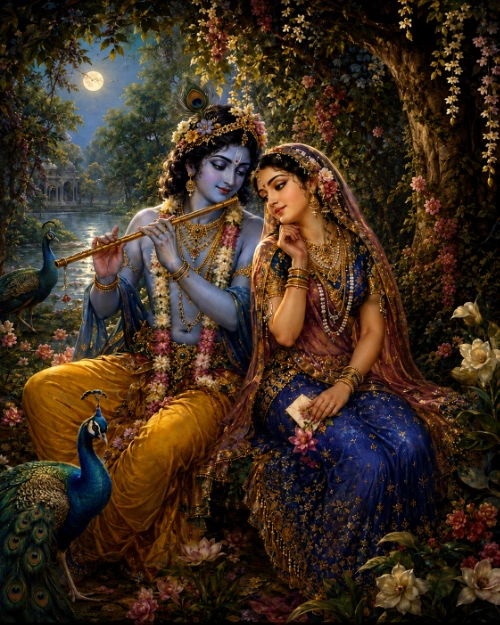
Vidagdha-mādhava: Rūpa Gosvāmī’s Sanskrit Drama of Rādhā-Kṛṣṇa Prema in Vṛndāvana
Vidagdha-mādhava is one of the great Sanskrit dramas of Śrī Rūpa Gosvāmī, composed in the sixteenth century and devoted entirely to the youthful love pastimes of Śrī Rādhā and Kṛṣṇa in Vṛndāvana. Its seven acts belong to the sophisticated world of classical Sanskrit dramaturgy, yet its purpose is distinctly Gauḍīya Vaiṣṇava: Rūpa does not use drama merely to tell an attractive romantic story, but to reveal the inner structure of prema-rasa — divine love as experienced through attraction, longing, jealousy, loving opposition, separation, reconciliation, humour, mediation by the sakhīs, and intimate union.
The work therefore stands at an important intersection: classical Sanskrit kāvya and dramaturgy; the emotional world of the Bhāgavata Purāṇa and Jayadeva; Śrī Caitanya Mahāprabhu’s theology of Rādhā-Kṛṣṇa prema; and Rūpa Gosvāmī’s own systematic theory of bhakti-rasa. The result is much more than a play about Kṛṣṇa. It is Gauḍīya rasa theology transformed into Sanskrit theatre.
What Does the Title Mean?
Mādhava is a celebrated name of Kṛṣṇa. The more difficult word is vidagdha, which can mean clever, refined, cultivated, witty, artful, ingenious, aesthetically sophisticated — and especially skilled in the arts of love. Translating it simply as “clever” loses most of its force. Rūpa Gosvāmī gives his own definition in the Bhakti-rasāmṛta-sindhu:
कलाविलासदिग्धात्मा विदग्ध इति कीर्त्यते ।
kalā-vilāsa-digdhātmā
vidagdha iti kīrtyate |
“One whose very being is imbued with artistic play is called vidagdha.” — Bhakti-rasāmṛta-sindhu 2.1.84
This is almost a definition of the Kṛṣṇa portrayed in the drama — a master of music, dance, flute-playing, poetry, wordplay, joking, disguise, romantic strategy and aesthetic improvisation. The title may therefore be rendered “The Artful Mādhava,” or “Mādhava, the Master of Refined Amorous Arts.” It does not merely call Kṛṣṇa intelligent; it presents him as the supreme rasika, exquisitely skilled in the delicate arts through which love is expressed, concealed, challenged and intensified.
A Drama Entirely of Vṛndāvana
One of the most important characteristics of Vidagdha-mādhava is that its dramatic world remains Vraja throughout. The forests, Yamunā banks, kuñjas, flower groves, village paths and secret meeting places of Vṛndāvana form the environment of the entire play. This distinguishes it fundamentally from Rūpa’s other great drama:
The distinction is not merely geographical. It is theological.
Why Rūpa Wrote Two Separate Dramas
According to the Caitanya-caritāmṛta, Rūpa originally intended a single drama combining Kṛṣṇa’s Vraja pastimes with his later city pastimes. Svarūpa Dāmodara explains:
স্বরূপ কহে,—“কৃষ্ণলীলার নাটক করিতে ।
ব্রজলীলা-পুরলীলা একত্র বর্ণিতে ॥”
svarūpa kahe—“kṛṣṇa-līlāra nāṭaka karite
vraja-līlā-pura-līlā ekatra varṇite”
“He intended to compose a drama of Kṛṣṇa-līlā, describing Vraja-līlā and the city pastimes together.” — Caitanya-caritāmṛta, Antya 1.124
During his journey, however, Rūpa stayed at a place remembered as Satyabhāmā-pura, where he dreamed of a beautiful divine woman who instructed him to compose a separate drama about her. He understood the figure to be Satyabhāmā, and this contributed to his decision to divide the material: Vraja-līlā into Vidagdha-mādhava, and pura-līlā into Lalita-mādhava.
Kṛṣṇa Never Leaves Vṛndāvana
The deeper theological principle behind the separation appears in a verse quoted in the Caitanya-caritāmṛta:
कृष्णोऽन्यो यदुसम्भूतो यः पूर्णः सोऽस्त्यतः परः ।
वृन्दावनं परित्यज्य स क्वचिन्नैव गच्छति ॥
kṛṣṇo ‘nyo yadu-sambhūto
yaḥ pūrṇaḥ so ‘sty ataḥ paraḥ |
vṛndāvanaṁ parityajya
sa kvacin naiva gacchati ||
“The Kṛṣṇa who appears in the Yadu dynasty is one manifestation, but beyond him is the complete Kṛṣṇa, who never leaves Vṛndāvana.” — quoted in Caitanya-caritāmṛta from the Laghu-bhāgavatāmṛta
This should not be misunderstood as denying the Bhāgavata Purāṇa’s narrative that Kṛṣṇa visibly travels from Vraja to Mathurā. The Gauḍīya point is ontological: Vrajendra-nandana Kṛṣṇa — Kṛṣṇa in his complete intimate identity as the son of Nanda and beloved of the Vrajavāsīs — eternally remains in Vṛndāvana, while his royal manifestations in Mathurā and Dvārakā belong to another dimension of the same Supreme Reality. Vidagdha-mādhava deliberately preserves Kṛṣṇa as Vraja-Kṛṣṇa.
The Seven Acts
The act titles are best preserved in Sanskrit; the simplified English labels often given for them lose real content.
वेणुनादविलास ।
मन्मथलेख ।
राधासङ्ग ।
वेणुहरण ।
राधाप्रसादन ।
शरद्विहार ।
गौरीतीर्थविहार ॥
veṇu-nāda-vilāsa |
manmatha-lekha |
rādhā-saṅga |
veṇu-haraṇa |
rādhā-prasādana |
śarad-vihāra |
gaurī-tīrtha-vihāra ||
The seven acts of the drama, in order.
Rādhā Is the Emotional Centre
Although the title names Mādhava, the play’s emotional centre is repeatedly Śrī Rādhā. Her love manifests through attraction, modesty, anxiety, longing, jealousy, māna, resistance, hope, fear, reconciliation and ecstatic fulfilment. It is therefore not enough to say the play is about Kṛṣṇa’s romantic adventures. It is equally — and arguably more deeply — an exploration of what Kṛṣṇa becomes when confronted with the intensity of Rādhā’s prema.
Rādhā and Candrāvalī
Candrāvalī plays an important dramatic role, and she should not be treated as a villain or merely as Rādhā’s rival. Within Gauḍīya rasa theology the two represent different styles of divine love:
The contrast itself produces rasa. It shows that divine love has different emotional grammars.
Candrāvalī Rebukes the Flute
A delightful example occurs in the fourth act, where Candrāvalī addresses Kṛṣṇa’s flute directly:
सखि मुरलि विशालच्छिद्रजालेन पूर्णा
लघुरतिकठिना त्वं ग्रन्थिला नीरसासि ।
sakhi murali viśāla-cchidra-jālena pūrṇā
laghur ati-kaṭhinā tvaṁ granthilā nīrasāsi |
“O friend, flute! You are full of great holes; you are light, exceedingly hard, full of knots and devoid of juice…” — Vidagdha-mādhava 4.7
The joke works on several levels at once, because each word of abuse carries a second sense:
Yet this apparently defective piece of bamboo receives extraordinary intimacy from Kṛṣṇa — his lips, his hands, his breath — and the gopīs become jealous of it. The comedy itself becomes theology: even a hollow piece of bamboo becomes supremely fortunate when it is completely available to Kṛṣṇa.
The Flute Is Almost a Character
Throughout the drama the flute behaves almost as an independent participant. It calls Rādhā, reveals Kṛṣṇa’s presence, crosses household boundaries, awakens desire, causes jealousy, is stolen, is accused, and repeatedly changes the course of the līlā. This matters because Rādhā’s social guardians can restrict her physical movement — but they cannot prevent Kṛṣṇa’s flute from entering her ears. The flute becomes a sonic messenger of Kṛṣṇa.
Prema Does Not Behave Like Ordinary Affection
One of the most profound theological statements in the play occurs in the fifth act, where Paurṇamāsī speaks about the strange nature of spontaneous love:
स्तोत्रं यत्र तटस्थतां प्रकटयच्चित्तस्य धत्ते व्यथां
निन्दापि प्रमदं प्रयच्छति परीहासश्रियं बिभ्रती ।
stotraṁ yatra taṭa-sthatāṁ prakaṭayac cittasya dhatte vyathāṁ
nindāpi pramadaṁ prayacchati parīhāsa-śriyaṁ bibhratī |
“Where praise, revealing a certain detachment, brings pain to the heart, and even reproach, bearing the beauty of playful teasing, gives delight…” The reason given is svārasikasya premṇaḥ — the intrinsic nature of spontaneous prema. — Vidagdha-mādhava 5.4
Ordinary attachment says: I love someone because they possess desirable qualities. This higher prema operates differently. It does not arise because of praise, it is not destroyed by criticism, and it possesses its own intrinsic momentum. That is one of Rūpa’s deepest theological insights.
Māna — Loving Anger
The fifth act is especially important for understanding māna, which is often translated simply as anger, jealousy or sulking. In Rādhā-Kṛṣṇa rasa it is subtler than any of these: māna is loving offended pride. Rādhā may refuse Kṛṣṇa not because love has disappeared, but because love has become so intense that even a slight disturbance in exclusivity becomes unbearable. Distance can thus become a form of intimacy. Kṛṣṇa must then plead, joke, explain, submit, or seek the help of the sakhīs — and the effort to overcome māna creates new rasa.
Paurṇamāsī, the Hidden Intelligence of the Drama
Paurṇamāsī is far more than an elderly supporting character; she functions almost as the dramatic intelligence of the līlā. She sees what Rādhā does not yet know, what Kṛṣṇa cannot openly arrange, and what the audience needs to understand, and she helps coordinate meetings, timing, circumstances and emotional transitions. In this sense she operates as a divine dramaturge within the drama itself.
Lalitā and Viśākhā
The sakhīs are indispensable.
Together they demonstrate a central principle of Gauḍīya devotion: Rādhā-Kṛṣṇa prema becomes an object of sevā. The devotee does not merely observe their love; the highest ideal becomes to serve and increase their happiness.
Madhumaṅgala and Hāsya-rasa
Madhumaṅgala contributes another emotional flavour, hāsya-rasa, the comic mood. His joking, appetite, cleverness and friendship with Kṛṣṇa break tension and help resolve difficult situations — and his comedy is not extraneous. Rūpa carefully weaves subsidiary rasas around the central mādhurya-rasa, so that the drama is never emotionally one-dimensional: it holds romance, humour, friendship, anxiety, jealousy, wonder and tenderness together.
Vṛndāvana Becomes the Stage
Rūpa repeatedly treats Vṛndāvana itself as a kind of cosmic theatre. The forests are not passive scenery but an emotional environment designed for līlā. The Sanskrit aesthetic term uddīpana-vibhāva refers to environmental stimuli that awaken or intensify an already existing emotion, and in this drama they include the flute, moonlight, spring, autumn, flowers, bees, cuckoos, Yamunā breezes, forest fragrance, kadamba trees and secluded kuñjas. Nature itself cooperates with prema.
A verse from the first act imagines vṛndāṭavī-garbha-bhūḥ, the inner ground of Vṛndāvana, as a natural arena for divine performance. This is an important feature of Rūpa’s dramatic imagination: there is no sharp distinction between the stage on which the play occurs and the sacred geography being represented. Vṛndāvana itself is the theatre.
The Famous Verse on the Name Kṛṣṇa
One of the most celebrated verses in all Gauḍīya literature comes from this drama:
तुण्डे ताण्डविनी रतिं वितनुते तुण्डावलीलब्धये
कर्णक्रोडकडम्बिनी घटयते कर्णार्बुदेभ्यः स्पृहाम् ।
tuṇḍe tāṇḍavinī ratiṁ vitanute tuṇḍāvalī-labdhaye
karṇa-kroḍa-kaḍambinī ghaṭayate karṇārbudebhyaḥ spṛhām |
… kṛṣṇeti varṇa-dvayī
Dancing upon the tongue, it produces a longing for many tongues; entering the hollow of the ear, it creates a desire for millions of ears; and entering the courtyard of the heart, it overwhelms the operations of the senses — such is the effect of the two syllables Kṛṣ-ṇa. — Vidagdha-mādhava 1.15
The verse matters because it makes unmistakable that Vidagdha-mādhava is not mundane erotic theatre. The same drama that depicts jealousy, romantic meetings, flute-stealing and intimate rasa also presents the name Kṛṣṇa as spiritually overwhelming.
This reveals something fundamental about Rūpa’s theology. Kṛṣṇa’s name, form, qualities and līlā belong to the same divine reality, so the apparently theatrical world of the drama functions as bhakti: hearing it is itself intended to generate remembrance of Kṛṣṇa.
Śrī Caitanya in the Opening Benediction
Perhaps the clearest theological key to the entire drama is its second verse:
अनर्पितचरीं चिरात् करुणयावतीर्णः कलौ
समर्पयितुमुन्नतोज्ज्वलरसां स्वभक्तिश्रियम् ।
हरिः पुरटसुन्दरद्युतिकदम्बसन्दीपितः
सदा हृदयकन्दरे स्फुरतु वः शचीनन्दनः ॥
anarpita-carīṁ cirāt karuṇayāvatīrṇaḥ kalau
samarpayitum unnatojjvala-rasāṁ sva-bhakti-śriyam |
hariḥ puraṭa-sundara-dyuti-kadamba-sandīpitaḥ
sadā hṛdaya-kandare sphuratu vaḥ śacī-nandanaḥ ||
“May Śacīnandana Hari, radiant with the brilliance of molten gold, always manifest within the cave of your hearts. Out of compassion he descended in this age of Kali to bestow what had not been given for a very long time — the splendid wealth of his own devotion, characterised by the most elevated radiant rasa.” — Vidagdha-mādhava 1.2
The key expression is unnatojjvala-rasa: unnata, elevated or exalted; ujjvala, radiant, brilliant, splendid; rasa, aesthetic-spiritual relish. In Gauḍīya theology ujjvala-rasa is especially associated with the radiant amorous devotion of Rādhā and the gopīs toward Kṛṣṇa. Rūpa therefore announces at the very beginning that the world the audience is about to enter is inseparable from Śrī Caitanya’s gift.
Caitanya is not a historical figure incidentally praised before a Kṛṣṇa play. He is the theological doorway into the rasa the play reveals. Later commentators make the principle explicit: without the mercy of Mahāprabhu, genuine entrance into the inner rasa of Hari’s līlā is not possible. Hence the Gauḍīya term rūpānuga — one who follows the devotional insight articulated by Rūpa Gosvāmī.
Caitanya tastes Rādhā-Kṛṣṇa prema
 └─ Rūpa receives and systematises that revelation
     └─ Vidagdha-mādhava dramatises it
Rūpa Recited the Drama Before Caitanya’s Circle
The Caitanya-caritāmṛta portrays Rūpa reciting portions of his compositions before Śrī Caitanya Mahāprabhu and his most qualified associates — among them Svarūpa Dāmodara and Rāmānanda Rāya, two of the most discerning connoisseurs of rasa in Caitanya’s circle. When Rūpa recited the verse on the holy name, the devotees were astonished. This gives the drama a particular authority in Gauḍīya literary memory: it is remembered not as a book Rūpa privately wrote, but as a work whose rasa and theological insight were recognised within the intimate circle surrounding Caitanya. The wider chain of such transmission is traced in Networks of Transmission in Early Gauḍīya Vaiṣṇavism.
From the Bhāgavata through Jayadeva to Rūpa
The theological world of the drama rests upon the Vraja narratives of the Śrīmad-Bhāgavatam, which supply Kṛṣṇa’s cowherd identity, the flute, the gopīs, the rāsa-līlā, Vṛndāvana, separation, the Yamunā, Govardhana and the emotional supremacy of Vraja. But Rūpa does not simply dramatise individual Bhāgavata chapters; he expands their emotional implications using classical Sanskrit aesthetics, earlier poetry, Gauḍīya theology and a fully developed Rādhā-centred devotional world. Between the Bhāgavata and Rūpa stands Jayadeva’s Gīta-govinda, which had already made Rādhā, the sakhī, jealousy, separation and reunion the substance of a lyrical drama.
Śrīmad-Bhāgavatam ── the foundational Vraja narrative
 └─ Jayadeva's Gīta-govinda ── Rādhā at the centre of a lyrical drama
     └─ Rūpa's Vidagdha-mādhava ── a complete Sanskrit drama structured by rasa theology
         └─ Rūpa's Ujjvala-nīlamaṇi ── the analytic classification of those categories
Vidagdha-mādhava and Ujjvala-nīlamaṇi
The two works complement one another exactly:
One is almost a grammar; the other is speech. One classifies rasa; the other makes the audience experience its movement.
Eternal Love Presented as Dramatic Development
One final distinction is important. It is tempting to summarise the plot by saying that Rādhā and Kṛṣṇa fall in love. That works at the level of dramatic appearance, but it is not quite accurate within Gauḍīya theology, where their relationship is nitya, eternal. Their prema does not begin at some historical moment. The drama presents the manifestation and intensification of an eternal love through apparent stages — first attraction, recognition, messages, meeting, separation, reconciliation — making an eternal reality dramatically intelligible by allowing it to unfold as though it were developing in time. That is one of the great artistic achievements of the play.
At first sight Vidagdha-mādhava may look like an elaborate Sanskrit romance of flute music, love letters, secret meetings, jealous rivals, stolen objects, disguises, arguments, humour and reconciliation. But Rūpa’s real subject is prema, and he asks what divine love looks like when it becomes so intense that praise can cause pain, rebuke can bring joy, separation can increase presence, jealousy can intensify intimacy, obstacles can increase longing, and service to the lovers becomes itself the highest aspiration. The Kṛṣṇa who moves through this world is therefore perfectly named: not merely clever, but the consummate artist of rasa — musician, lover, poet, jester, strategist and Lord of Vṛndāvana’s intimate līlā. And Rādhā is not merely the heroine who reacts to him; her prema is the emotional force around which the entire drama revolves. Its opening invocation to Śacīnandana and its celebration of the name Kṛṣṇa make the purpose unmistakable. This is not secular romantic theatre. It is bhakti theology expressed through the art of Sanskrit drama.
Primary Sources
Three points of wording are worth preserving. Rādhā-prasādana means primarily the appeasing or reconciliation of Rādhā, not simply “Kṛṣṇa decorates Rādhā.” Vidagdha should not be reduced to “clever”: Rūpa’s own definition associates it with a person whose being is permeated by artistic play and refined aesthetic skill. And the drama should not be described too literally as the story of Rādhā and Kṛṣṇa falling in love, since in Gauḍīya theology their love is eternal and what the play presents is its progressive manifestation within the temporal form of theatrical action. Texts consulted in digital form: the Bhaktivedanta Vedabase and VaniSource archives for the Caitanya-caritāmṛta passages; the IGNCA Sanskrit repository for the Bhakti-rasāmṛta-sindhu and Ujjvala-nīlamaṇi; GRETIL and Sanskrit Documents for related Sanskrit texts; and published Sanskrit and English editions of the drama for the act titles.