The title and its paradox
The third canto is named Mugdha-Madhusūdana. Mugdha has a rich range of meanings — charming, innocent, bewildered, fascinated, enchanted, infatuated — and here it is deliberately paradoxical. Madhusūdana is “the slayer of the demon Madhu,” the powerful divine hero. Yet that conqueror has now himself been conquered: not by an asura, not by a weapon, but by Rādhā.
The reversal
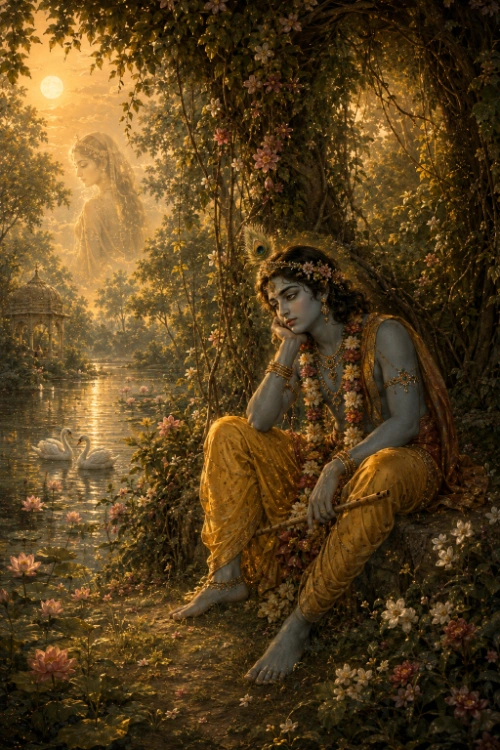
Until this point the emotional movement of the poem has appeared to run in one direction. Rādhā longs for Kṛṣṇa; she sees him surrounded by other gopīs, withdraws in jealousy, remembers their former intimacy, and confesses that she cannot stop loving him. Sarga III reveals the other half of the truth: Kṛṣṇa has not remained untouched.
The moment Rādhā disappears, the multitude of beautiful women around him loses its attraction. He abandons them, searches desperately through the forest, fails to find her, and finally collapses in a bower beside the Yamunā. There Jayadeva allows us to hear his thoughts directly. He regrets his offence. He imagines Rādhā before him. He begs forgiveness of a woman who is not physically present. He challenges Kāma, the god of love, and becomes so disordered by separation that he compares himself with Śiva. And eventually Rādhā’s body, remembered feature by feature, becomes Kāma’s entire arsenal against him.
Absence reveals supremacy
This is perhaps the most important insight of the canto. While Rādhā was physically present among the other gopīs, her unique position could appear uncertain. Only when she leaves does the truth become visible — Kṛṣṇa immediately abandons everyone else. Her departure therefore does not diminish her position; it reveals it, and her absence becomes more powerful than the presence of all the other women combined. That is why Jayadeva opens the canto with rādhām ādhāya hṛdaye tatyāja vraja-sundarīḥ, “placing Rādhā in his heart, he abandoned the beauties of Vraja.” The single verse contains the essential movement of the whole canto.
The conqueror conquered
Jayadeva deliberately surrounds the suffering Kṛṣṇa with heroic divine names — Kaṁsāri, enemy of Kaṁsa; Mādhava; Madhusūdana, slayer of Madhu; Hari. Yet none of those victories helps him. He conquered Kaṁsa and Madhu; he enchants the gopīs; Kāma conquers the world. But Rādhā conquers Kṛṣṇa. Her eyebrow becomes a bow, her glance an arrow, the line toward her ear a bowstring; her lips induce bewilderment; her touch, fragrance, voice and taste occupy all five senses; and finally her form becomes the object of his samādhi. That is the meaning of the title: Madhusūdana, the mighty conqueror, has himself become captivated.
Toward Sarga IV
But Rādhā does not yet know any of this, and that is the tension on which the canto ends. She believes herself abandoned; Kṛṣṇa believes she has abandoned him; both are suffering intensely, and neither yet knows the suffering of the other. A mediator therefore becomes necessary — and that is exactly what follows in Sarga IV, Snigdha-Mādhava, where Rādhā’s sakhī finds Kṛṣṇa in the bower beside the Yamunā and tells him what has happened to her. For the first time he will hear in detail how separation has transformed her body and mind. The structure moves from Rādhā’s longing, to Kṛṣṇa’s longing, and now to the sakhī carrying knowledge of that longing from one lover to the other. The path toward reunion has begun.