

From Sādhana to Mahābhāva
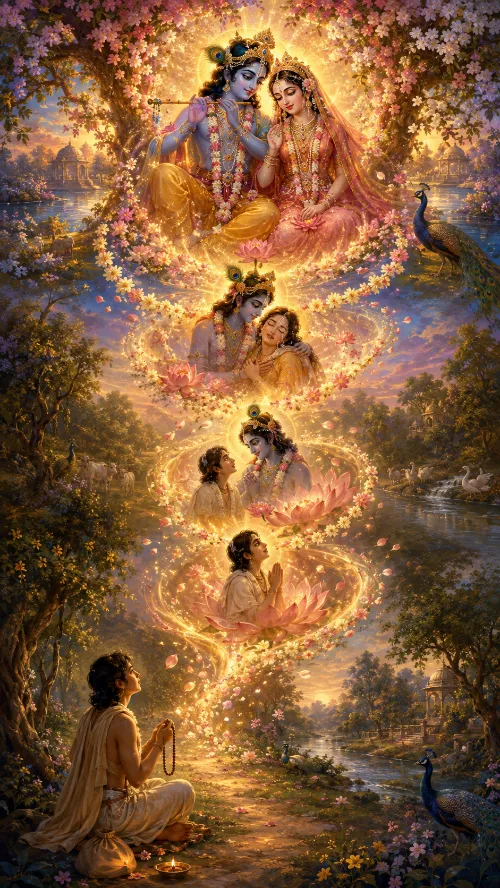
Nine Names for One Deepening Love
In Śrī Caitanya-caritāmṛta, Madhya-līlā 24, Śrī Caitanya Mahāprabhu gives Sanātana Gosvāmī His celebrated many-sided explanation of the Ātmārāma verse of the Śrīmad-Bhāgavatam. While examining the individual Sanskrit words of that verse, He pauses over one apparently simple word — bhakti — and makes a remarkable statement:
‘ভক্তি’-শব্দের অর্থ হয় দশবিধাকার ।
এক — ‘সাধন’, ‘প্রেমভক্তি’ — নব প্রকার ॥
bhakti-śabdera artha haya daśa-vidhākāra
eka — sādhana, prema-bhakti — nava prakāra
“The word bhakti has ten kinds of meaning. One is sādhana, while prema-bhakti has nine forms.”
Caitanya-caritāmṛta, Madhya 24.30
The nine developed states associated with this statement are rati → prema → sneha → māna → praṇaya → rāga → anurāga → bhāva → mahābhāva. They are sometimes rendered very simply as attraction, love, affection, adverse feeling, intimacy, attachment, subattachment, ecstatic love and sublime ecstatic love — but those English glosses conceal more than they reveal.
These are highly technical terms in Gauḍīya rasa-śāstra. They do not describe nine unrelated emotions. They describe the increasing concentration and transformation of one current of divine love, beginning with the awakening of stable spiritual affection for Kṛṣṇa and culminating — within its fullest development in mādhurya-rasa — in mahābhāva. It is one of the most sophisticated maps of love in the tradition.
The Ātmārāma Context
The verse Mahāprabhu is explaining is:
आत्मारामाश्च मुनयो निर्ग्रन्था अप्युरुक्रमे ।
कुर्वन्त्यहैतुकीं भक्तिमित्थम्भूतगुणो हरिः ॥
ātmārāmāś ca munayo nirgranthā apy urukrame
kurvanty ahaitukīṁ bhaktim ittham-bhūta-guṇo hariḥ
“Even the self-satisfied sages, though freed from bondage, render causeless bhakti to Urukrama because Hari possesses qualities of such an extraordinary nature.”
Śrīmad-Bhāgavatam 1.7.10
He systematically explores the semantic possibilities of the words in this verse. When He reaches:
भक्तिम्
bhaktim
the question becomes: how much can the word bhakti contain? His answer is astonishing. It can designate the path of devotional cultivation — sādhana-bhakti — but it can also include the developed states of divine love all the way to mahābhāva. One word spans an enormous spiritual spectrum.
One Word, Several Classifications
Before examining the individual stages, three different classifications must be kept apart. Confusing them is the commonest way this passage is misread.
The Ten Meanings in Madhya 24
Mahāprabhu speaks here of one sādhana and nine developed forms associated with prema-bhakti. This is a contextual analysis of the semantic range of bhakti within the Ātmārāma verse — not a universal taxonomy.
The Basic Threefold Classification
Rūpa Gosvāmī gives a simpler foundational structure:
सा भक्तिः साधनं भावः प्रेमा चेति त्रिधोदिता ॥
sā bhaktiḥ sādhanaṁ bhāvaḥ premā ceti tridhoditā
“Bhakti is said to be threefold: sādhana, bhāva and prema.”
Bhakti-rasāmṛta-sindhu 1.2.1
So the basic developmental structure is sādhana-bhakti → bhāva-bhakti → prema-bhakti. There is no contradiction between the two accounts: Rūpa is giving the foundational stages of bhakti, while Mahāprabhu is analyzing how widely the single word bhakti can function within one particular verse.
This Is Not Navadhā-bhakti
The nine developed states discussed here must also not be confused with Prahlāda Mahārāja’s famous nine practices:
श्रवणं कीर्तनं विष्णोः स्मरणं पादसेवनम् ।
अर्चनं वन्दनं दास्यं सख्यमात्मनिवेदनम् ॥
śravaṇaṁ kīrtanaṁ viṣṇoḥ smaraṇaṁ pāda-sevanam
arcanaṁ vandanaṁ dāsyaṁ sakhyam ātma-nivedanam
Śrīmad-Bhāgavatam 7.5.23
Those are nine limbs or modes of practice:
- hearing;
- chanting;
- remembering;
- serving;
- worshiping;
- praying;
- serving as a servant;
- befriending;
- and self-surrender.
By contrast, rati, prema, sneha, māna, praṇaya, rāga, anurāga, bhāva and mahābhāva describe increasingly intensified states of love. One list describes what bhakti does. The other describes what bhakti becomes.
Sādhana-bhakti: The Cultivation of Devotion
Rūpa Gosvāmī defines sādhana:
कृतिसाध्या भवेत् साध्यभावा सा साधनाभिधा ।
नित्यसिद्धस्य भावस्य प्राकट्यं हृदि साध्यता ॥
kṛti-sādhyā bhavet sādhya-bhāvā sā sādhanābhidhā
nitya-siddhasya bhāvasya prākaṭyaṁ hṛdi sādhyatā
“That bhakti performed through deliberate activity and directed toward the attainment of bhāva is called sādhana. Its perfection consists in the manifestation within the heart of eternally perfect bhāva.”
Bhakti-rasāmṛta-sindhu 1.2.2
The crucial phrase is prākaṭyaṁ hṛdi, “manifestation within the heart.” Rūpa does not describe sādhana as mechanically manufacturing prema. Rather, the perfection of sādhana lies in the manifestation of bhāva within consciousness; the practices of bhakti cultivate the heart toward that manifestation. Kṛṣṇadāsa Kavirāja summarizes the transition:
সাধনভক্তি হৈতে হয় ‘রতি’র উদয় ।
রতি গাঢ় হৈলে তার ‘প্রেম’ নাম কয় ॥
sādhana-bhakti haite haya ratira udaya
rati gāḍha haile tāra prema nāma kaya
“From sādhana-bhakti arises rati. When rati becomes deeply intensified, it is called prema.”
Caitanya-caritāmṛta, Madhya 19.177
Thus the first movement is sādhana → rati → prema.
1. Rati — Stable Spiritual Affection Awakens
The Sanskrit word rati can mean pleasure, delight, affection, attachment or love in different contexts. Here it is far more specific: it indicates the awakening of a stable transcendental affection directed toward Kṛṣṇa, closely associated with what Rūpa calls bhāva-bhakti. He defines bhāva:
शुद्धसत्त्वविशेषात्मा प्रेमसूर्यांशुसाम्यभाक् ।
रुचिभिश्चित्तमासृण्यकृदसौ भाव उच्यते ॥
śuddha-sattva-viśeṣātmā
prema-sūryāṁśu-sāmya-bhāk
rucibhiś citta-masṛṇya-kṛd asau bhāva ucyate
“Bhāva is a special manifestation of śuddha-sattva. It resembles a ray of the sun of prema and softens the heart through spiritual taste.”
Bhakti-rasāmṛta-sindhu 1.3.1
The metaphor is exact: prema is the sun, and bhāva or rati is a ray of that sun. Rati therefore means much more than “attraction.” It is the first stable awakening of transcendental relational affection for Kṛṣṇa.
Why is rati included among nine forms of prema-bhakti when strict terminology places rati and bhāva before prema? The safest explanation is contextual: here prema-bhakti is being used broadly for the developed devotional states beyond ordinary sādhana. Strictly, rati precedes prema — and when rati gāḍha haile, rati becomes sufficiently concentrated, it receives the name prema.
2. Prema — “Kṛṣṇa Is Mine”
Rūpa defines prema:
सम्यङ्मसृणितस्वान्तो ममत्वातिशयाङ्कितः ।
भावः स एव सान्द्रात्मा बुधैः प्रेमा निगद्यते ॥
samyaṅ-masṛṇita-svānto
mamatvātiśayāṅkitaḥ
bhāvaḥ sa eva sāndrātmā
budhaiḥ premā nigadyate
“When that same bhāva thoroughly softens the heart, becomes deeply condensed and is marked by extraordinary mamatā, the learned call it prema.”
Bhakti-rasāmṛta-sindhu 1.4.1
Three things stand out: the heart becomes deeply softened, bhāva becomes condensed, and mamatā intensifies. Mamatā means a powerful sense of belonging or “mine-ness,” and the consciousness moves beyond merely “Kṛṣṇa is the Supreme Lord” toward “Kṛṣṇa is mine.” This is not material possessiveness. It is intimate belonging.
In the specialized context of amorous love, Rūpa gives another definition:
सर्वथा ध्वंसरहितं सत्यपि ध्वंसकारणे ।
यद्भावबन्धनं यूनोः स प्रेमा परिकीर्तितः ॥
sarvathā dhvaṁsa-rahitaṁ saty api dhvaṁsa-kāraṇe
yad bhāva-bandhanaṁ yūnoḥ sa premā parikīrtitaḥ
“That emotional bond between the young lovers which remains completely indestructible even when causes for its destruction are present is called prema.”
Ujjvala-nīlamaṇi 14.63
Prema is therefore not merely strong affection. It is a bond that survives circumstances which would ordinarily destroy love.
The Sugarcane Analogy: One Sweetness Becoming Concentrated
The best image for the whole progression is sugarcane. Rūpa compares developing love to the successive concentration of sweetness:
बीजमिक्षुः स च रसः स गुडः खण्ड एव सः ।
स शर्करा सिता सा च सा यथा स्यात् सितोपला ॥
bījam ikṣuḥ sa ca rasaḥ sa guḍaḥ khaṇḍa eva saḥ
sa śarkarā sitā sā ca sā yathā syāt sitopalā
The sequence evokes seed → sugarcane → juice → molasses → raw sugar → refined sugar → candy → rock candy. Kṛṣṇadāsa Kavirāja applies the analogy directly to prema:
প্রেমা ক্রমে বাড়ি’ হয় — স্নেহ, মান, প্রণয় ।
রাগ, অনুরাগ, ভাব, মহাভাব হয় ॥
premā krame bāḍi’ haya — sneha, māna, praṇaya
rāga, anurāga, bhāva, mahābhāva haya
“As prema progressively increases, it becomes sneha, māna, praṇaya, rāga, anurāga, bhāva and mahābhāva.”
Caitanya-caritāmṛta, Madhya 23.42
The analogy gives the key: these are not separate emotional substances. They are one sweetness becoming progressively more concentrated, more refined, more intimate, more powerful.
From this point onward an important qualification is necessary. The most detailed technical definitions of sneha, māna, praṇaya, rāga, anurāga, advanced bhāva and mahābhāva come especially from Rūpa Gosvāmī’s treatment of mādhurya-rasa in the Ujjvala-nīlamaṇi. They should not automatically be generalized unchanged to every devotional rasa, or to every occurrence of these Sanskrit words elsewhere in Gauḍīya literature. What follows is principally the fully developed map of conjugal Vraja-prema.
3. Sneha — Prema Melts
The ordinary meaning of sneha includes affection, tenderness and attachment. In rasa terminology it is much deeper. A traditional definition states:
सान्द्रश्चित्तद्रवं कुर्वन् प्रेमा स्नेह इतीर्यते ।
क्षणिकस्यापि नेह स्याद् विश्लेषस्य सहिष्णुता ॥
sāndraś citta-dravaṁ kurvan premā sneha itīryate
kṣaṇikasyāpi neha syād viśleṣasya sahiṣṇutā
“Prema which becomes concentrated and melts the heart is called sneha. In this state even a moment of separation becomes difficult to tolerate.”
Sneha is therefore not merely “affection.” It is prema in a deeply melted condition: the beloved has become so precious that even brief separation grows increasingly unbearable.
4. Māna — Loving Pique
One of the most misleading old glosses is māna = adverse feelings, which obscures the actual theological meaning. Rūpa defines māna:
स्नेहस्तूत्कृष्टतावाप्त्या माधुर्यं मानयन् नवम् ।
यो धारयत्यदाक्षिण्यं स मान इति कीर्त्यते ॥
snehas tūtkṛṣṭatāvāptyā mādhuryaṁ mānayan navam
yo dhārayaty adākṣiṇyaṁ sa māna iti kīrtyate
“Sneha which reaches excellence, produces ever-new sweetness, and assumes an outwardly noncompliant or contrary character is called māna.”
Ujjvala-nīlamaṇi 14.96
Better English expressions include loving pique, affectionate indignation, jealous loving pride or loving contrariness. Rādhā may refuse Kṛṣṇa, accuse Him, turn away, decline to accept His apology immediately — and yet prema has not disappeared. Quite the opposite: māna becomes possible because intimacy has become extraordinarily strong. Love has become secure enough to assume a crooked form.
The definition contains another important phrase: mādhuryaṁ mānayan navam — māna produces fresh sweetness. Kṛṣṇa must plead; Rādhā may resist; the sakhīs intervene. Jealousy, humor, remorse, pride and reconciliation multiply the possibilities of rasa. The love has not weakened. Its relational richness has increased.
5. Praṇaya — Viśrambha, Intimacy Without Distance
When māna becomes still more intimate, it develops into praṇaya. Rūpa says:
मानो दधानो विश्रम्भं प्रणयः प्रोच्यते बुधैः ॥
māno dadhāno viśrambhaṁ praṇayaḥ procyate budhaiḥ
“Māna endowed with viśrambha is called praṇaya by the wise.”
Ujjvala-nīlamaṇi 14.108
The central word is viśrambha, which conveys deep confidence, intimate trust, complete familiarity and freedom from inhibiting distance. Rūpa later states:
स्वरूपं प्रणयस्यास्य विश्रम्भः कथितो बुधैः ।
svarūpaṁ praṇayasyāsya viśrambhaḥ kathito budhaiḥ
“The essential nature of praṇaya is said to be viśrambha.”
Ujjvala-nīlamaṇi 14.110
“Intimacy” is a reasonable short translation, but it is incomplete. Praṇaya is intimacy in which the normal psychological boundary between “your happiness” and “my happiness” becomes extraordinarily thin, and formal distance gives way to profound mutual belonging. This idea is central to Vraja. Theological majesty has not ceased to exist — but intimacy has become stronger than awareness of hierarchy.
6. Rāga — Love Reorganizes Pleasure and Pain
The ordinary word rāga may mean color, passion, attachment, affection or desire. In this specialized sequence it has a much more striking meaning. Rūpa says:
दुःखमप्यधिकं चित्ते सुखत्वेनैव व्यज्यते ।
यतस्तु प्रणयोत्कर्षात् स राग इति कीर्त्यते ॥
duḥkham apy adhikaṁ citte sukhatvenaiva vyajyate
yatas tu praṇayotkarṣāt sa rāga iti kīrtyate
“When, through the intensification of praṇaya, even great suffering manifests in the heart as happiness, that is called rāga.”
Ujjvala-nīlamaṇi 14.126
“Attachment” is much too weak as a complete translation. The extraordinary feature of rāga is that the usual distinction between pleasant and painful is reorganized around the beloved. If hardship allows service to Kṛṣṇa, that hardship becomes sweet; if apparent comfort separates one from Kṛṣṇa, that comfort may become unbearable. The determining question is no longer “how does this affect me?” but “how is this connected with my beloved?”
This is not glorification of suffering for its own sake. Pain is not considered good merely because it is painful. Its sweetness comes entirely from its relationship to Kṛṣṇa.
7. Anurāga — The Beloved Is Ever New
The old gloss “subattachment” should simply be abandoned. Rūpa defines anurāga:
सदानुभूतमपि यः कुर्यान्नवनवं प्रियम् ।
रागो भवन्नवनवः सोऽनुराग इतीर्यते ॥
sadānubhūtam api yaḥ kuryān nava-navaṁ priyam
rāgo bhavan nava-navaḥ so ’nurāga itīryate
“That rāga which itself becomes newer and newer and causes the beloved—although constantly experienced—to appear ever new is called anurāga.”
Ujjvala-nīlamaṇi 14.146
This is one of the most beautiful definitions in Gauḍīya rasa-theology. Ordinary experience tends toward familiarity: something repeatedly seen becomes less novel. Anurāga reverses that psychology. The beloved has been seen countless times, yet appears nava-navam, newer and newer. Kṛṣṇa becomes more astonishing through familiarity rather than less; love responds more deeply; that deeper love perceives still more of Kṛṣṇa; and the new perception produces still deeper love.
Anurāga is therefore ever-renewing passionate love in which familiarity continually generates fresh discovery. Infinite Kṛṣṇa cannot be exhausted — and love of Him cannot exhaust its capacity to discover Him.
8. Advanced Bhāva — A Second Technical Use of the Word
At this point a major terminological problem appears. The sequence runs rati → prema → sneha → māna → praṇaya → rāga → anurāga → bhāva → mahābhāva. But earlier we encountered bhāva-bhakti closely associated with rati and positioned before prema. How can bhāva appear near both the beginning and the summit? Because the same Sanskrit word is being used at two different technical levels.
Rūpa’s definition of the second is:
अनुरागः स्वसंवेद्यदशां प्राप्य प्रकाशितः ।
यावदाश्रयवृत्तिश्चेद् भाव इत्यभिधीयते ॥
anurāgaḥ sva-saṁvedya-daśāṁ prāpya prakāśitaḥ
yāvad-āśraya-vṛttiś ced bhāva ity abhidhīyate
“When anurāga reaches an exceptionally self-manifest condition and extends to the fullest possible limit within its āśraya, it is called bhāva.”
Ujjvala-nīlamaṇi 14.154
Same Sanskrit word, different technical position, different scope. This distinction is essential, and missing it is the single easiest way to garble the whole sequence.
9. Mahābhāva — The Supreme Limit of Prema
Mahābhāva is not merely “very intense emotion,” and “sublime ecstasy” is not really adequate either. It is the supreme technical intensification of prema within Gauḍīya rasa-theology. Madhya 24 itself specifies where this complete development belongs:
কান্তাগণের রতি পায় ‘মহাভাব’-সীমা ।
kāntā-gaṇera rati pāya mahābhāva-sīmā
“The rati of Kṛṣṇa’s beloveds reaches the limit of mahābhāva.”
Madhya 24.34
Mahābhāva is therefore not an ordinary stage through which every practitioner automatically passes. It belongs especially to the highest development of mādhurya-rasa among the Vraja-gopīs.
Śrī Rādhā as Mahābhāva Personified
Rūpa Gosvāmī makes an extraordinary statement concerning Śrī Rādhā:
तयोरप्युभयोर्मध्ये राधिका सर्वथाधिका ।
महाभावस्वरूपेयं गुणैरतिवरीयसी ॥
tayor apy ubhayor madhye rādhikā sarvathādhikā
mahābhāva-svarūpeyaṁ guṇair ativarīyasī
“Of the two, Rādhikā is superior in every respect. She is the very embodiment of mahābhāva and is exceedingly eminent in qualities.”
Ujjvala-nīlamaṇi 4.3
Kṛṣṇadāsa Kavirāja expresses the same conclusion:
প্রেমের পরম-সার ‘মহাভাব’ জানি ।
সেই মহাভাবরূপা রাধা-ঠাকুরাণী ॥
premera parama-sāra mahābhāva jāni
sei mahābhāva-rūpā rādhā-ṭhākurāṇī
“Mahābhāva is understood to be the supreme essence of prema, and Śrī Rādhā is the embodiment of that mahābhāva.”
Caitanya-caritāmṛta, Madhya 8.160
The progression therefore does not culminate in an abstraction. It culminates in the person whose love represents the highest imaginable capacity for Kṛṣṇa-prema.
Not Every Rasa Reaches the Same Technical Limit
This point is crucial. Madhya 24.30–34 does not teach that every devotee mechanically passes through the entire nine-stage sequence. Mahāprabhu distinguishes the technical reach of love according to rasa. In simplified form:
The fully elaborated sequence from sneha through mahābhāva therefore belongs most completely to the theology of mādhurya-rasa — which is why the detailed Ujjvala-nīlamaṇi definitions must be read within their proper scope.
Why Mādhurya Has the Widest Range
Mahāprabhu explains elsewhere that successive rasas incorporate additional dimensions of intimacy:
গুণাধিক্যে স্বাদাধিক্য বাড়ে প্রতি-রসে ।
শান্ত-দাস্য-সখ্য-বাৎসল্যের গুণ মধুরেতে বৈসে ॥
guṇādhikye svādādhikya bāḍe prati-rase
śānta-dāsya-sakhya-vātsalyera guṇa madhurete vaise
“As qualities increase, taste increases in each rasa. The qualities of śānta, dāsya, sakhya and vātsalya are present within madhura-rasa.”
Madhya 8.86
This gives the theological explanation for mādhurya’s broad emotional range. It includes dedication, service, confidence, care, intimacy and conjugal belonging; its relational architecture therefore permits the most extensive technical development of prema.
This Is Not a Ladder of Personal Worth
The sequence must not be misunderstood as a ranking of individual spiritual value. One should not imagine śānta → dāsya → sakhya → vātsalya → mādhurya as a scoreboard. Each eternal devotee is perfect within his or her own relationship: Hanumān does not suffer from a spiritual defect because his love is dāsya, and Yaśodā’s love is not an incomplete attempt to become a gopī.
The classifications describe different structures and capacities of relationship, not crude rankings of holiness. The Gauḍīya emphasis on Vraja-mādhurya concerns the particular intimacy and range of rasa available there. It does not require contempt for other forms of devotion.
The Progression in Simple Language
The sequence can now be restated more accurately.
The Progression Is More Than “Increasing Emotion”
The sequence becomes distorted if we imagine each stage merely as “more feeling.” Rūpa’s definitions describe an increasingly profound transformation of consciousness through relationship. Each stage can be heard as a sentence the heart has become able to say.
The development is therefore not merely quantitative. The entire structure of experience changes around the beloved: the self becomes progressively less central as the relationship with Kṛṣṇa becomes the measure through which pleasure, pain, nearness, separation and even perception itself are understood.
Why Separation Matters
The higher stages cannot be understood without the Gauḍīya theology of vipralambha, love in separation. Ordinary intuition suggests that love is strongest when the beloved is present; Gauḍīya rasa-theology discovers that separation can produce extraordinary intensification. In separation every object can recall Kṛṣṇa, every sound can awaken remembrance, time becomes difficult to endure, and apparent absence can make His presence within consciousness almost total.
Thus the increasing inability to tolerate separation in sneha, rāga and anurāga does not indicate weakness. It reveals how inseparable the beloved has become from consciousness itself.
Mahābhāva Is Not Merely Dramatic Ecstasy
Mahābhāva should not be reduced to striking bodily symptoms. Those manifestations belong to the theology, but they are not the essence. Mahābhāva is the culmination of:
- softened consciousness;
- intensified mamatā;
- indestructible attachment;
- deep confidential intimacy;
- a transformed experience of pleasure and pain;
- ever-new perception of Kṛṣṇa;
- and extreme intensification of love in both union and separation.
The outward symptoms are consequences. The essence is the unparalleled density of love itself. That is why Śrī Rādhā stands at the center: She is not merely described as someone who experiences mahābhāva, but as mahābhāva-svarūpa, its embodiment.
Returning to Madhya 24.30
We can now see how much Mahāprabhu contains in the seemingly simple statement bhakti-śabdera artha haya daśa-vidhākāra. The word bhakti can refer to the beginning — sādhana, the deliberate cultivation of devotion — but it can also contain the full flowering of divine love through rati, prema, sneha, māna, praṇaya, rāga, anurāga, advanced bhāva and mahābhāva.
The same word therefore encompasses practice, awakening, belonging, melting tenderness, loving opposition, deep confidential intimacy, passionate attachment, ever-new love, advanced ecstatic intensification, and the supreme state embodied by Śrī Rādhā.
The Sugarcane Analogy Gives the Final Key
The whole system becomes easiest to understand if we return to Rūpa’s metaphor. Sugarcane does not become an unrelated substance when pressed into juice; juice does not become unrelated when concentrated into molasses; molasses becomes sugar, and sugar becomes increasingly refined. The essential sweetness remains. Only its concentration changes.
It is one sweetness — becoming deeper, and deeper, and deeper still.
Caitanya-caritāmṛta Madhya 24.30 is therefore much more than a numerical classification. It presents bhakti as a living continuum. Bhakti begins as practice, but its goal is not merely perfected religious performance: practice exists for relationship, relationship matures into love, love becomes increasingly intimate, and intimacy transforms the experience of self, pleasure, pain, separation and perception. At the summit of the complete mādhurya-rasa development, love reaches mahābhāva — whose supreme embodiment is Śrīmatī Rādhārāṇī.
The ten meanings of bhakti thus trace a movement from doing devotion toward a consciousness increasingly constituted by love. Or, in the language of Rūpa Gosvāmī’s sugarcane analogy: the sweetness is present from the beginning, but with every development it becomes more concentrated — until almost nothing remains but sweetness itself.
Compact Reference
Each term with the shorthand that fails it, and what it actually means.
Principal Scriptural and Theological Sources
The passages drawn on above, gathered by text. Each is quoted in full — in its own script, with transliteration and translation — at the point where it is discussed.
Śrīmad-Bhāgavatam
Śrī Caitanya-caritāmṛta
Rūpa Gosvāmī — Bhakti-rasāmṛta-sindhu
Rūpa Gosvāmī — Ujjvala-nīlamaṇi
The Ujjvala-nīlamaṇi definitions belong specifically to Rūpa Gosvāmī’s detailed analysis of mādhurya-rasa and should be interpreted within that scope. Its Sanskrit also circulates in several printed and electronic recensions whose verse numbering and readings differ in small particulars; the verses above are reproduced as supplied, and anyone citing them in formal scholarship should check them against the specific edition they are working from.