

The Eighteen Chapters of the Bhagavad-gītā
Chapter titles, verse counts, and the arc from despair to surrender
The Bhagavad-gītā contains only eighteen chapters and about seven hundred verses, yet within that remarkably compact space it attempts something enormous. It asks: Who am I?, What is the difference between the body and the self?, Why must I act?, Can action be performed without bondage?, What is karma?, What is yoga?, What is renunciation?, What is material nature?, What happens at death?, What is Brahman?, Who is Paramātmā?, Who is Bhagavān?, Who is Kṛṣṇa?, What is bhakti?, And what does complete spiritual surrender actually mean?
The eighteen chapters are therefore not eighteen disconnected essays on different forms of yoga. They form a carefully developing conversation. The movement begins with Arjuna unable to act and ends with Arjuna acting from transformed understanding.
At the beginning, he drops his bow. At the end, he picks up his duty. What happens between those two moments is the Bhagavad-gītā.
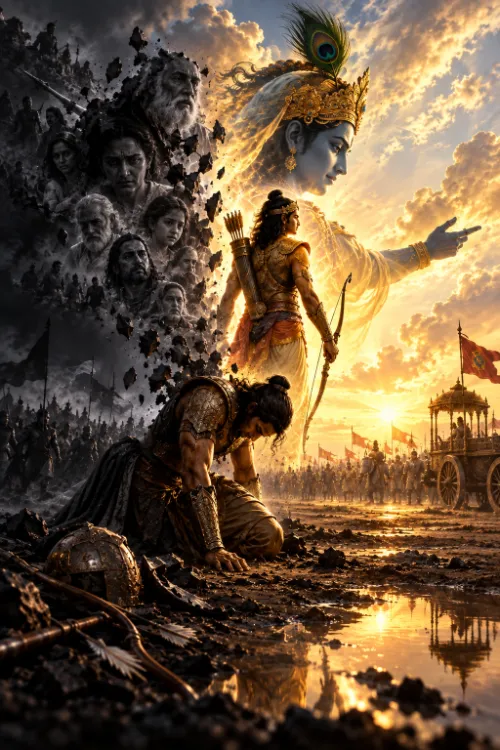
The Gītā on the Battlefield
The Bhagavad-gītā is not originally an independent book. It appears within the Bhīṣma-parvan of the Mahābhārata, immediately before the great war of Kurukṣetra begins. That setting is essential.
Kṛṣṇa does not deliver the Gītā in a peaceful hermitage to a philosopher who has withdrawn from the world. He delivers it to a warrior who suddenly discovers that every available course of action appears morally disastrous.
Across the battlefield stand Arjuna’s teachers, relatives, friends and elders. He realizes that victory will require killing people he reveres. His body begins to fail. His mouth dries.
His skin burns. His famous bow, Gāṇḍīva, slips from his hand. Finally he sits down. The first chapter ends:
सञ्जय उवाच
एवमुक्त्वार्जुनः सङ्ख्ये रथोपस्थ उपाविशत् ।
विसृज्य सशरं चापं शोकसंविग्नमानसः ॥
sañjaya uvāca
evam uktvārjunaḥ saṅkhye rathopastha upāviśat
visṛjya sa-śaraṁ cāpaṁ śoka-saṁvigna-mānasaḥ
Sañjaya said: Having spoken thus on the battlefield, Arjuna sat down upon the chariot, casting aside his bow and arrows, his mind overwhelmed by grief.
Bhagavad-gītā 1.46 in Bhagavad-gītā As It Is
This is where one of humanity’s great philosophical dialogues begins: not with certainty, but with collapse.
The Eighteen Chapters
The following verse counts correspond to the current edition of A. C. Bhaktivedanta Swami Prabhupāda’s Bhagavad-gītā As It Is. Traditional Sanskrit chapter titles vary slightly between textual traditions. The forms below represent a widely transmitted set of chapter headings or colophons.
अर्जुनविषादयोगः — Arjuna-viṣāda-yoga
साङ्ख्ययोगः — Sāṅkhya-yoga
कर्मयोगः — Karma-yoga
ज्ञानकर्मसंन्यासयोगः — Jñāna-karma-sannyāsa-yoga
संन्यासयोगः — Sannyāsa-yoga
आत्मसंयमयोगः — Ātma-saṁyama-yoga
ज्ञानविज्ञानयोगः — Jñāna-vijñāna-yoga
अक्षरब्रह्मयोगः — Akṣara-brahma-yoga
राजविद्याराजगुह्ययोगः — Rāja-vidyā-rāja-guhya-yoga
विभूतियोगः — Vibhūti-yoga
विश्वरूपदर्शनयोगः — Viśvarūpa-darśana-yoga
भक्तियोगः — Bhakti-yoga
क्षेत्रक्षेत्रज्ञविभागयोगः — Kṣetra-kṣetrajña-vibhāga-yoga
गुणत्रयविभागयोगः — Guṇa-traya-vibhāga-yoga
पुरुषोत्तमयोगः — Puruṣottama-yoga
दैवासुरसम्पद्विभागयोगः — Daivāsura-sampad-vibhāga-yoga
श्रद्धात्रयविभागयोगः — Śraddhā-traya-vibhāga-yoga
मोक्षसंन्यासयोगः — Mokṣa-sannyāsa-yoga
Total in Bhagavad-gītā As It Is: 700 verses.
Why Is Every Chapter Called “Yoga”?
The recurring word yoga is important. It comes from the Sanskrit verbal root yuj, “to yoke,” “join,” “apply,” or “bring into disciplined integration.” Yoga in the Gītā therefore means far more than bodily postures.
It refers broadly to methods by which human consciousness becomes properly ordered and ultimately connected with the Supreme. This explains a title that initially sounds paradoxical:
अर्जुनविषादयोगः
Arjuna-viṣāda-yoga
“The Yoga of Arjuna’s Despair.”
How can despair be yoga? Despair by itself is not yoga. But Arjuna’s despair destroys his confidence in his own reasoning and eventually forces him to ask a deeper question.
His crisis becomes the doorway through which instruction enters. That is why the traditional colophon after Chapter 1 describes the Gītā in striking terms:
ॐ तत्सदिति श्रीमद्भगवद्गीतासूपनिषत्सु
ब्रह्मविद्यायां योगशास्त्रे श्रीकृष्णार्जुनसंवादे
अर्जुनविषादयोगो नाम प्रथमोऽध्यायः ॥
oṁ tat sad iti śrīmad-bhagavad-gītāsūpaniṣatsu
brahma-vidyāyāṁ yoga-śāstre śrī-kṛṣṇārjuna-saṁvāde
arjuna-viṣāda-yogo nāma prathamo ‘dhyāyaḥ
Thus, in the Upaniṣads of the glorious Bhagavad-gītā, in the knowledge of Brahman, in the scripture of yoga, in the dialogue between Śrī Kṛṣṇa and Arjuna, ends the first chapter, entitled “The Yoga of Arjuna’s Despair.”
These traditional colophons are not counted among the Gītā’s principal verses, but their vocabulary is revealing. The Gītā is presented as: Upaniṣadic wisdom — knowledge of ultimate reality; brahma-vidyā — knowledge of spiritual reality; yoga-śāstra — practical spiritual discipline; and kṛṣṇārjuna-saṁvāda — a dialogue between Kṛṣṇa and Arjuna.
It is simultaneously philosophy and practice.
Chapter 1: The Necessary Collapse
Arjuna initially argues very intelligently. He invokes compassion. Family obligations. Social order. Sin. Tradition. Duty toward elders. Consequences for future generations.
These are not foolish concerns. That is precisely why the opening crisis is powerful. The problem is not that Arjuna has stopped thinking. He cannot determine which principle should govern when several genuine duties collide.
His intelligence has reached an impasse. And therefore the decisive moment does not actually occur when Arjuna drops his bow. It occurs a few verses later.
The Real Beginning of the Teaching: “I Am Your Disciple”
कार्पण्यदोषोपहतस्वभावः
पृच्छामि त्वां धर्मसम्मूढचेताः ।
यच्छ्रेयः स्यान्निश्चितं ब्रूहि तन्मे
शिष्यस्तेऽहं शाधि मां त्वां प्रपन्नम् ॥
kārpaṇya-doṣopahata-svabhāvaḥ
pṛcchāmi tvāṁ dharma-sammūḍha-cetāḥ
yac chreyaḥ syān niścitaṁ brūhi tan me
śiṣyas te ‘haṁ śādhi māṁ tvāṁ prapannam
My nature has been overcome by weakness, and my mind is confused regarding dharma. Tell me decisively what is truly best for me. I am Your disciple. Instruct me, for I have taken shelter of You.
Bhagavad-gītā 2.7
This changes everything. Until now Arjuna has been discussing matters with Kṛṣṇa as a friend. Now he becomes śiṣya — a disciple. And notice the question. Arjuna does not merely ask: “What would make me feel better?”
He asks:
यच्छ्रेयः स्यात्
yac chreyaḥ syāt
“What is truly for my highest good?”
That is the doorway into the Gītā.
Chapter 2: Before Asking What You Should Do, Ask What You Are
Kṛṣṇa’s first great correction concerns identity. Arjuna sees persons primarily as bodies: grandfather, teacher, cousin, son, friend, enemy. Kṛṣṇa begins by distinguishing the changing body from the conscious self inhabiting it.
देहिनोऽस्मिन्यथा देहे
कौमारं यौवनं जरा ।
तथा देहान्तरप्राप्तिर्
धीरस्तत्र न मुह्यति ॥
dehino ‘smin yathā dehe
kaumāraṁ yauvanaṁ jarā
tathā dehāntara-prāptir
dhīras tatra na muhyati
Just as the embodied self passes within this body from childhood to youth to old age, so it passes into another body. One who is sober is not bewildered by this.
Bhagavad-gītā 2.13
The Sanskrit distinction is fundamental: deha — the body; dehin — the one possessing or inhabiting the body. Before Kṛṣṇa reforms Arjuna’s behavior, He reforms his ontology—his understanding of what a person actually is.
The First Six Chapters: Who Am I, and How Should I Act?
A. C. Bhaktivedanta Swami Prabhupāda gives a particularly useful reading of the Gītā’s eighteen-chapter architecture. He explains Chapters 1–6 primarily in terms of the individual living being and the disciplines by which the living being approaches spiritual realization.
These chapters progressively address: identity; duty; karma; knowledge; renunciation; meditation; control of the mind. Yet their culmination is surprising. It is bhakti.
Karma-yoga: The Problem Is Not Action Itself
Arjuna’s instinct is to escape action. Kṛṣṇa’s answer is more subtle. Merely refusing to act does not automatically free a person from karma. The question is not simply: “Do I act?”
but: “From what consciousness do I act, and for whom is the action performed?”
यज्ञार्थात्कर्मणोऽन्यत्र
लोकोऽयं कर्मबन्धनः ।
तदर्थं कर्म कौन्तेय
मुक्तसङ्गः समाचर ॥
yajñārthāt karmaṇo ‘nyatra
loko ‘yaṁ karma-bandhanaḥ
tad-arthaṁ karma kaunteya
mukta-saṅgaḥ samācara
Action performed for anything other than sacrifice binds one to this world. Therefore, O son of Kuntī, perform action for that purpose, free from attachment.
Bhagavad-gītā 3.9
The Gītā therefore does not teach that spirituality means becoming inactive. It teaches the transformation of action. One may externally perform the same duty while internally moving from: possession → service ego → offering attachment to results → responsibility without possessiveness.
Chapter 4: The Teacher Becomes Part of the Teaching
A major shift occurs when Kṛṣṇa begins speaking not only about spiritual truth but about His own identity.
जन्म कर्म च मे दिव्यम्
एवं यो वेत्ति तत्त्वतः ।
त्यक्त्वा देहं पुनर्जन्म
नैति मामेति सोऽर्जुन ॥
janma karma ca me divyam
evaṁ yo vetti tattvataḥ
tyaktvā dehaṁ punar janma
naiti mām eti so ‘rjuna
One who understands in truth the divine nature of My birth and activities does not take birth again after leaving the body, but comes to Me, O Arjuna.
Bhagavad-gītā 4.9
The identity of Kṛṣṇa is no longer incidental. It becomes part of liberation itself. The question gradually changes from: “What does Kṛṣṇa know?” to: “Who is Kṛṣṇa?”
Chapter 6: The Highest Yogī
Chapter 6 develops meditation, discipline, detachment and control of the mind. Yet the final verse changes the emphasis.
योगिनामपि सर्वेषां
मद्गतेनान्तरात्मना ।
श्रद्धावान्भजते यो मां
स मे युक्ततमो मतः ॥
yoginām api sarveṣāṁ
mad-gatenāntar-ātmanā
śraddhāvān bhajate yo māṁ
sa me yukta-tamo mataḥ
Of all yogīs, the one who abides in Me inwardly, possesses faith, and worships Me is considered by Me the most deeply united in yoga.
Bhagavad-gītā 6.47
The crucial verb is:
भजते — bhajate
It means to worship, serve, adore, or participate devotionally. Thus the first six chapters do not terminate in impersonal mental stillness. They terminate in the yogī devoted to Kṛṣṇa.
Chapters 7–12: Who Is Kṛṣṇa?
Chapter 7 feels almost like a second beginning.
मय्यासक्तमनाः पार्थ
योगं युञ्जन्मदाश्रयः ।
असंशयं समग्रं मां
यथा ज्ञास्यसि तच्छृणु ॥
mayy āsakta-manāḥ pārtha
yogaṁ yuñjan mad-āśrayaḥ
asaṁśayaṁ samagraṁ māṁ
yathā jñāsyasi tac chṛṇu
O Pārtha, hear how, practicing yoga with your mind attached to Me and taking shelter of Me, you may know Me completely and without doubt.
Bhagavad-gītā 7.1
The first section largely asks: Who am I? How should I act? How can consciousness be purified? The middle section increasingly asks: Who is Kṛṣṇa? What is His relation to the universe? What is His relation to the individual soul?
This is why Prabhupāda repeatedly treats Chapters 7–12 as the central devotional heart of the Gītā.
Chapter 9: The King of Knowledge and the King of Secrets
The ninth chapter is named:
राजविद्याराजगुह्ययोगः
Rāja-vidyā-rāja-guhya-yoga
“The Yoga of the King of Knowledge and the King of Secrets.”
Kṛṣṇa describes its teaching:
राजविद्या राजगुह्यं
पवित्रमिदमुत्तमम् ।
प्रत्यक्षावगमं धर्म्यं
सुसुखं कर्तुमव्ययम् ॥
rāja-vidyā rāja-guhyaṁ
pavitram idam uttamam
pratyakṣāvagamaṁ dharmyaṁ
su-sukhaṁ kartum avyayam
This is the king of knowledge and the king of secrets. It is supremely pure, directly realizable, in accordance with dharma, joyfully practiced and imperishable.
Bhagavad-gītā 9.2
The “secret” of the Gītā is therefore not merely an esoteric cosmological fact. The deepest secret is relationship.
Chapter 10: The Source Behind Everything
अहं सर्वस्य प्रभवो
मत्तः सर्वं प्रवर्तते ।
इति मत्वा भजन्ते मां
बुधा भावसमन्विताः ॥
ahaṁ sarvasya prabhavo
mattaḥ sarvaṁ pravartate
iti matvā bhajante māṁ
budhā bhāva-samanvitāḥ
I am the source of everything; everything proceeds from Me. Knowing this, the wise worship Me with deep spiritual feeling.
Bhagavad-gītā 10.8
Again the sequence matters: knowledge → recognition → devotion. The wise do not merely conclude intellectually that Kṛṣṇa is the metaphysical source.
भजन्ते माम्
bhajante mām
“They worship Me.”
Knowledge becomes relationship.
Chapter 11: The Universal Form
Then comes one of the most astonishing scenes in the Gītā. Kṛṣṇa grants Arjuna divine vision and reveals the viśvarūpa, the universal form. Arjuna sees countless faces, beings, weapons, celestial powers and worlds within Kṛṣṇa.
He sees creation. He sees destruction. He sees warriors already entering death. He sees Time. Yet the universal form is not the ultimate destination of the dialogue. After revealing it, Kṛṣṇa brings Arjuna back to the question of personal devotion.
भक्त्या त्वनन्यया शक्य
अहमेवंविधोऽर्जुन ।
ज्ञातुं द्रष्टुं च तत्त्वेन
प्रवेष्टुं च परन्तप ॥
bhaktyā tv ananyayā śakya
aham evaṁ-vidho ‘rjuna
jñātuṁ draṣṭuṁ ca tattvena
praveṣṭuṁ ca paran-tapa
But through undivided bhakti, O Arjuna, I can truly be known, seen and entered into.
Bhagavad-gītā 11.54
The climax of cosmic vision therefore returns to bhakti.
Chapter 12: The Gītā Explicitly Names Bhakti-yoga
Arjuna now asks whether worship of the personal Supreme or meditation on the unmanifest Absolute is superior. Kṛṣṇa begins:
मय्यावेश्य मनो ये मां
नित्ययुक्ता उपासते ।
श्रद्धया परयोपेतास्
ते मे युक्ततमा मताः ॥
mayy āveśya mano ye māṁ
nitya-yuktā upāsate
śraddhayā parayopetās
te me yukta-tamā matāḥ
Those who fix their minds upon Me, constantly worship Me, and possess supreme faith are considered by Me the most perfectly united in yoga.
Bhagavad-gītā 12.2
The language deliberately echoes 6.47. The conclusion becomes increasingly difficult to miss: the perfected yogī is the devotee.
Chapters 13–18: How Bondage Works—and How It Ends
The final six chapters analyze the mechanism of conditioned existence in greater detail. They examine: prakṛti — material nature; puruṣa — the conscious being; kṣetra — the field, especially the body; kṣetra-jña — the knower of the field; the three guṇas — sattva, rajas and tamas; faith; character; action; knowledge; renunciation; and liberation.
Prabhupāda summarizes the eighteen chapters in roughly three movements:
This gives the Gītā a remarkably coherent internal architecture.
Chapter 13: The Field and the Knower
The body is called:
Thus the Gītā distinguishes three categories that are often confused: matter; the individual conscious self; the Supreme conscious being.
Chapter 14: The Invisible Psychology of the Guṇas
Material nature acts through three fundamental qualities:
These are not merely moral labels. They explain how nature conditions perception, appetite, behavior, knowledge and even religious practice.
Yet the Gītā does not end by telling the soul merely to become sāttvika. Its goal is to transcend all three.
मां च योऽव्यभिचारेण
भक्तियोगेन सेवते ।
स गुणान्समतीत्यैतान्
ब्रह्मभूयाय कल्पते ॥
māṁ ca yo ‘vyabhicāreṇa
bhakti-yogena sevate
sa guṇān samatītyaitān
brahma-bhūyāya kalpate
One who serves Me through undeviating bhakti-yoga transcends these guṇas and becomes qualified for the spiritual platform.
Bhagavad-gītā 14.26
Once again, bhakti appears not as one optional theme among many but as the means of crossing beyond material conditioning.
Chapter 15: What Are the Vedas Ultimately Trying to Reveal?
One of the boldest claims in the entire Gītā comes in Chapter 15.
सर्वस्य चाहं हृदि सन्निविष्टो
मत्तः स्मृतिर्ज्ञानमपोहनं च ।
वेदैश्च सर्वैरहमेव वेद्यो
वेदान्तकृद्वेदविदेव चाहम् ॥
sarvasya cāhaṁ hṛdi sanniviṣṭo
mattaḥ smṛtir jñānam apohanaṁ ca
vedaiś ca sarvair aham eva vedyo
vedānta-kṛd veda-vid eva cāham
I am situated in everyone’s heart. From Me come remembrance, knowledge and forgetfulness. By all the Vedas I am to be known. I am the author of Vedānta and the knower of the Vedas.
Bhagavad-gītā 15.15
For the Vaiṣṇava reading of the Gītā, this statement is decisive. Vedic knowledge ultimately has a personal referent. The culmination of Vedic knowledge is not simply knowing more propositions about ultimate reality.
It is knowing Kṛṣṇa.
Prabhupāda’s Five Subjects of the Bhagavad-gītā
In the introduction to Bhagavad-gītā As It Is, Prabhupāda offers another extremely useful map of the entire book. He identifies five fundamental subjects:
ईश्वर — īśvara
The Supreme controller
जीव — jīva
The individual living being
प्रकृति — prakṛti
Nature or energy
काल — kāla
Time
कर्म — karma
Action and its consequences Almost every major philosophical question in the Gītā can be organized around these five realities. Who controls? Who experiences? What is the world?
What does time do? Why do actions produce consequences? Prabhupāda further distinguishes them by explaining that īśvara, jīva, prakṛti and kāla are eternal realities, whereas the conditioned chain of karma can be terminated.
That is why liberation is possible.
Chapter 18: Kṛṣṇa Does Not Abolish Thought
One of the most important and sometimes overlooked verses comes immediately before the final climax. After almost the entire Gītā has been spoken, Kṛṣṇa says:
इति ते ज्ञानमाख्यातं
गुह्याद्गुह्यतरं मया ।
विमृश्यैतदशेषेण
यथेच्छसि तथा कुरु ॥
iti te jñānam ākhyātaṁ
guhyād guhyataraṁ mayā
vimṛśyaitad aśeṣeṇa
yathecchasi tathā kuru
Thus I have explained to you knowledge more confidential than the confidential. Reflect upon it completely, and then act as you choose.
Bhagavad-gītā 18.63
This verse is crucial. Kṛṣṇa does not tell Arjuna: “Stop thinking.” He tells him:
विमृश्य — vimṛśya
“Having reflected, examined or considered carefully.” The Gītā seeks not blind obedience but transformed understanding capable of intelligent surrender. Only then does Kṛṣṇa disclose what He calls the most confidential instruction.
The Entire Gītā Contracts into Its Final Teaching
सर्वधर्मान्परित्यज्य
मामेकं शरणं व्रज ।
अहं त्वां सर्वपापेभ्यो
मोक्षयिष्यामि मा शुचः ॥
sarva-dharmān parityajya
mām ekaṁ śaraṇaṁ vraja
ahaṁ tvāṁ sarva-pāpebhyo
mokṣayiṣyāmi mā śucaḥ
Abandon all varieties of dharma and take refuge in Me alone. I shall liberate you from all sinful reactions. Do not fear.
Bhagavad-gītā 18.66
This verse does not suddenly appear without preparation. The previous seventeen chapters have progressively established: who the self is; what action is; why action binds; what knowledge is; what renunciation is; what yoga is; who controls material nature; who Kṛṣṇa claims to be; what bhakti is; and why surrender to Him is spiritually possible.
Therefore 18.66 is not the arbitrary cancellation of the previous teaching. It is its compression.
Gauḍīya Vaiṣṇava Tradition: What Does Such Surrender Mean?
Kṛṣṇadāsa Kavirāja later gives an extraordinarily concise Bengali definition of śraddhā, faith, in the Caitanya-caritāmṛta.
‘শ্রদ্ধা’-শব্দে — বিশ্বাস কহে সুদৃঢ় নিশ্চয় ।
কৃষ্ণে ভক্তি কৈলে সর্বকর্ম কৃত হয় ॥
‘śraddhā’-śabde — viśvāsa kahe sudṛḍha niścaya
kṛṣṇe bhakti kaile sarva-karma kṛta haya
The word “śraddhā” means firm, confident conviction: by performing bhakti to Kṛṣṇa, all one’s essential duties are fulfilled.
Caitanya-caritāmṛta, Madhya 22.62
This is a later Gauḍīya explanation, not a verse from the Gītā itself, but it expresses how the Gauḍīya tradition reads the trajectory toward mām ekaṁ śaraṇaṁ vraja — “take shelter of Me alone.”
The point is not intellectual laziness. It is confidence that service to the source properly integrates all subordinate responsibilities.
Why Revelation Is Needed
Another Bengali verse from the Caitanya-caritāmṛta beautifully explains why revealed literature is necessary at all.
মায়ামুগ্ধ জীবের নাহি স্বতঃ কৃষ্ণজ্ঞান ।
জীবেরে কৃপায় কৈলা কৃষ্ণ বেদ-পুরাণ ॥
māyā-mugdha jīvera nāhi svataḥ kṛṣṇa-jñāna
jīvere kṛpāya kailā kṛṣṇa veda-purāṇa
The living being bewildered by māyā does not automatically possess knowledge of Kṛṣṇa. Out of mercy toward the living beings, Kṛṣṇa therefore gave the Vedas and Purāṇas.
Caitanya-caritāmṛta, Madhya 20.122
The logic fits the drama of the Gītā perfectly. Arjuna is intelligent. Arjuna is ethical. Arjuna is educated. Arjuna is sincere. And still Arjuna is bewildered. Intelligence alone has not resolved the deepest problem.
He requires knowledge from beyond his immediate conditioned perspective.
Arjuna’s Final Answer
At the beginning Arjuna says, in effect: “I cannot do this.” By the end he says:
अर्जुन उवाच
नष्टो मोहः स्मृतिर्लब्धा
त्वत्प्रसादान्मयाच्युत ।
स्थितोऽस्मि गतसन्देहः
करिष्ये वचनं तव ॥
arjuna uvāca
naṣṭo mohaḥ smṛtir labdhā
tvat-prasādān mayācyuta
sthito ‘smi gata-sandehaḥ
kariṣye vacanaṁ tava
Arjuna said: My delusion has been destroyed, and my understanding has been restored by Your grace, O Acyuta. I now stand firm, free from doubt. I shall act according to Your instruction.
Bhagavad-gītā 18.73
That is the real conclusion of the Gītā. Not: “I have escaped action.” But: “Now I understand how and why to act.”
From “I Will Not Fight” to “I Will Act”
The entire eighteen-chapter movement can be seen at a glance:
That is the Gītā’s dramatic arc.
But Does the Bhagavad-gītā Really Have Exactly 700 Verses?
For Bhagavad-gītā As It Is, yes: 700. But there is a fascinating textual complication. Different Sanskrit traditions divide and transmit a small number of verses differently.
The most obvious examples occur in Chapters 1 and 13.
Why Bhagavad-gītā As It Is Has 46 Verses in Chapter 1
एवमुक्त्वार्जुनः सङ्ख्ये रथोपस्थ उपाविशत् ।
विसृज्य सशरं चापं शोकसंविग्नमानसः ॥
evam uktvārjunaḥ saṅkhye rathopastha upāviśat
visṛjya sa-śaraṁ cāpaṁ śoka-saṁvigna-mānasaḥ
Having spoken thus on the battlefield, Arjuna sat down upon the chariot, casting aside his bow and arrows, his mind overwhelmed with grief.
Many Sanskrit editions end Chapter 1 with verse 1.47:
In Bhagavad-gītā As It Is, the same concluding verse is numbered 1.46. The difference results largely from how preceding Sanskrit material is divided into numbered verses, not from the disappearance of the ending.
So when one edition cites BG 1.46 and another cites BG 1.47, they may be referring to the same Sanskrit passage.
The More Important Variant: Bhagavad-gītā 13.1
Bhagavad-gītā As It Is begins Chapter 13 with Arjuna asking:
अर्जुन उवाच
प्रकृतिं पुरुषं चैव क्षेत्रं क्षेत्रज्ञमेव च ।
एतद्वेदितुमिच्छामि ज्ञानं ज्ञेयं च केशव ॥
arjuna uvāca
prakṛtiṁ puruṣaṁ caiva kṣetraṁ kṣetra-jñam eva ca
etad veditum icchāmi jñānaṁ jñeyaṁ ca keśava
Arjuna said: O Keśava, I wish to understand prakṛti and puruṣa, the field and the knower of the field, knowledge and the object of knowledge.
Bhagavad-gītā 13.1
Prabhupāda numbers this 13.1. Kṛṣṇa’s reply consequently becomes 13.2. But this question is absent from some major textual traditions, including the text commented upon by Śaṅkarācārya.
In those editions Chapter 13 begins directly with Kṛṣṇa:
इदं शरीरं कौन्तेय क्षेत्रमित्यभिधीयते
idaṁ śarīraṁ kaunteya kṣetram ity abhidhīyate
“This body, O son of Kuntī, is called the field.”
Consequently, some editions have 34 verses in Chapter 13, while Bhagavad-gītā As It Is has 35. This explains an apparent puzzle. One common 700-verse arrangement can effectively have: Chapter 1 = 47, Chapter 13 = 34
whereas Bhagavad-gītā As It Is has: Chapter 1 = 46, Chapter 13 = 35 Either way:
700 verses.
Some printed Sanskrit texts combine both expanded numberings and consequently display 701 numbered verses. That does not mean a mysterious extra philosophical chapter has appeared. It reflects the complicated history of verse division and textual transmission.
There Is Even an Old 745-Verse Tradition
The textual history goes deeper still. Some recensions of material following the Gītā in the Mahābhārata preserve a verse claiming that the dialogue contained: 620 verses spoken by Keśava; 57 by Arjuna; 67 by Sañjaya; 1 by Dhṛtarāṣṭra.
Total:
745 verses.
The Sanskrit tradition reads:
षट्शतानि सविंशानि श्लोकानां प्राह केशवः ।
अर्जुनः सप्तपञ्चाशत् सप्तषष्टिं तु संजयः ।
धृतराष्ट्रः श्लोकमेकं गीताया मानमुच्यते ॥
ṣaṭ-śatāni saviṁśāni ślokānāṁ prāha keśavaḥ
arjunaḥ sapta-pañcāśat sapta-ṣaṣṭiṁ tu sañjayaḥ
dhṛtarāṣṭraḥ ślokam ekaṁ gītāyā mānam ucyate
Keśava spoke six hundred and twenty verses; Arjuna fifty-seven; Sañjaya sixty-seven; and Dhṛtarāṣṭra one. Such is said to be the measure of the Gītā.
This passage itself is not present in all Mahābhārata recensions, and the received Gītā known to major commentators such as Śaṅkara is traditionally associated with the 700-verse form.
So the safest formulation is: The standard received Bhagavad-gītā contains 700 verses, but the manuscript and recension history preserves evidence of alternative ancient counting traditions.
For Bhagavad-gītā As It Is, however, there is no ambiguity:
18 chapters, 700 verses.
Why Chapter 6 Sometimes Has Different Names
Readers comparing editions may discover something else surprising. The current BBT edition calls Chapter 6:
Dhyāna-yoga
Yet many Sanskrit colophons call it:
आत्मसंयमयोगः
Ātma-saṁyama-yoga
“The Yoga of Self-Control.”
Furthermore, the original 1972 Macmillan edition of Prabhupāda’s Bhagavad-gītā As It Is called Chapter 6:
Sāṅkhya-yoga
The chapter itself has not suddenly changed. The editorial title has. This demonstrates an important principle: chapter headings are useful interpretive labels, but the Sanskrit verses themselves are primary.
Traditional chapter titles also show minor variation between manuscripts and editions. They should therefore not be confused with words supposedly spoken aloud by Kṛṣṇa announcing: “Now begins Chapter Six.”
The dialogue itself is ancient scripture; chapter titles and colophons belong to its textual framing and transmission.
The Curious Recurrence of Eighteen
The number 18 repeatedly appears in the Mahābhārata tradition:
- the Bhagavad-gītā has 18 chapters;
- the Kurukṣetra war lasts 18 days;
- the opposing armies total 18 akṣauhiṇīs;
- the Mahābhārata is traditionally organized into 18 major parvans.
This numerical symmetry has naturally attracted symbolic interpretations. It is reasonable to note the literary pattern. It is much less certain to claim exactly what mystical numerology the original composers intended.
The important fact is that eighteen functions repeatedly as a structural number within the Mahābhārata tradition.
The Gītā Is Not Eighteen Rival Philosophies
This may be the most important point of all. It is tempting to look at the chapter titles and imagine that Kṛṣṇa presents a spiritual supermarket: karma-yoga here; jñāna there; meditation elsewhere; bhakti somewhere else; renunciation as another option.
But the conversation does not read that way. Ideas introduced earlier are repeatedly reinterpreted and integrated later. Action is purified by knowledge. Knowledge reveals the distinction between soul and matter.
Yoga disciplines consciousness. Meditation points toward the Supreme. Knowledge of the Supreme leads toward devotion. Devotion transforms action. And surrender brings the entire system together.
The Gītā’s paths therefore function less like isolated roads that never meet and more like stages, perspectives and disciplines progressively integrated around the relationship between the jīva and the Supreme.
This is especially explicit in the Gauḍīya Vaiṣṇava interpretation represented by Prabhupāda.
The Deep Architecture of the Gītā
The whole book can be reduced to one extraordinary movement:
viṣāda
despair ↓
jijñāsā
inquiry ↓
jñāna
knowledge ↓
karma-yoga
purified action ↓
dhyāna
disciplined consciousness ↓
bhagavat-jñāna
knowledge of the Supreme ↓
bhakti
devotion ↓
śaraṇāgati
surrender ↓
right action
This is why the Gītā ends not with Arjuna disappearing into meditation but with Arjuna preparing to act. Spiritual realization does not merely remove him from the world. It changes the consciousness with which he enters it.
The Central Paradox
At first Arjuna wishes to renounce the battle because he believes renunciation means not acting. Kṛṣṇa ultimately teaches something much more radical: real renunciation is the renunciation of false proprietorship, false identity and self-centered motivation.
Arjuna can therefore externally perform an extraordinarily difficult action while internally relinquishing the claim: “I am the independent controller and beneficiary of this action.”
That is why karma, jñāna, yoga, bhakti and sannyāsa become intertwined rather than mutually exclusive.
The Bhagavad-gītā in One Sentence
The Gītā begins with a person asking:
“What should I do?”
Kṛṣṇa answers that question by forcing him to confront much deeper ones:
“Who are you?”
“What is reality?”
“What is action?”
“Who is the ultimate controller?”
“Who am I?”
“What is your relationship with Me?”
Only then can the original question— “What should I do?” —be answered correctly. That is why the battlefield is more than a background setting. It demonstrates the Gītā’s central claim: correct action requires correct vision.
The first chapter ends: Arjuna puts down his bow. The eighteenth chapter ends: Arjuna accepts Kṛṣṇa’s instruction. Between those two moments lie seven hundred verses explaining the soul, God, nature, time, karma, knowledge, meditation, death, cosmic manifestation, the guṇas, devotion, renunciation and liberation.
But the deepest transformation can be expressed in two statements. At the beginning:
“I will not act.”
At the end:
करिष्ये वचनं तव
kariṣye vacanaṁ tava
“I shall act according to Your word.”
That is the Bhagavad-gītā. Not the destruction of Arjuna’s intelligence. The purification of it. Not escape from responsibility. The discovery of its proper foundation. Not merely learning what to think.
Learning who one is, who the Supreme is, and therefore how one should live. And in the Gauḍīya Vaiṣṇava reading represented by Bhagavad-gītā As It Is, the eighteen chapters form one increasingly focused spiritual ascent:
- from karma to purified karma,
- from knowledge to realized knowledge,
- from yoga to bhakti,
- from bhakti to surrender,
- and from surrender to liberated action.
The journey begins with viṣāda — despair. It culminates in śaraṇāgati — surrender.
And only then does Arjuna truly become ready to act.