

When Knowing That Kṛṣṇa Is God Becomes Secondary to Loving Him
Why the love of Vraja is not ignorance of God’s greatness
One of the most subtle ideas in Gauḍīya Vaiṣṇava theology is that the highest intimacy with Kṛṣṇa is not produced by thinking less accurately about Him, but by loving Him so deeply that awareness of His unlimited majesty no longer governs the relationship.
This distinction lies behind a striking statement in Caitanya-caritāmṛta, Antya-līlā 7.26.
‘ঐশ্বর্যজ্ঞানযুক্ত’, ‘কেবল’-ভাব আর ।
ঐশ্বর্য-জ্ঞানে না পাই ব্রজেন্দ্রকুমার ॥
‘aiśvarya-jñāna-yukta’, ‘kevala’-bhāva āra
aiśvarya-jñāne nā pāi vrajendra-kumāra
“There are two kinds of bhāva: one accompanied by awareness of the Lord’s divine majesty, called aiśvarya-jñāna-yukta, and another called kevala, pure and unmixed. By awareness of divine majesty alone one does not attain Kṛṣṇa as Vrajendra-kumāra, the son of the king of Vraja.”
Caitanya-caritāmṛta, Antya 7.26
At first sight the verse might seem to say that the inhabitants of Vraja simply do not know that Kṛṣṇa is God. That would be too crude. The surrounding passages show something much more sophisticated.
The Vraja-vāsīs can see Kṛṣṇa’s supernatural power. They can even encounter unmistakable evidence of His divinity. Yet that knowledge does not become the organizing principle of their love.
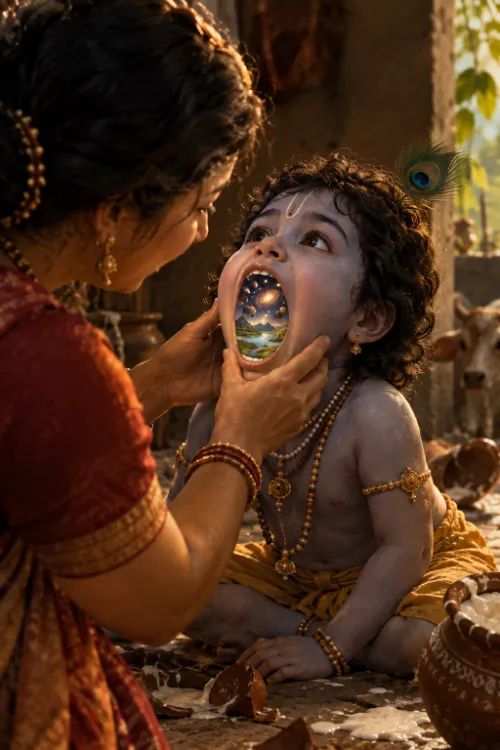
Mother Yaśodā may see the universe inside Kṛṣṇa’s mouth—and still return to thinking: “He is my son.” The cowherd boys may watch Kṛṣṇa perform impossible feats—and still wrestle with Him, climb on Him, joke with Him, and sometimes demand that He carry them on His shoulders.
The gopīs may know that nothing about Kṛṣṇa is ordinary—and still relate to Him not primarily as the Lord of countless universes, but as their beloved. This is the difference between aiśvarya-dominated devotion and the kevala-bhāva of Vraja.
The Key Word Is Not Simply Kṛṣṇa—It Is Vrajendra-kumāra
The final phrase in Antya 7.26 is critical: vrajendra-kumāra
Thus Mahāprabhu’s statement is not merely: “Knowledge of God’s greatness cannot attain God.”
That would be false within the very theology of the Caitanya-caritāmṛta. Reverential devotion to the majestic Lord is authentic bhakti. The actual point is much more precise: Awareness of divine greatness by itself does not grant access to Kṛṣṇa specifically as Nanda Mahārāja’s intimate cowherd son.
One may attain Bhagavān as the awe-inspiring Supreme Lord. One may worship Nārāyaṇa in Vaikuṇṭha. One may bow before the cosmic ruler. But Vrajendra-kumāra is encountered through the particular intimacy characteristic of Vraja.
The distinction concerns not whether Kṛṣṇa is God, but how God becomes available in relationship.
Two Modes of Kṛṣṇa-rati
Earlier in Caitanya-caritāmṛta, Mahāprabhu explains the same distinction to Rūpa Gosvāmī.
পুনঃ কৃষ্ণরতি হয় দুইত প্রকার ।
ঐশ্বর্যজ্ঞানমিশ্রা, কেবলা-ভেদ আর ॥
punaḥ kṛṣṇa-rati haya duita prakāra
aiśvarya-jñāna-miśrā, kevalā-bheda āra
“Kṛṣṇa-rati is again of two kinds: one mixed with awareness of His divine majesty, and another called kevalā, pure and unmixed.”
Caitanya-caritāmṛta, Madhya 19.192
Here the terminology is: aiśvarya-jñāna-miśrā “mixed with awareness of divine majesty” and: kevalā “pure, exclusive, unmixed.” The word kevala is important. It does not mean intellectually defective.
It means that another relational element—especially reverential consciousness of Kṛṣṇa’s overwhelming supremacy—does not interfere with the intimacy proper to the devotee’s rasa.
Gokula Is the Realm of Kevalā-rati
The following verse makes the geographical and relational contrast explicit.
গোকুলে ‘কেবলা’ রতি ঐশ্বর্যজ্ঞানহীন ।
পুরীদ্বয়ে, বৈকুণ্ঠাদ্যে — ঐশ্বর্য-প্রবীণ ॥
gokule ‘kevalā’ rati — aiśvarya-jñāna-hīna
purī-dvaye, vaikuṇṭhādye — aiśvarya-pravīṇa
“In Gokula there is kevalā-rati, in which awareness of divine majesty is not prominent; in Mathurā, Dvārakā, Vaikuṇṭha and similar realms, awareness of majesty is prominent.”
Caitanya-caritāmṛta, Madhya 19.193
The phrase: aiśvarya-jñāna-hīna may sound at first like “devoid of knowledge of God’s majesty.” But the subsequent verses demonstrate that this cannot simply mean factual ignorance.
The decisive issue is prādhānya—predominance. What governs the devotee’s emotional relationship? That is the real question.
The Most Important Explanatory Verse
The next verse is perhaps the best key to the entire doctrine.
ঐশ্বর্যজ্ঞানপ্রাধান্যে সঙ্কুচিত প্রীতি ।
দেখিয়া না মানে ঐশ্বর্য — কেবলার রীতি ॥
aiśvarya-jñāna-prādhānye saṅkucita prīti
dekhiyā nā māne aiśvarya — kevalāra rīti
“When awareness of the Lord’s majesty predominates, intimate love becomes contracted. But the characteristic of kevalā love is that even upon seeing His majesty, the devotee does not allow that majesty to govern the relationship.”
Caitanya-caritāmṛta, Madhya 19.194
This changes everything. The text says: dekhiyā — “having seen” and yet: nā māne aiśvarya — “does not give controlling importance to that majesty.” So the Vraja devotee may actually see aiśvarya.
The issue is not whether evidence of Godhood is present. The issue is what happens next. Does the devotee’s intimate relationship collapse into reverence? In Vraja: No.
Aiśvarya-jñāna-prādhānya Is the Real Contrast
A more precise formulation of the distinction is therefore: not aiśvarya-jñāna versus complete ignorance, but: aiśvarya-jñāna-prādhānya versus intimacy-prādhānya. The word prādhānya means predominance or governing importance.
One may know many true things about Kṛṣṇa. But what is emotionally primary? If consciousness is dominated by: “He is the omnipotent Supreme Lord, creator of innumerable universes, worshiped by Brahmā and Śiva,” then a natural psychological distance appears. One bows. One becomes cautious. One measures one’s words. One hesitates. One fears offense. All of this can be beautiful devotional reverence.
But certain relationships become difficult to sustain under such overwhelming awareness. Could Yaśodā threaten the cosmic creator with a stick while constantly meditating: “This child is the transcendent Parabrahman beyond prakṛti”?
Could Śrīdāma leap upon Kṛṣṇa’s back while thinking: “I am physically sitting on the source of Mahā-Viṣṇu”?
Could the gopīs quarrel with Him in jealous love while continuously maintaining formal awareness: “This is the Supreme Controller worshiped by all devas”?
Theologically, nothing prevents Kṛṣṇa from being all of these things. But rasa has its own psychological logic.
When Majesty Predominates, Love Contracts
Kṛṣṇadāsa Kavirāja uses the expression: saṅkucita prīti “contracted affection.” This does not mean that aiśvarya-bhakti is false or spiritually inferior in the crude sense of being defective.
It means that awareness of overwhelming superiority restricts certain modes of intimacy. Consider ordinary human psychology. A child may joke freely with someone. Then someone whispers: “Do you realize this man is the king?”
Nothing about the king has changed. But the child changes. Posture straightens. Speech becomes cautious. Familiarity disappears. The knowledge creates distance. Something analogous occurs in devotional rasa.
Aiśvarya naturally evokes reverence. Mādhurya permits intimacy. The more intimate the rasa, the more disruptive overwhelming reverence can become.
Śānta and Dāsya Can Accommodate More Aiśvarya
Mahāprabhu immediately explains this.
শান্ত-দাস্য-রসে ঐশ্বর্য কাহাঁ উদ্দীপন ।
বাৎসল্য-সখ্য-মধুরে ত’ করে সঙ্কোচন ॥
śānta-dāsya-rase aiśvarya kāhāṅ uddīpana
vātsalya-sakhya-madhure ta’ kare saṅkocana
“In śānta and dāsya rasa, awareness of the Lord’s majesty can act as a stimulus; but in vātsalya, sakhya and madhura rasa it causes contraction.”
Caitanya-caritāmṛta, Madhya 19.195
This is psychologically coherent.
Thus the same aiśvarya can nourish one relationship and constrict another.
A Necessary Clarification: Mādhurya Is Not the Same as Madhura-rasa
This distinction often gets blurred. Madhura-rasa refers specifically to conjugal or romantic love. But mādhurya, when contrasted with aiśvarya, has a broader theological meaning: the sweetness, intimacy and humanlike accessibility of Kṛṣṇa’s personal existence.
Therefore Vraja-mādhurya includes: dāsya — intimate service, sakhya — friendship, vātsalya — parental love, and: madhura — conjugal love. Yaśodā’s love is not madhura-rasa.
But it is one of the supreme manifestations of Kṛṣṇa’s mādhurya. The contrast is: majesty versus sweetness, not merely reverence versus romantic love.
Vasudeva and Devakī: When Godhood Interrupts Parenthood
The Caitanya-caritāmṛta gives a perfect example of saṅkucita-prīti.
বসুদেব-দেবকীর কৃষ্ণ চরণ বন্দিল ।
ঐশ্বর্যজ্ঞানে দুঁহার মনে ভয় হৈল ॥
vasudeva-devakīra kṛṣṇa caraṇa vandila
aiśvarya-jñāne duṅhāra mane bhaya haila
“When Kṛṣṇa bowed at the feet of Vasudeva and Devakī, awareness of His divine majesty caused reverential fear to arise in their minds.”
Caitanya-caritāmṛta, Madhya 19.196
The Bhāgavatam describes the underlying psychology.
देवकी वसुदेवश्च विज्ञाय जगदीश्वरौ ।
कृतसंवन्दनौ पुत्रौ सस्वजाते न शङ्कितौ ॥
devakī vasudevaś ca
vijñāya jagad-īśvarau
kṛta-saṁvandanau putrau
sasvajāte na śaṅkitau
“Devakī and Vasudeva, understanding that their sons were the Lords of the universe, became hesitant and did not immediately embrace Them.”
Śrīmad-Bhāgavatam 10.44.51
The crucial phrase is: vijñāya jagad-īśvarau “understanding Them to be the Lords of the universe.” That realization interrupts spontaneous parental behavior. The emotional sequence is almost visible: “My sons!”
becomes: “Wait—these are the Lords of the universe.” And the embrace pauses. That is aiśvarya-jñāna producing saṅkoca, contraction.
Yaśodā Gives the Opposite Example
Mother Yaśodā provides the clearest possible example of kevala-vātsalya. One day the child Kṛṣṇa is accused of eating dirt. Yaśodā tells Him to open His mouth. He does. Inside that tiny mouth she sees the cosmos.
सा तत्र ददृशे विश्वं
जगत् स्थास्नु च खं दिशः ।
साद्रिद्वीपाब्धिभूगोलं
सवाय्वग्नीन्दुतारकम् ॥
sā tatra dadṛśe viśvaṁ
jagat sthāsnu ca khaṁ diśaḥ
sādri-dvīpābdhi-bhūgolaṁ
sa-vāyv-agnīndu-tārakam
“There she saw the entire universe—the moving and nonmoving creation, space and all directions, mountains, islands, oceans, the earth, air, fire, moon and stars.”
Śrīmad-Bhāgavatam 10.8.37
The succeeding verses expand the vision further. She sees the elements. Cosmic principles. Living beings. Time. Nature. The guṇas. Even Vraja. Even herself. In other words: Yaśodā receives overwhelming empirical evidence that the child standing before her is not an ordinary child.
If kevala-bhāva simply depended upon ignorance, the experience should destroy her maternal mood forever. It does not.
The Vedas Say “Hari”; Yaśodā Says “My Son”
The Bhāgavatam summarizes the paradox magnificently.
त्रय्या चोपनिषद्भिश्च
साङ्ख्ययोगैश्च सात्वतैः ।
उपगीयमानमाहात्म्यं
हरिं सामन्यतात्मजम् ॥
trayyā copaniṣadbhiś ca
sāṅkhya-yogaiś ca sātvataiḥ
upagīyamāna-māhātmyaṁ
hariṁ sāmanyatātmajam
“Hari, whose greatness is sung by the Vedas, the Upaniṣads, Sāṅkhya, yoga and the Vaiṣṇava scriptures—she regarded that very Lord as her own son.”
Śrīmad-Bhāgavatam 10.8.45
This may be one of the finest scriptural descriptions of Vraja-mādhurya. The Vedas say: Hari. The Upaniṣads say: the Supreme. Philosophy says: the Absolute. Yaśodā says: “My boy.”
And the Bhāgavatam does not portray her as theologically deficient. It portrays her relationship as astonishingly intimate.
“Even When Aiśvarya Is Seen, One Holds to One’s Own Relationship”
Later Mahāprabhu states the principle almost mathematically.
‘কেবলা’র শুদ্ধপ্রেম ‘ঐশ্বর্য’ না জানে ।
ঐশ্বর্য দেখিলেও নিজ-সম্বন্ধ সে মানে ॥
‘kevalā’ra śuddha-prema ‘aiśvarya’ nā jāne
aiśvarya dekhileo nija-sambandha se māne
“The pure prema of kevalā love does not concern itself with divine majesty; even when aiśvarya is seen, the devotee maintains his own intimate relationship.”
Caitanya-caritāmṛta, Madhya 19.203
The second line is the theological jewel: aiśvarya dekhileo nija-sambandha se māne “Even after seeing His divine majesty, one still holds to one’s own relationship.” That sentence rules out the simplistic interpretation that Vraja love depends upon misinformation.
The issue is not: “What facts do I possess?” The issue is: “Who is Kṛṣṇa to me?”
Sambandha Is More Powerful Than Abstraction
The word sambandha means relationship, connection. For Yaśodā: “He is my son.” For Subala or Śrīdāma: “He is my friend.” For the gopīs: “He is our beloved.” These are not metaphorical approximations masking the “real truth” that Kṛṣṇa is merely an impersonal Absolute.
Within Gauḍīya theology, the relationship itself reveals a deeper personal dimension of the Absolute. Thus the Vraja-vāsī does not say: “Kṛṣṇa is not God.”
The heart says something closer to: “Whatever else He may be, He is still mine.”
That is kevala-bhāva.
The Cowherd Boys: A Perfect Scriptural Comparison
One of the most extraordinary verses describing Vraja-sakhya is Śrīmad-Bhāgavatam 10.12.11.
इत्थं सतां ब्रह्मसुखानुभूत्या
दास्यं गतानां परदैवतेन ।
मायाश्रितानां नरदारकेण
साकं विजह्रुः कृतपुण्यपुञ्जाः ॥
itthaṁ satāṁ brahma-sukhānubhūtyā
dāsyaṁ gatānāṁ para-daivatena
māyāśritānāṁ nara-dārakeṇa
sākaṁ vijahruḥ kṛta-puṇya-puñjāḥ
“In this way those greatly fortunate cowherd boys played with Him who is experienced by the sages as the bliss of Brahman, by those in reverential devotion as the Supreme Deity, and by those under māyā merely as an ordinary human child.”
The verse gives several perspectives on the same Kṛṣṇa. The contemplative sage realizes: brahma-sukha — the bliss of Brahman. The reverential devotee recognizes: para-daivata — the Supreme Deity.
The materially deluded see: nara-dāraka — merely a human child. But the Vraja boys do something astonishing: sākaṁ vijahruḥ “They played with Him.” They do not merely possess information about the Absolute.
They possess the Absolute as their friend.
Material Ignorance and Vraja Intimacy Are Opposites
This verse helps us distinguish two superficially similar but spiritually opposite states. A conditioned materialist may look at Kṛṣṇa and think: “He is just a human boy.”
A Vraja cowherd boy may also treat Him like a human boy. Externally, the behavior may appear similar. Internally, the two states could not be further apart. The materialist’s ordinary vision comes from māyā.
The Vraja devotee’s intimate vision operates through Yogamāyā, Kṛṣṇa’s internal spiritual potency. One does not perceive Kṛṣṇa. The other perceives Kṛṣṇa so intimately that Godhood no longer creates distance.
That distinction is essential.
The Friends Climb Onto God’s Shoulders
Mahāprabhu gives a deliberately startling description.
শুদ্ধভাবে সখা করে স্কন্ধে আরোহণ ।
শুদ্ধভাবে ব্রজেশ্বরী করেন বন্ধন ॥
śuddha-bhāve sakhā kare skandhe ārohaṇa
śuddha-bhāve vrajeśvarī karena bandhana
“In pure bhāva, Kṛṣṇa’s friend climbs onto His shoulders, and in pure bhāva the Queen of Vraja binds Him.”
Caitanya-caritāmṛta, Antya 7.30
This is Vraja theology compressed into two images: A boy sits on God’s shoulders. A mother ties God with rope. If these actions arose from contempt, they would be offensive.
But arising from pure prema, they become signs of supreme intimacy. The issue is never merely external behavior. It is the bhāva producing the behavior.
“My Friend.” “My Son.”
The following verse makes the internal consciousness explicit.
‘মোর সখা’, ‘মোর পুত্র’, — এই ‘শুদ্ধ’ মন ।
অতএব শুক-ব্যাস করে প্রশংসন ॥
‘mora sakhā’, ‘mora putra’, — ei ‘śuddha’ mana
ataeva śuka-vyāsa kare praśaṁsana
“‘He is my friend.’ ‘He is my son.’ This is the pure consciousness; therefore Śukadeva and Vyāsa praise it.”
Caitanya-caritāmṛta, Antya 7.31
The word mora—“my” is especially revealing. Aiśvarya naturally says: “I belong to Him.” Vraja-prema becomes so intimate that the devotee can experience: “He belongs to me.”
This is not egoistic possession. It is loving possession. The Supreme freely makes Himself the treasure of His devotee.
The Dāmodara Līlā: The Unbindable Becomes Bound
Nowhere is this more dramatic than in the Dāmodara pastime. Yaśodā tries to tie mischievous Kṛṣṇa to a mortar. Again and again the rope is two fingers too short. Finally Kṛṣṇa sees His mother exhausted.
स्वमातुः स्विन्नगात्राया
विस्रस्तकबरस्रजः ।
दृष्ट्वा परिश्रमं कृष्णः
कृपयासीत् स्वबन्धने ॥
sva-mātuḥ svinna-gātrāyā
visrasta-kabara-srajaḥ
dṛṣṭvā pariśramaṁ kṛṣṇaḥ
kṛpayāsīt sva-bandhane
“Seeing His own mother perspiring from her effort, with the flowers falling from her loosened hair, Kṛṣṇa became merciful and consented to be bound by her.”
Śrīmad-Bhāgavatam 10.9.18
The theology is extraordinary. Prakṛti cannot bind Him. Karma cannot bind Him. Time cannot bind Him. The guṇas cannot bind Him. Yet Yaśodā binds Him. Why? Not because her rope is stronger than infinity.
Because: Kṛṣṇa allows prema to conquer Him.
The Lord’s Freedom Includes the Freedom to Be Conquered
This is a crucial feature of Gauḍīya thought. At first one might think: “If God becomes controlled by His devotee, His supremacy has diminished.”
The Bhāgavata answer is almost the opposite. A supreme being who could not freely enter intimate reciprocal love would possess a strange limitation. Kṛṣṇa’s sovereignty is so complete that He can willingly put sovereignty in the background.
His supremacy includes the freedom: not always to act supreme. Therefore the mādhurya of Vraja does not diminish aiśvarya. It conceals and surpasses its relational effect.
Even Brahmā, Śiva, and Lakṣmī Do Not Receive Yaśodā’s Exact Mercy
The Bhāgavatam immediately emphasizes Yaśodā’s extraordinary position.
नेमं विरिञ्चो न भवो
न श्रीरप्यङ्गसंश्रया ।
प्रसादं लेभिरे गोपी
यत्तत्प्राप विमुक्तिदात् ॥
nemaṁ viriñco na bhavo
na śrīr apy aṅga-saṁśrayā
prasādaṁ lebhire gopī
yat tat prāpa vimukti-dāt
“Neither Brahmā, nor Śiva, nor even Śrī, the goddess of fortune who always rests upon the Lord, obtained the particular mercy that this gopī, Yaśodā, received from the giver of liberation.”
Śrīmad-Bhāgavatam 10.9.20
The verse does not insult Brahmā, Śiva, or Lakṣmī. It establishes a different point: knowledge of divine greatness and even eternal proximity to the majestic Lord are not identical with every possible intimacy available in Vraja.
Bhagavān as Gopikā-suta
Immediately after Antya 7.26, Caitanya Mahāprabhu cites another key Bhāgavata verse.
नायं सुखापो भगवान्
देहिनां गोपिकासुतः ।
ज्ञानिनां चात्मभूतानां
यथा भक्तिमतामिह ॥
nāyaṁ sukhāpo bhagavān
dehināṁ gopikā-sutaḥ
jñānināṁ cātma-bhūtānāṁ
yathā bhakti-matām iha
“Bhagavān as Gopikā-suta, the son of Yaśodā, is not easily attained by ordinary embodied beings or through impersonal self-realization in the way He is attained by those endowed with devotion.”
Śrīmad-Bhāgavatam 10.9.21
Again the title matters: gopikā-sutaḥ “the son of the gopī.” The issue is not merely access to some generic conception of God. It is access to: God-as-Yaśodā’s-child. That is a relational revelation.
Arjuna Shows What Happens When Aiśvarya Suddenly Floods Sakhya
Arjuna provides another perfect contrast. Before seeing Kṛṣṇa’s universal form, Arjuna relates to Him as a close friend. Then comes the viśvarūpa. Suddenly Arjuna sees cosmic infinity, divine terror, innumerable beings entering Kṛṣṇa’s blazing mouths, gods bowing, worlds trembling.
The Caitanya-caritāmṛta describes the psychological result.
কৃষ্ণের বিশ্বরূপ দেখি’ অর্জুনের হৈল ভয় ।
সখ্যভাবে ধার্ষ্ট্য ক্ষমাপয় করিয়া বিনয় ॥
kṛṣṇera viśva-rūpa dekhi’ arjunera haila bhaya
sakhya-bhāve dhārṣṭya kṣamāpaya kariyā vinaya
“Seeing Kṛṣṇa’s universal form, Arjuna became afraid and humbly begged forgiveness for the familiarity he had shown in friendship.”
Madhya 19.198
The Bhagavad-gītā itself records this change.
सखेति मत्वा प्रसभं यदुक्तं
हे कृष्ण हे यादव हे सखेति ।
अजानता महिमानं तवेदं
मया प्रमादात्प्रणयेन वापि ॥
sakheti matvā prasabhaṁ yad uktaṁ
he kṛṣṇa he yādava he sakheti
ajānatā mahimānaṁ tavedaṁ
mayā pramādāt praṇayena vāpi
“Thinking of You as my friend, I rashly addressed You as ‘O Kṛṣṇa,’ ‘O Yādava,’ ‘O my friend,’ not knowing Your greatness, through carelessness or because of affection.”
Bhagavad-gītā 11.41–42
Arjuna continues:
यच्चावहासार्थमसत्कृतोऽसि
विहारशय्यासनभोजनेषु …
तत्क्षामये त्वामहमप्रमेयम् ॥
yac cāvahāsārtham asat-kṛto ’si
vihāra-śayyāsana-bhojaneṣu …
tat kṣāmaye tvām aham aprameyam
“Whatever disrespect I may have shown You in jest, while playing, resting, sitting or eating together—I beg forgiveness from You, O immeasurable Lord.”
This is saṅkucita-sakhya under an overwhelming revelation of aiśvarya. The friend suddenly thinks: “How could I have behaved so casually?”
The Vraja Cowherd Boys React Differently
The Vraja boys repeatedly witness astonishing acts. Kṛṣṇa kills demons. He dances on Kāliya. He swallows a forest fire. He lifts Govardhana Hill. He protects everyone from impossible danger.
Yet their friendship does not permanently collapse into formal worship. They may marvel. They may celebrate Him. But soon: they eat together, steal from each other’s lunch, joke, wrestle, race, argue, and play.
In Vraja, aiśvarya is repeatedly domesticated by intimacy. One might summarize their reaction not as: “Now we understand that our friend is actually God, therefore we must stop playing with Him,” but rather: “Our friend Kṛṣṇa is unbelievable!”
The miracle is absorbed into friendship. Friendship is not absorbed into the miracle.
The Gopīs Carry Kevala-bhāva to Its Most Intense Form
The same principle reaches extraordinary intensity in the Vraja-gopīs. Caitanya Mahāprabhu quotes Uddhava’s famous praise.
नायं श्रियोऽङ्ग उ नितान्तरतेः प्रसादः
स्वर्योषितां नलिनगन्धरुचां कुतोऽन्याः ।
रासोत्सवेऽस्य भुजदण्डगृहीतकण्ठ-
लब्धाशिषां य उदगाद् व्रजसुन्दरीणाम् ॥
nāyaṁ śriyo ’ṅga u nitānta-rateḥ prasādaḥ
svar-yoṣitāṁ nalina-gandha-rucāṁ kuto ’nyāḥ
rāsotsave ’sya bhuja-daṇḍa-gṛhīta-kaṇṭha-
labdhāśiṣāṁ ya udagād vraja-sundarīṇām
“Not even Śrī, the goddess of fortune, though eternally devoted to the Lord, obtained the particular favor granted to the beautiful women of Vraja, whose necks Kṛṣṇa embraced with His arms during the rāsa festival; what then can be said of others?”
Śrīmad-Bhāgavatam 10.47.60
Again, the argument is not that Lakṣmī’s devotion is somehow material. The point is: a particular kind of intimacy requires a particular kind of prema. The majestic relationship and the Vraja relationship are not interchangeable.
Aiśvarya Is Not Rejected
This must be emphasized. Gauḍīya theology is not advocating theological ignorance. It does not teach: “Do not know that Kṛṣṇa is God.” Quite the opposite. Caitanya-caritāmṛta repeatedly establishes: Kṛṣṇa is Svayaṁ Bhagavān.
রামানন্দ-রায় কৃষ্ণ-রসের ‘নিধান’ ।
তেঁহ জানাইলা — কৃষ্ণ — স্বয়ং ভগবান্ ॥
rāmānanda-rāya kṛṣṇa-rasera ‘nidhāna’
teṅha jānāilā — kṛṣṇa — svayaṁ bhagavān
“Rāmānanda Rāya is a treasury of Kṛṣṇa-rasa; he taught that Kṛṣṇa is Svayaṁ Bhagavān, the Supreme Personality Himself.”
Caitanya-caritāmṛta, Antya 7.23
This statement comes before Mahāprabhu praises kevala-bhāva. That sequence matters. The theological order is: First: know who Kṛṣṇa actually is. Then: understand why His highest intimate devotees do not allow that truth to create emotional distance.
Thus Vraja-prema is not less informed than theology. It is relationally deeper than theology alone can produce.
Tattva and Rasa Must Be Distinguished
This leads to one of the most useful conceptual distinctions: tattva and rasa.
The statement: “Kṛṣṇa is the Supreme Lord” belongs primarily to tattva.
The statement: “Kṛṣṇa is my son” belongs to rasa and sambandha. They do not contradict each other. But in Vraja, rasa determines immediate experience.
The Context of Antya-līlā 7 Makes the Doctrine Even More Powerful
Antya-līlā 7 describes Caitanya Mahāprabhu’s encounter with Vallabha Bhaṭṭa. Mahāprabhu presents Himself with characteristic humility and attributes His understanding to great devotees.
He says that Rāmānanda Rāya taught Him two central truths. First:
কৃষ্ণ — স্বয়ং ভগবান্
kṛṣṇa — svayaṁ bhagavān
“Kṛṣṇa is Bhagavān Himself.”
Antya 7.23
Then:
তাতে প্রেমভক্তি — ‘পুরুষার্থ-শিরোমণি’ ।
রাগমার্গে প্রেমভক্তি ‘সর্বাধিক’ জানি ॥
tāte prema-bhakti — ‘puruṣārtha-śiromaṇi’
rāga-mārge prema-bhakti ‘sarvādhika’ jāni
“Prema-bhakti is the crown jewel of all human goals, and prema-bhakti on the path of rāga is understood to be supreme.”
Antya 7.24
Then comes the distinction: aiśvarya-jñāna-yukta versus: kevala-bhāva. The logical architecture is therefore: Kṛṣṇa is Svayaṁ Bhagavān. ↓ Prema is the supreme goal. ↓ Rāga-based prema reaches extraordinary intimacy.
↓ Kṛṣṇa-rati may be governed by majesty or unmixed intimacy. ↓ Aiśvarya alone cannot yield Vrajendra-kumāra. This is not anti-intellectual theology. It is a theology of relational depth.
The Supreme Goal Is Not Merely to Know What Kṛṣṇa Is
Knowledge can answer: “Who is Kṛṣṇa?” But prema asks: “Who is Kṛṣṇa to me?” One may correctly understand: “Kṛṣṇa is the cause of all causes.” Yet that knowledge alone does not produce: “Kṛṣṇa is my son.”
One may know: “Kṛṣṇa is the indwelling Paramātmā.” That does not automatically produce: “Come wrestle with me.” One may prove philosophically: “Kṛṣṇa is Svayaṁ Bhagavān.”
That does not automatically produce the gopīs’ longing. Knowledge identifies. Prema relates. That is why Antya 7.26 says: aiśvarya-jñāne nā pāi vrajendra-kumāra It is not attacking knowledge.
It is declaring that knowledge of greatness cannot manufacture intimacy.
Vraja-prema Is Not the Absence of Truth—It Is the Triumph of Relationship
This point can now be stated carefully. There are at least three very different ways a person may respond to Kṛṣṇa.
The Meaning of Yogamāyā
The distinction between māyā and Yogamāyā is indispensable here. Ordinary māyā causes the conditioned soul to misunderstand reality. Under māyā one may see Kṛṣṇa and think: “Just another man.”
Yogamāyā is Kṛṣṇa’s spiritual potency that facilitates His intimate līlā. Through Yogamāyā, the Vraja-vāsī may treat Kṛṣṇa with humanlike familiarity without that intimacy being material ignorance.
Externally the two may seem similar. But internally: māyā hides Kṛṣṇa because one lacks realization. Yogamāyā hides His majesty so that realization can become intimacy. That is an enormous difference.
Mādhurya Does Not Erase Aiśvarya—It Covers It
Kṛṣṇa does not cease to be omnipotent in Vṛndāvana. He does not temporarily stop being Bhagavān. His aiśvarya remains fully present. But it is often covered by sweetness.
He lifts Govardhana. Yet He remains the village boy. He kills Pūtanā. Yet Yaśodā still worries whether He is hungry. He reveals the cosmos. Yet she later feeds Him. He controls all existence.
Yet His friends tackle Him in play. He liberates souls. Yet the gopīs become angry when He disappears from the rāsa dance. This is why Vraja is not the realm of reduced divinity.
It is the realm where divinity becomes so perfectly personal that omnipotence no longer monopolizes the relationship.
Majesty Says “Bow”; Sweetness Says “Come Here”
The contrast can be expressed very simply.
Aiśvarya produces: wonder. Mādhurya produces: belonging.
Aiśvarya says: “He is the Lord of everything.” Vraja says: “Yes—and He stole butter from my kitchen.” Aiśvarya says: “He supports innumerable universes.” Yaśodā says: “He needs to eat.”
Aiśvarya says: “He is unconquerable.” Vraja-prema answers: “Then why is He running away from His mother?” This is not satire at the expense of Godhood. It is the theological beauty of a God whose greatness includes the capacity for absolute intimacy.
Why Vraja Is Considered So Confidential
One can understand divine greatness philosophically. Power is conceptually straightforward: If God is supreme, He must be able to create. If God is omniscient, He must know everything.
If God is omnipotent, He must control everything. But Vraja asks a stranger question: What does the all-powerful do when power is no longer needed? The answer is: He plays.
He jokes. He steals butter. He goes to pasture cows. He allows His friends to defeat Him. He cries before His mother. He meets the gopīs under the moon. This is why mādhurya is considered deeply confidential.
Cosmic sovereignty tells us how great God is. Vraja tells us what God loves.
The Paradox of Divine Supremacy
We can now see the theological paradox. Kṛṣṇa is supreme because nothing can control Him. Yet He is also supremely lovable because He chooses to be controlled by love. These are not contradictions.
His submission is voluntary. Matter does not overpower Him. Karma does not overpower Him. Time does not overpower Him. No rival God overpowers Him. But prema does not behave like an external enemy conquering Him.
Prema belongs to His own internal spiritual world. Thus: the Lord who controls everything freely allows His devotees to control Him. This is bhakta-vaśyatā—the Lord’s willing subordination to His devotee.
Yaśodā’s Rope Explains More Than a Thousand Abstract Arguments
The Dāmodara story therefore becomes a theological masterpiece. The Supreme cannot be measured. Yet Yaśodā measures rope. The Supreme cannot be bound. Yet Yaśodā tries to bind Him.
The rope repeatedly remains too short. Then Kṛṣṇa sees her exhaustion and allows Himself to be bound. The point is not: “Yaśodā became stronger than God.” It is: God decided that His mother’s love should win.
That is mādhurya.
The Highest Intimacy Does Not Continuously Announce Itself as “Highest”
Another subtle feature of Vraja-prema is that the Vraja-vāsīs do not stand around congratulating themselves: “Our rasa is superior to Vaikuṇṭha-bhakti.”
Such self-conscious theological ranking would itself destroy the immediacy of their love. Yaśodā does not think: “My vātsalya is an advanced manifestation of kevala-rati free from aiśvarya-jñāna-prādhānya.”
She thinks: “Where is that boy? Has He eaten?”
The cowherd boys do not think: “We represent the supremacy of viśrambha-sakhya.”
They think: “Kṛṣṇa cheated! Catch Him!”
That unconscious naturalness is part of the very phenomenon theology is trying to describe.
Viśrambha — Intimacy Without Fear
A useful Gauḍīya concept here is viśrambha. The word carries the sense of deep confidence, familiarity, trust, and absence of formal distance. In intimate Vraja relationships, especially sakhya and madhura, viśrambha becomes central.
Reverence repeatedly reminds the devotee: “He is above me.” Viśrambha allows: “He is mine, and I am His.” This does not erase ontological difference between the finite jīva and Kṛṣṇa.
It erases relational stiffness.
The Difference Between Equality of Love and Equality of Being
This distinction is important. When the cowherd boys treat Kṛṣṇa as equal, Gauḍīya theology does not mean: they are ontologically identical with Kṛṣṇa in every respect. It means: their rasa allows equality of familiarity.
Kṛṣṇa permits Himself to be treated as: friend among friends. Similarly, when Yaśodā feels superior to Kṛṣṇa as His mother, this does not mean she becomes metaphysically greater than Bhagavān.
It means that vātsalya-rasa requires the mother to experience herself as caretaker and protector. Rasa creates relational positions that divine omnipotence willingly honors.
The Great Secret: God’s Personality Is Not a Limitation
Much philosophy begins with the intuition that the Absolute must be beyond personality because personality seems limited. The Bhāgavata tradition reverses this assumption.
Material personality is limited. But perfect personality need not be. Kṛṣṇa can remain infinite while entering finite-looking relationships. He can be: the source of universes and Yaśodā’s son.
He can be: the indwelling Self of all beings and Arjuna’s friend. He can be: the Supreme Lord and the beloved of the gopīs. The relational identity does not reduce the Absolute.
It reveals a capacity that impersonal grandeur cannot display: reciprocal love.
Aiśvarya Reveals Power; Mādhurya Reveals Freedom
There is another way of framing the distinction. Aiśvarya shows that Kṛṣṇa can do anything. Mādhurya shows that He does not need to prove it. He can hide omnipotence. He can behave like a child.
He can ask a friend for food. He can become frightened when Yaśodā raises a stick. He can lose a game. He can carry another boy. None of these actions diminish His supremacy.
They reveal freedom from the need to display supremacy. In that sense: mādhurya is not the absence of aiśvarya. It is mastery over aiśvarya.
Why Mere Knowledge Cannot Reach Vrajendra-kumāra
We can finally return to the precise wording of Antya 7.26: aiśvarya-jñāne nā pāi vrajendra-kumāra Why not? Because knowing: “Kṛṣṇa is omnipotent” does not create motherhood.
Knowing: “Kṛṣṇa is the Absolute Truth” does not create friendship. Knowing: “Kṛṣṇa is the source of all Viṣṇu forms” does not create the gopīs’ love. Knowledge may provide correct ontological orientation.
But the relationships of Vraja require: rāga, rati, prema, sambandha, intimacy. One cannot deduce Yaśodā’s motherhood from metaphysics. One must enter the world of prema.
The Central Principle
The entire teaching can be condensed into the phrase: aiśvarya dekhileo nija-sambandha se māne “Even upon seeing Kṛṣṇa’s divine majesty, the devotee maintains his or her own intimate relationship with Him.”
That single sentence protects the doctrine from two opposite misunderstandings. It prevents us from saying: “The Vraja-vāsīs simply do not know who Kṛṣṇa is.” And it prevents us from saying: “Their intimacy proves that Kṛṣṇa is merely human.”
Instead: They encounter the Supreme precisely as son, friend and beloved.
A Clear Comparison
The difference can be summarized like this. Aiśvarya-dominated bhakti: “He is my Lord because He is infinitely great.” Kevala Vraja-bhāva: “He may be infinitely great—but He is still my Kṛṣṇa.”
The first is reverential. The second is intimate. Both accept Kṛṣṇa. But they encounter Him differently.
The Deeper Meaning of Kevala
The word kevala finally becomes much clearer. It does not mean: uninformed, naive, irrational, or lacking theology. It means: unmixed in relational orientation. Yaśodā’s motherhood is not repeatedly interrupted by God-consciousness.
Śrīdāma’s friendship is not repeatedly converted into formal worship. The gopīs’ love is not continually restrained by awareness of cosmic hierarchy. Their sambandha remains whole.
That is kevala-bhāva.
The Deepest Theological Point
The highest message of Antya-līlā 7.26 may therefore be stated this way: The greatness of Kṛṣṇa does not reach its fullest revelation merely when everyone falls before Him. His greatness is also revealed when He possesses such perfect freedom, beauty and love that His devotees can forget to fall down at all.
Instead: Yaśodā runs after Him. His friends jump onto Him. The gopīs argue with Him. And Kṛṣṇa accepts all of it. Because that intimacy is not a denial of His godhood. It is one of the things His godhood makes possible.
Caitanya-caritāmṛta Antya 7.26 does not teach that theological knowledge is useless. It teaches that knowledge of divine majesty and intimate prema are not identical achievements.
Aiśvarya-jñāna tells us: Kṛṣṇa is the Supreme Lord. Kevala-bhāva says: “And still He is my son.” “And still He is my friend.” “And still He is my beloved.” This is why the inhabitants of Vraja are not portrayed as people who possess false knowledge.
They possess something even more intimate than formal awareness of Godhood: an unbreakable personal sambandha with Bhagavān Himself. They may see miracles. They may see universal forms.
They may witness the impossible. But love repeatedly answers: “Whatever else may be true about Him, He is still my Kṛṣṇa.”
That is the essence of kevala-bhāva. And that is why Gauḍīya Vaiṣṇavism regards Vraja not as the place where God’s greatness is absent, but as the place where His greatness is so completely conquered by sweetness that omnipotence itself steps aside to make room for love.
Primary texts and useful online editions
The principal passages discussed here are found in Caitanya-caritāmṛta, Antya-līlā 7.23–32 and Madhya-līlā 19.192–203; Śrīmad-Bhāgavatam 10.8, 10.9, 10.12.11, 10.44.51 and 10.47.60; and Bhagavad-gītā 11.41–42.