The title
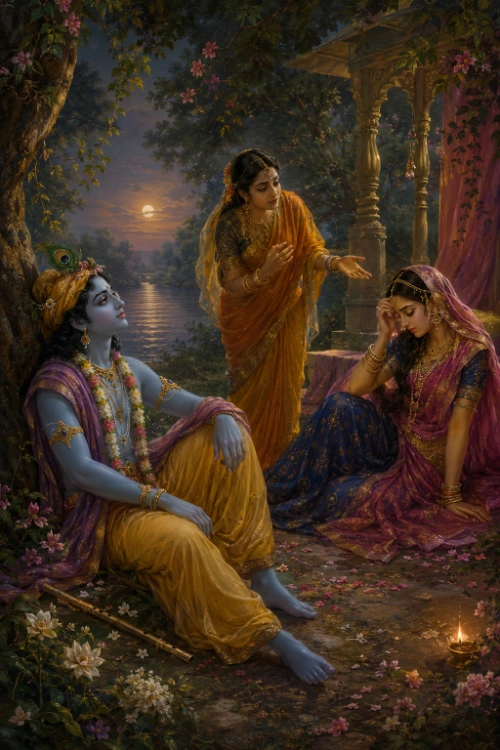
The fourth canto is named Snigdha-Mādhava. Snigdha covers a wide range — tender, affectionate, loving, soft, smooth, warm-hearted, deeply attached — and the choice is exact. The third canto showed Kṛṣṇa bewildered by his own longing; the fourth begins to turn that longing outward, into tender concern for Rādhā. What the sakhī works on is not his desire, which is already overwhelming, but his sense of responsibility.
The sakhī becomes a messenger
Until this point Rādhā’s friend has mostly listened. From here she is an active dūtī, a messenger and mediator, and the canto’s whole mechanism changes with her. Rādhā and Kṛṣṇa have each been suffering privately. Rādhā knows she cannot live without Kṛṣṇa; Kṛṣṇa knows he cannot live without Rādhā; but neither yet knows the extent of the other’s suffering. The sakhī is what crosses that gap. She carries emotional knowledge from one side of the separation to the other, and she chooses what Kṛṣṇa needs to hear.
That is why her role is far greater than an ordinary messenger’s. She interprets Rādhā to Kṛṣṇa. She returns, again and again, to the same points: Rādhā remembers no one else; she has grown physically emaciated; every cooling thing burns her; she draws his picture; she chants his name; she loses consciousness; she survives only by meditating on him; and his embrace alone can cure her.
Cause, disease, physician and medicine
The most sophisticated structure in the canto is its medical metaphor. Rādhā suffers from atanu-jvara, the fever of the Bodiless One, and the sakhī sets out the symptoms as a physician would: emaciation, burning breath, tears, delirium, collapse, unconsciousness. Then she names the treatment, and it is not sandalwood, moonlight or lotus leaves but tvad-aṅga-saṅgāmṛta-mātra-sādhyām — curable by the nectar of contact with your body, and by nothing else.
The rhetorical trap closes from four directions at once. Kṛṣṇa caused the longing. Kṛṣṇa is its object. Kṛṣṇa is the physician, addressed as the equal of the Aśvins. And Kṛṣṇa’s embrace is the medicine. Once the argument is put in those terms he cannot remain passive without becoming morally answerable for her condition, and the sakhī says as much: withhold the cure and you are harsher than the thunderbolt.
The two lovers begin to mirror one another
The canto also completes a symmetry that began in the third. There Kṛṣṇa placed Rādhā in his heart, searched for her, imagined her standing before him, spoke to a woman who was not present, and suffered Kāma’s arrows. Here Rādhā places Kṛṣṇa in her heart, draws him in solitude, imagines him standing before her, addresses an absent Kṛṣṇa, and suffers the same arrows. Their states have become reflections of each other. They remain separated in space, but psychologically the movement toward union has already begun.
The deepest image
The single most revealing moment is the second stanza of the eighth Aṣṭapadī. Rādhā lays wet lotus leaves over her heart like armour — and the sakhī explains the gesture as bhavad-avanāya, “for your protection.” Kṛṣṇa is already inside her heart, so when she shields it from Kāma’s arrows she is shielding him. She is the one being pierced, and her concern is for him. In a canto full of symptoms and arguments, that one image states Jayadeva’s conception of Rādhā’s love more precisely than any of them: even in suffering caused by Kṛṣṇa, her attention never turns back on herself.
Toward the fifth canto
The sakhī has now finished the first half of her task. She has carried Rādhā’s condition to Kṛṣṇa; the direction is about to reverse. In Sarga V — Sākāṅkṣa-Puṇḍarīkākṣa, the longing lotus-eyed lord, she returns to Rādhā and tells her that Kṛṣṇa is waiting: he has prepared the bower, he listens for her footsteps, he imagines her arrival. The messenger who has just told Kṛṣṇa that Rādhā is dying for him will now tell Rādhā that Kṛṣṇa is waiting for her, and the lovers’ private longing turns into the attempted abhisāra, the secret journey toward the meeting.