

Madness, Meaning, and the Bhāgavata
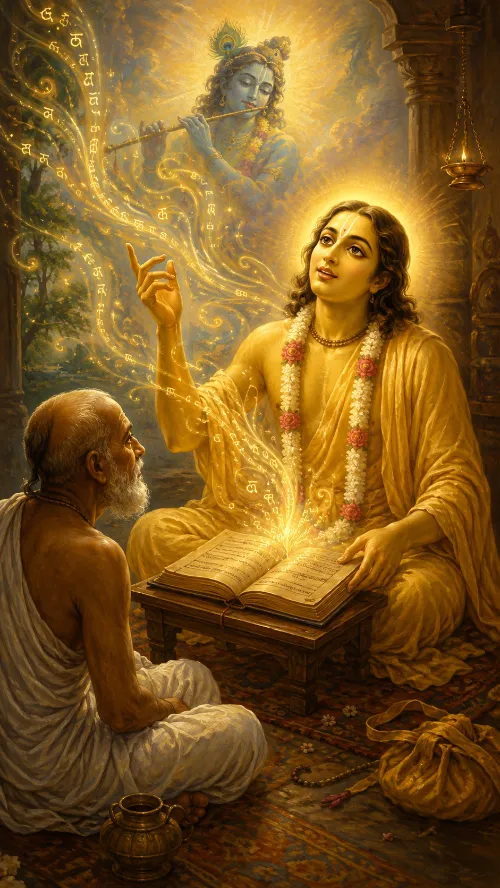
Why Mahāprabhu Called His Own Explanation Madness
At the end of one of the most extraordinary displays of scriptural interpretation in the Caitanya-caritāmṛta, Śrī Caitanya Mahāprabhu makes a startling statement:
আমা-হেন যেবা কেহ ‘বাতুল’ হয় ।
এই-দৃষ্টে ভাগবতের অর্থ জানয় ॥
āmā-hena yebā keha ‘vātula’ haya
ei-dṛṣṭe bhāgavatera artha jānaya
“One who becomes a ‘madman’ like Me may understand the meaning of the Bhāgavata in this way.”
Caitanya-caritāmṛta, Madhya 24.323
Read by itself, the statement can easily be misunderstood. Does Mahāprabhu mean that rational thought must be abandoned? Does spiritual ecstasy permit a person to invent whatever meaning he wishes from scripture? Is “madness” being recommended as a substitute for grammar, logic, scholarship or disciplined interpretation?
The context shows precisely the opposite. Mahāprabhu speaks these words after giving sixty-one explanations of a single Sanskrit verse — the celebrated ātmārāma verse of the Śrīmad-Bhāgavatam. His interpretations depend upon Sanskrit vocabulary, grammatical relationships, semantic range, particles, śāstric cross-reference, theological consistency and devotional realisation. What He jokingly calls “madness” appears at the conclusion of an astonishing display of intellectual precision.
The “madman” of Madhya 24.323 is therefore not a confused interpreter. He is a person whose intelligence has become flooded with Kṛṣṇa-bhakti. The passage points toward a distinctively Gauḍīya understanding of sacred reading: scripture is not fully understood through linguistic skill alone, yet genuine spiritual realisation never licenses arbitrary interpretation. The deepest reading emerges where śāstric intelligence and transformed devotional consciousness meet.
“Who Will Accept the Babbling of a Madman?”
Madhya 24.323 is actually the second half of a playful conclusion. Immediately before it, Mahāprabhu says:
এই মত কহিলুঁ এক শ্লোকের ব্যাখ্যান ।
বাতুলের প্রলাপ করি’ কে করে প্রমাণ ? ॥
ei mata kahiluṅ eka ślokera vyākhyāna
vātulera pralāpa kari’ ke kare pramāṇa?
“In this way I have explained a single verse. Who will accept the babbling of a madman as authoritative?”
Caitanya-caritāmṛta, Madhya 24.322
Then He adds:
আমা-হেন যেবা কেহ ‘বাতুল’ হয় ।
এই-দৃষ্টে ভাগবতের অর্থ জানয় ॥
āmā-hena yebā keha ‘vātula’ haya
ei-dṛṣṭe bhāgavatera artha jānaya
“One who becomes a ‘madman’ like Me may understand the Bhāgavata in this way.”
The tone is deliberately self-deprecating. Mahāprabhu has just accomplished something extraordinary and then calls it vātulera pralāpa, “the babbling of a madman.” There is humour here, but it is devotional humour: His statement combines ecstasy and humility.
The Same “Madness” Frames the Chapter
This is not the first time Mahāprabhu calls Himself vātula in Madhya 24. Near the beginning of the discussion, Sanātana Gosvāmī recalls hearing that Mahāprabhu had previously explained the ātmārāma verse in many ways before the great scholar Sārvabhauma Bhaṭṭācārya. Mahāprabhu responds:
প্রভু কহে, — “আমি বাতুল, আমার বচনে ।
সার্বভৌম বাতুল তাহা সত্য করি’ মানে ॥
prabhu kahe—“āmi vātula, āmāra vacane
sārvabhauma vātula tāhā satya kari’ māne”
“I am one madman, and Sārvabhauma is another madman; therefore he accepted My words as true.”
Caitanya-caritāmṛta, Madhya 24.7
Thus vātula frames the discourse — near the beginning, “I am a madman”; near the end, “another madman like Me may understand the Bhāgavata this way.” This literary framing invites the reader to think carefully about the relationship between ecstatic love and scriptural understanding.
The Verse Behind the Sixty-One Interpretations
The entire chapter revolves around one famous verse:
आत्मारामाश्च मुनयो निर्ग्रन्था अप्युरुक्रमे ।
कुर्वन्त्यहैतुकीं भक्तिमित्थम्भूतगुणो हरिः ॥
ātmārāmāś ca munayo
nirgranthā apy urukrame
kurvanty ahaitukīṁ bhaktim
ittham-bhūta-guṇo hariḥ
“Even the sages who delight in the Self and are free from bonds render causeless devotion to Urukrama, for Hari possesses qualities of such an extraordinary nature.”
Śrīmad-Bhāgavatam 1.7.10
The verse already makes a remarkable theological claim. The ātmārāmas are those who are satisfied within the self — not ordinary materialists seeking pleasure, possessions, prestige, or even necessarily liberation. Yet such self-satisfied sages become attracted to Hari. Why? The verse ends:
इत्थम्भूतगुणो हरिः
ittham-bhūta-guṇo hariḥ
— “such are Hari’s qualities.” Hari possesses qualities so extraordinary that they awaken devotion even in those who appear to have transcended ordinary need. This is the seed from which Mahāprabhu’s many explanations unfold.
How Can One Verse Have So Many Meanings?
Mahāprabhu is not treating Sanskrit as a vague mystical object onto which any meaning may be projected. He studies the words. Among the important terms are:
- ātmārāmāḥ
- munayaḥ
- nirgranthāḥ
- api
- urukrame
- ahaitukīm
- bhaktim
- ittham-bhūta-guṇaḥ
- hariḥ
Several have genuinely broad semantic ranges. The word ātman, for example, does not always mean only one thing: depending upon context it may refer to the self, mind, intelligence, body, nature, determination, Brahman and related senses. Likewise muni may denote a sage, thinker, contemplative, ascetic or silent one. Especially fertile is:
निर्ग्रन्थ
nirgrantha
The word grantha can refer to a knot or binding, but also to a book or textual work. Nirgrantha can therefore open several possible directions:
- one freed from binding knots,
- one free from attachment,
- one not bound by scriptural formalities,
- one lacking formal learning,
- or one without possessions.
Even apparently small particles such as ca and api matter. They may seem insignificant in translation — “and,” “also,” “even,” “although” — yet in Sanskrit they can alter how the other terms are grouped and related. Mahāprabhu uses such legitimate lexical and grammatical possibilities to generate different configurations of meaning, and his interpretations therefore remain rooted in the linguistic possibilities of the verse.
Many Meanings Do Not Mean Contradictory Meanings
It is important to understand what “sixty-one interpretations” actually means. Mahāprabhu is not claiming that the verse makes sixty-one unrelated theological assertions. The explanations repeatedly return to one centre: Hari is so attractive that every category of person can become drawn to causeless bhakti. The lexical possibilities expand the categories of persons and the ways in which their attraction to Hari can be understood.
The meanings are therefore multiple, but not chaotic. A useful image is a jewel: it reveals different flashes of light depending upon the angle from which it is viewed. The reflections vary; the jewel remains one.
More Than One Meaning Does Not Mean Any Meaning
This distinction is fundamental. Madhya 24 shows that Gauḍīya sacred interpretation accepts polysemy — the possibility that one scriptural expression may legitimately carry several meanings. But polysemy is not arbitrariness. A Sanskrit word may support several meanings; it does not support every imaginable meaning. Mahāprabhu’s interpretations arise from the interaction of:
- Sanskrit grammar,
- lexical meaning,
- traditional semantic range,
- śāstric cross-reference,
- theological coherence,
- and bhakti-rasa.
The interpreter does not dominate the text. Rather, the text is understood to be so rich that disciplined reading can discover more within it than a single flat translation can exhaust. This distinction is essential — otherwise the claim that scripture contains many meanings could become an excuse for inventing doctrine. Mahāprabhu’s example points in the opposite direction: it calls for deeper precision. On where independent reasoning reaches its limit in such matters, see The Limits of Independent Reasoning.
“The Bhāgavata Is Like Kṛṣṇa”
Immediately before the chapter’s conclusion, Mahāprabhu explains why the Bhāgavata can sustain such depth:
কৃষ্ণ-তুল্য ভাগবত — বিভু, সর্বাশ্রয় ।
প্রতি-শ্লোকে প্রতি-অক্ষরে নানা অর্থ কয় ॥
kṛṣṇa-tulya bhāgavata—vibhu, sarvāśraya
prati-śloke prati-akṣare nānā artha kaya
“The Bhāgavata is like Kṛṣṇa—unlimited and the shelter of everything. In every verse and every syllable it speaks manifold meanings.”
Caitanya-caritāmṛta, Madhya 24.318
This is the theological centre of the discussion. The Bhāgavata is not presented merely as a finite book containing information about an infinite God. Kṛṣṇadāsa Kavirāja makes the relationship far more intimate — kṛṣṇa-tulya bhāgavata, “the Bhāgavata is like Kṛṣṇa.” Kṛṣṇa is inexhaustible; therefore the revelation of Kṛṣṇa is also treated as inexhaustible. Kṛṣṇa cannot be exhausted by one experience; the Bhāgavata cannot be exhausted by one reading.
What Does Vibhu Suggest?
Mahāprabhu calls the Bhāgavata vibhu. The term can suggest greatness, expansiveness, abundance, pervasive power or inexhaustible potency, and it is frequently used in connection with the Supreme. Calling the Bhāgavata vibhu therefore means more than “this is an important book”: the text participates, in a theological sense, in the inexhaustibility of the reality it reveals. Hence prati-śloke prati-akṣare nānā artha — “in every verse, in every syllable, there are manifold meanings.” This is not merely a modern literary theory about ambiguity. It is a theological claim about revelation.
The Bhāgavata as Kṛṣṇa’s Continuing Presence
The opening of the Śrīmad-Bhāgavatam asks what happens when Kṛṣṇa withdraws His manifest earthly presence:
ब्रूहि योगेश्वरे कृष्णे
ब्रह्मण्ये धर्मवर्मणि ।
स्वां काष्ठामधुनोपेते
धर्मः कं शरणं गतः ॥
brūhi yogeśvare kṛṣṇe
brahmaṇye dharma-varmaṇi
svāṁ kāṣṭhām adhunopete
dharmaḥ kaṁ śaraṇaṁ gataḥ
“Now that Kṛṣṇa, Lord of yoga and protector of dharma, has returned to His own abode, in whom has dharma taken shelter?”
Śrīmad-Bhāgavatam 1.1.23
Later comes the famous answer:
कृष्णे स्वधामोपगते
धर्मज्ञानादिभिः सह ।
कलौ नष्टदृशामेष
पुराणार्कोऽधुनोदितः ॥
kṛṣṇe sva-dhāmopagate
dharma-jñānādibhiḥ saha
kalau naṣṭa-dṛśām eṣa
purāṇārko ’dhunoditaḥ
“When Kṛṣṇa returned to His own abode, together with dharma and knowledge, this Purāṇa arose like the sun for those whose vision is lost in the age of Kali.”
Śrīmad-Bhāgavatam 1.3.43
The image is:
पुराणार्क
purāṇārka
— “the Purāṇa-sun.” Kṛṣṇa’s visible earthly līlā has withdrawn, yet another sun rises: the Śrīmad-Bhāgavatam. The text is therefore not conceived merely as a historical record concerning a divine person who is no longer present. It becomes a medium through which Kṛṣṇa remains spiritually accessible to later generations.
The Bhāgavata Must Be “Drunk”
This helps explain the remarkable language used near the beginning of the Bhāgavata:
निगमकल्पतरोर्गलितं फलम्
शुकमुखादमृतद्रवसंयुतम् ।
पिबत भागवतं रसमालयं
मुहुरहो रसिका भुवि भावुकाः ॥
nigama-kalpa-taror galitaṁ phalaṁ
śuka-mukhād amṛta-drava-saṁyutam
pibata bhāgavataṁ rasam ālayam
muhur aho rasikā bhuvi bhāvukāḥ
“Drink the Bhāgavata—the ripened fruit of the Vedic wish-fulfilling tree, made nectarean through the mouth of Śuka. O rasikas and bhāvukas upon the earth, drink it again and again.”
Śrīmad-Bhāgavatam 1.1.3
The imperative is:
पिबत
pibata
— “drink.” The text is not merely to be analysed, classified or memorised; it is presented as rasa, something to be tasted. And its ideal audience is described as rasikāḥ and bhāvukāḥ — a rasika is capable of relishing rasa, a bhāvuka possesses refined sensitivity to bhāva. The Bhāgavata therefore expects understanding to include relish.
Does This Make Scholarship Unimportant?
No — and Madhya 24 itself makes such a conclusion impossible. The chapter shows Mahāprabhu distinguishing words carefully, examining particles, exploring lexical possibilities, citing śāstra and organising categories. The deeper principle is that philology without bhakti is incomplete, but bhakti without fidelity to the text is undisciplined. The Gauḍīya ideal joins them:
The Heart of the Reader Matters
The Bhāgavata itself suggests that spiritual understanding depends partly upon the state of the reader. Its opening declaration says:
धर्मः प्रोज्झितकैतवोऽत्र परमो निर्मत्सराणां सतां
वेद्यं वास्तवमत्र वस्तु …
dharmaḥ projjhita-kaitavo ’tra paramo nirmatsarāṇāṁ satāṁ
vedyaṁ vāstavam atra vastu …
“Here cheating forms of religion are completely rejected; the highest reality is to be known by the saintly who are free from envy.”
Śrīmad-Bhāgavatam 1.1.2
Especially significant is:
निर्मत्सराणां सताम्
nirmatsarāṇāṁ satām
— “for the saintly who are free from matsara.” Matsara includes envy, resentment, competitiveness and the inability to tolerate another’s excellence. This is more than an ethical observation; it carries an epistemological implication. The condition of the heart affects what the reader is able to perceive, and certain spiritual realities become increasingly intelligible as consciousness itself is transformed.
Devotional Knowledge Is Participatory
The Bhāgavata does not present spiritual knowledge as completely detached observation. Its model is participatory: to understand bhakti fully one must increasingly participate in bhakti; to understand prema one must become receptive to prema; to understand Kṛṣṇa’s attractiveness one must become capable of responding to it.
The ātmārāma verse itself demonstrates this. The sages are already self-satisfied, yet Hari’s qualities act upon them — ittham-bhūta-guṇo hariḥ. They do not merely acquire information about Kṛṣṇa; they are changed by encountering Him.
Hearing Changes the Hearer
The Bhāgavata describes this transformation explicitly:
शृण्वतां स्वकथाः कृष्णः
पुण्यश्रवणकीर्तनः ।
हृद्यन्तःस्थो ह्यभद्राणि
विधुनोति सुहृत्सताम् ॥
śṛṇvatāṁ sva-kathāḥ kṛṣṇaḥ
puṇya-śravaṇa-kīrtanaḥ
hṛdy antaḥ-stho hy abhadrāṇi
vidhunoti suhṛt satām
“Kṛṣṇa, dwelling within the heart and being the friend of the sincere, removes impurities from those who hear His own narrations.”
Śrīmad-Bhāgavatam 1.2.17
The subject of the verse is striking. It does not merely say “the reader purifies himself by reading.” It says that Kṛṣṇa acts within the hearer: the reader approaches Kṛṣṇa’s narration, and Kṛṣṇa, dwelling within the heart, responds. The next verse continues:
नष्टप्रायेष्वभद्रेषु
नित्यं भागवतसेवया ।
भगवत्युत्तमश्लोके
भक्तिर्भवति नैष्ठिकी ॥
naṣṭa-prāyeṣv abhadreṣu
nityaṁ bhāgavata-sevayā
bhagavaty uttama-śloke
bhaktir bhavati naiṣṭhikī
“When the heart’s impurities have been almost destroyed through continual service to the Bhāgavata, firm devotion arises toward Bhagavān Uttamaśloka.”
Śrīmad-Bhāgavatam 1.2.18
A living circle emerges:
- one hears the Bhāgavata;
- the heart becomes purified;
- bhakti becomes stronger;
- stronger bhakti allows deeper perception of Kṛṣṇa;
- deeper perception creates greater taste for the Bhāgavata;
- and greater taste produces deeper hearing.
The reader returns to the same verse but is no longer the same person.
The Two Bhāgavatas
Kṛṣṇadāsa Kavirāja develops another important Gauḍīya principle:
এক ভাগবত বড় — ভাগবত-শাস্ত্র ।
আর ভাগবত — ভক্ত ভক্তি-রস-পাত্র ॥
eka bhāgavata baḍa—bhāgavata-śāstra
āra bhāgavata—bhakta bhakti-rasa-pātra
“One Bhāgavata is the great Bhāgavata scripture; the other Bhāgavata is the devotee, a vessel of bhakti-rasa.”
Caitanya-caritāmṛta, Ādi 1.99
And:
দুই ভাগবত দ্বারা দিয়া ভক্তিরস ।
তাঁহার হৃদয়ে তাঁর প্রেমে হয় বশ ॥
dui bhāgavata dvārā diyā bhakti-rasa
tāṅhāra hṛdaye tāṅra preme haya vaśa
“Through these two Bhāgavatas bhakti-rasa enters the heart, and the Lord becomes conquered there by the devotee’s love.”
Caitanya-caritāmṛta, Ādi 1.100
Scripture is not meant to exist in isolation from living devotion. The traditional process is therefore not merely reader → book, but closer to Bhāgavata scripture → realised devotee → hearer → transformed heart → deeper understanding of the Bhāgavata. This is one reason the tradition insists on taking shelter of a teacher.
What Kind of “Madness” Does the Bhāgavata Recognise?
Mahāprabhu’s language has a clear resonance with descriptions of devotional ecstasy in the Śrīmad-Bhāgavatam. One famous verse says:
एवंव्रतः स्वप्रियनामकीर्त्या
जातानुरागो द्रुतचित्त उच्चैः ।
हसत्यथो रोदिति रौति गाय-
त्युन्मादवन्नृत्यति लोकबाह्यः ॥
evaṁ-vrataḥ sva-priya-nāma-kīrtyā
jātānurāgo druta-citta uccaiḥ
hasaty atho roditi rauti gāyaty
unmāda-van nṛtyati loka-bāhyaḥ
“Having developed deep loving attachment through chanting the name of his beloved Lord, his heart melts. He laughs, cries, calls out and sings; he dances like a madman, beyond concern for ordinary worldly convention.”
Śrīmad-Bhāgavatam 11.2.40
Two expressions are especially important. First:
जातानुरागः
jātānurāgaḥ
— “deep loving attachment has arisen.” Then:
उन्मादवत्
unmāda-vat
— “like one who is mad.” The text does not present randomness as holiness. The apparent madness has a cause: anurāga. The heart has become druta-citta, “melted,” and the outward behaviour appears irrational because ordinary social calculation is no longer the controlling centre of consciousness.
Madhya 24 Adds Another Dimension
Śrīmad-Bhāgavatam 11.2.40 describes ecstatic “madness” through outward symptoms — laughing, crying, calling, singing, dancing. Madhya 24 adds something subtler: bhakti can also transform perception and intelligence. Mahāprabhu’s ecstatic consciousness does not merely cause emotion; it allows Him to see the ātmārāma verse with extraordinary depth.
This is crucial. Bhakti does not simply add emotion beside intellect — in Mahāprabhu it transforms how intelligence itself encounters scripture. His love does not make Him less precise; it makes His precision astonishing. His “madness” discovers:
- more semantic relationships,
- more theological possibilities,
- more śāstric connections,
- more dimensions of Hari’s attractiveness.
Bhakti does not extinguish intelligence. It places intelligence within another horizon, so that the mind no longer asks only “what does this sentence grammatically denote?” but also “what reality of Kṛṣṇa is this sentence revealing?”
Information, Meaning, and Rasa
It can be useful to distinguish three dimensions of scriptural understanding.
At that third level the reader begins to see:
- why Parīkṣit can forget his approaching death while hearing about Kṛṣṇa;
- why Śukadeva, already self-satisfied, becomes absorbed in Kṛṣṇa’s līlā;
- why Yaśodā tries to bind the Absolute with rope;
- why the cowherd boys climb upon Kṛṣṇa’s shoulders;
- why Uddhava longs to become vegetation in Vraja;
- and why the gopīs cannot simply decide to forget Kṛṣṇa.
At that level the reader begins to understand why the Bhāgavata itself seems intoxicated with its subject. On who is qualified to write of such things, see Who May Describe the Līlā.
The Ātmārāma Verse Becomes a Demonstration of Its Own Claim
There is an elegant self-referential quality to Madhya 24. The ātmārāma verse says that even self-satisfied sages become attracted to Hari because ittham-bhūta-guṇo hariḥ. Mahāprabhu then becomes so absorbed in those qualities that the verse describing them unfolds into sixty-one interpretations. His interpretation becomes a living demonstration of the verse.
Hari is so attractive that contemplation of Him refuses to remain intellectually static. One meaning opens another; one realisation opens another. The text appears inexhaustible because its subject is inexhaustible.
The Bhāgavata Is Not Exhausted by Its Dictionary
A dictionary can tell us what ātman means. Grammar can show how api functions. A commentary can explain nirgrantha. All of this matters. Yet none of it by itself explains the existential force of kurvanty ahaitukīṁ bhaktim — the self-satisfied sages “perform causeless bhakti.” The decisive phrase remains ittham-bhūta-guṇo hariḥ: Hari possesses qualities of such a kind.
Eventually the reader must confront the theological claim itself: Hari is actually attractive. The Bhāgavata asks the reader not merely to define that attractiveness, but ultimately to encounter its force.
What Does Ei-dṛṣṭe Mean?
The final phrase of Madhya 24.323 deserves particular care:
এই-দৃষ্টে
ei-dṛṣṭe
Traditional translations commonly render ei-dṛṣṭe along the lines of “in this way” or “according to this process,” and that should remain the primary translation. At the same time the expression carries a possible resonance with the language of seeing or perspective, which makes “through this kind of vision” a useful explanatory rendering in the context of the chapter. It should not, however, be confused with a strictly literal translation.
The value of the nuance is theological. Mahāprabhu is not merely demonstrating a mechanical technique that anyone can reproduce by manipulating Sanskrit vocabulary. The chapter raises a deeper question: what kind of consciousness can perceive scripture with this depth? The answer lies at the intersection of disciplined interpretation and Kṛṣṇa-absorption.
Three Dimensions of Mahāprabhu’s Vātula
The word vātula therefore works on several levels at once:
These three dimensions converge in Madhya 24.323.
Why Humility Matters
A person who discovers many meanings could easily become proud — “no one else has understood this verse as deeply as I have.” Mahāprabhu’s rhetoric moves in the opposite direction. He does not say “observe My unparalleled interpretive genius”; He says vātulera pralāpa. The more extraordinary the interpretation, the less He claims ownership over it.
This is consistent with the Bhāgavata’s own description of the ideal reader as nirmatsara, free from envy and competitive self-assertion. Revelation should not become another instrument for enlarging the ego.
Why Madhya 24.323 Cannot Justify Arbitrary Interpretation
One cannot legitimately reason: “Mahāprabhu says every syllable has many meanings, therefore whatever meaning occurs to me is a valid interpretation.” That would contradict the chapter itself. Mahāprabhu does not abandon the text — he enters it more deeply, and his interpretations remain accountable to:
- the Sanskrit words,
- their possible meanings,
- their grammatical relationships,
- the surrounding verse,
- other śāstric passages,
- and the theological structure of bhakti.
Authentic spiritual interpretation therefore has freedom within fidelity. The Bhāgavata is inexhaustible — but inexhaustibility is not meaninglessness.
Nor Is Scholarship Alone Sufficient
The opposite conclusion is equally incomplete. A person could master Sanskrit grammar, study the commentarial tradition and catalogue every lexical possibility without possessing the bhāva that the text itself seeks to awaken. One can define prema without possessing prema; analyse rasa without tasting rasa; explain Kṛṣṇa’s attractiveness while remaining unattracted. Scholarship may explain the structure of the door; bhakti is what begins to take the reader through it.
The ideal is therefore neither sentimentalism nor cold analysis — not emotion without śāstra, and not śāstra without transformed feeling. Mahāprabhu models something more integrated:
- grammar illuminated by prema;
- reason disciplined by śāstra;
- theology made alive through bhakti;
- rasa grounded in textual fidelity.
Scripture as Encounter
This may be the deepest implication of the chapter. In ordinary reading a book remains an object and the reader remains the subject examining it. The Bhāgavata proposes something more dynamic: the reader hears Kṛṣṇa’s stories, Kṛṣṇa within the heart acts upon the hearer, the reader is purified, bhakti grows, the reader returns to the text — and the text now appears deeper. The subject of the book has transformed the person reading the book.
In that sense the Bhāgavata is not simply interpreted. It also interprets the reader, revealing:
- what the reader desires,
- where resistance remains,
- whether the heart responds to Kṛṣṇa’s qualities,
- and whether knowledge is producing humility or pride.
Why the Same Verse Can Become New
A verse read ten years ago may later appear completely different. The words have not changed; the reader has. If the Bhāgavata’s own theology is taken seriously, understanding depends partly upon the condition of the consciousness receiving the text.
Repeated reading is therefore not necessarily redundant. One does not return merely because the first reading has been forgotten — one returns because the reader himself may have changed, and a depth that was once invisible can become visible. This gives additional force to the command of Śrīmad-Bhāgavatam 1.1.3: muhuḥ, again and again. Drink the Bhāgavata repeatedly.
Is This “Madness” Meant to Be Imitated?
No, and the distinction is important. External signs of ecstasy are not themselves proof of spiritual realisation: laughing, crying, falling, shouting or speaking strangely can all be imitated. Śrīmad-Bhāgavatam 11.2.40 gives a sequence, and the order matters:
The external symptom follows an internal transformation. The transformation is the substance; the symptom is secondary. Likewise, one does not imitate Mahāprabhu’s sixty-one interpretations merely by generating dozens of clever meanings. The point is not numerical abundance — it is a heart and intelligence absorbed in Hari.
What Madhya 24.323 Really Means
A useful explanatory paraphrase would therefore be: “one whose consciousness becomes, like Mine, overwhelmed with loving absorption in Kṛṣṇa may learn to perceive the Bhāgavata in this same devotional manner and discover the manifold meanings already present within it.” This is intentionally fuller than the literal Bengali, which remains:
আমা-হেন যেবা কেহ ‘বাতুল’ হয় ।
এই-দৃষ্টে ভাগবতের অর্থ জানয় ॥
āmā-hena yebā keha ‘vātula’ haya
ei-dṛṣṭe bhāgavatera artha jānaya
“One who becomes a ‘madman’ like Me may understand the Bhāgavata in this way.”
The fuller paraphrase simply makes explicit what the chapter itself has demonstrated.
The Central Paradox
The beauty of Madhya 24.323 lies in a paradox: Mahāprabhu calls Himself irrational precisely when He appears most intellectually dazzling. He calls His words pralāpa, “babbling” — yet the babbling consists of sustained grammatical, lexical, theological and devotional interpretation. He calls Himself vātula, “mad” — yet this madness uncovers order rather than destroying it.
Reason and love have ceased to be enemies. Mahāprabhu’s love intensifies His intelligence; His intelligence gives articulate form to His love. Śāstra provides the structure, and rasa provides the depth.
The Deepest Meaning of Vātula
The ordinary translation “madman” should be retained. Softening it completely into “ecstatic devotee” would erase the deliberate shock and humour of Mahāprabhu’s language. But the word must be understood in context: the vātula of Madhya 24.323 is “mad” because Kṛṣṇa has displaced the ordinary centre of consciousness. Such a reader does not approach the Bhāgavata primarily to:
- collect information,
- win arguments,
- demonstrate scholarship,
- or establish intellectual superiority.
He reads because the text reveals Kṛṣṇa — and because Kṛṣṇa is inexhaustible, the revelation of Kṛṣṇa is inexhaustible.
The Central Idea
Caitanya-caritāmṛta Madhya 24.323 is not a rejection of reason. It is a statement about the transformation of reason by bhakti. The chapter shows that full Gauḍīya engagement with scripture requires more than one faculty:
The ātmārāma verse says that Hari’s qualities can turn even self-satisfied sages into devotees. Mahāprabhu’s sixty-one explanations demonstrate what may happen when consciousness itself has been conquered by those qualities. The apparently mad reader does not see less. He sees more. And this is why Mahāprabhu can conclude with characteristic humility and humour:
āmā-hena yebā keha ‘vātula’ haya
ei-dṛṣṭe bhāgavatera artha jānaya
“One who becomes a ‘madman’ like Me may understand the Bhāgavata in this way.”
The madness is not the abandonment of truth. It is what truth looks like when knowledge has ripened into love of Kṛṣṇa.
Principal Scriptural Sources
Digital Text Editions Consulted
For formal scholarly publication, quotations should ultimately be checked against the specific printed or critical editions adopted for the publication.