

Mahā-prasāda and Mahā-mahā-prasāda
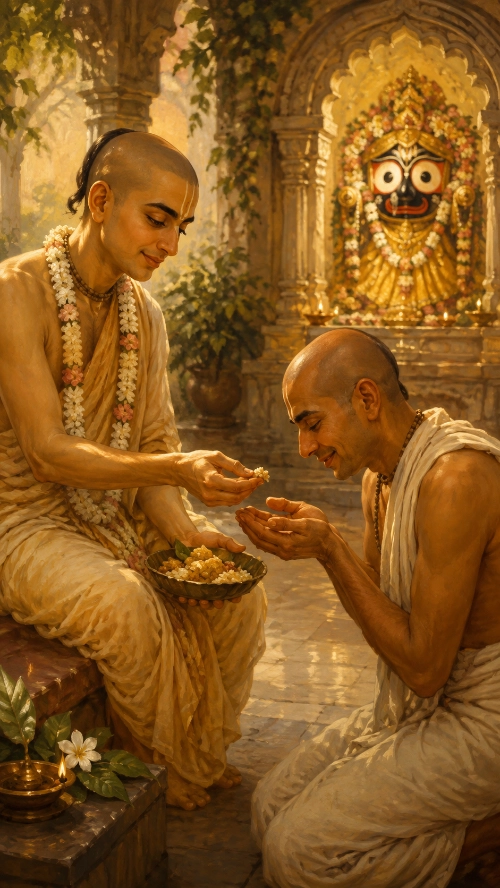
How Grace Travels From Hand to Hand
One of the most unusual teachings in the Śrī Caitanya-caritāmṛta concerns something outwardly very ordinary: food remaining after someone has eaten. In ordinary social and ritual life another person’s leftovers may be regarded as undesirable or impure — yet Kṛṣṇadāsa Kavirāja Gosvāmī presents a striking reversal. Food accepted by Kṛṣṇa becomes mahā-prasāda; and when a devotee has honored that mahā-prasāda and some portion remains, those remnants receive a still more emphatic name:
কৃষ্ণের উচ্ছিষ্ট হয় ‘মহাপ্রসাদ’ নাম ।
‘ভক্তশেষ’ হৈলে ‘মহা-মহাপ্রসাদাখ্যান’ ॥
kṛṣṇera ucchiṣṭa haya ‘mahā-prasāda’ nāma
bhakta-śeṣa haile mahā-mahā-prasādākhyāna
“Kṛṣṇa’s remnants are called mahā-prasāda. When that becomes the remainder of a devotee, it is known as mahā-mahā-prasāda.”
Śrī Caitanya-caritāmṛta, Antya 16.59
A commonly published English translation says such remnants are “elevated to mahā-mahā-prasāda.” That communicates the devotional hierarchy of the passage, but the Bengali is more restrained: the word ākhyāna here concerns designation or naming, so the verse says more literally that the devotee’s remnants are known as mahā-mahā-prasāda.
The nuance matters. Kṛṣṇadāsa is not suggesting that Kṛṣṇa’s prasāda is somehow incomplete and requires improvement by a human devotee. The verse points toward a different principle: the mercy of Bhagavān may be received through the mercy and association of Bhagavān’s devotee.
Prasāda Means More Than “Blessed Food”
The Sanskrit word:
प्रसाद
prasāda
has a wide semantic range — grace, favor, kindness, benevolence, serenity, clarity, gracious disposition. So when Vaiṣṇavas call food prasāda, the deepest idea is not “religiously blessed food” but grace received from Bhagavān.
The devotee does not ideally begin from “this is my food, I will eat it after asking God to bless it.” The devotional movement is: everything belongs to Kṛṣṇa; let this first be prepared and offered for His pleasure, and whatever He returns I shall receive as His mercy. The sequence is not food → ritual → sacred food but Kṛṣṇa’s energy → offered to Kṛṣṇa → accepted by Him → received back as His grace. Eating itself becomes relational.
Terminology varies by tradition and context, but the theological movement is clear: before acceptance, an offering; after acceptance, prasāda. The food has not become sacred because matter has magically ceased to be matter. Its significance has changed because its relationship has changed.
Eating What Remains After Sacrifice
Kṛṣṇa gives an older scriptural foundation for receiving food as remainder rather than as independent enjoyment:
यज्ञशिष्टाशिनः सन्तो
मुच्यन्ते सर्वकिल्बिषैः ।
भुञ्जते ते त्वघं पापा
ये पचन्त्यात्मकारणात् ॥
yajña-śiṣṭāśinaḥ santo
mucyante sarva-kilbiṣaiḥ
bhuñjate te tv aghaṁ pāpā
ye pacanty ātma-kāraṇāt
“The righteous who eat what remains after sacrifice become freed from impurities, whereas those who cook only for themselves partake of sin.”
Bhagavad-gītā 3.13
The important expression is:
यज्ञशिष्टाशिनः
yajña-śiṣṭāśinaḥ
— “those who eat the remainder of sacrifice.” The contrast is with:
आत्मकारणात्
ātma-kāraṇāt
— “for oneself.” The deeper question is therefore for whom was the food prepared? Material consciousness says “this exists for my enjoyment”; bhakti says “everything belongs to Kṛṣṇa, let it first be offered for His satisfaction.”
Śeṣa, Bhukta-śeṣa and Ucchiṣṭa
Three Sanskrit terms help illuminate the chapter.
Śeṣa
शेष
śeṣa
— remainder, what is left, what remains. So bhakta-śeṣa means “the remainder of the devotee.”
Bhukta-śeṣa
भुक्तशेष
bhukta-śeṣa
Bhukta comes from the root √bhuj — to eat, enjoy or partake — so bhukta-śeṣa means “what remains after being eaten or enjoyed.”
Ucchiṣṭa
उच्छिष्ट
ucchiṣṭa
Ucchiṣṭa commonly refers to food remaining after someone has eaten, and in ordinary ritual and social contexts another person’s ucchiṣṭa may carry the idea of bodily contamination. That is what makes Kṛṣṇadāsa Kavirāja’s phrase kṛṣṇera ucchiṣṭa so striking. What ordinary purity codes regard as contaminated becomes supremely sacred, because the person whose remnants these are is Bhagavān Himself. The value of the object cannot be read from its physical condition. Relationship changes meaning.
Uddhava: “We Eat Your Remnants”
One of the strongest Sanskrit foundations for this theology appears in Uddhava’s words to Kṛṣṇa:
त्वयोपभुक्तस्रग्गन्ध-
वासोऽलङ्कारचर्चिताः ।
उच्छिष्टभोजिनो दासास्
तव मायां जयेम हि ॥
tvayopabhukta-srag-gandha-
vāso-‘laṅkāra-carcitāḥ
ucchiṣṭa-bhojino dāsās
tava māyāṁ jayema hi
“Adorned with garlands, fragrances, garments and ornaments that You have enjoyed, and eating Your remnants, we Your servants shall indeed conquer Your māyā.”
Śrīmad-Bhāgavatam 11.6.46
The striking expression is:
उच्छिष्टभोजिनो दासाः
ucchiṣṭa-bhojino dāsāḥ
— “servants who eat Your remnants.” And then:
तव मायां जयेम हि
tava māyāṁ jayema hi
— “we shall indeed conquer Your māyā.” Prasāda is therefore not merely ceremonial food; it belongs to dāsya, the life of service. Uddhava identifies Kṛṣṇa’s servants through intimate participation in what Kṛṣṇa has already used or enjoyed — His garlands, fragrances, garments, ornaments, remnants. The governing principle is relationship with Kṛṣṇa through what has been related to Him.
The Touch of Kṛṣṇa’s Lips
Later in the same chapter Mahāprabhu receives prasāda connected with Lord Jagannātha. He says:
কৃষ্ণের যে ভুক্তশেষ, তার ‘ফেলা’-নাম ।
তার এক ‘লব’ যে পায়, সেই ভাগ্যবান ॥
kṛṣṇera ye bhukta-śeṣa, tāra phelā-nāma
tāra eka lava ye pāya, sei bhāgyavān
“What remains after Kṛṣṇa has eaten is called phelā. Whoever obtains even one tiny particle of it is fortunate.”
Caitanya-caritāmṛta, Antya 16.98
The word phelā ordinarily means something discarded or left over — yet Mahāprabhu says that whoever receives even a lava, a minute particle, is extraordinarily fortunate. A few verses later He explains why:
তাতে এই দ্রব্যে কৃষ্ণাধর-স্পর্শ হৈল ।
অধরের গুণ সব ইহাতে সঞ্চারিল ॥
tāte ei dravye kṛṣṇādhara-sparśa haila
adharera guṇa saba ihāte sañcārila
“These ingredients have received the touch of Kṛṣṇa’s lips, and the qualities of His lips have entered them.”
Antya 16.112
The key expression is kṛṣṇādhara-sparśa, the touch of Kṛṣṇa’s lips. The theology is intensely personal: the food is revered because it has entered into relationship with Kṛṣṇa — prepared for Him, offered to Him, accepted by Him, touched by Him, returned as mercy.
Four Things Ordinary Perception Cannot See
A famous Sanskrit verse traditionally cited in this context declares:
महाप्रसादे गोविन्दे
नामब्रह्मणि वैष्णवे ।
स्वल्पपुण्यवतां राजन्
विश्वासो नैव जायते ॥
mahā-prasāde govinde
nāma-brahmaṇi vaiṣṇave
svalpa-puṇyavatāṁ rājan
viśvāso naiva jāyate
“O king, those whose spiritual good fortune is slight do not readily develop faith in mahā-prasāda, Govinda, the divine Name, or the Vaiṣṇava.”
The verse is cited in the traditional commentary to Antya 16.96 and is traditionally attributed to the Mahābhārata and Skanda Purāṇa. A universally agreed recension and verse location is not always supplied in modern editions, so the attribution is best stated cautiously.
Its fourfold grouping is nevertheless revealing. Ordinary perception sees food, an image, a sound, another human being. Bhakti perceives something else in each case.
What separates the two ways of seeing is śraddhā — the capacity to recognize sacred relationship.
Why the Devotee’s Remainder Receives Such Language
Why should the devotee’s remnant be named so emphatically? The answer belongs to a foundational principle of bhakti: Bhagavān’s devotees are sacred because they belong to Bhagavān. Kṛṣṇadāsa Kavirāja quotes:
आराधनानां सर्वेषां
विष्णोराराधनं परम् ।
तस्मात् परतरं देवि
तदीयानां समर्चनम् ॥
ārādhanānāṁ sarveṣāṁ
viṣṇor ārādhanaṁ param
tasmāt parataraṁ devi
tadīyānāṁ samarcanam
“Of all forms of worship, worship of Viṣṇu is supreme. Yet higher still, O Devī, is the honoring of those who belong to Him.”
Padma Purāṇa, quoted in Caitanya-caritāmṛta, Madhya 11.31
The crucial word is:
तदीयानाम्
tadīyānām
— “those belonging to Him,” or “those intimately related to Him.” The Vaiṣṇava is spiritually precious not as a rival to Kṛṣṇa, but precisely because the Vaiṣṇava is kṛṣṇa-tadīya, belonging to Kṛṣṇa.
Nārada: The Strongest Sanskrit Precedent
Honoring devotees’ remnants is not unique to later Bengali Vaiṣṇava literature. One of its clearest precedents appears in the Śrīmad-Bhāgavatam, where Nārada Muni recalls his previous life. As a young boy he served saintly devotees during the rainy season; he listened to them and assisted them. Then:
उच्छिष्टलेपाननुमोदितो द्विजैः
सकृत्स्म भुञ्जे तदपास्तकिल्बिषः ।
एवं प्रवृत्तस्य विशुद्धचेतसस्
तद्धर्म एवात्मरुचिः प्रजायते ॥
ucchiṣṭa-lepān anumodito dvijaiḥ
sakṛt sma bhuñje tad-apāsta-kilbiṣaḥ
evaṁ pravṛttasya viśuddha-cetasas
tad-dharma evātma-ruciḥ prajāyate
“Once, with the permission of those sages, I ate their food remnants. By this my impurities were removed. As I continued in their association, my consciousness became purified, and attraction for their spiritual way of life arose within me.”
Śrīmad-Bhāgavatam 1.5.25
The sequence is remarkable, and each step depends on the one before it.
The boy who received those remnants eventually became Nārada Muni. The Bhāgavata therefore presents saints’ remnants as part of a transformative encounter with sādhu-saṅga.
A Crucial Safeguard
One phrase in Nārada’s account is especially important:
अनुमोदितो द्विजैः
anumodito dvijaiḥ
— “with the approval of the sages.” This prevents a crude reading. The teaching is not that any half-eaten food belonging to anyone called a devotee automatically possesses miraculous power, and it is certainly not that one should violate another person’s boundaries to obtain leftovers.
Nārada served the saints, heard from them, lived in their association, received their favor — and then, with their approval, honored their remnants. The physical remnant belongs inside a much larger relationship: sevā → sādhu-saṅga → mercy → purification → spiritual taste. Without that context, a theology of grace is easily reduced to external imitation.
The Bhāgavatam repeatedly presents saintly association as transformative. Ṛṣabhadeva says:
महत्सेवां द्वारमाहुर्विमुक्तेः …
mahat-sevāṁ dvāram āhur vimukteḥ …
“Service to the great souls is said to open the door to liberation.”
Śrīmad-Bhāgavatam 5.5.2
And Kapiladeva likewise:
सतां प्रसङ्गान्मम वीर्यसंविदो
भवन्ति हृत्कर्णरसायनाः कथाः ।
तज्जोषणादाश्वपवर्गवर्त्मनि
श्रद्धा रतिर्भक्तिरनुक्रमिष्यति ॥
satāṁ prasaṅgān mama vīrya-saṁvido
bhavanti hṛt-karṇa-rasāyanāḥ kathāḥ
taj-joṣaṇād āśv apavarga-vartmani
śraddhā ratir bhaktir anukramiṣyati
“In deep association with the saints, discussions of My glories become nectar for the heart and ear. By cultivating such association, faith, attraction and bhakti develop successively on the path beyond bondage.”
Śrīmad-Bhāgavatam 3.25.25
The principle is relational. A devotee hears from another devotee, observes another devotee, serves another devotee, receives instruction, receives correction, receives mercy — and gradually begins to value what the devotee values. The essence is not magically potent food. Bhakti awakens through contact with bhakti, and bhakta-śeṣa is one tangible expression of that.
Kālidāsa: A Living Commentary
The immediate context of the verse is the extraordinary devotee Kālidāsa, a relative of Raghunātha dāsa Gosvāmī. Kṛṣṇadāsa Kavirāja introduces him:
মহাভাগবত তেঁহো সরল উদার ।
কৃষ্ণনাম-‘সঙ্কেতে’ চালায় ব্যবহার ॥
mahā-bhāgavata teṅho sarala udāra
kṛṣṇa-nāma-saṅkete cālāya vyavahāra
“He was a mahā-bhāgavata, simple-hearted and generous, and even in ordinary dealings he moved through life accompanied by Kṛṣṇa’s name.”
Antya 16.6
This qualification matters. Kālidāsa is not presented as an eccentric beginner whose behavior everyone should reproduce; he is explicitly called mahā-bhāgavata, a highly advanced devotee, and his unusual outward conduct expresses an extraordinary faith in Vaiṣṇavas.
He sought the remnants of Vaiṣṇavas without restricting his reverence to devotees of socially prestigious birth:
শূদ্র-বৈষ্ণবের ঘরে যায় ভেট লঞা ।
এইমত তাঁর উচ্ছিষ্ট খায় লুকাঞা ॥
śūdra-vaiṣṇavera ghare yāya bheṭa lañā
ei-mata tāṅra ucchiṣṭa khāya lukāñā
“He also went with gifts to the homes of Vaiṣṇavas born in śūdra families, and in this way secretly honored their remnants.”
Antya 16.13
The most famous example is Jhaḍu Ṭhākura, a saint from a community regarded as socially low by the conventions of the time. Kālidāsa does not argue from social theory. He argues from śāstra, quoting Prahlāda:
विप्राद् द्विषड्गुणयुतादरविन्दनाभ-
पादारविन्दविमुखात् श्वपचं वरिष्ठम् …
viprād dvi-ṣaḍ-guṇa-yutād aravinda-nābha-
pādāravinda-vimukhāt śva-pacaṁ variṣṭham …
“I consider a dog-eater who has offered his mind, words, actions, possessions and life to the Lord superior to a brāhmaṇa endowed with the twelve brahminical qualities but turned away from the Lord’s lotus feet.”
Śrīmad-Bhāgavatam 7.9.10
quoted in Antya 16.26
The decisive principle is tad-arpita — offered to Bhagavān: mind offered, speech offered, action offered, possessions offered, life offered. He then quotes Devahūti:
अहो बत श्वपचोऽतो गरीयान्
यज्जिह्वाग्रे वर्तते नाम तुभ्यम् …
aho bata śva-paco ’to garīyān
yaj-jihvāgre vartate nāma tubhyam …
“How glorious is even one born among dog-eaters if Your holy name is present upon his tongue.”
Śrīmad-Bhāgavatam 3.33.7
quoted in Antya 16.27
The spiritual question is therefore not “what is your birth?” but “what is your relationship with Bhagavān?” The episode does not claim that every social distinction lacks historical or conventional meaning. Its deeper claim is that social status cannot measure the depth of bhakti: birth cannot manufacture devotion, and birth cannot nullify genuine devotion.
The Mangoes of Jhaḍu Ṭhākura
The story becomes especially vivid when Kālidāsa brings mangoes to Jhaḍu Ṭhākura. Jhaḍu Ṭhākura offers them to Kṛṣṇa and eats them; his wife later honors what remains; the skins and seeds are discarded. Kālidāsa, who has remained nearby, then honors the traces remaining on those discarded skins and seeds.
To an external observer the act may look humiliating. Kālidāsa experiences it in exactly the opposite way. He is not thinking “how low I have fallen,” but “how extraordinary that I have obtained the mercy of a Vaiṣṇava.” This is an inversion of ordinary prestige: material ego seeks the position of the enjoyer, while Kālidāsa seeks the position beneath the servants of Kṛṣṇa.
The Real Subject Is Humility
The external act is dramatic, but its interior principle matters more. Material ego asks “why should I accept another person’s remnants?” Kālidāsa’s consciousness asks “how could someone as unqualified as I be fortunate enough to receive the mercy of a servant of Kṛṣṇa?” The theology of bhakta-śeṣa is therefore inseparable from dainya, devotional humility. Honoring the remnant becomes an embodied declaration: “I do not place myself above the Vaiṣṇava.”
Kālidāsa is an exemplar, not a template for mechanical imitation. Kṛṣṇadāsa calls him mahā-bhāgavata, and it does not follow that every practitioner should reproduce every external detail of his behavior. Nārada’s precedent is useful precisely because it says anumodito dvijaiḥ — he received the sages’ remnants with their approval. The lesson is not “ignore etiquette because remnants are sacred” but “cultivate deep faith in the mercy and association of genuine Vaiṣṇavas.” Humility is not created by copying the visible act of an advanced saint.
When Kālidāsa later comes to Jagannātha Purī, Mahāprabhu recognizes his extraordinary faith. Kṛṣṇadāsa Kavirāja concludes:
বৈষ্ণবের শেষ-ভক্ষণের এতেক মহিমা ।
কালিদাসে পাওয়াইল প্রভুর কৃপা-সীমা ॥
vaiṣṇavera śeṣa-bhakṣaṇera eteka mahimā
kālidāse pāoyāila prabhura kṛpā-sīmā
“Such is the glory of honoring the remnants of Vaiṣṇavas that Kālidāsa attained the extreme limit of the Lord’s mercy.”
Antya 16.57
The striking expression is prabhura kṛpā-sīmā, the “limit” or fullest extent of Mahāprabhu’s mercy. Kālidāsa’s faith in Kṛṣṇa’s devotees attracts Kṛṣṇa’s own grace through Mahāprabhu — the logic of tadīyānāṁ samarcanam, honoring those who belong to Bhagavān.
Three Things of Extraordinary Power
Immediately after defining mahā-mahā-prasāda, Kṛṣṇadāsa expands the teaching:
ভক্তপদধূলি আর ভক্তপদ-জল ।
ভক্তভুক্ত-অবশেষ,—তিন মহাবল ॥
bhakta-pada-dhūli āra bhakta-pada-jala
bhakta-bhukta-avaśeṣa — tina mahā-bala
“The dust of a devotee’s feet, the water associated with a devotee’s feet, and the remnants of food eaten by a devotee—these three possess extraordinary power.”
Antya 16.60
And the next verse gives their purpose:
এই তিন-সেবা হৈতে কৃষ্ণপ্রেমা হয় ।
পুনঃ পুনঃ সর্বশাস্ত্রে ফুকারিয়া কয় ॥
ei tina-sevā haite kṛṣṇa-premā haya
punaḥ punaḥ sarva-śāstre phukāriyā kaya
“Through service connected with these three, Kṛṣṇa-prema arises. The scriptures proclaim this again and again.”
Antya 16.61
Notice the goal. Not wealth, not heaven, not occult power, not ritual prestige — but kṛṣṇa-prema.
The symbolism of devotees’ foot-dust also has a strong Bhāgavata foundation. Prahlāda says:
नैषां मतिस्तावदुरुक्रमाङ्घ्रिं
स्पृशत्यनर्थापगमो यदर्थः ।
महीयसां पादरजोऽभिषेकं
निष्किञ्चनानां न वृणीत यावत् ॥
naiṣāṁ matis tāvad urukramāṅghriṁ
spṛśaty anarthāpagamo yad-arthaḥ
mahīyasāṁ pāda-rajo-‘bhiṣekaṁ
niṣkiñcanānāṁ na vṛṇīta yāvat
“The mind does not truly reach the feet of the Lord until one accepts the consecrating dust of the feet of great souls who possess nothing for themselves.”
Śrīmad-Bhāgavatam 7.5.32
The phrase mahīyasāṁ pāda-rajaḥ, “the foot-dust of the great souls,” shows that this is not an isolated Bengali custom. The physical act symbolizes taking shelter beneath the devotees; the external gesture embodies an internal posture.
Grace Travels Through Relationship
At this point the central theology can be stated plainly. Vaiṣṇava remnants should not be imagined as magical substances acting independently of spiritual relationship. Nārada’s transformation involved service, hearing, association, affection, permission, remnants, purification and awakening taste. Kālidāsa’s behavior likewise embodies a whole cluster of devotional attitudes.
One useful way to understand the designation is therefore through two relational dimensions. First, relationship with Kṛṣṇa: Kṛṣṇa’s remnants are mahā-prasāda. Then, relationship with Kṛṣṇa’s devotee: that same prasāda becomes the devotee’s remainder. This does not mean the devotee completes something lacking in Kṛṣṇa. It means another relationship is now present — bhakta-kṛpā, the grace of the devotee. Prasāda expresses Bhagavān’s grace; bhakta-śeṣa expresses Bhagavān’s grace encountered through devotee-association.
A Radical Reversal of Ordinary Purity
There is a deliberate paradox in the language of ucchiṣṭa. Ordinary ritual logic says another person’s leftovers mean contamination. Bhakti says Kṛṣṇa’s leftovers are mahā-prasāda — and that Kṛṣṇa’s prasāda honored by His devotee is mahā-mahā-prasāda.
This does not mean Vaiṣṇavism rejects cleanliness; temple worship contains extensive standards of physical and ritual purity. The deeper point is that material cleanliness is not the highest possible category of purity. Bhagavān is supremely pure, matter does not contaminate Kṛṣṇa, and relationship with Kṛṣṇa sanctifies matter. The same principle explains Kālidāsa’s refusal to judge a genuine Vaiṣṇava by social birth: the decisive spiritual category is bhakti.
Prasāda as Embodied Theology
Prasāda teaches through the body what philosophy teaches through words. The devotee becomes hungry; food is present; the spontaneous material impulse says “I want it.” Bhakti inserts Kṛṣṇa into the act: before eating, the devotee remembers “this belongs to Him.” The food is prepared, offered, waited for, and then received. Eating becomes daily training in a fundamental truth — I am not the independent proprietor and enjoyer. Kṛṣṇa is the center, and what I receive comes as mercy.
If prasāda teaches “I depend upon Kṛṣṇa’s mercy,” then bhakta-śeṣa teaches “I also depend upon the mercy of those who love and serve Kṛṣṇa.” That second admission is often harder for the ego: it may be easier to imagine oneself humbly related to an invisible God than to become genuinely humble before another living person. Gauḍīya Vaiṣṇavism therefore joins bhagavat-prasāda, the mercy of Bhagavān, with vaiṣṇava-prasāda, the mercy of the Vaiṣṇava.
A Chapter About Sacred Taste
There is a beautiful literary structure in Antya-līlā 16. The chapter begins with Kālidāsa honoring the remnants of Vaiṣṇavas; later it turns toward Mahāprabhu honoring Jagannātha’s remnants; and then the prasāda becomes kṛṣṇādhara-sparśa, the touch of Kṛṣṇa’s lips. The chapter moves through successive forms of sacred relationship — Vaiṣṇava, Vaiṣṇava remnants, Mahāprabhu’s mercy, Jagannātha’s prasāda, Kṛṣṇa’s lips, and remembrance of Kṛṣṇa’s sweetness. The subject is larger than food: it is how divine taste enters embodied devotional life.
Mahāprabhu makes the point vividly when He reflects on Jagannātha’s prasāda. The ingredients are familiar — sugar, camphor, cardamom, cloves, butter, spices — and their material chemistry has not ceased to exist. Yet He experiences the prasāda as incomparable, because the ingredients now possess a devotional history: prepared, offered, accepted, returned, and touched by Kṛṣṇa. A flower remains materially a flower; placed at Kṛṣṇa’s feet it becomes prasāda. Water remains water; used in Bhagavān’s service it becomes sacred. Food remains food — but its relationship has changed, and in bhakti relationship changes meaning.
The Whole Movement in One Sequence
The movement is Kṛṣṇa → prasāda → bhakta → another bhakta. Grace travels through relationship.
Removed from its context, the verse can sound exotic: “the devotee’s leftovers are mahā-mahā-prasāda.” In context it rests on several major principles of Bhāgavata bhakti — that everything belongs to Bhagavān; that food should be received as grace rather than as independent enjoyment; that Bhagavān’s remnants are sacred because they are related to Him; that association with devotees transforms consciousness; that service to great souls opens the door to liberation; that birth status can neither determine nor nullify genuine spiritual attainment; and that humility before Vaiṣṇavas attracts divine mercy.
The subject is therefore ultimately not leftovers. The subject is how grace travels. Kṛṣṇa gives mercy through prasāda, through His Name, through śāstra, through sādhus, through His devotees — and the devotee receives that grace not as an abstract doctrine but through hearing, serving, touching, tasting, remembering and being changed.
Kṛṣṇa’s remnants are called mahā-prasāda; the devotee’s remnants are called mahā-mahā-prasāda — not because the bhakta independently surpasses Kṛṣṇa, but because the bhakta belongs to Kṛṣṇa, carries devotion to Kṛṣṇa, and becomes one of the ways through which another heart encounters Kṛṣṇa’s mercy. That is why Nārada’s consciousness changed, why Kālidāsa sought the mercy of Vaiṣṇavas, why social prestige could not determine spiritual realization, and why the culmination named in the next verse is neither food nor ritual purity nor even liberation, but kṛṣṇa-prema.
Principal Scriptural Sources
The passages drawn on above, gathered by text. Each is quoted in full — in its own script, with transliteration and translation — at the point where it is discussed.
Śrī Caitanya-caritāmṛta
Śrīmad-Bhāgavatam
Bhagavad-gītā
Padma Purāṇa
ārādhanānāṁ sarveṣāṁ viṣṇor ārādhanaṁ param
tasmāt parataraṁ devi tadīyānāṁ samarcanam
Also quoted in Caitanya-caritāmṛta, Madhya 11.31.
Traditional Mahābhārata / Skanda Purāṇa attribution
mahā-prasāde govinde nāma-brahmaṇi vaiṣṇave…
This verse is traditionally cited in connection with Antya 16.96. Modern editions commonly preserve the traditional attribution without providing a universally agreed recension and verse location, so it is best cited with that caveat. Sanskrit and Bengali quotations throughout should ultimately be checked against the particular printed edition adopted for any formal publication.