

Knowledge in Kṛṣṇa’s Own Light
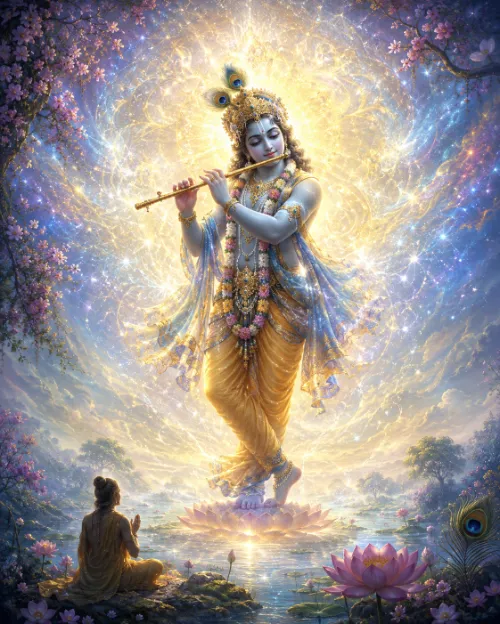
Knowledge in Kṛṣṇa’s Own Light: Saṁvit, Brahman, and What It Means to Know Kṛṣṇa as Bhagavān
Not all spiritual knowledge is equal in completeness. That is the striking claim made by Kṛṣṇadāsa Kavirāja Gosvāmī in a single Bengali couplet. Knowledge of Brahman is not dismissed as false, and knowledge of the Absolute is not divided among rival truths. Instead, every genuine realization is arranged around a center: the fullest operation of spiritual knowledge is the revelation of Kṛṣṇa as Bhagavān.
This is why the word parivāra matters. It does not literally mean “component.” It means a family, surrounding company, retinue, entourage, or circle of dependents. The metaphor is hierarchical but inclusive. Brahman-realization belongs to the court of spiritual knowledge, but it is not placed on the throne.
The verse is therefore translated correctly in its broad theological meaning, but its language is richer and more precise than the familiar English rendering first suggests. To understand it fully, one must read it inside its immediate discussion of Kṛṣṇa’s internal potency, trace its Sanskrit foundation to the Viṣṇu Purāṇa, and examine Jīva Gosvāmī’s explanation of how the one spiritual potency functions as sandhinī, saṁvit, and hlādinī.
The verse and a closer translation
কৃষ্ণে ভগবত্তা-জ্ঞান—সংবিতের সার ।
ব্রহ্মজ্ঞানাদিক সব তার পরিবার ॥ ৬৭ ॥
kṛṣṇe bhagavattā-jñāna — saṁvitera sāra
brahma-jñānādika saba tāra parivāra
“Knowledge of Bhagavānhood in Kṛṣṇa is the essence of the saṁvit potency; knowledge of Brahman and the rest are all its retinue.”
Caitanya-caritāmṛta, Ādi 4.67
The published translation reads:
“The essence of the saṁvit potency is knowledge that the Supreme Personality of Godhead is Lord Kṛṣṇa. All other kinds of knowledge, such as the knowledge of Brahman, are its components.”
That rendering conveys the Gauḍīya conclusion accurately, but it is interpretive in two places. First, bhagavattā means the state, quality, or fullness of being Bhagavān. The compact phrase kṛṣṇe bhagavattā-jñāna therefore means, more literally, “knowledge of Bhagavānhood in Kṛṣṇa” or “knowledge that Kṛṣṇa possesses the full nature of Bhagavān.” The translation “the Supreme Personality of Godhead is Lord Kṛṣṇa” gives the intended conclusion rather than reproducing the Bengali syntax mechanically.
Second, parivāra is more vivid than “components.” It denotes those who surround a central person: family members, attendants, dependents, or a royal retinue. “Components” expresses inclusion, but “retinue” preserves both inclusion and rank. The other realizations are not outside spiritual knowledge; they stand around its fullest personal disclosure.
The expression brahma-jñānādika means “knowledge of Brahman and so forth.” The suffix ādika, “beginning with” or “and the like,” leaves the category open. In the immediate Gauḍīya framework, it naturally includes Paramātmā-realization and other partial apprehensions of the Absolute. The verse itself foregrounds Brahman; it does not provide an exhaustive list.
A small textual note
The standard Roman reading and word-for-word gloss give kṛṣṇe, “in Kṛṣṇa.” Some current digital Bengali displays print instead:
কৃষ্ণের
kṛṣṇera
“of Kṛṣṇa.”
The two readings produce nearly the same doctrinal sense: either “knowledge of Bhagavānhood in Kṛṣṇa” or “knowledge of Kṛṣṇa’s Bhagavānhood.” Since the transmitted Roman text, the grammatical gloss, and later traditional quotations read kṛṣṇe, that is the reading followed here.
Is the original note correct?
Yes—with one useful refinement. The marginal gloss “dependents” for parivāra is legitimate and closer to the literal image than “components.” Yet “dependents” can sound as though Brahman-realization were merely defective or worthless. The wider semantic field—retinue, entourage, family, surrounding circle—expresses Kṛṣṇadāsa Kavirāja’s point better.
The verse does not say:
- Brahman is unreal.
- Brahman-realization has no spiritual value.
- Different realizations concern unrelated absolutes.
- ordinary factual knowledge and Brahman-realization are identical.
It says that knowledge of Kṛṣṇa as Bhagavān is the concentrated essence of the spiritual power of knowing, while Brahman-realization and related forms of spiritual awareness are included within, dependent upon, and surpassed by that fullness.
This is a hierarchy of disclosure, not a multiplication of realities.
The real Sanskrit source behind the section
Ādi 4.67 is not itself a translation of an older Sanskrit verse. It is Kṛṣṇadāsa Kavirāja’s Bengali synthesis. Its immediate Sanskrit foundation appears only four verses earlier, at Ādi 4.63, where the Caitanya-caritāmṛta quotes Viṣṇu Purāṇa 1.12.69.
In the Viṣṇu Purāṇa, the speaker is the young devotee Dhruva. After intense meditation, Dhruva sees Viṣṇu before him but feels unable to praise Him. The Lord touches him with the tip of His conch, granting him the power of sacred speech. Dhruva then offers a profound hymn describing Viṣṇu as the source, support, indwelling Self, and transcendent ground of the cosmos. Within that hymn comes the verse on the threefold spiritual potency:
ह्लादिनी सन्धिनी संवित् त्वय्येका सर्वसंस्थितौ ।
ह्लादतापकरी मिश्रा त्वयि नो गुणवर्जिते ॥
hlādinī sandhinī saṁvit
tvayy ekā sarva-saṁsthitau
hlāda-tāpa-karī miśrā
tvayi no guṇa-varjite
“Hlādinī, sandhinī, and saṁvit are one potency in You, in whom everything is established. The mixed potency that produces material pleasure and pain does not exist in You, who are free from the material guṇas.”
Viṣṇu Purāṇa 1.12.69; quoted in Caitanya-caritāmṛta, Ādi 4.63
The verse makes two distinctions at once. First, hlādinī, sandhinī, and saṁvit are one—ekā. They are not three independent substances competing inside God. They are distinguishable functions or aspects of one intrinsic spiritual potency.
Second, this pure potency must not be confused with material nature. Material experience produces pleasure, pain, and mixtures of the two under the changing modes of sattva, rajas, and tamas. The Lord is guṇa-varjita—free from those material modes. This does not mean that He has no qualities. It means that His nature, qualities, knowledge, and bliss are not products of material prakṛti.
A genuine textual variant
The critical Sanskrit edition of the Viṣṇu Purāṇa reads sarva-saṁsthitau, “in whom everything is established.” Some quotations in the Gauḍīya textual tradition read sarva-saṁśraye, “in the shelter of all.” The readings differ, but their theological direction is close: the Lord is the one in whom all things stand and upon whom all depend. The critical edition numbers the verse 1.12.69; occasional traditional references to 1.12.68 or other numbers reflect differences of edition and enumeration.
One spiritual potency, three inseparable functions
Immediately before quoting the Viṣṇu Purāṇa, Kṛṣṇadāsa Kavirāja gives the interpretive framework:
সচ্চিদানন্দ, পূর্ণ, কৃষ্ণের স্বরূপ ।
একই চিচ্ছক্তি তাঁর ধরে তিন রূপ ॥ ৬১ ॥
আনন্দাংশে হ্লাদিনী, সদংশে সন্ধিনী ।
চিদংশে সম্বিৎ—যারে জ্ঞান করি’ মানি ॥ ৬২ ॥
sac-cid-ānanda, pūrṇa, kṛṣṇera svarūpa
eka-i cic-chakti tāṅra dhare tina rūpa
ānandāṁśe hlādinī, sad-aṁśe sandhinī
cid-aṁśe samvit — yāre jñāna kari’ māni “Kṛṣṇa’s intrinsic nature is complete existence, consciousness, and bliss. His one spiritual potency manifests in three forms. In relation to bliss it is hlādinī; in relation to existence it is sandhinī; and in relation to consciousness it is saṁvit, which we understand as knowledge.”
—Caitanya-caritāmṛta, Ādi 4.61–62 The mapping is exact but should not be treated mechanically:
These are not sealed compartments. Spiritual existence is conscious and blissful; spiritual knowledge is living and joyful; spiritual bliss is conscious and real. The distinctions indicate which function predominates in a particular manifestation.
This prevents a common mistake. Kṛṣṇadāsa does not divide Kṛṣṇa into three pieces or propose three unrelated energies. One indivisible spiritual reality is analyzed according to three inseparable powers of being, knowing, and delighting.
Jīva Gosvāmī’s precise definition of saṁvit
Jīva Gosvāmī develops this doctrine systematically in the Bhagavat-sandarbha. Different editions number the relevant passage differently. Prabhupāda’s purport to Ādi 4.62 cites Bhagavat-sandarbha 103; in the GRETIL text used here, the extended discussion appears in anuccheda 117. The difference is editorial numbering, not a difference of doctrine.
Jīva first states the principle of unity and threefold function:
प्रथमं तावद् एकस्यैव तत्त्वस्य सच्चिदानन्दत्वाच्छक्तिरप्येका त्रिधा भिद्यते ।
prathamaṁ tāvad ekasyaiva tattvasya sac-cid-ānandatvāc chaktir apy ekā tridhā bhidyate
“First, because the one Reality is existence, consciousness, and bliss, its one potency is also distinguished threefold.”
He then defines saṁvit with extraordinary economy:
तथा संविद्रूपोऽपि यया संवेत्ति संवेदयति च सा संवित् ।
tathā saṁvid-rūpo ’pi yayā saṁvetti saṁvedayati ca sā saṁvit
“Although He is Himself the form of consciousness, that by which He knows and causes others to know is saṁvit.”
Jīva Gosvāmī, Bhagavat-sandarbha, anuccheda 117 in the GRETIL numbering
This definition is crucial. Saṁvit is not merely information stored in a divine mind. It is Kṛṣṇa’s self-luminous power of awareness and revelation. Through it, He knows Himself, His energies, His associates, and all reality; through that same potency, He makes Himself knowable to others.
The phrase “causes others to know” changes the entire epistemology. Bhagavān is not an inert object waiting to be conquered by sufficient intellectual effort. He is the conscious subject who discloses Himself. Human reason, scripture, instruction, memory, and contemplation remain meaningful, but full realization occurs when the divine power of revelation illumines the knower.
This is why Prabhupāda’s purport distinguishes ordinary cognition, indirect spiritual knowledge, and full personal realization. Material cognition is obstructed and distorted by limited senses and conditioning. Impersonal realization reaches genuine transcendence but apprehends the Absolute without the full disclosure of divine form, qualities, relationships, and līlā. When saṁvit acts in its spiritual fullness—and especially when it operates together with hlādinī—the Personality of Godhead becomes known.
What exactly is “Bhagavānhood”?
The word bhagavattā does not mean merely that Kṛṣṇa is powerful or that He belongs to a general class called “gods.” It means the complete condition of being Bhagavān. The Viṣṇu Purāṇa gives the classical definition of bhaga, the fullness possessed by Bhagavān:
ऐश्वर्यस्य समग्रस्य वीर्यस्य यशसः श्रियः ।
ज्ञानवैराग्ययोश्चैव षण्णां भग इतीरणा ॥
aiśvaryasya samagrasya
vīryasya yaśasaḥ śriyaḥ
jñāna-vairāgyayoś caiva
ṣaṇṇāṁ bhaga itīraṇā
“Complete sovereignty, power, fame, beauty and fortune, knowledge, and detachment—these six are designated by the word bhaga.”
Viṣṇu Purāṇa 6.5.74 in the critical edition; numbered 6.5.47 in many older editions
The following verses explain that Bhagavān in its fullest, non-figurative sense refers to Vāsudeva, who knows the origin and dissolution of beings, their coming and going, knowledge and ignorance, and who possesses knowledge, power, sovereignty, strength, and splendor without defect.
Thus bhagavattā-jñāna is knowledge of the personal Absolute in the fullness of His energies, attributes, form, will, beauty, freedom, and relationships. It is not simply the proposition “God exists.” It is knowledge of who the Absolute is.
Within the Gauḍīya reading, the decisive scriptural identification is:
एते चांशकलाः पुंसः कृष्णस्तु भगवान् स्वयम् ।
इन्द्रारिव्याकुलं लोकं मृडयन्ति युगे युगे ॥
ete cāṁśa-kalāḥ puṁsaḥ
kṛṣṇas tu bhagavān svayam
indrāri-vyākulaṁ lokaṁ
mṛḍayanti yuge yuge
“These are portions or portions of portions of the Supreme Person, but Kṛṣṇa is Bhagavān Himself. Age after age they protect the world when it is troubled by the enemies of the gods.”
Śrīmad-Bhāgavatam 1.3.28
The words kṛṣṇas tu bhagavān svayam are central to Gauḍīya theology. They do not merely say that Kṛṣṇa is an avatāra who may properly be called Bhagavān. They are read as identifying Kṛṣṇa as Svayaṁ Bhagavān, Bhagavān in His original and fullest personal form.
Therefore Ādi 4.67 compresses two conclusions into one phrase:
- Full saṁvit reveals the Absolute as Bhagavān rather than only as undifferentiated Brahman.
- The fullest personal identity of Bhagavān is Śrī Kṛṣṇa.
Brahman, Paramātmā, and Bhagavān: one truth, unequal fullness of disclosure
Calling Brahman-knowledge a member of saṁvit’s parivāra does not make Brahman unreal. The Bhāgavatam explicitly speaks of one nondual reality known in three ways:
वदन्ति तत्तत्त्वविदस्तत्त्वं यज्ज्ञानमद्वयम् ।
ब्रह्मेति परमात्मेति भगवानिति शब्द्यते ॥
vadanti tat tattva-vidas
tattvaṁ yaj jñānam advayam
brahmeti paramātmeti
bhagavān iti śabdyate
“Knowers of truth speak of that nondual reality as Brahman, Paramātmā, and Bhagavān.”
Śrīmad-Bhāgavatam 1.2.11
Kṛṣṇadāsa Kavirāja restates the same principle in Bengali:
অদ্বয়জ্ঞান তত্ত্ববস্তু কৃষ্ণের স্বরূপ ।
ব্রহ্ম, আত্মা, ভগবান্—তিন তাঁর রূপ ॥
advaya-jñāna tattva-vastu kṛṣṇera svarūpa
brahma, ātmā, bhagavān — tina tāṅra rūpa
“Kṛṣṇa’s intrinsic nature is the nondual Absolute Reality. Brahman, Paramātmā, and Bhagavān are His three manifestations.”
Caitanya-caritāmṛta, Ādi 2.65
The three do not refer to three competing absolutes. The difference lies in the degree and mode of disclosure.
- Brahman is the Absolute apprehended as unlimited, undifferentiated spiritual being and consciousness, without full realization of personal form and relationships.
- Paramātmā is the Absolute apprehended as the indwelling witness, regulator, and all-pervading Lord within the cosmos and every living being.
- Bhagavān is the same nondual Absolute fully disclosed as the possessor of form, qualities, energies, associates, will, beauty, līlā, and reciprocal love.
From the Gauḍīya standpoint, Bhagavān-realization is fuller because it includes what Brahman and Paramātmā disclose while revealing dimensions they do not disclose. Personal fullness does not negate infinity; it explains the source of infinity. Divine form does not limit the Absolute; it is the self-expression of limitless spiritual power.
The metaphor of parivāra is therefore exact. A king’s radiance, authority, officers, and retinue are real, but they are intelligible in relation to the king. Similarly, Brahman and Paramātmā are real disclosures of the one Absolute, but the Gauḍīya conclusion locates their source and completion in Bhagavān.
Brahman-realization is partial not because it discovers something false, but because it does not yet disclose everything true.
Knowledge becomes complete through revelation and devotion
If saṁvit is Kṛṣṇa’s power both to know and to cause others to know, full knowledge of Bhagavān cannot be manufactured by analysis alone. It must be received through self-disclosure.
The Bhagavad-gītā states:
भक्त्या मामभिजानाति यावान्यश्चास्मि तत्त्वतः ।
ततो मां तत्त्वतो ज्ञात्वा विशते तदनन्तरम् ॥
bhaktyā mām abhijānāti
yāvān yaś cāsmi tattvataḥ
tato māṁ tattvato jñātvā
viśate tad-anantaram
“Through bhakti one knows Me in truth—who I am and the extent of My being. Then, having known Me in truth, one enters into Me.”
Bhagavad-gītā 18.55
This does not reject disciplined thought. It rejects the assumption that the supreme conscious Person can be reduced to an object under the control of an unaided intellect. Even in ordinary life, knowing facts about a person is not identical with knowing that person. Personal knowledge requires self-disclosure, trust, relationship, and reciprocity. Gauḍīya theology extends this principle to its highest degree: Bhagavān is known when He grants the power by which He is known.
Here the cooperation of saṁvit and hlādinī becomes decisive.
- Saṁvit discloses who Kṛṣṇa is.
- Hlādinī brings the devotee into loving participation in His bliss.
- When knowing is illumined by love, Bhagavān is no longer approached only as an object of metaphysical description. He is encountered as the living center of relationship.
Prabhupāda’s purport to Ādi 4.67 therefore says that when the cognitive factor of saṁvit is enlightened by hlādinī, the two work together and knowledge of the Personality of Godhead becomes possible. Bhaktivinoda Ṭhākura’s Amṛta-pravāha-bhāṣya makes the same point: when the spiritual saṁvit potency, united with hlādinī, bestows grace upon the jīva, realization of Kṛṣṇa’s divine nature arises.
The highest knowledge in this theology is consequently not cold omniscience. It is truth made luminous within love.
Does this contradict the intimacy of Vraja?
A subtle question now arises. If knowledge of Kṛṣṇa’s Bhagavānhood is the essence of saṁvit, why does the same chapter praise the residents of Vraja, whose love is so intimate that awareness of Kṛṣṇa’s majesty recedes into the background?
Kṛṣṇa says earlier in the chapter:
ঐশ্বর্য-জ্ঞানেতে সব জগৎ মিশ্রিত ।
ঐশ্বর্য-শিথিল-প্রেমে নাহি মোর প্রীত ॥ ১৭ ॥
আমারে ঈশ্বর মানে, আপনাকে হীন ।
তার প্রেমে বশ আমি না হই অধীন ॥ ১৮ ॥
aiśvarya-jñānete saba jagat miśrita
aiśvarya-śithila-preme nāhi mora prīta
āmāre īśvara māne, āpanāke hīna
tāra preme vaśa āmi nā ha-i adhīna “The whole world is mixed with awareness of My majesty, but love weakened by that majesty does not satisfy Me. If someone regards Me as the Supreme Lord and himself as low and subordinate, I do not become fully controlled by that love.”
—Caitanya-caritāmṛta, Ādi 4.17–18 There is no contradiction once two levels are distinguished. At the ontological level, saṁvit reveals the truth that Kṛṣṇa is Bhagavān. The Vraja devotees do not love an ordinary material boy mistakenly elevated into God. Their Kṛṣṇa is truly Svayaṁ Bhagavān.
At the relational level, the same internal potency can veil the formal awareness of His majesty so that more intimate love may flourish. Yaśodā binds Kṛṣṇa as her son; the cowherd boys climb on His shoulders as their friend; the gopīs address Him as their beloved. Their intimacy is not material ignorance. It is Yogamāyā’s spiritual arrangement, in which the truth of Kṛṣṇa’s identity remains intact while reverential distance is overcome by love.
Jīva Gosvāmī explicitly allows for such a function within the internal potency: it can produce a loving “forgetfulness” of Bhagavān’s overwhelming greatness so that maternal, friendly, and conjugal relationships become possible. This is the opposite of material avidyā. Material ignorance hides reality and creates bondage; Yogamāyā selectively hides majesty in order to reveal deeper personal sweetness.
Thus the highest saṁvit does not require a devotee to repeat mentally at every moment, “Kṛṣṇa is the Supreme Controller.” This means the relationship rests on Kṛṣṇa’s true identity and is disclosed by His own spiritual potency. In Vraja, knowledge reaches such intimacy that direct loving participation surpasses metaphysical reverence.
The fullness of knowledge is not always the greatest distance from mystery. Sometimes it is the greatest nearness to the Person known.
Why Ādi 4.67 stands between sandhinī and hlādinī
The placement of the verse is deliberate. Kṛṣṇadāsa Kavirāja moves through the three functions of the internal potency in sequence. First comes sandhinī. Its essential manifestation is called śuddha-sattva, pure spiritual existence. Kṛṣṇa’s abode, parents, home, seat, bed, associates, and the entire variegated spiritual world are not temporary material constructions; they are manifestations of the potency that establishes spiritual reality.
Then comes saṁvit in Ādi 4.67. Spiritual reality is not merely present; it is self-aware and self-revealing. The essence of this revelation is the knowledge of Kṛṣṇa’s full personal identity.
Finally comes hlādinī:
হ্লাদিনীর সার ‘প্রেম’, প্রেমসার ‘ভাব’ ।
ভাবের পরমকাষ্ঠা, নাম—‘মহাভাব’ ॥ ৬৮ ॥
মহাভাবস্বরূপা শ্রীরাধা-ঠাকুরাণী ।
সর্বগুণখনি কৃষ্ণকান্তা-শিরোমণি ॥ ৬৯ ॥
hlādinīra sāra ‘prema’, prema-sāra ‘bhāva’
bhāvera parama-kāṣṭhā, nāma — ‘mahābhāva’
mahābhāva-svarūpā śrī-rādhā-ṭhākurāṇī
sarva-guṇa-khani kṛṣṇa-kāntā-śiromaṇi “The essence of hlādinī is prema; the essence of prema is bhāva; and the highest limit of bhāva is called mahābhāva. Śrī Rādhā Ṭhākurāṇī is the embodiment of mahābhāva, the mine of all virtues and the crown jewel of Kṛṣṇa’s beloveds.”
—Caitanya-caritāmṛta, Ādi 4.68–69 The progression is powerful:
- Sandhinī: spiritual reality exists.
- Saṁvit: spiritual reality knows and reveals itself.
- Hlādinī: spiritual reality tastes and shares bliss through love.
The discussion therefore does not culminate in an abstract theory of consciousness. It culminates in Śrī Rādhā as mahābhāva, the supreme personal embodiment of Kṛṣṇa-directed love. This, in turn, explains the chapter’s larger subject: why Rādhā and Kṛṣṇa appear united as Śrī Caitanya Mahāprabhu.
Ādi 4.67 is consequently not an isolated attack on impersonalism. It is the middle movement of a theology of spiritual existence, divine self-revelation, and love.
Three forms of cognition—and why ordinary knowledge is not saṁvit’s essence
The traditional commentaries distinguish several levels of cognition.
Distorted cognition
The conditioned jīva knows material objects through limited senses, a conditioned mind, memory, inference, and language. Such knowledge can be useful and relatively accurate, but it is never unlimited. The knower selects, interprets, forgets, mistakes, and projects. In the theological language of the purport, this is a distorted or reflected operation of cognition under material energy.
Indirect or negative spiritual knowledge
By negating material limitation—“not finite, not changing, not divided, not describable by material qualities”—the seeker may realize Brahman. This is genuine transcendental knowledge, but it is primarily apophatic: it knows what the Absolute is not and realizes undifferentiated spiritual being. According to the Gauḍīya reading, it remains incomplete when the Absolute’s personal form, qualities, energies, and relationships are not disclosed.
Direct personal revelation
Full saṁvit reveals Kṛṣṇa as Bhagavān. This knowledge is positive and relational. It includes awareness of His form, qualities, energies, abode, associates, actions, and loving exchanges. Because Bhagavān is unlimited, such knowledge is never exhausted, but it is true knowledge of the whole personal center rather than awareness of only an undifferentiated aspect.
The difference is not simply the quantity of facts acquired. It is a difference in mode of access. Material knowledge observes through conditioned instruments. Brahman-realization transcends material differentiation. Bhagavān-realization arises through divine self-disclosure and loving participation.
Important misunderstandings to avoid
Saṁvit is not the jīva’s ordinary intelligence
The jīva is conscious, but finite consciousness is not identical with Bhagavān’s svarūpa-śakti. Saṁvit, in this doctrinal classification, is an intrinsic potency of Bhagavān. The jīva knows Kṛṣṇa when that revelatory potency graciously illumines the jīva’s consciousness.
The three potencies are not three independent beings
The Viṣṇu Purāṇa says ekā—one. Sandhinī, saṁvit, and hlādinī are three distinguishable functions of one internal potency. Their personal manifestations do not destroy their essential unity with the possessor of potency.
Brahman-realization is not declared imaginary
The text calls it parivāra, not mithyā. It belongs to the spiritual domain but is subordinate in completeness to realization of Bhagavān.
“Kṛṣṇa is Bhagavān” is not merely sectarian labeling
Within the argument of the Bhāgavatam and the Caitanya-caritāmṛta, this conclusion is tied to a complete metaphysics: one nondual reality, three modes of realization, the sixfold fullness of Bhagavān, and the declaration kṛṣṇas tu bhagavān svayam.
Full knowledge is not exhausted by reverence
Knowing Kṛṣṇa’s Bhagavānhood establishes His true identity. Yet the highest Vraja relationships can spiritually veil the consciousness of majesty so that friendship, parental affection, and conjugal love attain complete intimacy.
Kṛṣṇa does not depend on an external substance called śuddha-sattva
When the text says His existence “rests” in sandhinī or śuddha-sattva, it does not place something more fundamental beneath Him. Sandhinī is His own intrinsic potency. The possessor of potency and His potency are distinguishable for explanation but inseparable in reality.
The deepest meaning of parivāra
The word parivāra finally reveals the verse’s elegance. A retinue does three things:
- It surrounds a center.
- It belongs to that center.
- It displays something of the center’s greatness without replacing it.
That is precisely how Gauḍīya theology understands Brahman-knowledge in relation to knowledge of Bhagavān. Brahman is the unlimited spiritual radiance of the Absolute. Paramātmā is His all-pervading and indwelling manifestation. Both are real; both reveal Him; neither exhausts His personal fullness.
Knowledge of Kṛṣṇa as Bhagavān is therefore the sāra, the essence—not because it abolishes all other knowledge, but because it supplies their personal source, unity, and completion.
The verse’s deepest claim can be expressed simply: Brahman is truly known when its source is known. Paramātmā is fully understood when the indwelling Lord’s complete identity is known. And saṁvit reaches its essence when Kṛṣṇa reveals Himself as Bhagavān.
Final conclusion
The original note is substantially correct. Parivāra can indeed mean “dependents,” but “retinue,” “entourage,” or “subordinate circle” better preserves the verse’s metaphor. The published word “components” conveys inclusion but softens the hierarchy present in the Bengali.
The real source history is also clear:
- Ādi 4.67 is Kṛṣṇadāsa Kavirāja’s own Bengali synthesis.
- Its immediate Sanskrit foundation is Viṣṇu Purāṇa 1.12.69, quoted at Ādi 4.63 in Dhruva’s prayer to Viṣṇu.
- Jīva Gosvāmī explains that the one sac-cid-ānanda potency is distinguished as sandhinī, saṁvit, and hlādinī.
- Saṁvit is the potency by which Bhagavān knows and causes others to know.
- Its essence is the revelation of Kṛṣṇa’s full Bhagavānhood.
- Brahman and related realizations are genuine but subordinate disclosures of the same nondual truth.
- When saṁvit acts together with hlādinī, knowledge becomes loving personal realization.
The surrounding verses then carry the argument beyond knowledge itself. Sandhinī manifests spiritual reality; saṁvit reveals its personal center; hlādinī turns that revelation into prema; and prema reaches its supreme intensity as mahābhāva in Śrī Rādhā.
Thus Ādi 4.67 does far more than rank theological concepts. It states a philosophy of revelation: The Absolute is not fully known when only infinity is perceived. The Absolute is fully known when infinity reveals its face—and that face is Kṛṣṇa.
Primary texts and classical commentaries cited
- Kṛṣṇadāsa Kavirāja Gosvāmī, Śrī Caitanya-caritāmṛta, Ādi-līlā 2.65; 4.17–19, 4.59–69.
- Śrīmad-Bhāgavatam 1.2.11; 1.3.28.
- Bhagavad-gītā 18.55.
- Viṣṇu Purāṇa 1.12.69; 6.5.74–79 in the critical edition.
- Jīva Gosvāmī, Bhagavat-sandarbha, the discussion numbered anuccheda 117 in the GRETIL text and cited as section 103 in Prabhupāda’s purport to Ādi 4.62.
- Bhaktivinoda Ṭhākura, Amṛta-pravāha-bhāṣya on Caitanya-caritāmṛta, Ādi 4.61–69.
- A. C. Bhaktivedanta Swami Prabhupāda, translations and purports to Caitanya-caritāmṛta, Ādi 4.60–69.