

Vidura and Vasudeva Are Brothers-in-Law
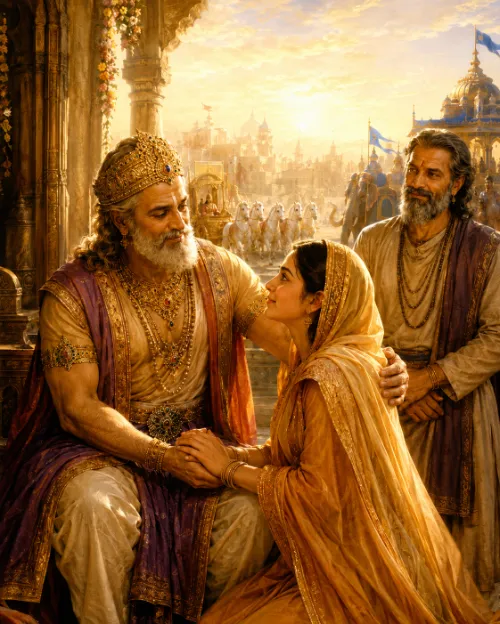
The Kuru–Yādava Family Network and the Complicated Genealogy of Rohiṇī and Pauravi
When Vidura asks Uddhava about Vasudeva in Śrīmad-Bhāgavatam 3.1.27, he does not speak of him merely as “Kṛṣṇa’s father.” He calls him family. More than that, Vidura remembers Vasudeva as one of the Kurus’ greatest well-wishers—a generous man who cared for his sisters almost like a father.
The verse therefore opens a window into something easy to overlook when reading the Kṛṣṇa narratives: The Yādavas and Kurus were not two unrelated royal houses occasionally brought together by politics. They were deeply interconnected by marriage, kinship, obligation, affection, and shared history.
Yet Prabhupāda’s purport to this verse also contains a genealogical statement that becomes surprisingly complicated when compared with other sections of the Bhāgavatam and parallel Purāṇic traditions.
The purport identifies “Pauravī or Rohiṇī,” Balarāma’s mother, as Vidura’s sister and states that Vasudeva had sixteen wives. The broader Sanskrit evidence is not quite so simple.
The Bhāgavatam’s Ninth Canto explicitly lists Pauravī and Rohiṇī as separate wives, and the Tenth Canto explicitly refers to Vasudeva’s eighteen wives. At the same time, older Purāṇic genealogical traditions do identify Rohiṇī as a woman of the Puru line—effectively a Pauravī—which helps explain how the identification arose.
So this small family note gives us something valuable beyond genealogy: It shows how Purāṇic family traditions can preserve variant lines of transmission, and why we should acknowledge such differences rather than artificially force them into one perfectly uniform family tree.
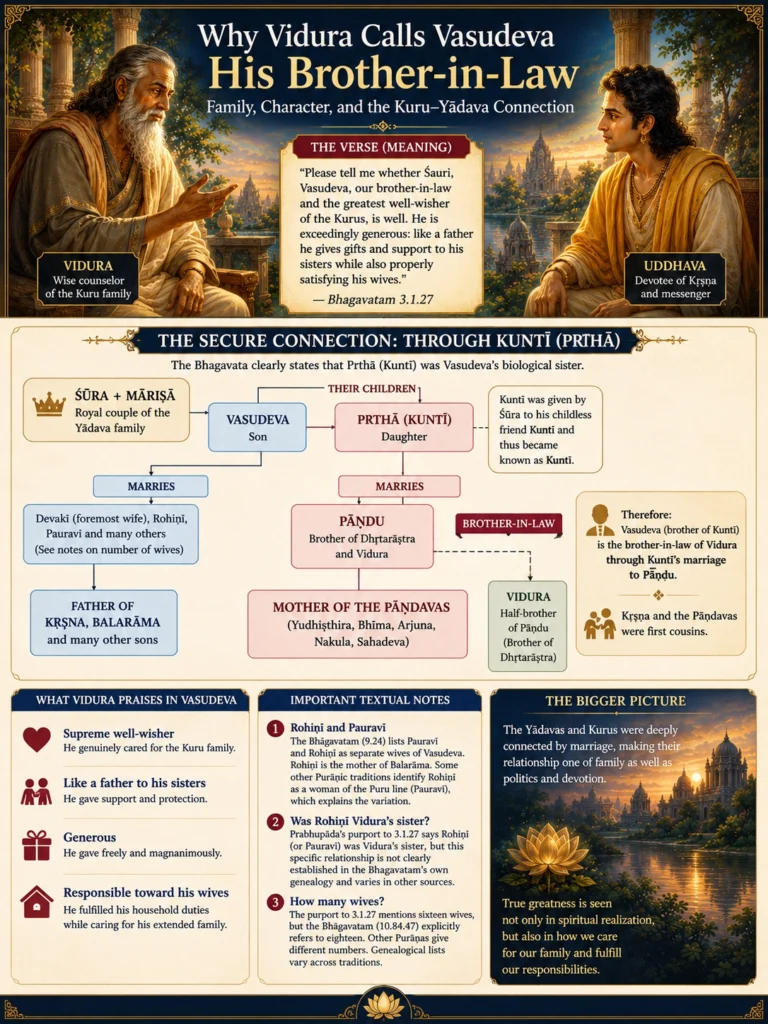
A single sheet tracing the Kuru–Yādava marriage links from Śūra and Māriṣā through Vasudeva and Kuntī to Pāṇḍu, with notes on what Vidura praises in Vasudeva and on the Rohiṇī–Pauravi question.
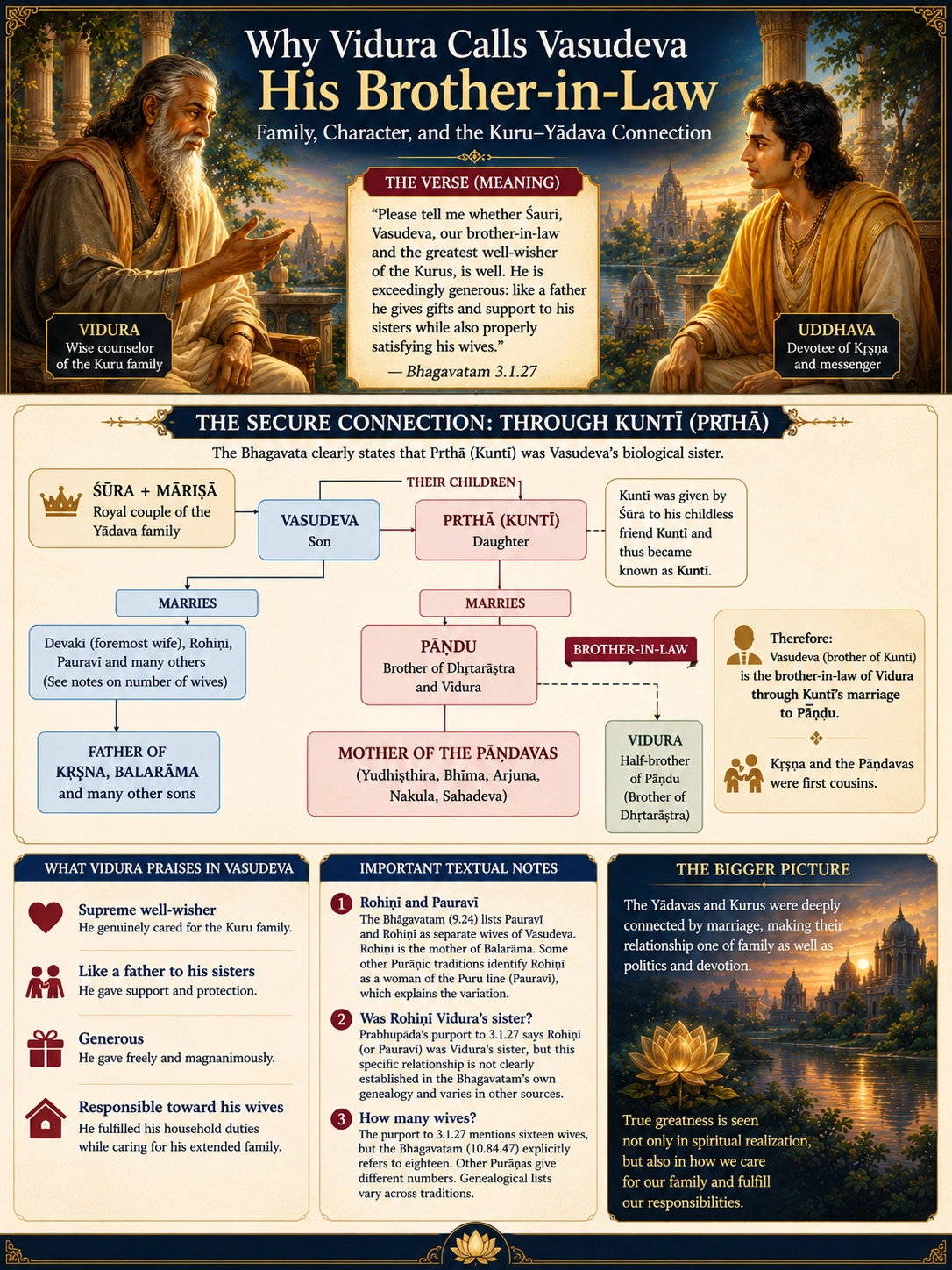
The Verse
कच्चित्कुरूणां परमः सुहृन्नो
भामः स आस्ते सुखमङ्ग शौरिः ।
यो वै स्वसॄणां पितृवद्ददाति
वरान् वदान्यो वरतर्पणेन ॥
kaccit kurūṇāṁ paramaḥ suhṛn no
bhāmaḥ sa āste sukham aṅga śauriḥ
yo vai svasṝṇāṁ pitṛvad dadāti
varān vadānyo vara-tarpaṇena
“O dear one, is Śauri—Vasudeva—our brother-in-law and the supreme well-wisher of the Kurus living happily? He is exceedingly generous: like a father, he gives gifts and support to his sisters while also properly satisfying his wives.”
Śrīmad-Bhāgavatam 3.1.27
The verse is spoken by Vidura to Uddhava. Vidura is asking about the surviving members of Kṛṣṇa’s family after the destruction of the Yādava dynasty. His language is affectionate.
Vasudeva is not merely: a famous king, Kṛṣṇa’s father, or a Yādava patriarch. He is: “our brother-in-law” and: “the greatest well-wisher of the Kurus.”
The Key Family Word: Bhāmaḥ
The important word is:
भामः
bhāmaḥ
In this context, it is understood as: “brother-in-law.” That immediately raises the genealogical question: How exactly was Vasudeva Vidura’s brother-in-law? Prabhupāda’s purport gives two explanations.
The first is through one of Vasudeva’s wives. The second is through Vasudeva’s sister Kuntī. The second is extremely secure. The first is where the textual complications begin.
The Secure Connection: Vasudeva Was Kuntī’s Brother
The Bhāgavatam gives Vasudeva’s birth family in the Ninth Canto. Śūra and Māriṣā had sons headed by Vasudeva and five daughters:
पृथा च श्रुतदेवा च
श्रुतकीर्तिः श्रुतश्रवाः ।
राजाधिदेवी चैतेषां
भगिन्यः पञ्च कन्यकाः ॥
pṛthā ca śrutadevā ca
śrutakīrtiḥ śrutaśravāḥ
rājādhidevī caiteṣāṁ
bhaginyaḥ pañca kanyakāḥ
“Pṛthā, Śrutadevā, Śrutakīrti, Śrutaśravā and Rājādhidevī were their five sisters.”
Thus Pṛthā, later famous as Kuntī, was Vasudeva’s biological sister. That is one of the most important family relationships in the entire Kṛṣṇa narrative.
Why Pṛthā Became “Kuntī”
The Bhāgavatam explains that Śūra gave his daughter Pṛthā to his childless friend Kunti:
कुन्तेः सख्युः पिता शूरो
ह्यपुत्रस्य पृथामदात्
kunteḥ sakhyuḥ pitā śūro
hy aputrasya pṛthām adāt
“Her father Śūra gave Pṛthā to his childless friend Kunti.”
She therefore became known as: Kuntī because she was raised in Kunti’s household. This is important because it means Kuntī’s adoption did not change her biological relationship with Vasudeva.
She remained: Vasudeva’s sister.
Kuntī Marries Pāṇḍu
Kuntī later becomes the wife of: Pāṇḍu. Pāṇḍu is the brother of: Dhṛtarāṣṭra and: Vidura. Therefore the family relationship is straightforward: Vasudeva ↓ brother of Kuntī / Pṛthā ↓ wife of Pāṇḍu ↓ brother of Vidura Thus Vasudeva belongs by marriage to the same extended Kuru family.
Even without introducing Rohiṇī, this gives Vidura an entirely natural basis for calling Vasudeva: bhāmaḥ brother-in-law.
Kṛṣṇa and the Pāṇḍavas Were First Cousins
This relationship also explains something far more important than the technical term “brother-in-law.” Kṛṣṇa’s father: Vasudeva and the Pāṇḍavas’ mother: Kuntī were brother and sister.
Therefore Kṛṣṇa and: Yudhiṣṭhira, Bhīma, Arjuna, were first cousins. This gives the Mahābhārata relationship between Kṛṣṇa and the Pāṇḍavas several layers simultaneously.
Kṛṣṇa is: their divine protector; their political ally; Arjuna’s charioteer; their spiritual guide; and also: their close relative. Kuntī is Kṛṣṇa’s paternal aunt. The emotional intimacy of the Kṛṣṇa–Pāṇḍava relationship is therefore not merely devotional symbolism.
It is embedded in family history.
Why Vidura Calls Vasudeva the Kurus’ Great Well-Wisher
The verse says:
कुरूणां परमः सुहृत्
kurūṇāṁ paramaḥ suhṛt
“the supreme well-wisher of the Kurus.” The word:
सुहृत्
suhṛt
is deeper than an ordinary political ally. It means: a genuine well-wisher, one who desires another’s welfare from the heart. Vidura therefore remembers Vasudeva as someone whose concern for the Kuru family was personal.
That makes perfect sense through Kuntī. Her suffering was not distant news to Vasudeva. She was his sister. Her children were his nephews. The disasters of the Kuru family were therefore also family disasters for the Yādavas.
Vasudeva Was “Like a Father” to His Sisters
Vidura says:
स्वसॄणां पितृवत्
svasṝṇāṁ pitṛ-vat
“toward his sisters, like a father.” This is a beautiful domestic detail. Vasudeva is not praised merely because he had royal wealth. He is praised because he used it responsibly.
He cared for his sisters with: pitṛ-vat father-like concern. This is especially meaningful in Kuntī’s case. Pāṇḍu died relatively early, leaving Kuntī with an extraordinarily difficult life: widowhood, political hostility, attempts on her sons’ lives, exile, war.
The image of Vasudeva as a father-like elder brother therefore has real emotional weight.
Vadānyaḥ : Vasudeva the Generous
Vidura also calls him:
वदान्यः
vadānyaḥ
meaning: generous, liberal, magnanimous. The verse therefore gives us a small but vivid character portrait.
Vasudeva is:
- paramaḥ suhṛt — an exceptional well-wisher;
- pitṛ-vat — father-like toward his sisters;
- vadānyaḥ — generous.
This is important because Vasudeva can easily disappear behind his more famous sons. But the Bhāgavatam repeatedly presents him as an intelligent, responsible and dignified patriarch.
He Also Did Not Neglect His Wives
The end of the verse refers to his responsibility toward his wives as well. The sense is that Vasudeva’s generosity toward his sisters did not come at the expense of neglecting his own household.
This is an unexpectedly practical detail. One can imagine someone appearing generous toward relatives or society while failing to fulfill obligations to those closest to him.
The verse praises Vasudeva for maintaining balance. He cared for: his sisters and: his wives. His generosity was not merely public performance.
Prabhupāda’s First Explanation: Rohiṇī or Pauravī as Vidura’s Sister
The more difficult part of the purport says, in substance: Vasudeva had sixteen wives, and one of them, named Pauravī or Rohiṇī, the mother of Baladeva, was Vidura’s sister.
This gives another possible reason for the expression: bhāmaḥ brother-in-law. If Vidura’s sister married Vasudeva, then Vasudeva would obviously be Vidura’s brother-in-law directly through his own marriage.
But when we compare this with the Bhāgavatam’s Ninth Canto, a difficulty appears.
The Bhāgavatam Lists Pauravī and Rohiṇī Separately
ŚB 9.24.45 gives a list of Vasudeva’s wives:
पौरवी रोहिणी भद्रा
मदिरा रोचना इला ।
देवकीप्रमुखाश्चासन्
पत्न्य आनकदुन्दुभेः ॥
pauravī rohiṇī bhadrā
madirā rocanā ilā
devakī-pramukhāś cāsan
patnya ānakadundubheḥ
“Pauravī, Rohiṇī, Bhadrā, Madirā, Rocanā, Ilā, Devakī and others were wives of Ānakadundubhi [Vasudeva], with Devakī foremost among them.”
The syntax is straightforward. It names: Pauravī and: Rohiṇī separately. That strongly indicates that in this genealogy: Pauravī and Rohiṇī are two different women. The next verses confirm it.
Rohiṇī Is the Mother of Balarāma
The following verse says:
बलं गदं सारणं च
दुर्मदं विपुलं ध्रुवम् ।
वसुदेवस्तु रोहिण्यां
कृतादीनुदपादयत् ॥
balaṁ gadaṁ sāraṇaṁ ca
durmadaṁ vipulaṁ dhruvam
vasudevas tu rohiṇyāṁ
kṛtādīn udapādayat
“Through Rohiṇī, Vasudeva begot Bala, Gada, Sāraṇa, Durmada, Vipula, Dhruva, Kṛta and others.”
The Bala here is: Balarāma. So the Ninth Canto clearly identifies: Rohiṇī → Balarāma.
Pauravī Has a Different Set of Sons
Then the next verse separately says:
सुभद्रो भद्रबाहुश्च
दुर्मदो भद्र एव च ।
पौरव्यास्तनया ह्येते
भूताद्या द्वादशाभवन् ॥
subhadro bhadrabāhuś ca
durmado bhadra eva ca
pauravyās tanayā hy ete
bhūtādyā dvādaśābhavan
“From Pauravī were born twelve sons headed by Bhūta, including Subhadra, Bhadrabāhu, Durmada and Bhadra.”
Thus the Bhāgavatam itself gives:
Rohiṇī
→ Bala/Balarāma and others.
Pauravī
→ a separate group of twelve sons. That makes it difficult to read “Pauravī or Rohiṇī” as two interchangeable names for one woman within this particular Ninth-Canto genealogy.
But Other Purāṇic Traditions Do Identify Rohiṇī as Pauravī
This is where the situation becomes more interesting rather than merely contradictory. Other Purāṇic genealogies preserve a tradition in which Rohiṇī is identified as a woman of the: Puru lineage.
A woman of that lineage could naturally be called: Pauravī “a woman descended from Puru.” Parallel traditions in works such as the Harivaṁśa and Vāyu Purāṇa connect Rohiṇī with the Paurava line and with Bāhlīka.
So the expression: “Pauravī or Rohiṇī” is not random. It reflects a real genealogical tradition. The complication is simply that the received Śrīmad-Bhāgavatam genealogy in 9.24 has chosen to preserve: Pauravī and: Rohiṇī as distinct wives.
This Is a Good Example of Purāṇic Genealogical Variation
Modern readers often assume that ancient Indian genealogical texts should function like a single standardized civil registry. That is not how the Purāṇic corpus developed.
Different texts often preserve: variant names, alternate patronymics, different wife lists, different numbers of children, different genealogical combinations. Sometimes two names may represent: titles, lineage designations, alternate personal names.
Sometimes different traditions have simply preserved different family arrangements. Therefore the responsible historical approach is not always: “One must be wrong; choose one and suppress the other.”
Sometimes the correct conclusion is: “Two ancient textual traditions preserve different genealogical forms.”
Was Rohiṇī Literally Vidura’s Sister?
This is the least securely established part of the purport. The statement is clearly present in Prabhupāda’s explanation. But the Sanskrit genealogical material normally used to reconstruct Rohiṇī’s lineage does not straightforwardly establish her as Vidura’s biological sister.
In some parallel traditions Rohiṇī/Pauravī belongs to the lineage of Bāhlīka, which produces a rather different genealogical relationship. Therefore a careful article should distinguish:
What Prabhupāda’s purport says
Rohiṇī/Pauravī was Vidura’s sister.
What can be independently established without difficulty
Kuntī was Vasudeva’s biological sister and the wife of Vidura’s brother Pāṇḍu. The latter is sufficient by itself to establish the close marriage relationship between Vasudeva and the Kuru household.
Thus it is safest to say: Prabhupāda gives Rohiṇī/Pauravī as an additional relationship, while the Kuntī–Pāṇḍu connection is the genealogically secure explanation directly supported by the Bhāgavatam.
The Number of Vasudeva’s Wives Is Also Complicated
The purport to ŚB 3.1.27 says: sixteen wives. But the Bhāgavatam later gives an explicit Sanskrit number:
अष्टादश
aṣṭādaśa
eighteen. ŚB 10.84.47 says:
तमभ्यषिञ्चन् विधिवदक्तमभ्यक्तमृत्विजः ।
पत्नीभिरष्टादशभिः सोमराजमिवोडुभिः ॥
tam abhyaṣiñcan vidhi-vad
aktam abhyaktam ṛtvijaḥ
patnībhir aṣṭādaśabhiḥ
soma-rājam ivoḍubhiḥ
“The priests duly bathed and consecrated Vasudeva, who, surrounded by his eighteen wives, resembled the moon surrounded by the stars.”
The crucial expression is:
पत्नीभिरष्टादशभिः
patnībhir aṣṭādaśabhiḥ
“with eighteen wives.” That is unambiguous.
Even Prabhupāda Elsewhere Gives Eighteen
This makes the matter even clearer. In another Bhāgavatam purport, Prabhupāda himself refers to Vasudeva as having: eighteen wives. So the “sixteen” in the 3.1.27 purport should not be treated as the only or final enumeration.
The most precise statement is: The Purāṇic traditions preserve differing enumerations, while the received Sanskrit of ŚB 10.84.47 explicitly gives eighteen.
Other Texts Preserve Still Other Lists
The Harivaṁśa, Viṣṇu Purāṇa, Vāyu Purāṇa, and related genealogical sources preserve somewhat different wife lists. This reinforces the same point. Multiple ancient genealogical traditions transmitted Vasudeva’s family.
The lists were not always perfectly standardized. Thus asking: “Was the historically correct number sixteen or eighteen?” may impose a degree of uniformity that the textual tradition itself does not preserve.
For the Bhāgavatam specifically, however: eighteen has the strongest direct Sanskrit support.
Devakī Was Not Vasudeva’s Only Major Wife
Modern retellings often create a simplified picture: Vasudeva + Devakī and perhaps: Vasudeva + Rohiṇī. The Purāṇic family is much larger. The Bhāgavatam says that Devaka had seven daughters: Dhṛtadevā, Śāntidevā, Upadevā, Śrīdevā, Devarakṣitā, Sahadevā, and: Devakī.
Vasudeva married them. Thus Devakī belonged to a larger set of closely related marriages. Yet she is described as: pramukhā the foremost among Vasudeva’s wives. This explains why the Kṛṣṇa narrative naturally focuses overwhelmingly upon Devakī while genealogical sections preserve a much wider household.
Rohiṇī Occupies a Unique Place
Rohiṇī deserves special attention because she becomes the mother of: Balarāma. But her importance goes beyond maternity. During Kaṁsa’s persecution, she lives under the protection of: Nanda Mahārāja in Vraja.
Thus she stands at the intersection of two worlds:
Mathurā
Vasudeva’s Yādava household.
Vraja
Nanda and Yaśodā’s cowherd household. Through Rohiṇī, Balarāma belongs naturally to both environments.
The Mystical Transfer of Balarāma
The Tenth Canto narrates how the embryo identified with Saṅkarṣaṇa is transferred from Devakī’s womb to Rohiṇī. This is why Balarāma bears the name: Saṅkarṣaṇa associated with drawing or transferring.
He then appears as Rohiṇī’s son. Thus Rohiṇī becomes one of the great maternal figures of Kṛṣṇa-līlā. She is frequently remembered devotionally as the mother of: Rohiṇī-nandana Balarāma.
Rohiṇī Also Helps Connect Vraja and Mathurā Emotionally
She is not merely a genealogical bridge. She has lived among the Vrajavāsīs. She knows: Nanda, Yaśodā, Kṛṣṇa’s childhood environment, the cowherd community. Yet she also belongs to Vasudeva’s royal Yādava family.
Through her, the two families are not abstractly linked. They overlap emotionally. That matters greatly in later reunion narratives.
The Kuru and Yādava Houses Were Interwoven
If we step back from the individual names, an important historical-literary pattern becomes visible. The Mahābhārata world is built through: intermarriage. The Kurus, Yādavas, Pañcālas, Madrakas, Cedis, and other royal houses are connected by dense family networks.
Thus alliances and conflicts are rarely merely geopolitical. They are often: family disputes. Kurukṣetra itself is the supreme example. Arjuna looks across the battlefield and sees: teachers, grandfathers, cousins, brothers-in-law, friends.
The political world is a family world.
Kṛṣṇa’s Relationship With the Pāṇḍavas Is Therefore Doubly Close
We often emphasize the spiritual relationship: Kṛṣṇa is Bhagavān. Arjuna is His devotee and friend. But there is also ordinary human kinship: Kṛṣṇa’s father and Arjuna’s mother are siblings.
This helps explain the extraordinary intimacy with which Arjuna speaks to Kṛṣṇa. In the Bhagavad-gītā, Arjuna even apologizes for previously addressing Kṛṣṇa casually as: friend, companion, equal.
That familiarity did not arise in an emotional vacuum. They were relatives and lifelong associates.
Vidura Is Himself a Fascinating Genealogical Figure
Vidura belongs to the Kuru household but occupies an unusual position within it. He is the half-brother of: Dhṛtarāṣṭra and: Pāṇḍu. He therefore stands simultaneously: inside the royal family and somewhat outside its central succession.
That position makes him uniquely suited to act as: counselor, moral critic, detached observer. His affection for Vasudeva therefore carries another dimension. Both men repeatedly function as morally serious elders inside enormous and difficult royal families.
Vidura Does Not Ask Merely “Is Vasudeva Alive?”
Notice the emotional texture of 3.1.27. He does not simply say: “What happened to Vasudeva?” He remembers his virtues. paramaḥ suhṛt great well-wisher. pitṛ-vat father-like.
vadānyaḥ generous. That is how memory works after catastrophe. The person is remembered through: character. The Yādava dynasty has been destroyed. Vidura asks Uddhava about people he loves.
The verse is therefore not dry genealogy. It is grief.
This Changes How We Should Read the Genealogy
Family trees can make epic literature feel mechanical: A begot B. B married C. C produced D. But the Bhāgavatam gives us moments such as this precisely to show that genealogy represents: relationship.
When Vidura says: “our brother-in-law” behind those words stand: marriages, widowhood, support, political catastrophe, shared children, war, and affection. Genealogy becomes narrative.
A Simple Family Map
The most secure relationship can be represented like this: Śūra + Māriṣā → Vasudeva → marries Devakī, Rohiṇī, Pauravī and others → father of Kṛṣṇa, Balarāma and other children and: Śūra + Māriṣā → Pṛthā / Kuntī → adopted by Kunti → marries Pāṇḍu → mother of the Pāṇḍavas Pāṇḍu’s half-brother: → Vidura Therefore: Vasudeva and Kuntī are siblings.
Kuntī and Pāṇḍu are husband and wife. Pāṇḍu and Vidura are brothers. Therefore: Vasudeva and Vidura belong to the same extended marriage network. And: Kṛṣṇa and the Pāṇḍavas are first cousins.
What Should We Do With the Pauravī–Rohiṇī Problem?
The best approach is neither dismissal nor forced harmonization. We should say clearly:
ŚB 3.1.27 purport
identifies: Pauravī = Rohiṇī and calls her Vidura’s sister.
ŚB 9.24
distinguishes: Pauravī from: Rohiṇī and gives them different children.
Parallel Purāṇic traditions
sometimes identify Rohiṇī as belonging to the Paurava/Puru line and therefore naturally call her: Pauravī. Thus the material reflects: variant genealogical transmission. That is a much stronger scholarly conclusion than pretending the evidence is perfectly uniform.
What Should We Do With “Sixteen Wives”?
Similarly:
Prabhupāda’s purport to 3.1.27
says: sixteen.
The Sanskrit of ŚB 10.84.47
says: eighteen. Therefore in a careful article: eighteen should be identified as the explicit number in the received Bhāgavata Sanskrit, while sixteen should be attributed specifically to the 3.1.27 purport.
That is transparent.
Textual Variants Do Not Destroy the Main Point
It is important not to let genealogical complications obscure what the verse itself is actually doing. ŚB 3.1.27 is not primarily trying to establish: the exact total number of Vasudeva’s wives, or: whether Pauravī and Rohiṇī represent one or two women across every Purāṇic recension.
The verse is showing: Vidura’s affection for Vasudeva. That point remains secure. The broader family relationship through Kuntī is secure. And the character portrait of Vasudeva is secure.
The Real Subject Is Vasudeva’s Character
Three expressions tell us almost everything.
परमः सुहृत्
paramaḥ suhṛt
“The supreme well-wisher.” Vasudeva is remembered as someone who genuinely cared for the Kuru family.
पितृवत्
pitṛ-vat
“Like a father.” He cared for his sisters with paternal concern.
वदान्यः
vadānyaḥ
“Generous, magnanimous.” He expressed his family responsibility materially and practically. This is the heart of the verse.
Why This Matters Spiritually
The Bhāgavatam does not separate spirituality from ordinary human responsibility. Vasudeva is important because he is: Kṛṣṇa’s father. But Vidura praises him here for something very human: he cared for his family.
That matters. One can speak about: God, liberation, bhakti, cosmology— yet still fail in ordinary kindness. The verse quietly suggests that spiritual character should appear in: family responsibility, generosity, care.
Vasudeva’s greatness is not presented only through theology. It is visible in how he treats people.
The Bhagavata Ideal Is Not Neglect in the Name of Spirituality
The phrase: pitṛ-vat is especially beautiful in this regard. A brother does not say: “I have transcended family attachment; your suffering is your karma.” He acts like a father.
He helps. He protects. He provides. That is not condemned as materialism. It is praised as: vadānyatā generosity. The lesson is practical: detachment does not mean irresponsibility.
Vasudeva’s Family Life Is Enormously Complex
This makes his portrayal even more striking. He has: many wives, many children, political responsibilities, Kaṁsa’s persecution, imprisonment, separation from his sons, extended family obligations.
Yet Vidura remembers him as: a well-wisher. The spiritual lesson is not that holiness requires an uncomplicated life. It is that character can persist inside complexity.
What the Purāṇic Variants Teach Us About Reading Scripture
The Pauravī–Rohiṇī issue provides a broader methodological lesson. Scripture should not be approached with the assumption: “Every surviving ancient text must preserve every genealogical detail in identical form.”
The Purāṇas developed through: oral transmission, regional recensions, textual expansion, parallel genealogical traditions. That does not make them meaningless. It means they must be read with: philological care.
The responsible reader asks: What does this particular text say? What do parallel texts say? Where do they agree? Where do they differ? What is the theological or narrative point?
That approach is stronger than pretending the differences do not exist.
What We Can Say With Confidence
Several conclusions are secure. Vasudeva was Kuntī/Pṛthā’s biological brother. Kuntī married Pāṇḍu. Vidura was Pāṇḍu’s brother. Thus Vasudeva was closely connected by marriage with Vidura and the Kuru family.
Kṛṣṇa and the principal Pāṇḍavas were first cousins. Rohiṇī was Balarāma’s mother. ŚB 9.24 distinguishes Rohiṇī and Pauravī. ŚB 10.84.47 explicitly mentions eighteen wives of Vasudeva.
These points are textually strong.
What Requires Qualification
These should be phrased more cautiously: “Pauravī and Rohiṇī were always the same woman.” Not according to ŚB 9.24. “Vasudeva unquestionably had exactly sixteen wives.” Not according to ŚB 10.84.47.
“Rohiṇī was certainly Vidura’s biological sister.” This is stated in Prabhupāda’s purport, but it is not straightforwardly established by the Sanskrit genealogical sources normally cited.
A responsible article should preserve these distinctions.
Śrīmad-Bhāgavatam 3.1.27 is easy to pass over as one more question in Vidura’s long inquiry about the Yādavas. But the verse contains a deeply human memory:
कुरूणां परमः सुहृत्
kurūṇāṁ paramaḥ suhṛt
“the supreme well-wisher of the Kurus.” And:
स्वसॄणां पितृवत्
svasṝṇāṁ pitṛ-vat
“like a father toward his sisters.” Vidura remembers Vasudeva not merely because Vasudeva fathered Kṛṣṇa. He remembers him because Vasudeva was: family, generous, protective, kind.
The genealogical relationship through Kuntī makes this especially clear. Vasudeva’s sister Pṛthā became Kuntī. Kuntī married Pāṇḍu. Pāṇḍu was Vidura’s brother. Thus the houses of: Yadu and: Kuru were joined by blood and marriage long before Kṛṣṇa stood beside Arjuna at Kurukṣetra.
The additional claim in Prabhupāda’s purport—that Pauravī/Rohiṇī, Balarāma’s mother, was also Vidura’s sister—belongs to a more complicated genealogical tradition. The Bhāgavatam’s own Ninth Canto distinguishes Pauravī and Rohiṇī, while parallel Purāṇic traditions sometimes identify Rohiṇī as Pauravī because of her Puru-line ancestry.
Likewise, the purport’s number of sixteen wives differs from the explicit:
पत्नीभिरष्टादशभिः
patnībhir aṣṭādaśabhiḥ
“with eighteen wives” of ŚB 10.84.47. These differences should not be hidden. They are part of the textual history. Yet none of them changes the essential meaning of ŚB 3.1.27.
The verse is fundamentally about: relationship and character. Genealogy explains why Vasudeva belonged to Vidura’s family. But the words: paramaḥ suhṛt, pitṛ-vat, vadānyaḥ tell us why Vidura loved and respected him.
And that may be the deepest lesson: Vasudeva’s importance was not only that he stood close to Kṛṣṇa by blood. He was remembered as a man who stood close to his family in care.
Primary Texts Discussed
Śrīmad-Bhāgavatam
Parallel Purāṇic and Epic Genealogies
- These parallel traditions help explain why “Pauravī” can occur as an alternative lineage designation for Rohiṇī in some sources even though the Bhāgavatam itself distinguishes Pauravī and Rohiṇī in its Ninth-Canto wife list.